Hotels in Amsterdam

160 canals, 1 million bikes and 3 world-class museums on 1 square

Amsterdam

LanguageEnglish
CurrencyEUR
TimezoneGMT+1
Temperature4-22 °C
Dial Code+31
Population17.8M
Area41,543 km²
SocketsType C / Type F
Tap waterDrinkable

Discover Amsterdam

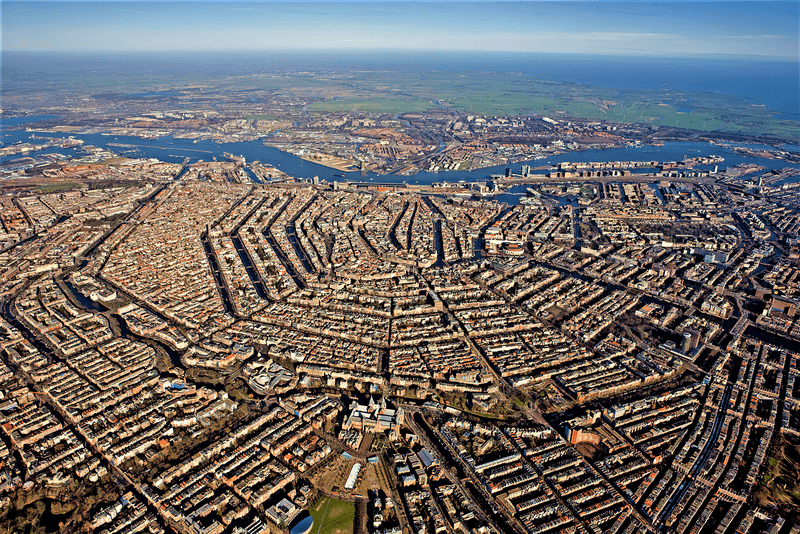
Amsterdam is a city built on wooden piles driven into a swamp — the Rijksmuseum stands on 8,000 piles and the Royal Palace on nearly 14,000. The layout you get lost in today came from a single decision at the start of the 17th century: the city had 3 concentric canals dug — Herengracht, Keizersgracht and Prinsengracht — and divided narrow plots along them, from which grew those tall, slender houses with hoisting hooks in the gable. The Golden Age, when the Dutch East India Company controlled half the world's trade, paid for Rembrandt and Vermeer, and their paintings hang a 15-minute walk from where they were made. Today just under 900,000 people live here, and 700,000 bicycles are ridden daily. The historic centre can be walked in 2 hours, but it's densely packed with things to see: 3 major museums stand on a single square, 5 minutes apart.

What to see

The places worth your time in Amsterdam, and what to expect at each

Rijksmuseum

Rijksmuseum

Museumplein

The national gallery, with 8,000 works on display, concentrating the painting of the Golden Age: Rembrandt's Night Watch in its own room at the end of the Gallery of Honour, 4 Vermeers including The Milkmaid, plus Frans Hals and Jan Steen. Besides paintings, there are ship models, Delft pottery and a library dating from 1885.

Tip: The ticket is for a timed entry slot and is bought online, otherwise you can queue for an hour. It's quietest after 4pm, once the tour groups leave. A free public underpass for pedestrians and cyclists runs beneath the museum and has the best acoustics in the city — licensed musicians perform there. The garden behind the museum is also open to all.

Admission:
€22.50
Time needed:
3 h
Van Gogh Museum

Van Gogh Museum

Museumplein

The largest collection of Vincent van Gogh's work in the world — 200 paintings, 500 drawings and 700 letters, bequeathed to the museum by the family of the painter's brother Theo. The display runs chronologically, showing how dark Dutch canvases became Sunflowers and Wheatfield with Crows within 4 years.

Tip: Tickets are sold exclusively online for a specific half-hour slot and sell out days in advance in season — this is the one attraction in the city you genuinely must plan for. It's quietest at the first morning slot and on Friday evenings, when it stays open until 9pm. The audio guide with letters is worth the extra few euros.

Admission:
€22
Time needed:
2 h
Anne Frank House

Anne Frank House

Jordaan / Grachtengordel

The rear annexe of a house on the Prinsengracht, where 8 people hid for 2 years behind a revolving bookcase before being betrayed in August 1944. Visitors pass through empty rooms left unfurnished at Otto Frank's request, ending at the diary's original manuscript. It's the quietest museum in the city.

Tip: Tickets are sold online only, 6 weeks ahead, and sell out within hours — there's no queue at the door without a booking. A batch of tickets is released every day at 11am for same-day entry. The stairs are as steep as a ladder, and backpacks aren't allowed inside.

Admission:
€16
Time needed:
1.5 h
Golden Age canals

Golden Age canals

Grachtengordel

3 concentric canals from the early 17th century and over 1,000 bridges form a semicircle around the old town, UNESCO-listed since 2010. Merchant houses with gable hoisting hooks line them, still used today to move furniture in, since the staircases are too narrow.

Tip: The sightseeing cruise from Damrak is the most expensive and most crowded; boats also leave from the Rijksmuseum and the Anne Frank House at the same price with half the queue. An evening cruise is best, when the bridges are lit up. To skip paying, walk to the Papiermolensluis bridge on the Reguliersgracht at dusk, where 15 arches are visible at once.

Admission:
free, cruises from €18
Time needed:
1–2 h
Royal Palace on the Dam

Royal Palace on the Dam

Centre / Dam

A building from 1665, originally built as the town hall of Europe's wealthiest city and converted into a palace by Louis Bonaparte. Inside is the Citizens' Hall with a marble map of the then-known world set into the floor, and a collection of Empire furniture left behind by Napoleon's brother as he fled.

Tip: The palace is still used for state ceremonies and can close for several days without notice — check the website before visiting. Admission includes an audio guide. Dam Square in front of the palace is the busiest spot in the city, so watch your pockets; the New Church next door has its own separate exhibitions.

Admission:
€12.50
Time needed:
1–1.5 h
Rembrandt House Museum

Rembrandt House Museum

Jodenbuurt

The house where the painter lived and kept his studio for 20 years, until he went bankrupt in 1656. The inventory drawn up during the bankruptcy proceedings made it possible to furnish the interiors exactly as they looked — including a cabinet of curiosities with shells and weapons he used as props.

Tip: Several times a day the workshop demonstrates mixing paint from pigments, and the print studio shows etching prints made on the original press; times are posted at the ticket desk and it's the most interesting part of the visit. The museum owns an almost complete set of Rembrandt's etchings, rotated through exhibitions.

Admission:
from €20
Time needed:
1.5 h
Albert Cuyp Market

Albert Cuyp Market

De Pijp

The longest street market in the Netherlands — 260 stalls along a kilometre of street in De Pijp, open Monday to Saturday. It sells food, flowers, fabrics, cheese and souvenirs, and it's a market genuinely used by locals, not just visitors.

Tip: This is the cheapest place in the city for lunch: a fresh stroopwafel off the griddle, herring from a stall and fried fish cost just a few euros. Visit in the morning; stalls start packing up after 5pm. Cheese stalls let you taste everything and are a third cheaper than shops in the centre. The De Pijp neighbourhood, with good restaurants, surrounds the market.

Admission:
free
Time needed:
1–2 h
Begijnhof

Begijnhof

Centre / Spui

An enclosed courtyard from the 14th century, once home to beguines — unmarried devout women living in community without taking religious vows. 2 churches stand in the middle of the lawn, and number 34 is Amsterdam's oldest wooden house, dating from around 1420, 1 of only 2 to survive the city's fire regulations.

Tip: It's the quietest spot in the centre and free to visit, but only open from 9am to 5pm, and the entrance from Spui is an unassuming door in an arcade that most people walk past. People still live in the houses, and signs asking for quiet are genuinely respected. Combine a visit with the neighbouring Friday book market on the Spui.

Admission:
free
Time needed:
30 min
Vondelpark

Vondelpark

Oud-Zuid

A 47-hectare park dating from 1865, used by around 20,000 people daily. It has an open-air theatre with free summer performances, ponds, a rose garden with several hundred varieties and a 1965 Picasso sculpture. An official cross-city cycle route also runs through it.

Tip: It's the best place in the city for a picnic and the only spot to properly rest between 2 museums — the Rijksmuseum and Van Gogh are 5 minutes from the north entrance. In summer, the open-air theatre hosts free performances from May to September. Lying on the grass is allowed; barbecuing isn't, and it's enforced.

Admission:
free
Time needed:
1–2 h

Photos: Rijksmuseum — Trougnouf (Benoit Brummer) (CC BY 4.0) · Van Gogh Museum — Koeweiden Postma[1] (Public domain) · Anne Frank House — Dietmar Rabich (CC BY-SA 4.0) · Golden Age canals — Andrés Barrios (CC BY-SA 4.0) · Royal Palace on the Dam — Diego Delso (CC BY-SA 4.0) · Rembrandt House Museum — 14:43, 17 October 2006 (CC BY-SA 3.0) · Albert Cuyp Market — Michiel1972 at Dutch Wikipedia (CC BY-SA 3.0) · Begijnhof — Massimo Catarinella (CC BY-SA 3.0) · Vondelpark — Dguendel (CC BY 4.0)

Where to stay

Areas and districts, matched to the kind of trip you are taking

Grachtengordel and the centre

Best for: a first visit and the main sights

The belt of 3 major canals around the old core, with Dam Square, the Royal Palace and the Anne Frank House. It's the most photogenic and most expensive part of the city; accommodation costs the most and ground floors are full of shops. Everything is walkable, and trams run along the main avenues. It's lively in the evening but not loud — the clubs are elsewhere.

Jordaan

Best for: cafés, galleries and quieter evenings

A former working-class district west of the canals, now the most pleasant part of the city to live in or stroll through: narrow lanes, hofjes courtyards hidden behind doors, small galleries and wood-panelled brown cafés. Food prices are lower than in the centre, and everything is nearby. There's a flea market on the Noordermarkt on Mondays.

De Pijp

Best for: food, markets and value for location

A densely populated district south of the canals, with the Albert Cuyp market, the Heineken Experience and the highest concentration of restaurants in the city, from Surinamese to Italian. Accommodation here is around a quarter cheaper than in the centre, and it's a 10-minute walk to the Rijksmuseum. Sarphatipark is a smaller, quieter alternative to Vondelpark.

Oud-Zuid and Museumplein

Best for: museums, families and quiet

Wide avenues of brick houses around Vondelpark and Museumplein, home to the Rijksmuseum, Van Gogh Museum and Stedelijk standing side by side. It has the most greenery, the least noise and good family-friendly hotels; the P.C. Hooftstraat shopping street is the most expensive in the country. It's a 10-minute tram ride to the centre.

Getting around

From the airport

Amsterdam is served by frequent flights from many European cities, most journeys under 2 hours. Schiphol is one of Europe's largest airports, yet it still offers the simplest connection to the centre of any major Western European hub city: a train runs directly from the underground station beneath the arrivals hall to Amsterdam Centraal in 17 minutes, costs under €5, and runs every 10 minutes (hourly at night). Driving in is possible via the motorway network from neighbouring countries, but a car is a burden once you're in the city itself — parking in the centre costs over €7 an hour. International rail links connect Amsterdam with Brussels, Paris and cities across Germany, with an overnight service reaching further into Central Europe.

Amsterdam Schiphol (AMS) · 17 km

  • NS train to Amsterdam Centraal· 17 min· €4.90
  • Amsterdam Airport Express bus 397· 30 min· €6.50
  • Taxi· 25–40 min· €45

Eindhoven (budget airlines) (EIN) · 125 km

  • Bus 401 and train via Eindhoven Centraal· 1 h 45 min· €20

Around town

The historic centre can be walked in 2 hours, and most of the sightseeing doesn't require transport. Where it does, trams and the metro run under a single fare system: pay with a contactless bank card or phone directly at the reader in the doorway, tapping both when boarding and alighting, with the fare charged by distance, starting around €2. Paper tickets are no longer sold by drivers. Frequent riders should buy a GVB day pass. A bike is the fastest way around the city and hire shops are everywhere, but Amsterdam traffic is dense and unforgiving — anyone unsure in the saddle should walk instead. Don't bring a car into the centre: parking costs over €7 an hour, and the P+R system on the edge of town is far cheaper.

GVB trams and metro16 tram lines and 5 metro lines. Pay with a contactless card tapped on boarding and alighting; fare depends on distance. Forgetting to tap out means being charged the maximum fare. · from €2 depending on distance
GVB day ticket1 day €9.50, 2 days €16, 3 days €23. Worth it from the fourth ride of the day; buy it from a machine, the information centre at the station or the app. · €9.50 / 24 h
Bike hireDaily hire from €12, usually with 2 locks, both of which must be used. Ride only on the red cycle lanes, signal turns by hand, and lights are compulsory at night, enforced by fines. · from €12 per day
Ferries across the IJFree and running round the clock from the quay behind Centraal Station to the north bank, serving the EYE film museum and the NDSM district. Bikes travel free too. It's the cheapest sightseeing cruise in the city. · free
On footIt's a 35-minute walk from Centraal Station to Museumplein, passing half the centre along the way. Watch out for cycle lanes — stepping onto the red asphalt is the most common cause of visitor injury. · free

Useful apps: 9292, GVB, Google Maps, NS Reisplanner

When to go

It rains year-round in Amsterdam, so weather isn't a reason to plan around — the real choice is between longer daylight and lower prices. April and May are best: tulips bloom at Keukenhof and in the fields around Lisse, daylight lasts until 8.30pm and the crowds haven't peaked yet. June to August is the busiest and most expensive stretch, but you can sit outside and parks host free concerts. Late April brings King's Day, when the whole city dresses in orange and turns into a giant flea market — the biggest event of the year and also the one time it's nearly impossible to find a hotel room. November to February are cheap, dark and foggy, but the museums are empty, and between November and January the Light Festival illuminates the canals.

Best time

April and May for the tulips, September for fewer crowds

What to avoid

27 April, if you don't want crowds, and the turn of the year for high prices

MonthJanFebMarAprMayJunJulAugSepOctNovDec
Day6°7°10°14°18°20°22°22°19°15°10°7°
Night1°1°3°5°8°11°13°13°11°8°5°2°
Rainy days1210119910101011121312

Food & drink

Dutch cuisine is short and honest — herring, cheese, chips, pea soup — and Amsterdam adds to it whatever the former colonies brought. Indonesian rijsttafel, with 15 to 25 miniature courses, is the local festive dinner, and Surinamese and Javanese places in De Pijp and Bijlmer serve some of the cheapest good food in the city. People eat early: kitchens open at 6am and often stop cooking by 9.30pm, so an 8pm booking counts as late rather than early. The afternoon "borrel" between 5pm and 7pm is an institution — beer with bitterballen alongside. Prices are higher than in many Central European capitals but lower than in London; a lunch from a stall runs €5–8, dinner in a restaurant €25–35.

What to try

Hollandse nieuwe (herring)

Pickled raw herring with onion and gherkin, sold from stalls. The new herring season starts in June. The Amsterdam way is to have it chopped and eaten with a fork; in The Hague it's held by the tail and lowered into the mouth.

Gouda and oude kaas

Aged cheeses are sold by maturity: jong is young and mild, belegen is matured, oude kaas is 1 to 2 years old with crystals and a sharp flavour. Markets let you taste everything first, served with mustard.

Bitterballen

Deep-fried balls of thick beef ragout, served with mustard alongside beer. The standard snack for the afternoon borrel. They're genuinely hot inside — take the first bite carefully and wait.

Patat met

Thick chips in a paper cone; "met" means with mayonnaise. "Oorlog" combines mayonnaise, peanut sauce and raw onion. Sold from stalls and the cheapest meal in the country.

Stroopwafel

2 thin waffles glued together with caramel syrup. Fresh off the griddle at a market it's warm and soft, quite unlike the packaged supermarket version; warm a packaged one on top of a coffee cup to soften it.

Erwtensoep (snert)

Pea soup so thick a spoon stands up in it, served with sausage and smoked pork belly. A winter dish served from October to March; you won't find it on menus in summer.

Poffertjes

Small, fluffy pancakes with butter and icing sugar, baked on a dimpled copper pan. Sold at markets and by ice rinks in winter; a portion is roughly 15 pieces.

Appeltaart

A tall apple cake with cinnamon and raisins, served with a generous portion of whipped cream. Ordered with afternoon coffee, and 1 slice is enough dessert for 2.

Jenever

The Dutch forerunner of gin, made from juniper, in old (oude) and young (jonge) styles. Poured to the brim in a tulip-shaped glass, the first sip is slurped standing with hands behind the back so it doesn't spill.

What it costs

Coffee in a café

€3.50–4.50

Half-litre of beer in a brown café

€5–6.50

Chips or herring from a stall

€4–7

Dinner in a restaurant

€25–35 per person

GVB day ticket

€9.50

Rijksmuseum or Van Gogh

€22–22.50

Bike hire for the day

from €12

Night in a 3-star hotel for 2

€140–220

Indicative prices that change over time — treat them as a guide, not a price list.

Practical information

SocketsCEuroplug, two round pinsFSchuko
Voltage230V / 50Hz
Tap waterTap water is drinkable — Dutch tap water is among the cleanest in Europe and chlorinated so lightly it can't be tasted. It's drunk routinely, though restaurants aren't obliged to bring it free on request — it's often charged as a carafe for €2–3. Bottled water is unnecessary, and in shops you also pay a bottle deposit, refunded only via a machine in a supermarket.
TippingService and tax are included, and tipping is entirely optional: people round up, or add 5–10% in a restaurant when happy with the service. The Netherlands is practically cashless, but the thing that actually trips visitors up is different — many shops, markets and smaller restaurants accept only debit cards on the Maestro or V PAY networks and will decline a credit card even if a sticker on the door suggests otherwise. Carry at least a little cash.
Driving on theright
SafetyDutch cities are safe, and it's fine to walk almost anywhere even at night. Crime affecting tourists is mainly pickpocketing on trams, at stations and in crowds around major sights. The biggest practical risk, though, is traffic: cycle lanes are full-fledged roads, cyclists move fast and mopeds are allowed on them too. Stepping onto a cycle lane while taking a photo is the most common way to get hurt in Amsterdam — red asphalt means you don't belong there. Bike theft is rampant, so a lock is essential. The emergency number is 112.
Opening hoursShops open at 9am or 10am and close at 6pm, staying open until 9pm on 1 evening a week (koopavond, usually Thursday). Many smaller shops don't open at all on Monday mornings. On Sundays, big cities shop normally from noon to 5pm, while smaller towns are closed. Albert Heijn supermarkets often stay open until 10pm in the evening. Museums are typically open daily from around 10am to 5pm, with only some closing on Mondays; tickets for the biggest ones are bought online for a specific time slot.
Customs & etiquetteThe Dutch are direct to a degree that can feel blunt to visitors used to softer phrasing — a plain "no" isn't a personal rejection, and polite circumlocutions aren't the norm. Almost everyone speaks fluent English, and no one expects you to learn Dutch. Splitting the bill is normal, and the waiter will usually ask about it unprompted. Dropping by unannounced isn't done; visits and meetings are arranged in advance. Photographing the red-light district's window displays is forbidden, and both staff and passers-by will enforce it. A coffeeshop sells marijuana; a café or koffiehuis serves coffee.
A few local wordsGood day — GoedendagThank you — Dank je welPlease — AlstublieftThe bill, please — De rekening, graagCheers — Proost

How to plan your days

1 day

A day in Amsterdam

  1. 1Booked morning entry to the Rijksmuseum, straight to the Night Watch.
  2. 2Cross Museumplein to the Van Gogh Museum.
  3. 3Lunch at the Albert Cuyp market in De Pijp.
  4. 4Afternoon walk along the canals through Jordaan to the Anne Frank House.
  5. 5Evening canal cruise, when the bridges are lit up.

2 days

2 days at a calmer pace

  1. 1Day 1 as above.
  2. 2Morning at the Begijnhof and Dam Square with the Royal Palace.
  3. 3Rembrandt House and an etching-print demonstration.
  4. 4Lunch in Jordaan, then the free ferry to the north bank and EYE in the afternoon.
  5. 5Early-evening borrel with bitterballen in a brown café.

3 days

3 days with a day trip

  1. 1The first 2 days as above.
  2. 2Train to Zaanse Schans for the windmills, a 20-minute journey.
  3. 3Back for lunch, then Vondelpark in the afternoon.
  4. 4Travelling in April? Swap the mills for Keukenhof and the tulip fields.
  5. 5Evening Indonesian rijsttafel as a farewell dinner.

Day trips

Zaanse Schans

18 km · 20 min by train to Zaandijk

An open-air museum on the banks of the Zaan river, with 8 working windmills that still grind pigment, oil and mustard — some can be entered to see the gears turning. Around them stand green wooden houses, a cheese dairy and a clog workshop with demonstrations. Entry to the site is free; you pay only for individual mills and museums. It's a 15-minute walk over the bridge from Zaandijk Zaanse Schans station.

Haarlem and Zandvoort

20 km · 15 min by train

Haarlem is Amsterdam in miniature and without the crowds: a large square with St Bavo's Cathedral, where a 10-year-old Mozart once played the organ, the Frans Hals Museum and the Teylers Museum, the country's oldest. From there a train continues 10 minutes to Zandvoort, the nearest sea beach, with a 20-km dune and a Formula 1 circuit. A return ticket to both places costs around €10.

Keukenhof and the tulip fields

35 km · 1 h by bus from Schiphol

The largest flower garden in the world, open for only around 8 weeks from mid-March to mid-May, when 7 million bulbs bloom. Commercial fields stretch around the garden, free to visit and often better for photos than the garden itself; a bike hire stand sits right at the entrance. Tickets and bus travel are bought together online and sell out on April weekends.

Frequently asked questions

Do I need to book museum tickets in advance?+

For the Anne Frank House, absolutely — tickets are sold exclusively online, 6 weeks ahead, and without a booking you won't get in. The Van Gogh Museum sells tickets for a specific half-hour slot and sells out days ahead in season. The Rijksmuseum also uses timed entry, but a same-day ticket is usually available. Other museums don't require booking.

Is the I amsterdam City Card worth it?+

It pays off if you manage 2 big museums a day and use public transport — the card covers transport, entry to most museums and 1 canal cruise. It doesn't cover the Anne Frank House, which is essential for many visitors. For a 2-day visit with the Rijksmuseum and Van Gogh it works out about even; do the maths for your own list.

Should I rent a bike in Amsterdam?+

Only if you're confident in heavy traffic. Cycle lanes are full-fledged roads, cyclists move fast, mopeds are allowed on them, and no one makes allowances for a hesitant tourist. If you cycle regularly at home, you'll love it; if not, walk or take the tram. Bikes must be locked with 2 locks and lit at night.

How many days are enough for Amsterdam?+

2 days cover the Rijksmuseum, Van Gogh, the Anne Frank House and a walk along the canals. 3 days allow a calmer pace and a trip out of town — Zaanse Schans, Haarlem or, in spring, Keukenhof. The historic centre can be walked in 2 hours, so more than 4 days only makes sense as a base for the Netherlands as a whole.

Can I pay by credit card in Amsterdam?+

Not always, and it's the most common unpleasant surprise. The Netherlands is largely cashless, but many shops, markets and smaller restaurants accept only debit cards on the Maestro or V PAY networks and will decline a credit card. Carry a debit card and some cash; conversely, big museums and hotels often won't accept cash at all.

Are coffeeshops open to tourists?+

In Amsterdam, yes — selling soft drugs to adults is tolerated and ID is required. Smoking on the street, though, is banned and fined in the centre, and since 2023 smoking marijuana in public has been banned around the red-light district. A coffeeshop sells marijuana; for actual coffee, go to a "café" or "koffiehuis".

How do I get from Schiphol Airport to the centre?+

By train from the underground station right below the arrivals hall — it runs every 10 minutes, reaches Amsterdam Centraal in 17 minutes and costs under €5. At night it runs hourly. It's clearly the fastest and cheapest option; a taxi takes longer and costs from €45.

Is it safe to walk through the red-light district at night?+

Yes, De Wallen is patrolled and busy; the risk is pickpocketing in crowds, not assault. A hard rule applies though: photographing women in the windows is forbidden, and anyone who tries risks trouble with security staff and passers-by alike. Since 2023, bars close and shops are banned from selling alcohol after 1am on Fridays and Saturdays.

Visa Requirements

Check the latest visa requirements for entering this country. Some nationalities may need to apply for a visa or e-visa before travel.

Check visa requirements

Language

Dutch

Currency

EUR

Timezone

GMT+1

Dial Code

+31

Population

17.8M

Area

41,543 km²

Voltage

230V / 50Hz

Driving Side

Right

Top Hotels in Amsterdam

Live prices from 500+ properties

Loading hotels...

Planning a trip to Amsterdam?

Compare hundreds of hotels, find the best price, and book with free cancellation on TravelManiac.