Hotels in Bora Bora

A volcanic peak rising from a lagoon of seven shades of blue

Bora Bora

LanguageEnglish
CurrencyXPF
TimezoneGMT-10
Temperature26-30 °C
Dial Code+689
Population280K
Area4,167 km²
SocketsType A / Type B / Type E
Tap waterBottled advised

Discover Bora Bora

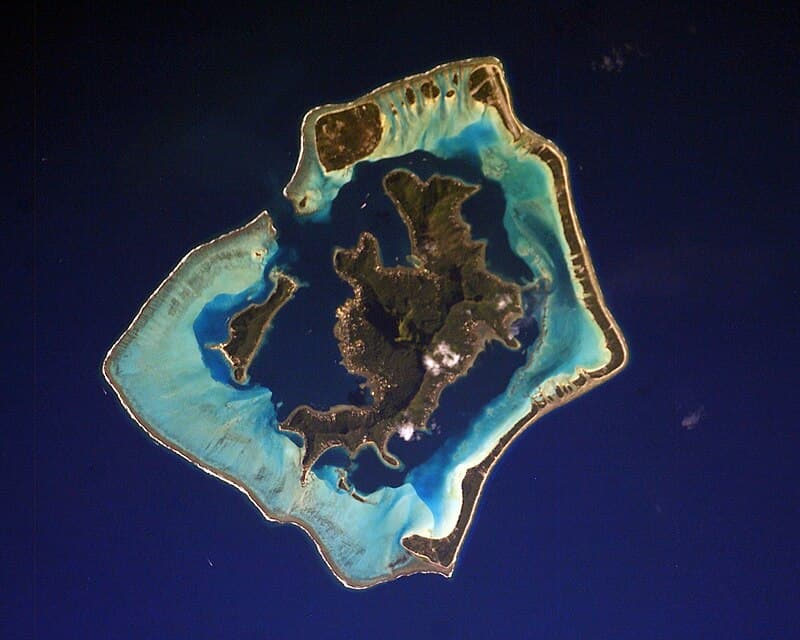
Bora Bora isn't a single island but the remains of an extinct volcano ringed by a chain of coral islets, or motu, enclosing a lagoon 3-times the size of the island itself. It looks like a natural pool 30 kilometres long, waist-deep in places, at a constant 29 degrees, changing colour with the depth of the seabed from pale green to inky blue. At its centre rises the basalt spike of Mount Otemanu, 727 metres high, whose summit no one has legally reached, since the mountain is sacred. Fewer than 11,000 people live on the island, whose single road runs 32 kilometres and can be cycled in an afternoon. Overwater bungalows built on stilts above the lagoon originated here in the 1960s and spread from here around the world. It's one of the most expensive destinations on the planet, yet family-run guesthouses and cheap shore snorkelling exist here too.

What to see

The places worth your time in Bora Bora, and what to expect at each

Mount Otemanu

Mount Otemanu

centre of the island

The basalt remains of a volcanic plug rising 727 metres above the lagoon, the island's defining landmark. The walls are sheer and crumbling, so only a single, unsecured route leads to the summit, which is off-limits out of respect for the mountain's sacred status.

Tip: The best view isn't from the island itself but from the lagoon at sunset, off the motu of Toopua — from a boat you see the mountain's full profile, whereas palm trees block the view from the coastal road.

Admission:
free
Time needed:
views from anywhere
Matira Beach

Matira Beach

south, Matira Point

The only genuinely public beach on the island, 2-kilometres of white sand on the southern tip. The water is shallow, calm and coral-free close to shore, making it safe to swim with children. At the tip of the point, a sandbank stretches out for hundreds of metres at low tide.

Tip: The sand is public along the whole bay, even in front of the InterContinental hotel — park by the shop on the main road and use the signposted public access point.

Admission:
free
Time needed:
half a day
Vaitape

Vaitape

west coast

The island's only town, with the harbour where ferries from the airport dock, the Chin Lee supermarket, a bank, a church and a handful of black pearl shops. It's the only place where you'll pay normal prices instead of resort prices.

Tip: The supermarket in Vaitape is the one real way to save money on Bora Bora — baguettes, cheese and fruit for the beach cost a tenth of a hotel lunch.

Admission:
free
Time needed:
2 h
The lagoon and Coral Gardens

The lagoon and Coral Gardens

east side of the lagoon

A shallow coral garden between the main island and the motu of Piti Aau, home to hundreds of fish species, moray eels and clownfish in sea anemones, at a depth of 2–4 metres. The water is clear to 30 metres, and the current carries you along the coral without any need to swim.

Tip: Hotels usually lend out snorkelling gear for free, but you can't reach real coral from shore — it's worth booking a lagoon tour for 7,000–10,000 francs, which also takes in rays and sharks.

Admission:
tour from XPF 8,000
Time needed:
full day
Snorkelling with rays and sharks

Snorkelling with rays and sharks

northern part of the lagoon

A standard stop on every lagoon tour: a shallow area where stingrays, used to people, gather, with blacktip reef sharks further out in deeper water. The rays have a wingspan of over a metre and will brush against your legs.

Tip: Don't apply chemical sunscreen before the trip — it harms coral and is being phased out in Polynesia; bring mineral sunscreen or wear a long-sleeved rash guard in the water instead.

Admission:
included in lagoon tour
Time needed:
2 h
Motu Tapu

Motu Tapu

northwest lagoon

The lagoon's most photographed islet, a small stretch of sand fringed with palms directly opposite Mount Otemanu. Once private and long off-limits, it's now used by some boat tours for a grilled-fish lunch stop.

Tip: A stop at Motu Tapu isn't included on every tour, and some boats simply cruise past; if you want to land there, confirm it by name when booking.

Admission:
included on some tours
Time needed:
2 h
Mount Pahia

Mount Pahia

centre of the island

The island's second peak, 661 metres high and the only one you can climb. The route runs over tree roots and rope-secured rock steps, and from the ridge you can see the whole ring of the lagoon along with the neighbouring islands of Taha'a and Raiatea.

Tip: The climb is only permitted with a local guide, takes 5–6 hours, and the rock turns slippery and dangerous after rain — schedule it early in your stay so you have room to reschedule around the weather.

Admission:
guide from XPF 8,000
Time needed:
5–6 h
American WWII coastal guns

American WWII coastal guns

southeastern hills

During the war, Bora Bora served as the American supply base Bobcat, home to 5,000 troops, and eight 155mm naval guns remain on the hills, aimed at the reef pass. They still stand on their original mounts today.

Tip: A steep track leads up to the guns above Fitiiu, suitable only for a 4x4, but you can also walk it — about 40 minutes from the main road — for what's the best lagoon view on the island.

Admission:
free
Time needed:
2 h
Round-island coastal road

Round-island coastal road

whole island

The island's only road runs 32 kilometres, hugging the coast on flat terrain. Along the way you pass the villages of Anau and Faanui, stone marae, churches with coral-block walls, and lagoon views from every side, including the undeveloped eastern stretch.

Tip: Rent a bicycle rather than a scooter — the loop is easily done in 3–4 hours including stops, and a bike costs a fraction of a scooter, which at 200 francs a litre for petrol makes little sense anyway.

Admission:
bicycle from XPF 2,000/day
Time needed:
half a day

Photos: Mount Otemanu — Borabora.jpg: User:Taka-0905 derivative work: Alvaro qc (talk) (CC BY-SA 3.0) · Matira Beach — The original uploader was Sba2 at English Wikipedia. (CC BY 2.5) · Vaitape — modified by Telim tor (Public domain) · The lagoon and Coral Gardens — Earth Science and Remote Sensing Unit, Lyndon B. Johnson Space Center (Public domain) · Snorkelling with rays and sharks — Supertoff (CC BY-SA 3.0) · Motu Tapu — Planet Labs, Inc (CC BY-SA 4.0) · Mount Pahia — Balou46 (CC BY-SA 4.0) · American WWII coastal guns — LecomteB (CC BY-SA 4.0) · Round-island coastal road — NASA Johnson Space Center (Public domain)

Where to stay

Areas and districts, matched to the kind of trip you are taking

Matira and the south

Best for: the public beach and the best value for money

The island's most beautiful and only long public beach, around which sit most guesthouses, restaurants and two large hotels. It's the only part of the island where you can stay without needing a boat and still have sand at your door. Ideal for a first visit.

Vaitape and the west

Best for: practicality and the lowest prices

The area around the main harbour, with shops, a bank and rental outfits. There's barely a beach here, but accommodation is the cheapest on the island and everything is within walking distance. A good choice if you're taking boat tours and only sleeping in your room.

Motu to the east

Best for: overwater bungalows and views of Otemanu

A ring of coral islets home to large resorts with overwater bungalows and views across the lagoon to the volcanic peak. You stay in isolation here and reach the main island by the resort's own boat. The most expensive way to stay.

Anau and the east coast

Best for: peace and quiet away from tourism

The least developed side of the island, with villages, churches and family guesthouses far from the hotels. The beaches here are narrow with coral seabeds, but mountains rise beyond the road and prices are half what they are elsewhere. Without a bike or scooter, you're not going anywhere from here.

Getting around

From the airport

There's no direct international flight to Bora Bora. The route runs via Paris or Los Angeles to Tahiti's Papeete airport, then a 50-minute Air Tahiti domestic flight; altogether that's 27–35 hours with at least 2 stops. Bora Bora's airport sits on the islet of Motu Mute in the middle of the lagoon, so you transfer straight from the plane onto a boat. A free ferry takes 15 minutes to Vaitape, while resort guests are met by their own boats. A return domestic ticket from Papeete to Bora Bora costs around 30,000 francs and sells out months ahead in high season.

Bora Bora Airport (Motu Mute) (BOB) · 7 km

  • Free ferry to Vaitape· 15 min· free
  • Resort boat to a motu· 10–25 min· included in stay
  • Flight from Papeete· 50 min· XPF 30,000 return
  • Ferry from Tahiti· 16 h· from XPF 8,000

Around town

A single 32-kilometre road rings the island and is flat, so a bicycle is the most sensible way to get around. Rental starts at 2,000 francs a day, and the full loop takes half a day. Scooters and small cars can be hired too, but with petrol over 200 francs a litre, they make little sense over such short distances. Public transport barely exists — only an irregular island bus timed to the ferries. Taxis are expensive and must be booked by phone. Travel between the main island and the motu resorts is exclusively by resort boats running to a set schedule.

BicycleThe best choice — the road is flat and traffic-free. A full loop of the island takes 3–4 hours. · XPF 2,000/day
Scooter or small carHandy when it rains or you have luggage, but expensive given petrol at over 200 francs a litre. · XPF 8,000/day
Resort boatThe only link between the motu and the main island, running to a schedule, usually hourly. · included in stay
Lagoon tourA full-day circuit of the lagoon with snorkelling and lunch on a motu — the biggest expense and the main experience. · XPF 8,000

Useful apps: Air Tahiti, Google Maps, Windy

When to go

Bora Bora lies 16 degrees south of the equator, so it has a dry and a wet season rather than winter and summer. The dry season, from May to October, is the main one: 27–29 degrees, dry, bearable humidity and a calm lagoon. The wet season, from November to April, brings mugginess, short sharp downpours and occasional tropical storms, but also lower prices and empty beaches. The best months are August and September, which also coincide with whale-watching season — southern right whales and humpbacks are present in nearby waters from July to October. January is the wettest month.

Best time

August and September, when it's dry and the whales are around

What to avoid

January and February, because of humidity and heavy rain

MonthJanFebMarAprMayJunJulAugSepOctNovDec
Day31°31°31°31°30°29°29°29°29°30°30°31°
Night24°24°24°24°23°22°22°22°22°23°23°24°
Rainy days161515129765681114
Sea29°29°29°29°28°27°27°26°27°27°28°29°

Food & drink

Polynesian cuisine is built on raw fish, coconut and tropical fruit. The national dish, poisson cru, is fresh tuna marinated in lime juice and coconut milk, found in every restaurant and roadside eatery. French cooking is common too, since French Polynesia is a French overseas territory — subsidised baguettes cost just a few dozen francs. Restaurants are expensive even by European standards, with a main course typically running 3,000–5,000 francs. The cheapest meals come from roulotte food trucks, which park by the harbour in Vaitape in the evening.

What to try

Poisson cru

Cubes of raw tuna marinated in lime juice with coconut milk, cucumber and tomato. Polynesia's national dish, eaten at lunchtime and made a little differently at every place.

Grilled mahi-mahi

A firm white fish, grilled with a vanilla or coconut sauce. The most common restaurant main course and a reliable choice.

Ahima'a

Meat and root vegetables cooked in an earth oven on heated stones under banana leaves. Prepared for Sundays and Polynesian dinner shows at hotels — you won't find it in home cooking.

Polynesian-style chow mein

Fried noodles with chicken and vegetables, a legacy of Chinese immigrants. The cheapest and most filling evening meal at the roulotte food trucks.

Firi firi

A coconut doughnut loop, fried and dusted with sugar, a traditional Sunday breakfast. Sold at the market in the morning and usually sold out by nine.

Po'e

A sweet pudding of banana, papaya or pumpkin with tapioca starch and coconut milk. Served cold as a dessert, with the colour giving away what it's made from.

Vaitape baguette

French bread is state-subsidised in Polynesia, so a baguette costs around 60 francs. With cheese and fruit from a shop, it makes the cheapest lunch on the island.

Hinano

A Tahitian lager brewed on Tahiti and drunk everywhere. It costs a third of the bar price in a shop, and it's perfect for a sunset on Matira Beach.

What it costs

Baguette from a shop

XPF 60–90

Meal from a roulotte in Vaitape

XPF 1,500–2,000

Main course at a restaurant

XPF 3,000–5,000

Hinano beer at a bar

XPF 800–1,200

Night in a family guesthouse

XPF 12,000–20,000

Night in an overwater bungalow

from XPF 90,000

Full-day lagoon tour

from XPF 8,000

Return flight Papeete–Bora Bora

approx. XPF 30,000

Indicative prices that change over time — treat them as a guide, not a price list.

Practical information

SocketsAtwo flat pins (US/JP)Btwo flat pins plus ground (US)EFrench, with earth pin
Voltage220V / 60Hz
Tap waterTap water is treated, bottled is common — Tap water in Vaitape and in hotels is desalinated and safe to drink; in more remote guesthouses it comes from rainwater tanks and is best boiled first. Bottled water costs around 150 francs a bottle in a supermarket and 4-times that at a hotel, so it's worth stocking up in Vaitape.
TippingTipping isn't traditional in Polynesia, and many family-run businesses will refuse it, since hospitality isn't meant to come with a price tag. It has caught on at international chain hotels, where 5–10 percent, or a thousand francs for a lagoon tour guide, is left. It's never expected.
Driving on theright
SafetyBora Bora is exceptionally safe — crime is negligible and the island is small. The risks here are natural ones: a strong current in the reef pass where the lagoon meets the ocean, and while the sharks are used to being fed and harmless, stonefish and sea urchins on the seabed are not — water shoes are worth wearing. The nearest fully equipped hospital is on Tahiti, and a serious injury means an air evacuation, which without insurance costs tens of thousands of euros.
Opening hoursShops in Vaitape open from 6am to 6pm, often closing for 2-hours over lunch. On Sundays almost everything is shut, including the supermarket, and the evening roulotte food trucks don't come out. Restaurants close around 9pm, and by 10pm the island is shut for the night.
Customs & etiquettePolynesians are relaxed, but politeness is expected: greeting people with "ia orana" on entering anywhere is standard. Swimwear belongs on the beach and by the pool — dress properly to go into a village or shop. Marae, the ancient stone temples, are sacred sites: don't walk on them or sit on them. Topless sunbathing is tolerated at resorts, but not on the public beach at Matira.
A few local wordsHello — Ia oranaThank you — MauruuruGoodbye — NanaGood (tasty) — Maita'iHow much is it? — E hia moni?

How to plan your days

1 day

A day on the island

  1. 1Morning cycling the coastal road, with lagoon views.
  2. 2Stop at the American guns above Fitiiu.
  3. 3Lunch from a shop in Vaitape, afternoon at Matira Beach.
  4. 4Sunset from Matira Point, then dinner at a roulotte by the harbour.

2 days

2-days on the lagoon

  1. 1Day one as above.
  2. 2Day two, a full-day lagoon tour by outrigger boat.
  3. 3Snorkelling at Coral Gardens and among the rays and sharks.
  4. 4Grilled-fish lunch on a motu, back before sunset.

3 days

3-days including the mountains

  1. 1First 2-days as above.
  2. 2Day three, climb Mount Pahia with a local guide, 5–6 hours.
  3. 3Afternoon rest and a swim at Matira.
  4. 4Evening Polynesian dinner with ahima'a from the earth oven.
  5. 5If you have a spare day, add a boat trip to Taha'a for vanilla and pearls.

Day trips

Taha'a

30 km · 45 min by boat

The vanilla island, producing 80 percent of Polynesian vanilla, along with black pearl farms and a coral garden between motu islets that the current carries you through without swimming. Trips leave Bora Bora in the morning and return by evening.

Raiatea

45 km · 1 h by boat or 20 min by air

Polynesia's sacred island, home to the UNESCO-listed Taputapuatea marae, from where, according to tradition, canoes set sail to settle Hawaii and New Zealand. It has the only navigable river in Polynesia and is a centre for sailing.

Maupiti

50 km · 20 min by air

A small island that looks like Bora Bora did 50 years ago: no hotels, just family guesthouses, a lagoon of the same colour, and manta rays you can snorkel with year-round. Flights run a few times a week, and an overnight stay is usually necessary.

Frequently asked questions

How expensive is Bora Bora really?+

An overwater bungalow starts around 90,000 francs a night, roughly €800, and at luxury resorts it can be 3 times that. A family-run guesthouse, though, can be found from 12,000 francs, and food from shops and roulotte food trucks costs much less than eating out. The one unavoidable big expense is transport: the international flight plus the domestic leg together eat up most of the budget.

How do I get here?+

There's no direct flight. You fly via Paris or Los Angeles to Tahiti's Papeete airport, then take a 50-minute connecting flight with Air Tahiti. All in, that's 27–35 hours with at least 2 stops. Book the domestic leg together with the long-haul flight, since in high season it sells out months ahead.

Do I have to stay in an overwater bungalow?+

No. An overwater bungalow is an experience in itself, but the lagoon looks just as beautiful from Matira Beach, which anyone can visit for free. Family guesthouses on the main island cost a fraction of the price and are closer to shops, restaurants and local life. A common solution is a week in a guesthouse plus 2 nights in a bungalow at the end.

Are there dangerous sharks in the lagoon?+

No. The lagoon is home to blacktip reef sharks around a metre and a half long, used to people after decades of being fed. Snorkelling among them is a standard part of every lagoon tour. The real hazards are stonefish on the seabed and currents in the reef pass, not the sharks.

When can you see whales?+

Humpback whales come to Polynesian waters to calve from July to October, and Bora Bora is one of the places where you can swim with them — a strictly regulated activity in French Polynesia, permitted only through licensed operators. Chances are highest in August and September, which also happen to have the best weather.

Do I need a visa?+

French Polynesia is a French overseas territory but is not part of the Schengen area. Visitors from many countries don't need a visa and can stay for up to 90 days, though your passport must be valid for the entire stay. If you're flying via the United States, you'll also need an ESTA, even for a layover.

What currency is used?+

The Pacific franc (CFP), whose exchange rate is fixed to the euro. Cards are accepted without issue in hotels and restaurants, but small shops, roulotte food trucks and bike rental outfits want cash. There's an ATM in Vaitape.

How many days are enough for Bora Bora?+

3–4 nights. The island is small, and the main experiences — a lagoon tour, Matira Beach and the round-island road — can be done in 3 days. Given how long it takes to get here, though, it's rarely worth flying in just for Bora Bora alone — it's usually combined with Tahiti, Moorea or Taha'a for a total of 2–3 weeks.

Visa Requirements

Check the latest visa requirements for entering this country. Some nationalities may need to apply for a visa or e-visa before travel.

Check visa requirements

Emergency Numbers

Language

French / Tahitian

Currency

XPF

Timezone

GMT-10

Dial Code

+689

Population

280K

Area

4,167 km²

Voltage

220V / 60Hz

Driving Side

Right

Top Hotels in Bora Bora

Live prices from 500+ properties

Loading hotels...

Planning a trip to Bora Bora?

Compare hundreds of hotels, find the best price, and book with free cancellation on TravelManiac.