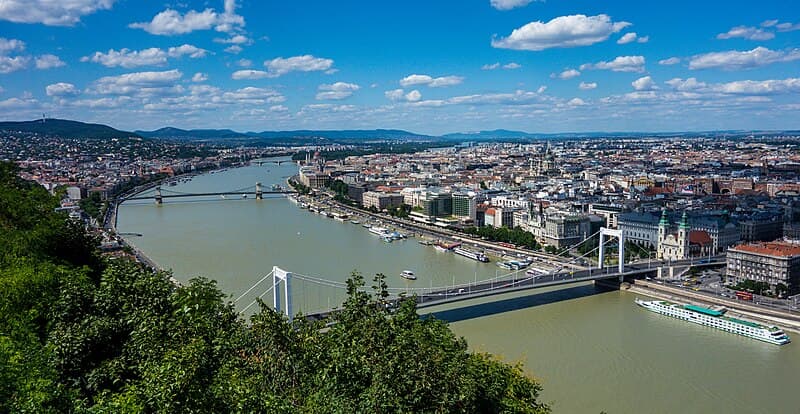
Two cities on the Danube, 120 thermal springs and Central Europe's cheapest big city
Budapest
LanguageEnglish
CurrencyHUF
TimezoneGMT+1
Temperature2-28 °C
Dial Code+36
Population9.6M
Area93,028 km²
SocketsType C / Type F
Tap waterDrinkable
Discover Budapest
Budapest only came into being in 1873, when three separate towns merged — hilly, castle-topped Buda, old Óbuda, and flat, commercial Pest on the left bank. That divide is still the basic way to get your bearings today: Buda climbs and sleeps, Pest is flat, loud and alive. Beneath the whole city runs thermal water from 120 springs, which makes Budapest the only capital in the world with its own therapeutic baths set among its neighbourhoods — the Ottomans were already building baths here in the 16th century, and some have run continuously ever since. A golden age arrived with the millennial celebrations of the Hungarian state in 1896, when continental Europe's first underground railway opened, along with the parliament building and Heroes' Square. For international visitors, it remains one of the most accessible major capitals in Central Europe, with prices well below those of wealthier Western European cities.
What to see
The places worth your time in Budapest, and what to expect at each
Hungarian Parliament Building
Lipótváros
The world's third-largest parliament building, completed in 1904, 268 metres long with a dome 96 metres high — the same number as the year the Hungarians arrived in the Carpathian Basin. The Holy Crown of Hungary is kept beneath the dome, alongside a staircase with 96 columns and gilding.
Tip: Entry is only with a tour at a fixed time, in Hungarian, English or German; tickets are sold online and in season can sell out days ahead. EU citizens pay significantly less than others — bring a passport or ID card to show at the ticket desk. The best photo is from the opposite bank, from Fisherman's Bastion at dusk.
Admission:
from 5,500 HUF for EU citizens
Time needed:
1 h tour
Buda Castle
Várnegyed (Buda)
The royal palace on Castle Hill, first built in the 13th century and levelled several times since — today's building is a post-war reconstruction. It houses the Hungarian National Gallery, with Gothic altarpieces and paintings by Munkácsy, and the History Museum, which shows the medieval cellars beneath the palace.
Tip: You can ride the Sikló funicular up from the Chain Bridge for around 2,500 forints, or walk up the steps beside it for free in about 10 minutes — the funicular is a short novelty ride, not real transport. Bus 16 from Deák tér runs right up to the castle courtyard and takes a standard ticket. The courtyard and viewing terraces are freely accessible all night.
Admission:
courtyard free, galleries from 3,800 HUF
Time needed:
2–3 h
Fisherman's Bastion
Várnegyed (Buda)
A neo-Romanesque viewing terrace with 7 cone-shaped towers, built in 1902 on the site of a former fish market — each tower represents one of the Hungarian tribes that settled here. Behind it stands Matthias Church, with its roof of colourful Zsolnay tiles and its coronation-era interior.
Tip: Most of the bastion is free, and only the upper walkway is paid — the view from below is almost as good, so you can usually skip it. Before 7am and after 8pm, even the upper section is free and empty. Matthias Church has its own admission fee, and there's a Latin Mass at 10am on Sundays that you can attend without paying.
Admission:
free, upper walkway from 1,500 HUF
Time needed:
1 h
Széchenyi Thermal Baths
Városliget
The largest bath complex in Europe, opened in 1913, with 18 pools fed by 2 thermal wells at temperatures up to 77°C. The outdoor neo-baroque pools are heated to 38°C and run even in frost, when steam rises over the water and people play chess in the pool.
Tip: Towels and robes can be rented for an extra fee — bringing your own saves around 2,000 forints. Go right at 6am or after 7pm; between 11am and 4pm it's busiest. Swimwear is compulsory, and a swim cap only in the lap lanes. Lock your own locker with the wristband — staff aren't responsible for its contents. Saturday night 'sparties' are parties, not regular bathing sessions.
Admission:
from 10,500 HUF for a full day
Time needed:
3–4 h
St Stephen's Basilica
Lipótváros
Budapest's largest church, completed in 1905 after 52 years of construction, with a dome the same height as the parliament building. A side chapel holds the mummified right hand of St Stephen, Hungary's first king, carried through the city in procession every 20 August.
Tip: Entry to the nave is by voluntary donation; the viewing terrace under the dome costs extra — there's a lift, making it the easiest panoramic view in the city. The relic is only lit up after a coin is dropped into the machine beside it. Organ concerts are held regularly in the basilica and tend to be cheaper than similar concerts in Vienna.
Admission:
nave by donation, viewing terrace from 3,200 HUF
Time needed:
1 h
Dohány Street Synagogue
Erzsébetváros
The largest synagogue in Europe and the second largest in the world, built in Moorish Revival style in 1859 to seat 3,000 people. The complex includes a cemetery with graves of ghetto victims from 1945 and Imre Varga's metal Weeping Willow memorial, its leaves engraved with the names of murdered Hungarian Jews.
Tip: Admission is pricey, but it includes a guided tour, the Jewish museum and the memorial garden, and the guides tend to be excellent. Men are given a free paper kippah at the entrance; women need covered shoulders. It's closed on Saturdays for Shabbat, which catches most visitors by surprise. The surrounding district is now the centre of the ruin bar scene.
Admission:
from 9,000 HUF
Time needed:
1.5 h
Great Market Hall
Ferencváros
A 3-nave steel hall from 1897 by Samu Pecz, roofed with Zsolnay tiles. The ground floor sells meat, paprika, sausages and vegetables, the basement fish and pickled vegetables, and the upper floor souvenirs and hot food stalls. It's the largest covered market in the country.
Tip: Lángos costs twice as much upstairs as in an ordinary neighbourhood, but the portions are huge and the queue moves fast. Ground paprika is cheaper bought downstairs from vendors in paper bags rather than in decorative tins upstairs — it's the same product for a third of the price. Closed on Sundays, and open only until 3pm on Saturdays.
Admission:
free
Time needed:
1–1.5 h
Chain Bridge
on the border of Buda and Pest
The first permanent bridge between Buda and Pest, opened in 1849 to a design by William Tierney Clark. Count Széchenyi had it built after ice on the Danube stopped him reaching his father's funeral in time. Stone lions guard both ends, and it remains a symbol of the two cities' union.
Tip: Cross on foot — it's the best 20-minute walk in the city, especially at dusk, when both the parliament and the castle light up. A funicular runs up to the castle from the Buda end, and sightseeing boats depart from the Pest side. For a photo of the whole bridge, walk about 200 metres upstream along the embankment.
Admission:
free
Time needed:
30 min
Gellért Hill and Citadel
Gellérthegy (Buda)
A 140-metre limestone hill above the Danube, named after the bishop pagans threw from it in a barrel in 1046. On top stands an Austrian citadel from 1854 and a 14-metre Statue of Liberty holding a palm frond; it offers the most complete view over the city and both riverbanks.
Tip: You can walk up in about 25 minutes from Gellért Baths — the path is steep but shaded — or take bus 27 from Móricz Zsigmond körtér almost to the top. The best light is an hour before sunset. On the hillside is a cave church carved into the rock, run by the Pauline order and open with an audio guide.
Areas and districts, matched to the kind of trip you are taking
Lipótváros and Belváros
Best for: first visit and sightseeing
Pest's centre between the Danube and the Grand Boulevard, with the parliament, the basilica, pedestrian Váci utca and the Shoes on the Danube Bank. It has the highest concentration of hotels, and everything is within walking distance. Restaurants on Váci utca are the most expensive in the city and offer the worst value — just walk a couple of streets inland.
Erzsébetváros and the Jewish Quarter
Best for: nightlife and ruin bars
The 7th district, home to the Dohány synagogue, which over the past 20 years has gone from a decaying quarter to the centre of nightlife. Ruin bars grew up in abandoned apartment buildings filled with mismatched old furniture instead of being demolished. It has the cheapest food in the centre and the most noise after midnight — anyone wanting sleep should stay elsewhere.
Várnegyed and Buda
Best for: views and quiet evenings
The hilltop castle district, with the palace, Matthias Church and Fisherman's Bastion, surrounded by baroque houses and narrow, car-free lanes. It's busiest with day-trippers, but empties out after 7pm to become the quietest part of Budapest. Accommodation is limited and restaurants are few; it's a 20-minute walk over the bridge to Pest.
Városliget and around Andrássy Avenue
Best for: baths, families and greenery
The city park, with Széchenyi Baths, the zoo, Vajdahunyad Castle and Heroes' Square, reached from the centre via the 2.5-kilometre Andrássy Avenue with its opera house and villas. Beneath it runs the continent's oldest metro line, M1 from 1896, with its wooden stations. It's the best part of the city for families with children.
Budapest has good rail connections from across Central Europe, plus direct flights from many European cities to Budapest Ferenc Liszt Airport, taking a little over an hour from nearby hubs. Buses from surrounding countries are often the cheapest option, though slower. The airport lies 16 kilometres south-east of the centre and has no rail or metro connection — bus 100E runs directly to Deák Ferenc tér in the centre in 45 minutes, though it needs a special ticket. Driving from neighbouring countries takes several hours, and Hungary requires an electronic motorway vignette, bought online or at the first petrol station.
Budapest Ferenc Liszt (BUD) · 16 km
Bus 100E to Deák Ferenc tér· 45 min· 2,200 HUF
Bus 200E and metro M3· 1 h· 450 HUF + ticket
Official Főtaxi taxi· 30–50 min· 9,000 HUF
Around town
Budapest has 4 metro lines, a dense network of trams and trolleybuses, and a single shared fare system. A single ticket covers one ride with no transfer and must be validated — at the machine before the escalator on the metro, or inside the vehicle on trams. For visitors, a 24-hour or 72-hour travel card is almost always better value, since it covers transfers. Ticket inspectors with red armbands check systematically at metro exits, and fines run to 20,000 forints. Line M1, dating from 1896, is the oldest metro on the continent and runs just below Andrássy Avenue. Trams 4 and 6 run around the Grand Boulevard all night, and tram line 2 along the Danube is the cheapest sightseeing ride in the city. Taxis are booked by app; taxis waiting outside stations tend to have prices set for the unwary.
Metro4 lines. M1 is the historic shallow line under Andrássy Avenue; M2 to M4 are modern. Trains run every 2–5 minutes, roughly from 4.30am to half past midnight. · 450 HUF single ride
TramsLine 2 runs along the Pest embankment past the parliament and is the cheapest sightseeing ride in the city. Lines 4 and 6 loop the Grand Boulevard and run all night. · 450 HUF
Travel cards24-hour 2,500 HUF, 72-hour 5,500 HUF, weekly 6,400 HUF. Valid across the whole network, including ferries, and pays off from the third ride of the day. · 2,500 HUF / 24 h
Sikló funicular to the castleWooden cabins from 1870 running from the Chain Bridge to the castle courtyard. Takes 2 minutes; a standard ticket isn't valid. Free steps run alongside, taking about 10 minutes. · 3,000 HUF one way
BKK ferries and boatsLine D on the Danube is part of the public transport system and a travel card is valid on it. It runs mornings and afternoons on weekdays and offers a cruise past the parliament for the price of a ticket. · included with travel card
Useful apps: BudapestGO, Google Maps, Bolt, MÁV
When to go
Budapest has a sharp continental climate — January brings frost, August often tops 30°C and the streets of Pest can feel stifling. May, June and September are best, with warm weather and terraces open. Summer has one real draw: the Sziget Festival on Óbuda Island in August. Autumn is wine season, and October can still see over 20°C. Winter is, surprisingly, one of the strongest seasons, because bathing in the outdoor thermal pools at Széchenyi is at its best in freezing weather, and the Christmas market on Vörösmarty tér is among the loveliest in Central Europe. Hotel prices are lowest in January and February.
Best time
May, June and September; January for the baths and lowest prices
What to avoid
the first half of August, due to the heat and festival prices
Month
Jan
Feb
Mar
Apr
May
Jun
Jul
Aug
Sep
Oct
Nov
Dec
Day
2°
5°
12°
17°
22°
25°
28°
28°
23°
16°
8°
3°
Night
-3°
-2°
2°
6°
11°
14°
16°
16°
12°
7°
3°
-1°
Rainy days
7
6
6
7
8
8
7
6
5
6
7
7
Food & drink
Hungarian cuisine is built on ground paprika, onions, lard and soured cream, and stays hearty even in summer. The key is knowing what to order: what's often called 'goulash' abroad is actually pörkölt in Hungary, the main course, while gulyás is a soup. It's served in three types of establishment — an étterem is a restaurant, a vendéglő is a tavern with home cooking and the best value, and a büfé is a fast counter-service spot where a meal costs just a few hundred forints. The pedestrian street Váci utca and the terraces around the basilica are the tourist trap, with prices double and a 12.5% service charge easily appearing on the bill, plus a Roma band playing for a separate fee. A couple of streets away, a full lunch with soup costs 3,000–4,000 forints.
What to try
Gulyásleves
What Hungarians call goulash is a thick soup of beef, potatoes and paprika with small pinched noodles, not a meat stew. It's cooked in a kettle and served as a starter, not with dumplings.
Pörkölt and paprikás
Meat stewed with onion and ground paprika — this is actually what's known elsewhere as 'goulash'. Paprikás is a milder version with soured cream, classically made with chicken and nokedli (little dumplings).
Halászlé
A fiery red fish soup made with carp and catfish and plenty of paprika, richer and spicier than anything else on the menu. The Szeged version uses several types of fish; the Baja version is served with noodles.
Lángos
A deep-fried flatbread of leavened dough, classically brushed with garlic and topped with grated cheese and soured cream. Sold at markets and at the baths; one lángos is a meal for two.
Töltött káposzta
Cabbage rolls stuffed with minced meat and rice, braised in sauerkraut with smoked meat and cream. A winter and holiday dish that tastes better the day after cooking than fresh.
Kürtőskalács
Chimney cake baked on a wooden spit over coals, dusted with sugar, cinnamon or nuts. Transylvanian in origin; you can tell a fresh one because it's baked in front of you rather than sitting in a pile.
Dobos torte
Layers of sponge cake with chocolate cream and a hard caramel top, invented by confectioner József Dobos in 1884. The cafés Gerbeaud and Ruszwurm still make it in its original form.
Pálinka and Tokaji
A fruit brandy made from apricots, plums or pears, at least 37%, drunk before a meal. Tokaji Aszú is a sweet dessert wine made from grapes affected by noble rot, and the puttonyos number on the label indicates its sweetness.
What it costs
Coffee at a café
900–1,400 HUF
Half-litre of beer at a pub
900–1,500 HUF
Lángos at the market
1,500–2,500 HUF
Lunch at a vendéglő
3,000–4,500 HUF
Dinner at a restaurant
7,000–12,000 HUF per person
24-hour travel card
2,500 HUF
Full-day ticket to Széchenyi Baths
from 10,500 HUF
Night at a 3-star hotel for two
25,000–45,000 HUF
Indicative prices that change over time — treat them as a guide, not a price list.
Practical information
SocketsCEuroplug, two round pinsFSchuko
Voltage230V / 50Hz
Tap waterTap water is drinkable — Tap water in Hungary is safe to drink, and Budapest's is good — the city draws it from bank-filtration wells by the Danube on Óbuda Island. Restaurants usually don't offer tap water and bring bottled instead, distinguishing szénsavas (sparkling) from mentes (still). Thermal water from the healing springs the city is famous for should only be drunk from designated drinking halls, never from the pool.
TippingTipping in Hungary is effectively part of the bill: 10% is standard, and tourist venues in Budapest often print a 12.5% 'service fee' on the bill — in that case nothing extra is added, so just check to avoid paying twice. Money isn't left on the table; you tell the server the total when paying. The currency is forints; venues that charge in euros use an unfavourable rate. Exchange offices in the centre advertising 'no commission' have poor rates — an ATM or an exchange office a street away is better value.
Driving on theright
SafetyBudapest and Hungarian towns are safe, and violent crime doesn't affect tourists. The classic problems are financial: taxis without a meter that quote inflated prices near stations (use the Bolt app or call Főtaxi), venues on Váci utca with hostesses that produce bills running into the tens of thousands of forints, and exchange offices with rates a fifth worse than they should be. Pickpockets work the M1 metro line, Keleti station and crowds at ruin bars. The emergency number is 112 and operators speak English.
Opening hoursShops open roughly from 10am to 7pm, shopping centres until 9pm and also on Sundays, which is an advantage over Austria. Small 'nonstop' convenience stores run around the clock. Museums close on Mondays, while the baths run daily, most from 6am to 8pm and some pools later. Restaurants serve lunch from noon, with kitchens closing around 10pm. Ruin bars open in the afternoon and run until 4am; from 11pm, noise restrictions apply on terraces in the centre.
Customs & etiquetteWhen toasting with pálinka, Hungarians never clink glasses — the custom dates to 1849, when Austrians toasted with clinking glasses after executing Hungarian generals, and although younger people don't take it too seriously today, older generations do. Clinking with wine is fine. Surnames are written and said before given names. At the baths, pools are divided by temperature and swim caps are compulsory in the lap lanes, available to buy on site. Don't wear shorts in churches, and women should keep their shoulders covered.
A few local wordsHello — Jó napot kívánokThank you — KöszönömPlease — KéremThe bill, please — A számlát, legyen szívesCheers — Egészségedre
How to plan your days
1 day
A day in Budapest
1Morning: St Stephen's Basilica and the lift to the viewing terrace.
2Walk to the parliament and the Shoes on the Danube Bank.
3Cross the Chain Bridge and take the funicular up to Buda Castle.
4Lunch in Buda, then Fisherman's Bastion and Matthias Church in the afternoon.
5Head back to Pest in the early evening for the Great Market Hall and dinner in the Jewish Quarter.
2 days
Two days with the baths
1Day 1 as above.
2Morning: metro line M1 to Heroes' Square and Városliget park.
3Late morning: Széchenyi Baths, 3–4 hours in the pools.
4Lunch nearby, then the Dohány Street Synagogue in the afternoon.
5Evening: a ruin bar in the 7th district.
3 days
Three days with views and a day trip
1The first two days as above.
2Morning: climb Gellért Hill and the Citadel for the panorama.
3The cave church on the hillside and Gellért Baths from outside.
4Afternoon: boat or HÉV train to Szentendre.
5Return in the evening for a final dinner on the Pest embankment.
Day trips
Szentendre
20 km · 40 min by HÉV suburban railway
A baroque town on the right bank of the Danube, founded by Serbian refugees fleeing the Ottomans — hence the 4 pastel-coloured Orthodox churches. The lanes are full of galleries, the marzipan museum is a hit with kids, and a hilltop viewpoint overlooks the river. Reached by the HÉV suburban railway from Batthyány tér, it's the easiest day trip from Budapest.
Danube Bend: Visegrád and Esztergom
45 km · 1 h 15 min by train or bus
The point where the Danube sharply changes course from eastward to southward. Above Visegrád stand the ruins of a royal castle with the best view of the river bend, and below it the remains of the Renaissance palace of Matthias Corvinus. 25 kilometres further on is Esztergom, home to Hungary's largest basilica, whose dome is visible from both banks. In summer, Danube sightseeing boats also run here.
Eger
130 km · 2 h by train
A baroque town in the northern hills with a castle that in 1552 was defended by 2,000 defenders against a 40,000-strong Ottoman army — one of the best-known stories in Hungarian history. The town has the northernmost Ottoman minaret in Europe, and just beyond it begins the Valley of the Beautiful Women, where Egri Bikavér wine is poured straight from the barrel in cellars carved into the rock.
Frequently asked questions
Do you pay in euros or forints in Budapest?+
Forints. Places that accept euros use a rate about a fifth worse, so it's not worth it. Cards are widely accepted at hotels, restaurants and shops; markets and small snack bars want cash. Change money at an ATM or exchange office outside the tourist zone — exchange booths on Váci utca advertising 'no commission' have the worst rates in the city.
Which baths should I choose?+
Széchenyi is the largest, with 18 pools and an outdoor section that works even in freezing weather — for a first visit, it's the clear choice. Gellért has an Art Nouveau hall with stained glass and is more photogenic, but smaller. Rudas and Király are original 16th-century Turkish baths with an octagonal pool under a dome and a quiet, therapeutic atmosphere; Rudas also has a rooftop hot tub with a panoramic view.
How many days are enough for Budapest?+
Three days is ideal: one for both banks and the main sights, one for the baths and Városliget park, and one for Gellért Hill or a day trip to Szentendre. In two days you can cover the essentials without the baths, which take up half a day on their own. The city is spread out, but transport is fast and cheap.
Do I need to book the parliament tour in advance?+
Yes — entry is only with a tour at a fixed time and in a specific language, and in season tickets can sell out days ahead. Book online. EU citizens pay significantly less than others, but must show ID at the ticket desk, so bring a passport or ID card to the tour as well.
What's the etiquette for tipping in Budapest?+
10% is standard and is handed over when paying, not left on the table. In tourist restaurants, the bill often includes a pre-printed 'service fee' of 12.5% — in that case nothing extra is added, so just check to avoid paying twice. Live music at the table is often billed separately, and on Váci utca that can be an unpleasant surprise.
Are the ruin bars safe and worth it?+
Yes, they're ordinary bars in abandoned apartment buildings filled with mismatched old furniture, and people of all ages go there. Szimpla Kert is the largest and best known, but also the most crowded — a couple of streets away are smaller places with beer at half the price and no queue. The only real risk is pickpocketing in the crush after midnight.
How do I get from the airport to the centre?+
Bus 100E runs directly to Deák Ferenc tér in the centre in 45 minutes and costs 2,200 forints — this line needs a special ticket, and a regular travel card isn't valid on it. A cheaper option is bus 200E to the M3 metro terminus and then the metro from there. The airport has no rail or metro connection.
Is Budapest really cheap?+
Compared with Vienna, yes: food, drink and transport cost roughly two-thirds of prices in wealthier Western European capitals, and hotels are cheaper. That doesn't apply to the tourist zone around Váci utca and the basilica, where prices are Western European. Entry to the baths and the parliament, on the other hand, is comparable to Austria and is one of the biggest items in the budget.
Visa Requirements
Check the latest visa requirements for entering this country. Some nationalities may need to apply for a visa or e-visa before travel.