Hotels in Copenhagen

Colourful houses along the canal, the Nordic region's finest food, and more bikes than cars

Copenhagen

LanguageEnglish
CurrencyDKK
TimezoneGMT+1
Temperature2-21 °C
Dial Code+45
Population5.9M
Area42,924 km²
SocketsType C / Type E / Type F / Type K
Tap waterDrinkable

Discover Copenhagen

Copenhagen sits on the eastern edge of the island of Zealand, and although it's the capital of a kingdom over 1,000 years old, its present shape was largely set by Christian IV at the start of the 17th century: he built the stock exchange with its spire of 4 entwined dragon tails, the Rundetårn tower with a spiral ramp instead of stairs, and the Nyboder naval quarter, which still stands. His successor had the Nyhavn harbour dug out so ships could sail right up beneath the pub windows — which is why those colourful houses stand so close to the water, and Hans Christian Andersen lived in one of them for 18 years. The city has 600,000 residents and 400 kilometres of cycle lanes carrying more people than cars; the harbour baths in the middle of the city are clean enough to swim in during summer. The historic centre can be walked in 2 hours, and all the main sights lie within 2 kilometres of City Hall Square.

What to see

The places worth your time in Copenhagen, and what to expect at each

Nyhavn

Nyhavn

Indre By

A canal dug out in 1673 so ships could reach the city centre, lined with a row of narrow houses in ochre, red and blue. The oldest dates from 1681, and Hans Christian Andersen lived at numbers 20, 67 and 18. Old wooden ships are moored at the quay today, and harbour sightseeing cruises depart from here.

Tip: The sun lights the colourful north-side façades in the morning and the south side in the afternoon — for the classic shadow-free photo, come before 9am, when there's also no one else around. Restaurants right on the waterfront have the highest prices in the city; 2 blocks away on Store Strandstræde, the same meal costs a third less. Boat tours leave from both ends of the canal, and the one from Ved Stranden tends to be half-empty.

Admission:
free, boat tour from DKK 105
Time needed:
1 h
Tivoli

Tivoli

Indre By / Vesterbro

The second-oldest operating amusement park in the world, opened in 1843, which inspired Walt Disney. It's not just rides: the gardens hold a concert hall, a pantomime theatre, a lake with a pirate ship and 40 restaurants. The 1914 wooden roller coaster Rutschebanen still has a brakeman who rides along with you.

Tip: Admission and rides are priced separately — anyone who doesn't want to ride just pays for entry and strolls the gardens, which makes more sense in the evening with the lanterns lit than the rides do. It's cheapest after 5pm. The park only opens seasonally: April to September, at Halloween, and from mid-November to early January for the Christmas market, when it's at its prettiest. Outside food isn't allowed in.

Admission:
DKK 175 entry, DKK 275 with rides
Time needed:
3–4 h
The Little Mermaid

The Little Mermaid

Langelinie / Østerbro

A bronze statue 125 centimetres tall, cast in 1913 for the Carlsberg owner based on Andersen's fairy tale. She sits on a rock a few metres from the shore on the Langelinie promenade. Over the past 100 years, vandals have cut off her head twice and 1 arm once; the current head is a replica.

Tip: It's Europe's smallest famous statue, and 9 out of 10 visitors leave disappointed — go treating it as a stop on a walk along Langelinie, not a destination in itself. Tour buses bring crowds between 10am and 2pm; at 8am there are maybe 5 people there. On the way back, walk through the Kastellet fortress next door, which is more interesting.

Admission:
free
Time needed:
30 min
Christiansborg Palace and Tower

Christiansborg Palace and Tower

Slotsholmen

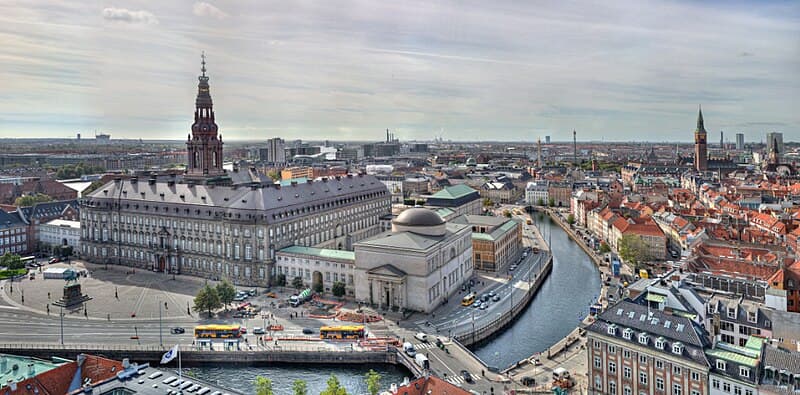
Home to parliament, the supreme court and the royal reception rooms — the only building in the world housing all 3 branches of power together. The tour includes halls with tapestries given to the queen for her 60th birthday, the royal stables, and the ruins of Bishop Absalon's 1167 castle in the basement.

Tip: The observation tower is the tallest in the city and free to enter, which no one expects compared with paid viewpoints elsewhere — you ride a lift up, and there's a restaurant at the top. The tower closes on Mondays and during state visits. The royal reception rooms are ticketed separately, and a combined ticket for all 4 parts works out cheaper than buying 2 separately.

Admission:
tower free, tour DKK 175
Time needed:
2 h
Rosenborg Castle and the Crown Jewels

Rosenborg Castle and the Crown Jewels

Indre By / Kongens Have

Christian IV's 1606 Renaissance summer palace in the Kongens Have garden, with original interiors preserved, including the marble hall with its silver lions. In the vault below, the Danish crown jewels and Christian IV's crown are kept, and are still used today.

Tip: Queues build up around midday; come at opening time or an hour before closing. The ticket office is entered from the park, not the street. The Kongens Have garden is free and Copenhagen's favourite park for picnics — a puppet theatre performs there in summer. A combined ticket with Amalienborg is valid for 36 hours and costs 20% less.

Admission:
DKK 150
Time needed:
1.5–2 h
Amalienborg and the Changing of the Guard

Amalienborg and the Changing of the Guard

Frederiksstaden

4 identical rococo palaces around an octagonal square, forming the winter residence of the Danish royal family. One houses a museum with the studies of monarchs from the last 150 years, left exactly as they were. An equestrian statue of Frederik V stands at the centre.

Tip: The Royal Life Guards change every day at 12 noon, and the procession sets off at 11:30am from the barracks near Rosenborg — following it gives you the whole march through the city instead of just 5 minutes on the square. When a flag flies over the palace, the monarch is home and the changing is more ceremonial. From the square there's a view across the water to the Opera House, and in the other direction to the Marble Church.

Admission:
free, museum DKK 125
Time needed:
1 h
Christiania

Christiania

Christianshavn

An autonomous district founded in 1971 in abandoned military barracks, where over 800 people live by their own rules on land they've gradually bought from the state. It has self-built houses, workshops, a concert hall and a small lake ringed by 17th-century ramparts.

Tip: Photography is a sensitive subject throughout the district, and was banned outright for years on Pusher Street; residents enforce this, so it's best to keep your camera in your bag. Residents themselves shut down the drug trade in 2024 and dug up the street's paving. The most interesting part is actually the architecture around the edge by the ramparts — the walk along the walls around the lake is a peaceful half-hour that most visitors skip.

Admission:
free
Time needed:
1–1.5 h
Vor Frelsers Kirke

Vor Frelsers Kirke

Christianshavn

A baroque church from 1695, its gilded spire wound with a staircase that spirals around the outside of the dome. 400 steps in total, the last 150 outside on a spiral walkway that narrows as it climbs. At the top, 90 metres up, there's a view over all of Copenhagen and across to Malmö.

Tip: The final steps are narrow, exposed and slippery in the rain — anyone afraid of heights shouldn't attempt it, and there's no turning back at the top. The tower closes in strong wind and can be shut for whole weeks in winter, so check ahead. Entry is by timed slot and sells out by mid-morning in summer. The church itself, with its organ carried by 2 elephants, is free.

Admission:
DKK 79 tower
Time needed:
1 h
Rundetårn

Rundetårn

Indre By / Latin Quarter

A round tower from 1642, built as the university's astronomical observatory and still in use today — it's the oldest functioning observatory in Europe. Instead of stairs, a 200-metre paved spiral ramp leads to the top, which Tsar Peter the Great is said to have ridden up on horseback.

Tip: The ramp is easy going even with a pram, and it's the only viewpoint in the city reachable without stairs. Halfway up is a library hall with exhibitions that most people walk straight past, plus a glass floor over the shaft. In winter the observatory opens to the public on Tuesday and Wednesday evenings, and you can look through the telescope — it's free with a tower ticket.

Admission:
DKK 40
Time needed:
45 min

Photos: Nyhavn — European Commission (CC BY 4.0) · Tivoli — European Commission (CC BY 4.0) · The Little Mermaid — Unknown authorUnknown author (Public domain) · Christiansborg Palace and Tower — Julian Herzog (Website) (CC BY 4.0) · Rosenborg Castle and the Crown Jewels — Elgaard (CC BY-SA 3.0) · Amalienborg and the Changing of the Guard — Rob Deutscher from Melbourne, Australia (CC BY 2.0) · Christiania — Franklin Heijnen (CC BY-SA 2.0) · Vor Frelsers Kirke — Avda (CC BY-SA 3.0) · Rundetårn — Avda (CC BY-SA 3.0)

Where to stay

Areas and districts, matched to the kind of trip you are taking

Indre By

Best for: first-time visitors and sightseeing

The historic core between the station and Nyhavn, home to Tivoli, Rundetårn, Christiansborg, and the 1.5-kilometre pedestrian street Strøget. Everything is walkable and transport isn't needed. Accommodation is the priciest in the city, and it goes fairly quiet in the evening once the shops close — nightlife is elsewhere.

Vesterbro

Best for: food, bars and value for location

A former working-class and red-light district behind the Central Station that has become Copenhagen's liveliest area. Around the Kødbyen meatpacking district are restaurants and bars in former slaughterhouses, Istedgade has the highest concentration of cafés, and hotels here cost a quarter less than in the centre. It's a 10-minute walk to Tivoli.

Nørrebro

Best for: cafés, markets and life off the tourist trail

The youngest and most international district, northwest of the centre, where the best affordable food is found — Turkish, Middle Eastern and Nordic places side by side. It's home to Assistens Cemetery, doubling as a park and holding Andersen's grave, and the Superkilen public square. It's a 6-minute metro ride to the centre.

Christianshavn

Best for: quiet, canals and families

An island district dating to 1618, with its own canals lined by houseboats, home to Christiania and the Vor Frelsers Kirke tower. It's the quietest part of inner Copenhagen, with smaller and cheaper shops and restaurants than across the water, and the Inderhavnsbroen pedestrian and cycle bridge leads to the centre in a 5-minute walk.

Getting around

From the airport

Copenhagen has direct flights from most major European hubs, including London, Paris, Frankfurt, Amsterdam and Zurich. Kastrup Airport lies 8 kilometres from the centre on the island of Amager, and the connection is one of the easiest in Europe: the M2 metro line runs from Terminal 3 directly to Kongens Nytorv by Nyhavn in 13 minutes and operates around the clock, every 15–20 minutes at night. The DSB train reaches the Central Station in 13 minutes and continues over the Øresund Bridge to Malmö in Sweden, 20 minutes further. By car, Copenhagen is reachable from northern Germany via the Jutland peninsula or the Rødby–Puttgarden ferry crossing, which shortens the route by an hour. A car is a liability within Copenhagen itself, though — parking in the centre costs over DKK 37 an hour and most streets are one-way.

Copenhagen Kastrup (CPH) · 8 km

  • M2 metro to Kongens Nytorv· 13 min· DKK 36
  • DSB train to Central Station· 13 min· DKK 36
  • Taxi· 20–30 min· DKK 300

Malmö Sturup (budget airlines) (MMX) · 60 km

  • Bus and train via Malmö C and the Øresund Bridge· 1 h 30 min· DKK 180

Around town

Copenhagen is small and flat: it's a 40-minute walk from the Central Station to the Little Mermaid, and most of the sights lie along the way. Where walking isn't enough, the metro, S-train and buses run on a single zone-based fare — the centre and airport are covered by zones 1–3, and a single ticket is valid for an hour with transfers. Pay through the DOT Billetter app or with a contactless card at a machine; tickets are only sold on board buses and trains. The metro runs driverless and around the clock, a rarity in Europe — at weekends locals use it instead of night buses. But the bike is the local norm: 400 kilometres of cycle lanes with fast traffic and their own traffic lights, and renting one costs a fraction of a taxi. Don't bring a car into the city — parking in the centre is among the most expensive in Europe.

Metro M1–M4Driverless and around the clock, every 2 minutes at peak times. The M3 Cityringen line loops around the centre, stopping at the Central Station, Nørreport and Østerport. A 2-zone ticket is valid for an hour, including bus transfers. · DKK 24 / 2 zones
City PassUnlimited travel including the airport: 24 hours for DKK 100, 72 hours for DKK 220 across zones 1–4. It pays off from the third ride of the day and also covers the airport transfer, which would otherwise be paid separately. · DKK 100 / 24 h
Bike rentalDaily rental from DKK 110; city e-bikes through the Donkey Republic app from DKK 20 per half hour. Ride in the right-hand lane, raise a hand before stopping, and lights are compulsory at night under a DKK 700 fine. · from DKK 110 / day
Harbour bus 991 and 992A boat line included in the ordinary public transport fare, running from Knippelsbro past the Opera House to Refshaleøen. For the price of a normal ticket it works just like a sightseeing cruise, and it's usually half-empty. · DKK 24
On footStrøget, from City Hall Square to Kongens Nytorv, runs 1.5 kilometres and is entirely pedestrianised. Watch for the blue cycle lanes — stepping into one while taking a photo is the most common cause of collisions with cyclists. · free

Useful apps: DOT Billetter, Rejseplanen, Donkey Republic, Google Maps

When to go

Copenhagen's best period runs from May to early September, when there's daylight until half past 10 at night, the harbour baths are open and the whole city moves outdoors. June and July are the warmest and most expensive months, though even then it only reaches around 22°C and this isn't a beach destination. May and early September are the best compromise: warm, long days and lower hotel prices. From mid-November to early January, Tivoli runs its Christmas season and the city is lit up, which offsets the darkness — in December, sunrise is after 9am and sunset before 4pm. February and March are the worst combination: cold, dark and Tivoli closed. Rain falls fairly evenly year-round, so there's no point planning a date around it.

Best time

May to early September for long days, December for Tivoli

What to avoid

February and March, when Tivoli is closed and days are short

MonthJanFebMarAprMayJunJulAugSepOctNovDec
Day3°3°6°11°16°20°22°21°18°13°8°5°
Night-1°-2°0°3°7°11°13°13°10°7°3°1°
Rainy days1199889101010111212

Food & drink

Copenhagen has the densest concentration of starred restaurants in Northern Europe, and New Nordic cuisine, launched by a manifesto signed in this city in 2004, spread out from here to the world. But that's not what you'll eat every day. The daily reality is 3 smørrebrød sandwiches for lunch, a hot dog from a stand, and dinner at a pub where a main course costs DKK 200–300. The best value for the experience comes from the covered markets — Torvehallerne near Nørreport and Reffen on the northern waterfront — where DKK 150 buys a meal that would cost twice as much on the main shopping street. Lunch menus tend to be half the evening price, and an 8pm reservation counts as late: Danes have dinner at 6pm. Tap water is free, and coffee refills are only offered at some cafés.

What to try

Smørrebrød

An open sandwich on dark rye bread called rugbrød, where the topping is what matters: herring, smoked salmon, roast pork with crispy onions, prawns with mayonnaise. It's eaten with a knife and fork, never by hand, and for lunch you order 3 in sequence — fish, meat, cheese.

Stegt flæsk med persillesovs

Crispy fried slices of pork belly with parsley sauce and boiled potatoes, voted Denmark's national dish in a public poll. It's served as an all-you-can-eat portion — they keep bringing more until you give up. Pubs often offer it as a lunch menu at half the evening price.

Pølser from a pølsevogn

The stand-bought hot dog has been a Danish street food classic since the 1920s. A ristet hotdog is a grilled sausage in a bun with 6 toppings including fried onions and pickled cucumber; a rød pølse is a bright red sausage served on paper with mustard. The cheapest hot meal in the country.

Pickled herring

The staple of the Nordic lunch table in 3 versions: in vinegar brine, curry mayonnaise and tomato sauce. Served on rye bread with onion, alongside a shot of akvavit. In a restaurant it's a starter, not a side dish.

Frikadeller

Patties of minced pork and veal, pan-fried and served with potatoes and red cabbage. A home-style dish you'll find more in pubs than tourist restaurants; served cold, they also go on smørrebrød.

Stegt rødspætte

Breaded fried plaice with remoulade and lemon, traditionally a Friday dish. At harbourside stands it's served in a bun as a fiskefilet sandwich, and it's the best fast food by the water.

Kanelsnegl and wienerbrød

A cinnamon roll and a puff pastry that the rest of the world calls a "Danish". In Denmark it's sold at a bakery called a bager, fresh in the morning; by afternoon it's often sold out. At around DKK 30 it costs half what a café charges.

Flødebolle

A dome of stiff egg-white foam on a wafer base, coated in chocolate. Sold in confectioners and supermarkets alike, and a popular treat visitors take home as a souvenir. Handmade ones from a confectioner have far better chocolate than packaged versions.

Akvavit and Carlsberg

The caraway spirit is drunk chilled with pickled fish, downed in a single shot after a toast, not sipped with the meal. Beer in Denmark means lager — Carlsberg and Tuborg — but small breweries have been producing excellent beer in recent years, and at a pub you'll pay around DKK 20 more for one.

What it costs

Coffee at a café

DKK 35–50

Half-litre of beer at a pub

DKK 55–75

Hot dog from a stand

DKK 35–50

Lunch of 3 smørrebrød

DKK 150–220

Dinner at a restaurant

DKK 250–350 per person

City Pass for 24 hours

DKK 100

Tivoli admission with rides

DKK 275

Night in a 3-star hotel for 2

DKK 900–1,500

Indicative prices that change over time — treat them as a guide, not a price list.

Practical information

SocketsCEuroplug, two round pinsEFrench, with earth pinFSchukoKDanish
Voltage230V / 50Hz
Tap waterTap water is drinkable — Danish tap water is drinkable throughout the country and drawn entirely from groundwater sources, so it's barely treated chemically. It tastes noticeably soft. Restaurants bring a carafe of water on request for free, which isn't a given in the neighbouring Nordic countries. Buying bottled water in Denmark is a waste of money — a half-litre in a shop costs around DKK 20, more than a coffee back home.
TippingService and tax are always included, and tipping isn't expected in Denmark — the standard rate is zero and no one minds. Anyone especially pleased rounds up or adds 5%. A more important point: Denmark is largely cashless, plenty of places won't take cash kroner at all, and many museums and cafés have signs on the door saying card only. Contactless cards work everywhere, including ticket machines, so treat cash as a backup for emergencies only. Watch out for dynamic currency conversion at the terminal: always choose to pay in Danish kroner.
Driving on theright
SafetyDenmark is among the safest countries in the world, and walking alone at night is normal even for women on their own. The only real risk for visitors is pickpocketing at the Central Station, in the centre and on pedestrian streets. By far the biggest real danger is cycle traffic: the cycle lanes are full-fledged roads with their own traffic-light logic and fast-moving bikes, so stepping into one while taking a photo is the most common way to get hurt here. Bikes are stolen constantly, so a lock is essential. The emergency number is 112, and pharmacy on-call services run around the clock in every larger town.
Opening hoursShops open at 10am and close at 6pm, often as early as 4pm on Saturdays; large department stores and supermarkets stay open later, typically until 10pm. Sundays are quiet in smaller towns, but Copenhagen and Aarhus shop normally. Museums are generally open from around 10am to 5pm, and most close on Mondays — planning a single-day visit for a Monday is a classic mistake. 1 day a week (usually Wednesday or Thursday) major museums stay open until 9pm, which tends to be the quietest time to visit. Restaurants cook early: kitchens close around 9pm.
Customs & etiquetteDanes are politely reserved: no one will approach you without reason, but if asked, they'll answer in fluent, precise English. Queuing is taken seriously, cutting in line is a real offence, and offices and pharmacies use ticket-number systems. In restaurants and at home, the "skål" toast involves looking the other person in the eye. Shoes come off when entering a home. Talking loudly on public transport is seen as rude, and the Copenhagen metro even has quiet carriages. Egalitarianism is a core value, so flaunting money or titles comes across as embarrassing.
A few local wordsHello — GoddagThank you — TakPlease / you're welcome — VelbekommeThe bill, please — Må jeg bede om regningenCheers — Skål

How to plan your days

1 day

A Day in Copenhagen

  1. 1Nyhavn before 9am, while it's empty and the sun lights up the colourful façades.
  2. 2Walk via Kongens Nytorv to Amalienborg for the Changing of the Guard at 12 noon.
  3. 3Lunch of 3 smørrebrød at the Torvehallerne market.
  4. 4Afternoon at Christiansborg, with the free lift up the tower.
  5. 5Evening at Tivoli after 5pm, when admission is cheaper and the lanterns light up.

2 days

2 Days at a Gentler Pace

  1. 1Day 1 as above.
  2. 2Morning at Rosenborg Castle and the Crown Jewels right after opening.
  3. 3A stroll through the Kongens Have garden and up the Rundetårn spiral ramp.
  4. 4Afternoon across the Inderhavnsbroen bridge to Christianshavn and up the Vor Frelsers Kirke tower.
  5. 5Dinner in Kødbyen in Vesterbro, where the highest concentration of restaurants is found.

3 days

3 Days with a Day Trip

  1. 1Days 1–2 as above.
  2. 2Train to Helsingør for Kronborg, a 45-minute journey.
  3. 3On the way back, stop at the Louisiana Museum of Modern Art in Humlebæk.
  4. 4Early evening walk along Langelinie past the Little Mermaid and Kastellet fortress.
  5. 5Final dinner in Nørrebro, where the food is cheapest and best.

Day trips

Kronborg in Helsingør

45 km · 45 min by train

A Renaissance fortress at the narrowest point of the Øresund, from which Danish kings collected toll for 400 years from every ship sailing into the Baltic — that income alone paid for half of Copenhagen. Shakespeare set Hamlet here without ever visiting, and plays are performed in the courtyard in summer. Beneath the castle are dark casemates with a statue of the sleeping Holger Danske; bring a torch, the passages aren't lit. Across the water you can see the Swedish town of Helsingborg, reached by a ferry every 15 minutes on a 20-minute crossing.

Roskilde

35 km · 25 min by train

Denmark's former capital, home to a brick cathedral where 39 Danish kings and queens are buried across 20 side chapels — each monarch had their own built, so you can walk through 600 years of architecture in a single building. Down by the fjord stands the Viking Ship Museum, with 5 vessels raised from the seabed, where in summer you can row out on a replica. On the edge of town, the Roskilde Festival takes place every July, making accommodation impossible to find that week.

Malmö and the Øresund Bridge

40 km · 35 min by train

The train crosses an 8-kilometre bridge and a 4-kilometre tunnel, putting you in Sweden in 35 minutes — the easiest way to add a second country to a Copenhagen trip. Malmö has the twisting Turning Torso skyscraper, the old square Lilla Torg with its wooden houses, and Ribersborg, the best beach in southern Sweden, with a wooden sauna on the pier. Pay in Swedish kronor or by card; bring ID or a passport, as spot checks happen on the bridge.

Frequently asked questions

How many days are enough for Copenhagen?+

2 days cover Nyhavn, Tivoli, Amalienborg, Christiansborg and Christiania at an easy pace, since everything lies within 2 kilometres of each other and it's all walkable. 3 days let you add 1 day trip — Kronborg in Helsingør, Roskilde, or a hop over the bridge to Malmö. More than 4 days only makes sense as a base for exploring the whole of Zealand.

Is the Copenhagen Card worth it?+

It pays off for anyone who fits Tivoli plus 2 more paid attractions into a day and uses public transport — the card covers over 80 museums, transport including the airport, and Tivoli admission. Anyone mainly wanting to walk the city, photograph Nyhavn and visit 1 palace will lose money on it. Work out your specific list: individual entries cost DKK 40–175.

Can I pay with euros or card in Copenhagen?+

Denmark has its own currency and most places don't accept euros; where they do, change comes back in kroner at a poor rate. Cards work practically everywhere, including hot dog stands and ticket machines, so cash is barely needed. At the terminal, always choose to pay in Danish kroner, not your home currency — dynamic currency conversion costs 5–10% more.

Should I rent a bike in Copenhagen?+

Yes, more so than in any other European city: 400 kilometres of separated cycle lanes, flat terrain and rental points on every corner. The rules are enforced, though — keep to the right-hand lane, raise a hand before stopping, stop at red lights even on a bike, and lights are compulsory at night under a DKK 700 fine. Anyone unsure about riding in heavy traffic will get around just as well on foot.

When is Tivoli open?+

It's not open year-round. The main season runs from early April to the end of September, then around 3 weeks over Halloween, and a Christmas market from mid-November to early January. Between January and March it's closed completely, which is the most common disappointment among winter visitors. The Christmas opening is the loveliest part of the year and worth planning a trip around.

Can you swim right in the city in Copenhagen?+

Yes, and it's one of the few things you won't experience elsewhere. The harbour baths at Islands Brygge, Sluseholmen and Fisketorvet are freely accessible and free, the water is tested daily and is clean. The season runs from early June to the end of August, and in July there are queues for the pools; before 10am it's empty. Even in summer the water sits around 18°C.

Is food in Copenhagen really that expensive?+

Yes, dinner at an ordinary restaurant comes to DKK 250–350 per person without drinks, and a half-litre of beer costs around 60. You can save money 3 ways: lunch menus, which tend to be half the evening price; the covered markets Torvehallerne and Reffen; and supermarkets — Netto and Fakta sell ready meals and sandwiches. Tap water is free and excellent.

How do I get from Kastrup Airport to the centre?+

By the M2 metro line direct from Terminal 3 to Kongens Nytorv by Nyhavn in 13 minutes; a ticket costs DKK 36 and the metro runs around the clock. The DSB train takes the same time and price to the Central Station and continues to Malmö. A taxi takes 20–30 minutes and costs from DKK 300, so it's only worth it for 3 or more people with heavy luggage.

Visa Requirements

Check the latest visa requirements for entering this country. Some nationalities may need to apply for a visa or e-visa before travel.

Check visa requirements

Language

Danish

Currency

DKK

Timezone

GMT+1

Dial Code

+45

Population

5.9M

Area

42,924 km²

Voltage

230V / 50Hz

Driving Side

Right

Top Hotels in Copenhagen

Live prices from 500+ properties

Loading hotels...

Planning a trip to Copenhagen?

Compare hundreds of hotels, find the best price, and book with free cancellation on TravelManiac.