Hotels in Dublin

Ireland's oldest book, beer brewed since 1759, and the pub as a way of life

Dublin

LanguageEnglish
CurrencyEUR
TimezoneGMT+0
Temperature5-18 °C
Dial Code+353
Population5.1M
Area70,273 km²
SocketsType G
Tap waterDrinkable

Discover Dublin

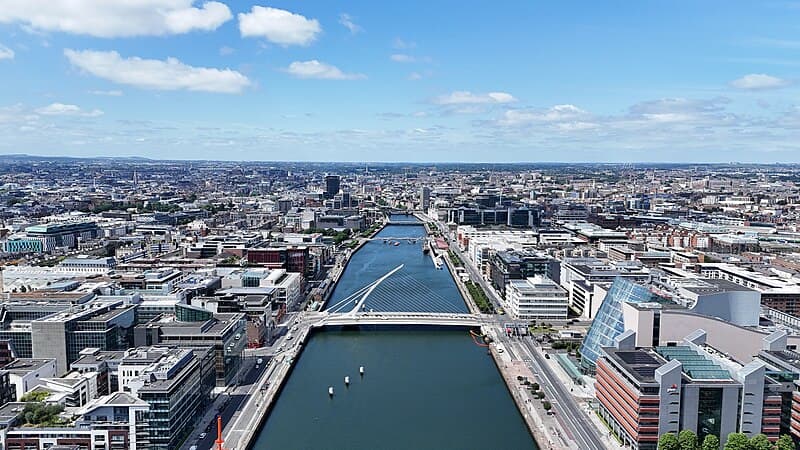
Dublin was founded in 841 by Vikings as a port where the Poddle stream flows into the River Liffey, leaving a dark pool at low tide — the Irish name Duibhlinn means exactly that, black pool. 800 years later the city was a showcase of British rule in Ireland, and the Georgian brick houses with their colourful doors around Merrion Square and Fitzwilliam Square date from that era. The 20th century played out here in very concrete terms: the 1916 Easter Rising began at the General Post Office on O'Connell Street, where bullet holes still mark the stone columns, and its leaders were executed in the yard of Kilmainham Gaol. Independence came in 1922, and the poor city only transformed in the 1990s, when technology companies arrived. Today around 1.3 million people live in the greater area, the centre can be walked in an hour, and 4 of the 5 main sights lie within 20 minutes' walk of Trinity College.

What to see

The places worth your time in Dublin, and what to expect at each

Book of Kells and Trinity College

Book of Kells and Trinity College

Centre / Trinity

An illuminated gospel book from around the year 800, written by monks on the skin of 185 calves, with a single page containing thousands of hand-drawn interlacing patterns. One spread is on display at a time. Above the exhibition is the Long Room, a 1732 library hall holding 200,000 old volumes beneath a barrel-vaulted timber ceiling.

Tip: Tickets are sold online for a timed slot and sell out days ahead in season; the first morning slot is the only one where you won't queue at the display case. The Long Room is undergoing conservation work and some shelves are currently empty — check the latest status before you go, since it's the main reason most people visit. The rest of the university campus is open and free to walk through.

Admission:
from €18.50
Time needed:
1.5 h
Guinness Storehouse

Guinness Storehouse

Liberties

A 7-storey building shaped like a giant pint glass inside the brewery at St James's Gate, where stout has been brewed since 1759. The exhibition runs from raw ingredients through the history of advertising to a pouring lesson, ending in the glass-walled Gravity Bar with a 360-degree view over the whole city.

Tip: Ireland's most visited attraction — tickets are sold exclusively online, and the cheapest option is a weekday morning slot. Save your included pint for the Gravity Bar upstairs, or you'll be standing there without a beer. If you want to try pouring your own, you need to add the course when booking; it can't be added on the day. The lease on the site runs for 9,000 years.

Admission:
from €26
Time needed:
2 h
Kilmainham Gaol

Kilmainham Gaol

Kilmainham

An 1796 prison where the leaders of practically every Irish uprising, including the 1916 Easter Rising, were held and executed. At its centre is a Victorian east wing with a glass roof and galleried landings, used as a filming location for Michael Collins and V for Vendetta. The tour ends in the yard where the firing squads stood.

Tip: Entry is by guided tour only, and tickets go on sale online a month ahead; in season they sell out within hours, so don't count on getting in on the day. A batch of tickets is released daily each morning. It's the most powerful and least touristy experience in Dublin, and the guides are excellent. It's 20 minutes from the centre by bus 69 or the Luas tram.

Admission:
€8
Time needed:
1.5 h
Dublin Castle

Dublin Castle

Centre / Dame Street

The seat of British administration in Ireland from 1204 to 1922, today used for state ceremonies, including the presidential inauguration. The tour takes in the Empire-style State Apartments, a medieval Viking wall in the basement, and a chapel with carved coats of arms of every Lord Lieutenant.

Tip: The grounds and garden are freely open and free of charge, and it's the quickest shortcut from Temple Bar to the south side of the river. Inside the castle is the Chester Beatty Library, with a collection of Islamic manuscripts, Qurans and Chinese scrolls; admission is free, and it's one of the best museums in the city — most visitors have no idea it's there. Closed on Mondays.

Admission:
grounds free, tour €8
Time needed:
1.5 h
St Patrick's Cathedral

St Patrick's Cathedral

Liberties

Ireland's largest church, built in 1191 beside the well where St Patrick is said to have baptised converts. Jonathan Swift, author of Gulliver's Travels, was dean here from 1713 to 1745 and is buried in the nave under a marble slab beside his companion Stella. Banners of Irish knights hang inside.

Tip: The neighbouring Christ Church Cathedral is older and smaller and has a crypt with a mummified cat and rat found inside the organ pipes. Admission to each is separate, and a combined ticket exists only in high season; if you can only pick one, go to St Patrick's for its scale and Christ Church for the crypt. Choral evensong is held several times a week and is free.

Admission:
€9.50
Time needed:
1 h
Temple Bar

Temple Bar

Temple Bar

A cobbled district on the south bank of the Liffey with the highest concentration of pubs in the country, many with live Irish music from afternoon until closing time. Besides the bars there's a photography gallery, a film institute, a Saturday food market and a Sunday flea market with books.

Tip: Beer here is the priciest in Ireland — a pint costs €2–3 more than just a few streets away. For a pub with music and no crowds, head to Camden Street or the Cobblestone in Smithfield, where local musicians play for themselves. Visit Temple Bar for a photo of the red facade and the atmosphere, not for a big night out; the area is more pleasant by day than at night.

Admission:
free
Time needed:
1–2 h
National Museum – Archaeology

National Museum – Archaeology

Centre / Kildare Street

A collection featuring Europe's finest Irish Bronze Age gold, monastic treasures such as the Ardagh Chalice and the Tara Brooch, and five bog bodies preserved for 2,000 years in peat, skin and hair intact. The 1890 building has a mosaic floor and a domed entrance hall.

Tip: Admission is free, which no one expects from a collection of this quality — and that's exactly why it draws fewer visitors than the Guinness Storehouse. The bog bodies sit in a separate dark rotunda entered via a curved passage, so you don't stumble on them unexpectedly; think twice with young children. The same district holds three more national museums and the National Gallery, all free.

Admission:
free
Time needed:
2 h
Phoenix Park

Phoenix Park

Phoenix Park

Europe's largest enclosed city park: 700 hectares ringed by an 11-kilometre stone wall — more than twice the size of New York's Central Park. A herd of around 400 fallow deer has roamed freely here since 1662, and the park is also home to the Irish president's residence, the US ambassador's residence, and Dublin Zoo.

Tip: Fallow deer graze most often in the morning and before dusk around the Papal Cross, and will let you approach to within 10 metres; feeding them is forbidden, and stags are dangerous during the autumn rut. The park is too large to cover on foot alone — a bike rental stand sits by the Parkgate entrance. The president's residence, Áras an Uachtaráin, opens for free tours on Saturdays, with tickets handed out on-site.

Admission:
free
Time needed:
2 h
EPIC – The Irish Emigration Museum

EPIC – The Irish Emigration Museum

Docklands

A museum in the vaulted cellars of the old Custom House on the north quays, dedicated to the 10 million people who left Ireland — above all after the famine of 1845–1852, when the country lost a quarter of its population. 20 interactive rooms trace what emigrants carried with them: music, language, politics and whiskey.

Tip: This is a museum with not a single original object, built entirely on projections and sound, which some visitors find disappointing and others find brilliant — read up before buying a ticket. Next door is the Jeanie Johnston, a replica of an emigrant ship, with its own tour. Food is available throughout the CHQ building, and it's a 10-minute walk to the centre.

Admission:
€21
Time needed:
1.5 h

Photos: Book of Kells and Trinity College — Unattributed (Public domain) · Guinness Storehouse — Steven Lek (CC BY-SA 4.0) · Kilmainham Gaol — Colin (CC BY-SA 4.0) · Dublin Castle — J.-H. Janßen (CC BY-SA 3.0) · St Patrick's Cathedral — Diliff (CC BY-SA 3.0) · Temple Bar — William Murphy (CC BY-SA 2.0) · National Museum – Archaeology — Photograph by Mike Peel (www.mikepeel.net). (CC BY-SA 4.0) · Phoenix Park — William Murphy (CC BY-SA 2.0) · EPIC – The Irish Emigration Museum — Sheila1988 (CC BY-SA 4.0)

Where to stay

Areas and districts, matched to the kind of trip you are taking

City centre south of the Liffey

Best for: first-time visits and sightseeing

The stretch between Trinity College, Grafton Street and Dublin Castle, home to most of what visitors come to see, along with all the national museums. St Stephen's Green is here too, along with the best shops and most hotels. Everything is within a 20-minute walk, so you won't need transport — but it's also the most expensive area in the city for accommodation.

Temple Bar

Best for: pubs, music and nightlife

A cobbled riverside district with the highest concentration of bars in the country and live music all day long. Staying here means noise until 3am and the highest beer prices in Ireland, but everywhere is walkable from it. By day the district is pleasant, with a Saturday food market and galleries; by night it belongs to rowdy groups.

Liberties

Best for: breweries, distilleries and value for location

Dublin's oldest quarter, west of the castle around Guinness and St Patrick's Cathedral, where brewing and distilling once thrived and has made a comeback in recent years — there are now 5 distilleries and 3 breweries open for tours. Accommodation costs about a quarter less than in the centre, and it's a 20-minute walk to Trinity. The area is working-class and gritty rather than picturesque.

Docklands and the north quays

Best for: modern hotels and quiet

Redeveloped harbour docks with tech companies, a conference centre and the EPIC museum, where new hotels offer good rates outside the working week. It's a 10-minute walk along the quays to the centre, or a ride on the Luas tram. It's quiet and empty in the evening, an advantage for families and a downside for anyone wanting a pub on their doorstep.

Getting around

From the airport

Dublin is served by direct flights from across Europe several times a day, and thanks to low-cost carriers it's one of the cheapest Western European destinations to reach. The airport lies 10 kilometres north of the centre and has no rail link — the only option is the bus. The Airlink 747 runs to O'Connell Street in 30 minutes for €9, while ordinary city routes 16 and 41 take 50 minutes for €2.30. Driving in from continental Europe is rare, since it means a ferry from Britain or France, and a rental car only really makes sense for exploring the countryside — remember traffic drives on the left. Don't bring a car into Dublin itself: city-centre parking costs over €3 an hour, and the streets are narrow and one-way.

Dublin Airport (DUB) · 10 km

  • Airlink 747 bus to O'Connell Street· 30 min· €9
  • City bus 16 or 41· 50 min· €2.30
  • Taxi· 25–40 min· €30

Around town

Dublin is small for a capital city: it's a 25-minute walk from Trinity College to the Guinness Storehouse, and most of what you'll want to see lies in between. Where walking isn't enough, there are Dublin Bus routes, two unconnected Luas tram lines, and the DART suburban train along the coast. Pay with a Leap Card or a contactless bank card; paying cash to the driver costs more and gives no change — the machine issues a receipt you then have to exchange at an office, which is the most common trap for visitors. The daily cap on a Leap Card is €8, so you'll never pay for more than 4 journeys a day. The DART train is the best way to reach the coast at Howth or Dún Laoghaire, running right along the sea. A car is more trouble than it's worth in the centre, and traffic drives on the left.

Dublin BusThe city's main transport network. Pay with a Leap Card or bank card at the reader; cash is more expensive and drivers don't give change — the machine issues a receipt for the balance owed. The Leap Card daily cap is €8. · €2
Luas tramTwo lines, green and red, which cross in the centre but share no interchange station. The green line runs south to Stephen's Green, the red line west to Kilmainham and Heuston. · €2.10
DART suburban trainA coastal line running from Howth in the north to Bray in the south, every 10–15 minutes. The stretch along the cliffs at Killiney is the prettiest, and it's the cheapest scenic ride around Dublin. · from €2.60
Leap CardA prepaid card valid on all transport, sold at newsagents and at the airport for a €5 deposit. The €8 daily and €32 weekly caps apply automatically, and fares are a third cheaper than paying cash. · €5 deposit
On footIt's 10 minutes from Trinity College to the castle, 25 to the Guinness Storehouse. Watch out when crossing — traffic drives on the left, so crossings in the centre are marked LOOK RIGHT. · free

Useful apps: TFI Live, Leap Top-Up, Free Now, Google Maps

When to go

Dublin has no temperature extremes or a clear-cut season: it's around 8°C in January, around 20°C in July, and it rains 10–13 days in every month of the year. The real difference, then, is day length and price. May to September are best, with daylight until 9:30pm, good for the coast and for walking in Wicklow. 17 March belongs to St Patrick, when the city turns into one long parade for 5 days — it's the biggest event of the year, and also when hotel prices double and booking 6 months ahead is essential. November to February are cheap, dark and wet, but the pubs with music run just the same and the museums are empty. The rain here is fine and steady, not heavy; a waterproof jacket with a hood is more useful than an umbrella, since it's windy.

Best time

May to September for the long days, 17 March for St Patrick's Day

What to avoid

the week around 17 March, if you don't want crowds and double prices

MonthJanFebMarAprMayJunJulAugSepOctNovDec
Day8°8°10°12°15°18°20°19°17°14°10°8°
Night3°3°4°5°7°10°12°12°10°8°5°4°
Rainy days131011101010111111121213

Food & drink

Irish food had little to offer for a long time, and that's only changed in Dublin over the last 20 years — today it draws on some of the best raw ingredients in Europe: grass-fed beef, lamb, butter and seafood from the Atlantic. Pub classics are Irish stew, fish and chips and a Sunday roast, and the pub is also the only place you can eat late, since kitchens close around 9pm. The best value comes from set lunch menus at €12–16 and from markets — George's Street Arcade and the weekend market in Temple Bar. Guinness really does taste different in Dublin than from a bottle, poured in 2 stages with a rest in between; if you're handed a pint straightaway, it hasn't been poured properly. Watch out for the "round" system: if you accept a pint from someone, you buy the next one.

What to try

Irish stew

Stewed lamb or mutton with potatoes, carrots and onion, cooked in a thin broth with no thickening. The original version is just meat, potatoes and onion — everything else is a later addition. Served in pubs with dark bread, and it's the cheapest filling dinner around.

Full Irish breakfast

Bacon, sausages, eggs, beans, mushrooms, tomato, plus white and black pudding. Served until midday and stands in for lunch. If you don't want the puddings, say so when ordering, or they'll arrive automatically.

Seafood chowder

A thick, creamy soup with cod, salmon, mussels and smoked fish, served with a chunk of soda bread. In coastal pubs it's the best thing on the menu, and costs around €10.

Soda bread

Bread leavened with baking soda and buttermilk instead of yeast, with a cross cut into the top. It bakes in an hour with no proving time, and is served with everything, especially soups, with a generous knob of salted butter.

Boxty

A potato pancake made from both raw and cooked potato, fried in a pan and filled with meat or salmon. It comes from the north-west of the country, and only a handful of places in Dublin serve it; it's more common as a breakfast side.

Colcannon and champ

Mashed potato with cabbage or kale (colcannon), or with spring onion (champ), always with a well of melted butter in the middle. A side with meat, or a meal on its own during Lent.

Oysters with Guinness

Irish oysters from Galway and Carlingford are traditionally eaten with a pint of Guinness rather than wine. The season runs from September to April; in Dublin you'll find them at markets and fish bars from around €2 each.

Guinness

A dry Irish stout poured in 2 stages with a rest in between, taking around 120 seconds in total — a bartender who sets the glass down and walks away is doing it right. It tastes different in Dublin than back home from a bottle, because the beer hasn't travelled even 50 kilometres.

Irish whiskey

Triple-distilled, smoother and less peaty than Scotch. Jameson, Powers and Redbreast represent 3 tiers of the same style. In a pub, order "a small one" and drink it with a splash of water, not ice.

What it costs

Coffee at a café

€3.50–4.50

Pint of Guinness

€6–7.50, €8–10 in Temple Bar

Fish and chips

€12–16

Set lunch menu

€12–16

Dinner at a restaurant

€30–45 per person

Daily transport cap with Leap Card

€8

Guinness Storehouse

from €26

Night at a 3-star hotel for two

€140–250

Indicative prices that change over time — treat them as a guide, not a price list.

Practical information

SocketsGBritish, three rectangular pins
Voltage230V / 50Hz
Tap waterTap water is drinkable — Irish tap water is safe to drink, and restaurants bring it for free, but it's noticeably harder and more chlorinated than at home — especially in Dublin, where it's sourced from the River Liffey. The taste is more of a problem for coffee than for drinking. Occasionally, the utility issues a boil-water notice for part of a district, announced on the Uisce Éireann website and in local news. Bottled water costs around €2 and is unnecessary.
TippingTipping is more common in Ireland than in Scandinavia: in a restaurant with table service, 10% is standard; in a pub where you fetch your own pint from the bar, nothing is expected. Round up for taxis. Since 2023, the law requires venues to state who receives the tip, and a service charge on the bill isn't compulsory — you can decline it. Cards are accepted everywhere, including on Dublin buses, but small rural pubs are often cash-only with few ATMs nearby.
Driving on theleft
SafetyIreland is a safe country with very low violent crime; the real problem is theft — from cars, from café tables, and pickpocketing in the evening entertainment districts. Never leave anything visible in a parked car, the most common loss for visitors. In the evening, there are often a lot of drunk people around bars, though aggression is rare. Traffic drives on the left, a real hazard when crossing the road — Dublin paints "LOOK RIGHT" on crossings for this reason. The emergency number is 112 or 999.
Opening hoursShops open at 9am and close at 6pm, with later closing at 9pm on Thursdays in Dublin, and Sunday opening only from around midday. Supermarkets stay open well into the evening. Pubs serve until 11:30pm on weekdays and 12:30am on Friday and Saturday, followed by 30 minutes' drinking-up time; venues with a music licence can stay open later. The Good Friday alcohol ban no longer applies, but everything, including transport, is closed on Christmas Day. Museums open at 10am, with some closed on Mondays; national museums are free.
Customs & etiquetteThe Irish are chatty and friendly with strangers in a way that can catch visitors off guard at first — conversation in a pub, a queue or on the bus is normal, and turning it down can seem rude. In a pub you order and pay at the bar; no one comes to your table. The "round" system is a commitment: if you accept a pint from someone, you buy the next one, and skipping it is a serious faux pas. The toast is "sláinte". Northern Ireland and politics aren't topics to raise out of curiosity. Irish appears on signs everywhere, but no one expects you to speak it.
A few local wordsHello — Dia dhuitThank you — Go raibh maith agatPlease — Le do thoilCheers — SláinteHow are you? — Conas atá tú?

How to plan your days

1 day

A day in Dublin

  1. 1A booked morning slot for the Book of Kells and Long Room at Trinity College.
  2. 2The National Museum of Archaeology, with its bog bodies, free entry.
  3. 3Lunch at George's Street Arcade or a pub with a set lunch menu.
  4. 4Afternoon at Dublin Castle and the Chester Beatty Library.
  5. 5Early evening: Guinness Storehouse and a pint in the Gravity Bar at sunset.

2 days

2 days at a slower pace

  1. 1Day 1 as above.
  2. 2A booked morning tour of Kilmainham Gaol.
  3. 3St Patrick's Cathedral and the crypt at Christ Church.
  4. 4Afternoon in Phoenix Park for the deer, with a bike from the Parkgate rental stand.
  5. 5Evening: a pub with live music on Camden Street instead of Temple Bar.

3 days

3 days with a day trip

  1. 1The first 2 days as above.
  2. 2DART train to Howth, 25 minutes along the coast.
  3. 3Cliff walk above the harbour and lunch of fresh fish by the pier.
  4. 4Back in the afternoon, then the EPIC emigration museum in the docks.
  5. 5Last evening: a concert at the Cobblestone in Smithfield.

Day trips

Howth

15 km · 25 min by DART train

A fishing harbour on a rocky peninsula on Dublin's northern edge, reached by suburban train in 25 minutes for €2. A signed 6-kilometre cliff walk loops around the head of the peninsula with views over the Irish Sea and the Baily Lighthouse; seals haul out on the pier waiting for scraps from fishermen. The harbour has a row of seafood restaurants serving what was landed that morning. It's the easiest way to add a stretch of Irish coast to a city trip.

Glendalough and Wicklow

50 km · 1 h 30 min by St Kevin's Bus

A monastic settlement in a valley of two lakes in the Wicklow Mountains, founded by St Kevin in the 6th century, with a 30-metre round tower, churches and a graveyard with Celtic crosses still standing. Marked trails run from 1 to 5 hours; the one to the Upper Lake and back is easy and the most scenic. The valley is more atmospheric in mist or rain than in sunshine. The St Kevin's Bus runs twice a day from St Stephen's Green, so plan around its fixed return times.

Malahide Castle

15 km · 25 min by DART train

The seat of the Talbot family, who lived here for 800 years with a single break under Cromwell, set in a 90-hectare park with a botanic garden and glasshouses. Inside are original interiors, a portrait collection and an oak-panelled hall said to be haunted. The harbourside village of Malahide is pleasant for lunch, and Portmarnock Beach is a short distance away. Families can combine the castle with the maze and playground in the park.

Frequently asked questions

How many days are enough for Dublin?+

2 days cover Trinity College, Guinness, Kilmainham, the castle and both cathedrals — the centre is small and walkable. 3 days let you add 1 side trip: Howth by train in 25 minutes, Glendalough in the Wicklow Mountains, or Malahide Castle. Anyone wanting to see the Irish countryside, cliffs and west coast should plan Dublin as 2 days and spend the rest with a car.

Do I need to book tickets in advance?+

For Kilmainham Gaol, absolutely — tickets are sold exclusively online a month ahead and sell out within hours in season. The Book of Kells and Guinness Storehouse have timed entry and sell out days ahead in summer. The national museums, the cathedrals and the Chester Beatty Library don't require booking, and some are free.

Is a tourist card worth it in Dublin?+

Usually not. Dublin Pass and Go City work out expensive, because Dublin's best museums — all 4 national ones, plus the National Gallery and the Chester Beatty — are free, so a card saves you nothing there. The paid attractions are mainly Guinness, Kilmainham and the Book of Kells; buying those 3 separately works out cheaper than a day pass. For transport, a Leap Card with its €8 daily cap is worth it.

Where should you drink in Dublin, and what does it cost?+

A pint of Guinness costs €6–7.50, and €8–10 in Temple Bar — the most expensive district in the country. Pubs with live music and normal prices are on Camden Street, in Smithfield (the Cobblestone) and around Capel Street. You order and pay at the bar; if someone buys you a pint, you buy the next round, and skipping that is a real faux pas.

How do I get from the airport to the centre?+

Only by bus — there's no train to the airport. The Airlink 747 runs to O'Connell Street in 30 minutes for €9, and city routes 16 and 41 take 50 minutes for €2.30 with a Leap Card. A taxi takes 25–40 minutes depending on traffic and costs from €30, so it only pays off with 3 or more people.

What's the weather like in Dublin, and what should I pack?+

Mild and changeable: around 8°C in January, around 20°C in July, with rain on 10–13 days in every month. The rain is fine and steady rather than heavy, but it's windy, so a waterproof jacket with a hood is more useful than an umbrella. Expect the weather to change three times in a single day, and pack layers even in summer — evenings by the sea are cold.

Is Dublin safe?+

Yes, violent crime against visitors is rare. The real risks are pickpocketing on O'Connell Street and in Temple Bar at night, and theft from cars — never leave anything visible in a parked car, which is the most common loss for visitors. There are often a lot of drunk people around bars after midnight, though aggression is rare. Watch out when crossing the road, since traffic drives on the left.

Is it worth visiting for St Patrick's Day?+

It's worth it if you don't mind crowds and hotel prices doubling. 17 March is a 5-day festival with a parade, concerts and the whole city dressed in green — an experience you can't get anywhere else. Book several months ahead, and expect pubs to be packed from midday, with some impossible to get into. Anyone who wants peace and quiet should avoid this week instead.

Visa Requirements

Check the latest visa requirements for entering this country. Some nationalities may need to apply for a visa or e-visa before travel.

Check visa requirements

Language

English / Irish

Currency

EUR

Timezone

GMT+0

Dial Code

+353

Population

5.1M

Area

70,273 km²

Voltage

230V / 50Hz

Driving Side

Left

Top Hotels in Dublin

Live prices from 500+ properties

Loading hotels...

Planning a trip to Dublin?

Compare hundreds of hotels, find the best price, and book with free cancellation on TravelManiac.