Hotels in Monaco

Two square kilometers between mountain and sea, where every meter has a price

Monaco

LanguageEnglish
CurrencyEUR
TimezoneGMT+1
Temperature12-26 °C
Dial Code+377
Population39K
Area2 km²
SocketsType C / Type E / Type F
Tap waterDrinkable

Discover Monaco

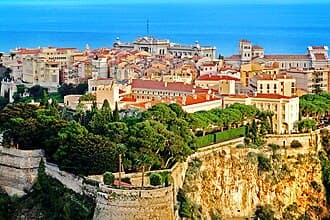
Monaco is the world's second-smallest state after the Vatican: two square kilometers that could be walked in an hour, if half of them weren't vertical. The Grimaldi family has ruled here since 1297, when François Grimaldi, disguised as a monk, talked his way into the fortress and opened the gate to his own men — a monk with a sword still appears on the state emblem today. The Monte Carlo Casino was founded in 1863 to rescue the bankrupt principality, and it worked so well that income tax was abolished a few years later and still isn't collected. Of the thirty-nine thousand residents, only about a quarter are native Monégasques, who are themselves barred from gambling at the casino. The country expands in the only direction available — into the sea, where more than twenty hectares of artificial land have been added. For a visitor, it's an odd combination: free elevators and two-euro buses sit right alongside a thousand-euro-a-night hotel room two streets over.

What to see

The places worth your time in Monaco, and what to expect at each

Monte Carlo Casino

Monte Carlo Casino

Monte Carlo

A gaming house from 1863, built by Charles Garnier, architect of the Paris Opera, in the same lavish style with gilding, frescoes and stained glass. Inside are two circuits: the public atrium and the European Rooms with roulette and trente et quarante tables, which require a separate ticket.

Tip: In the morning until 2 p.m. the casino is open as a sightseeing attraction with no gambling and no dress code; in the afternoon it's open only to gamblers in a shirt and trousers. Photography isn't allowed inside, and bags are checked at a cloakroom. Monégasque citizens are barred by law from the gaming rooms; a foreign visitor needs only a passport and to be eighteen.

Admission:
from 18 € for a visit
Time needed:
1–2 h
Prince's Palace

Prince's Palace

Monaco-Ville

The Grimaldi family's seat on the rock above the harbor, built on the foundations of a Genoese fortress from 1191. Open to visitors are the state rooms with sixteenth-century frescoes and a portrait gallery of the family. Each day at 11:55, guards change in front of the palace, wearing white or dark uniforms depending on the season.

Tip: For the changing of the guard, be on the square by 11:40 at the latest, or you won't see over the crowd. The square itself is free and offers the best view of the harbor and the whole country. The palace closes in winter, and some rooms aren't open to visitors while the prince is in residence.

Admission:
10 €
Time needed:
1–2 h
Oceanographic Museum

Oceanographic Museum

Monaco-Ville

A building suspended on an eighty-meter cliff above the sea, commissioned in 1910 by Prince Albert I, a seafarer and scientist. Inside is an aquarium with six thousand animals, including a shark lagoon, a whale skeleton collection, and the laboratories where Jacques Cousteau served as director for thirty years.

Tip: This is the best destination with kids anywhere in the principality and the only place suited to a whole rainy afternoon. On the roof is a terrace with a café and sea view that most visitors never reach. Tickets bought online cost a few euros less than at the box office.

Admission:
from 19 €
Time needed:
half day
Cathedral of Our Lady Immaculate

Cathedral of Our Lady Immaculate

Monaco-Ville

A white Romanesque-Byzantine church built from Carrara stone in 1875, containing the tombs of the Grimaldi princes. The most visited is the simple grave of Grace Kelly, the American actress and Princess of Monaco, who died in 1982 after a road accident above the city.

Tip: Admission is free, and it stays quiet here even at midday when crowds peak in front of the palace. The tombs are in the ambulatory behind the main altar; Princess Grace's grave is marked with the name Gratia Patricia. On Sundays at ten in the morning, the cathedral school choir sings at mass.

Admission:
free
Time needed:
30 min
Exotic Garden and cave

Exotic Garden and cave

Jardin Exotique

A garden suspended on a slope a hundred meters above the sea, home to several thousand succulents and cacti from the Americas and Africa that thrive on the dry rock face. Below it lies the Observatory Cave, a stalactite cave sixty meters deep with a constant temperature around eighteen degrees.

Tip: This offers the best view of all of Monaco and the coast toward Italy, better than from the palace, yet draws only a fraction of the visitors. Part of the garden may be closed for cliff-face repairs, so check ahead. Bus number two takes you all the way up, and walking back down takes twenty minutes.

Admission:
from 8 €
Time needed:
2 h
Formula 1 Circuit

Formula 1 Circuit

all of Monte Carlo and the harbor

The Monaco Grand Prix circuit has run over ordinary public streets since 1929: starting by the harbor, climbing toward the palace, passing through a tunnel beneath a hotel, and descending back to the sea. It's the slowest and narrowest circuit of the season and the only one that can be walked in full, in about an hour and a half.

Tip: The Fairmont hairpin and the tunnel function as ordinary roads and can be walked at any time outside race weekend. Curbs and track markings around the harbor are permanently painted on. Anyone arriving in late May will find the city closed off and hotel prices tripled.

Admission:
free
Time needed:
2 h on foot
Port Hercule

Port Hercule

La Condamine

The coast's only natural harbor, where yachts over seventy meters long dock. A promenade with restaurants runs around its perimeter, and in September it hosts Europe's largest yacht show. In winter part of the harbor is covered by an ice rink, and in summer a fifty-meter pool is installed there.

Tip: The promenade is public, and a walk along the pier among the yachts costs nothing — it's the best free activity in Monaco. Restaurants right on the water are expensive; a street up in La Condamine is a covered market with lunch for ten euros. Around eight in the morning you'll only meet the crews.

Admission:
free
Time needed:
1–2 h
Japanese Garden

Japanese Garden

Larvotto

Seven thousand square meters of garden built in 1994 on reclaimed land by Larvotto beach, designed by a Japanese architect according to Zen principles, with a pond, waterfall and tea house. The stones and pines were imported from Japan, and the plants are pruned into shapes.

Tip: Admission is free, and it's the quietest spot in the whole principality, open from nine until sunset. Right next door is Larvotto beach, with a free public section and showers. Eating, running and dogs aren't allowed inside the garden, and staff enforce this.

Admission:
free
Time needed:
1 h
Prince Rainier III's Car Collection

Prince Rainier III's Car Collection

Fontvieille

Over a hundred cars collected by Monaco's rulers: carriages, a 1903 De Dion-Bouton, Rolls-Royces used at coronations, a Lexus from a princely wedding, and Formula 1 cars that won in Monaco. The collection has occupied a new building at the Terrasses de Fontvieille since 2022.

Tip: This is a solid hour's worth of visiting, and the adjoining Stamp and Coin Museum in the same building can be added on. Fontvieille is the newest district, built on reclaimed land, with ordinary prices — lunch at its market costs half what it does in Monte Carlo.

Admission:
10 €
Time needed:
1–2 h

Photos: Monte Carlo Casino — Steve Hedin (CC BY-SA 4.0) · Prince's Palace — Nikolai Karaneschev (CC BY 3.0) · Oceanographic Museum — Berthold Werner (CC BY-SA 3.0) · Cathedral of Our Lady Immaculate — User:Berthold Werner (CC BY-SA 3.0) · Exotic Garden and cave — Georges Jansoone (JoJan) (CC BY 3.0) · Formula 1 Circuit — Mario30095 (CC BY-SA 3.0) · Port Hercule — Uhooep (CC BY-SA 4.0) · Japanese Garden — User:Parisette (Public domain) · Prince Rainier III's Car Collection — Gael13011 (CC BY 3.0)

Where to stay

Areas and districts, matched to the kind of trip you are taking

Monte Carlo

Best for: the casino, boutiques and nightlife

The most famous district, home to the casino, the Hôtel de Paris, the opera house and the Golden Circle of luxury shops. Accommodation here is the priciest and the streets are the busiest. Everything is within walking distance, and Larvotto beach is ten minutes away. Anyone wanting the postcard version of Monaco comes here.

Monaco-Ville

Best for: sightseeing and views

The old rock above the harbor, with the palace, the cathedral and the Oceanographic Museum, ringed by remnants of the old walls. The lanes are narrow and cars are banned. During the day it's full of day-trippers, but after six in the evening the rock empties out and becomes the quietest part of the country. There's almost no accommodation here.

La Condamine

Best for: normal prices and the harbor

The district around the harbor, with a covered market, the pedestrian Rue Princesse Caroline and shops that locals actually use. Food prices here run roughly half of Monte Carlo's, and everything is close by. For most visitors, it's the most sensible place to spend time outside of sightseeing.

Fontvieille and Larvotto

Best for: quiet, the beach and families

Two districts built on reclaimed land: Fontvieille in the south, with a park, museums and a market, and Larvotto in the north, with the principality's only public beach and the Japanese Garden. Both are quieter and cheaper than the center and connected to it by free elevators and buses.

Getting around

From the airport

Monaco has no airport and no international train station in the usual sense — the nearest airport is Nice Côte d'Azur, twenty-two kilometers to the west. From there, direct bus route 110 reaches Monaco in forty minutes; by train, with a change in Nice, it takes an hour. The fastest connection is a helicopter, flying from the airport to the heliport in Fontvieille in seven minutes, starting at a hundred fifty euros. The Monaco-Monte-Carlo station sits entirely underground inside the rock, with trains from Nice and Ventimiglia stopping every twenty minutes. Driving is possible, but parking is paid everywhere and expensive in the center.

Nice Côte d'Azur (NCE) · 22 km

  • Bus 110 Express· 40 min· 22 €
  • Tram and train via Nice-Ville· 1 h· 9 €
  • Helicopter to Fontvieille heliport· 7 min· 150 €
  • Taxi· 35 min· 95 €

Around town

Monaco is a slope, and the key to getting around comfortably is its network of public elevators and escalators connecting the city's different levels — there are roughly eighty of them, free to use and mostly running around the clock. Without them, you'd be climbing stairs over fifty meters of elevation. Six bus routes cover the whole territory, with a single ticket costing two euros; the buses are air-conditioned and run every ten minutes. A car is useless here: parking is paid everywhere, costs three to five euros an hour in the center, and traffic keeps circling the same streets. Trains to Nice and Ventimiglia leave from the underground station every twenty minutes.

Public elevators and escalatorsRoughly eighty connections between the city's levels, free and mostly running around the clock. The most important ones link the station down to the harbor and Fontvieille up to the rock. · free
CAM busesSix routes covering the whole principality, running every ten minutes. Tickets are bought at a stop machine or through an app; buying from the driver costs more. · 2 € single ticket, 5.50 € day pass
TER trainThe underground Monaco-Monte-Carlo station, with trains to Nice in twenty-five minutes and to Ventimiglia in Italy in twenty. The cheapest way to make day trips along the Riviera. · 4–6 €
Bateau Bus water taxiAn electric boat that crosses the harbor between both shores in two minutes. A standard bus ticket is valid, saving twenty minutes of walking around the pier. · 2 €
On footThe whole country can be walked in an hour and a half if you use the elevators. The longest crossing, from Fontvieille to Larvotto, takes thirty-five minutes. · free

Useful apps: Google Maps, CAM Monaco, SNCF Connect, MonaPass

When to go

Monaco operates year-round, with practically nothing closing. May, June and September are the most pleasant, warm but not muggy. Late May belongs to the Formula 1 Grand Prix: the city is half-shut behind grandstands, hotel prices triple, and rooms book a year in advance — anyone not attending the race should avoid these dates. July and August are the hottest and busiest, with yachts filling the harbor and lively nightlife. Winter is mild, around thirteen degrees, with a Christmas market at the port and a winter opera season; hotels are cheapest then.

Best time

May outside the Grand Prix dates, June and September

What to avoid

the last weekend of May for the race, August for the crowds

MonthJanFebMarAprMayJunJulAugSepOctNovDec
Day13°13°15°17°21°24°27°27°25°21°17°14°
Night8°8°10°12°16°19°22°22°20°16°12°9°
Rainy days655764235776
Sea14°13°14°15°18°21°24°25°24°21°18°15°

Food & drink

Monégasque cuisine is Provençal with a Ligurian accent — olive oil, chard, anchovies and pasta. There are only a handful of genuinely local dishes, but barbagiuan and fougasse are truly Monaco's own and aren't found elsewhere. Price differences within these two square kilometers are enormous: a set menu on a terrace near the casino starts at seventy euros, while a meal at the covered market in La Condamine costs ten. The cheapest option is the fixed-price lunch menu between noon and two, offered even by expensive restaurants. Tap water can be requested for free at restaurants and saves several euros per person.

What to try

Barbagiuan

Fried pastries filled with chard, rice and ricotta — Monaco's national dish. They're served as a starter, and on November 19, the national holiday, they're handed out across the city.

Socca and pissaladière

A chickpea flatbread and an onion tart topped with anchovies, both from the La Condamine market. Eaten by hand straight from the paper, they're the cheapest hot food you'll find here.

Stocafi

Dried cod braised for hours in tomatoes with olives. A traditional dish of old Monaco that you won't find at tourist-oriented places and that family-run restaurants serve only on certain days.

Fougasse monégasque

A sweet anise bread with nuts and colorful sprinkles, baked for holidays. Bakeries in the old quarter sell it by the piece.

Salade niçoise

A salad with tuna, egg, olives and green beans from across the region. The authentic version has no cooked vegetables or potatoes, something any local can spot at a glance.

Fish from the Ligurian Sea

Sea bass and sea bream grilled with herbs, often priced by weight. The menu price is usually per hundred grams, so ask in advance how much the portion will weigh.

Café gourmand

An espresso served with three miniature desserts on a small plate. Cheaper than a full dessert, and at pricey cafés it's a way to have something sweet at a reasonable cost.

Provençal rosé

A pale, dry wine from Côtes de Provence, drunk here with everything in summer. It's ordered by the quarter or half-liter carafe and costs noticeably less than a bottle.

What it costs

Espresso at the counter

2.50 €

Lunch at the covered market in La Condamine

10–15 €

Set lunch menu at a restaurant

25–40 €

Dinner on a terrace in Monte Carlo

80–150 € per person

Bus ticket

2 €

Casino admission

from 18 €

Oceanographic Museum

from 19 €

Night in a 4-star hotel for two

250–450 €

Indicative prices that change over time — treat them as a guide, not a price list.

Practical information

SocketsCEuroplug, two round pinsEFrench, with earth pinFSchuko
Voltage230V / 50Hz
Tap waterTap water is drinkable — Tap water in Monaco is safe to drink, supplied by the Monégasque water utility from France's Roquebrune and from underground boreholes. Restaurants will provide a carafe of tap water for free on request, but on terraces near the port staff won't offer it unprompted and will bring bottled water for six to eight euros instead. Drinking fountains can be found in the Jardin Exotique and in the parks above the port.
TippingService is included in the price, noted on the bill as "service compris." A tip is given as rounding up or around five percent, ten percent at upscale places. At the casino it's customary to hand the croupier a chip when leaving the table, though it isn't required. A hotel concierge who secures a table or a taxi is tipped ten to twenty euros.
Driving on theright
SafetyMonaco ranks among the safest places on earth: roughly five hundred police officers cover just two square kilometers, and the entire territory is monitored around the clock by cameras. Violent crime is practically nonexistent, and it's safe to walk around at any hour of the night. The one real risk is pickpocketing in crowds during the Grand Prix and yacht show weeks, when the city's population effectively doubles. The emergency line is 112, police 17.
Opening hoursShops are open roughly from ten to seven, with luxury boutiques on the Golden Circle often open until eight. Most shops close on Sundays, but restaurants, the casino and museums stay open. The Monte Carlo Casino admits gamblers from two in the afternoon, while the atrium and sightseeing circuit are open in the morning. Restaurants serve lunch from noon to two and dinner from half past seven; in between, only coffee is available.
Customs & etiquetteSaying "bonjour" on entering a shop is expected, just as in France. The casino and hotel bars enforce a dress code: no shorts or sports shoes for men, a jacket in the evening. Walking around town in swimwear or without a shirt is banned by municipal ordinance, and the fine is real. Photography inside the casino's gaming rooms is forbidden and staff enforce it. No one under eighteen is admitted to the gaming rooms, even just to look around.
A few local wordsGood day — BonjourThank you — MerciPlease — S'il vous plaîtThe bill, please — L'addition, s'il vous plaîtCheers — SantéGoodbye — Au revoir

How to plan your days

1 day

A day in Monaco

  1. 1Morning: train or bus from Nice, aiming to arrive before ten.
  2. 2The Monaco-Ville rock: the cathedral and the Oceanographic Museum.
  3. 3At 11:45, the changing of the guard in front of the palace.
  4. 4Lunch at the covered market in La Condamine, at normal prices.
  5. 5Afternoon: the casino inside and out, plus a stroll along the marina.

2 days

Two days with the views

  1. 1Day one as above, staying overnight in Monaco or Beaulieu.
  2. 2Morning: bus up to the Exotic Garden and its cave.
  3. 3Walk down through the old quarters into Fontvieille.
  4. 4Prince Rainier's car collection and lunch at the local market.
  5. 5Afternoon: the Japanese Garden and a swim at Larvotto.

3 days

Three days with the surroundings

  1. 1Days one and two as above.
  2. 2Morning: train to Èze, then walk or bus up to the village on the cliff.
  3. 3Lunch in Èze, then onward to Nice in the afternoon.
  4. 4A walk along the Promenade des Anglais and through the old town.
  5. 5With a fourth day, take the train to Ventimiglia in Italy for the Friday market.

Day trips

Èze and the Grande Corniche

10 km · 25 min by bus

A village perched on a cliff four hundred meters above the sea, entered through a single gate, with nothing inside but cobbled lanes and stone houses. At the top is an exotic garden with a view over half the Riviera. The Nietzsche Path leads down to the sea, the same route the philosopher walked while writing Thus Spoke Zarathustra; the descent takes an hour.

Nice

22 km · 25 min by train

The Riviera's largest city, with a seven-kilometer promenade, an old town with a market on Cours Saleya, and the Colline du Château hill with a view over the whole bay. The Marc Chagall Museum and the Matisse collection in Cimiez rank among the best in the region. Trains run every twenty minutes and tickets cost under five euros.

Ventimiglia and the Italian border

18 km · 20 min by train

The first Italian town across the border, where a Friday market draws day-trippers from Monaco — one of the largest on the coast, with clothing, cheese and olives lining the entire promenade. Prices are a fraction of Monaco's, making it the fastest way to step from the principality into a completely different world.

Frequently asked questions

Do I need a visa or passport for Monaco?+

Monaco isn't in the European Union, but it's in a passport union with France and part of the Schengen area, so an EU citizen enters without checks and just needs an ID card. To enter the casino, however, you need photo ID and must be at least eighteen — a passport or ID card is required there.

How do I get to Monaco from Nice?+

By train from Nice-Ville in twenty-five minutes for under five euros, or by the 110 Express bus straight from the airport in forty minutes. The train runs every twenty minutes, and Monaco's station sits underground in the middle of the city. The fastest option is a helicopter from the airport in seven minutes, though it starts at a hundred fifty euros.

Is it worth driving to Monaco?+

No. Parking is paid throughout the principality, costing three to five euros an hour in the center, and the streets are one-way and congested. The train from Nice or Menton is faster and cheaper. Anyone who does drive ends up leaving the car in an underground garage and walking everywhere anyway.

Can I just look inside the casino?+

Yes, in the morning until 2 p.m. the casino is open as a sightseeing attraction: admission starts at eighteen euros, there's no gambling and no dress code. In the afternoon the gaming rooms open, requiring ID, a minimum age of eighteen, and at least a shirt and trousers. Photography isn't allowed inside.

How much time is enough for Monaco?+

One day covers the rock with the palace, the museum and the casino; two days allow a calmer pace with the Exotic Garden and Fontvieille. The whole country can be walked in an hour and a half, so staying more than two days makes sense mainly as a base for trips along the Riviera, with trains running every twenty minutes.

Can you eat cheaply in Monaco?+

Yes, but not on the well-known terraces. The covered market in La Condamine and the market in Fontvieille offer lunch for ten to fifteen euros. Even expensive restaurants offer fixed-price lunch menus between noon and two for twenty-five to forty euros. Dinner on a terrace near the casino starts at eighty.

When is the Monaco Formula 1 Grand Prix?+

The last weekend in May. The city is then half-shut behind grandstands and barriers, hotel prices triple, and rooms book up a year in advance. Anyone not attending the race should avoid these dates. The circuit itself can be walked at any other time of year, and it's free.

Is there a beach in Monaco?+

One public beach — Larvotto in the northeast, with coarse imported sand, showers and a free swimming zone. Next to it are paid beach clubs with loungers from thirty euros. The sea reaches twenty-five degrees in summer. For longer stretches of sand, take the train to Menton or Beaulieu, ten minutes away.

Visa Requirements

Check the latest visa requirements for entering this country. Some nationalities may need to apply for a visa or e-visa before travel.

Check visa requirements

Emergency Numbers

Language

French

Currency

EUR

Timezone

GMT+1

Dial Code

+377

Population

39K

Area

2 km²

Voltage

230V / 50Hz

Driving Side

Right

Top Hotels in Monaco

Live prices from 500+ properties

Loading hotels...

Planning a trip to Monaco?

Compare hundreds of hotels, find the best price, and book with free cancellation on TravelManiac.