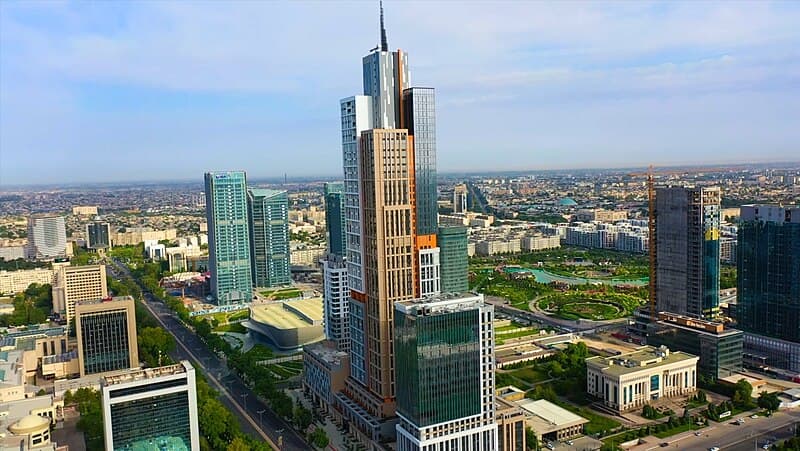
Central Asia's largest city, rebuilt after an earthquake with a metro fit for a palace
Tashkent
LanguageUzbek
CurrencyUZS
TimezoneAsia/Tashkent
Temperature5-35 °C
Dial Code+998
Population36M
Area449,009 km²
SocketsType C / Type F
Tap waterNot drinkable
Discover Tashkent
With nearly three million residents, Tashkent is the largest city in Central Asia — and the least postcard-pretty of Uzbekistan's cities, so travelers arriving straight from Samarkand are often disappointed at first. The reason traces back to April 26, 1966, when an earthquake above magnitude five leveled the city and left three hundred thousand people without a roof. The Soviet Union then rebuilt Tashkent as a showcase: wide boulevards, vast squares, parks, earthquake-resistant housing blocks, and a metro whose stations are decorated with marble, wrought metal, and mosaics on a par with Moscow's. Some of the old city survived too — Hazrati Imam with the world's oldest surviving Quran, the Kukeldash Madrasah, and above all Chorsu, a bazaar under a huge dome, still ringed today by the old clay-walled quarter. The last decade has added a third layer: the glass towers of Tashkent City, and cafés and restaurants that wouldn't feel out of place in Istanbul. Tashkent is the country's gateway, the hub for every train and flight, and it earns two days — not as a mere transit stop, but for the way three different eras collide here.
What to see
The places worth your time in Tashkent, and what to expect at each
Chorsu Bazaar
Old Town
The city's largest and oldest market, housed under a blue dome nearly 350 meters around, on a site that has traded goods since medieval caravan routes crossed here. Meat and dairy are sold beneath the dome, spices, dried fruit, bread, cookware, and textiles in the surrounding halls, and produce outside. The old clay-walled quarter spreads out around it.
Tip: Go between seven and ten in the morning, when the bazaar is busiest and the bread is still warm; by afternoon it's half-empty. Climb up to the gallery around the dome for the best view of the bustle below — hardly anyone bothers. Next to the bazaar is a teahouse serving some of the city's best plov, but only until noon. Nobody takes cards here, so bring cash, and bargain over textiles and souvenirs, not food.
Admission:
free
Time needed:
1.5–2 h
Tashkent Metro
Citywide
Central Asia's first metro, opened in 1977, built to double as a nuclear shelter and also as a showcase — each of its dozens of stations has its own theme, decorated in marble, ceramic, wrought metal, and glass. Kosmonavtlar is devoted to space exploration with cosmonaut portraits on blue glass, Alisher Navoi has domes echoing a madrasa, and Pakhtakor is tiled with cotton-boll mosaics.
Tip: Photography was banned in the metro until 2018; it's now allowed and makes for the cheapest tour in the city — a ticket costs 2,000 UZS and, since fares are per entry rather than distance, you can ride around and photograph as many stations as you can manage on one ticket. The prettiest are Kosmonavtlar, Alisher Navoi, Mustaqillik Maydoni, and Pakhtakor, all on the two original lines. Trains run until midnight, and the air-conditioned platforms make a good summer-afternoon escape.
Admission:
2,000 UZS per ride
Time needed:
1.5 h
Hazrati Imam Complex
Old Town
Uzbekistan's religious center, in the old part of the city, home to the Hazrati Imam mosque, the sixteenth-century Barak Khan Madrasah, the mausoleum of Kaffal Shashi, and a library. The library holds the Uthman Quran, traditionally dated to the seventh century and considered the oldest surviving Quran manuscript in the world; Timur brought it to Samarkand, and Lenin returned it to Tashkent in 1924.
Tip: The Quran is displayed in a special climate-controlled room, and photography is banned and enforced. Entry to the complex itself is free; only the library holding the Quran charges admission. This is a working place of worship, not a museum — several thousand people arrive for Friday noon prayers, and it's not the moment for tourists to be there. Covered shoulders and knees are required, and women should wear a headscarf.
Admission:
complex free, library from 20,000 UZS
Time needed:
1.5 h
Kukeldash Madrasah
Old Town, above Chorsu
Tashkent's largest surviving madrasa, built in the sixteenth century under the Shaybanid dynasty on high ground above Chorsu. Over the centuries it served as a school, caravanserai, and fortress, and in the nineteenth century condemned women sewn into sacks were reportedly thrown from its terrace. Today it functions again as a religious school, its courtyard ringed by student cells.
Tip: It's a five-minute walk from Chorsu, so the two combine naturally into one walk. The courtyard is free to enter and stays quiet even when the bazaar below is in full swing. Next door stands the large 1990s Juma Friday mosque. Note that the madrasa still functions as a school — don't enter the cells or photograph students without permission.
Admission:
free, donations welcome
Time needed:
45 min
Amir Timur Square and the clock tower
Downtown
A circular square at the heart of the modern center, with an equestrian statue of Timur, ringed by plane-tree parkland and the city's most iconic buildings — the 1970s Hotel Uzbekistan, the blue-domed Timur museum, and Tashkent's clock tower, built in 1947 from a clockwork mechanism seized in Germany.
Tip: The square is the best landmark in the city, an easy walk to both Mustaqillik Maydoni and the Navoi Theatre. The small Timur museum on its edge is more interesting than it looks, and it's air-conditioned. The park offers the best shade downtown, which matters more than almost anything in summer. The statue of Timur stands on a pedestal that once held statues of Kaufman, Stalin, and Marx before him — four regimes on one plinth.
Admission:
free, museum from 30,000 UZS
Time needed:
1 h
Independence Square
Downtown
The city's largest square and Uzbekistan's main ceremonial space, once home to the world's largest statue of Lenin until 1991 — its pedestal now holds a globe outlined with Uzbekistan's borders. It includes the Alley of Memory, with a monument to a grieving mother and an eternal flame honoring four hundred thousand Uzbeks who died in the Second World War, and a colonnade topped with storks.
Tip: Visit in the early evening, when whole families arrive, the fountains run, and the heat eases; by day it's a sun-baked expanse of concrete with no shade. The Grieving Mother memorial with its book of the fallen is Tashkent's most powerful spot and taken very seriously — behave accordingly. Soldiers guard the entrances, and some surrounding buildings can't be photographed, which they'll make clear.
Admission:
free
Time needed:
45 min
State Museum of Applied Arts
Downtown, near Oybek
A museum housed in the 1907 former residence of Russian diplomat Alexander Polovtsov, whose interiors were designed by master craftsmen from Bukhara, Khiva, and Fergana — the carved alabaster and painted ceilings of the house itself are the star exhibit. The collection covers suzani textiles, ceramics from every Uzbek school, metalwork, silk ikat, and tools.
Tip: This is the best place to learn to tell which ceramics and patterns come from which region — without that, you'll buy anything at the bazaar for any price. Few visitors come here, the building is air-conditioned, and a visit takes about an hour. The museum shop sells genuine pieces at fixed prices, making it a useful benchmark against bazaar prices.
Admission:
from 30,000 UZS
Time needed:
1 h
Tashkent Tower
North, 3 km from downtown
A 375-meter tower built in 1985, the eleventh-tallest free-standing structure in the world and the tallest in all of Central Asia. A viewing platform sits at 100 meters, with a revolving restaurant above it that completes a rotation in an hour. On a clear day the whole city is visible, with the Tian Shan mountains on the horizon.
Tip: Arrive an hour before sunset and stay until the city lights up — it's the one place that reveals just how enormous Tashkent is, and how regularly it was replanned after the earthquake. Foreigners need a passport at the entrance. The restaurant upstairs is overpriced with mediocre food; a ticket to the viewing platform alone is enough. The tower sits three kilometers north of downtown, a ten-minute taxi ride.
Admission:
from 40,000 UZS
Time needed:
1.5 h
State Museum of History of Uzbekistan
Downtown
Central Asia's oldest museum, founded in 1876, offering the most complete overview of the country's history, from the Buddhist period through the Arab conquest, the Timurid empire, and the Russian protectorate, to independence. Its most prized exhibit is a first-century faience figure of Buddha from Fayaz-Tepe, evidence that Uzbekistan was once a Buddhist land.
Tip: Go here on your very first day, not your last — without the context this museum provides, the monuments in Samarkand and Bukhara will be hard to place. Labels are in Uzbek, Russian, and partly English. It's three minutes from Independence Square, air-conditioned, and cheap, making it a good fit for a hot afternoon.
Areas and districts, matched to the kind of trip you are taking
Downtown around Amir Timur Square
Best for: first-time visitors, hotels, and orientation
A Soviet-planned district of boulevards, parks, and the main museums, from which the metro reaches everywhere. Most international hotels are here, along with mid-range restaurants and the best transport links in the city. Tree-lined streets make walking pleasant thanks to the shade, which matters a great deal in summer. Accommodation prices are the highest in Tashkent, though still low by European standards.
Old Town around Chorsu
Best for: the bazaar, sights, and atmosphere
Tashkent's oldest quarter, which suffered less damage from the 1966 earthquake than the center — a maze of courtyarded clay houses around the bazaar, with the Kukeldash Madrasah and the Hazrati Imam complex just to the north. It's the only part of the city that still feels like the rest of Uzbekistan. Family-run guesthouses here are cheaper than downtown, but the streets go dark at night and taxis are harder to flag.
Mirabad and Oybek
Best for: food, cafés, and evening life
A district south of downtown around the Oybek and Kosmonavtlar metro stations, with the city's best restaurant and café scene, including Korean and Georgian cuisine. It's home to Alay Bazaar, smaller and cleaner than Chorsu, and a number of small hotels. It's one metro stop from downtown, and food here costs a quarter less than at hotel restaurants.
Tashkent City and Yunusabad
Best for: modern hotels and families
A new business district of glass towers, a park, and international hotels west of downtown, and the sprawling residential Yunusabad district to the north, home to the TV Tower and an aquapark. It's comfortable, new, and air-conditioned, but has little connection to historic Tashkent. The metro reaches it, and a taxi downtown costs around 20,000 UZS.
Tashkent is the main gateway to Uzbekistan and to Central Asia as a whole. From Prague it's reached with one connection — most often via Istanbul with Turkish Airlines, via Dubai, or on direct Uzbekistan Airways flights from Frankfurt and Milan; the whole trip takes roughly nine to twelve hours. Most Western passport holders don't need a visa for stays up to thirty days. Islam Karimov International Airport lies just six kilometers south of downtown, one of the shortest airport-to-center distances anywhere, though the terminal is dated and check-in slow — allow an extra hour. From Tashkent, Afrosiyob high-speed trains reach Samarkand in two hours ten minutes and Bukhara in three and a half hours; tickets go on sale three weeks ahead on railway.uz and disappear almost instantly in peak season.
Tashkent, Islam Karimov International Airport (TAS) · 6 km
Taxi to downtown· 20 min· 40,000 UZS
Yandex Go· 20 min· 25,000 UZS
Bus 67 to Independence Square· 40 min· 2,000 UZS
Around town
Tashkent is vast and laid out in the Soviet style of huge blocks, so distances that look short on a map can be a half-hour walk. Fortunately there's the metro — three lines, a flat 2,000 UZS fare regardless of distance, trains until midnight — making it the fastest, cheapest, and in summer the only air-conditioned option. Above ground, buses run at the same fare, paid by card or cash. Taxis are very cheap: a ride across downtown via the Yandex Go app runs 20,000–30,000 UZS, and the app shows the price upfront, which is the best protection against overcharging. Without the app, agree on a price before getting in, since the first number quoted to a tourist tends to be double. Informal ride-sharing is also common — a raised hand by the road will flag down a private car willing to drive you for an agreed fee, and it's completely normal practice in Uzbekistan.
MetroThree lines, a flat 2,000 UZS fare regardless of distance, trains every 5–10 minutes. The fastest transport in the city and the only air-conditioned option; the stations are attractions in their own right, and photography has been allowed since 2018. · 2,000 UZS
Yandex GoApp-hailed taxi with an upfront price; a ride across downtown costs 20,000–30,000 UZS. Requires internet, so buy a local SIM at the airport. The best way to avoid overpaying. · from 15,000 UZS
BusesA dense network, flat 2,000 UZS fare paid to the driver. Routes are labeled in Uzbek and Russian and are tricky to look up on maps; mainly useful for the airport line. · 2,000 UZS
Afrosiyob high-speed train2 h 10 min to Samarkand, 3.5 h to Bukhara. Tickets go on sale three weeks ahead on railway.uz and sell out within days in peak season. Departs from South (Toshkent) Station. · 150,000 UZS
Informal ride-sharingA raised hand by the roadside flags down a private car willing to give you a lift for an agreed fee — common and safe. Agree the price beforehand; it's usually cheaper than a taxi, around 15,000 UZS across downtown. · 15,000 UZS
Useful apps: Yandex Go, Google Maps, railway.uz, Google Translate with Russian
When to go
Tashkent follows the same pattern as the rest of the country, just about two degrees warmer: April, May, September, and October are best, with temperatures around 25°C and dry weather. April is the greenest month, with the city full of blossoming trees and its parks in full swing. July and August routinely hit 37°C, and the afternoon heat feels worse in this concrete city than in Samarkand — the air-conditioned metro and museums save the day, so plan to be outdoors before ten and after seven. Winter is mild, around freezing, without snow, damp and gray; hotels are cheapest then and the sights are empty. Navruz, around March 21st, is the biggest holiday of the year, and Tashkent comes more alive for it than any other Uzbek city. Ramadan doesn't slow the city down.
Best time
April, May, September, and October
What to avoid
July and August, for the heat around 37°C
Month
Jan
Feb
Mar
Apr
May
Jun
Jul
Aug
Sep
Oct
Nov
Dec
Day
8°
11°
16°
23°
29°
34°
37°
35°
30°
23°
16°
10°
Night
-1°
1°
6°
11°
16°
20°
22°
20°
15°
10°
5°
1°
Rainy days
9
9
10
9
6
2
1
1
1
5
7
9
Food & drink
Tashkent is the country's most varied city for food: alongside Uzbek cuisine, decades of Soviet-era population movement brought Korean, Georgian, Uyghur, and Tatar cooking here, and in recent years European-style cafés and restaurants have appeared too. Tashkent-style plov differs from Samarkand's — the rice steams together with the meat, comes out darker and richer, and often includes quail eggs and horse sausage (kazy). It's cooked from morning in giant cauldrons and typically sells out by noon, so plov is a lunchtime dish here. The cheapest meals are at a canteen or bazaar for 30,000–50,000 UZS; restaurants aimed at tourists cost double and add a 10% service charge. The Korean salads at Alay Bazaar are a Tashkent specialty you won't find in Samarkand — a legacy of Korean families deported here in 1937.
What to try
Plov (osh)
The national dish: rice steamed in sheep-tail fat with carrots, onion, chickpeas, and mutton, with every region making its own version. It's cooked in giant cauldrons from morning and often sells out by noon — plov is eaten for lunch, not dinner. A portion runs 20,000–40,000 UZS.
Shashlik
Marinated meat grilled on skewers over charcoal, most often mutton, beef, or minced lyulya kebab. It's ordered by the skewer, not the portion, and always comes with raw onion in vinegar. Best where the smoke drifts right out onto the street.
Lagman
Hand-pulled noodles with braised meat and vegetables, served either as a soup or pan-fried dry as 'kovurma lagman.' A legacy of Uyghur cuisine, and the safest bet if plov feels too rich.
Samsa
A triangular or round pastry filled with meat and onion, baked stuck to the wall of a clay tandoor oven. It's the best street food in the country at 3,000–6,000 UZS, and you'll know it's fresh because it's still too hot to hold.
Manti and chuchvara
Manti are large steamed dumplings filled with meat and onion; chuchvara is the small version floating in soup. Both are eaten with sour cream and are the cheapest hot dish on most menus.
Lepyoshka
A round bread baked in a tandoor, stamped with a decorative pattern and black nigella seeds in the center. The Samarkand version is firmer and keeps for weeks, so it's often carried back to Tashkent as a gift. It's broken by hand and never set down upside-down.
Green tea and pomegranate juice
Kok choy, unsweetened green tea, is served with every meal in a pot for the whole table and costs a couple of thousand som. Black tea is more common in Tashkent than elsewhere. In autumn, pomegranate juice is pressed everywhere, and a liter costs less than a single glass would back home.
Korean salads and kimchi
A Tashkent specialty thanks to Korean families deported to Central Asia in 1937. At Alay Bazaar dozens of spicy salads of carrot, mushroom, and seaweed are sold by weight; a hundred grams costs a couple thousand som and pairs perfectly with shashlik.
What it costs
Green tea at a teahouse
5,000–12,000 UZS
Plov at a canteen
30,000–45,000 UZS
Dinner at a good restaurant
100,000–180,000 UZS
Metro ticket
2,000 UZS
Taxi across downtown via Yandex Go
20,000–30,000 UZS
TV Tower admission
from 40,000 UZS
High-speed train to Samarkand
from 150,000 UZS
Night in a 3-star hotel, double
350,000–700,000 UZS
Indicative prices that change over time — treat them as a guide, not a price list.
Practical information
SocketsCEuroplug, two round pinsFSchuko
Voltage220V / 50Hz
Tap waterDo not drink tap water — Don't drink Tashkent's tap water — it's chlorinated, but the pipes are old and even locals boil it before drinking. Bottled water costs 2,000–4,000 UZS per 1.5 liters in a regular shop, triple that at hotels; buy it at ordinary stores rather than near sights. Green tea is served with every meal and is the safest liquid in the country. In summer, when it's over 35°C, plan on three liters per person per day — dehydration is a more common problem here than stomach trouble.
TippingTipping isn't expected, but tourist-oriented restaurants in Samarkand and Tashkent add a 10% service charge directly to the bill — check the receipt before adding more. Drivers on a full-day trip get five to ten dollars, guides ten to fifteen. Visa and Mastercard work at hotels and upscale restaurants, but bazaars, taxis, and small teahouses take cash only. ATMs dispense som and dollars but often run empty; exchange money at a bank or hotel, never on the street.
Driving on theright
SafetyUzbekistan is a safe country for tourists, with very low street crime and a constant police presence in city centers. The real risks lie elsewhere: heat above 35°C from June to August, traffic where pedestrians have no right of way even at crossings, and stomach trouble from street food. Photographing the metro has been allowed since 2018, but military sites and border areas are off-limits. Foreigners must have proof of residence registration for every night; hotels issue it automatically, and private accommodation should be asked to provide one. The emergency number is 112.
Opening hoursBazaars open at dawn, and the best goods are gone by ten; by afternoon they're half-empty, and smaller markets often close Mondays. Sights open from eight or nine until six, later in summer, and charge an extra fee for photography. Restaurants serve from noon until ten p.m., teahouses from morning. Ramadan doesn't slow the country down — Uzbekistan is a secular state and restaurants stay open — but smaller towns visibly empty out during the day.
Customs & etiquetteUzbek hospitality comes with obligations: an invitation to tea isn't turned down, and your host will keep topping up your cup until you leave it full. Tea is poured in small amounts, not to the brim — a full cup signals 'time to go.' Lepyoshka bread is never set down upside-down and is never cut with a knife, only broken by hand. Shoes come off before entering a mosque, women cover their hair with a scarf, and men should avoid shorts. The left hand isn't used for passing food. Bargaining at the bazaar is expected and usually starts around half the first price quoted, but keep it friendly — rudeness doesn't work here.
A few local wordsHello — Assalomu alaykumThank you — RahmatPlease / you're welcome — MarhamatHow much does it cost? — Qancha turadi?Too expensive — Juda qimmatGoodbye — Xayr
How to plan your days
1 day
A day in Tashkent
1Morning: Chorsu Bazaar while it's full and the bread is warm.
2The Kukeldash Madrasah, five minutes above the bazaar.
3Plov for lunch at a teahouse near Chorsu, before noon.
4Afternoon: the Hazrati Imam complex and the Uthman Quran.
5Early evening: Independence Square, then dinner in Mirabad.
2 days
Two days with the metro and museums
1Day 1 as above.
2Morning: a loop of the prettiest metro stations on a single ticket.
3The State Museum of History of Uzbekistan, as an introduction to the whole trip.
4Afternoon: the Museum of Applied Arts in the Polovtsov mansion.
5Before sunset: the Tashkent Tower, passport in hand.
3 days
Three days with the mountains
1The first two days as above.
2By car to Chimgan and Charvak Reservoir, ninety minutes away.
3The Beldersay chairlift or a swim in the reservoir, depending on season.
4Return in the evening, dinner in Tashkent City.
5Alternative: a day trip by high-speed train to Samarkand.
Day trips
Chimgan and Charvak Reservoir
80 km · 1 h 30 min by car
Foothills of the Tian Shan northeast of Tashkent, where the whole city flees the summer heat. Chimgan is a ski resort at 1,500 meters, with a chairlift up to a ridge overlooking peaks over 3,000 meters. Below lies the turquoise Charvak Reservoir, where people swim and boat from June to September. In winter, skiing happens at nearby Beldersay. Reach it by taxi or with a driver; a full-day hire runs 400,000–600,000 UZS, since public transport barely reaches here.
Kokand was the seat of an independent khanate until the Russian conquest of 1876, and it left behind the hundred-room Khudayar Khan Palace with its facade of colorful tilework. From there you continue into the Fergana Valley, the most densely populated and fertile part of Central Asia, where blue-and-white ceramics are made in Rishtan and silk ikat is still woven by hand in Margilan's Yodgorlik factory. The route crosses the Kamchik Pass at 2,000 meters. It's an ambitious day trip; staying overnight in Fergana is the more sensible option.
Frequently asked questions
Is Tashkent worth it, or should I head straight to Samarkand?+
It's worth two days. It doesn't have Timurid monuments like Samarkand, because a 1966 earthquake leveled the old city, but it has three things you won't find elsewhere: the Chorsu Bazaar under its huge dome, a metro with stations decorated like palaces, and the oldest surviving Quran in the world at the Hazrati Imam complex. It's also the one place where the museums give you context that will make Samarkand and Bukhara click into place later.
Can I take photos in the Tashkent metro?+
Yes. Photography was banned until 2018 because the metro doubled as a nuclear shelter and military site, but it's now allowed and guards let it be. A ticket costs 2,000 UZS and covers entry rather than distance, so with a single ticket you can ride around and photograph as many stations as you can fit in. The prettiest are Kosmonavtlar, Alisher Navoi, Pakhtakor, and Mustaqillik Maydoni.
Do I need a visa and residence registration?+
No visa is required for most Western passport holders visiting Uzbekistan for stays up to thirty days, with a passport valid for three months beyond the return date — check your own country's specific rules before you go. You do need a residence registration slip for every night, though; hotels issue this automatically as a small receipt, which you should keep, since it's sometimes checked on departure. Anyone staying with a private host or through a booking platform should explicitly ask for one.
How do I get from Tashkent to Samarkand and Bukhara?+
By the Afrosiyob high-speed train from South Station: two hours ten minutes to Samarkand, three and a half hours to Bukhara. A ticket costs around 150,000 UZS. Tickets go on sale three weeks ahead on railway.uz and sell out within days during peak season in spring and autumn — book as soon as you have your flight. The slower Sharq trains are cheaper and usually have availability.
What about money and cards?+
The currency is the Uzbek som. Visa and Mastercard work at hotels, international chains, and upscale restaurants, but the metro, taxis, bazaars, and local eateries take cash only. ATMs dispense som and dollars but often run empty, so exchange cash at a bank or hotel and keep a buffer. Dollars and euros exchange best; creased or marked banknotes may be refused in some places.
How do I handle Tashkent in summer?+
Split your day. Go out before ten in the morning and after seven in the evening, when it's bearable; between eleven and six, plan around the metro, museums, the Museum of Applied Arts, and shopping malls, since they're air-conditioned. Drink three liters per person per day, bottled water only. The city has many plane-tree-lined boulevards and parks where the shade is noticeably cooler than the main squares, which turn into sun-baked concrete plains by noon.
Will English get me by?+
Often at hotels, with Yandex Go, and with younger people, but less so elsewhere. Tashkent speaks Uzbek and Russian, with Russian serving as the common lingua franca. If you can read Cyrillic, you'll navigate the metro and signage far more easily — some signs use the Latin alphabet, some Cyrillic. Download Google Translate with offline Russian and Uzbek, and buy a local SIM at the airport, since roaming is expensive.
Is Tashkent safe?+
Yes, street crime is very low and police presence downtown is constant; walking through parks in the evening is fine. The real risks are the heat, traffic — pedestrians have no right of way even at crossings and cars won't stop — and stomach trouble from street food and tap water. Drink only bottled water. Photographing military sites and some government buildings around Independence Square is prohibited, and soldiers will let you know.
Visa Requirements
Check the latest visa requirements for entering this country. Some nationalities may need to apply for a visa or e-visa before travel.