Hotels in Aruba

The island below the hurricane belt, where the wind never stops

Aruba

LanguageEnglish
CurrencyAWG
TimezoneGMT-4
Temperature27-32 °C
Dial Code+297
Population107K
Area180 km²
SocketsType A / Type B / Type F
Tap waterDrinkable

Discover Aruba

Aruba is the smallest and westernmost of the 3 ABC islands, lying just 25 kilometres off the coast of Venezuela. It isn't a tropical island in the usual sense — it's a semi-desert of 5-metre cacti, rocky plains and divi-divi trees permanently bent into a right angle by the wind, so that they all point the same way. Beaches are few and confined to the south-west coast, but they rank among the best in the world: Eagle Beach is 100 metres wide, with sand as fine as flour and a calm, shallow sea. The rest of the island is the opposite — the north-east coast is wild, with surf that breaks against the rocks, and it forms the celebrated Arikok National Park. Aruba sits below the hurricane belt, so tropical storms never reach it and you can fly here even in September. It's part of the Kingdom of the Netherlands, and it shows: cleanliness, order, drinkable tap water and a level of safety not a given elsewhere in the Caribbean. At the same time, it's one of the priciest destinations in the region.

What to see

The places worth your time in Aruba, and what to expect at each

Eagle Beach

Eagle Beach

south-west

The island's widest beach, with a strip of white sand up to 100 metres wide in places, a calm shallow sea and low-rise development — hotels stand on the far side of the road, not on the sand. 2 famous bent fofoti trees grow on it, the most photographed sight in Aruba.

Tip: Sea turtles nest at the north end of the beach from March to September, and their nests are marked with stakes — don't walk between them, and don't shine lights on the beach at night, as light disorients newly hatched turtles. Unlike at Palm Beach, sun loungers here are mostly free or cheap.

Admission:
free
Time needed:
full day
Palm Beach

Palm Beach

south-west

The livelier neighbouring beach north of Eagle Beach, lined with tall hotels, restaurants and casinos. The sea is equally calm, the beach a touch narrower, and everything is within reach — watersports, bars, shops. You can snorkel off the Hadicurari pier.

Tip: Sun loungers in front of hotels are reserved for guests and monitored; public access is between the hotels and is signposted. Best to arrive before 9am, as loungers on the public stretch fill up fast. In the evening the boardwalk is lively, with live music in the bars.

Admission:
free
Time needed:
full day
Arikok National Park

Arikok National Park

east

A protected area covering a fifth of the island, with limestone plateaus, cactus desert, caves with indigenous rock art and the wild north-east coast where surf pounds the rocks. Home to endemic snakes and iguanas, with a restored traditional cunucu adobe house.

Tip: Standard cars aren't allowed into the park — the tracks are rocky and rentals ban it — so you need a 4x4 or a guided 4x4 tour. Bring plenty of water, there's no shade and it's desert. Last entry is usually in the afternoon and it closes early.

Admission:
from USD 15
Time needed:
half day
California Lighthouse

California Lighthouse

north-west

A white lighthouse from 1916 at the island's north-western tip, named after the steamship California, which sank nearby. It stands on a rise, with views of the entire west coast — beaches on one side, wild rocks on the other.

Tip: You can climb to the top for a fee, and the staircase is narrow and steep. Most people come at sunset, and it's justified — it's the best spot on the island to watch the sun set straight into the sea. Arrive half an hour early, as the car park fills up.

Admission:
climb from USD 10
Time needed:
1 h
Antilla wreck

Antilla wreck

north-west coast

A German freighter 130 metres long, scuttled by her own crew in 1940 to keep her out of Dutch hands. She lies in shallow water off the north-west coast at a depth of 5–18 metres and is the largest wreck in the Caribbean accessible even by snorkel.

Tip: The upper part of the wreck lies just a few metres below the surface, so a mask and snorkel are enough — no need to wait for a diving certificate. Trips leave Palm Beach in the morning, when the sea is calmer. The wreck is covered in coral and full of fish, making it good snorkelling in its own right.

Admission:
trip from USD 50
Time needed:
3 h
Baby Beach

Baby Beach

south-east

A shallow horseshoe-shaped lagoon at the island's south-eastern tip near San Nicolas, sheltered by a reef, with waist-deep water even 100 metres from shore. It's the safest spot on Aruba for swimming with young children, and the water here runs about 2 degrees warmer than on the west coast.

Tip: Snorkelling is best at the right-hand end of the lagoon, but don't swim past the reef — there's a strong current just beyond it. It's 40 minutes by car from the main resorts, so it's worth combining with a visit to San Nicolas and its street murals.

Admission:
free
Time needed:
half day
Oranjestad

Oranjestad

Oranjestad

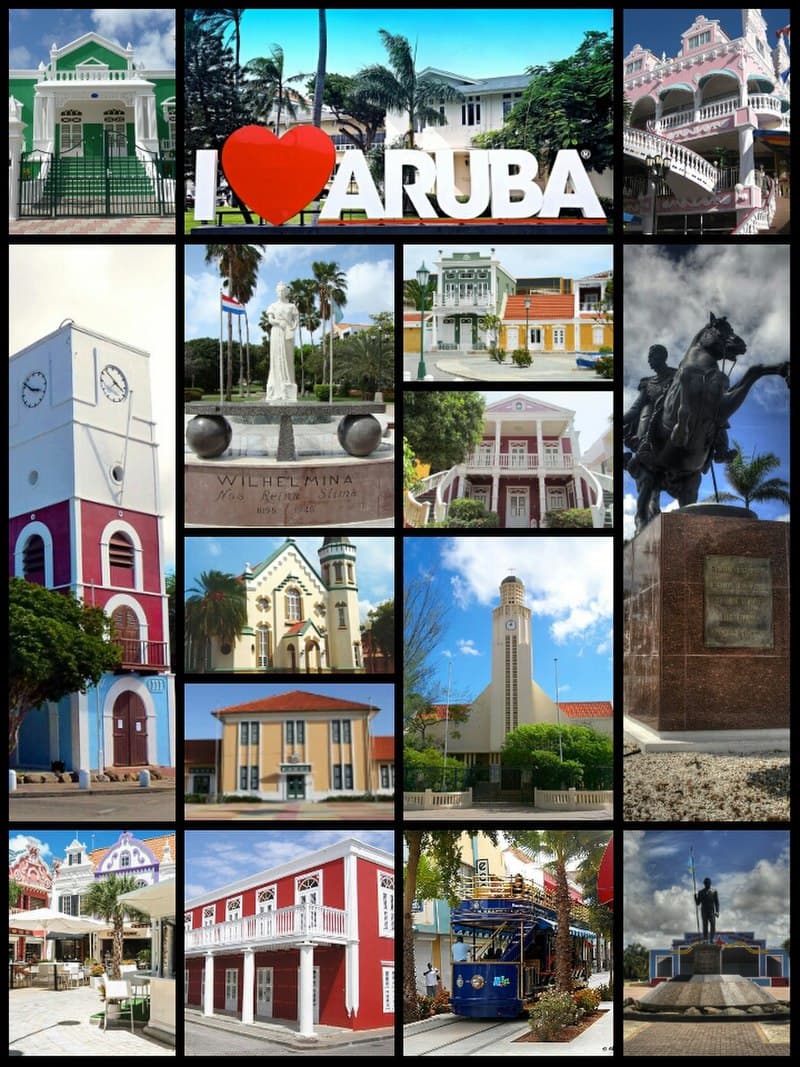
The capital, with Dutch colonial architecture in pastel colours, a cruise-ship harbour and the main shopping street, Caya Betico Croes. A free tram has run along the main street since 2018, and the town's museums include the National Archaeological Museum, with finds from the pre-Columbian era.

Tip: On days when cruise ships are docked, the centre gets crowded and shop prices rise; the ship schedule is public and worth checking. Oranjestad is most pleasant in the late afternoon once the ships have sailed and only locals remain. The tram is free and runs the length of the main street.

Admission:
free
Time needed:
3 h
Alto Vista Chapel

Alto Vista Chapel

north

A small yellow chapel on a hill above the north coast, built in 1952 on the site of the island's first Catholic church from 1750. A road lined with white Stations of the Cross crosses leads up to it, with views of the sea and the cactus plain.

Tip: The chapel is open and empty, and it's the quietest spot on Aruba. The road there crosses the desert and is signposted, but the last stretch is unpaved. Combine it with a nearby natural limestone formation or a trip to the California Lighthouse.

Admission:
free
Time needed:
1 h
Casibari rock formations

Casibari rock formations

island centre

A cluster of giant tonalite boulders in the middle of the island, up to 7 metres tall, looking as if someone stacked them on top of each other. Carved steps lead between and up them, and from the top you can see the whole island, coast to coast.

Tip: The climb takes 10 minutes, is easy and free — it's the best view on Aruba for nothing. Pre-Columbian rock carvings are etched into some of the boulders and can be found once you know where to look; the guide at the entrance will point them out. Go in the morning, as the rock heats up through the day.

Admission:
free
Time needed:
1 h

Photos: Eagle Beach — SIryn (CC BY-SA 4.0) · Palm Beach — Bjørn Christian Tørrissen (CC BY-SA 3.0) · Arikok National Park — Misty Johnson (CC BY 2.0) · California Lighthouse — Aruba Paradise Photos (CC BY-SA 4.0) · Antilla wreck — unbekannt, Foto aus dem Jahr 1939 (Public domain) · Baby Beach — No machine-readable author provided. Dje9537459 assumed (based on copyright claims). (Public domain) · Oranjestad — Richard Bateman Lloyd (Public domain) · Alto Vista Chapel — Reg Kennerty (Public domain) · Casibari rock formations — Cup of Asclepius (CC BY 3.0)

Where to stay

Areas and districts, matched to the kind of trip you are taking

Palm Beach and Noord

Best for: big hotels, casinos and nightlife

The north-western strip with tall hotels and the highest concentration of restaurants, casinos and shops. Everything is walkable, and it's the busiest part of the island. Aruba's most expensive area, but also its most convenient — anyone who wants somewhere to go in the evening without a car belongs here.

Eagle Beach and Druif

Best for: the best beach and lower-rise development

South of Palm Beach, where the beach is at its widest and hotels stand on the far side of the road, so nothing blocks the sea view. There's less choice of restaurants and evenings are quieter; Palm Beach is 10 minutes away. The choice for anyone who cares about the beach above all else.

Oranjestad

Best for: the town, museums and shopping

The capital, with colonial architecture, a cruise-ship harbour, a free tram and the best choice of shops. The beach in town is average, so people visit for a day rather than a week — but anyone who wants to be outside a resort and close to the airport finds cheaper accommodation here.

San Nicolas and the south-east

Best for: street art and Baby Beach

The island's second town at the opposite end, formerly a refinery hub, which turned itself into an open-air street-art gallery after the refinery closed. A short distance away is Baby Beach, the shallowest water on the island. It's 40 minutes from the resorts, and tourists here are a fraction of elsewhere.

Getting around

From the airport

Queen Beatrix Airport lies 3 kilometres from Oranjestad and is one of the best-equipped in the Caribbean — it has US pre-clearance, so anyone flying on to the United States clears US immigration while still in Aruba. There are no direct flights from most of Europe; the most common route is via Amsterdam, from where KLM flies non-stop, with a total journey time of 15–17 hours. Connecting through Madrid or a US hub is an alternative, though the latter requires ESTA registration. Visitors from many countries, including EU and US citizens, do not need a visa and can stay for up to 30 days; before travelling you fill in the free, mandatory online ED Card. Proof of accommodation and a return ticket are also required.

Queen Beatrix International (AUA) · 5 km

  • Hotel transfer included in the stay· 15–25 min· included
  • Arubus route 10· 25 min· USD 2.60
  • Taxi to Palm Beach· 20 min· USD 30
  • Taxi to Oranjestad· 10 min· USD 22

Around town

By Caribbean standards Aruba has an excellent public bus, Arubus, which runs the main route from San Nicolas through Oranjestad to Palm Beach roughly every half hour from morning to evening and costs under $3. That's more than enough for getting between resorts and town, and it's far cheaper than taxis, which have no meters and run on a fixed, government-issued price list — it's posted and non-negotiable. A free tram runs along the main street in Oranjestad. Anyone wanting to see Arikok and the wild north coast needs a 4x4; standard cars are barred from the park and rentals explicitly ban it. Driving is on the right and roads are in good condition.

ArubusThe main San Nicolas – Oranjestad – Palm Beach route runs roughly every half hour. Tickets are bought from the driver; a day pass is good value. · USD 2.60
TaxiNo meters; runs on a fixed government-set price list by zone. The list is posted and non-negotiable. · USD 15
Oranjestad tramA free line along the main street from the harbour to the bus terminal. Runs on days when ships are docked. · free
Rental 4x4Needed for Arikok National Park and the north coast — rental agreements ban standard cars there. · USD 70 / day

Useful apps: Google Maps, Aruba.com, XE Currency, WhatsApp

When to go

Aruba can be visited at any time of year, and it's one of the few Caribbean destinations where that's literally true — the temperature moves by only 3 degrees across the year, it rains on roughly 50 days a year, and the island sits below the hurricane belt, so tropical storms never reach it. The driest spell is from February to June. High season runs from mid-December to April, when Americans and Canadians arrive and hotel prices peak; from May to November the same hotels are markedly cheaper with almost identical weather, making Aruba the best value for money anywhere in the Caribbean. Rainfall peaks in November and December, but even then it's brief showers. Carnival peaks in February and is the biggest event of the year.

Best time

year-round, cheapest from May to November

What to avoid

nothing major, being outside the hurricane belt

MonthJanFebMarAprMayJunJulAugSepOctNovDec
Day30°30°31°31°32°32°32°33°33°32°31°30°
Night24°24°24°25°26°26°26°26°26°26°25°25°
Rainy days74222343361010
Sea26°26°26°27°27°28°28°29°29°29°28°27°

Food & drink

Aruban cuisine blends Dutch, Caribbean, South American and Indonesian influences — the island has always had a port character and took in whatever arrived by sea. The national dish is keshi yena, a ball of Edam cheese stuffed with spiced chicken, which grew out of the hollowed-out cheese rinds left behind by Dutch colonists. The standard side is funchi, a firm cornmeal porridge, and pan bati, a cornmeal flatbread. The Dutch legacy shows in the cheeses, in fried croquettes, and in an Indonesian rijsttafel served better here than in most of the Netherlands. The fish is fresh, and mahi-mahi or wahoo from local waters is always a better choice than imported salmon. Aruba is expensive — dinner on Palm Beach costs as much as in Amsterdam — and you'll eat more cheaply at stalls and local spots in San Nicolas and Oranjestad.

What to try

Keshi yena

A hollowed-out ball of Dutch Edam cheese stuffed with spiced chicken, raisins and olives, then baked. It grew out of what Dutch colonists left behind — the hollowed cheese rinds — and it's the island's national dish.

Pan bati

A flatbread made from cornmeal and cooked on a griddle, used to scoop up meat and fish sauces. It's served as a side with everything, and at tourist spots it's sometimes swapped for bread, which is a shame — ask for pan bati.

Stoba

A thick goat stew with vegetables and papaya, slow-cooked for several hours. Goats are everywhere on Aruba, and stoba di cabrito is a local family's Sunday meal, not a buffet item.

Funchi

Cornmeal porridge cooked firm and cut into cubes, which are then pan-fried. The Caribbean equivalent of polenta and a staple side; the fried version is also sold as a bar snack.

Fresh catch of the day

Mahi-mahi, wahoo or red snapper grilled with a Creole sauce. Aruba is a fishing island, and the catch of the day is always a better choice than the imported salmon on the menu.

Pastechi

A fried pastry filled with cheese, tuna or beef that Arubans eat for breakfast. Sold at bakeries from 6am for a few florins — grab one on the way to the beach.

Keri keri

Flaked white fish stewed with annatto, onion and pepper until orange. Originally a fisherman's dish from making use of the catch's leftovers, now made only at traditional spots.

Bolo pretu

A dark fruitcake made with rum-soaked fruit, baked for weddings and Christmas and left to mature for months. Sold by the slice at bakeries and very sweet.

What it costs

Pastechi from a bakery for breakfast

3–5 AWG

Lunch at a local spot

25–40 AWG

Dinner on Palm Beach

USD 60–120 per person

Balashi beer from a shop

AWG 2.50

Cocktail at a beach bar

USD 12–16

Arubus day pass

USD 5

Arikok entry

USD 15

Night at a 4* hotel on Palm Beach

from USD 280 per double

Indicative prices that change over time — treat them as a guide, not a price list.

Practical information

SocketsAtwo flat pins (US/JP)Btwo flat pins plus ground (US)FSchuko
Voltage120V / 60Hz
Tap waterTap water is drinkable — Aruba is one of the few Caribbean destinations where the tap water is safe to drink and tastes good too — the island makes it by desalinating seawater at one of the world's largest desalination plants, and the quality matches a European mains supply. You don't need bottled water here and it's needlessly expensive; bring your own bottle and refill it at the hotel. Ice is, of course, safe everywhere.
TippingRestaurants often add a 15 percent service charge to the bill, which is effectively a mandatory tip — check the bill before adding more. Where it's not included, 15–20 percent is customary in the American style, since Aruba lives off American tourists. $1 per drink for bartenders, $2–3 a day for housekeeping, 10 percent for taxi drivers. The dollar is accepted everywhere and tips are given in it.
Driving on theright
SafetyAruba is one of the safest destinations in the Caribbean and sits below the hurricane belt, so tropical storms pass it by — the main reason you can fly here even in September. Crime is low, and an evening walk along Palm Beach is worry-free. There are 2 real risks. The sun: the island is semi-desert, the constant trade wind cools you down, and you can burn without noticing — high-factor sunscreen matters more here than elsewhere. And the sea on the north-east coast: the island's wild side has strong surf and currents, and swimming is banned there, including at the Natural Pool, where someone is injured every season. Healthcare is Dutch-standard but expensive — insurance is essential.
Opening hoursShops in Oranjestad open from 9am to 6pm, and most close on Sundays — the exception being days when a cruise ship is docked, when they open on Sundays too. Super Food and Ling & Sons supermarkets run from 8am to 8pm. Restaurants on Palm Beach serve until 11pm, and hotel casinos stay open into the early hours. Arikok National Park opens at 8am and last entry is at 2pm, which many visitors find out too late.
Customs & etiquetteAruba is part of the Kingdom of the Netherlands, and it shows: there's order, punctuality and polite formality. Locals speak Papiamento, but Dutch, English and Spanish are common, and you'll get by anywhere with English. Greeting with bon dia on entering a shop is a habit locals appreciate. Swimwear belongs on the beach; restaurants call for changing first, and smart casual applies at better places in the evening. Topless sunbathing is banned, unlike in the European Netherlands. The island depends on tourism and treats visitors with exceptional warmth.
A few local wordsGood day — Bon dia (papiamento)Thank you — Masha dankiHow are you? — Con ta bai?The bill, please — E cuenta, por faborGoodbye — Ayó

How to plan your days

1 day

1 day in Aruba

  1. 1Morning at Eagle Beach, while loungers are free and the sun is gentle.
  2. 2Mid-morning at the Casibari rock formations for a view of the whole island.
  3. 3Lunch in Oranjestad and a stroll along Caya Betico Croes.
  4. 4Afternoon snorkelling on the Antilla wreck from Palm Beach.
  5. 5Sunset from the California Lighthouse and dinner on the boardwalk.

2 days

2 days: beaches and desert

  1. 1Day 1: Eagle Beach and Palm Beach, evening in Oranjestad.
  2. 2Day 2: 4x4 into Arikok National Park.
  3. 3Caves with indigenous rock art and the wild north coast.
  4. 4Afternoon at Alto Vista Chapel and the California Lighthouse.
  5. 5Sunset from the lighthouse and a final dinner on Palm Beach.

3 days

3 days: the whole island

  1. 1Day 1: Eagle Beach and snorkelling on the Antilla wreck.
  2. 2Day 2: Arikok National Park and the north coast.
  3. 3Day 3: San Nicolas with its street murals and Baby Beach.
  4. 4Afternoon return via Casibari for the viewpoint.
  5. 5Evening in Oranjestad, once the cruise ships have sailed.

Day trips

San Nicolas and street art

30 km · 40 min by car or bus

The island's second-largest town spent a century as a refinery port, and after the refinery closed it had to find a new identity. The answer was a street-art festival that has, since 2016, covered the facades of the entire centre in large-scale murals by artists from around the world — there are over 70 of them, walkable in about 2 hours. A short distance away is Baby Beach, with the shallowest water on the island, so combining them makes for a full day out.

Conchi natural pool

25 km · 1 h 30 min by 4x4

A rock pool on the wild north-east coast inside Arikok National Park, separated from the ocean by a volcanic ring that waves crash over. You can only get here by 4x4 along a rocky track, on horseback, or on a ninety-minute hike. Swimming is at your own risk and is banned when the surf is strong — someone is injured on the rocks here every season. Even so, it's the most striking spot on the island.

Curaçao

130 km · 35 min by plane

A sister island 80 kilometres east, served by several short inter-island flights a day. It's larger, more varied, and has something Aruba lacks — Willemstad, a UNESCO-listed colonial town with the pastel-coloured Handelskade waterfront and a floating bridge. Its beaches are smaller but tucked into coves below cliffs and far better for diving. Rushed as a day trip; ideally worth 2 nights.

Frequently asked questions

When is the best time to visit Aruba?+

Any time of year. Aruba sits below the hurricane belt, the temperature moves by only 3 degrees across the year, and it rains on roughly 50 days a year. The driest spell is from February to June. High season runs from mid-December to April, when hotel prices peak; from May to November the same hotels are markedly cheaper with almost identical weather, making Aruba's off-season the best value in the Caribbean.

Can you drink the tap water in Aruba?+

Yes, and it's one of the few Caribbean destinations where that holds without caveats. The island makes its own water by desalinating seawater at one of the world's largest desalination plants, and the quality matches a European mains supply. You don't need bottled water here and it's needlessly expensive — bring your own bottle and refill it at the hotel. Ice is safe everywhere.

What's the difference between Eagle Beach and Palm Beach?+

Eagle Beach is wider, with a strip of sand up to 100 metres in places, and its hotels stand on the far side of the road, so nothing blocks the sea view; it's quieter and sun loungers are often free. Palm Beach to its north is lined with tall hotels, casinos and restaurants, is livelier, and everything is within walking distance. The sea is equally calm and shallow on both. If you want a beach, choose Eagle; if you want nightlife, choose Palm.

Do I need a car in Aruba?+

Not for getting between resorts, Oranjestad and San Nicolas — the Arubus bus runs the main route every half hour and costs under $3. You need a car only if you want to visit Arikok National Park and the wild north coast, and it has to be a 4x4: the tracks are rocky and rental agreements explicitly ban standard cars from entering the park.

Do hurricanes affect Aruba?+

No. Aruba sits roughly 15 degrees above the equator, below the main hurricane belt, and tropical storms pass it by. That's the main reason you can fly here without worry in September and October, when the rest of the Caribbean is at the peak of hurricane season. The last genuinely serious hit is a matter of decades, not years.

Is Aruba expensive?+

Yes, it's one of the priciest destinations in the Caribbean — dinner on Palm Beach costs as much as in Amsterdam, and hotels in high season run well over $200 a night. You can save money by travelling from May to November, when prices drop sharply with almost the same weather, taking the bus instead of taxis, and eating at bakeries and local spots in Oranjestad and San Nicolas rather than on the boardwalk.

How do I get to Aruba?+

There's no direct flight from most of Europe. The most common and comfortable route is via Amsterdam, from where KLM flies non-stop to Aruba; total journey time runs 15–17 hours. Connecting through a hub in the United States is also possible but requires ESTA registration. Before travelling you fill in the free, mandatory online ED Card, and you'll need proof of accommodation and a return ticket.

How much should you tip?+

Restaurants often add a 15 percent service charge to the bill, which is effectively a mandatory tip — check the bill before adding more. Where it's not included, 15–20 percent is customary in the American style, since Aruba lives off American tourists. $1 per drink for bartenders, $2–3 a day for housekeeping, 10 percent for taxi drivers. The dollar is accepted everywhere.

Visa Requirements

Check the latest visa requirements for entering this country. Some nationalities may need to apply for a visa or e-visa before travel.

Check visa requirements

Language

Dutch / Papiamento

Currency

AWG

Timezone

GMT-4

Dial Code

+297

Population

107K

Area

180 km²

Voltage

120V / 60Hz

Driving Side

Right

Top Hotels in Aruba

Live prices from 500+ properties

Loading hotels...

Planning a trip to Aruba?

Compare hundreds of hotels, find the best price, and book with free cancellation on TravelManiac.