Hotels in Krabi

Limestone towers rising straight out of the beaches

Krabi

LanguageEnglish
CurrencyTHB
TimezoneGMT+7
Temperature26-35 °C
Dial Code+66
Population71.8M
Area513,120 km²
SocketsType A / Type B / Type C / Type O
Tap waterNot drinkable

Discover Krabi

Krabi is a province, not a town — the first thing worth knowing, since a hotel 'in Krabi' might be in the bustle of Ao Nang or on an isolated beach reachable only by boat. The landscape is defined by limestone towers that rose from the seabed and now stand directly on the beach or amid rice paddies. The best known is the Railay peninsula: it's technically attached to the mainland, but an impassable rock wall cuts it off, so you get there by boat and it feels like an island. Those same cliffs have made Krabi one of the best climbing destinations in the world. Most tourists base themselves in Ao Nang, with its promenade, restaurants and longtail-boat pier. Inland are hot springs, emerald pools and a temple atop 1,200 steps. The airport is 15km from town.

What to see

The places worth your time in Krabi, and what to expect at each

Railay

Railay

by boat from Ao Nang, 15min

A peninsula with 4 beaches, cut off from the mainland by a limestone cliff, so it's reachable only by boat. West Railay is a wide beach lined with resorts; Phra Nang, on the other side, is considered the most beautiful in Thailand — beneath its stalactite-hung overhang lies the Princess Cave, filled with wooden phallic carvings left as offerings by fishermen.

Tip: Longtail boats from Ao Nang leave once 8 people have gathered — otherwise you pay extra for the empty seats. The last one leaves around 6pm and none run after dark; miss it, and a private boat costs several times as much.

Admission:
boat THB 150
Time needed:
full day
Ao Nang

Ao Nang

resort centre

The province's main resort, with a promenade, restaurants, shops and the pier all boats leave from. The beach itself is unremarkable and exposes a rocky bottom at low tide, but it has the best infrastructure around, and everything's within walking distance.

Tip: Stay here even if you're not here for the beach — it's your launch pad for Railay and the islands, and in the evening it has the only decent choice of food around. For swimming, head to neighbouring Nopparat Thara, which is longer and cleaner.

Admission:
free
Time needed:
half day
Tiger Cave Temple

Tiger Cave Temple

Krabi Town, 12km

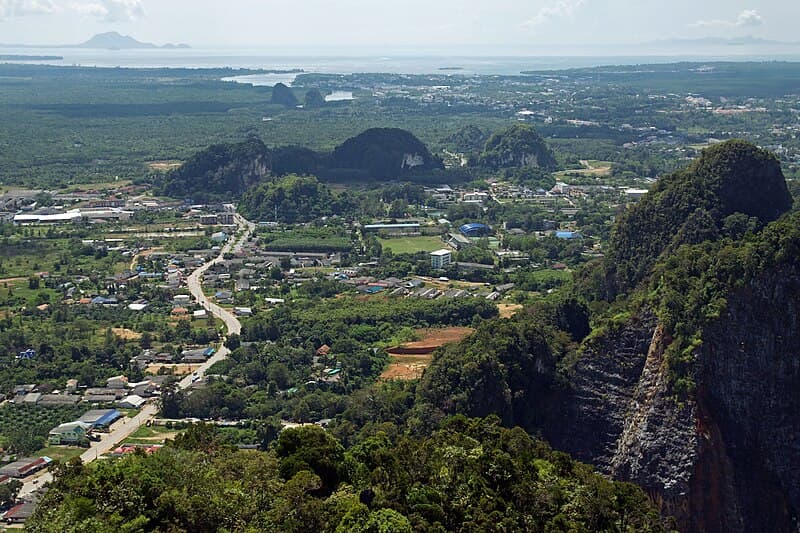
Wat Tham Suea monastery at the foot of a limestone massif, with a golden Buddha statue standing atop the cliff above it. 1,260 steps carved into the rock lead up, and the whole province and the sea are visible from the summit. Down in the grounds, monkeys live alongside monks in cave cells.

Tip: The climb takes an hour and is genuinely tough — go at 6am, while it's cool and mist still lingers over the palms up top. Bring your own water, since it's sold for triple the price at the summit, and there's no shade halfway up the steps.

Admission:
free, donation
Time needed:
3h
Emerald Pool and Blue Pool

Emerald Pool and Blue Pool

inland, 65km

Natural pools in the Khao Phra Bang Khram rainforest, fed by hot springs and tinted green by minerals. Swimming is allowed in the Emerald Pool; the neighbouring Blue Pool is a deeper spring with ink-coloured water, and entry into it is forbidden.

Tip: Arrive right at opening at 8am — by 10am the tour buses arrive and the pool-sized lagoon fills up. It's usually combined with the Klong Thom hot springs a few kilometres further on, where you sit in cascades at around 40°C.

Admission:
from THB 200
Time needed:
half day
Hong Islands

Hong Islands

by boat from Ao Nang, 30min

An archipelago north of Ao Nang whose main island hides a flooded lagoon inside, reached through a narrow channel in the rock — in Thai, such a lagoon is called a hong, meaning 'room'. The water is shallow and turquoise, and at low tide you can wade across the lagoon.

Tip: Tour boats arrive here around 11am. Hiring a longtail boat in Ao Nang for 7am gets you the lagoon to yourself for an hour, for roughly the same price as a group tour.

Admission:
trip from THB 900
Time needed:
full day
Four Islands and Poda

Four Islands and Poda

by boat from Ao Nang, 20min

The classic longtail-boat circuit: Poda Island with its white beach, Chicken Island, named for a rock shaped like a neck and head, and the Tup sandbar, which emerges at low tide to join 2 islands together so you can walk between them dry-shod.

Tip: The sandbar between Tup and Mor islands only appears at low tide — ask at the pier for the tide times and pick your trip accordingly, or you'll miss the main attraction entirely. Bring your own snorkel, since rental gear tends to be poor quality.

Admission:
trip from THB 800
Time needed:
full day
Klong Muang and Tubkaek

Klong Muang and Tubkaek

18km north of Ao Nang

Quiet beaches north of Ao Nang, home to large resorts with their own stretch of coast and views of the Hong Islands' silhouette. The water is shallow and retreats a long way at low tide, but it's peaceful, with almost no one around in the evening.

Tip: The trail up to Khao Ngon Nak, a viewpoint over the bay, starts at Tubkaek — it's a 1.5-hour walk through jungle and the best view in the province you can reach without a boat. The gate closes at 3pm to allow time to descend.

Admission:
free
Time needed:
full day
Krabi Town and night market

Krabi Town and night market

Krabi Town, 22km

A provincial town at the river mouth, with statues of prehistoric apes at the traffic lights and metal crabs along the waterfront. Tourists come mainly for the ferries, but there's a weekend night market with the best and cheapest food in the province.

Tip: The market on Maharaj Soi 10 runs Friday to Sunday from 5pm, with prices a fraction of Ao Nang's. A songthaew from Ao Nang takes 40 minutes, and the last one back leaves around 7pm.

Admission:
free
Time needed:
half day
Rock climbing on the limestone cliffs

Rock climbing on the limestone cliffs

Railay and Tonsai

Railay and Tonsai are among the most famous climbing areas in the world: over 700 bolted routes in limestone right above the beach, from beginner grades to extreme. Courses for complete beginners can be completed in a single morning.

Tip: A half-day course with gear costs around THB 1,000, and climbing schools are based right on East Railay. The limestone is sharp and gets slippery in the rainy season; rent proper climbing shoes, since ordinary footwear isn't up to it.

Admission:
course from THB 1,000
Time needed:
half day

Photos: Railay — kallerna (CC BY-SA 3.0) · Ao Nang — kallerna (CC BY-SA 3.0) · Tiger Cave Temple — kallerna (CC BY-SA 3.0) · Emerald Pool and Blue Pool — Karelj (CC BY-SA 4.0) · Hong Islands — Wolfgang Holzem (CC BY-SA 4.0) · Four Islands and Poda — kallerna (CC BY-SA 3.0) · Klong Muang and Tubkaek — Stefan Fussan (CC BY-SA 4.0) · Krabi Town and night market — Edson Aoki (CC BY-SA 3.0) · Rock climbing on the limestone cliffs — Thitigul Kaewchingdoung (CC BY 3.0)

Where to stay

Areas and districts, matched to the kind of trip you are taking

Ao Nang

Best for: a first stay and easy access to trips

The main resort, with a promenade, restaurants and the pier all boats leave from. The beach is unremarkable, but the infrastructure is the best in the province and everything is walkable. The most sensible base if you don't want to rely on a hotel transfer.

Railay

Best for: the best beaches and climbing

A peninsula reachable only by boat, with 4 beaches and climbing cliffs. After 6pm, once the last boat of day-trippers has left, only a few hundred people remain. Accommodation costs more and the choice of restaurants is limited, but in the morning you'll have Phra Nang almost to yourself.

Klong Muang and Tubkaek

Best for: resorts and quiet

A stretch north of Ao Nang with large hotels, pools and private beaches. It's quiet, with shallow water and island views. Without a hotel transfer or taxi you can't get anywhere from here, and in the evening there's nowhere to go outside the resort grounds.

Krabi Town

Best for: low budget and ferry connections

A provincial town 20km from the sea, with the cheapest accommodation and the best street food. It has no beach, but ferries to Phi Phi and Lanta leave from here, and it's close to the airport. A choice for travellers, not for a beach holiday.

Getting around

From the airport

Krabi Airport lies 15km from town and 25km from Ao Nang, served by connecting flights from major hubs such as those in the Gulf or via Bangkok. Another option is to fly into Phuket and cover the rest by road in about 2.5 hours, which is often cheaper and better connected. An airport bus runs from the airport to both Ao Nang and Krabi Town, and taxis charge fixed zone rates. Ferries to Phi Phi and Koh Lanta leave from the Klong Jilad pier near Krabi Town.

Krabi International (KBV) · 25 km

  • Hotel transfer to Ao Nang· 40min· included with stay
  • Airport bus to Ao Nang· 50min· THB 150
  • Taxi to Ao Nang· 35min· THB 600
  • Grab to Krabi Town· 20min· THB 350

Phuket International (HKT) · 165 km

  • Minibus to Ao Nang· 3h· THB 400
  • Private transfer· 2h 30min· THB 2,500

Around town

In Ao Nang, everything's within walking distance. Songthaews and minibuses run between Ao Nang, Krabi Town and the airport, though connections to the beaches further north are weaker. Railay, the islands and most beaches are reached by longtail boat from the pier at the end of the promenade — boats leave once full, and don't run after dark. A scooter is the cheapest way inland to the pools and temple, but the same insurance warning applies as everywhere in Thailand.

Longtail boatFrom Ao Nang to Railay and the islands; leaves once 8 seats are filled, last one around 6pm. · THB 150 to Railay
SongthaewAo Nang–Krabi Town and to the airport, running roughly every half hour during the day. · THB 60
Rental scooterThe most practical option for inland trips and the temple; insurance won't pay out without a proper motorcycle licence. · THB 250/day
Island ferryFrom Klong Jilad to Phi Phi and Koh Lanta, 2–3 times a day in season. · THB 400

Useful apps: Grab, Google Maps, Bolt, 12Go Asia

When to go

The season runs from November to April: dry, calm seas, and every boat trip runs. December to February, with around 32°C and minimal rain, is best. From May to October it's monsoon season — the sea can turn rough, longtail boats to Railay sometimes stop running, and snorkelling isn't worth much with the cloudy water. Prices are about half during that period. Inland trips to the pools and temple work year-round, with rain limited to short afternoon showers.

Best time

December to February

What to avoid

May to October, because of the monsoon and unreliable boats

MonthJanFebMarAprMayJunJulAugSepOctNovDec
Day33°34°34°34°33°32°32°32°32°32°32°32°
Night23°24°25°25°25°25°25°25°24°24°24°23°
Rainy days2248171617182019136
Sea28°28°29°30°29°29°29°29°29°29°29°28°

Food & drink

The cooking in Krabi is southern Thai — spicier than in Bangkok, built on coconut milk and turmeric, with Muslim influence, so pork is off the menu in many places. Fish and prawns are picked from ice and charged by weight, which causes plenty of misunderstandings in Ao Nang: get the price per kilogram in writing beforehand. The best value is at the Krabi Town night market and the eateries in Ao Nang's side streets, not the promenade restaurants with picture menus.

What to try

Tom yum goong

A hot-and-sour soup with prawns, lemongrass, galangal and kaffir lime leaves. It comes in a clear version and a creamy one with coconut milk; the creamy version is milder and better for beginners.

Gaeng som

A southern Thai sour curry with fish and vegetables, orange from turmeric and very hot. It's a home-cooked dish in southern Thailand and rarely found in tourist restaurants.

Pad thai

Rice noodles fried with egg, tofu and peanuts, served with lime and bean sprouts. The safest choice for anyone who doesn't like spicy food, and a fraction of restaurant prices from a street stall.

Som tam

Shredded green papaya salad, pounded in a mortar with chilli, lime and fish sauce. The standard spice level is unbearable for most Europeans — say 'mai phet' or ask for just 1 chilli.

Massaman curry

A mild curry with coconut milk, potatoes, peanuts and cinnamon, brought to Thailand by Muslim traders from the south. The least spicy of all Thai curries.

Roti

A thin fried flatbread with banana and sweetened condensed milk, a legacy of the Muslim south. Sold at night markets from stalls with a large griddle, and the most common street dessert around.

Moo ping

Marinated pork skewers grilled over charcoal, sold roadside in the morning with a bag of sticky rice. The cheapest and best Thai breakfast.

Khao niao mamuang

Sticky rice with coconut milk and slices of ripe mango. It's best from March to May, mango season; outside those months it's made with imported fruit, and it shows.

What it costs

Food from the night market

THB 50–80

Lunch at an eatery in Ao Nang

THB 120–180

Dinner at a promenade restaurant

THB 400–600 per person

Large Chang beer

THB 90–140

Boat to Railay

THB 150

Four Islands trip

from THB 800

Half-day climbing course

from THB 1,000

Night in a 4-star hotel

THB 2,000–3,500

Indicative prices that change over time — treat them as a guide, not a price list.

Practical information

SocketsAtwo flat pins (US/JP)Btwo flat pins plus ground (US)CEuroplug, two round pinsOThai
Voltage220V / 50Hz
Tap waterDo not drink tap water — Don't drink the tap water, or even brush your teeth with it. Bottled water costs around THB 10 at 7-Eleven and is sold everywhere. Ice in drinks, on the other hand, is safe — it's made industrially from treated water and you can spot it by its regular shape with a hole in the middle; worrying about ice is outdated advice in Thailand.
TippingTipping isn't obligatory, and Thais don't tip each other. In tourist restaurants people round up or leave THB 20–50; smarter places often already add a 10% service charge to the bill. Tuk-tuk and taxi drivers get rounded up too. Masseuses at a spa are given THB 50–100.
Driving on theleft
SafetyThe biggest risk in Thailand isn't crime, but scooters: foreigners on motorbikes account for most serious accidents, and travel insurance typically only pays out if you hold a proper motorcycle licence or an international driving permit with the right endorsement — without one, you cover the hospital bill yourself, and it can run into thousands of dollars. The second risk is the sea: during monsoon season, red flags go up on beaches because of rip currents, and drownings happen every year. Crime is low; scams are more common — a rented scooter with a mysteriously invented scratch, a jet ski with alleged damage, and taxis without a meter. Always photograph any car or scooter at pick-up.
Opening hours7-Eleven and Family Mart stores are open 24 hours and there are plenty of them everywhere. By law, alcohol can only be sold in shops from 11am to 2pm and 5pm to midnight — outside those windows you won't get any, whatever you try; this doesn't apply to restaurants. Markets and food stalls run from morning until night, and temples close around 5pm. On Buddhist holidays and election days, alcohol sales are banned nationwide.
Customs & etiquetteThe head is sacred and feet are unclean — never touch anyone's head, and never point your feet at a person or a Buddha statue. Shoulders and knees should be covered at temples, and shoes are left at the door. The royal family is protected by strict lèse-majesté laws, and any disrespectful remark, or damage to a banknote bearing the king's portrait, is a criminal offence carrying real prison sentences. Don't raise your voice or show anger: losing your composure means losing face in Thailand, and it always makes things worse.
A few local wordsHello — Sawatdi khráp (muž) / khá (žena)Thank you — Khòp khun khráp / kháHow much does this cost? — Thâo rai?Not spicy, please — Mai phetThe bill, please — Kep tang

How to plan your days

1 day

A day in Krabi

  1. 1Morning boat from Ao Nang to Railay.
  2. 2Phra Nang beach and the Princess Cave beneath the overhang.
  3. 3Lunch on East Railay, afternoon swim on West Railay.
  4. 4Return by boat before 6pm.
  5. 5Dinner in a side street of Ao Nang, then a massage.

2 days

2 days with the islands

  1. 1Day 1 as above.
  2. 2Morning: private longtail boat to the Hong Islands.
  3. 3The lagoon hidden inside the rock, before the group tours arrive.
  4. 4Afternoon: the sandbar between Tup and Mor islands at low tide.
  5. 5Evening: the Krabi Town night market, if it's Friday to Sunday.

3 days

3 days with the inland sights

  1. 1Days 1–2 as above.
  2. 26am climb to Wat Tham Suea, 1,260 steps.
  3. 3Lunch in Krabi Town beneath the crab statues.
  4. 4Afternoon: the Emerald Pool and Klong Thom hot springs.
  5. 5If time allows, a day trip to Phi Phi or Koh Lanta the following day.

Frequently asked questions

Is Krabi a town or a region?+

A province. Krabi Town is the administrative centre, 20km from the sea; the main resort is Ao Nang, and the best beaches are on the Railay peninsula, reachable only by boat. When booking a hotel, always check which part of 'Krabi' it's actually in.

How do I get to Railay?+

By boat only — an impassable limestone cliff separates the peninsula from the mainland. Longtail boats from Ao Nang take 15 minutes and leave once 8 passengers have gathered. The last one usually goes around 6pm; boats don't run after dark.

Which beach in Krabi is the most beautiful?+

Phra Nang, on Railay, beneath a limestone overhang with stalactites and the Princess Cave. It's considered one of the most beautiful in Thailand, and the crowds between 11am and 3pm reflect that. Before 9am and after 5pm it's half empty.

When should I go to Krabi?+

From November to April, when it's dry and the sea is calm. December to February is best. From May to October it's monsoon season: it doesn't rain all day, but the sea can be rough, boat trips get cancelled, and underwater visibility is poor. Accommodation prices are about half in that period.

Is the climb to Tiger Cave worth it?+

Yes, but it's physically demanding — 1,260 uneven steps in humid heat, taking about an hour to climb. Go at 6am, while it's still cool. The whole province is visible from the top, often with morning mist over the palms. Entry is free; donations are voluntary.

Do I need a car or scooter in Krabi?+

Not for the beaches and islands — those are reached by boat from Ao Nang. A scooter is useful for inland trips: the temple, the Emerald Pool and the hot springs. Without a proper motorcycle licence, though, insurance won't pay out in an accident, which is a significant risk given Thai traffic.

Can you climb in Krabi with no experience?+

Yes, climbing schools on East Railay run half-day courses for complete beginners, gear included, for around THB 1,000. The area has over 700 bolted routes of every difficulty right above the beach and is among the most famous in the world.

Where can I eat cheapest in Krabi?+

At the Krabi Town night market, which runs Friday to Sunday and where food costs a fraction of Ao Nang prices. In Ao Nang itself, the cheapest eateries are in the side streets a block back from the promenade — on the promenade you're mostly paying for the view.

Arrival Card

Fill in the required arrival card before your trip to avoid delays at immigration.

Complete Arrival Card

Visa Requirements

Check the latest visa requirements for entering this country. Some nationalities may need to apply for a visa or e-visa before travel.

Check visa requirements

Language

Thai

Currency

THB

Timezone

GMT+7

Dial Code

+66

Population

71.8M

Area

513,120 km²

Voltage

220V / 50Hz

Driving Side

Left

Top Hotels in Krabi

Live prices from 500+ properties

Loading hotels...

More destinations in Thailand

Planning a trip to Krabi?

Compare hundreds of hotels, find the best price, and book with free cancellation on TravelManiac.