Hotels in Phuket

Thailand's largest island, with its own airport

Phuket

LanguageThai
CurrencyTHB
TimezoneGMT+7
Temperature26-35 °C
Dial Code+66
Population71.8M
Area513,120 km²
SocketsType A / Type B / Type C / Type O
Tap waterNot drinkable

Discover Phuket

Phuket is Thailand's largest island, connected to the mainland by a bridge, though most visitors arrive by air — it has the only international airport on the entire Andaman coast. That makes it the gateway to the whole region: from here you can reach Phi Phi, Phang Nga Bay and the Similan Islands. The island is forty-five kilometres long and roughly divides as follows: the west coast has the beaches and hotels, the east has ports and mangroves, the south has viewpoints, and the north is quiet. Patong is the loud nightlife hub, Kata and Karon are a family-friendly middle ground, Nai Harn and Bang Tao are calmer. Beyond the beaches there's genuine history too — the old town built by Chinese tin merchants in the nineteenth century is one of the finest Sino-Portuguese quarters in Asia. The main season runs from November to April.

What to see

The places worth your time in Phuket, and what to expect at each

Big Buddha

Big Buddha

Chalong, 12 km

A forty-five-metre seated Buddha statue on Nakkerd Hill, clad in white Burmese marble and visible from half the island. The statue is funded entirely by donations and is still not fully complete; thousands of bells bearing donors' names hang around the terrace.

Tip: The road up is six kilometres of switchbacks that two people on a scooter often struggle to climb — plan accordingly. Sarongs are lent for free at the top, but supplies are limited; arriving in shorts after noon may mean you can't get in.

Admission:
free, donations welcome
Time needed:
1.5 h
Wat Chalong

Wat Chalong

Chalong, 10 km

The island's most important temple, dedicated to two monks who treated the wounded during a 1876 uprising of Chinese tin-mine workers. A sixty-metre pagoda holds a fragment of the Buddha's bone, and the walls are covered in paintings depicting his life.

Tip: Firecrackers are sold outside the temple and set off in a brick furnace as thanks for granted wishes — it's noisy and the most memorable part of a visit. Shoes come off and knees must be covered to enter the main hall.

Admission:
free
Time needed:
1 h
Phuket Old Town

Phuket Old Town

Phuket Town, 20 km

A district of nineteenth-century Sino-Portuguese houses, built by Chinese merchants who grew wealthy from tin. Thalang, Dibuk and Yaowarat streets are lined with colourful arcaded facades housing cafes, galleries and shops. It's the island's least touristy area.

Tip: On Sunday afternoons Thalang turns into a walking night market that's noticeably better and cheaper than the markets in Patong. During the day the district has little shade in the midday heat, so go in the late afternoon instead.

Admission:
free
Time needed:
3 h
Patong Beach and Bangla Road

Patong Beach and Bangla Road

Patong, 15 km

A three-kilometre beach with the island's biggest concentration of everything on offer: watersports, massages, shopping malls, and Bangla Road, a strip of bars and clubs that closes to traffic every evening at six and turns into a pedestrian zone.

Tip: The beach gets crowded in high season, and sun loungers have been banned on most of the shoreline since 2014 — bring a towel for the sand. If you want quiet, stay elsewhere and visit Patong just for the evening.

Admission:
free
Time needed:
half a day
Kata and Karon beaches

Kata and Karon beaches

Kata–Karon, 17 km

Two neighbouring beaches south of Patong, calmer but far from empty. Karon is longer and wider, with sand that squeaks underfoot; Kata is smaller and popular with beginner surfers, with real waves during monsoon season.

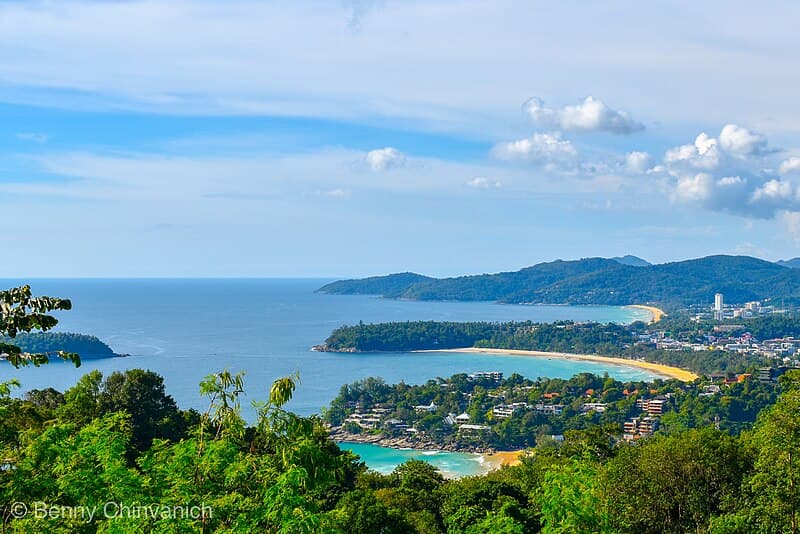
Tip: Between Kata and Karon is the Karon Viewpoint, capturing three bays in one shot — it's the most photographed spot on Phuket and looks best around 4:30pm, when the sun isn't shining into the lens.

Admission:
free
Time needed:
full day
Nai Harn and Ya Nui

Nai Harn and Ya Nui

Nai Harn, 20 km

The island's southernmost beaches, separated from development by a lagoon and temple grounds, so large hotel complexes never took hold here. The water is clear, the sand fine, and sailboats anchor here in season. Nearby, the small rocky cove of Ya Nui is good for snorkelling.

Tip: Nai Harn has strong rip currents during monsoon season, and red flags are taken seriously — lifeguards do send swimmers out of the water. Free parking is available under the trees by the lagoon, unlike at most beaches on the island.

Admission:
free
Time needed:
full day
Promthep Cape

Promthep Cape

southern tip, 22 km

A rocky headland at the island's southernmost point, with a lighthouse and a shrine holding hundreds of elephant figurines left as offerings of thanks. It's the classic sunset spot, drawing several hundred people in high season.

Tip: Arrive an hour early, since the car park fills up and the drive down after dark can mean a traffic jam. A better view than the main terrace can be found from the lighthouse a hundred metres higher, where most visitors don't bother going.

Admission:
free
Time needed:
2 h
Koh Racha and Coral Island

Koh Racha and Coral Island

boat trip from Chalong

Two small islands south of Phuket with noticeably clearer water than the main island's coastline. Racha Yai has a white-sand beach and is the nearest good spot for snorkelling and diving; Coral Island is closer and cheaper, but busier.

Tip: Speedboats leave from Chalong and Rawai around nine in the morning. Visit Racha in the morning if you can; by afternoon boats from Phuket arrive and a nearly empty beach fills up within the hour.

Admission:
trips from 1,200 THB
Time needed:
full day
Bang Pae Waterfall and Gibbon Rehabilitation Centre

Bang Pae Waterfall and Gibbon Rehabilitation Centre

Thalang, 25 km

In the island's northern part lies a remnant of the original rainforest with a waterfall and a station that rescues gibbons from bars and photo studios and retrains them to live in the forest. The animals aren't available for petting or photos — that's the whole point of the project.

Tip: Entry to the sanctuary is free and donation-based, but the visit is short and you'll often just hear the gibbons rather than see them. Combine it with the walk up to the waterfall, fifteen minutes above the station, where swimming is possible.

Admission:
free, donations welcome
Time needed:
2 h

Photos: Big Buddha — Subhrajyoti07 (CC BY-SA 4.0) · Wat Chalong — Lerdsuwa (CC BY-SA 3.0) · Phuket Old Town — Myinternationalwikipedia (CC0) · Patong Beach and Bangla Road — Wikimedia Commons (CC BY-SA 3.0) · Kata and Karon beaches — Wikimedia Commons (CC BY-SA 3.0) · Nai Harn and Ya Nui — ADwarf (Public domain) · Promthep Cape — Phuket@photographer.net (CC BY 2.0) · Koh Racha and Coral Island — Roma Neus (CC BY 3.0) · Bang Pae Waterfall and Gibbon Rehabilitation Centre — Roma Neus (CC BY 3.0)

Where to stay

Areas and districts, matched to the kind of trip you are taking

Patong

Best for: nightlife and the lowest prices

The loudest and cheapest part of the island, with the highest concentration of hotels, shops and bars. Bangla Road closes to traffic every evening and runs until dawn. The beach is crowded. A poor choice for families with young children, but the best option for a low budget and nightlife.

Kata and Karon

Best for: families and a middle ground

Two beaches south of Patong with mid-range and upscale hotels, restaurants, and quieter evenings. Patong is a ten-minute taxi ride away when needed. The most sensible compromise between fun and calm, and the most common choice for visitors.

Bang Tao and Surin

Best for: luxury resorts and quiet

The northwest coast, home to the long Bang Tao beach lined with large resort complexes with their own beach frontage and golf courses. Restaurants are pricier, and outside the resorts you won't get anywhere without a taxi. The quietest part of the island, with strong hotel infrastructure.

Phuket Town

Best for: sightseeing and a low budget away from the beach

The island's historic centre, with Chinese architecture, markets, and the best food at the lowest prices. It's a twenty-minute drive to the sea from here, so it doesn't work as a beach base — but it's ideal for sightseeing and for anyone who wants to see how Phuket lives beyond tourism.

Getting around

From the airport

Phuket International Airport sits in the north of the island and is the only international airport on the entire Andaman coast — both direct and connecting flights run from Prague with one stopover in the Gulf, taking around thirteen hours total. From the airport it's thirty-two kilometres to Patong and forty to Kata, and crossing the island takes longer than the map suggests. Official airport taxis charge fixed zone-based fares posted at the exit; the Grab app is cheaper but picks up away from the main terminal due to disputes with local drivers.

Phuket International (HKT) · 32 km

  • Hotel transfer· 50–70 min· included with stay
  • Airport minibus to Patong· 1 h 15 min· 200 THB
  • Official taxi to Patong· 50 min· 800 THB
  • Grab to Kata· 1 h· 700 THB

Around town

Phuket has no usable public transport — local songthaew trucks only run between Phuket Town and the beaches and stop around six in the evening. In practice, your options are taxi, Grab, or a rented scooter. Taxis between beaches are disproportionately expensive because of a local driver cartel; Grab is cheaper, but drivers refuse pickups in some spots. A scooter is the most practical option and also the riskiest: without a category A licence, insurance won't pay out, and police do carry out checks.

GrabThe cheapest reliable way to get around the island; pickup points near the airport and some beaches are set slightly apart. · 250 THB Patong–Kata
Taxi and tuk-tukNo meters, with fixed prices set by drivers, notably more expensive than elsewhere in Thailand. Agree the fare in advance. · 400 THB short ride
Rented scooterThe cheapest way to get around, but insurance won't pay out without a category A licence. Helmets are mandatory and enforced with fines. · 250 THB / day
SongthaewBlue pickup trucks running from Phuket Town to the beaches until early evening, but not between beaches directly. · 40 THB

Useful apps: Grab, Google Maps, Bolt, 12Go Asia

When to go

The season runs from November to April, when it's dry, the sea is calm and all the boat trips run. November to February is best: around 32°C with minimal rain and bearable humidity. From May to October the southwest monsoon arrives — it doesn't rain non-stop, but the sea gets rough, red flags go up on the beaches, and Similan trips stop entirely because the park closes. Accommodation prices are roughly half, and the island is much quieter, which suits some travellers just fine.

Best time

November to February

What to avoid

May to October, due to the monsoon and closed excursions

MonthJanFebMarAprMayJunJulAugSepOctNovDec
Day33°34°34°34°33°32°32°32°32°32°32°32°
Night23°24°25°25°25°25°25°25°24°24°24°23°
Rainy days2248171617182019136
Sea28°28°29°30°29°29°29°29°29°29°29°28°

Food & drink

Southern Thai cuisine is spicier than food from Bangkok and shows clear Muslim and Malay influence. Phuket has its own specialty — mee hokkien noodles, brought by Chinese immigrants who worked the island's tin mines — and the best food is found in the old town and at night markets, not on the beach promenades. Use the phrase "mai phet" (not spicy) even if you think you can handle heat; standard local spice levels are typically too much for foreign visitors. Fruit is sold pre-cut in bags at the market, and durian is banned from hotel rooms — the sign is usually right on the door.

What to try

Pad thai

Rice noodles stir-fried with egg, tofu and peanuts, served with lime and bean sprouts. The safest choice for anyone who doesn't like spicy food, and far cheaper from a street stall than a restaurant.

Tom yum goong

A hot and sour soup with shrimp, lemongrass, galangal and kaffir lime leaves. It comes in a clear version and a creamy one made with coconut milk; the creamy version is milder and a good place to start.

Som tam

A salad of shredded green papaya pounded in a mortar with chilli, lime and fish sauce. The standard spice level is usually too much for foreign visitors — ask for "mai phet" or a single chilli.

Massaman curry

A mild curry with coconut milk, potatoes, peanuts and cinnamon, which arrived in Thailand via Muslim traders from the south. The least spicy of all Thai curries.

Gaeng som

A sour southern curry with fish and vegetables, coloured orange by turmeric and very spicy. It's a home-style dish rarely found in tourist-oriented restaurants.

Khao niao mamuang

Sticky rice with coconut milk and slices of ripe mango. Best from March to May during mango season; outside that window it's made with imported fruit and tastes noticeably different.

Moo ping

Marinated pork skewers grilled over charcoal, sold roadside in the morning with a bag of sticky rice. The cheapest and best Thai breakfast.

Roti

A thin fried pancake with banana and sweetened condensed milk, a legacy of the Muslim south. Sold at night markets from stalls with a large hotplate, and the most common street dessert on the island.

What it costs

Pad thai from a street stall

60–90 THB

Lunch at a local eatery

100–150 THB

Dinner at a tourist restaurant

400–700 THB per person

Large Chang beer

90–150 THB

One-hour Thai massage

300–400 THB

Scooter rental per day

250 THB

Full-day trip to Phi Phi

from 1,500 THB

Night in a 4-star hotel

2,500–4,500 THB

Indicative prices that change over time — treat them as a guide, not a price list.

Practical information

SocketsAtwo flat pins (US/JP)Btwo flat pins plus ground (US)CEuroplug, two round pinsOThai
Voltage220V / 50Hz
Tap waterDo not drink tap water — Don't drink tap water or use it to brush your teeth. Bottled water costs about ten baht at 7-Eleven and is sold everywhere. Ice in drinks, on the other hand, is safe — it's industrially produced from treated water and has a recognisable regular shape with a hole in the middle; worries about ice are outdated in Thailand.
TippingTipping isn't mandatory, and Thais don't tip each other. In tourist restaurants it's common to round up or leave twenty to fifty baht; better establishments already add a ten percent service charge to the bill. Tuk-tuk and taxi drivers get the fare rounded up. Massage therapists at a salon are given fifty to one hundred baht.
Driving on theleft
SafetyThe biggest risk in Thailand isn't crime but scooters: foreign riders make up most serious accident cases, and travel insurance only pays out if you hold a category A motorcycle licence or an international driving permit with the matching endorsement — without one you cover hospital costs yourself, and that can run into the thousands of dollars. The second risk is the sea: during monsoon season red flags go up on beaches because of rip currents, and drownings occur every year. Crime is low; scams are more common — a rented scooter with an invented scratch, a jet-ski with alleged damage, or a taxi without a meter. Always photograph any rented vehicle or scooter when you pick it up.
Opening hours7-Eleven and Family Mart stores are open around the clock and are everywhere. Alcohol sales are restricted by law to 11am–2pm and 5pm–midnight — outside those windows shops won't sell it no matter what you try, though this doesn't apply to restaurants. Markets and food stalls run from morning until night, and temples close around 5pm. On Buddhist holidays and election days there's a nationwide ban on alcohol sales.
Customs & etiquetteThe head is considered sacred and the feet unclean — never touch anyone's head, and never point your feet at a person or a Buddha statue. Shoulders and knees should be covered when visiting temples, and shoes are left at the door. The royal family is protected by lèse-majesté law, and any disrespectful comment or damage to a banknote bearing the king's portrait is a criminal offence with real prison sentences. Avoid raising your voice or showing anger: losing composure means losing face in Thailand, and it always makes things worse.
A few local wordsHello — Sawatdi khráp (male) / khá (female)Thank you — Khòp khun khráp / kháHow much does it cost? — Thâo rai?Not spicy, please — Mai phetThe bill, please — Kep tang

How to plan your days

1 day

One day on Phuket

  1. 1Morning at Big Buddha on Nakkerd Hill, before the heat sets in.
  2. 2Wat Chalong and the thanksgiving firecrackers.
  3. 3Lunch at a local eatery, not on the beach promenade.
  4. 4Afternoon at Kata or Karon beach and the viewpoint between them.
  5. 5Sunset at Promthep Cape, evening on Bangla Road in Patong.

2 days

Two days with island hopping

  1. 1Day one as above.
  2. 2Morning speedboat from Chalong to Koh Racha.
  3. 3Snorkelling and swimming in clear water away from the main island.
  4. 4Return in the afternoon, beach massage.
  5. 5Dinner in Phuket Old Town.

3 days

Three days with Phang Nga

  1. 1First two days as above.
  2. 2Full-day trip to Phang Nga Bay and its limestone towers.
  3. 3Kayaking into the hong caves, with a stop at James Bond Island.
  4. 4Return in the late afternoon, dinner at the old town market.
  5. 5If time allows, an extra day trip to Phi Phi.

Day trips

Phi Phi

45 km · 2 h by ferry, 45 min by speedboat

An archipelago of limestone cliffs plunging into turquoise water, with the famous Maya Bay, closed for six years for coral restoration. A day trip mostly means seeing other boats; to experience Phi Phi without the crowds, you need to stay overnight.

Phang Nga Bay

60 km · 1 h by car and 1 h by boat

Hundreds of limestone towers rising straight out of shallow water, including James Bond Island from The Man with the Golden Gun and the floating Muslim village of Koh Panyee, built on stilts. The best part of the trip is kayaking into the flooded hong caves inside the cliffs.

Similan Islands

85 km · 1 h 30 min by car and 1 h 30 min by boat

Nine uninhabited islands with the best underwater visibility in Thailand, popular with divers. The national park is completely closed from mid-May to mid-October, and visitor numbers are capped even in season, so trips need to be booked in advance.

Frequently asked questions

When is the best weather on Phuket?+

From November to April, when it's dry and the sea is calm. November through February is the most pleasant combination of warmth and low humidity. From May to October the monsoon brings choppier seas, red flags on the beaches, and cancelled boat trips, even though it doesn't rain constantly.

Can you swim on Phuket during monsoon season?+

Only carefully and according to the flags. Rip currents on the west coast are strong from May to October, and drownings among foreign visitors happen every year. A red flag means no swimming, and lifeguards enforce it. The bays on the island's east side and hotel pools are safer during this period.

Do I need a driving licence for a scooter on Phuket?+

Yes, a category A motorcycle licence or an international driving permit with the matching endorsement. Without it, riding is illegal, police do carry out checks, and crucially your travel insurance won't cover treatment after an accident — private hospital bills in Thailand can run into the thousands of dollars.

Where should I stay on Phuket?+

Patong for nightlife and the lowest prices, Kata and Karon as a family-friendly middle ground, Bang Tao and Surin for peace and quiet plus luxury resorts, Nai Harn for the prettiest undeveloped beach. Phuket Town has no beach, but the best food and lowest prices on the island.

Is Patong suitable for families with children?+

Not really. The beach is crowded, the promenade noisy, and Bangla Road turns into a bar street every evening that you can't easily walk through with kids without a lot of explaining. Kata, Karon or Bang Tao are better bases for families, with Patong just a taxi ride away for an evening out.

Is a day trip to Phi Phi worth it?+

Only with reservations. Speedboats bring hundreds of people to Maya Bay and the surrounding coves at the same hour, so mostly you'll see other boats. To really experience Phi Phi, stay at least one night and head to the beaches early in the morning before the tour boats arrive from Phuket.

How do you get around Phuket cheaply?+

Use the Grab app, which costs a fraction of local taxi and tuk-tuk fares — those are set by a driver cartel and are disproportionately expensive. Songthaew shared trucks only run between Phuket Town and the beaches, and stop in the early evening. A scooter is the cheapest option but risky without a proper licence.

Should I worry about ice in drinks on Phuket?+

No. Ice in Thailand is industrially produced from treated water and is safe — you can recognise it by its regular shape with a hole in the middle. Tap water, however, should not be drunk or even used to brush your teeth; bottled water costs pennies at 7-Eleven and is sold everywhere.

Arrival Card

Fill in the required arrival card before your trip to avoid delays at immigration.

Complete Arrival Card

Visa Requirements

Check the latest visa requirements for entering this country. Some nationalities may need to apply for a visa or e-visa before travel.

Check visa requirements

Language

Thai

Currency

THB

Timezone

GMT+7

Dial Code

+66

Population

71.8M

Area

513,120 km²

Voltage

220V / 50Hz

Driving Side

Left

Top Hotels in Phuket

Live prices from 500+ properties

Loading hotels...

More destinations in Thailand

Planning a trip to Phuket?

Compare hundreds of hotels, find the best price, and book with free cancellation on TravelManiac.