Hotels in Palma de Mallorca

A cathedral above the sea, and a city that stays alive even in January

Palma de Mallorca

LanguageEnglish
CurrencyEUR
TimezoneGMT+1
Temperature12-32 °C
Dial Code+34
Population47.6M
Area505,990 km²
SocketsType C / Type F
Tap waterDrinkable

Discover Palma de Mallorca

Palma is the only real city in the Balearics — four hundred thousand people live here, almost half of Mallorca's population, and unlike the coastal resorts it runs all year round. Above the bay stands La Seu Cathedral, built over three hundred fifty years from sandstone that turns orange at sunset, with a canopy over the altar designed by Antoni Gaudí. Below it spreads the medieval core, its streets twisting along an Arab-era layout from when the city was called Medina Mayurqa, hiding the inner courtyards of noble palaces behind unassuming doorways. But Palma isn't just a heritage showcase: it has the best restaurant scene in the islands, a working neighbourhood in Santa Catalina with its own market, a modern art gallery built into a Renaissance fortress, and the second-largest marina in the Mediterranean. The centre is twenty minutes from the airport, and a short bus ride from Playa de Palma, so the city also works as a day trip from any resort on the island's south coast.

What to see

The places worth your time in Palma de Mallorca, and what to expect at each

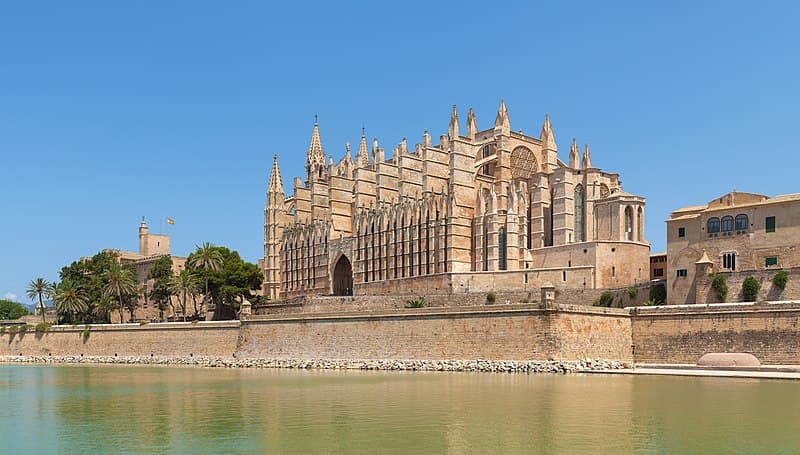
La Seu Cathedral

La Seu Cathedral

old town

A Gothic cathedral built from 1229 to 1601 directly above the sea walls, with the tallest Gothic nave in Spain and the largest rose window in the world, fourteen metres across. The interior was reworked by Antoni Gaudí, and the Chapel of the Holy Sacrament is the work of Miquel Barceló.

Tip: Twice a year, on 2 February and 11 November around eight in the morning, light from the great rose window projects exactly onto a smaller rose window on the opposite wall, forming a figure-eight pattern. It's free to attend, but you need to arrive an hour early.

Admission:
from €10
Time needed:
1.5 h
Almudaina Palace

Almudaina Palace

old town

A royal palace facing the cathedral, converted from a Moorish alcazar after the city's conquest in 1229. It kept its Arab-era layout, baths and water system, and remains the official residence of the Spanish king in the Balearics, occasionally closing for state visits.

Tip: Entry is free for EU citizens on Wednesday and late Thursday afternoon, from three in winter and five in summer. The terrace above the S'Hort del Rei garden gives the best view of the cathedral from below, without other visitors in frame.

Admission:
€7, free for EU citizens at set hours
Time needed:
1 h
Bellver Castle

Bellver Castle

west, above the city

A Gothic castle from 1311 on a hill a hundred twelve metres above the city, the only circular castle in Spain. It served as a royal summer residence and as a prison, and today houses the city museum. From the ramparts you can see the whole bay, the harbour and the cathedral.

Tip: An hour's walk uphill through pine forest from the centre gets you there, or bus 46 from Plaça d'Espanya. Entry is free on Sundays. For photos, late afternoon is best, when the bay is lit and the castle is still open.

Admission:
€4, free on Sundays
Time needed:
2 h
Old town and its courtyards

Old town and its courtyards

old town

A tangle of lanes between the cathedral and Passeig del Born, hiding the interior courtyards of noble houses from the fifteenth to eighteenth centuries behind unassuming doorways, with stone staircases and arcades. There are over a hundred of them, and many keep their gates open during the day.

Tip: The best-preserved courtyards are on Carrer de Can Savellà and Carrer de la Portella; you may step into the entrance hall but no further. Once a year, on one weekend in October, the city opens all of them, including private ones.

Admission:
free
Time needed:
2 h
Banys Àrabs (Arab Baths)

Banys Àrabs (Arab Baths)

old town

The only surviving building from the city's Moorish era, tenth-century baths with twelve columns supporting a dome pierced with openings for light and steam. The columns themselves came from even older Roman and Byzantine buildings, and no two are alike. A quiet citrus garden surrounds it.

Tip: The visit takes twenty minutes and is more a stop than a destination in itself; combine it with a walk along the seaside ramparts right next door. Mornings are quiet; afternoons bring cruise-ship groups.

Admission:
€3
Time needed:
30 min
Mercat de l'Olivar

Mercat de l'Olivar

centre

The city's main marketplace, dating from the 1940s, on two floors — fish and meat below, fruit and cheese above. Bars ring the stalls, serving breakfast or tapas made from whatever's sold right next to them.

Tip: The fish bars on the ground floor will cook whatever you choose from the counter for the price of the ingredient plus a few euros — the best value fish lunch in the whole city. The market closes around three and stays shut all day Sunday.

Admission:
free
Time needed:
1.5 h
Es Baluard

Es Baluard

Santa Catalina

A museum of modern and contemporary art built into a sixteenth-century Renaissance bastion of the city walls. The collection includes Picasso, Miró and Barceló, and its real appeal lies in how the gallery's concrete meets the fortification's sandstone. A terrace on the ramparts overlooks the harbour.

Tip: On Friday afternoons entry is pay-what-you-wish, essentially a token amount. The café on the bastion can be entered without a ticket, and it's one of the best viewpoints in the city over both the cathedral and the marina.

Admission:
€6, pay-what-you-wish on Fridays
Time needed:
2 h
Santa Catalina

Santa Catalina

Santa Catalina

A former fishing and working-class district west of the centre, today Palma's culinary heart. Around the covered Mercat de Santa Catalina are dozens of restaurants, wine bars and bakeries, along with the city's last surviving windmills.

Tip: The market is open until two and closed on Sundays; the surrounding bars, by contrast, come alive from seven in the evening. It's the best part of Palma for dinner and also the cheapest place to stay downtown — fifteen minutes on foot from the cathedral.

Admission:
free
Time needed:
3 h
Playa de Palma and Portixol

Playa de Palma and Portixol

east coast

Six kilometres of sandy beach stretching from the airport to S'Arenal, the city's main swimming zone, with the quieter fishing quarter of Portixol between it and the centre, home to a small harbour and promenade. A cycle path runs along the whole coastline into the centre.

Tip: Portixol is everything Playa de Palma isn't: a small beach, promenade cafés and no tour groups. It's fifteen minutes from the centre by bike via the Bicipalma rental scheme, or a half-hour walk along the coast past the cathedral.

Admission:
free
Time needed:
half a day

Photos: La Seu Cathedral — Thomas Wolf, www.foto-tw.de (CC BY-SA 3.0 de) · Almudaina Palace — Antoni I. Alomar Canyelles (CC BY-SA 3.0) · Bellver Castle — Poniol60 (Public domain) · Old town and its courtyards — Sir James (CC BY-SA 3.0) · Banys Àrabs (Arab Baths) — Font i Torner (Public domain) · Mercat de l'Olivar — Николай Максимович (CC BY 3.0) · Es Baluard — Olaf Tausch (CC BY 3.0) · Santa Catalina — Paucabot (CC BY-SA 3.0) · Playa de Palma and Portixol — Rolf Heinrich, Köln (CC BY 3.0)

Where to stay

Areas and districts, matched to the kind of trip you are taking

Old town and La Llotja

Best for: a first visit and sightseeing

The historic core between the cathedral and Passeig del Born, with palaces, courtyards and the city's prettiest streets. In the La Llotja quarter by the harbour, a strip of bars and restaurants stays lively into the night. Everything is walkable, but accommodation here is the most expensive, and a car is practically unusable due to the restricted-access zone.

Santa Catalina

Best for: food and life off the tourist circuit

Ten minutes west of the centre, around the covered market, with the best choice of restaurants and wine bars in the city. Accommodation here is cheaper than in the old town, drawing locals and long-term foreign residents alike, and it's a few minutes' walk to both Es Baluard and the marina. Evenings are lively, but not club-scene lively.

Portixol and Molinar

Best for: seaside quiet close to the centre

Former fishing settlements east of the harbour, today a quiet district with a promenade, small beaches and cafés. It's a fifteen-minute bike ride to the centre along the coast. The best choice for anyone who wants to be by the sea without staying in the hotel strip of Playa de Palma.

Playa de Palma and S'Arenal

Best for: cheaper hotels and the beach

A six-kilometre strip of hotels along the sandy beach between the airport and S'Arenal, where accommodation is significantly cheaper than in the city. Bus 25 takes about half an hour into the centre. This is the classic resort zone, noisy in peak season and geared toward group tourism.

Getting around

From the airport

Palma de Mallorca Airport is one of the busiest in Spain and lies eight kilometres east of the centre, just past Playa de Palma. In season, charter and low-cost flights run from Prague; outside it, connections go via Barcelona or Madrid, where services are frequent and cheap. From the airport, bus A1 runs into the centre every fifteen minutes, and line A2 serves the southern resorts. Palma is also the main port of the Balearics — ferries run to Barcelona, Valencia and Ibiza and take cars too.

Palma de Mallorca (Son Sant Joan) (PMI) · 8 km

  • Bus A1 to the centre· 20 min· €5
  • Bus A2 to Playa de Palma· 25 min· €5
  • Taxi to the centre· 15 min· €25
  • Hotel transfer· 20 min· included in package

Around town

Palma is a walkable city: the cathedral, the market, Es Baluard and Santa Catalina are all within twenty minutes of each other on foot. EMT city buses cover the rest, running often and cheaply, and a suburban train plus the heritage line to Sóller both leave from Plaça d'Espanya. A car is a burden downtown — much of the old town is a restricted-access zone monitored by cameras, and underground garage parking costs around twenty-five euros a day. A bike, on the other hand, works well, with a cycle path running the whole coastline.

EMT busesThe city network includes line 25 to Playa de Palma and 46 up to Bellver Castle; tickets are bought from the driver or by card. · €2
Train to SóllerA historic narrow-gauge line from 1912, running from Plaça d'Espanya through the Tramuntana; the ride takes an hour. · €25 return
BicipalmaA city bike-share scheme with docking stations along the whole coast and in the centre; the fastest way to reach Portixol. · €2 / day
TaxiMetered fare, around twenty-five euros from the airport to the centre; the Cabify app works, Uber operates only to a limited extent on the island. · €5

Useful apps: Google Maps, Moovit, Cabify, El Tiempo AEMET

When to go

Palma is the only place on Mallorca that's genuinely worth visiting year-round. The city is most pleasant in April, May, September and October, with twenty to twenty-seven degrees and days made for walking. Summer is hot downtown, and the stone lanes hold their heat into the night; anyone arriving in July or August should plan sightseeing for the morning and spend afternoons by the water. Winter is mild, around fifteen degrees, and unlike the resorts, the city runs at full capacity — restaurants and museums stay open, and hotel prices are the lowest of the year.

Best time

April, May, September and October

What to avoid

August, for the heat downtown and the prices

MonthJanFebMarAprMayJunJulAugSepOctNovDec
Day15°15°17°19°23°27°30°30°27°23°19°16°
Night4°4°6°8°11°15°18°19°16°13°8°6°
Rainy days655542125766
Sea15°14°14°16°18°22°25°26°25°22°19°17°

Food & drink

Palma has the best food scene in the Balearics, and the gap between tourist and normal prices is wide but predictable: on Passeig del Born and around the cathedral you pay for location, in Santa Catalina and around Mercat de l'Olivar you pay for the food itself. The cooking is Mallorcan — bread with oil, sobrasada, pork and fish stews from the harbour — alongside a modern scene with several Michelin stars. The best move is lunch at a fish bar right inside the market, where they'll cook whatever you pick from the counter.

What to try

Pa amb oli

Ramallet bread rubbed with tomato and olive oil, served with cheese, sobrasada or ham. The most common light dinner and the cheapest item on the menu at any bar.

Sobrasada

A soft, paprika-cured sausage made from black Balearic pig, spread onto bread. Best with honey, which balances the spice.

Ensaïmada

A spiral-shaped yeasted pastry with lard and sugar, breakfast across the whole Balearics. Sold in large round boxes as a gift, and it fits in carry-on luggage.

Frit

Sautéed offal with potatoes, peppers and fennel. It sounds bold, but it's the most typical island dish; the frit de peix version, made with fish, is milder.

Hierbas

An herbal liqueur macerated with fennel, rosemary and thyme, in sweet and dry versions. Drunk chilled after a meal, and homemade batches tend to be better than bottled ones.

Tumbet

Layered aubergine, potato and pepper baked with tomato sauce, Mallorca's answer to ratatouille. Served hot or cold, and the most common vegetarian dish on the island.

Arròs brut

Literally 'dirty rice' — thick rice cooked in a broth of rabbit, squab and mushrooms, coloured with spices. A winter dish cooked in a clay pot and ordered for two or more.

Coca de trampó

A cheese-free flatbread topped with tomato, pepper and onion, the island's answer to pizza. Sold by the piece at bakeries and the cheapest beach snack around.

What it costs

Coffee and an ensaïmada

€4–6

Menu del día (lunch menu)

€14–20

Dinner at a restaurant

€30–45 per person

Beer, 0.33 l

€3.50–5

Cathedral entry

€10

Bus A1 from the airport

€5

Garage parking per day

€20–28

Night in a 4-star hotel

€140–240

Indicative prices that change over time — treat them as a guide, not a price list.

Practical information

SocketsCEuroplug, two round pinsFSchuko
Voltage230V / 50Hz
Tap waterTap water is drinkable — Tap water is safe to drink but very hard, and slightly brackish in coastal towns since the wells sit close to the sea. It's fine for cooking; for drinking, bottled water in five-litre jugs is the usual choice.
TippingTipping isn't mandatory, and locals themselves tip little — loose change at a café, rounding up or adding five percent at a restaurant. Ten percent is the upper limit, given in cash, since card terminals usually have no tip option.
Driving on theright
SafetyThe main risk is essentially pickpocketing, and it's a real one — in crowds on the metro, at the market and on restaurant terraces, where a bag hung on a chair back is a target. Carry documents and cash separately, and don't leave your phone on the table. Evenings are safe even downtown; just avoid the abandoned industrial blocks near the harbour. The emergency number is the standard European 112, and operators speak English.
Opening hoursSmall shops keep a midday siesta roughly from half past one to five; chains and shopping centres run continuously until nine in the evening. Museums close on Mondays, and many let visitors in free for the last two hours on Sunday. Restaurant kitchens open at two for lunch and eight for dinner.
Customs & etiquetteCatalan is spoken in the Balearics, and signs, including town names, are usually in Catalan; everyone speaks Spanish too, but the local language is a matter of identity for residents. Lunch is around two, dinner after nine. Walking around shirtless away from the beach is fined by municipal ordinance in both Palma and Ibiza.
A few local wordsHello — Bon diaThank you — GràciesPlease — Si us plauThe bill, please — El compte, si us plauCheers — Salut

How to plan your days

1 day

One Day in Palma

  1. 1Morning at La Seu Cathedral right after opening.
  2. 2Almudaina Palace and the seaside ramparts with the Arab Baths.
  3. 3Lunch at a fish bar in Mercat de l'Olivar.
  4. 4Afternoon in the old town and its courtyards between Born and Portella.
  5. 5Early evening at Es Baluard, then dinner in Santa Catalina.

2 days

Two Days with Views and the Sea

  1. 1Day one as above.
  2. 2Day two, morning by bus or on foot through the forest up to Bellver Castle.
  3. 3Lunch at the marina or in Portixol.
  4. 4Afternoon swim in Portixol or at Playa de Palma.
  5. 5Evening walk along Passeig Marítim with the cathedral behind you.

3 days

Three Days Including the Mountains

  1. 1The first two days as above.
  2. 2Day three, take the morning heritage train from Plaça d'Espanya to Sóller.
  3. 3Tram to Port de Sóller and lunch by the harbour.
  4. 4Afternoon return by train or bus via Valldemossa.
  5. 5Anyone with a fourth day should visit the Caves of Drach or the island's north.

Day trips

Sóller by the historic train

30 km · 1 h by train

A narrow-gauge railway from 1912, with wooden carriages, leaves Plaça d'Espanya and runs through thirteen tunnels under the Tramuntana ridge to Sóller, through orange groves. From there a heritage tram continues to the coast at Port de Sóller. A return ticket costs around twenty-five euros, and it's worth buying in advance in season.

Valldemossa

18 km · 30 min by car, 45 min by bus

A mountain town in the Tramuntana with a Carthusian monastery, where Frédéric Chopin and George Sand stayed in the winter of 1838. Stone lanes, valley views, and the most photogenic village within reach of Palma. Bus 210 runs several times a day from Plaça d'Espanya.

Caves of Drach

65 km · 1 h by car

Stalactite caves near Porto Cristo on the east coast, home to one of the largest underground lakes in the world, where a boat concert plays during the tour. Tickets are booked online for a specific time slot, and in season they can sell out two days ahead.

Frequently asked questions

Is it better to stay in Palma or in a resort?+

If you're interested in the city, food and sightseeing, then Palma — it has the best restaurants in the Balearics, runs year-round, and has good bus and train connections. For a classic beach holiday, resorts on the north and east of the island are better, since Playa de Palma is long but busy and sits under the flight path.

How much time do I need for Palma?+

One well-planned day is enough for the main sights: the cathedral, the Almudaina, the old town and the market. Two days let you add Bellver Castle, Es Baluard and an evening in Santa Catalina. Anyone staying a full week can use the city as a base, taking the train to Sóller and buses into the mountains.

Can you visit the cathedral for free?+

Entry to the museum section costs around ten euros, but you can visit the cathedral for free during Mass, usually held in the early evening — it's polite to stay at the back and not take photos. On two dates each year, 2 February and 11 November, it also opens early in the morning for a light phenomenon through the rose window, with free admission then.

Do I need a car in Palma?+

No, quite the opposite. Much of the old town is a restricted-access zone monitored by cameras, and fines follow you abroad too. Parking in garages costs around twenty-five euros a day. The city itself is walkable; for trips around the island, it's better to rent a car for just that specific day, or use the train and buses.

Where can you eat well for reasonable money in Palma?+

In Santa Catalina around the covered market, and at the bars right inside Mercat de l'Olivar, where they'll cook fish from the counter for the price of the ingredient plus a few euros. A three-course menu del día lunch costs fourteen to twenty euros. Terraces on Passeig del Born and around the cathedral, by contrast, charge for location.

Is there a beach in Palma?+

Yes, several. The six-kilometre Playa de Palma starts near the airport and is the main swimming zone, with hotels, a promenade, and crowds in season. Closer to the centre are the quieter Ciutat Jardí and the fishing quarter of Portixol, with a small beach and cafés, reachable from downtown in fifteen minutes by bike along the coastal cycle path.

What's Palma like in winter?+

Open and cheap. Temperatures hover around fifteen degrees, restaurants, museums and shops run as normal, and hotel prices are the lowest of the year. Swimming isn't an option and some of the island's resorts close down, but the city itself is pleasant in December and January, and the cruise ships are gone.

How do I get from the airport to the centre?+

By bus A1, which runs every fifteen minutes, takes twenty minutes and costs five euros; it stops at Plaça d'Espanya and the harbour. A taxi costs around twenty-five euros, and there can be a queue for one at the terminal in peak season. Line A2 goes to Playa de Palma. Car rental companies have desks right at the terminal.

Visa Requirements

Check the latest visa requirements for entering this country. Some nationalities may need to apply for a visa or e-visa before travel.

Check visa requirements

Language

Spanish

Currency

EUR

Timezone

GMT+1

Dial Code

+34

Population

47.6M

Area

505,990 km²

Voltage

230V / 50Hz

Driving Side

Right

Top Hotels in Palma de Mallorca

Live prices from 500+ properties

Loading hotels...

Planning a trip to Palma de Mallorca?

Compare hundreds of hotels, find the best price, and book with free cancellation on TravelManiac.