Hotels in Roatan

A diving island on the world's second-largest reef

Roatan

LanguageSpanish
CurrencyHNL
TimezoneAmerica/Tegucigalpa
Temperature22-32 °C
Dial Code+504
Population10.3M
Area112,090 km²
SocketsType A / Type B
Tap waterNot drinkable

Discover Roatan

Roatán is the largest of Honduras's Bay Islands, sixty kilometers off the mainland, sitting on the Mesoamerican Barrier Reef, the second-largest reef system on Earth after the Great Barrier Reef. That's the whole reason people come: the reef wall drops off a few hundred meters from shore, and a diving course here costs a fraction of the usual Caribbean price. The island is narrow and sixty kilometers long, with a ridge of hills down the middle and a single spine road. Its history differs from the mainland — the island was settled by English pirates and later by English-speaking settlers from the Cayman Islands, so Caribbean English is spoken here and Spanish is very much the second language; a Garifuna community with its own language and cuisine lives in the east. Tourist life concentrates in two spots at the western tip: West End, a strip of wooden buildings with dive shops and bars, and West Bay, a white-sand beach lined with resorts. The rest of the island is quiet, poorer and more authentic. The airport sits near Coxen Hole, with direct flights from Miami and domestic connections from La Ceiba.

What to see

The places worth your time in Roatan, and what to expect at each

West Bay Beach

West Bay Beach

West Bay

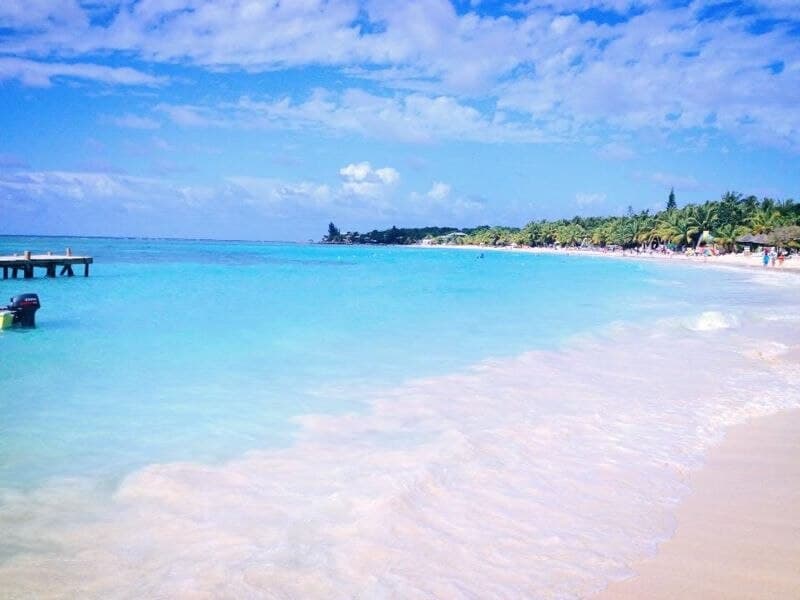
A two-kilometer strip of white sand at the island's western tip, where the reef starts just fifty meters from shore — snorkel out and parrotfish swim right overhead. It's Roatán's prettiest beach and also its busiest, especially on days when a cruise ship is anchored offshore.

Tip: Snorkel from the northern end of the beach near the rocks, where the reef wall is closest; the southern end is just sand. The current near the channel is stronger than it looks — swim along the shore, not away from it. On days without a cruise ship in port, the beach empties out after two in the afternoon.

Admission:
free
Time needed:
half day
West End

West End

West End

A single seaside street of wooden buildings, with twenty dive shops, bars, and restaurants on piers. There's no real beach here, but it's the island's hub of diving life and the cheapest place to eat and stay.

Tip: Course prices vary little between dive centers — the real difference is the student-to-instructor ratio, so ask about that, not the price. The street isn't fully lit and has no sidewalk; bring a headlamp at night. Water taxis to West Bay run until ten at night and cost a fraction of a car.

Admission:
free
Time needed:
full day
Mesoamerican Barrier Reef

Mesoamerican Barrier Reef

whole island

The second-largest reef system on Earth stretches from the Yucatán to Honduras, and Roatán sits right on it. Walls like Mary's Place and the West End Wall drop past forty meters, visibility often reaches twenty to thirty meters, and the water stays at twenty-seven degrees year-round.

Tip: The Open Water course here runs about three hundred fifty dollars, one of the cheapest certifications in the world. The one rule worth respecting: your last dive at least twenty-four hours before your flight, or you risk decompression sickness onboard. The chamber is in Sandy Bay.

Admission:
dive from 45 USD
Time needed:
3 h
Gumbalimba Park

Gumbalimba Park

West Bay

A private park above West Bay with a rainforest trail, a macaw aviary, a capuchin monkey enclosure, and a reconstructed pirate cave. A suspension bridge crosses the valley, and the grounds have their own beach with calm water.

Tip: Monkeys and macaws will land on your shoulder, which is the main reason to bring kids here — leave earrings at home and keep sunglasses off your head, since the capuchins will take them. The grounds take about two hours to see, and it's best right at nine when it opens, before the cruise crowds arrive.

Admission:
admission fee
Time needed:
2–3 h
Carambola Botanical Gardens

Carambola Botanical Gardens

Sandy Bay

A botanical garden in Sandy Bay with orchids, fragrant hardwoods, and a trail up Carambola Mountain. From the viewpoint at the top you can see the island's whole northwest tip, the reef beneath the surface, and neighboring Utila on the horizon.

Tip: The climb to the top takes twenty-five minutes, steep and without shade — go first thing in the morning or late afternoon, since midday is needless suffering. Bird activity in the garden peaks around seven in the morning; arrive early if you want to see toucans.

Admission:
admission fee
Time needed:
2 h
Roatán Institute for Marine Sciences

Roatán Institute for Marine Sciences

Sandy Bay

A research and rescue center in Sandy Bay, home to a group of bottlenose dolphins in a marine enclosure. It offers reef lectures, dolphin swims, and dives in their presence, along with a small museum on the island's settlement history.

Tip: Animal-encounter programs raise ethical questions worth reading up on beforehand, so check what each center actually does with its animals. If that's not a concern for you, book ahead — capacity is small, and it fills up on cruise ship days. The museum and lecture alone cost a fraction of the price.

Admission:
museum cheap, dolphin program pricier
Time needed:
2 h
Punta Gorda and Garifuna culture

Punta Gorda and Garifuna culture

east of the island

The island's oldest continuously settled village, founded in 1797 by Garifuna people put ashore by the British from the island of St. Vincent. Garifuna is still spoken here, along with distinctive drumming and cooking traditions found nowhere else on the island. An annual festival on April 12th commemorates the landing.

Tip: Visit the village with a local guide rather than on your own — it's a living community, not an open-air museum, and photographing people without asking isn't done. Anyone wanting to try machuca and Garifuna fish soup should come here specifically; you won't find them at restaurants in the west.

Admission:
guided tour
Time needed:
half day
Coxen Hole and island life

Coxen Hole and island life

Coxen Hole

The island's capital and administrative center, with a harbor, market, banks, and the only sizable supermarket. Not much to look at as a tourist, but it's the only place to see how life on Roatán actually works, and where prices are normal.

Tip: The market and Eldon's supermarket sell water, fruit and beer for a third of West End prices — anyone staying in an apartment should make this trip on day one. Shared minibuses run to Coxen Hole from West End for a few dozen lempiras. There's no reason to stick around after dark.

Admission:
free
Time needed:
2 h
Whale sharks and Little French Key

Whale sharks and Little French Key

east and offshore

Whale sharks pass through the waters between Roatán and Utila from February to April, and boats run full-day expeditions to find them. Closer to hand is Little French Key, a small private islet off the east coast with a calm lagoon, water swings, and a restaurant.

Tip: Odds of a whale shark encounter are better from Utila than from Roatán, though even there it's not guaranteed — anyone paying for this should understand they're paying for the trip, not the animal. Little French Key charges for entry plus food and drinks, and prices are the highest on the island; it's a half-day trip, not a full one.

Admission:
full-day boat trip from 120 USD
Time needed:
full day

Photos: West Bay Beach — Pi3.124 (CC BY-SA 4.0) · West End — Cory Doctorow (CC BY-SA 2.0) · Mesoamerican Barrier Reef — Tony Hisgett from Birmingham, UK (CC BY 2.0) · Gumbalimba Park — Larry D. Moore (CC BY 4.0) · Carambola Botanical Gardens — Afanasovich (CC BY-SA 4.0) · Roatán Institute for Marine Sciences — Geoff Alexander (CC BY 2.0) · Punta Gorda and Garifuna culture — Andrea Booher (Public domain) · Coxen Hole and island life — Larry D. Moore (CC BY 4.0) · Whale sharks and Little French Key — Holmbergius (CC BY 3.0)

Where to stay

Areas and districts, matched to the kind of trip you are taking

West Bay

Best for: beach and resorts

The island's prettiest beach, with resorts right on the water and the reef within swimming distance. Accommodation and food here are the priciest on the island, and evenings are quiet since everyone heads to West End. It's the best choice for families and anyone who just wants water and nothing to think about.

West End

Best for: diving and lower prices

A single street of dive shops, guesthouses, and bars, where the island's social life happens. Lodging costs a fraction of West Bay, and so does food. There's no real beach, but the water taxi to West Bay takes five minutes and costs a few dollars. Evenings here are loud, and that's the point.

Sandy Bay

Best for: quiet and families with children

The stretch between West End and Coxen Hole, home to the botanical garden, the marine institute, the decompression chamber, and several larger resorts. It's quiet, with smaller, shallower beaches that suit families with young children. Without a car or taxi, you won't reach dinner from here easily.

East End and Camp Bay

Best for: seclusion and longer stays

The eastern third of the island, with Garifuna villages, empty beaches, and a handful of small guesthouses. The road is partly unpaved, and the drive from the airport takes an hour. It's the most authentic and cheapest part of Roatán, but without your own car it's isolation rather than a stay.

Getting around

From the airport

Juan Manuel Gálvez Airport sits near Coxen Hole, roughly in the middle of the island, with direct flights from Miami, Houston, and several Canadian cities, plus domestic connections from La Ceiba and San Pedro Sula. From Prague, travelers fly with two connections, typically via Madrid or Amsterdam and Miami, with the whole trip taking around twenty hours. An alternative is the Galaxy Wave ferry from La Ceiba, which takes an hour and a quarter; the open-water crossing can be uncomfortably rough, and motion-sickness tablets are handed out on board.

Juan Manuel Gálvez International Airport (RTB) · 13 km

  • Taxi to West End· 20 min· 25 USD
  • Hotel transfer to West Bay· 25 min· included in stay
  • Shared shuttle· 30 min· 10 USD
  • Taxi to East End· 1 h· 60 USD

Golosón, La Ceiba (mainland, then ferry) (LCE) · 60 km

  • Galaxy Wave ferry· 1 h 15 min· 52 USD
  • Domestic flight to Roatán· 20 min· 90 USD

Around town

The island has one spine road, and everything sits along it. Shared minibuses called colectivos run along it for a few dozen lempiras and are the cheapest way to get around; taxis split into shared (colectivo) and private (privado), and you need to agree on the price and type of ride before getting in, or you'll be charged the private rate. A water taxi connects West End and West Bay and is the fastest, most pleasant option. Cars, ATVs, and scooters can all be rented; drive on the right, the road is narrow with no shoulder, and it gets slippery after rain.

Water taxi West End – West BayThe fastest link between the two hubs, running until ten at night depending on demand. · 4 USD
Colectivo (shared minibus)Runs the main road between West End and Coxen Hole; flag it down anywhere. · 35 HNL
Private taxiAlways agree in advance that you're riding privately and at what price, or you'll be charged the private rate for a shared ride. · 15 USD
Rental ATV or carNecessary for the east of the island; the road is narrow, has no shoulder, and gets slippery after rain. · 45 USD / day

Useful apps: WhatsApp, Google Maps, Maps.me

When to go

The best period is February to April: the least rainfall, the best underwater visibility, and whale shark season all at once. May to September is warmer and more humid, but diving is still excellent and prices are lower. October through January brings a north wind, the heaviest rain, and choppier seas — visibility drops and some north-side dives are called off. Roatán sits outside the main hurricane corridor, though it occasionally gets a glancing hit; sea temperature stays between twenty-seven and thirty degrees year-round.

Best time

February to April

What to avoid

October to December, due to rain and poorer visibility

MonthJanFebMarAprMayJunJulAugSepOctNovDec
Day28°28°29°30°30°30°30°31°31°30°29°28°
Night23°23°24°24°25°25°25°25°25°25°24°23°
Rainy days161297811111011151718
Sea27°27°27°28°29°29°29°30°30°29°28°27°

Food & drink

Roatán's cuisine is Caribbean, not mainland Central American: coconut milk, fish and plantain rather than corn and beans. West End has a high concentration of international restaurants that cook well and charge American prices; genuinely Honduran food is found in the canteens of Coxen Hole and in the Garifuna villages to the east, where a baleada and fish cost a third as much. Lobster is in season from July to February and shouldn't appear on a menu outside that window. Anyone wanting to shop for themselves should head to Eldon's in Coxen Hole — prices in West End are several times higher, since everything arrives from the mainland by boat.

What to try

Baleada

A wheat tortilla folded in half and filled with mashed beans, mantequilla cream and cheese; the 'baleada especial' adds egg and meat. The country's cheapest meal, costing around thirty lempiras, eaten for breakfast or late at night alike.

Sopa de caracol

A conch (lambi) soup in coconut milk with yucca and plantain, a classic of the northern Caribbean coast. The meat must be pounded tender for a long time or it turns rubbery — never order it somewhere that cooks it in ten minutes.

Pescado frito

A whole fish fried head-on, served with fried plantains and curtido cabbage slaw. On Roatán it's usually caught that same morning and priced per fish, not by weight, unlike in the Mediterranean.

Tajadas and plátanos

Slices of green plantain fried crisp like chips (tajadas), or ripe plantain fried sweet (maduros). A standard side to everything, including fish and beans.

Machuca

A Garifuna specialty: mashed green plantain with a coconut fish soup. It's cooked in Punta Gorda and the Garifuna villages, and you'll rarely find it on the menu at tourist-oriented restaurants.

Caribbean spiny lobster

Roatán's lobster has no claws and is priced per tail. The season runs from July to February; outside it, fishing is banned, so any lobster on offer in March is either frozen or caught illegally.

Honduran coffee

Honduras is Central America's biggest coffee producer, and the arabica from the mountains around Marcala is excellent. Canteens, though, often serve instant — ask for 'café de grano,' ground bean coffee.

Salva Vida and Port Royal

Two Honduran beers, both light lagers, costing around twenty-five lempiras a bottle in a shop and three times that in a West End bar. Flor de Caña rum is Nicaraguan, but it's poured more often here than any local spirit.

What it costs

Baleada from a canteen

30–60 HNL

Lunch in West End

10–18 USD

Fish dinner

20–30 USD

Salva Vida beer at a bar

2–3 USD

One dive with gear

45–55 USD

PADI Open Water course

330–400 USD

Water taxi West End – West Bay

4 USD

Night at a West End guesthouse

40–80 USD

Indicative prices that change over time — treat them as a guide, not a price list.

Practical information

SocketsAtwo flat pins (US/JP)Btwo flat pins plus ground (US)
Voltage110V / 60Hz
Tap waterDo not drink tap water — Tap water isn't safe to drink anywhere in Honduras, on Roatán or on the mainland. Island hotels have their own desalination or filtration units and label that water as drinkable, but bottled is still recommended — a five-liter jug costs around forty lempiras in a shop and is the cheapest option. Ice in Roatán's bars is made from treated water and is safe. Fresh water is scarce on the island and conserved during the dry months; hotels don't appreciate long showers.
TippingA ten percent tip is standard in restaurants, and on Roatán it's often already added to the bill as 'servicio' — check so you don't pay it twice. Dive instructors get five to ten dollars a day, boat captains similarly, and a tour guide around two hundred lempiras. US dollars are accepted almost everywhere on Roatán and resorts often price in them, but change comes back in lempiras at a rate that favors the vendor. Hotels and dive centers take cards; small canteens and taxis usually don't.
Driving on theright
SafetyHonduras has one of the highest murder rates in the world, but that applies to the mainland cities of San Pedro Sula and Tegucigalpa — Roatán and the Bay Islands have dramatically lower crime statistics and function as a world apart with their own economy. The real risk on the island is petty theft from an unlocked room or from the beach, and riding a scooter on a narrow road with no shoulder. Avoid unlit roads outside West End and West Bay at night. Healthcare on the island is limited: for divers, the decompression chamber in Sandy Bay is critical, and more serious cases are flown to La Ceiba or Florida — travel insurance covering diving and air evacuation is a necessity here, not a formality.
Opening hoursShops open from eight to six, with only some open on Sundays; a lot depends on cruise ship arrivals — when a ship is docked at Mahogany Bay, everything is open, and when there isn't one, things close earlier. Dive centers head out in the morning at eight and again at two in the afternoon. West End restaurants serve until ten at night, while Coxen Hole shuts down after dark. ATMs are found in Coxen Hole, West End, and at the airport; elsewhere it's cash only.
Customs & etiquetteRoatán is linguistically distinctive: descendants of English settlers and Garifuna communities speak Caribbean English, with Spanish very much the second language — you'll get by with English better here than almost anywhere else in Central America. A greeting and brief pleasantries before a question are expected. Don't photograph locals, especially in Garifuna villages, without asking. Don't touch the coral reef, and sunscreens containing oxybenzone are unwelcome on the island, with some dive centers banning them outright. Walking into a Coxen Hole shop in a swimsuit isn't done, though nobody minds in West End.
A few local wordsHello — Buenos díasThank you — GraciasHow much does it cost? — ¿Cuánto cuesta?The bill, please — La cuenta, por favorI don't speak Spanish — No hablo españolGoodbye — Adiós

How to plan your days

1 day

One day on Roatán

  1. 1Morning snorkeling at the north end of West Bay.
  2. 2Lunch on a pier in West End.
  3. 3Afternoon at Gumbalimba Park or the botanical gardens.
  4. 4Sunset from a West End bar, which faces west.
  5. 5Fish dinner and a walk down the main street.

2 days

Two days with a dive

  1. 1Day one as above.
  2. 2Morning: two dives at West End Wall or Mary's Place.
  3. 3Lunch and rest — no altitude activities right after diving.
  4. 4Afternoon at the beach and shore snorkeling.
  5. 5Evening market stop and shopping in Coxen Hole on the way back.

3 days

Three days covering the whole island

  1. 1The first two days as above.
  2. 2Drive or ride an ATV to the east of the island.
  3. 3Punta Gorda and a Garifuna lunch with machuca.
  4. 4Afternoon at the empty beach in Camp Bay.
  5. 5On the last day, a course or a whale shark trip — but not on departure day.

Day trips

Utila

50 km · 2 h by ferry

A smaller, cheaper neighboring island that's a global hub for budget diving courses and the most reliable place to encounter a whale shark. The vibe is rawer and younger than Roatán, and hotels are simpler. The ferry runs via La Ceiba, so it's a tight squeeze for a day trip — better to stay overnight.

Cayos Cochinos

45 km · 1 h 30 min by boat

An archipelago of thirteen coral islets within a protected reserve between Roatán and the mainland, where fishing is restricted and the reef is in the best condition anywhere in Honduras. The largest islet is home to Chachahuate, a Garifuna village of palm-thatched houses without electricity.

Copán

420 km · by air and car, 2 days

A UNESCO-listed Maya city in western Honduras, famous for the finest stone carvings anywhere in the Maya world and the Hieroglyphic Stairway, the longest known Maya inscription. From Roatán this is a trip of at least two nights via San Pedro Sula, not a day trip.

Frequently asked questions

Is Roatán safe, given Honduras's poor reputation?+

Yes. The statistics behind Honduras's poor reputation come from the mainland cities of San Pedro Sula and Tegucigalpa. The Bay Islands have dramatically lower crime rates and function as a separate economy built on tourism. The real risks on Roatán are petty theft from the beach and riding a scooter on a narrow road.

Is it worth doing a diving course on Roatán?+

Yes, it's one of the cheapest places in the world to get PADI Open Water certified — the course runs around three hundred fifty dollars including gear and four dives. The reef starts a few hundred meters from shore, so you don't spend hours traveling by boat. Choose based on the student-to-instructor ratio, not the price.

When can you swim with whale sharks?+

The main season is February to April, with a weaker second window from August to October. Boats head out for a full day into the waters between Roatán and Utila, and a sighting isn't guaranteed — you're paying for the trip, not the animal. Odds are better from Utila, where operators specialize specifically in this.

West Bay or West End?+

West Bay has the prettiest beach and resorts right on the water, but it's pricier and quiet at night. West End has no real beach, but it has the dive shops, restaurants, bars, and half the prices. A water taxi runs between them in five minutes, so most experienced visitors stay in West End and go to the beach in West Bay.

How do I get to Roatán from Europe?+

There's no direct flight — expect two connections, typically via a European hub to Miami or Houston and then straight on to Roatán. The whole trip takes around twenty hours. A cheaper option is flying to San Pedro Sula or La Ceiba and continuing by domestic flight or ferry, which adds half a day.

How much does a stay on Roatán cost?+

Cheaper than the Caribbean generally, but not as cheap as you might expect from a Central American destination — everything on the island arrives by boat. You can eat in West End for ten to twenty dollars; in a West Bay resort, double that. The cheapest option is shopping at the supermarket in Coxen Hole and eating where locals eat.

When should you avoid visiting Roatán?+

October to December, when rainfall peaks, a north wind blows, and underwater visibility drops — some north-side dive sites are called off during this window. The best period is February to April. The island sits outside the main hurricane corridor, but glancing impacts do happen.

What documents and insurance do I need?+

Nationals of most Western countries don't need a visa; a stay of up to ninety days within the Central American CA-4 zone is visa-free, and your passport must be valid for six months. Insurance is essential: there's no high-quality hospital on the island, and serious cases are flown out. Divers need a policy that explicitly covers diving, including a decompression chamber.

Visa Requirements

Check the latest visa requirements for entering this country. Some nationalities may need to apply for a visa or e-visa before travel.

Check visa requirements

Language

Spanish

Currency

HNL

Timezone

America/Tegucigalpa

Dial Code

+504

Population

10.3M

Area

112,090 km²

Voltage

110V / 60Hz

Driving Side

Right

Top Hotels in Roatan

Live prices from 500+ properties

Loading hotels...

More destinations in Honduras

Planning a trip to Roatan?

Compare hundreds of hotels, find the best price, and book with free cancellation on TravelManiac.