Hotels in Sochi

Subtropics and mountains on Russia's Black Sea coast

Sochi

LanguageRussian
CurrencyRUB
TimezoneEurope/Moscow
Temperature-10-25 °C
Dial Code+7
Population144M
Area17,098,242 km²
SocketsType C / Type F
Tap waterNot drinkable

Discover Sochi

Sochi is Europe's longest city — it stretches a hundred and fifty kilometres along the Black Sea coast, squeezed between the Caucasus Mountains and the water, so travelling from one end to the other takes two hours. It's the only place in Russia with a humid subtropical climate: palms, magnolias, tea plantations and bamboo all grow here, even though the same latitude in Europe corresponds to the south of France. The city began in the 19th century as a spa town and developed into a resort under Stalin, who built his own dacha here and commissioned sanatoriums shaped like ancient palaces. It was transformed a second time by the 2014 Winter Olympics, which added an entirely new district in Adler with an Olympic Park, a Formula 1 circuit, and mountain resorts forty kilometres inland in Krasnaya Polyana. As a result, Sochi today is really two destinations in one: seaside resorts with pebble beaches in summer, and ski resorts at 2,000 metres in winter. There's one crucial practical detail for travellers from Europe: foreign payment cards don't work in Russia, and it's essential to check your government's current travel advisory before planning any trip, since most currently advise against travel to the country.

What to see

The places worth your time in Sochi, and what to expect at each

Rosa Khutor and Krasnaya Polyana

Rosa Khutor and Krasnaya Polyana

Krasnaya Polyana

A mountain resort forty kilometres from the coast, built for the 2014 Olympics. Cable cars climb to 2,300 metres, the ski runs total more than a hundred kilometres, and the season runs from December to April. In summer, hiking trails lead out along the Caucasus ridge from here.

Tip: Lift passes and cable car tickets can be bought separately for the three neighbouring resort areas — Rosa Khutor, Gorki Gorod and Alpika — with Rosa Khutor being the largest. In summer, riding the cable car up costs a fraction of the winter price and is the cheapest way to reach the high mountains. It's typically about ten degrees cooler at the top than at the base.

Admission:
lift pass; cheaper cable-car-only tickets in summer
Time needed:
full day
Olympic Park and the Formula 1 circuit

Olympic Park and the Formula 1 circuit

Adler

A complex in Adler built for the 2014 Games, with ice arenas, the Olympic stadium and a singing fountain, encircled by the Russian Grand Prix racetrack. The park can be toured by bike or scooter and opens directly onto the beach.

Tip: The site is huge and exhausting to cover on foot — bikes and electric scooters can be rented at the entrance, and without them it's a needless slog. The singing fountain performs after dark and is the most visited spot in the park. Entry to the park itself is free; only the individual attractions charge admission.

Admission:
park entry free, attractions charged separately
Time needed:
half a day
Sochi Arboretum

Sochi Arboretum

city centre

A botanical garden dating to 1892, on a slope above the city centre, holding some 1,800 plant species from around the world — cedars, palms, bamboo, sequoias. A cable car crosses the garden, and the upper station has views over both the city and the sea. The lower part of the garden runs down to the coastal road.

Tip: Take the cable car up and walk back down rather than the reverse — the nicest section starts at the top, and walking downhill is far more pleasant than climbing. The garden is at its best in April and May, when the magnolias and camellias bloom. The lower section charges separate admission and most visitors skip it, even though it holds the best cactus greenhouse.

Admission:
entry fee, cable car separate
Time needed:
3 h
Agura Waterfalls

Agura Waterfalls

Khosta

A cascade of three waterfalls in the Agura River gorge, within the national park above Matsesta. The trail follows the river across footbridges and rock ledges; the first waterfall is half an hour away, the third an hour and a half. Swimming is possible in the pools below the falls.

Tip: The waterfalls carry the most water in spring and after rain; by August they're often reduced to a trickle or dry — which is exactly when the crowds are biggest. The path is wet and slippery, so sandals are a bad idea. Entry to the national park is paid at the entrance to the gorge.

Admission:
park entry fee
Time needed:
3–4 h
Mount Akhun and its lookout tower

Mount Akhun and its lookout tower

Khosta

A 660-metre hill between Sochi and Khosta topped by a stone lookout tower from 1936, built to resemble a medieval keep. On a clear day it offers views of the whole coast from Sochi to Adler, and inland toward the main Caucasus ridge with its 2,000-metre peaks.

Tip: The road up has thirty-one hairpin bends, and there's no point going in fog — you won't see anything from the top. Check the forecast and go early morning, when the air is clearest; haze tends to build up by afternoon in summer. The restaurant by the tower has a view but charges more than in town.

Admission:
tower admission fee
Time needed:
2 h
SkyPark and the gorge bridge

SkyPark and the gorge bridge

Kazachy Brod

Russia's longest pedestrian suspension bridge, spanning 439 metres above the Mzymta river gorge at a height of 200 metres. Bungee jumps launch from the bridge — at 207 metres, one of the highest bungee jumps in the world — and a zip line also runs across the valley from here.

Tip: Entry to the bridge is charged even without a jump, and it's the most expensive viewpoint in the area — anyone who doesn't want to jump gets a comparable view for free from Mount Akhun. Jumps are booked in advance, and in fog or high wind they're cancelled without a refund, only a rescheduling.

Admission:
bridge entry, jump priced separately
Time needed:
3 h
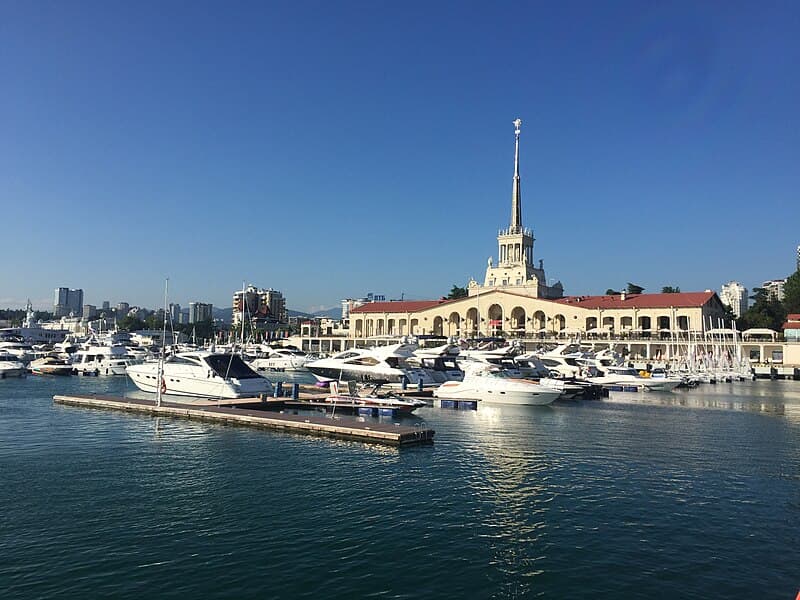
Seafront promenade and port

Seafront promenade and port

city centre

The central seafront runs from the sea terminal to Riviera Park, lined with palms, cafés and pebble beaches. The 1955 sea terminal building, with its tower and spire, is the finest piece of Stalin-era architecture in the city and is still in use today.

Tip: The beaches in the centre are pebble, and water shoes genuinely help — walking into the sea can hurt on the larger stones. Sunbeds are charged separately and in short supply during high season. The nicest stretch of the promenade runs between the sea terminal and Riviera Park; further south it's mostly a concrete seawall.

Admission:
free
Time needed:
2 h
Riviera Park

Riviera Park

city centre

The city's oldest park, dating to 1898, with an avenue of magnolias, carousels, a music pavilion, and the Avenue of Friendship, where cosmonauts and prominent visitors have planted magnolia trees since the 1960s. It's the main gathering spot for evening walks among locals.

Tip: Come in the evening, when the lights go on and bands play — during the day it's just a park with fairground rides. Entry is free; only the rides charge admission. The northern edge of the park opens onto Riviera Beach, the busiest in the city — for calmer swimming, head to Khosta instead.

Admission:
free
Time needed:
2 h
Vorontsovka Caves and the tea plantations

Vorontsovka Caves and the tea plantations

Khosta and Dagomys

A karst cave system stretching more than eleven kilometres through the mountains above Khosta, of which a half-kilometre loop with stalactites and underground chambers is open to visitors. En route lie the plantations at Dagomys, the northernmost tea-growing region on earth.

Tip: The cave stays at around 12°C year-round and is damp throughout — a jacket and sturdy shoes are essential even in August. At the tea plantation, taste before you buy, but purchase the actual tea in an ordinary shop in town, since the excursion price is several times higher. Both stops can be combined into a single half-day trip by car.

Admission:
cave entry fee
Time needed:
half a day

Photos: Rosa Khutor and Krasnaya Polyana — Sergei Kazantsev (CC BY-SA 3.0) · Olympic Park and the Formula 1 circuit — Wikimedia Commons (CC BY-SA 3.0 de) · Sochi Arboretum — Wikimedia Commons (Public domain) · Agura Waterfalls — NadezhdaKhaustova (CC BY-SA 4.0) · Mount Akhun and its lookout tower — Alexander V. Solomin (Public domain) · SkyPark and the gorge bridge — Tulen Travel tulen (CC0) · Seafront promenade and port — Sergei Kazantsev (CC BY-SA 3.0) · Riviera Park — Popugayka (CC BY-SA 3.0) · Vorontsovka Caves and the tea plantations — Koralex2020 (CC BY-SA 4.0)

Where to stay

Areas and districts, matched to the kind of trip you are taking

Central district

Best for: first-time visitors and city life

The historic core, with the promenade, the Arboretum, Riviera Park and the largest concentration of hotels and restaurants. The beaches are pebble and packed in season. It's the only part of Sochi where you can stay without a car and reach everything essential on foot or with a short bus ride.

Adler and the Olympic Park

Best for: families and modern hotels

The southern part of the city near the airport, with the Olympic complex, water parks, a dolphinarium, and newer hotels built for the Games. The beaches are wider than in the centre and the infrastructure is the most modern in Russia. It's forty minutes to the historic centre, which is the main drawback.

Krasnaya Polyana and Rosa Khutor

Best for: skiing and the mountains

A mountain district forty kilometres inland, with ski resorts, slopeside hotels, and cable cars climbing to 2,300 metres. In winter it's the main reason to visit Sochi at all; in summer it's a base for hiking. It's an hour from the sea by train or car.

Khosta and Kudepsta

Best for: quiet and lower prices

The stretch between the centre and Adler, with quieter beaches, sanatoriums set in greenery, and trailheads for the Agura Waterfalls, Mount Akhun and the Vorontsovka Caves. Prices are lower than in the centre or Adler, and it's the closest base to the mountains above the coast.

Getting around

From the airport

Sochi's airport sits in Adler, thirty kilometres from the centre and just a few kilometres from the Olympic Park. Direct flights from Europe to Russia have been suspended since 2022 and the airspace is closed, so travel now typically routes through Istanbul, Dubai or Yerevan to Moscow followed by a domestic flight, or via a direct connection from Istanbul. With connections, the whole journey can take fifteen hours or more. From the airport, the Lastochka commuter train reaches the centre in under an hour and is the fastest, cheapest option.

Sochi International Airport (Adler) (AER) · 30 km

  • Lastochka train to the centre· 55 min· 180 RUB
  • Lastochka train to Krasnaya Polyana· 1 h· 400 RUB
  • Taxi to the centre (Yandex Go)· 45 min· 1,500 RUB
  • Bus to Adler and the Olympic Park· 20 min· 50 RUB

Around town

The backbone of transport here is the Lastochka commuter train, which links Sochi, Khosta, Adler, the airport and Krasnaya Polyana, and is faster and more reliable than driving, since the coastal road jams up in high season. Buses run frequently within the city, and taxis are booked through the Yandex Go app, which is cheap. The biggest obstacle for foreign visitors is payment: foreign cards don't work in Russia, and most services, including apps, expect a Russian card or cash. Both buses and trains can be paid for in cash, at the driver or the ticket counter.

Lastochka trainThe fastest link between the coast and the mountains, running regularly from the airport to Krasnaya Polyana; tickets can be bought for cash at the counter. · 180 RUB
City busA dense network along the entire coast, paid in cash to the driver. · 38 RUB
Taxi via Yandex GoCheap and everywhere, though the app expects a Russian payment card; cash can be selected as an option. · 200 RUB
Cable cars in Krasnaya PolyanaThree connected resort areas, each with its own cable cars; a standalone scenic ride is significantly cheaper in summer. · 1,200 RUB

Useful apps: Yandex Go, Yandex Maps, RZD Passengers

When to go

Sochi effectively has two seasons that barely overlap. The swimming season runs from June to September, with the sea at its warmest, 21–26°C; August is the hottest and priciest month, and the beaches fill up. The ski season in Krasnaya Polyana runs from December to April, with the best snow in February and March. In between, May and October, the coast is pleasant and quiet — the best time for hiking in the mountains and visiting the national park. Winter on the coast itself is mild, around 12°C, but rainy.

Best time

June to September for the sea, December to April for the mountains

What to avoid

November, for the rain and closed resorts

MonthJanFebMarAprMayJunJulAugSepOctNovDec
Day11°11°13°17°21°25°28°29°25°21°16°13°
Night4°4°6°10°14°18°21°22°18°14°10°6°
Rainy days121111109877991012
Sea9°9°10°12°17°21°25°26°24°20°16°12°

Food & drink

Sochi's food scene is largely Caucasian rather than Russian: Georgian, Armenian and Abkhazian dishes are more common here than borscht, and they're cooked better than in Moscow. Khachapuri, khinkali and shashlik are on every corner and offer the best value for money in town. Along the promenade and on the beaches, vendors sell churchkhela, walnuts coated in thickened grape juice. Black Sea fish — especially red mullet — is seasonal and typically appears on menus in summer. For the best food, head to the villages in the mountains above the city, where home cooking costs a third of what you'd pay on the seafront.

What to try

Khachapuri

Georgian cheese bread; the Adjarian version is boat-shaped, with an egg and butter melted in the centre. Georgian cooking is as common in Sochi as Russian food, and khachapuri offers the best value for money.

Shashlik

Marinated meat grilled on skewers over charcoal — lamb in the Caucasus, pork elsewhere. In Krasnaya Polyana and the mountain lodges it's the main item on every menu, served with onion and lavash bread.

Khinkali

Large Georgian dumplings filled with meat and broth. Eaten by hand, holding the twisted “cap” at the top — that part isn't eaten and is left on the plate, and traditionally the number left behind showed how many you'd had.

Adjika and satsivi

Adjika is a fiery paste of peppers and herbs from Abkhazia; satsivi is chicken in a cold walnut sauce. Both are part of the Caucasian tradition that Sochi cooks better than Moscow does.

Borscht and solyanka

Beetroot soup with sour cream, and tangy solyanka with cured meats and olives. Served year-round in Sochi, even when it's 30°C outside.

Pelmeni

Small meat dumplings boiled in water and served with sour cream and vinegar. The cheapest hot dish on any menu, and a safe bet even at a restaurant that otherwise cooks poorly.

Churchkhela

Walnuts threaded on a string and dipped repeatedly in thickened grape juice. Sold on every beach, shaped like a candle, and the best edible souvenir around.

Sochi tea

The area around Sochi is the northernmost tea-growing region in the world, and the plantations near Dagomys can be visited. The tea is mild with no bitterness; buying it in an ordinary shop costs a fraction of the excursion price.

What it costs

Khachapuri at a diner

350–600 RUB

Business lunch (set midday menu)

400–700 RUB

Dinner at a seafront restaurant

2,000–4,000 RUB

Coffee on the promenade

200–350 RUB

Arboretum entry with cable car

from 600 RUB

Daily lift pass at Rosa Khutor

3,500–5,500 RUB

Lastochka train, airport to centre

180 RUB

Night at a 4-star hotel in season

6,000–12,000 RUB

Indicative prices that change over time — treat them as a guide, not a price list.

Practical information

SocketsCEuroplug, two round pinsFSchuko
Voltage220V / 50Hz
Tap waterDo not drink tap water — Tap water in Sochi is chlorinated and technically safe, but tastes poor and locals don't drink it. Bottled water costs around 50 rubles for a litre and a half at a shop, three times that on the beach. In Krasnaya Polyana the water comes straight from the mountains and is noticeably better. Mineral water from the nearby Caucasus region — Yessentuki, Narzan — is sold everywhere but is salty, so it's not really suited to everyday drinking.
TippingA tip of around ten percent is customary, and some tourist-oriented restaurants add it to the bill automatically. Payment is mostly by contactless card, but cards issued outside Russia don't work here — both Visa and Mastercard issued abroad are disconnected from the local network, as are Apple Pay and Google Pay. Foreign visitors need to bring cash in rubles for the entire trip and exchange it locally; ATMs reject foreign cards. This is the single most important practical fact for the whole trip.
Driving on theright
SafetyMost Western foreign ministries currently list Russia as a country to avoid travelling to, because of the war in Ukraine, the risk of arbitrary detention of foreign nationals, and limited consular assistance. Before any trip, check your own government's current travel advisory and the status of your travel insurance, since standard policies usually exclude the country. Everyday crime in Sochi itself is low and rarely touches tourists; the real risks are up in the mountains, where weather in Krasnaya Polyana can change within an hour and avalanches are a danger off the marked runs. The emergency number is 112.
Opening hoursShops open from nine or ten until eight, and the Magnit and Pyaterochka supermarket chains are often open around the clock. Restaurants serve from midday until midnight and typically offer a “business lunch” — a cheap set midday menu. Museums close on Mondays. Seasonality matters a great deal in Sochi: the summer coastal infrastructure runs from June to September, the mountain resorts from December to April, and in between most cable cars and hotels in Krasnaya Polyana simply close.
Customs & etiquetteSmiling at strangers isn't customary in Russia, and a neutral expression from staff doesn't mean unfriendliness. Shoes come off at the door when entering someone's home. Toasts are given and drunk with eye contact; declining alcohol is possible but expected to come with a reason. Politics and the war are not topics to raise with a foreigner — for locals, bringing them up is risky, not just impolite. Photographing military installations, bridges and train stations is prohibited. Flowers are given in odd numbers — an even number is reserved for funerals.
A few local wordsHello — ZdravstvuyteThank you — SpasiboPlease — PozhaluystaHow much is this? — Skolko stoit?The bill, please — Schyot, pozhaluystaI don't understand — Ya ne ponimayu

How to plan your days

1 day

A day in Sochi

  1. 1Morning at the Arboretum, cable car up and a walk back down.
  2. 2Lunch at a Georgian diner away from the seafront.
  3. 3Afternoon along the promenade and the sea terminal.
  4. 4Early evening at Riviera Park and the Avenue of Friendship.
  5. 5Dinner with khinkali, then a walk along the seafront.

2 days

Two days including the mountains

  1. 1Day one as outlined above.
  2. 2Morning: Lastochka train to Krasnaya Polyana.
  3. 3Cable car up to the ridge and a walk along the scenic trails.
  4. 4Lunch at altitude or in the Rosa Khutor resort village.
  5. 5Train back and dinner in Adler near the Olympic Park.

3 days

Three days with nature

  1. 1The first two days as outlined above.
  2. 2Morning: Agura Waterfalls through the gorge above Khosta.
  3. 3Lunch in Khosta, then the lookout tower on Mount Akhun in the afternoon.
  4. 4The following day: the Olympic Park by bike and the beach in Adler.
  5. 5Final afternoon: Vorontsovka Caves or the tea plantations at Dagomys.

Day trips

Krasnaya Polyana

45 km · 1 h by train

A mountain resort in the Mzymta valley that grew from a highland village into an Olympic venue with three connected ski areas and cable cars reaching 2,300 metres. Winter brings skiers; summer brings hikers tackling the Caucasus ridge and scenic cable car rides that cost a fraction of the winter lift price.

Gagra and Abkhazia

60 km · 2 h by car, including the border crossing

A former Soviet resort just across the border in Abkhazia, with a seafront colonnade, abandoned sanatoriums, and Lake Ritsa up in the mountains. It's a de facto separate, internationally unrecognized territory, and crossing the border at the Psou River can take an hour or more. Check entry requirements beforehand, and whether your insurance covers the area at all — many policies don't.

Sochi National Park and Psakho Canyon

35 km · 1 h by car

A protected area covering most of the mountains above the city, including a yew and boxwood grove in Khosta — a relict forest with no equivalent elsewhere in Europe. Psakho Canyon has swimming pools and a trail along a rock ledge. Entry is paid at the gate and the routes are marked.

Frequently asked questions

Is it possible to travel to Sochi today?+

Most Western governments currently advise against travel to Russia because of the war in Ukraine, the risk of arbitrary detention of foreign nationals, and limited consular assistance. There are no direct flights from Europe and the airspace is closed. Before deciding anything, check your own government's current travel advisory and whether your travel insurance even covers Russia — most standard policies exclude it entirely.

Do foreign payment cards work in Russia?+

No. Visa and Mastercard cards issued outside Russia are disconnected from the local payment network, as are Apple Pay and Google Pay, and ATMs will reject foreign cards. Visitors need to bring cash and exchange it for rubles. This is the single most important practical fact for the whole trip, and people routinely only discover it once they've already arrived.

When is the best time to swim in Sochi?+

From July to September, when the Black Sea reaches 24–26°C. In June the water is still around 21°C, which many find too cold. August is the warmest and most expensive month, with packed beaches. Sochi's beaches are pebble, not sand — water shoes genuinely help.

How do you get from the coast up into the mountains?+

By the Lastochka train, which runs from the airport and from the city centre to Krasnaya Polyana in about an hour and costs a few hundred rubles. It's faster and more reliable than driving, since the coastal road gets jammed in high season. From the mountain town, cable cars connect to the three linked resort areas — Rosa Khutor, Gorki Gorod and Alpika.

Is Sochi better in summer or winter?+

They're really two different trips. In summer it's a seaside resort with pebble beaches, subtropical greenery and the Olympic Park. In winter it's a ski destination with the best infrastructure in Russia and slopes reaching up to 2,300 metres. May and October offer the best balance of low prices and quiet, with hiking possible in the mountains and an empty coastline below.

Is Sochi safe?+

Street crime in the city is low and rarely affects tourists. The real risks are up in the mountains: weather in Krasnaya Polyana can change within an hour, and avalanches are a danger off the marked runs. More important than local safety, though, is the broader context of travelling to Russia — consular assistance is limited and travel insurance typically doesn't apply.

How long does it take to get around the city?+

Sochi stretches a hundred and fifty kilometres along the coast, and travelling from one end to the other takes about two hours. From the centre it's forty minutes to Adler and an hour to Krasnaya Polyana. It's worth choosing a base according to what you plan to do, rather than staying in the centre and commuting everywhere.

What should you bring back from Sochi?+

Sochi tea from the plantations near Dagomys, the northernmost tea-growing region in the world, and churchkhela — walnuts threaded on a string and dipped repeatedly in thickened grape juice. Buy both at an ordinary shop in town, not on an excursion or along the promenade, where the same items cost several times more.

Visa Requirements

Check the latest visa requirements for entering this country. Some nationalities may need to apply for a visa or e-visa before travel.

Check visa requirements

Language

Russian

Currency

RUB

Timezone

Europe/Moscow

Dial Code

+7

Population

144M

Area

17,098,242 km²

Voltage

220V / 50Hz

Driving Side

Right

Top Hotels in Sochi

Live prices from 500+ properties

Loading hotels...

More destinations in Russia

Planning a trip to Sochi?

Compare hundreds of hotels, find the best price, and book with free cancellation on TravelManiac.