Hotels in Vladivostok

The port at the end of the Trans-Siberian, closer to Seoul and Tokyo than to Moscow

Vladivostok

LanguageRussian
CurrencyRUB
TimezoneAsia/Vladivostok
Temperature-10-25 °C
Dial Code+7
Population144M
Area17,098,242 km²
SocketsType C / Type F
Tap waterNot drinkable

Discover Vladivostok

Vladivostok sits on a peninsula between two bays of the Sea of Japan, nine thousand kilometres and seven time zones from Moscow, yet only two hours' flight from Seoul and less than an hour from the Chinese border. It was founded by Russian soldiers in 1860 and its name means 'ruler of the East'. For most of the twentieth century it was a closed military city, home of the Pacific Fleet and off limits to foreigners; it only opened up in 1992. Today it is the liveliest Russian city in the Far East: hilly like San Francisco, with two cable-stayed bridges from 2012, a seafront promenade and a cuisine built on seafood — crab, sea urchin and scallops are cheaper here than anywhere in Europe. Most visitors arrive here as the last stop of the Trans-Siberian Railway, whose station stands right in the port next to the kilometre post marked 9,288. Because of the closed airspace between the EU and Russia, foreign cards that don't work and government travel warnings, it is a demanding trip today that needs careful planning in advance.

What to see

The places worth your time in Vladivostok, and what to expect at each

Golden Horn Bay and the Golden Bridge

Golden Horn Bay and the Golden Bridge

Zolotoj Rog

Centre, Golden Horn

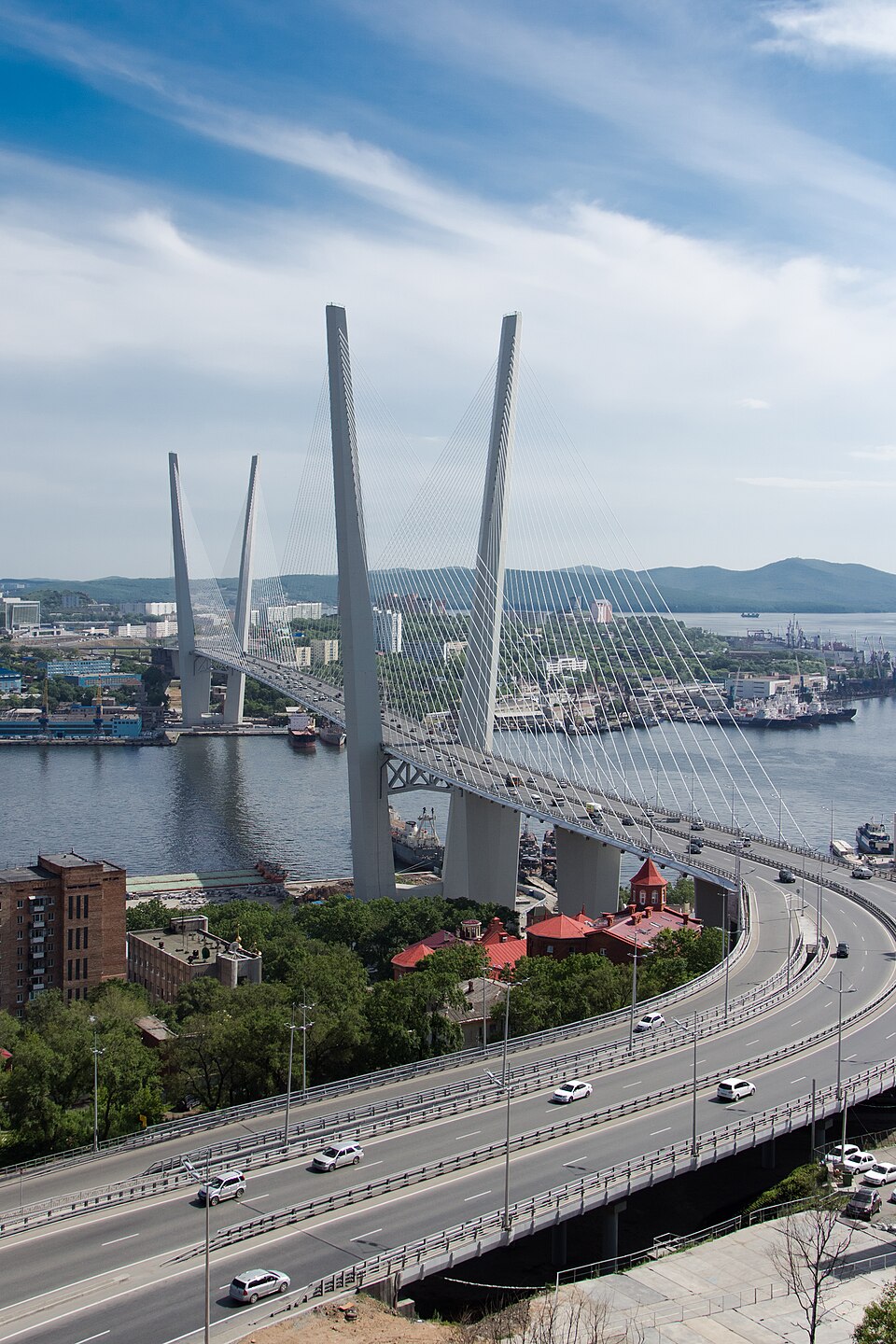
A seven-kilometre natural harbour around which the city grew, named after the bay in Istanbul. Since 2012 its mouth has been spanned by the cable-stayed Golden Bridge, with two V-shaped towers, which is the symbol of Vladivostok. Pacific Fleet warships are moored in the bay and ferries to the islands pass beneath them.

Tip: The bridge is best photographed from below, from the Korabelnaya embankment by the Marine Terminal, and in the evening when it is lit up — the lights go off before midnight. You cannot walk across it; it has no pavements. Mind your camera: the fleet's ships in the bay are a military site, and anyone pointing a telephoto lens at them may end up talking to security. The bridge and the skyline behind it are fine.

Admission:
free
Time needed:
1 h
Eagle's Nest viewpoint and funicular

Eagle's Nest viewpoint and funicular

Orlinoje gnezdo

Centre

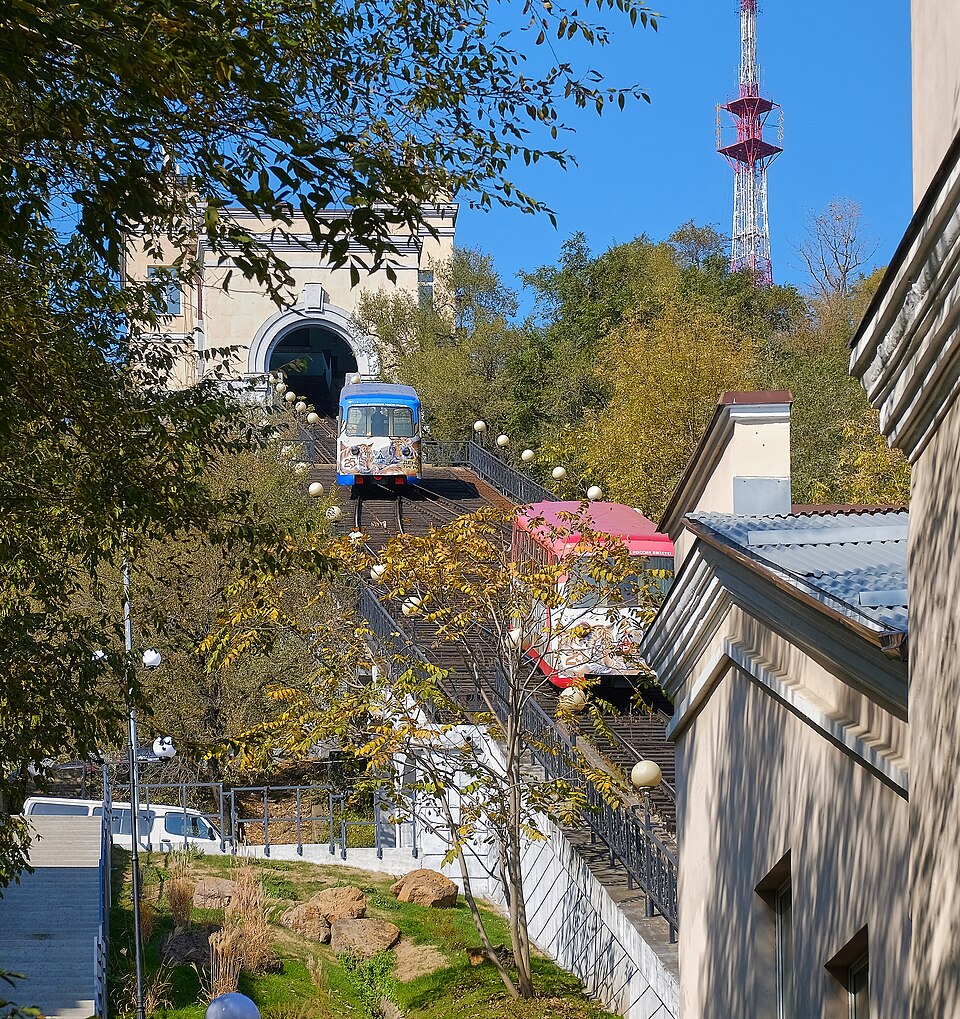
The highest hill in the centre, two hundred and fourteen metres above sea level, with a viewing platform above the Golden Horn and the bridge. A short funicular from 1962, one of the few in Russia, runs up its flank, covering a hundred and eighty metres of track in under two minutes. The viewpoint has a monument to Cyril and Methodius, the missionaries credited with the Slavic alphabet from which Cyrillic derives.

Tip: The funicular costs a few dozen roubles, paid in cash; its upper station is on Sukhanova Street, and from there it is another ten minutes on foot to the viewpoint via a footbridge over the motorway. Go at dusk, when the bridge and the city light up, and bring a jacket, as it is windy at the top even in summer. In June and July the whole bay is often under fog in the morning and the view is zero.

Admission:
viewpoint free, funicular around 30 ₽
Time needed:
1 h
S-56 submarine

S-56 submarine

Korabelnaya embankment

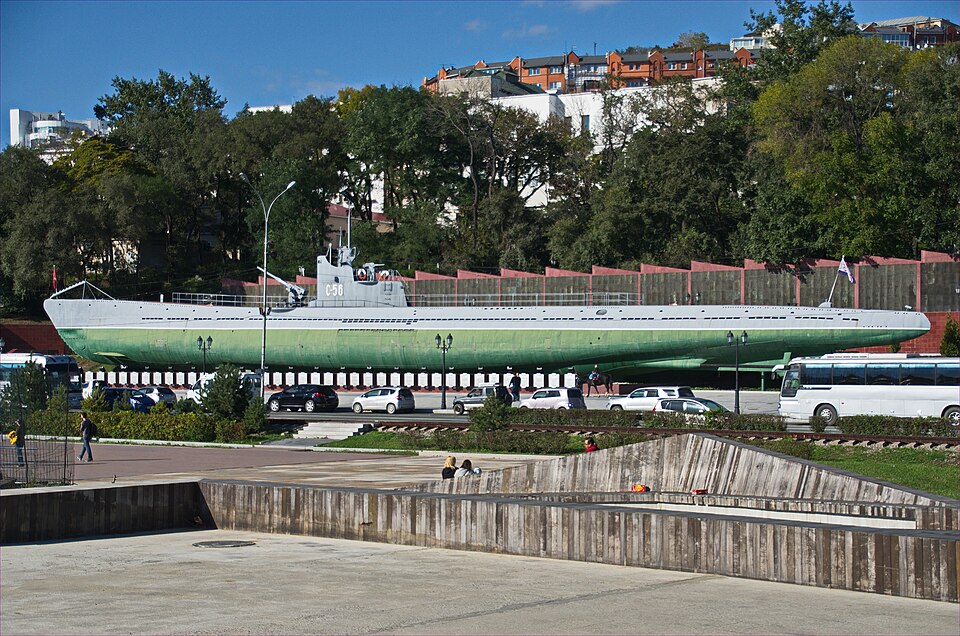
A Soviet Second World War submarine which in 1942–43 transferred from the Pacific via the Panama Canal and the Atlantic to the Northern Fleet, and sank several enemy ships during the war. It stands on a plinth on the embankment by the Eternal Flame and you can walk inside: the front half holds a small museum of the submarine fleet, while the rear half has been left as it was in service — torpedo tubes, cabins and the engine room.

Tip: The museum is small, half an hour is enough, and admission is nominal. Anyone taller than 1.80 m should expect narrow hatches between compartments. Right next to it are the Pacific Fleet memorial hall and the chapel of St Andrew; the whole area combines with the Arsenal and the Korabelnaya embankment into a two-hour walk.

Admission:
around 200 ₽
Time needed:
30–45 min
Vladivostok Fortress

Vladivostok Fortress

Sports Harbour

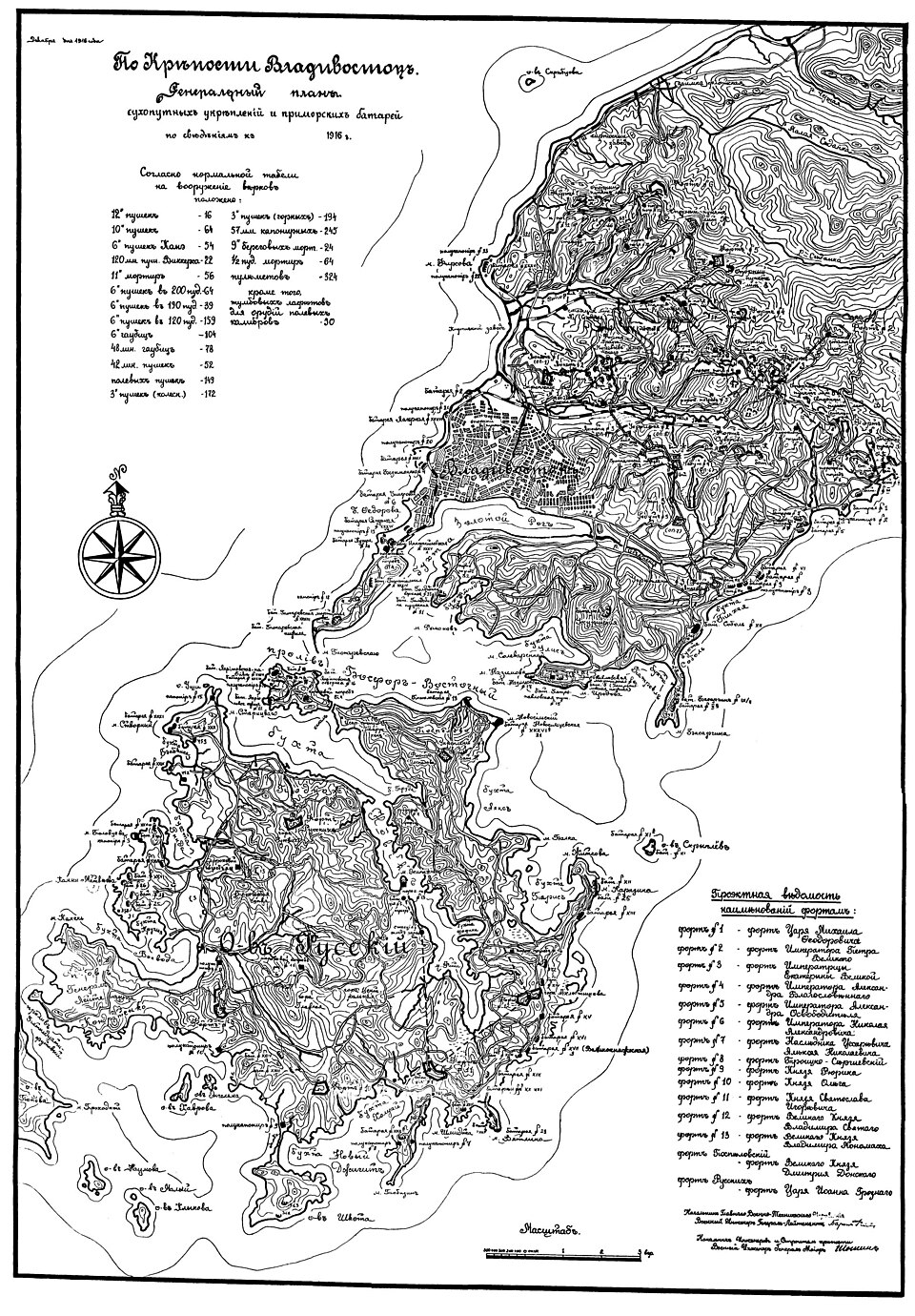
At the turn of the twentieth century Vladivostok was one of the most heavily fortified naval strongholds in the world, with sixteen forts and dozens of batteries scattered across the peninsula and islands. In the centre, a museum occupies the former Bezymyannaya battery above Sports Harbour, with guns, casemates and an exhibition on the defence of the Far East. The forts themselves are spread around the suburbs and several are open to visitors.

Tip: The museum in the centre is a good one-hour introduction, but you will see the real fortress at Fort No. 7 in the north of the city — more than one and a half kilometres of tunnels inside the hill, reached by taxi and visited with a guide. It is around eight degrees inside all year, so bring an extra layer even in August.

Admission:
around 400 ₽
Time needed:
1–1.5 h
Railway station and the end of the Trans-Siberian

Railway station and the end of the Trans-Siberian

Centre, Aleutskaya Street

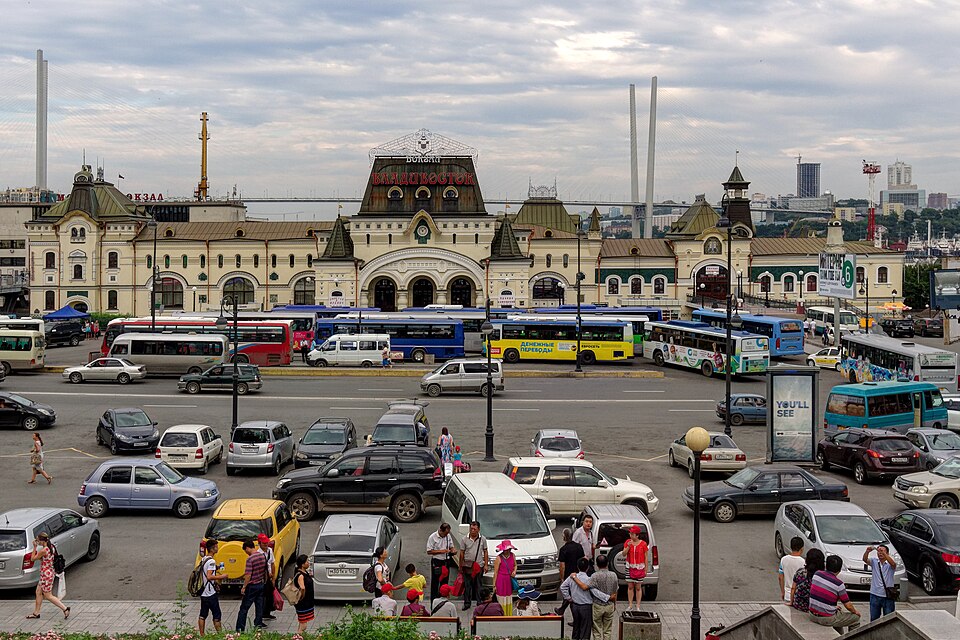
A 1912 station building in Neo-Russian style, built as a scaled-down copy of Moscow's Yaroslavsky station, where trains to Vladivostok depart. On the platform stands a post marked 9,288, the distance in kilometres from Moscow, and a steam locomotive as a monument. A footbridge leads from the station straight to the Marine Terminal, where ships depart.

Tip: The finest part is the interior of the main hall with its ceiling paintings, which you can enter without a ticket via the security scanner. The 9,288 post is on the platform by track one, reached by the footbridge from the hall. If you arrive on the Trans-Siberian, the station left-luggage office saves you dragging a suitcase to the hotel if check-in is not until the afternoon.

Admission:
free
Time needed:
30 min
Tokarevsky Lighthouse

Tokarevsky Lighthouse

Egersheld

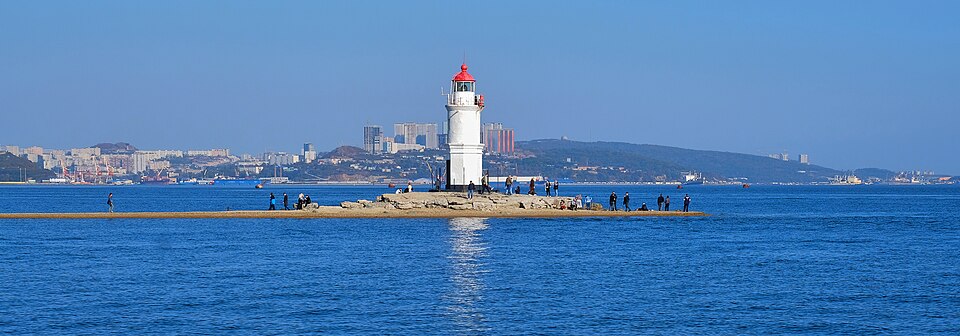
One of the oldest lighthouses in the Russian Far East, dating from 1876, standing at the end of a narrow sand spit on the southern tip of the Egersheld peninsula. The white tower with its red lantern is the most photographed spot in the city, with views of the Russky Bridge and the entrance to the Eastern Bosphorus strait, through which ships sail into port.

Tip: The spit to the lighthouse is partly flooded at high tide and in waves, so check the tide in an app or expect wet shoes. Go at sunset, when the sun goes down behind the Russky Bridge. In spring, in April and May, spotted seals bask on the rocks around the spit — don't feed them or go closer than a few metres. Take a bus to the Egersheld terminus, then walk ten minutes.

Admission:
free
Time needed:
1–1.5 h
Russky Bridge and Russky Island

Russky Bridge and Russky Island

Russky Island

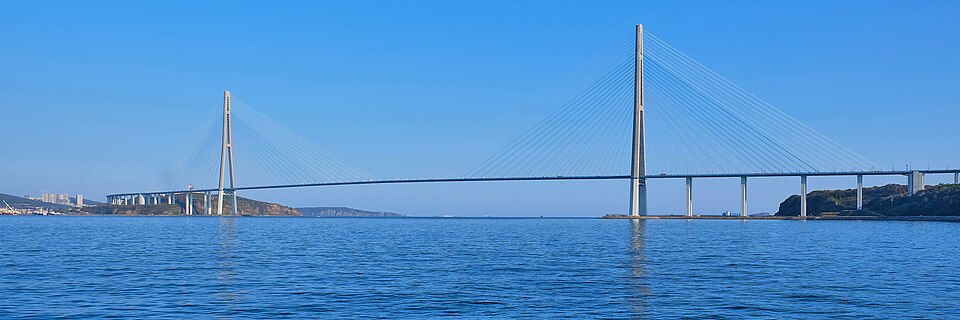
The Russky Bridge linking the city with Russky Island, pictured on the 2,000-rouble banknote, had the longest cable-stayed span in the world when it opened in 2012, at 1,104 metres. Beyond it lies an island with the Far Eastern Federal University campus built for the APEC summit, coastal cliffs, coves and the Voroshilov Battery — a coastal fortress battery with twelve-inch guns in rotating turrets, now a museum.

Tip: The university campus is open to the public and its waterfront overlooking the Ussuri Bay is the quietest walk around; bus 15 runs here from the centre. The Voroshilov Battery is twenty minutes by taxi from the campus and admission includes a tour of the underground spaces beneath the turrets. The island's finest cliffs, at Cape Tobizin, are reached on a dirt road that ordinary taxis won't take — you need an off-road vehicle or an organised trip.

Admission:
bridge free, Voroshilov Battery around 400 ₽
Time needed:
half a day
Primorsky Oceanarium

Primorsky Oceanarium

Russky Island

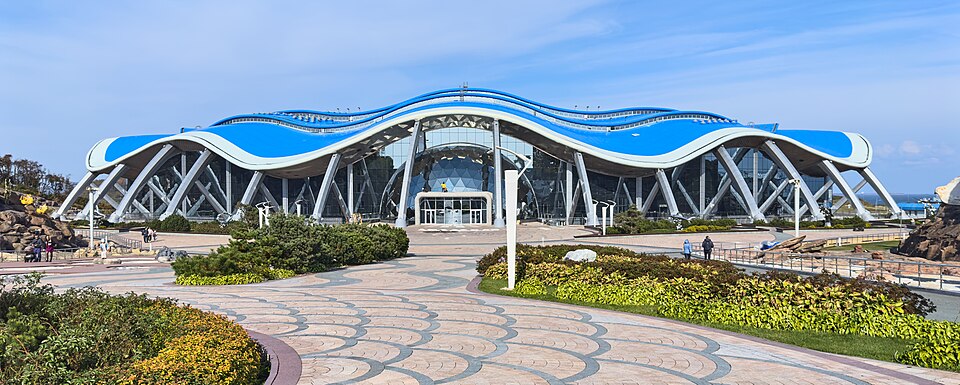
A large marine aquarium on Russky Island, opened in 2016, with a tunnel beneath a tank, an exhibition on the evolution of life in the ocean and a dolphinarium. The shell-shaped building stands right on the shore of Ajax Bay next to the university campus. It focuses mainly on the fauna of the Sea of Japan and the North Pacific — crabs, octopus, jellyfish and the fish you will later see at the market.

Tip: Tickets for the dolphinarium shows are sold separately and sell out at weekends, so buy them at the ticket desk first thing in the morning. It is quietest on weekday mornings. The oceanarium combines well with a walk around the university campus next door — bus 15 from the centre takes about thirty minutes, a taxi is quicker.

Admission:
around 1,500 ₽
Time needed:
2–3 h
Svetlanskaya Street and the Arsenyev Museum

Svetlanskaya Street and the Arsenyev Museum

Centre, Svetlanskaya

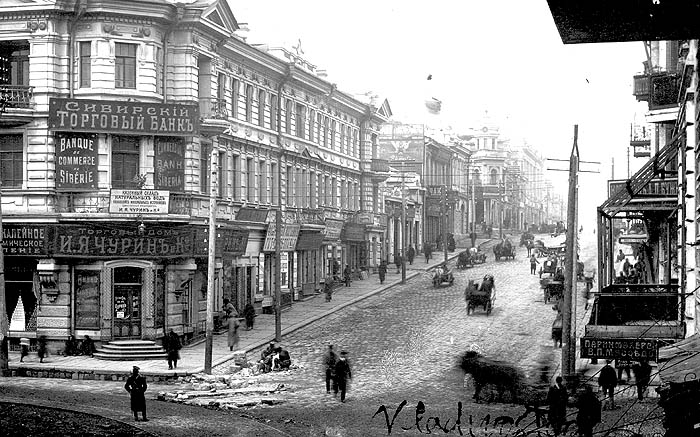
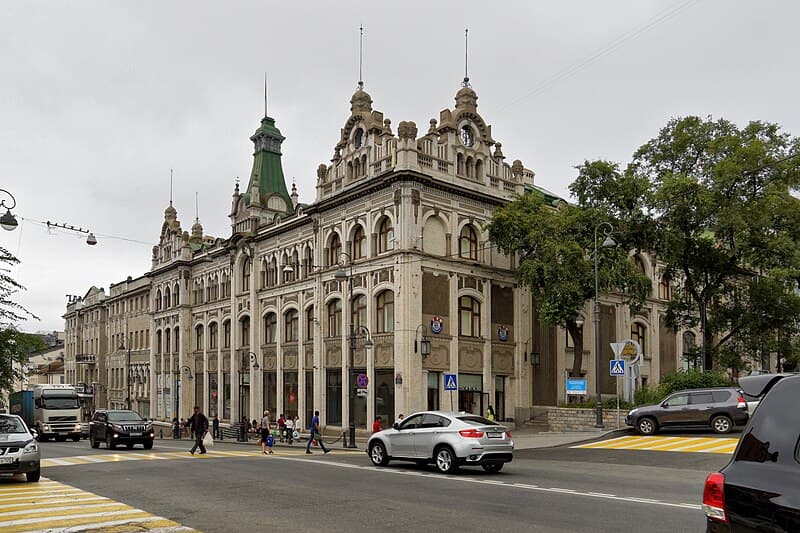
The main street of old Vladivostok, lined with department stores and banks from before the revolution, when Germans, Chinese, Koreans and Americans did business here. At number 20 is the Arsenyev Museum, the oldest museum in Primorye, named after the explorer Vladimir Arsenyev, whose book Dersu Uzala was filmed by Akira Kurosawa. The exhibition covers the indigenous peoples, tigers and the gold rush in the Far East.

Tip: Near the museum, at Svetlanskaya 33, is the GUM department store, formerly Kunst & Albers, once the most modern shop in the Far East — the courtyard behind it with brick warehouses is now full of cafés. In the Arsenyev Museum the room on the Amur tiger and leopard is worth seeing — around seven hundred tigers and about a hundred and twenty leopards live in the Russian Far East. Labels are mostly in Russian only.

Admission:
museum around 400 ₽
Time needed:
1.5–2 h

Photos: Golden Horn Bay and the Golden Bridge — Даниил Рыжков (Daniil Ryzhkov) (CC BY-SA 3.0) · Eagle's Nest viewpoint and funicular — Vyacheslav Bukharov (CC BY-SA 4.0) · S-56 submarine — Uwe Brodrecht (CC BY-SA 2.0) · Vladivostok Fortress — Шошин А.П. (Public domain) · Railway station and the end of the Trans-Siberian — Alexxx1979 (CC BY-SA 4.0) · Tokarevsky Lighthouse — Vyacheslav Bukharov (CC BY-SA 4.0) · Russky Bridge and Russky Island — Vyacheslav Bukharov (CC BY-SA 4.0) · Primorsky Oceanarium — Vyacheslav Bukharov (CC BY-SA 4.0) · Svetlanskaya Street and the Arsenyev Museum — Unknown authorUnknown author (Public domain)

Where to stay

Areas and districts, matched to the kind of trip you are taking

Centre and Svetlanskaya

Best for: first visit, walking distance to the station and the waterfront

The old centre between the railway station, Svetlanskaya Street and the Golden Horn, where most sights, hotels and restaurants are. Streets climb steeply into the hills, so distances on the map are deceptive — what looks like five minutes is ten minutes up steps. Hotels near the Square of the Fighters for Soviet Power have the best location and views of the bay.

Admirala Fokina and Sports Embankment

Best for: evening walks, cafés, sunsets

The pedestrian Admirala Fokina Street, locally known as the Arbat, links the centre with the embankment by Sports Harbour, which has a beach, a big wheel and the city's favourite promenade. In the evening this is where the crowds and cafés are. Nobody swims from the beach because of the port; people come here for a stroll and the sunset over Amur Bay.

Egersheld

Best for: the lighthouse, views, quieter stays

A peninsula south-west of the centre with port cranes, Soviet apartment blocks and the Tokarevsky Lighthouse at its tip. It is a working, slightly rough port district, but with the best views of the Russky Bridge. A few apartments here offer cheaper accommodation with sea views; the centre is twenty minutes away by bus.

Russky Island

Best for: nature, the university campus, the oceanarium

The island beyond the Russky Bridge, with the university campus, the oceanarium, fortress batteries and cliff-lined coves. Accommodation is limited to hotels on the campus and a few guesthouses; it suits those who want peace and nature and don't mind half an hour's journey to the centre. Off the campus the roads are dirt tracks and public transport is almost non-existent.

Getting around

From the airport

Vladivostok cannot be reached from the EU directly, nor with a single change within the EU. EU airspace is closed to Russian carriers and European airlines don't fly to Russia, so the route goes via Istanbul, Dubai or Belgrade to Moscow and from there on a domestic flight lasting eight and a half to nine hours. The second option is via Asia: there are flights to Vladivostok from Beijing, Shanghai, Harbin and Seoul. Overland, the Trans-Siberian Railway leads here; the Rossiya train from Moscow takes six days. Most foreign nationals, including EU citizens, need a Russian visa — Russia also issues a unified e-visa, but the list of eligible countries and the conditions change, so check them in advance with your foreign ministry and on official Russian websites.

Knevichi (VVO) · 45 km

  • Aeroexpress train to the main station· 50 min· 300 ₽
  • Bus 107 to the centre· 1 h 20 min· 200 ₽
  • Taxi (Russian apps or taxi ranks only)· 45 min· 1,500 ₽

Around town

Central Vladivostok is walkable, just steep — streets climb into the hills and often end in a staircase. Public transport relies on buses and minibuses; you pay in cash to the driver when getting off or with a Russian card, and the fare is the same regardless of distance. A single tram line survives on the outskirts, and the funicular only runs up to the Eagle's Nest. Buses run to Russky Island across the Russky Bridge, and ferries to Popov and Reineke islands leave from the Marine Terminal. Taxis via Yandex Go or Maxim are cheap, but the apps need a Russian phone number and a local card. Foreign cards work nowhere, so carry rouble cash.

Buses and minibusesThe backbone of city transport with a dense network, but they get stuck in traffic on the main avenues at rush hour. Pay cash to the driver when getting off; one price for the whole route. · 40 ₽
FunicularA short line from Pushkinskaya Street to Sukhanova Street below the Eagle's Nest, running every few minutes; the ride takes under two minutes. · 30 ₽
Ferries to the islandsFrom the Marine Terminal to Popov, Reineke and Russky islands several times a day; in summer tickets sell out, so buy them at the ticket office an hour ahead. · 150 ₽
Yandex Go / Maxim taxiCheap: 300–500 ₽ across town, around 800 ₽ to Russky Island. Requires a Russian phone number and local payment; otherwise you are left with taxis from a rank, agreeing the fare in advance. · 300 ₽
AeroexpressTrain from the main station to Knevichi airport several times a day, timed to flights; the journey takes fifty minutes. The timetable is tied to the main flights to Moscow. · 300 ₽

Useful apps: 2GIS, Yandex Maps, Yandex Go, Google Translate with offline Russian

When to go

Vladivostok lies on the same latitude as Nice, but its climate is monsoonal and completely different. Winter is dry, sunny and freezing — minus eight by day in January, fifteen below at night and a cold wind from Siberia; the bays freeze over and locals fish through holes in the ice. Summer, by contrast, is humid and foggy: June and July are grey, with fog that can sit on the bay all day, and temperatures hover around twenty. The best time is late August and September, when the fog lifts, it is over twenty degrees and the sea is at its warmest of the year. Late August and September, however, bring the risk of typhoons, which can shut ferries and the airport for a day or two.

Best time

late August to early October

What to avoid

January and February because of the frost, June and July because of the fog

MonthJanFebMarAprMayJunJulAugSepOctNovDec
Day-8°-4°3°10°15°18°22°24°21°13°3°-5°
Night-15°-12°-4°3°8°12°17°19°14°6°-3°-11°
Rainy days34691113141310754
Sea-1°-1°0°4°8°13°18°21°18°13°6°1°

Food & drink

Vladivostok eats from the sea, and its cuisine is the most Asian of any Russian city: alongside pelmeni and borscht you will find Korean, Chinese and Japanese places on every street, because Primorye has a large Korean minority and China is just round the corner. Seafood is cheap — Kamchatka crab, sea urchin, scallops and sea cucumber sell at the fish market by Sports Harbour for a fraction of European prices. Midday is the time for a cheap business lunch, evening for a crab restaurant. Payment is in rouble cash only; foreign cards don't work.

What to try

Kamchatka crab

A giant crab with legs over a metre long, sold here cooked whole or as legs only. In restaurants a kilo costs a fraction of European prices, and at the market even less. It is freshest in winter and spring; in summer it is often frozen.

Sea urchin

The raw roe of sea urchins, eaten with a spoon straight from the shell or on rice. It tastes sweet and of the sea. At the market they are sold alive and the vendor cracks them open on the spot; the season runs from spring to autumn.

Scallops and sea cucumber

Scallops from the Sea of Japan are eaten raw with lemon or grilled in the shell. Sea cucumber (trepang) is a Chinese delicacy with a rubbery texture, worth trying at least once in a Korean or Chinese restaurant.

Pyanse

Steamed yeast buns filled with minced meat and cabbage and served with a spicy sauce, the street food of Korean immigrants from Sakhalin. They are sold at kiosks all over the city for around a hundred roubles and eaten hot.

Kuksi

Cold Korean noodles in a sour broth with cucumber, egg and beef, a dish local Koreans brought with them from Central Asia. In summer it is the most refreshing lunch in town; it is ordered with kimchi and Korean side salads.

Fish he

Raw fish marinated in vinegar with carrot, onion and chilli, a Korean starter sold by weight in every supermarket here. It is made from salmon, flounder or octopus and eaten as a snack with vodka.

Fish pelmeni

The local version of Russian dumplings, filled with salmon or pike instead of pork. They are served boiled with sour cream or fried; in canteens they are the cheapest hot dish on the menu.

Salmon caviar

Red roe of chum and pink salmon from Kamchatka and Sakhalin is sold at the market by weight from open tubs. It is eaten on bread and butter. Taste before you buy and avoid anything too cheap — it gets diluted with oil.

What it costs

Coffee in a café

200–300 ₽

Pyanse from a kiosk

100–150 ₽

Business lunch at midday

350–500 ₽

Seafood dinner per person

2,000–4,000 ₽

Kilo of crab legs at the market

from 3,000 ₽

Public transport fare

40 ₽

Museum admission

300–500 ₽

Night in a 3* hotel for two

4,500–8,000 ₽

Indicative prices that change over time — treat them as a guide, not a price list.

Practical information

SocketsCEuroplug, two round pinsFSchuko
Voltage220V / 50Hz
Tap waterDo not drink tap water — Tap water in Vladivostok is treated and chlorinated, but locals don't drink it — the pipe network is old and quality worsens after summer typhoons. Drink bottled water; a litre and a half costs around sixty roubles in a supermarket. On Russky Island and in the suburban settlements the water comes from wells and should not be drunk without boiling either. Tea in cafés and canteens is made with filtered water and is fine.
TippingThe usual tip is ten per cent, and tourist restaurants sometimes add it to the bill automatically. Payment is mostly by card and contactless, but cards issued abroad do not work in Russia — Visa and Mastercard issued outside Russia are cut off from the local network, as are Apple Pay and Google Pay. Foreigners therefore need rouble cash for the entire stay and have to exchange it; cash machines reject foreign cards. This is the single most important practical point of the whole trip.
Driving on theright
SafetyMany governments, including those of EU countries, advise against all travel to Russia because of the war in Ukraine, the risk of arbitrary detention of foreigners and very limited consular assistance — and from Vladivostok, most European embassies are in Moscow, a nine-hour flight away. Before travelling, check your government's current advice and whether your insurance covers Russia at all. Vladivostok is the base of the Pacific Fleet: photographing warships, harbour moles, military buildings and guarded bridges is forbidden and taken seriously. Street crime is low. The real risks are natural — typhoons in late summer, ice on the steep streets in winter and fog that closes the airport. The emergency number is 112.
Opening hoursShops open from ten in the morning to ten at night, and the Samberi and Reshta chains are often open around the clock. Restaurants serve from noon to midnight and offer a 'business lunch' at midday for three to five hundred roubles. Museums close on Mondays; the Vladivostok Fortress and the submarine are open daily. The time zone is UTC+10, eight hours ahead of Central Europe in summer and nine in winter — bear that in mind when arranging calls home. The beach season at Shamora and on the islands is short, from mid-July to mid-September.
Customs & etiquetteSmiling at strangers is not the custom in Russia, and a cool expression from staff does not mean unfriendliness. Shoes come off in the hallway when entering a home. Toasts are made and glasses raised with eye contact; you can decline alcohol, but it helps to have a reason. Politics and the war are not topics to raise with a foreigner, and for locals discussing them is risky, not just impolite. Photographing military sites, bridges and stations is forbidden. Flowers are given in odd numbers — even numbers are for funerals.
A few local wordsHello — ZdravstvujteThank you — SpasiboPlease — PožalujstaHow much is it? — Skolko stoit?The bill, please — Sčot, požalujstaI don't understand — Ja ně ponimaju

How to plan your days

1 day

Vladivostok in one day

  1. 1In the morning, the railway station with the 9,288 post and across the footbridge to the Marine Terminal.
  2. 2The Korabelnaya embankment, the S-56 submarine and a view of the Golden Bridge.
  3. 3Lunch at a pyanse kiosk or a Korean canteen, then Svetlanskaya and the Arsenyev Museum.
  4. 4In the afternoon, Admirala Fokina Street, Sports Embankment and the fortress museum.
  5. 5At sunset, the funicular up to the Eagle's Nest, then a crab dinner.

2 days

Two days: the city and Russky Island

  1. 1Day one as in the one-day plan.
  2. 2Day two: bus 15 across the Russky Bridge to the university campus in the morning.
  3. 3The Primorsky Oceanarium and a walk along the campus waterfront.
  4. 4Taxi to the Voroshilov Battery and back to the city.
  5. 5Sunset at the Tokarevsky Lighthouse in Egersheld.

3 days

Three days: add an island or the fortress

  1. 1The first two days as in the previous plan.
  2. 2Day three: morning ferry to Popov Island, a walk to the cliffs and a swim in summer.
  3. 3Off-season alternative: Fort No. 7 with a guide and the fish market.
  4. 4In the afternoon, the market by Sports Harbour to buy caviar and sea urchin.
  5. 5Farewell dinner at a Korean restaurant in the centre.

Day trips

Popov Island

25 km · 1 h 15 min by ferry

An island in the Empress Eugénie Archipelago south of Russky, reached by ferry from the Marine Terminal. It is a village of fishermen and dachas with quiet coves and the cleanest water around the city, where you can swim in August. The island has a small nature museum and trails to the cliffs on its southern coast. In summer the ferry runs several times a day; buy tickets in advance, as they sell out at weekends. The last return sailing is in the afternoon, and out of season there is only one a day, so check it before leaving the port.

Shamora Bay

30 km · 45 min by bus

A sandy beach in Lazurnaya Bay on the shores of the Ussuri Bay, Vladivostok's main summer beach. In July and August it is crowded at weekends, with barbecues and music and the feel of a lakeside day out; weekdays are calmer. The water is around twenty degrees in August. Buses run here from the centre and the journey takes about three quarters of an hour depending on traffic. Out of season the beach is empty and worth visiting mainly for a walk along the cliffs above the bay.

Land of the Leopard National Park

120 km · 2–2.5 h by car

A protected area near the borders with China and North Korea, home to most of the last wild Amur leopards — about a hundred and twenty of them — and several Siberian tigers. You won't see a leopard, they are far too shy, but the park's visitor centre and its nature trails show the habitat it lives in and footage from camera traps. Visits are organised or by car with advance arrangement; access to the trails must be registered with the park because of the border zone rules, and you need your passport.

Frequently asked questions

How do I get to Vladivostok from Europe?+

Not directly, and not with a single change within the EU. The most common route is via Istanbul, Dubai or Belgrade to Moscow and then a domestic flight of eight and a half to nine hours; allow two days of travel in total. The alternative is a connection in Asia, with flights to Vladivostok from Beijing, Shanghai and Seoul. The slowest and most famous route is the Trans-Siberian Railway from Moscow, six days by train.

Do I need a visa?+

Most foreign nationals, including EU citizens, need a visa for Russia. Russia issues a unified electronic visa applied for online, for which many European countries have been eligible, but the list of countries, length of stay and conditions change. A standard visa is issued by a Russian consulate and requires an invitation or hotel booking. Many governments advise against travel to Russia; check the current situation before planning.

Will my bank cards work there?+

No. Visa and Mastercard issued outside Russia have been cut off from the Russian network since 2022, as have Apple Pay and Google Pay, and cash machines reject them. You need to bring euros or dollars in cash for the whole stay and exchange them locally. In the Far East, Chinese yuan are also useful and exchange offices take them routinely. There is no way round it, and it is the most important practical point of the whole trip.

How many days do I need in Vladivostok?+

The city itself can be covered in two days: day one for the centre, station, waterfront and Eagle's Nest, day two for Russky Island with the oceanarium and the Tokarevsky Lighthouse. A third day is worth spending on the ferry to Popov Island or at Fort No. 7. Given the length and cost of the journey, though, most people combine Vladivostok with the Trans-Siberian Railway or a trip to Korea or Japan.

Is Vladivostok the end of the Trans-Siberian Railway?+

Yes, the station has a post marked 9,288, the length of the line from Moscow in kilometres. The Rossiya train takes six days from Moscow to Vladivostok and passes through eight time zones. Today it runs only as a domestic Russian train and foreigners buy tickets from Russian Railways; international trains from Europe to Moscow no longer run.

Can you swim in the sea in Vladivostok?+

Yes, but the season is short — from mid-July to mid-September, when the water is around twenty degrees. Nobody swims in the centre at Sports Harbour because of the port; people go to Shamora, to Russky Island or by ferry to Popov Island, where the water is cleanest. In June and July, however, the beaches are often shrouded in fog and the water is still cold.

Why is there a monument to Cyril and Methodius at the Eagle's Nest?+

Russia honours Cyril and Methodius as the creators of the Slavic script from which Cyrillic derives, and monuments to them stand in many Russian cities. The one at the Eagle's Nest viewpoint is linked to the Day of Slavic Literature, celebrated in Russia on 24 May. The brothers were born in Thessaloniki and worked as missionaries in Great Moravia in Central Europe.

Will I get by in English?+

Only to a very limited extent. English is spoken at the reception desks of better hotels and by some university students, and hardly anywhere else. Thanks to tourists from Korea and China, however, Vladivostok has more signs in English and Korean than other Russian cities. Learn at least enough Cyrillic to read stop names, download 2GIS offline maps and Russian for Google Translate — EU mobile roaming generally does not work in Russia.

Visa Requirements

Check the latest visa requirements for entering this country. Some nationalities may need to apply for a visa or e-visa before travel.

Check visa requirements

Language

Russian

Currency

RUB

Timezone

Asia/Vladivostok

Dial Code

+7

Population

144M

Area

17,098,242 km²

Voltage

220V / 50Hz

Driving Side

Right

Top Hotels in Vladivostok

Live prices from 500+ properties

Loading hotels...

More destinations in Russia

Planning a trip to Vladivostok?

Compare hundreds of hotels, find the best price, and book with free cancellation on TravelManiac.