Hotels in Tabarka

A coral coast beneath cork forests in northern Tunisia

Tabarka

LanguageArabic / French
CurrencyTND
TimezoneAfrica/Tunis
Temperature12-35 °C
Dial Code+216
Population12.5M
Area163,610 km²
SocketsType C / Type E
Tap waterNot drinkable

Discover Tabarka

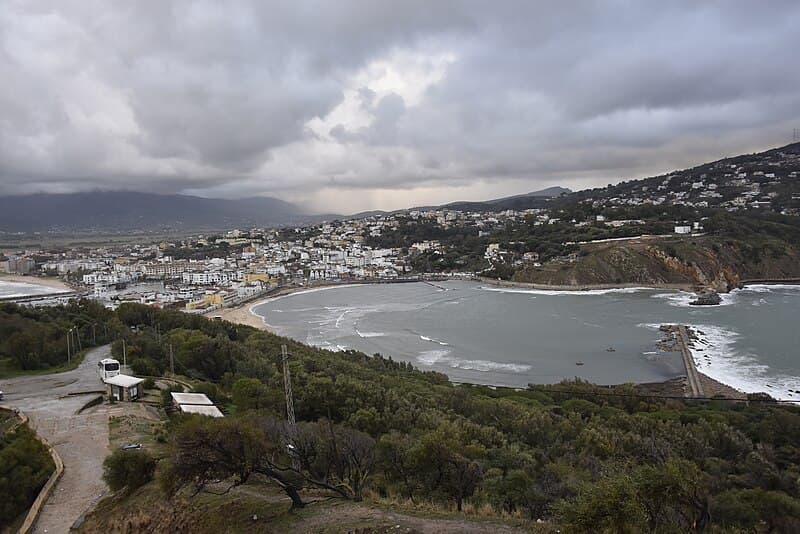
Tabarka lies in northwestern Tunisia, twenty kilometers from the Algerian border, and it's a completely different Tunisia from the one visitors to Djerba or Sousse know. Behind the town rise the Kroumirie Mountains, covered in cork oak forest and receiving over a thousand millimeters of rainfall a year — more than Prague — creating a genuine forest with springs and mushrooms. The coast is made up of rocks and coves, with the Needles rising from the sea in front of the harbor: twenty-meter sandstone pillars carved by the waves. On an islet above the harbor stands a 16th-century Genoese fortress, built when the Genoese Lomellini family controlled the local coral trade. Red coral from Tabarka's coast sustained the town for centuries and is still sold here as jewelry. Tabarka was never a major charter resort: there are only a handful of hotels, beaches are half-empty even in August, and cicadas can be heard in the evening. The season is shorter than in the south — the sea stays above twenty degrees from June to October — and in July the town hosts a jazz festival that draws half of Tunisia.

What to see

The places worth your time in Tabarka, and what to expect at each

The Needles (Les Aiguilles)

The Needles (Les Aiguilles)

western edge of town

A row of sandstone rock pillars up to twenty meters tall standing in a line at the western edge of town, right by the sea. They formed through erosion of softer rock around harder veins and create the most recognizable silhouette of northern Tunisia. A footpath runs along the coast between them.

Tip: The best light is late afternoon, when the sandstone turns red and the sun comes in low from the sea. The path between the Needles is unpaved and slippery after rain — don't attempt it in flip-flops.

Admission:
free
Time needed:
1 h
Genoese Fortress

Genoese Fortress

harbor

A 16th-century fortress on a rocky islet above the harbor, built by the Genoese Lomellini family, who managed the local coral trade. The island is now linked to the mainland by a built-up causeway you can walk right up to the walls.

Tip: Much of the fort's interior is closed off and used by the military; a visit means a walk around the ramparts and a view over the harbor and the Needles. Go up in the morning — the causeway is exposed to the sun with no shade in the afternoon.

Admission:
free
Time needed:
1 h
Diving the coral walls

Diving the coral walls

coast near the harbor

The coast between Tabarka and the Algerian border has steep rock walls, caves and tunnels at depths of ten to forty meters, covered in red coral and gorgonians. It's Tunisia's best diving area and the only spot in the Mediterranean with coral this close to shore.

Tip: The best-known sites are the Tunnels and the Caves, but both require certification. Without experience, you can do a trial dive in the bay by the fortress — visibility is clearest in September and October, once summer plankton has settled.

Admission:
trial dive from 120 TND
Time needed:
half day
Tabarka's beaches

Tabarka's beaches

east of town

A continuous strip of pale sand east of town, followed by an even emptier beach at Zouaraa, fifteen kilometers further on. The water is cooler than in the south but cleaner, and even in August there's room even on weekends. Facilities are minimal — a few stalls and hotel sections.

Tip: There's no lifeguard service at these beaches, and currents can appear after northerly winds. Swim near the hotel sections, where there's at least some oversight, and expect waves in the afternoon — northern Tunisia faces the open Mediterranean with no shelter.

Admission:
free, sunbed from 12 TND
Time needed:
full day
Bulla Regia

Bulla Regia

60 km south

A Roman city sixty kilometers to the south, where residents built underground living quarters to escape the summer heat. The subterranean villas, complete with mosaic floors and columns, survive intact because the earth protected them. Nowhere else in North Africa was building done quite this way.

Tip: The underground rooms are reached by the original staircases and are around ten degrees cooler than street level. Visit at midday, when it's hottest outside — which is exactly why the houses were built this way.

Admission:
from 8 TND
Time needed:
3 h
Chemtou

Chemtou

75 km southwest

Ancient quarries for yellow-pink numidicum marble, shipped from here across the Roman Empire, with a museum right on site. Traces of block-cutting are still visible, along with a camp for convict laborers and a bridge over the Medjerda River.

Tip: The museum, built by the Germans, is the best-presented in all of Tunisia, with English labels throughout. The quarries are a few hundred meters from the building, reached via an unpaved track that an ordinary car can't manage after rain.

Admission:
from 8 TND
Time needed:
3 h
Aïn Draham

Aïn Draham

26 km south

A mountain town eight hundred meters above sea level, with red gabled-roof houses that look more like Alsace than Africa. It snows here in winter, and it's the only place in Tunisia where snow has a chance of lasting more than a day.

Tip: The road from Tabarka runs twenty-six kilometers and climbs through switchbacks — allow thirty minutes. It's worth coming up here at midday in August, since it's about eight degrees cooler than down by the sea.

Admission:
free
Time needed:
half day
Kroumirie cork forests

Kroumirie cork forests

south of town

A mountain range between Tabarka and the Algerian border covered in cork oak, stripped of its bark every nine years. It's the greenest corner of Tunisia, with springs, mushrooms and wild boar, hunted here each autumn.

Tip: Marked trails barely exist — without a local guide, stick to the forest tracks between Aïn Draham and Hammam Bourguiba. In autumn, wear bright colors in the forest, since hunting is common.

Admission:
free
Time needed:
full day
La Galite archipelago

La Galite archipelago

80 km offshore

A group of volcanic islands eighty kilometers north of the coast, the northernmost point of Africa. It's home to Tunisia's last colony of Mediterranean monk seals, and the surrounding water is among the cleanest in the Mediterranean. The islands are protected, with limited access.

Tip: Regular excursion boats don't come here — the trip is arranged with dive centers at the harbor and requires a permit they handle. Plan for a full day and calm seas, which in Tabarka means July or August.

Admission:
excursion from 250 TND
Time needed:
full day

Photos: The Needles (Les Aiguilles) — La belle ayouty (CC BY-SA 4.0) · Genoese Fortress — The original uploader was Asram at French Wikipedia. (CC BY-SA 2.5) · Diving the coral walls — Amine Ltaief (CC BY-SA 4.0) · Tabarka's beaches — NadiaHamdi (CC BY-SA 4.0) · Bulla Regia — Houss 2020 (CC BY-SA 4.0) · Chemtou — Daniela Gauss (CC BY-SA 3.0) · Aïn Draham — Noussawolf1 (CC BY-SA 3.0) · Kroumirie cork forests — Aymen (CC BY-SA 2.0) · La Galite archipelago — Vallee (CC0)

Where to stay

Areas and districts, matched to the kind of trip you are taking

Center and main avenue

Best for: first-time visitors and evening life

Most of the town's cafés, bakeries and shops line the palm-lined Avenue Habib Bourguiba. Small guesthouses here cost a fraction of a hotel, and everything is within walking distance — the harbor, the fortress and the start of the beach. In July the jazz festival fills the town; otherwise it's quiet.

Harbor and fortress headland

Best for: diving and fish restaurants

The fishing and yachting harbor below the fortress, where dive boats depart and the morning catch is sold. This is where the town's best fish restaurants are, along with an afternoon view of the causeway and fortress. Accommodation is limited here, a ten-minute walk from the center.

Coastal hotel zone

Best for: beach and golf

A strip of several large hotels east of town along the sandy beach, with a golf course set among pines. It's the most comfortable base for a stay, but there's nothing outside the hotel grounds, and the center is a five-dinar, three-kilometer taxi ride away. The beach stays half-empty even in August.

Aïn Draham and the mountains

Best for: cooler summers and nature

A mountain resort eight hundred meters above sea level, with remnants of colonial-era hunting lodges, where you can sleep without air conditioning even in August. Tunisians come here for the snow in winter. It's half an hour down to the sea, so forest and beach can be combined in a single day.

Getting around

From the airport

Tabarka has its own airport, Tabarka–Aïn Draham, eighteen kilometers east, but service is only seasonal and irregular, so visitors almost always travel via Tunis. From Tunis–Carthage Airport it's a hundred and seventy kilometers along the coast road or via Béja, a two-and-a-half-hour drive. Without a car, a louage shared taxi runs from Tunis's Bab Saadoun station until roughly mid-afternoon and costs about fifteen dinars. There's no train service to Tabarka — the line ends at Jendouba.

Tunis–Carthage (TUN) · 170 km

  • Louage from Bab Saadoun· 3 h· 15 TND
  • Private transfer· 2 h 30 min· 250 TND
  • Rental car· 2 h 30 min· 110 TND / day

Tabarka–Aïn Draham (TBJ) · 18 km

  • Taxi· 20 min· 25 TND
  • Hotel transfer· 20 min· included in package

Around town

The town is small, and everything is within a twenty-minute walk. For day trips, though, a car is practically essential: the mountains, Bulla Regia and Chemtou are only reachable by road, and public transport is limited to louage shared taxis between larger towns. Yellow taxis in town use meters and cost three to five dinars per ride; for a full-day excursion, a driver can be hired for roughly a hundred and fifty. The road to Aïn Draham is narrow, winding and slick after rain — expect slow going, and fog above seven hundred meters can make visibility genuinely poor.

Yellow taxiUnder five dinars around town; a fixed price is negotiated for a full-day mountain trip. · 3 TND
LouageShared vans to Tunis, Jendouba and Aïn Draham; they leave once full, with the last one in the afternoon. · 5 TND
Rental carThe most sensible option — without one, the Roman sites and forests are hard to reach. · 110 TND / day
Dive boatDive centers at the harbor run trips to sites along the coast, twice a day in season. · 120 TND

Useful apps: Google Maps, Bolt, Maps.me

When to go

Tabarka has the shortest swimming season in Tunisia. The sea doesn't pass twenty degrees until the second half of June, peaking at twenty-six in August and twenty-five in September, and still at twenty-two in October. Thanks to the mountains nearby, the air is more bearable than in the south — around thirty-two in August. Spring, on the other hand, is the finest season anywhere in Tunisia: in April and May the landscape turns green and blooms, with ideal weather for hikes in Kroumirie. From November to March, Tabarka is rainy, with more than twelve rainy days in December, and it snows in the mountains.

Best time

July through October for the sea, April and May for nature

What to avoid

November through March, when it rains and hotels run limited service

MonthJanFebMarAprMayJunJulAugSepOctNovDec
Day15°16°18°20°23°28°31°32°29°25°20°16°
Night6°6°8°9°13°16°19°20°18°15°11°8°
Rainy days1110986312581012
Sea15°14°14°16°18°21°24°26°25°22°19°16°

Food & drink

Northern Tunisia cooks differently from the south: more fish, more vegetables and less mutton. In Tabarka, the catch of the day is grilled right by the harbor, fish couscous is a local specialty, and in the mountains there's wild boar, which appears here almost uniquely in this Muslim country, eaten occasionally by locals and mostly by European visitors. Kroumirie is also mushroom country, and in autumn taverns serve mushrooms sautéed in butter. A local specialty is slightly bitter arbutus honey, sold along the road to Aïn Draham.

What to try

Brik

A thin sheet of malsouka pastry fried with egg, tuna and parsley. The yolk stays runny inside, so the first bite is taken from a corner, eaten by hand over the plate.

Couscous

The whole country's Friday dish: semolina steamed over a pot of meat and vegetables. In coastal towns it's also made with fish, a version you won't get at a hotel buffet.

Mechouia salad

Roasted peppers, tomatoes and garlic crushed in a mortar, served with tuna, egg and olives. Served cold as a starter, it's the best way to gauge the strength of the local harissa.

Ojja

A tomato and harissa skillet dish with eggs cracked in, usually with merguez sausage or shrimp. Quick, spicy and the cheapest hot meal at any local tavern.

Lablabi

A chickpea soup with garlic and cumin, into which you crumble stale bread right in the bowl. A workers' breakfast, sold in the morning and usually sold out by midday.

Harissa

A paste of roasted chili, garlic and cumin, served with bread before the menu even arrives. Tunisian harissa is spicier than the Moroccan version — taste the first spoonful carefully.

Makroud and pine nut tea

Diamond-shaped semolina pastries filled with dates and soaked in honey, paired with strong sweet green tea with a handful of pine nuts floating on top.

Grilled fish by the kilo

Choose your sea bream, sea bass or mullet from the display case and pay by weight. The price per kilo is usually posted on a board — have the fish weighed in front of you.

What it costs

Coffee on the main avenue

2–3 TND

Sandwich or brik

4–7 TND

Grilled fish by the harbor

30–55 TND per person

Celtia beer, 0.5 l

7–10 TND

Two sunbeds with umbrella

12–20 TND

Trial dive

from 120 TND

Taxi to Aïn Draham

40–60 TND

Entry to Bulla Regia

8 TND

Indicative prices that change over time — treat them as a guide, not a price list.

Practical information

SocketsCEuroplug, two round pinsEFrench, with earth pin
Voltage230V / 50Hz
Tap waterDo not drink tap water — Don't drink the tap water — it's chlorinated, hard and has an unpleasant taste in summer. A liter and a half of bottled water costs under a dinar at a shop, four times that at a hotel. It's best to avoid ice in drinks outside hotels, and wash fruit with bottled water.
TippingTipping is expected in small change: round up at a café, leave around ten percent at a restaurant, and give hotel porters a dinar per bag. Card terminals don't allow adding a tip, so keep some one- and five-dinar notes on hand. Guides and drivers on a full-day trip expect roughly five dinars per person.
Driving on theright
SafetyTabarka is a quiet town with low crime and none of the pushy sales tactics found in Sousse or Tunis. Two things to watch for: swimming at beaches without lifeguards, where currents form after northerly winds, and driving mountain roads, which are narrow, without guardrails and slick after rain. The Algerian border lies twenty kilometers away and is off-limits — it's a controlled military zone.
Opening hoursResort shops are open from nine until late evening, including Sundays; medinas and souks close around midday on Fridays for prayers. Government offices and banks run from eight to four, or just until one in summer. During Ramadan, the daily rhythm shifts: cafés and restaurants outside hotels don't open until after sunset, while hotel service continues as normal.
Customs & etiquetteTunisia is a secular but Muslim country: swimwear is fine at the resort, but wear a t-shirt and trousers or a knee-length skirt in town and in the medina. Tourists usually can't go beyond the courtyard of a mosque. The left hand isn't used for eating or handing over objects. Photographing people, especially women, without asking is frowned upon, and it's forbidden near police and military sites.
A few local wordsHello — As-salamu alaykumThank you — ShukranNo, thank you — La, shukranHow much does it cost? — B'kaddech?That's too expensive — Ghali barsha

How to plan your days

1 day

A day in Tabarka

  1. 1Morning at the fortress on the headland and a walk along the causeway.
  2. 2Fish lunch at one of the taverns by the harbor.
  3. 3Afternoon at the rocky Needles and the coastal footpath.
  4. 4Evening swim and coffee on the main avenue.

2 days

Two days with the mountains

  1. 1Day one as above.
  2. 2Day two, drive the switchbacks up to Aïn Draham in the morning.
  3. 3Walk through the cork forest and lunch at a mountain restaurant.
  4. 4Head back down to the sea for an afternoon swim.

3 days

Three days including Roman cities

  1. 1Days one and two as above.
  2. 2Day three, head early to Bulla Regia for the underground villas.
  3. 3Continue to Chemtou for the marble quarries and museum.
  4. 4Return via Jendouba in the evening.
  5. 5If time remains, a dive at the coral walls or the beach at Zouaraa.

Day trips

Bizerte

150 km · 2 h by car

Africa's northernmost city, with an old fishing harbor between two forts and the prettiest beaches on the northern coast near Cap Angela. Can be combined with the drive back to Tunis, since it lies along the way.

Dougga

120 km · 2 h by car

North Africa's best-preserved Roman city, spread across a hillside above a valley, with a capitol, a theater seating three and a half thousand, and a Punic mausoleum. The site is large and takes two to three hours to walk, with little shade.

Lake Ichkeul

110 km · 1 h 40 min by car

A UNESCO-listed national park around a shallow lake where tens of thousands of waterbirds, including geese and flamingos, winter. A museum and viewing trail sit on the hill above the lake. Best from December to February; in summer the lake shrinks and the birds are gone.

Frequently asked questions

How is Tabarka different from Sousse or Djerba?+

It's the green, mountainous north, not the desert south. Cork oak forests grow just outside town, it rains more here than in Prague, and the coast is rocky, with coves rather than long sandy beaches. There are only a handful of hotels, so crowds are absent even in August, and the sea is two to three degrees cooler. Anyone wanting all-inclusive and guaranteed heat should go elsewhere; anyone wanting nature and quiet should come here.

When can you swim at Tabarka?+

From mid-June to the end of October. The sea reaches twenty-one degrees in June, twenty-six in August, twenty-five in September, and still twenty-two in October. Spring is too cold for swimming — the water is eighteen degrees in May — but it's the best time for mountain hikes.

How do I get to Tabarka?+

Almost always via Tunis–Carthage Airport, a hundred and seventy kilometers away and two and a half hours by car. The local Tabarka–Aïn Draham airport only has irregular seasonal service. Without a car, a louage shared taxi leaves from Tunis's Bab Saadoun station for fifteen dinars, but the last one departs in the afternoon — arrange a transfer for a late arrival.

Do I need a car in Tabarka?+

Not in town, but yes for day trips. There's no public transport to Bulla Regia, Chemtou or the Kroumirie forests, and a taxi for a full day costs a hundred and fifty dinars, more than a rental car. The roads are empty and well signposted, except the mountain road to Aïn Draham, which is narrow and slow in fog.

What is diving like at Tabarka?+

For rock walls, tunnels and caves at depths of ten to forty meters, covered in red coral and gorgonians — a rarity in the Mediterranean this close to shore. Visibility is best in September and October. A trial dive for beginners costs from a hundred and twenty dinars; the Tunnels and Caves sites require certification.

Is it worth coming for the jazz festival?+

If you don't mind the town being full and accommodation twice the usual price, then yes — the festival takes place in July in a venue below the fortress and features international acts. Book accommodation months ahead. Anyone looking for quiet should avoid that particular week.

Is Tabarka suitable for families with children?+

More suited to families with older children. The beaches have no lifeguard service, the seabed near the rocks can be uneven, and currents appear after northerly winds. On the plus side, there's space, quiet and nature for excursions. Families with toddlers are better served by Djerba or Hammamet, with their shallow, gently sloping seabeds.

Can you visit Tabarka outside summer?+

Yes, but not for the sea. April and May are the most beautiful months of the year — the landscape is green and blooming, and the weather is ideal for hiking in Kroumirie. Autumn is mushroom season. Winter is rainy, with rain on twelve days in December, and it snows in the mountains, which draws Tunisians for weekend trips to Aïn Draham.

Visa Requirements

Check the latest visa requirements for entering this country. Some nationalities may need to apply for a visa or e-visa before travel.

Check visa requirements

Language

Arabic / French

Currency

TND

Timezone

Africa/Tunis

Dial Code

+216

Population

12.5M

Area

163,610 km²

Voltage

230V / 50Hz

Driving Side

Right

Top Hotels in Tabarka

Live prices from 500+ properties

Loading hotels...

More destinations in Tunisia

Planning a trip to Tabarka?

Compare hundreds of hotels, find the best price, and book with free cancellation on TravelManiac.