Hotels in Valencia

Futuristic white structures in a former riverbed, a Gothic exchange and authentic paella

Valencia

LanguageEnglish
CurrencyEUR
TimezoneGMT+1
Temperature12-32 °C
Dial Code+34
Population47.6M
Area505,990 km²
SocketsType C / Type F
Tap waterDrinkable

Discover Valencia

Valencia is Spain's third-largest city, on the Mediterranean coast, and the birthplace of paella. It combines things that are usually kept apart elsewhere: a historic center with a Gothic cathedral holding a chalice venerated as the Holy Grail, the UNESCO-listed silk exchange La Lonja, and one of Europe's most beautiful markets — and, a short distance away, Santiago Calatrava's futuristic City of Arts and Sciences, white structures like whale skeletons rising over reflecting pools. Both are linked by the nine-kilometer Turia park, laid out in the former riverbed after the river was diverted around the city following a devastating flood in 1957. At the end of the park begin the wide sandy beaches of Malvarrosa and the fishing quarter of Cabanyal. Valencia is cheaper and calmer than Barcelona, gets more sun and fewer tourists, and its residents get around by bike and dine on terraces in the evening. In March, hundreds of giant papier-mâché and wood figures burn during the Fallas festival, turning the city into a week-long fireworks show.

What to see

The places worth your time in Valencia, and what to expect at each

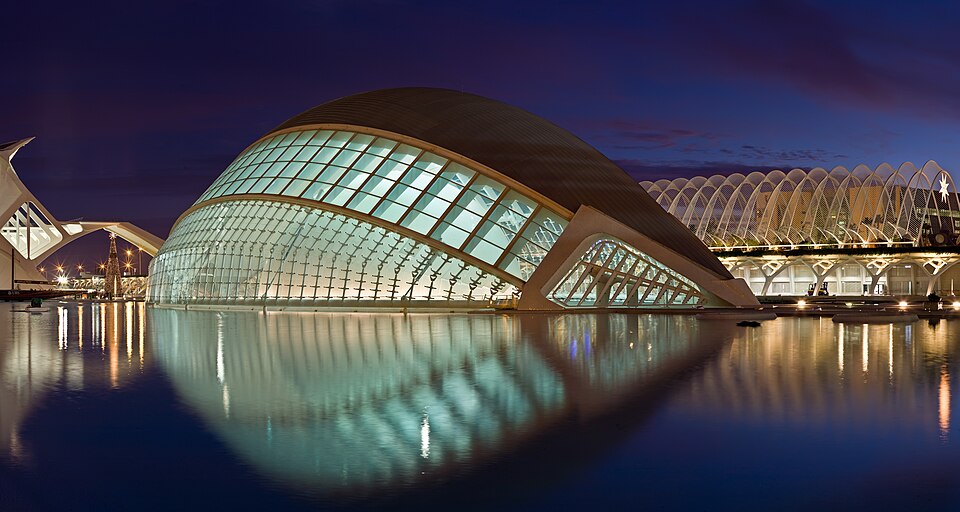
City of Arts and Sciences

City of Arts and Sciences

Ciutat de les Arts i les Ciències

Turia

A complex of futuristic structures by architect Santiago Calatrava, built in the former bed of the Turia River, including the Palau de les Arts opera house, the Príncipe Felipe science museum, the eye-shaped Hemisfèric cinema and planetarium, and the Umbracle botanical garden. The white structures over turquoise pools are the symbol of modern Valencia.

Tip: The grounds can be walked and photographed from outside for free — for most people, that's the main draw. It's prettiest at dusk, when the buildings light up and reflect in the water. The science museum is good for kids; adults will find the exterior enough. A combined ticket with the Oceanogràfic is better value. From the center, it's a forty-minute walk through Turia park, or fifteen by bike.

Admission:
free from outside, museum around 9 €
Time needed:
2 h
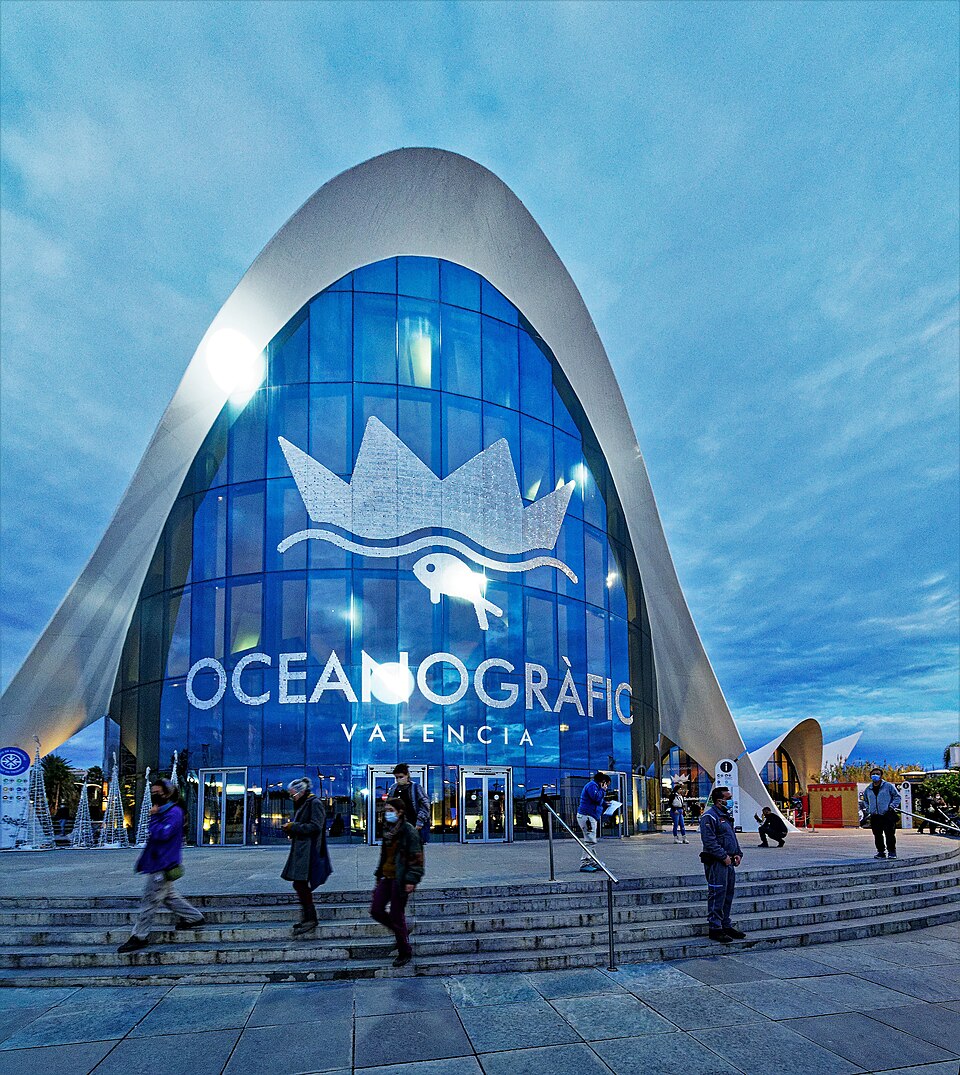
Oceanogràfic

Oceanogràfic

L'Oceanogràfic

Turia

Europe's largest aquarium, part of the City of Arts and Sciences, with underwater tunnels, sharks, belugas, penguins and marine ecosystems from every ocean. The underwater Submarino restaurant building and the lily-pad-shaped pavilion were designed by Félix Candela.

Tip: Allow four hours — the grounds are huge. Tickets are cheaper online. The shark tunnel is best in the morning, when it's less crowded. The Submarino restaurant, surrounded by the aquarium, is pricier but memorable. The best day out in Valencia for families with children.

Admission:
around 40 €
Time needed:
3–4 h
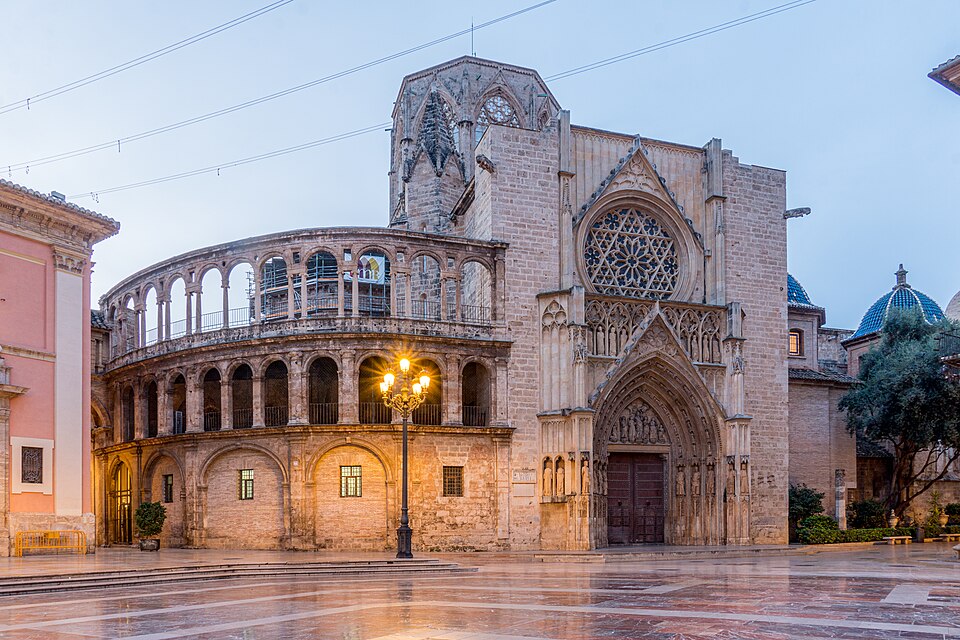
Cathedral and the Miguelete tower

Cathedral and the Miguelete tower

Catedral de València

Ciutat Vella

Built from the thirteenth century on the site of a mosque, the cathedral combines Romanesque, Gothic and Baroque styles. Its chapel holds an agate chalice venerated by the church as the Holy Grail of the Last Supper. The Miguelete bell tower has two hundred seven steps and views over the whole city.

Tip: The chalice is in the Gothic Chapel of the Holy Grail immediately to the right of the entrance. Access to the Miguelete tower is separate, and the spiral stairs are narrow. Every Thursday at noon, the Water Tribunal — Europe's oldest court — convenes before the Apostles' Door to settle irrigation disputes as it has since medieval times; it lasts a few minutes and is conducted in Valencian.

Admission:
around 9 €, tower around 3 €
Time needed:
1.5 h
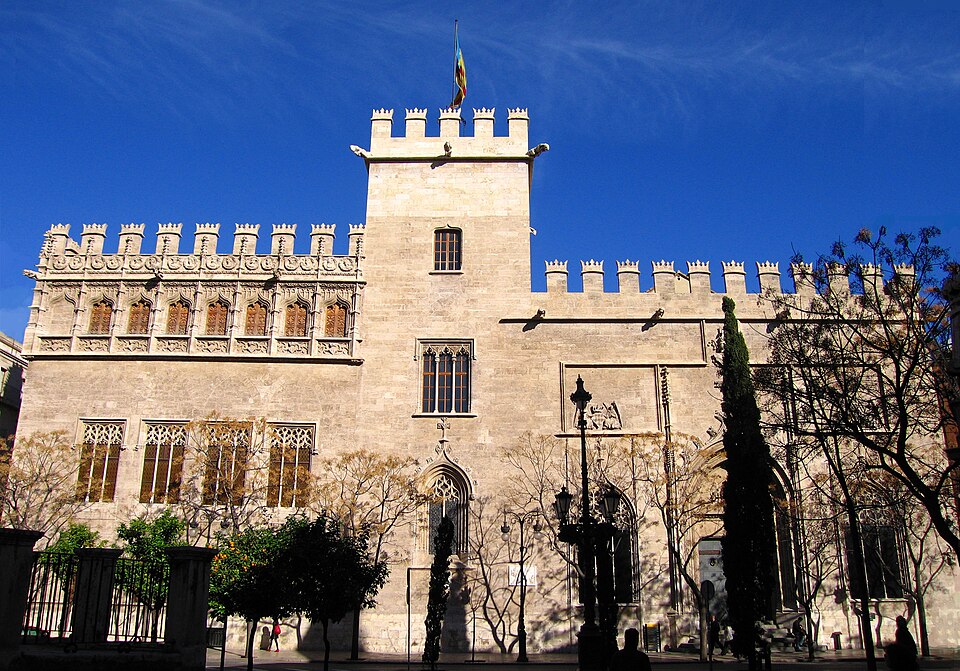
La Lonja de la Seda

La Lonja de la Seda

La Llotja de la Seda

Ciutat Vella

A Gothic silk exchange from the late fifteenth century, listed as UNESCO World Heritage. The columned trading hall has spiral columns that branch out like palm trees into the vaulted ceiling. Silk was traded here, and the building also housed a commercial court and a debtors' prison.

Tip: The main hall is small but one of the most beautiful Gothic spaces in Europe; forty minutes is enough for a visit. Look for grotesque gargoyles on the walls, including erotic ones. Entry is free on Sundays. The Central Market sits right across the street, so both can be combined into one morning.

Admission:
around 2 €
Time needed:
45 min
Central Market

Central Market

Mercat Central

Ciutat Vella

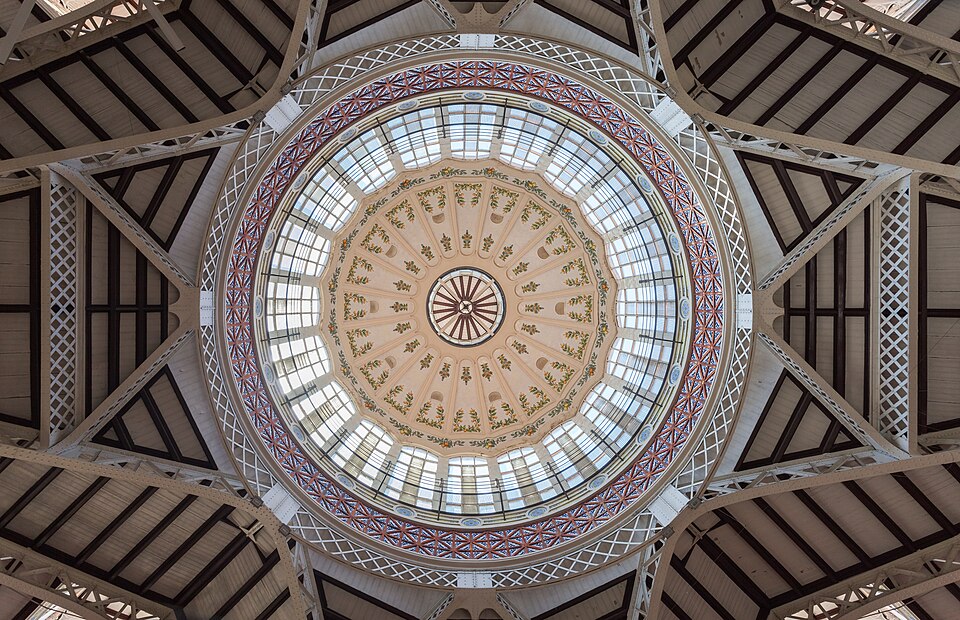
An Art Nouveau market hall from 1928 with iron structure, ceramics and a glass dome, one of Europe's largest with more than three hundred stalls. It sells fruit, vegetables, fish, meat, jamón, cheeses and spices from Valencian farmers.

Tip: Best between nine and eleven in the morning, when locals do their shopping. Closed in the afternoon and on Sundays. Inside is the Central bar by chef Ricard Camarena, good for a quick lunch at the counter. Pick up oranges or horchata. The 1916 Colón market in Eixample is smaller and has cafés.

Admission:
free
Time needed:
1 h
Turia Gardens

Turia Gardens

Jardí del Túria

Turia

A nine-kilometer park in the former bed of the Turia River, diverted around the city after a devastating flood in 1957. Paths, playgrounds, running tracks, sports facilities and gardens run under eighteen bridges all the way to the City of Arts and Sciences.

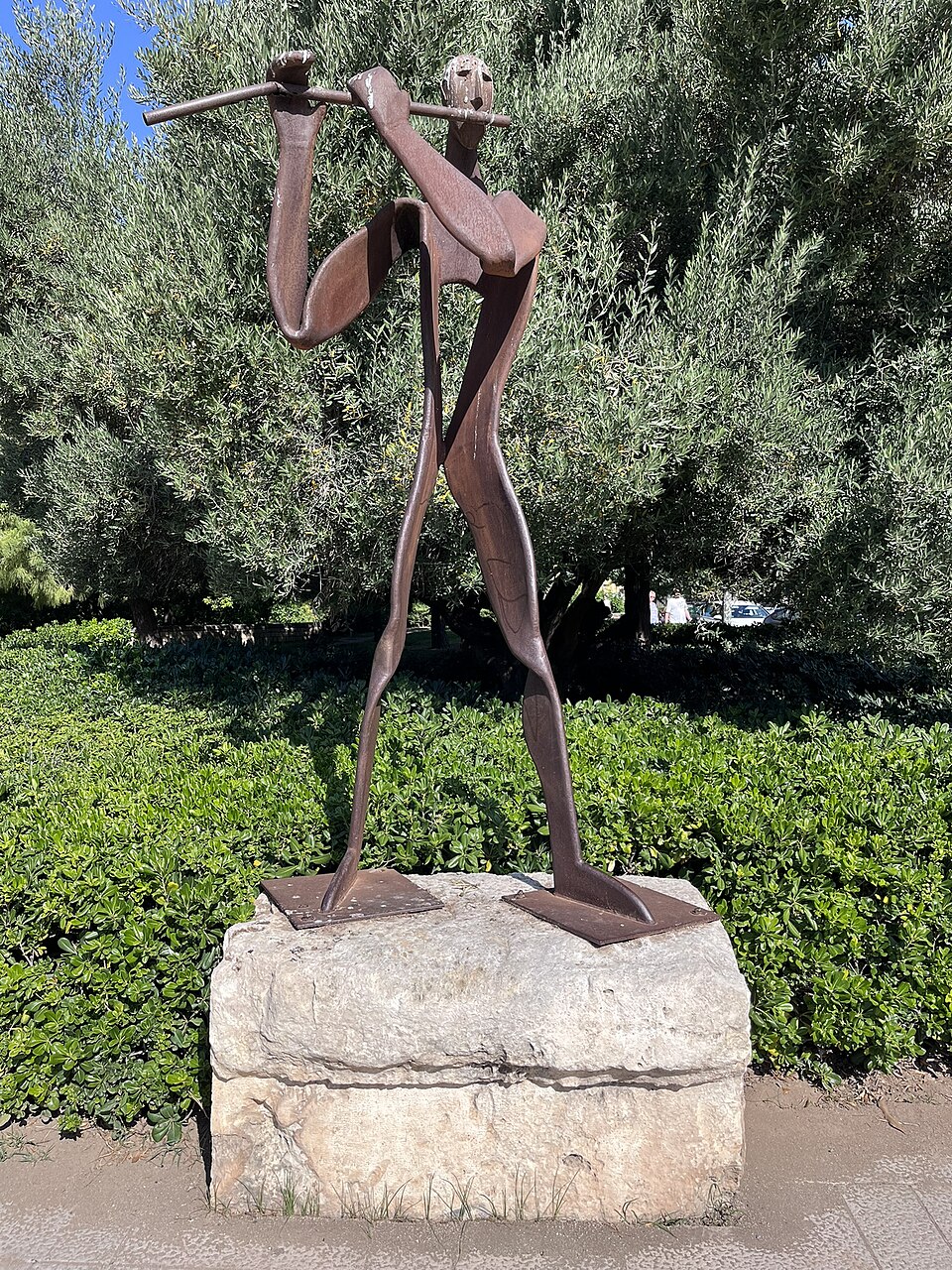
Tip: Best done by renting a bike and riding the whole park from the Bioparc to the City of Arts and Sciences in about an hour. The Gulliver playground, with a giant figure kids climb over, is a highlight. Locals jog here in the morning and sit around in the evening. Shade is everywhere, making it an ideal summer walk.

Admission:
free
Time needed:
1–2 h
Torres de Serranos

Torres de Serranos

Torres de Serrans

Ciutat Vella

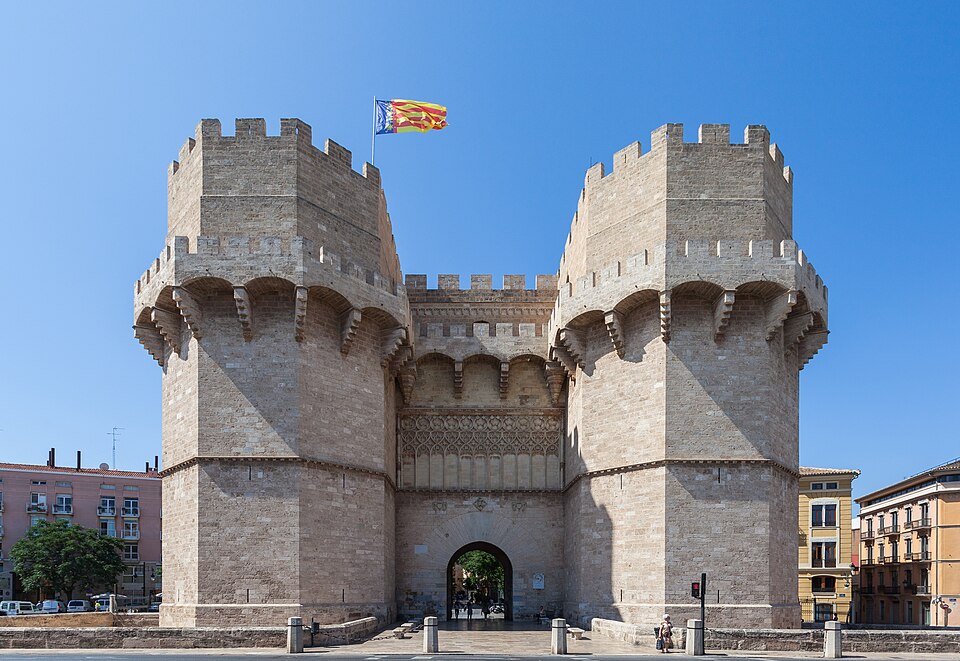
A fourteenth-century Gothic city gate with two massive towers, one of only two surviving gates of the medieval walls. It served as the main entrance to the city from the north and later as a prison for nobility.

Tip: Climbing the towers rewards you with excellent views over the old town and Turia park. Entry is free on Sundays. During Fallas, the festivities begin here with a proclamation from the towers. The other surviving gate, Torres de Quart, still bears pockmarks from Napoleonic cannonballs.

Admission:
around 2 €
Time needed:
30 min
Plaça de la Mare de Déu

Plaça de la Mare de Déu

Ciutat Vella

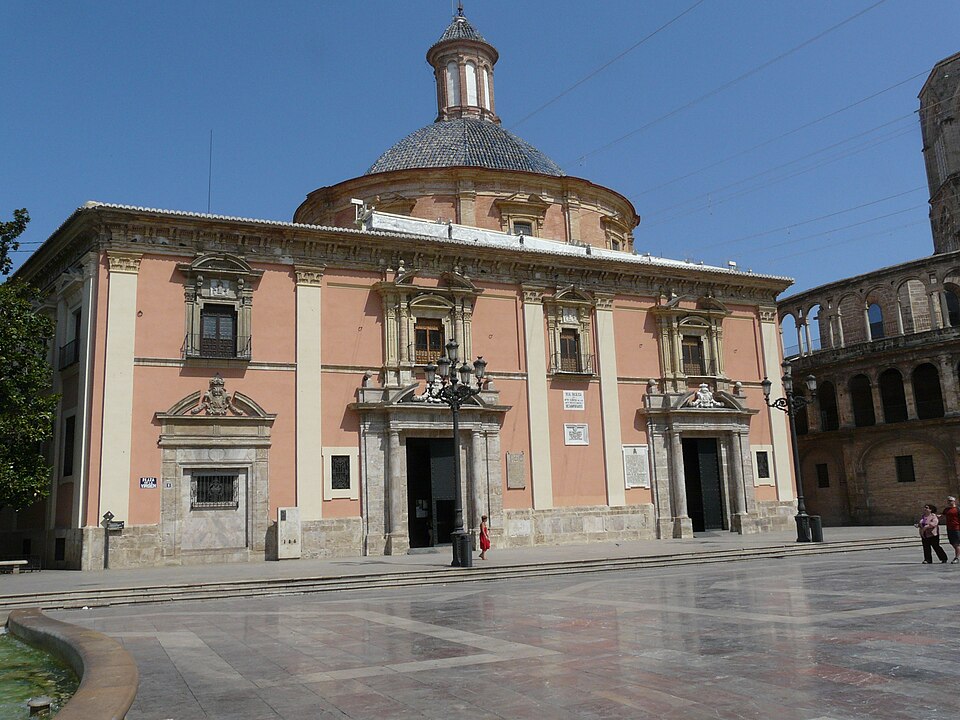
Valencia's prettiest square, between the cathedral, the Basilica of Our Lady of the Forsaken and the Generalitat palace, with a fountain symbolizing the Turia River and its irrigation canals. A Roman forum once stood here.

Tip: The basilica holds a statue of the Virgin of the Forsaken, patron saint of Valencia; during Fallas, a giant flower figure made of thousands of bouquets is built in front of it. The terrace cafés around the square are pricier but worth it in the evening, with the cathedral lit up. Beneath the square, the L'Almoina archaeological museum shows Roman ruins visible through a glass floor.

Admission:
free
Time needed:
30 min
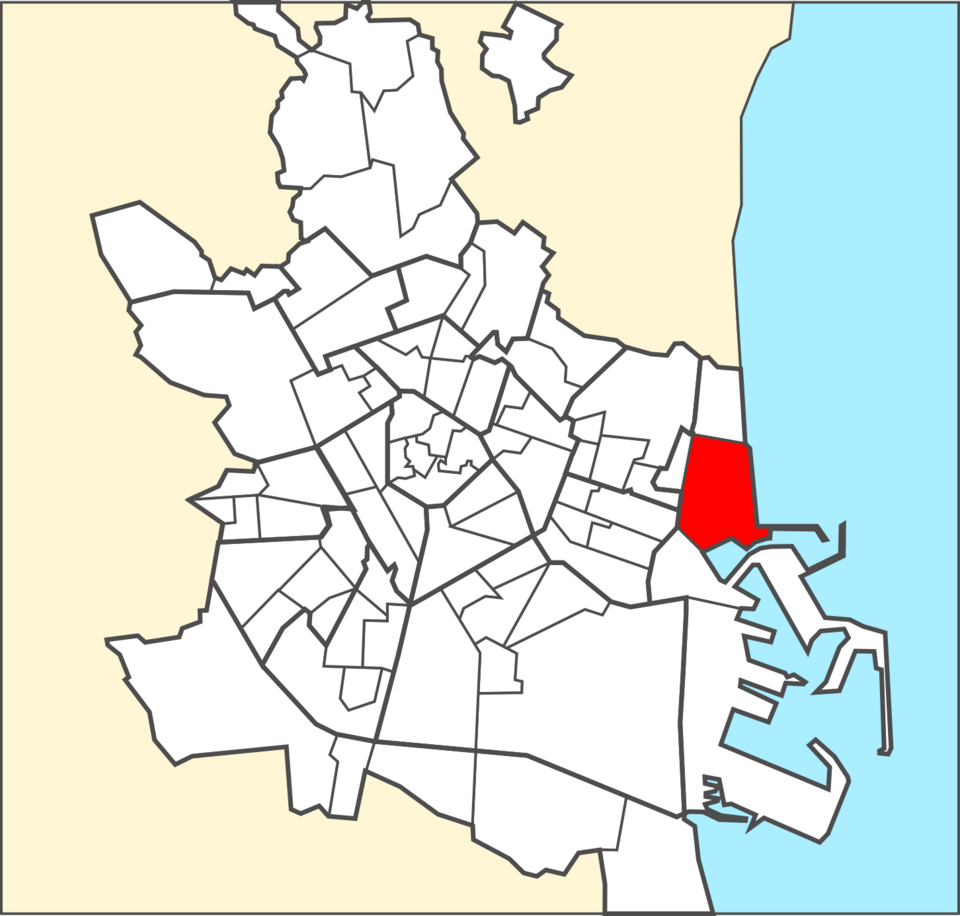
Cabanyal and Malvarrosa beach

Cabanyal and Malvarrosa beach

El Cabanyal i la Malva-rosa

Cabanyal

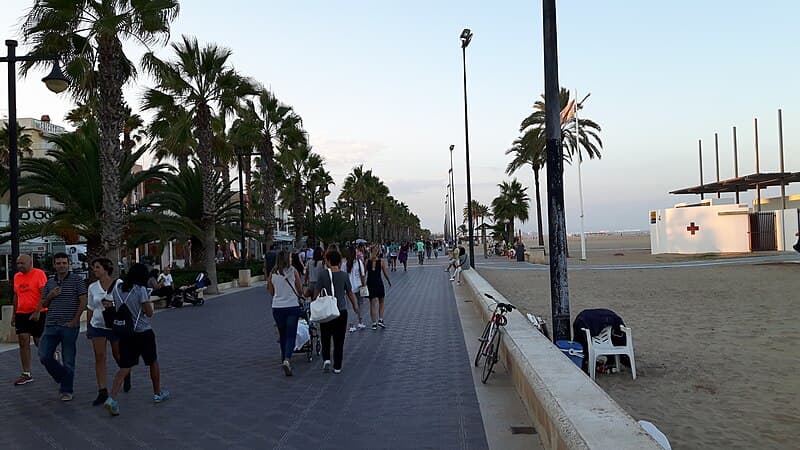
A former fishing quarter by the sea, with houses fronted in colorful tiles, backing onto the wide sandy Malvarrosa and Las Arenas beaches with their promenade. This is where paella is eaten at the beachside restaurants.

Tip: Cabanyal has the most authentic bars — try Casa Montaña, a traditional bodega dating from 1836. The beach is wide and clean, with sunbeds and showers. La Pepica and Casa Carmela restaurants cook paella over wood; book ahead for lunch. It's a twenty-minute tram or bus ride from the center.

Admission:
free
Time needed:
half day

Photos: City of Arts and Sciences — Diliff (CC BY-SA 3.0) · Oceanogràfic — Holger Uwe Schmitt (CC BY-SA 4.0) · Cathedral and the Miguelete tower — Fernando Pascullo (CC BY-SA 4.0) · La Lonja de la Seda — Felivet (Public domain) · Central Market — Diego Delso (CC BY-SA 4.0) · Turia Gardens — MCAE Consulting (CC0) · Torres de Serranos — Diego Delso (CC BY-SA 4.0) · Plaça de la Mare de Déu — Pere López (CC BY-SA 3.0) · Cabanyal and Malvarrosa beach — Enrique Íñiguez Rodríguez (Qoan) (CC BY-SA 3.0)

Where to stay

Areas and districts, matched to the kind of trip you are taking

Ciutat Vella

Best for: history, walkability

Hotels in the historic center around the cathedral, the market and La Lonja, within walking distance of every sight. The El Carmen district is full of bars, street art and nightlife. Best for a short stay.

Ruzafa

Best for: restaurants, nightlife

A multicultural neighborhood south of the center with Valencia's best restaurants, cafés and bars. A ten-minute walk to the center, close to the train station. Young and lively.

City of Arts and Sciences

Best for: modern stays, families

Modern hotels near Calatrava's buildings, close to the Oceanogràfic and Turia park. Quiet, fifteen minutes to the center by bike. Well suited to families.

Malvarrosa beach and Cabanyal

Best for: the sea, summer

Beachfront hotels with sea views, ideal for combining beach and city. Twenty minutes to the center by tram. Most pleasant in summer.

Getting around

From the airport

Direct low-cost flights connect Prague to Valencia, with a flight time under three hours. Spain is in the Schengen area, so Czech travelers can fly with just their ID card. Manises airport is eight kilometers from the center and connected by metro. From Joaquín Sorolla station, the AVE high-speed train reaches Madrid in under two hours, and Barcelona in three.

Valencia Manises (VLC) · 8 km

  • Metro line 3 or 5· 25 min· around 5 €
  • Taxi· 20 min· 25 €
  • Aerobus· 25 min· around 3 €

Around town

Valencia is flat and compact; the center is entirely walkable, and the best way to get around is by bike — there are over a hundred fifty kilometers of cycle paths, and Turia park itself is one long bike route. The Valenbisi bike-share system is cheap. Metro and tram connect the airport, the center and the beaches. EMT buses cover the whole city. Taxis are cheap. Bus 25 runs to the Albufera from the center.

Metro and tramZone-based fares, SUMA card. · 1.50 €
EMT busPaper ticket or contactless. · 1.50 €
ValenbisiBike share, weekly registration. · 15 € per week
TaxiCheap, within the center. · 4 €

Useful apps: Google Maps, Moovit, Cabify, El Tiempo AEMET

When to go

Valencia has more than three hundred sunny days a year. The best time is from April to June and September to October, with temperatures of twenty to twenty-eight degrees and a warm sea. Summer is hot and humid at around thirty degrees; beaches are packed and the city empties out on weekends. Fallas, from 15 to 19 March, is the biggest festival — giant figures, firecrackers every day at two in the afternoon, and a final night when everything burns; hotels are expensive and the city is loud. Winter is mild at around sixteen degrees. In autumn, flash floods are a risk, and caused devastating flooding south of the city in 2024.

Best time

April–June, September–October

What to avoid

August for the humidity, Fallas if you want peace and quiet

MonthJanFebMarAprMayJunJulAugSepOctNovDec
Day16°17°19°21°24°28°30°31°29°25°20°17°
Night7°8°10°12°15°19°22°22°20°16°11°8°
Rainy days444553125555
Sea14°14°14°16°18°22°25°27°25°22°19°16°

Food & drink

Valencia is the birthplace of paella, and authentic Valencian paella is made with chicken, rabbit, green beans and snails — not seafood, which belongs in arroz a banda or paella de marisco. It's cooked over wood and eaten at lunch, never dinner; locals don't consider paella for dinner a proper meal. The best paella restaurants are on Malvarrosa beach and in El Palmar by the Albufera. In the heat, people drink horchata with fartons and agua de Valencia. Tapas bars in Ruzafa and Cabanyal are excellent and cheap. Prices are lower than in Barcelona.

What to try

Paella

Rice cooked in a wide, shallow pan, originally from Valencia. The authentic version uses rabbit and chicken; the seafood version is more of a tourist favorite, but still good. It's a lunch dish, not dinner, and ordered for two or more.

Horchata and fartons

An iced drink made from tiger nuts, sweet and slightly nutty, served with elongated sweet pastries called fartons for dipping. A Valencian classic for summer afternoons.

All i pebre

Eel from the Albufera stewed in a sauce of garlic, paprika and potatoes. A traditional dish of the fishermen of El Palmar.

Agua de Valencia

A cocktail of cava, orange juice, vodka and gin, served in a pitcher. It sounds innocent but packs a punch.

Tapas

Small portions ordered gradually to share alongside drinks. In Andalusia, many bars give them free with a drink; on the eastern coast, they're charged separately.

Menu del día

A fixed-price three-course lunch with bread and a drink, legally required on weekdays. The cheapest way to eat well in Spain.

Arroz negro and arroz a banda

Seafood rice dishes: arroz negro is blackened with squid ink and served with aioli, while arroz a banda is cooked in fish stock. Both are made in a paella pan and eaten at lunch.

Esgarraet

A salad of roasted red peppers and dried cod with garlic and olive oil. A typical Valencian starter to have with beer.

What it costs

Horchata with fartons

3–5 €

Tapa

3–5 €

Lunch set menu

12–16 €

Paella for two

30–50 €

Draft beer (caña)

2–3 €

Metro from the airport

around 5 €

Oceanogràfic

around 40 €

Night at a 3-star hotel for two

80–140 €

Indicative prices that change over time — treat them as a guide, not a price list.

Practical information

SocketsCEuroplug, two round pinsFSchuko
Voltage230V / 50Hz
Tap waterTap water is drinkable — Tap water in Spain is safe and hygienic, but along the southern coast it's quite hard and tastes of chlorine, so even locals routinely buy bottled water. At restaurants, tap water — called 'agua del grifo' — must be provided free on request.
TippingTipping isn't mandatory, and Spaniards themselves tip lightly — small change at a café, rounding up or adding five percent at a restaurant. Ten percent is the upper limit, given in cash, since card terminals rarely have a tip option.
Driving on theright
SafetyThe real risk is pickpocketing, and it's genuine — in crowded metro cars, at the market and on restaurant terraces, where bags hang on the back of chairs. Carry documents and money separately, and never leave your phone on the table. The center is safe at night; just avoid the deserted industrial areas near the port. The emergency number is the standard European 112, and operators speak English.
Opening hoursSmall shops take a midday siesta roughly from half past one to five; chains and shopping centers stay open continuously until nine in the evening. Museums are closed on Mondays, and many offer free entry in the last two hours on Sunday. Restaurant kitchens open at two for lunch and eight for dinner.
Customs & etiquetteLunch runs from two to four, dinner after nine — arriving at a restaurant at seven often means an empty room and a closed kitchen. Swimwear belongs on the beach: walking around town shirtless or in swimwear is fined in most coastal towns, and fines are genuinely enforced. Greetings are a handshake, or two cheek kisses between acquaintances. Spaniards talk loudly; it's not an argument.
A few local wordsGood day — Bon dia (Valencian) / Buenos díasThank you — Gràcies / GraciasPlease — Per favor / Por favorHow much does it cost? — Quant costa? / ¿Cuánto cuesta?The bill, please — El compte, per favor / La cuenta, por favorCheers — Salut / Salud

How to plan your days

1 day

Valencia in one day

  1. 1Morning at the Central Market and La Lonja.
  2. 2The cathedral, Miguelete tower and Plaça de la Mare de Déu.
  3. 3Paella lunch at Malvarrosa beach.
  4. 4Afternoon cycling through Turia park.
  5. 5Evening at the illuminated City of Arts and Sciences.

2 days

Two days in Valencia

  1. 1Day 1: the market, La Lonja, the cathedral, Torres de Serranos.
  2. 2Day 1 evening: El Carmen and Ruzafa.
  3. 3Day 2: the City of Arts and Sciences and the Oceanogràfic.
  4. 4Day 2 afternoon: the beach and Cabanyal.

3 days

Three days with the Albufera

  1. 1Day 1: the old town and the market.
  2. 2Day 2: the Oceanogràfic and the City of Arts and Sciences.
  3. 3Day 3: the Albufera, a boat ride and paella in El Palmar.
  4. 4Day 3 evening: Malvarrosa beach.

Day trips

Albufera and El Palmar

15 km · 30 min by bus

A nature park with a lagoon and rice paddies south of the city, where the rice for paella is grown. At sunset, traditional boats take visitors out on the lagoon. The village of El Palmar has the best restaurants for paella and eel all i pebre. Bus 25 runs from the center.

Xàtiva

60 km · 1 h by train

A town with a castle on a mountain ridge, birthplace of two Borgia popes. The castle offers views over the valley. The old town, with its churches and fountains, is calm and sees few tourists. Trains run hourly from Nord station.

Sagunto

30 km · 30 min by train

An Iberian and Roman city whose siege by Hannibal in 219 BC triggered the Second Punic War. A Roman theater and a hilltop fortress stretch a kilometer along the ridge with sea views. Trains run from Valencia every half hour.

Frequently asked questions

How many days for Valencia?+

Two to three days for the old town, the City of Arts and Sciences and the beach. A fourth day for the Albufera or Xàtiva. Valencia is ideal for combining city and sea, and can be joined with Madrid or Barcelona by train for a week-long trip.

Valencia or Barcelona?+

Barcelona has more monuments, Gaudí and nightlife, but it's pricier, more crowded and has more pickpockets. Valencia is calmer, cheaper, with better beaches and authentic paella. For families and for combining city with sea, Valencia is the better choice.

Where can I try authentic paella?+

At restaurants on Malvarrosa beach like La Pepica and Casa Carmela, or in El Palmar by the Albufera. Authentic Valencian paella is made with chicken, rabbit and green beans, cooked over wood. It's eaten at lunch, not dinner. Book ahead.

When are the Fallas?+

From 15 to 19 March, peaking on the night of 19 March, when hundreds of giant figures are burned. Every day at two in the afternoon there's the mascletà, a deafening firecracker show, on the city hall square. Hotels are expensive and sell out, and the city is loud day and night.

Can you swim in the sea in Valencia?+

Yes, Malvarrosa, Las Arenas and Patacona beaches are right in the city, twenty minutes from the center by tram. They're wide, sandy and Blue Flag certified. The sea is warm from June to October, reaching up to twenty-seven degrees in August.

Is Valencia expensive?+

Mid-range, cheaper than Barcelona and Madrid. A lunch set menu costs twelve to sixteen euros, paella for two thirty to fifty. Hotels are pricier during Fallas and in summer.

How do I get from the airport to the center?+

By metro line 3 or 5 in twenty-five minutes, with a ticket including the airport surcharge costing around five euros. A taxi costs around twenty-five euros. The airport is eight kilometers from the center.

Is Valencia safe?+

Yes, Valencia is a safe city. Just watch for pickpockets at the market, on the metro and at the beach — don't leave belongings unattended on the sand. The center and Ruzafa are safe in the evening.

Visa Requirements

Check the latest visa requirements for entering this country. Some nationalities may need to apply for a visa or e-visa before travel.

Check visa requirements

Language

Spanish

Currency

EUR

Timezone

GMT+1

Dial Code

+34

Population

47.6M

Area

505,990 km²

Voltage

230V / 50Hz

Driving Side

Right

Top Hotels in Valencia

Live prices from 500+ properties

Loading hotels...

Planning a trip to Valencia?

Compare hundreds of hotels, find the best price, and book with free cancellation on TravelManiac.