Hotels in Zanzibar

The Spice Island between Africa and Arabia

Zanzibar

LanguageSwahili / English
CurrencyTZS
TimezoneAfrica/Dar_es_Salaam
Temperature22-30 °C
Dial Code+255
Population65.5M
Area947,303 km²
SocketsType D / Type G
Tap waterNot drinkable

Discover Zanzibar

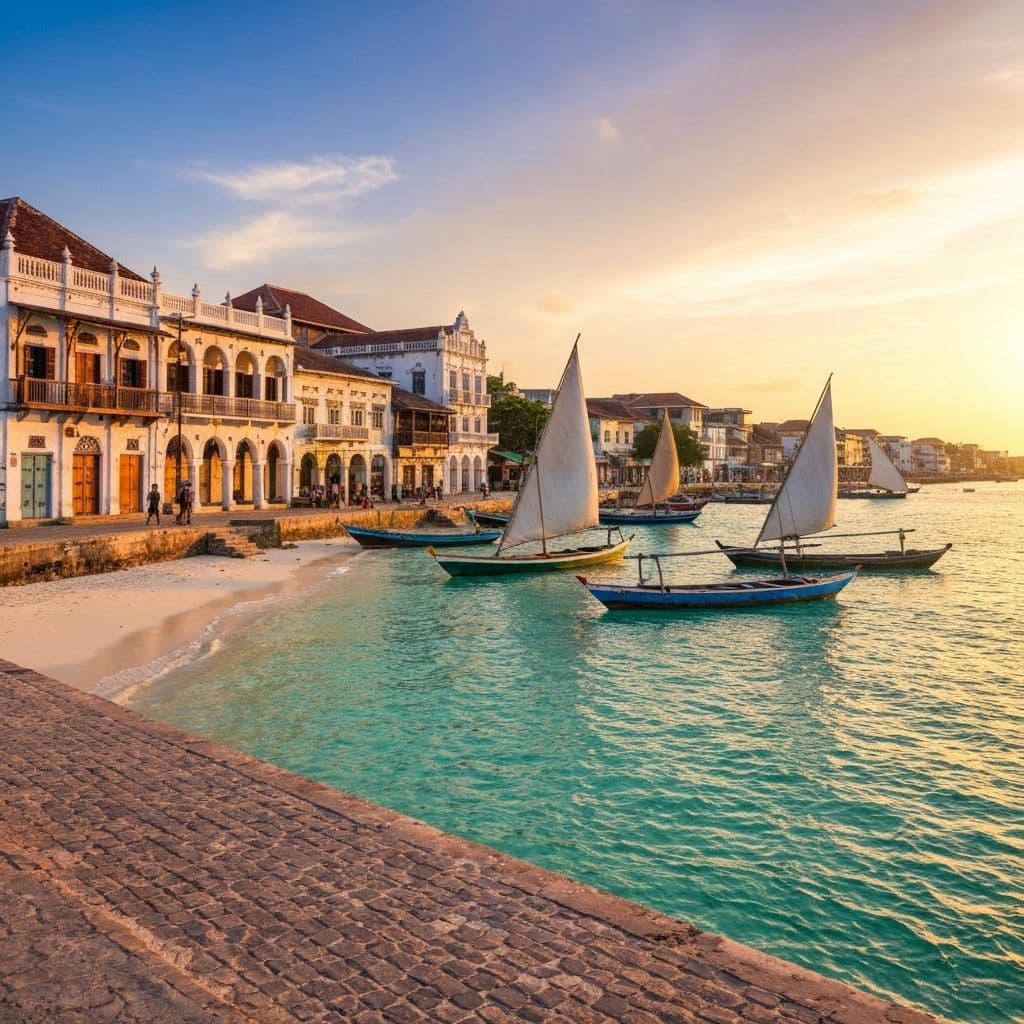
Zanzibar lies thirty-five kilometres off the coast of Tanzania and is a semi-autonomous part of the country, with its own government, its own visa stamps, and its own identity. For a thousand years it was a crossroads of trade between Africa, Arabia and India — dhows arrived here from Oman, cloves, ivory and enslaved people were shipped out, and from that mix grew a Swahili world unlike anywhere else. The capital, Stone Town, is a UNESCO World Heritage Site, and its maze of alleys with carved doors and Arab-style balconies can be walked in a day — though you'll get lost within ten minutes. The coastline has two very different sides. The north, around Nungwi and Kendwa, has deep water with little tidal swing and can be swum at any time; the east has a shallow lagoon where the sea retreats half a kilometre at low tide and returns in the afternoon, so the day is planned around tide tables. The island remains ninety-five percent Muslim, and how you dress outside the resort is a real matter here, not a formality.

What to see

The places worth your time in Zanzibar, and what to expect at each

Stone Town

Stone Town

Stone Town

The historic core of the capital, a UNESCO World Heritage Site, with a maze of alleys so narrow no car fits through. The houses have Arab-style balconies, Indian shopfronts at ground level, and famous carved doors — hundreds of them, each one's brass studs signalling the original owner's wealth.

Tip: Don't try to navigate by map — phones lose signal between the walls here, and you'll get lost anyway. Follow the rule that walking in one consistent direction eventually leads to the sea. The best time of day is late afternoon, when the sun enters the alleys and shops reopen after the midday break.

Admission:
free
Time needed:
full day
Forodhani Market

Forodhani Market

Stone Town

A nighttime food market on the waterfront in front of the old fort, where from sunset dozens of stalls sell grilled seafood, Zanzibar pizza, and freshly pressed sugarcane juice. Nearby, local boys jump from the fort wall into the sea, a sight in its own right.

Tip: Skip seafood sitting cold on a table attracting flies — pick a stall that grills to order and wait. Agree the price beforehand, or you'll get an inflated bill. Sugarcane juice with ginger and lime is the best thing at the market.

Admission:
food from TZS 5,000
Time needed:
2 h
House of Wonders and Old Fort

House of Wonders and Old Fort

Stone Town, waterfront

The tallest building in old Stone Town, an 1883 sultan's palace that was the first building in East Africa to have electricity and an elevator — hence its name. Next to it stands the Old Fort, built by the Omanis in the late seventeenth century on the foundations of a Portuguese church; today it houses an amphitheatre and craft stalls.

Tip: The House of Wonders partially collapsed in 2020 and remains under reconstruction — you can't go inside, only see the façade and scaffolding. The Old Fort is open, free to enter, and the best shade around Forodhani.

Admission:
fort free
Time needed:
1 h
Jozani National Park

Jozani National Park

central island

The last remnant of Zanzibar's original rainforest, fifty square kilometres of protected land, home to the Zanzibar red colobus — an endemic species found nowhere else on Earth, with around two thousand individuals remaining. Besides the forest itself, a boardwalk trail crosses a stand of mangroves.

Tip: The monkeys are used to people and will approach within a metre, but touching them is forbidden and enforced — they can pass diseases to you and vice versa. They're most active early morning and early evening, sleeping in the shade at midday. Admission includes a mandatory guide, whose fee is included, with tips handled separately.

Admission:
from USD 15
Time needed:
2–3 h
Nungwi

Nungwi

north

A fishing village on the island's northern tip, today Zanzibar's largest resort area. Its key advantage: the sea is deep right at the shore, and tides matter far less than on the east coast, so swimming is possible any time of day. Wooden dhows are still built on the beach here, using traditional methods and no blueprints.

Tip: Nungwi is the island's busiest and most westerly spot, with bars and an evening buzz found nowhere else on Zanzibar. For the same beach without the noise, stay in Kendwa a few kilometres south instead. Sunsets from Nungwi are the best on the whole island, since it's the only spot facing west.

Admission:
free
Time needed:
full day
Kendwa

Kendwa

north

A beach three kilometres south of Nungwi, with the same deep, tide-unaffected sea, but a calmer atmosphere and a wider stretch of white sand. Accommodation here tends to be smaller hotels, and once a month the Full Moon Party draws half the island.

Tip: Kendwa is the best choice for anyone who wants to swim any time and doesn't want Nungwi's buzz. Check the date of the Full Moon Party ahead of time — either to catch it, or to sleep elsewhere that weekend, since the music runs until morning.

Admission:
free
Time needed:
full day
Changuu (Prison Island)

Changuu (Prison Island)

islet near Stone Town

An islet five kilometres from Stone Town, home to a prison built in 1893 for rebellious enslaved people, which was never used for that purpose and instead served as a yellow fever quarantine station. Today its main draw is a colony of giant Aldabra tortoises, the oldest of which are over a hundred ninety years old.

Tip: The tortoises may be fed leaves you're given at the entrance, and they're entirely calm. The islet also has a beach with coral for snorkelling. The boat from Stone Town takes half an hour and runs in the afternoon; agree the price for the round trip and set an exact return time.

Admission:
from USD 4 plus boat
Time needed:
half a day
Spice farm

Spice farm

inland, Kizimbani

Zanzibar was, for a hundred years, the world's largest producer of cloves, and the nickname Spice Island is no marketing invention. At farms inland near Kizimbani, a guide shows you growing cloves, vanilla, nutmeg, cinnamon, cardamom and ylang-ylang, letting you taste and smell them straight from the plant.

Tip: The tour takes two hours and ends at a spice stall where prices run noticeably lower than in Stone Town — vanilla pods and cloves make the best souvenir from the island. Wear closed shoes, since the ground is muddy, and bring repellent, as mosquitoes are common in the undergrowth.

Admission:
from USD 15
Time needed:
2–3 h
Paje and Jambiani

Paje and Jambiani

east

The east coast, with the whitest sand and a turquoise lagoon protected by a reef a kilometre offshore. At low tide the sea retreats half a kilometre, exposing a sandbank you can walk across past seaweed gardens tended by local women; at high tide the lagoon turns flat and shallow, ideal for kitesurfing.

Tip: You can't plan a day here without tide tables — swimming works for roughly four hours around high tide, otherwise you're wading ankle-deep. Every hotel keeps a table at reception. Water shoes are essential, as the seabed is covered in sea urchins and sharp coral fragments.

Admission:
free
Time needed:
full day

Photos: Stone Town — No machine-readable author provided. Mbz1 assumed (based on copyright claims). (CC BY-SA 3.0) · Forodhani Market — Moongateclimber (Public domain) · House of Wonders and Old Fort — Moongateclimber (CC BY-SA 4.0) · Jozani National Park — Mnazini (CC BY 4.0) · Nungwi — Sansibar-freundeskreis.de (CC BY-SA 4.0) · Kendwa — Zoheb (CC BY-SA 3.0) · Changuu (Prison Island) — Mangapwani (CC BY-SA 4.0) · Spice farm — Bärbel Miemietz (CC BY-SA 4.0) · Paje and Jambiani — AmyAbroad (CC BY-SA 4.0)

Where to stay

Areas and districts, matched to the kind of trip you are taking

Stone Town

Best for: history, atmosphere, and a first or last night

The historic city, with alleys, a market, museums, and the island's best restaurant scene. Accommodation is in converted Arab houses with wooden doors and rooftop terraces. There's no usable beach here, so this is a stay for the city itself — one or two nights, ideally at the start or end of the trip.

Nungwi and Kendwa

Best for: swimming any time of day

The northern tip, where the sea is deep right at the shore and the tide doesn't complicate the day. Nungwi is livelier, with bars and evening life; Kendwa, three kilometres south, is quieter with a wider beach. It's the only part of the island where swimming works regardless of tide tables.

East coast (Paje, Jambiani, Bwejuu)

Best for: the prettiest beach and kitesurfing

The whitest sand and a turquoise lagoon, but with a pronounced tide that twice a day exposes half a kilometre of sandbank. Paje is the kitesurfing hub with a younger crowd; Jambiani and Bwejuu are quieter and more village-like. Beautiful for photos, less practical for swimming.

Southeast and Michamvi

Best for: quiet and luxury resorts

A peninsula in the southeast with a few large resorts, empty beaches and the best sunset outside the north — the only spot on the east side that faces west. Stone Town is an hour and a half away, and besides the resorts there's nothing here, which is the whole point.

Getting around

From the airport

Zanzibar has its own international airport, Abeid Amani Karume, just outside Stone Town. There's no direct flight from Prague, so you'll connect once — most commonly via Istanbul, Doha, Dubai or Addis Ababa, with a total journey of twelve to sixteen hours. An alternative is flying to Dar es Salaam and taking a two-hour ferry, which is more comfortable than it sounds. Czechs need a visa, arranged online in advance through the Tanzanian immigration portal, or bought on arrival at the airport for fifty dollars, paid in cash. Since 2024, a special Zanzibar travel insurance has been mandatory, paid online in advance — without proof of it, you won't be let through the airport, something many travellers only discover once they're there.

Abeid Amani Karume International (ZNZ) · 7 km

  • Hotel transfer, included in stay· 15 min – 1 h 30 min· included
  • Taxi to Stone Town· 15 min· USD 15
  • Taxi to Nungwi· 1 h 15 min· USD 50
  • Taxi to the east coast· 1 h· USD 45

Dar es Salaam Julius Nyerere (DAR) · 80 km

  • Azam Marine ferry to Stone Town· 2 h· USD 35

Around town

The cheapest transport is the dala dala, a crowded pick-up truck with benches in the back, running set routes from the market in Stone Town; it costs a few thousand shillings, is slow, and is more of an experience than actual transport. Tourists mostly get around by taxi, which have no meters and negotiate fares upfront — from the airport to Nungwi runs around fifty dollars. Shared shuttle buses between Stone Town and the beaches run several times daily and cost a fraction of a taxi; book through your hotel. A rented scooter is popular but requires a local Zanzibar driving permit, bought at the police station, and the roads have sharp potholes and pedestrians; Czech insurance without a category A endorsement won't cover you.

Dala dalaShared pick-up truck on main routes from the Stone Town market. The cheapest and slowest way to get anywhere. · TZS 2,000
TaxiNo meters, price agreed beforehand. The most common way tourists get around, expensive for longer distances. · USD 15
Shared shuttleBetween Stone Town and the beaches several times daily, booked through your hotel. A fraction of the taxi price. · USD 10
Rented scooterRequires a Zanzibar driving permit bought at the police station. Czech insurance won't cover you without a category A endorsement. · USD 20/day

Useful apps: Google Maps, Maps.me, Bolt, Google Translate

When to go

There are two good dry windows. From June to October it's dry and slightly cooler, and this is also mainland safari season, so the two can be combined — July and August are peak season. From December to February it's hot and humid but dry, with the sea at twenty-nine degrees. Avoid the main masika rainy season from mid-March to May, when it rains daily, the sea turns murky, and some hotels close; it's the cheapest but least pleasant time. The short vuli rains in November, by contrast, are brief afternoon showers that won't spoil a holiday. Dolphins and whale sharks can be spotted near Mnemba from February to March and September to November.

Best time

June to October and December to February

What to avoid

mid-March to May, the masika rainy season

MonthJanFebMarAprMayJunJulAugSepOctNovDec
Day32°32°32°30°29°29°28°28°29°30°31°32°
Night24°24°24°24°23°22°21°21°21°22°23°24°
Rainy days76111614655571211
Sea29°29°29°29°28°27°26°26°26°27°28°29°

Food & drink

Zanzibari cuisine is Swahili with a strong Arab and Indian layer — coconut milk, spices from the island's own plantations, and seafood from the lagoon. Coconut goes into practically everything: fish in coconut curry, octopus in coconut sauce, beans in coconut. The most characteristic dish is pilau, rice cooked in a broth with cardamom, cloves and cinnamon, in which the island's history is unmistakable. The best food isn't in the resorts but at the Forodhani night market and in small village eateries, where grilled octopus with coconut sauce costs a fraction of the hotel price. Zanzibar is Muslim, so alcohol is practically unavailable outside tourist venues, and the situation is even stricter during Ramadan. Drinks include fresh juices, sweet spiced tea, and coffee sold from pots in Stone Town's squares.

What to try

Pilau

Rice cooked in broth with cardamom, cloves, cinnamon and cumin, with pieces of beef or chicken. It's the most Zanzibari dish there is — the island grew rich on spices, and pilau carries six of them at once.

Zanzibar pizza

Thin dough filled with minced meat, egg, mayonnaise and cheese, folded into a parcel and fried on a hotplate. It has nothing to do with pizza; it's sold in the evening at the Forodhani market and is street food, not restaurant fare.

Octopus in coconut curry

Pweza wa nazi: octopus stewed in coconut milk with turmeric, garlic and lime. A staple fisherman's dish of the east coast, costing a fraction of the resort price at local restaurants.

Mishkaki

Marinated beef skewers grilled over charcoal and served with maize porridge or fries. An evening street food Zanzibaris grab on the way home from work; one skewer costs a few thousand shillings.

Samaki wa kupaka

A whole fish grilled over charcoal and doused in a thick coconut sauce with tamarind. Chosen from the ice and charged by weight — confirm the price per kilogram before it goes on the grill.

Ugali

A dense maize-flour porridge eaten across East Africa in place of bread — a piece is torn off, shaped in the palm, and used to scoop up sauce. On its own it's flavourless; it's a vehicle, not a dish.

Urojo

A yellow Zanzibari soup coloured with turmeric and mango, mixed with potato fritters, fried batter and chutney. Ladled from a pot at the market, with every stall making it slightly differently.

Kahawa and spices

Strong coffee brewed with cardamom and ginger, sold from pots in Stone Town's squares for a few hundred shillings in a small cup. It's paired with kashata, a sweet peanut-and-coconut bar.

What it costs

Food at the Forodhani market

TZS 5,000–15,000

Lunch at a local eatery

TZS 8,000–15,000

Dinner at a tourist restaurant

TZS 25,000–50,000

Kilimanjaro beer

TZS 5,000

Entry to Jozani with a guide

USD 15

Spice farm tour

from USD 15

Full-day snorkelling trip to Mnemba

from USD 60

Night at a 4-star beach hotel

from USD 100 per double room

Indicative prices that change over time — treat them as a guide, not a price list.

Practical information

SocketsDthree round pins (India)GBritish, three rectangular pins
Voltage230V / 50Hz
Tap waterDo not drink tap water — Don't drink tap water or even brush your teeth with it, and don't buy ice outside hotels and vetted restaurants. Bottled water costs around a thousand shillings a bottle in shops and is usually free in resort rooms. Peel fruit yourself, and avoid salads outside your hotel for the first few days until your stomach adjusts.
TippingTipping is expected and matters to staff income. Ten percent at restaurants, five to ten dollars per person for a guide on a full-day trip, similarly for a snorkelling boat captain. Hotels often keep a shared tip box at reception for the whole staff, fairer than tipping individuals. Pay in shillings — dollar bills are hard to exchange, and any printed before 2009 are refused outright.
Driving on theleft
SafetyZanzibar is safe, and violent crime is rare, but petty theft on beaches and in Stone Town's alleys after dark is common — don't walk the beach alone at night, and keep valuables in a safe. Three health points matter more than anything else. Malaria exists on Zanzibar, though cases have declined: prophylaxis is recommended, and DEET repellent plus a mosquito net are essential. Yellow fever vaccination is only required arriving from a country where it's endemic, not from Europe, but carry proof if flying via Ethiopia or Kenya. And healthcare on the island is limited — a serious case means transport to Dar es Salaam or Nairobi, so insurance with repatriation cover matters more here than almost anywhere in Europe. On east-coast beaches, tides are strong, with the sea retreating hundreds of metres and returning quickly in the afternoon.
Opening hoursResorts operate independently of their surroundings. Village shops and restaurants open around nine and close by eight, with a two-hour closure around midday on Fridays for prayer. Stone Town's markets are best early in the morning — by ten, the best goods are gone. During Ramadan, daytime hours outside the tourist zones are effectively dead, and life starts up again only after sunset.
Customs & etiquetteZanzibar is ninety-five percent Muslim, and dress is taken more seriously than tourists expect. Inside your resort and on its beach, ordinary rules apply, but in Stone Town and the villages, women keep shoulders and knees covered and men don't go shirtless — swimwear in town is an offence, not a fashion faux pas. Topless sunbathing is banned everywhere. During Ramadan, eating, drinking or smoking in public during the day isn't done, and many restaurants outside the resorts close. Don't photograph people, especially women, without asking, and homosexuality is illegal in Tanzania — public displays of affection between same-sex partners carry real risk.
A few local wordsHello — Jambo / HabariThank you — AsanteHow much does it cost? — Bei gani?No, thank you — Hapana, asanteSlowly, please — Pole pole

How to plan your days

1 day

A day on Zanzibar

  1. 1Morning in the maze of Stone Town's alleys and its carved doors.
  2. 2Lunch on a rooftop terrace overlooking the harbour.
  3. 3Afternoon boat trip to Changuu for the giant tortoises.
  4. 4Early evening back in town, watching cliff-jumpers by Forodhani.
  5. 5Dinner at the Forodhani night market, grilled octopus to order.

2 days

Two days: town and north

  1. 1Day one: Stone Town, the Old Fort, and Forodhani.
  2. 2Day two morning: drive north to Nungwi.
  3. 3Late morning swim, possible any time regardless of the tide.
  4. 4Afternoon at the beachside dhow-building yard.
  5. 5Sunset from Nungwi, the island's only west-facing spot.

3 days

Three days: town, rainforest and both coasts

  1. 1Day one: Stone Town and the evening Forodhani market.
  2. 2Day two: a spice farm in the morning, Jozani and its colobus monkeys in the afternoon.
  3. 3Day three: the east coast at Paje, timed to the tide tables.
  4. 4At low tide, a walk across the sandbank past the seaweed gardens.
  5. 5Last evening back up north or in Stone Town.

Day trips

Mnemba Atoll

30 km · 1 h 30 min by car and boat

A coral atoll off the northeast coast with the best snorkelling and diving on Zanzibar — visibility exceeds thirty metres, and the waters hold turtles, moray eels and, from February to March, even dolphins. The islet itself is private and off-limits; swimming happens in the protected waters around it. Trips depart from Matemwe, and morning excursions are better, since wind picks up in the afternoon and visibility drops.

Kizimkazi and the dolphins

55 km · 1 h 15 min by car

A fishing village on the island's southern tip, home to a resident population of bottlenose and humpback dolphins. Small boats head out at dawn, and the chances of an encounter are high. Choose your operator carefully: many aggressively chase the dolphins and push tourists to jump into their path, which stresses the animals — pick one that keeps a respectful distance. Kizimkazi is also home to East Africa's oldest mosque, dating from 1107.

Safari Blue and Menai Bay

40 km · 1 h by car

A full-day sail on a traditional dhow around Menai Bay in the southwest, with stops for snorkelling, a mangrove lagoon, and a sandbank that only appears at low tide. Lunch is grilled fish and seafood right on a sandy islet, and a tropical fruit tasting is included. It's the island's best full-day trip for anyone who wants to be on the water, and the only one worth its full price.

Frequently asked questions

When is the best time to visit Zanzibar?+

From June to October, when it's dry and slightly cooler, which pairs well with a mainland safari, or from December to February, when it's hot and humid but dry, with the sea at twenty-nine degrees. Avoid the masika rainy season from mid-March to May, when it rains daily, the sea turns murky, and some hotels close. Short November rains are only afternoon showers.

What do I need for a trip to Zanzibar?+

A visa, arranged online through the Tanzanian immigration portal or bought on arrival for fifty dollars in cash. Your passport must be valid for another six months. Since 2024, a special Zanzibar travel insurance is mandatory, paid online in advance — without proof of it, you won't be allowed through at the airport; standard Czech travel insurance doesn't count, as this is a separate charge. Yellow fever vaccination is required only when arriving from a country where it's endemic, not directly from Europe.

How do the tides work, and where can you swim?+

On the east coast, the difference between high and low tide is so large that the sea retreats half a kilometre and exposes a sandbank — swimming works for roughly four hours around high tide, and the rest of the day you're wading ankle-deep. Every hotel keeps a tide table at reception. In the north, at Nungwi and Kendwa, the sea is deep right at the shore and tides don't complicate the day, which makes the north the best choice for anyone who mainly wants to swim.

How should I dress on Zanzibar?+

Inside your resort and on its beach, ordinary rules apply. Outside it, Zanzibar is ninety-five percent Muslim, and it's taken seriously: in Stone Town and the villages, women keep shoulders and knees covered and men don't go shirtless. Swimwear in town is an offence, not a fashion faux pas, and topless sunbathing is banned everywhere. During Ramadan, eating, drinking or smoking in public during the day isn't done.

Is malaria a risk on Zanzibar?+

Yes, although case numbers have dropped significantly in recent years. Prophylaxis is recommended — ask a travel doctor — and DEET repellent plus a mosquito net over the bed are essential, since malaria-carrying mosquitoes bite after dark. Dengue fever also occurs here. Healthcare on the island is limited, and a serious case means transport to Dar es Salaam or Nairobi, so insurance with repatriation cover matters more here than in Europe.

Can I drink tap water on Zanzibar?+

No, and don't even brush your teeth with it. Bottled water costs around a thousand shillings a bottle in shops and is usually free in your resort room. Buy ice only at hotels and vetted restaurants, never from street stalls. Peel fruit yourself, and avoid salads outside your hotel for the first few days until your stomach adjusts.

Is it worth combining Zanzibar with a safari?+

Yes, it's the most common and logical combination — flights from Zanzibar to Kilimanjaro and Arusha take an hour, and from there you continue to the Serengeti and Ngorongoro Crater. The best window is June to October, when both the island and the mainland are dry and animals gather around water sources. The standard pattern is three to four days of safari followed by a week on the island, in that order, so the holiday ends by the sea.

How much should I tip?+

Tipping is expected and matters to the staff's income. Ten percent at restaurants, five to ten dollars per person for a guide on a full-day trip, similarly for a boat captain. Hotels often keep a shared tip box at reception for the whole staff, which is fairer than tipping individuals. Pay in shillings; dollar bills printed before 2009 are refused everywhere.

Visa Requirements

Check the latest visa requirements for entering this country. Some nationalities may need to apply for a visa or e-visa before travel.

Check visa requirements

Language

Swahili / English

Currency

TZS

Timezone

Africa/Dar_es_Salaam

Dial Code

+255

Population

65.5M

Area

947,303 km²

Voltage

230V / 50Hz

Driving Side

Left

Top Hotels in Zanzibar

Live prices from 500+ properties

Loading hotels...

More destinations in Tanzania

Planning a trip to Zanzibar?

Compare hundreds of hotels, find the best price, and book with free cancellation on TravelManiac.