Hotels in Helsinki

A white cathedral above the harbour, a fortress on 6 islands, and a sauna instead of a café

Helsinki

SpracheEnglish
WährungEUR
ZeitzoneGMT+2
Temperatur-10-22 °C
Vorwahl+358
Bevölkerung5.6M
Fläche338,424 km²
SteckdosenTyp C / Typ F
LeitungswasserTrinkbar

Entdecken Sie Helsinki

Helsinki was founded by the Swedish king Gustav Vasa in 1550 to rival Tallinn, but for 200 years it remained an insignificant fishing town. That changed when the Russian tsar Alexander I moved the capital of the Grand Duchy of Finland here in 1812 and had Carl Ludvig Engel build an entire new centre in the Empire style, modelled on Saint Petersburg — hence the white cathedral on its steps above Senate Square, and why American films set in the Soviet Union were once shot here. Finland only gained independence in December 1917, and the 20th century added its own architecture: national romanticism in granite, Alvar Aalto's functionalism, and today, timber public buildings such as the Oodi library. The city is home to 600,000 people, along with 300 islands and 400km of coastline — and Tallinn is just a 2-hour ferry ride away, making Helsinki the most convenient gateway to the Baltics.

What to see

The places worth your time in Helsinki, and what to expect at each

Helsinki Cathedral

Helsinki Cathedral

Kruununhaka / Senate Square

A white Lutheran church with a green domed roof, completed in 1852 as the centrepiece of Engel's Empire-style city centre. It stands on a flight of 25 steps above Senate Square and is Finland's most photographed building. The interior is deliberately plain — white walls, wooden pews and 3 statues of reformers.

Tip: The steps in front of the cathedral are the main viewpoint here and people sit on them in summer; at midday, though, they fill with groups from cruise ships. The best light is late afternoon, when the sun hits the façade. Entry is free. There's a crypt in the basement used for exhibitions, with an exit on the other side that most visitors don't know about.

Admission:
free
Time needed:
45 min
Suomenlinna

Suomenlinna

Suomenlinna

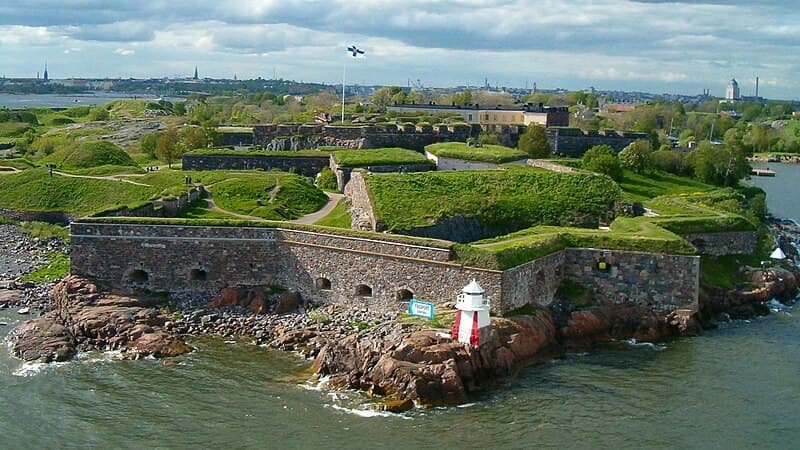
A fortress across 6 connected islands, which the Swedes began building in 1748 and which nonetheless fell within a century, first to the Russians, then to the Finns. It's a UNESCO World Heritage Site, home to 800 residents, and doubles as one of Helsinki's residential districts. It includes the submarine Vesikko, ramparts, tunnels and 6 museums.

Tip: The HSL ferry from Market Square is covered by an ordinary public transport ticket and takes 15 minutes — never buy the pricier tourist boat alongside it. The islands are freely accessible 24 hours a day and free of charge; only the museums charge admission. Set aside half a day and wear sturdy shoes; the marked blue route loops past the main sights in 2 hours. The ferry also runs in winter, when the island is nearly empty.

Admission:
entry free, ferry included in HSL ticket
Time needed:
3–4 h
Temppeliaukio Rock Church

Temppeliaukio Rock Church

Töölö

A church carved directly into a granite outcrop in 1969, right in the middle of a residential district: the walls are raw rock, the ceiling is a copper spiral 22m in diameter, and light enters through 180 windows around its rim. The acoustics are so good that albums are regularly recorded here.

Tip: From outside it looks like a circular wall in a car park, and half of visitors walk straight past it. Come an hour after opening, when sunlight streams onto the rock inside; by midday there are tour groups and often a queue. Best of all is a concert — classical music is performed here several times a week, and tickets cost a fraction of a concert hall's price. It closes for services and weddings.

Admission:
€8
Time needed:
45 min
Oodi Library

Oodi Library

Kluuvi / Töölönlahti

A wooden building from 2018 opposite parliament, built by Finns to mark the centenary of independence. It's not just a library: the first floor has workshops with 3D printers, sewing machines and recording studios, while the second floor is a book-filled living room under an undulating white ceiling with a terrace.

Tip: Entry is free and it's open until 9pm even on weekends — the best place in Helsinki to shelter from rain or frost. The top-floor terrace overlooks parliament and is freely accessible. There's a café and a cinema on the ground floor. This is the place that shows how Finns think about public space better than any museum could.

Admission:
free
Time needed:
1 h
Uspenski Cathedral

Uspenski Cathedral

Katajanokka

The largest Orthodox cathedral in Western Europe, built of red brick in 1868, when Finland belonged to tsarist Russia. It stands on a rock above the harbour in Katajanokka and has 13 gilded domes; the interior is dark, with an iconostasis and a blue, star-studded ceiling.

Tip: It stands on a hill, with steps up from Kanavakatu; the terrace at the entrance gives the best combined view of the cathedral and the harbour, a shot most visitors get wrong. Entry is free, but it closes on Mondays and during services. The neighbouring Katajanokka district, with its Art Nouveau buildings, is the finest block of housing in the city.

Admission:
free
Time needed:
45 min
Ateneum

Ateneum

Kluuvi

The national gallery holds the largest collection of Finnish art: Akseli Gallen-Kallela's scenes from the Kalevala epic, Helene Schjerfbeck, Hugo Simberg and his Wounded Angel, voted Finland's favourite painting. The second floor also has van Gogh, Cézanne and Modigliani.

Tip: The Wounded Angel hangs on the second floor and draws a queue for photos; on a weekday morning there's no one there. On Thursdays the gallery stays open until 8pm. The building stands opposite the main railway station, so it's easy to fit in between a train and a boat. The ticket also covers temporary exhibitions and is cheaper bought online.

Admission:
€20
Time needed:
1.5 h
Market Square and Vanha Kauppahalli

Market Square and Vanha Kauppahalli

Kaartinkaupunki / harbour

A harbourside market that has sold fish, berries and handicrafts since morning for generations, and from which ferries depart for Suomenlinna and Tallinn. Beside it stands the old covered market hall from 1889, with wooden counters selling salmon, reindeer meat and lohikeitto soup.

Tip: The outdoor stalls charge tourist prices; the covered market 50m away sells the same food for a third less, and you can sit indoors in the warmth. Forest-berry season runs from July to September, and blueberries are sold by the litre tub. Locals shop here from around 8am; cruise-ship crowds arrive after 10am.

Admission:
free
Time needed:
1 h
Löyly and Allas public saunas

Löyly and Allas public saunas

Hernesaari and the harbour

In Finland, the sauna isn't a wellness treatment but a way of spending time with people — there are 3 million saunas for a population of 5.5 million. The wooden Löyly on the southern shore and the Allas Sea Pool right in the harbour are 2 public saunas you can visit without booking, with a pool in the sea attached.

Tip: At Löyly and Allas, swimwear is worn since they're mixed-sex — bring your own, or rent one on site for an extra fee. A towel is included in the entry price. People jump into the sea after the sauna even in winter, when a hole is kept open in the ice; it's safe, but go into the water slowly, and never after drinking alcohol. Löyly gets booked ahead on Fridays and Saturdays.

Admission:
from €19
Time needed:
2 h
Seurasaari

Seurasaari

Seurasaari

An open-air museum island linked to the mainland by a wooden bridge, with 87 relocated buildings from across Finland — farmsteads, granaries, a church from 1686 and a merchant's house. A loop trail winds through the forest around it, where squirrels and geese roam freely, open all year round.

Tip: The buildings are only open from June to August, but the island and its path are free and open round the clock, year-round — in winter it's the loveliest walk in Helsinki, and you'll meet no one. Squirrels take nuts straight from your hand. The city's biggest bonfire is lit here on midsummer night. Bus 24 from the centre takes 25 minutes and ends at the bridge.

Admission:
island free, open-air museum €12
Time needed:
2 h

Photos: Helsinki Cathedral — Manster323 (CC0) · Suomenlinna — Migro (Public domain) · Temppeliaukio Rock Church — Jens Strauß (CC BY-SA 4.0) · Oodi Library — Cope Baronet (CC BY-SA 4.0) · Uspenski Cathedral — Diego Delso (CC BY-SA 3.0) · Ateneum — Alvesgaspar (CC BY-SA 3.0) · Market Square and Vanha Kauppahalli — DXR (CC BY-SA 4.0) · Löyly and Allas public saunas — kallerna (CC BY-SA 4.0) · Seurasaari — MattiPaavola (CC BY-SA 3.0)

Where to stay

Areas and districts, matched to the kind of trip you are taking

Kluuvi and Kaartinkaupunki

Best for: first visit and hotels

The Empire-style core between the main railway station, the cathedral and the harbour, home to most of the hotels, the Esplanadi shopping boulevard with a park down its middle, and all the main tram stops. From here it's walkable to the cathedral, the market and the Tallinn ferries. Accommodation prices are the highest in the city, and evenings are relatively quiet.

Punavuori and the Design District

Best for: design, galleries and restaurants

A district south of the centre where some 200 shops, studios and galleries build the brand of Finnish design. It has the city's best restaurants, vintage shops and cafés, and nightlife around Uudenmaankatu. Accommodation is about a fifth cheaper than near the station, and it's a 10-minute walk to the centre.

Kallio

Best for: cheap food, bars and off-the-beaten-path life

A former working-class district north of the centre, where eating and drinking is the cheapest in Helsinki — a half-litre of beer costs €2 less than in the centre. It has the granite Kallion kirkko church, the Hakaniemi market hall, and the highest concentration of public saunas in the city, including the legendary wood-fired Kotiharju. It's a 3-minute metro ride to the centre.

Katajanokka and Töölö

Best for: Art Nouveau, quiet and families

2 quiet residential districts with Art Nouveau architecture: Katajanokka is a peninsula behind the Uspenski Cathedral with a former prison converted into a hotel, while Töölö sits around a bay with the Finlandia Hall, the opera house and the Rock Church. Töölö has the most greenery, plus the 1952 Olympic stadium with its observation tower; both are a 10-minute tram ride from the centre.

Getting around

From the airport

Helsinki is well served by direct flights from many major European cities, typically taking 2.5–4 hours depending on the departure point. Vantaa Airport lies 19km north of the centre, and the connection into town is cheap and simple: the commuter train, lines I and P, reaches the main railway station in 30 minutes, runs every 10 minutes, and a zone-ABC ticket costs €4.50 — a fraction of what airport express trains cost in neighbouring countries. The line is a loop, so it doesn't matter which direction you board. Helsinki is also reachable by sea: from Tallinn it takes 2 hours, with Tallink and Viking sailing every hour, while an overnight ferry from Stockholm through the archipelago takes 16 hours. Driving overland from central Europe takes at least a day and a half, via the Baltics and a ferry from Tallinn. A car isn't needed in the city, and parking in the centre costs €4 per hour.

Helsinki Vantaa (HEL) · 19 km

  • Commuter train I / P to the main railway station· 30 min· €4.50
  • Finnair City Bus· 35 min· €7.50
  • Taxi· 25–35 min· €45

Around town

Central Helsinki is small, and it's a 15-minute walk from the railway station to both the cathedral and the harbour. HSL covers the rest: trams, metro, buses, commuter trains and — a local speciality — the ferry to Suomenlinna, all under one fare system. A zone-AB ticket is valid for 80 minutes with transfers and is bought via the HSL app or by tapping a contactless card at the reader; buying from the driver costs more. Tram lines 2 and 3 loop past all the main sights and, for the price of an ordinary ticket, double as a sightseeing route — the best trick in the city. The metro has only 2 branches and is of limited use to visitors. In winter, pavements ice over and are gritted — think about your footwear more than anything else.

HSL trams and busesA zone-AB ticket is valid for 80 minutes with unlimited transfers, including the Suomenlinna ferry. Bought via the HSL app or by tapping a bank card at the reader by the door; buying from the driver costs more. · €3.10
HSL day ticket24 hours for €9, each additional day €4.90, valid in zones AB. Worth it from the third trip of the day, and includes the Suomenlinna ferry, which is otherwise a separate charge. · €9 / 24 h
Suomenlinna ferryRuns from Market Square every 20 minutes, year-round and at night too, a 15-minute crossing. Covered by the standard HSL fare — the tourist boats alongside charge three times as much for the same trip. · included in HSL ticket
Tram 2 and 3 as a sightseeing routeA loop route past the cathedral, the Rock Church, the Olympic Stadium and the Design District. For the price of an ordinary ticket you pass through all the main districts; with a day ticket you can hop on and off freely. · included in HSL ticket
City bikes and walkingHSL city bikes run from April to October; a day pass costs €5, and the first 30 minutes of each ride are included. The city is flat, and the coastal path runs from the harbour all the way to Seurasaari. · €5 / day

Useful apps: HSL, Whim, Google Maps, Foreca

When to go

June to August is best, when Helsinki is light almost round the clock — around the summer solstice, the sun sets after 11pm and rises again at 4am, so it never fully gets dark. Terraces are open then, boats run to the islands, and people swim in the harbour. The Juhannus midsummer night in late June is the year's biggest holiday, but the city empties out and many businesses close as Finns head to their summer cottages. May and early September are cheaper and quieter. Winter is long and dark: in December, dawn breaks after 9am and dusk falls before 3pm, temperatures drop to around -10°C, and the sea in the harbour freezes over. That's exactly why winter is when a sauna with a hole cut in the ice, and the Christmas market on Senate Square, make sense. November and March are the worst — no snow, just rain and darkness.

Best time

June to August for the white nights, December for the markets and sauna season

What to avoid

November and March, for the darkness and sleet

MonthJanFebMarAprMayJunJulAugSepOctNovDec
Day-1°-2°2°8°15°19°22°20°15°9°3°0°
Night-6°-7°-4°1°6°11°14°13°9°4°0°-4°
Rainy days119877891111121313

Food & drink

Finnish cuisine is simple and built on fish, rye, potatoes and forest berries, but Helsinki has cooked noticeably better over the last 15 years than the country's reputation suggests. The best value is the midday buffet called lounas — from 11am to 2pm, almost every restaurant, including good ones, serves a hot dish, a salad bar, bread and coffee for €12–16, about half the evening price for the same food. The second sure bet is the covered markets: the old Vanha kauppahalli by the harbour and Hakaniemi in Kallio, where you can eat well at the counter for €10. Finns drink more coffee per head than anyone else in the world, and an afternoon coffee-and-cake break is common even at work. Alcohol is expensive due to taxes — a half-litre of beer in a pub costs €7–9, and about €2 less in Kallio than in the centre. Tap water is among the best in the world and free everywhere.

What to try

Lohikeitto

A creamy salmon soup with potatoes, leek and plenty of dill. The most typical Finnish dish, served at harbourside markets in a bowl with dark bread for €10–14 as a full lunch.

Karjalanpiirakka

A Karelian pastry of rye dough filled with rice porridge, served with egg butter (munavoi). A breakfast classic sold in every supermarket; warm from the bakery it's a completely different dish from a cold one out of the fridge.

Poronkäristys

Thinly sliced reindeer meat, sautéed in butter and served with mashed potato, lingonberries and pickled cucumber. A Lapland classic served by Nordic-cuisine restaurants in Helsinki; the meat is lean, tasting somewhere between game and beef.

Muikut

Small lake vendace coated in rye flour and fried whole, eaten head, bones and all, like chips, with mashed potato and lemon. Sold at markets straight from a big pan, and the best dish you'll find at a Finnish market.

Ruisleipä

Dark rye bread, sour and dense, which Finns have chosen as their national food. Eaten with everything, most often with butter and cheese. For those wanting to take some home, the dried version, näkkileipä, keeps for months.

Leipäjuusto

"Bread cheese" made from colostrum, toasted so it develops dark spots on the surface and squeaks when eaten. Served warm with cloudberry jam as a dessert; in Lapland it's also dropped straight into a cup of coffee.

Korvapuusti

A cinnamon-and-cardamom bun whose name means "a slap on the ear" after its shape. The staple of the Finnish coffee break — Finns drink more coffee per head than anyone else on Earth. Costs around €3 at a bakery.

Salmiakki

A salty liquorice sweet containing ammonium chloride, a flavour Finns consider a national treasure and most foreigners find shocking. Also sold as Salmiakki Koskenkorva liqueur. Buy a small pack before committing to a large one.

Kalakukko

A loaf of rye bread baked for several hours with fish and bacon inside, originating from Savonia and sliced like a cake. It weighs about a kilogram and is a dish for travelling, not for a sit-down restaurant lunch.

What it costs

Coffee with a korvapuusti

€6–8

Half-litre of beer in a pub

€7–9

Midday lounas buffet

€12–16

Lohikeitto at a market

€10–14

Dinner at a restaurant

€30–45 per person

HSL day ticket

€9

Entry to a public sauna

from €19

Night in a 3-star hotel for 2

€110–180

Indicative prices that change over time — treat them as a guide, not a price list.

Practical information

SocketsCEuroplug, two round pinsFSchuko
Voltage230V / 50Hz
Tap waterTap water is drinkable — According to international measurements, Finnish tap water is the cleanest in the world, and Finns drink it straight from the tap as a matter of course. Restaurants bring it free without being asked, and every sauna has a drinking fountain. Bottled water is bought almost exclusively by tourists and costs around €2. Bringing your own bottle is the best money-saver in an otherwise expensive country.
TippingTipping isn't done in Finland and no one expects it — service and tax are included in the price, so the rate is zero. Rounding up is fine for those who want to. Finland is nearly cashless: cards work on the tram, in the sauna, at the market and even at hot-dog stands, and some places refuse cash altogether. ATMs (Otto) charge a fee, and since Finland is in the eurozone, there's no reason to exchange currency in advance.
Driving on theright
SafetyFinland regularly ranks among the safest countries in the world, and as a visitor there's practically nothing to worry about — a night-time walk through central Helsinki is safer than in most cities elsewhere. Pickpocketing occurs occasionally at the main railway station and the market. The real risk is winter: between December and March, pavements ice over, darkness lasts most of the day, and the most common visitor injury is a fall. Shoes with a rough sole and slip-on ice grips for a few euros do more good than a warm coat. The emergency number is 112.
Opening hoursShops open at 9 or 10am and close at 9pm, with supermarkets commonly open until 11pm, even on Sundays — Finland has the most liberal opening hours in northern Europe. Alcohol above 8% is only sold at state-run Alko shops, which close at 6pm on Saturdays and are shut on Sundays; beer and cider up to 8% can be bought at supermarkets until 9pm. Museums open between 10 and 11am, many are closed on Mondays, and 1 evening a week often has extended hours with reduced or free admission.
Customs & etiquetteFinns don't talk much, and silence in conversation doesn't feel uncomfortable to them — don't try to fill it, as that can come across as nervous. Personal space is large; people stand far apart at a bus stop, and that isn't rudeness. Punctuality is taken seriously: arriving 10 minutes late to an arranged meeting is a real problem. The sauna is a social institution, not a wellness treatment: people go in nude (in separate sections by sex at public saunas), sit on a towel, stay quiet or speak softly, and leave their phone in the changing room. Shoes always come off before entering a home.
A few local wordsHello — Hyvää päivääThank you — KiitosPlease — Ole hyväThe bill, please — Lasku, kiitosCheers — Kippis

How to plan your days

1 day

A day in Helsinki

  1. 1Morning: Senate Square and the cathedral while it's still quiet.
  2. 2Via Market Square and the old market hall to the Uspenski Cathedral.
  3. 3Midday lounas buffet in the Design District.
  4. 4Afternoon at the Temppeliaukio Rock Church and Oodi library.
  5. 5Evening at the Löyly or Allas public sauna with a swim in the sea.

2 days

2 days at a gentler pace

  1. 1Day 1 as above.
  2. 2Morning ferry to Suomenlinna, following the blue marked route across the whole fortress.
  3. 3Lunch at a café on the island, or a picnic on the ramparts.
  4. 4Afternoon back in the city and the Ateneum, with the Wounded Angel.
  5. 5Dinner in Kallio, where prices run a third lower than in the centre.

3 days

3 days with a day trip

  1. 1The first 2 days as above.
  2. 2Bus to Porvoo to see the red wooden granaries by the river, an hour's journey.
  3. 3Afternoon back in the city and a walk around Seurasaari island.
  4. 4Those who'd rather stay in the city can swap the trip for a morning boat to Tallinn and back in the evening.
  5. 5Final dinner at the Hakaniemi market hall.

Day trips

Porvoo

50 km · 1 h by bus

Finland's second-oldest town, dating from 1346, with a medieval layout that has never burned down completely. A row of rust-red wooden granaries lines the riverbank, painted according to tradition in honour of the Swedish king, with cobbled lanes of wooden houses and a 15th-century cathedral above them. It's a day trip that works even without a car — buses run from Kamppi every half hour and a ticket costs around €10. In summer, a historic steamship also sails there, taking 3.5 hours.

Nuuksio National Park

35 km · 1 h by train and bus

The nearest patch of genuine Finnish wilderness: lakes in granite hollows, pine forest and marked trails from 2 to 17km. There's a free-firewood campfire spot, covered laavu shelters, and the park's own Haltia visitor centre with an exhibition on Finnish nature. Under the jokamiehenoikeus "everyman's right", you can walk freely and pick berries. Take the train to Espoo and then bus 245 to get there in an hour; in winter the trails are good for cross-country skiing.

Tallinn

85 km · 2 h by ferry

The easiest way to add a second country to a Helsinki trip. Tallink, Viking and Eckerö ferries leave the harbour every hour, the crossing takes 2 hours, and a return ticket can be had from €25 — Finns mostly come here for cheaper alcohol. Estonia's Old Town is the best-preserved medieval core in northern Europe, with complete city walls, and the upper town of Toompea gives views over the whole bay. It's doable in a single day, but the round trip alone takes 4 hours.

Frequently asked questions

How many days are enough for Helsinki?+

2 days cover the centre, the cathedral, the Rock Church, the Ateneum and all of Suomenlinna without rushing. 3 days let you add a trip to Porvoo, to Nuuksio National Park, or a boat trip to Tallinn. The city itself is smaller than Stockholm and the sights run out after 2 days; Helsinki does make sense as the start of a longer trip through the Baltics or up to Lapland.

Do I have to do a sauna in Finland, and how does it work?+

You don't have to, but without it you haven't really been to the country. At public saunas like Löyly and Allas, swimwear is worn because they're mixed-sex; at traditional saunas like Kotiharju there are separate sections and people go nude. You sit on a towel, speak quietly or not at all, and phones stay in the changing room. After the sauna, people jump into the sea even in winter — enter the water slowly, and never after drinking alcohol.

Is the Helsinki Card worth it?+

It's worth it for anyone who can manage 3 paid museums in a day and uses public transport — the card covers transport, over 30 museums and a sightseeing cruise. Plenty of Helsinki's best spots are free, though: the cathedral, the Uspenski Cathedral, the Oodi library, Seurasaari island and entry to Suomenlinna. Anyone mainly after those is fine with a €9 HSL day ticket.

Will I see the northern lights or the midnight sun in Helsinki?+

The northern lights only occasionally, during a strong geomagnetic storm and away from city lights; they're reliably visible only in Lapland, 1,000km further north. The midnight sun doesn't occur in Helsinki, since it lies south of the Arctic Circle, but around the summer solstice it never really gets dark — at midnight it's dusk-like twilight, and by 5am it's already light.

How do I get from Helsinki to Tallinn?+

By ferry from the harbour; the crossing takes 2 hours, and Tallink, Viking and Eckerö boats run every hour. A return ticket starts at around €25, and you can walk on board without a car. It's the most popular day trip, and you can do it there in the morning and back in the evening — just note the crossing alone takes 4 hours in total.

How do I get from Vantaa Airport to the centre?+

By commuter train, lines I or P, from the underground station beneath the terminal — it runs every 10 minutes, reaches the main railway station in 30 minutes, and a ticket for zones ABC costs €4.50. The line is a loop, so it doesn't matter which of the two trains you board. It's clearly the cheapest and most reliable option; taxis start from €45.

Is there an entry fee for Suomenlinna?+

No, entry to the islands is free and they're accessible year-round, 24 hours a day — you only pay for individual museums and the Vesikko submarine. The HSL ferry from Market Square is covered by an ordinary public transport ticket, so the whole trip costs the same as a single fare. The tourist boats moored alongside charge 3 times as much for the same route.

What should I wear in winter?+

Shoes with a rough sole are essential, since Helsinki's pavements are gritted rather than salted in winter, and the most common visitor injury is a fall on ice; slip-on ice grips cost a few euros and solve the problem. Beyond that, layers, a hat and gloves — temperatures drop to around -5 to -10°C, with wind off the sea. Indoors it's kept very warm everywhere, so expect to be changing layers.

Visabestimmungen

Prüfen Sie die aktuellen Visabestimmungen für die Einreise in dieses Land.

Visabestimmungen prüfen

Sprache

Finnish / Swedish

Währung

EUR

Zeitzone

GMT+2

Vorwahl

+358

Bevölkerung

5.6M

Fläche

338,424 km²

Spannung

230V / 50Hz

Fahrseite

Rechts

Top Hotels in Helsinki

Live-Preise von 500+ Unterkünften

Hotels werden geladen...

More destinations in Finland

Planen Sie eine Reise nach Helsinki?

Vergleichen Sie Hunderte von Hotels, finden Sie den besten Preis und buchen Sie mit kostenloser Stornierung.