Hotels in Petra

A Nabataean city carved into rose-coloured rock, entered through a kilometre-long gorge

Petra

SpracheEnglish
WährungJOD
ZeitzoneGMT+2
Temperatur12-35 °C
Vorwahl+962
Bevölkerung11.5M
Fläche89,342 km²
SteckdosenTyp B / Typ C / Typ D / Typ F / Typ G / Typ J
LeitungswasserLieber Flaschenwasser

Entdecken Sie Petra

Petra was the capital of the Nabataeans, an Arab trading people who controlled the caravan routes carrying frankincense, myrrh and spices between Arabia and the Mediterranean two thousand years ago. They carved hundreds of tombs, temples and a theatre into rose-red sandstone, and built an ingenious water-storage system that let up to twenty thousand people live in the desert. After an earthquake and a shift in trade routes, the city declined, and Europe only rediscovered it in 1812. Today it's Jordan's most important heritage site and one of the New Seven Wonders of the World. The site is enormous, over sixty square kilometres, and in a single day you'll only manage the main route — the Siq gorge, the Treasury, the Royal Tombs and the climb to the Monastery already add up to twenty kilometres of walking and eight hundred steps. It's worth buying a two- or three-day ticket and staying in the neighbouring town of Wadi Musa. Petra is almost always combined with the Wadi Rum desert and the Red Sea at Aqaba into a single trip.

What to see

The places worth your time in Petra, and what to expect at each

The Siq

The Siq

the entrance to Petra

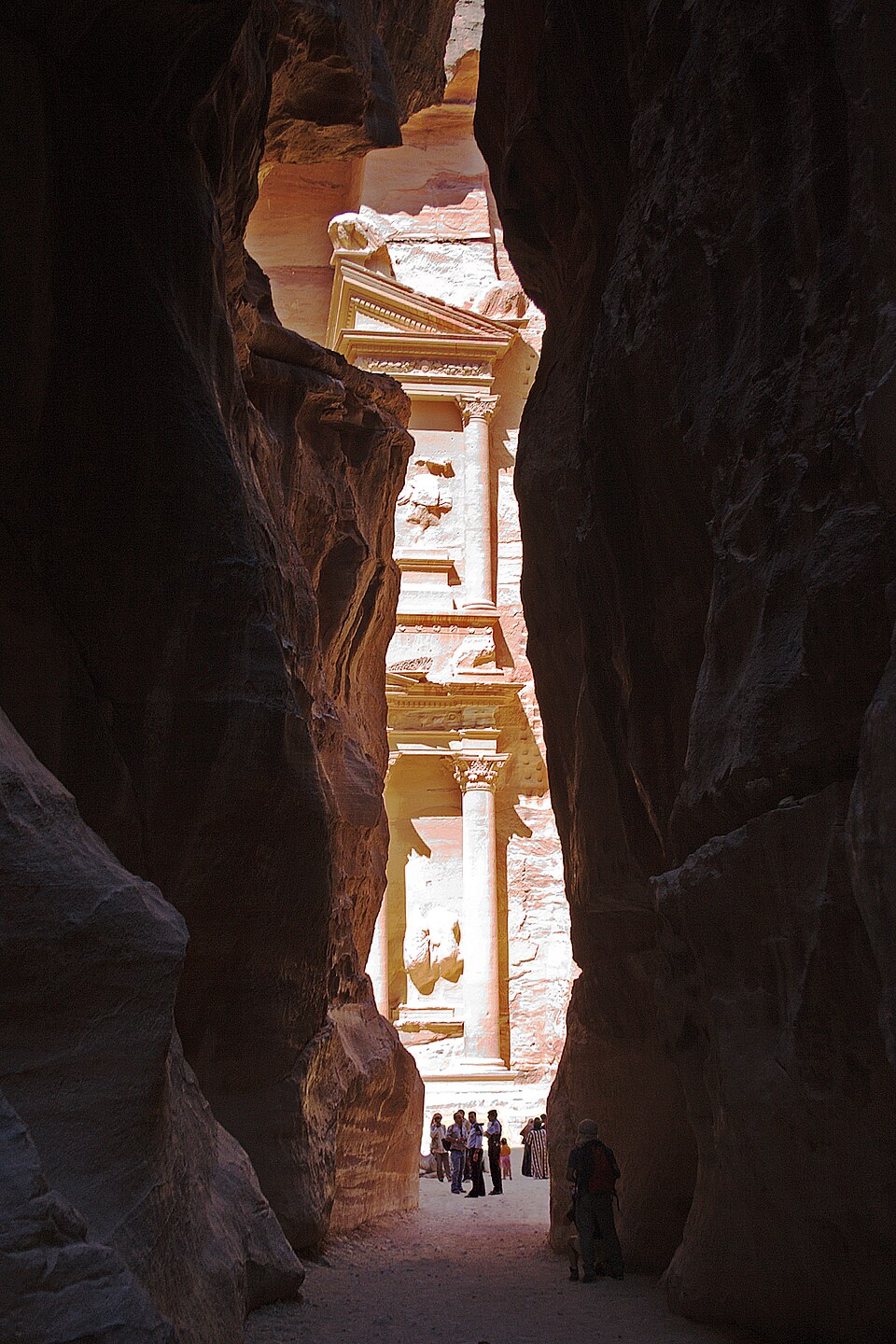
Petra's main entrance: a natural gorge 1.2 kilometres long, narrowing in places to just three metres between walls eighty metres high. Along the sides are remnants of Nabataean water channels, Roman-era paving and carved camel figures with their handlers. At the end, the Treasury appears for the first time through a narrow crack in the rock.

Tip: Walk the Siq right at opening, six in the morning — for that first hour you'll have it almost to yourself, and the light on the Treasury is soft. A horse ride from the gate to the start of the Siq is included in the ticket price, but a tip is expected; walking takes about the same time anyway. Carriages travel the Siq in the opposite direction, so keep to the wall.

Admission:
included in admission
Time needed:
30 min
The Treasury (Al-Khazneh)

The Treasury (Al-Khazneh)

end of the Siq

Petra's most famous structure, a forty-metre-high façade carved into the rock in the first century as the tomb of King Aretas IV. Bedouins once believed a pharaoh's treasure was hidden in the urn at the top and fired at it — bullet marks are still visible today. The façade shifts colour through the day, from pink to deep orange.

Tip: The best light falls between nine and eleven, when the sun hits the façade directly. The elevated view familiar from photos comes from a viewpoint above the Treasury, reached in an hour via the trail from the Royal Tombs over Al-Khubtha, or by a shorter, riskier Bedouin-guided route for a fee — not recommended. Entry inside isn't permitted.

Admission:
included in admission
Time needed:
30 min
Street of Facades and the Theatre

Street of Facades and the Theatre

the Outer Siq

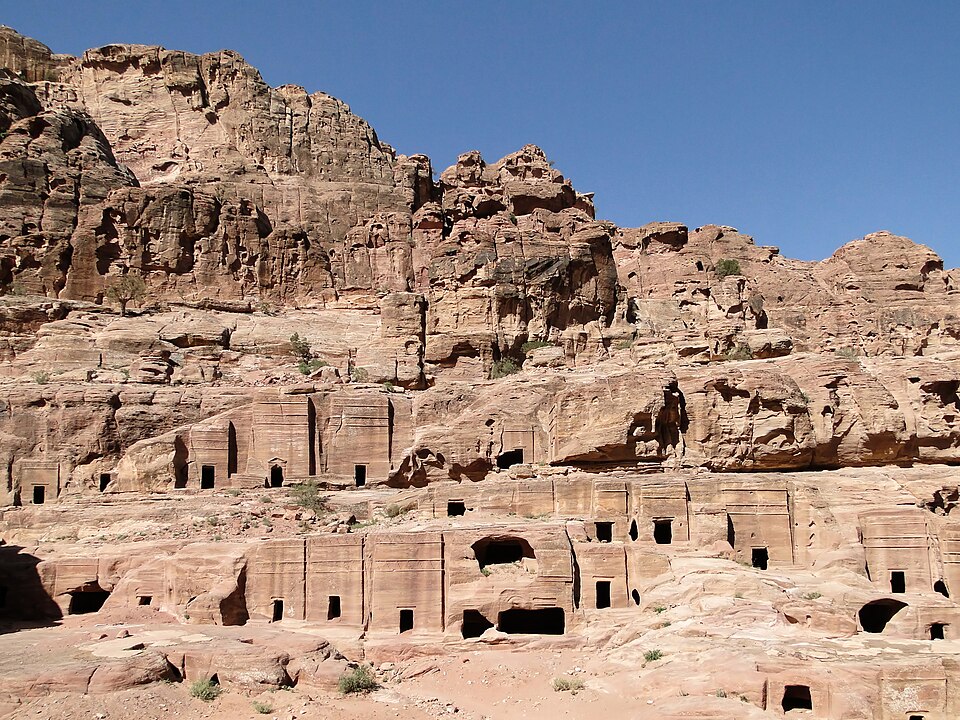
Past the Treasury, the gorge widens into the Outer Siq, lined with dozens of tombs featuring the typical stepped-crown façades. Further on stands a theatre carved into the rock for around eight thousand spectators, enlarged by the Nabataeans after the Roman conquest; older tombs were cut through during construction, and their openings are still visible in the back rows.

Tip: This stretch has the most vendors and camels, but also the best shady spots to rest. Toilets and a café are by the theatre; the next ones are at the restaurants in the centre. Anyone short on time moves briskly through here — the main highlights are still ahead.

Admission:
included in admission
Time needed:
45 min
The Royal Tombs

The Royal Tombs

the Petra valley

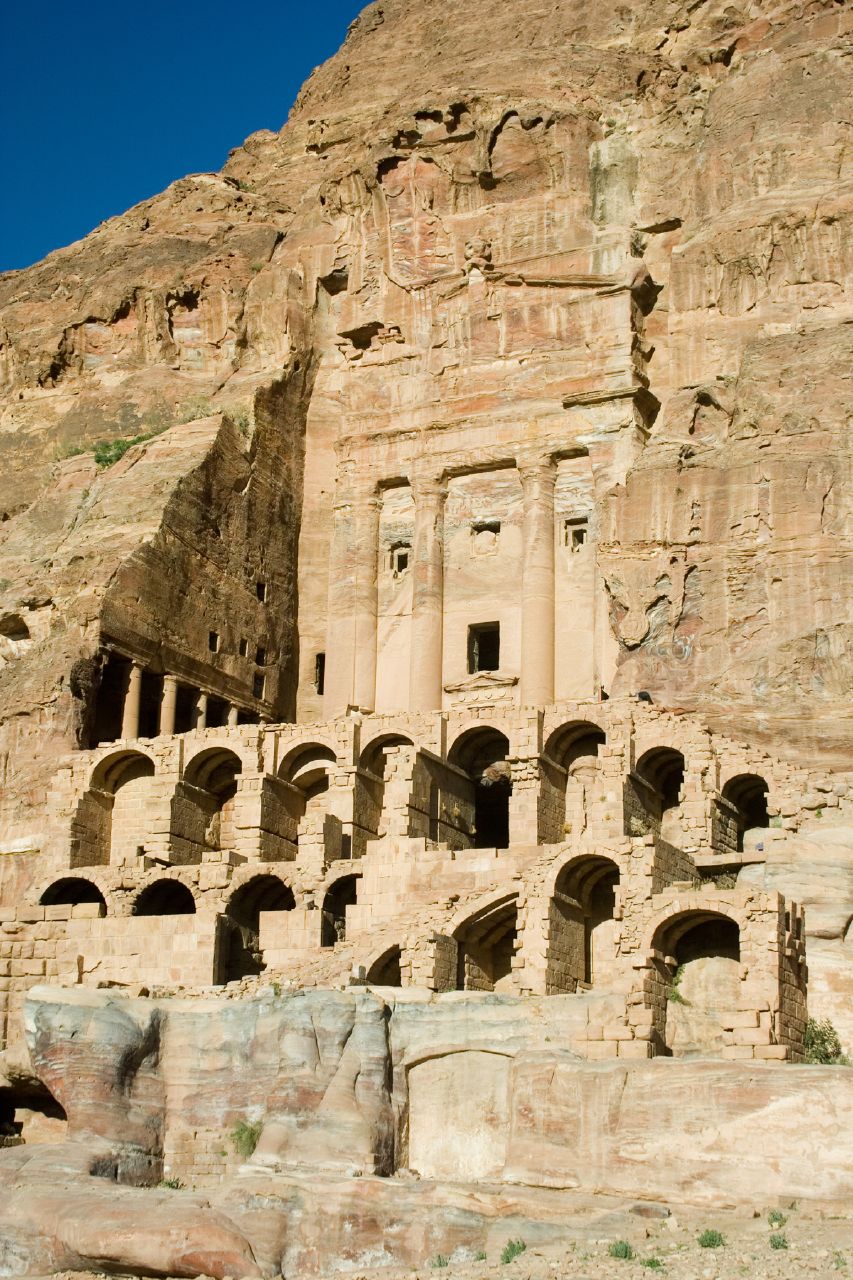
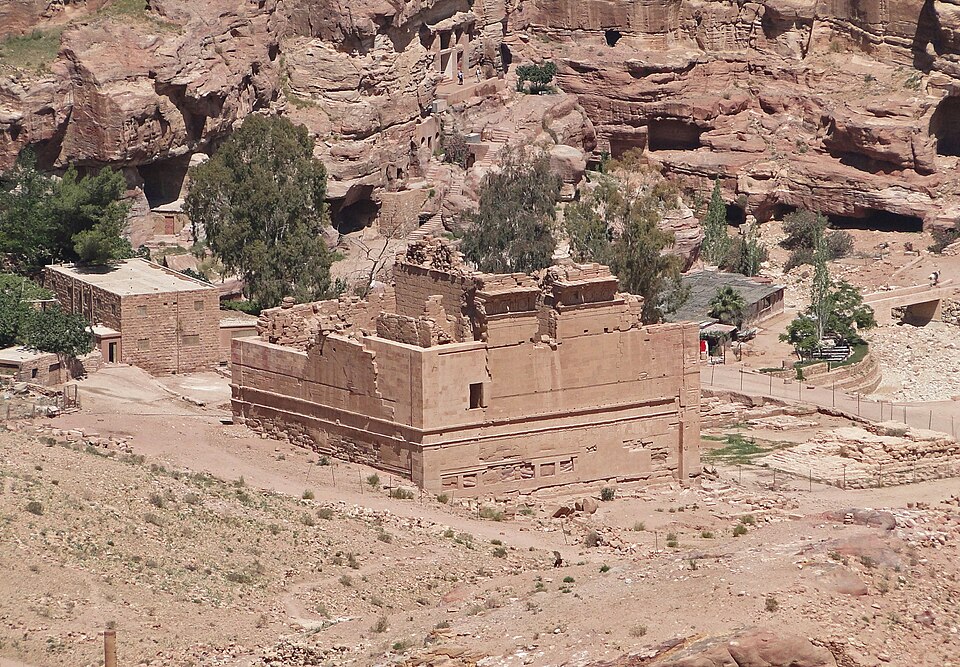
A row of four monumental tombs carved into the slope of Mount Al-Khubtha: the Urn Tomb with its vaulted crypts, the Silk Tomb with its bands of coloured sandstone, the Corinthian Tomb and the three-storey Palace Tomb. The Urn Tomb served as a church in Byzantine times. This spot offers the best view over the whole Petra valley.

Tip: Come after three in the afternoon, when the sun hits the façades directly and the sandstone's colours stand out — mornings leave them in shadow. Inside the Silk Tomb, the rock layers look like marble. Beyond the tombs, a trail up to Al-Khubtha begins, with a view over the Treasury, an hour round trip.

Admission:
included in admission
Time needed:
1 h
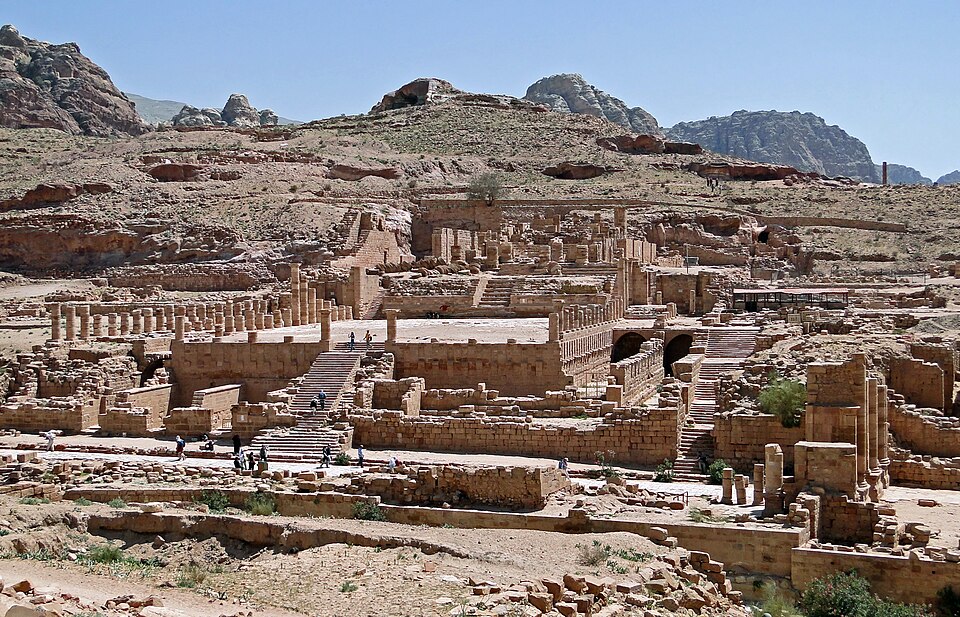
Colonnaded Street and the Great Temple

Colonnaded Street and the Great Temple

central Petra

The main Roman-era street of central Petra, paved and lined with columns, flanked by markets, baths and a nymphaeum. Rising above it is the Great Temple, the city's largest structure, only excavated in the 1990s — it had its own small theatre and floors of white and grey marble.

Tip: This is where the restaurants and cafés are, and where most visitors stop for lunch; the buffet at the Basin Restaurant costs around seventeen dinars, with cheaper sandwiches available at Bedouin stalls. Better yet, bring your own food and water from Wadi Musa — everything inside costs triple.

Admission:
included in admission
Time needed:
45 min
Qasr al-Bint

Qasr al-Bint

end of the Colonnaded Street

Petra's only freestanding structure, not carved but built from stone blocks: a temple from the late first century BC, dedicated to the Nabataeans' chief god, Dushara. It survived earthquakes thanks to wooden beams within the masonry that absorbed the shocks. It stands at the end of the Colonnaded Street, beneath the mountain.

Tip: The trail up to the Monastery begins just past the temple, so this is the last good spot to refill water and rest. Nearby is the Petra Museum, with Nabataean sculptures and pottery, included in the ticket and air-conditioned — ideal in the midday heat.

Admission:
included in admission
Time needed:
20 min
The Monastery (Ad-Deir)

The Monastery (Ad-Deir)

Mount Ad-Deir

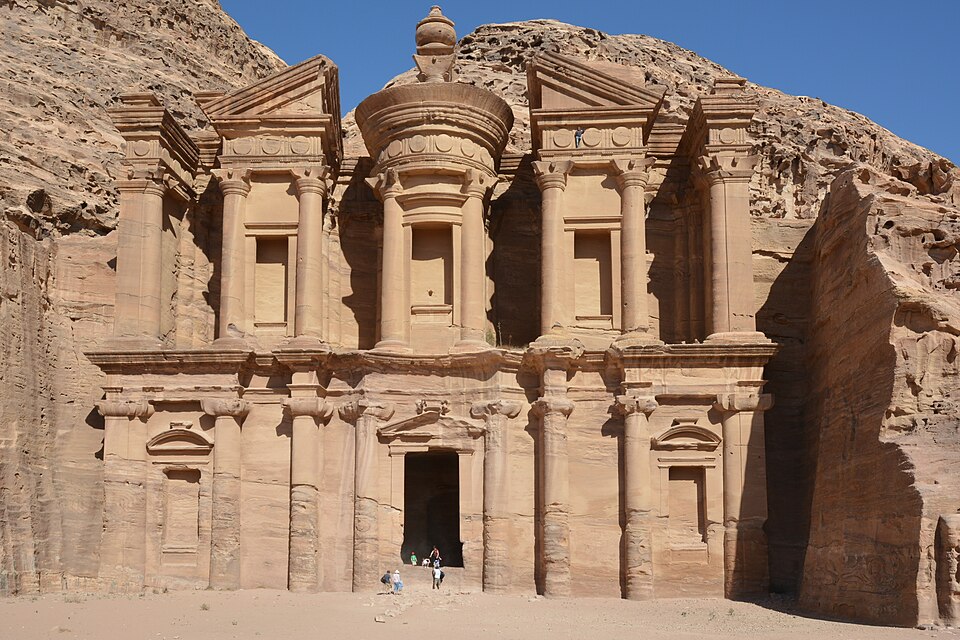
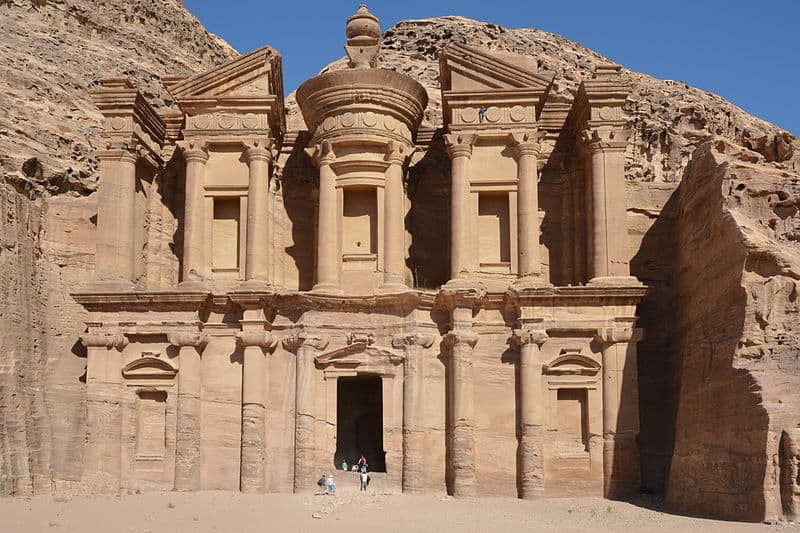
Petra's largest façade, forty-seven metres tall and fifty wide, carved into the mountaintop. A trail of roughly eight hundred rock-cut steps leads up, taking forty minutes to an hour. At the top, a Bedouin café faces the façade, with views into the Wadi Araba valley reaching toward Israel.

Tip: Go up in the afternoon, when the trail is shaded and the façade catches the sun. Donkey rides up are offered at every turn, but the animals are often in poor condition, and it isn't safe on the steps anyway. From the café by the Monastery, a ten-minute walk leads to a marked View Point — the best vista in all of Petra.

Admission:
included in admission
Time needed:
2–3 h round trip
The High Place of Sacrifice

The High Place of Sacrifice

Mount Madhbah

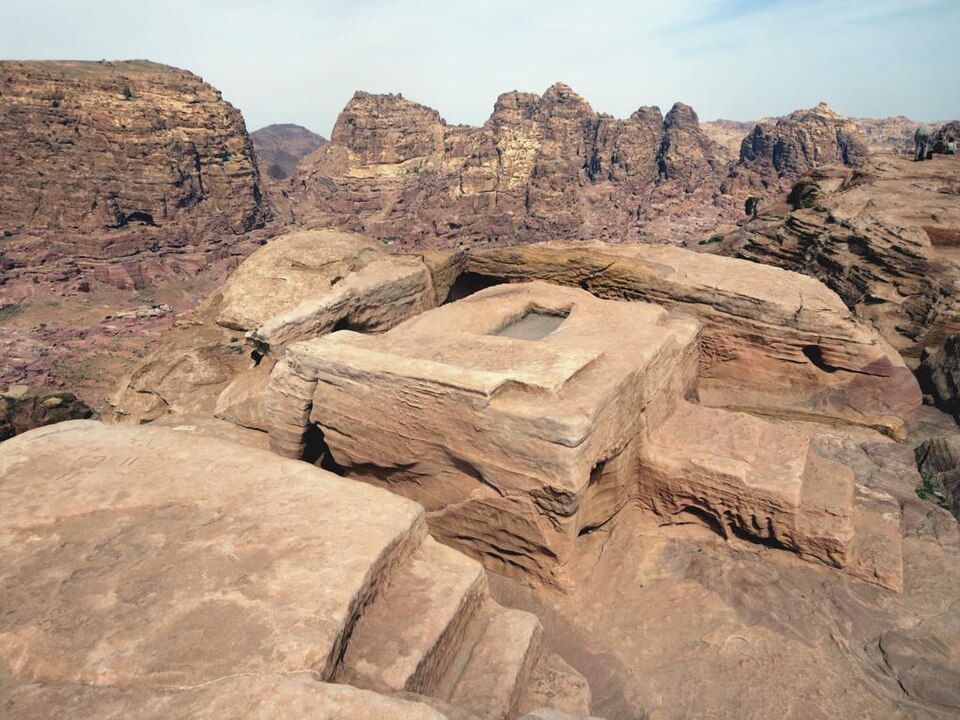
A Nabataean altar atop Mount Madhbah, with a sacrificial stone and carved basins, reached by a trail from the Outer Siq. Along the way stand two obelisks, and the summit offers a view over the whole city. The return route runs down the other side through Wadi Farasa, passing the Lion Fountain and the Garden Tomb.

Tip: This is Petra's most beautiful route, walked by only about one in ten visitors. Go in the morning of your second day: the climb from the theatre takes forty minutes, the descent through Wadi Farasa an hour and a half, ending at Qasr al-Bint. The trail is steep but safe — wear sturdy shoes.

Admission:
included in admission
Time needed:
3 h
Petra by Night

Petra by Night

the Siq and the Treasury

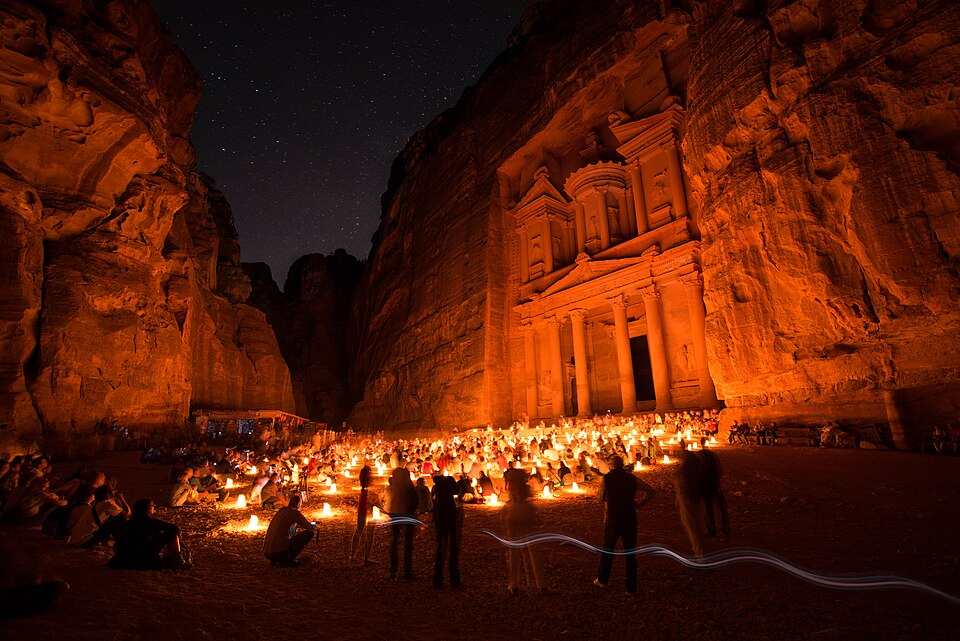
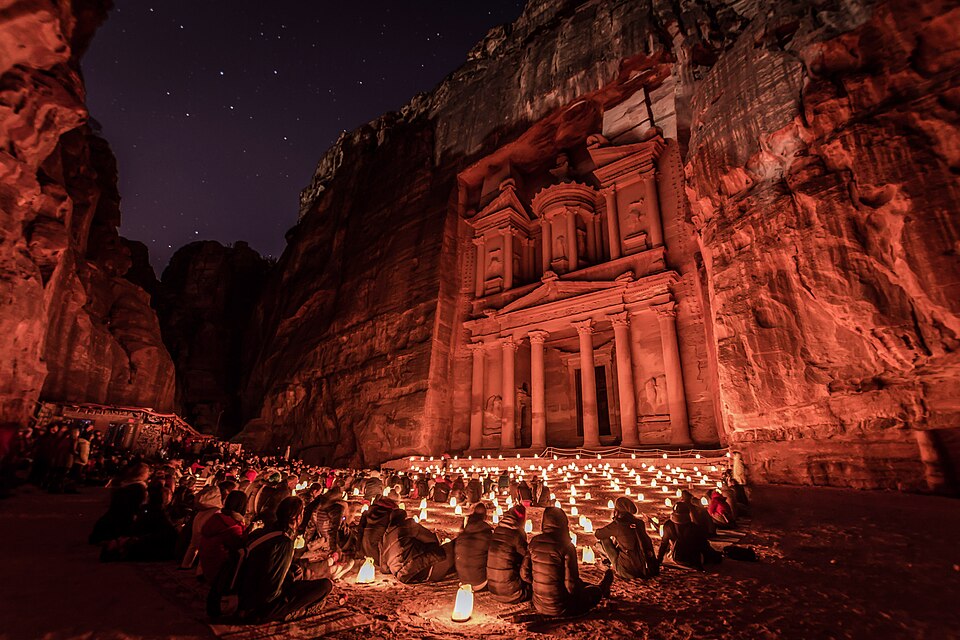
Three nights a week — Monday, Wednesday and Thursday — the Siq is lit with fifteen hundred candles in paper lanterns, and Bedouin music and storytelling take place in front of the Treasury. The show starts at half past eight and runs two hours. It requires a separate ticket, not included in the Jordan Pass.

Tip: The Treasury by candlelight is photogenic, but the show is touristy, and up to six hundred people can show up. Arrive at the Siq among the first to get a front spot on the mat. Coloured lights are projected onto the Treasury afterward, which not everyone finds photogenic. Tea is included.

Admission:
JOD 17
Time needed:
2 h

Photos: The Siq — David Bjorgen (CC BY-SA 3.0) · The Treasury (Al-Khazneh) — Susanahajer (CC BY-SA 3.0) · Street of Facades and the Theatre — Bernard Gagnon (CC BY-SA 3.0) · The Royal Tombs — Original uploader was User: (WT-shared) Cybjorg at wts wikivoyage (CC BY-SA 1.0) · Colonnaded Street and the Great Temple — Bernard Gagnon (CC BY-SA 3.0) · Qasr al-Bint — Bernard Gagnon (CC BY-SA 3.0) · The Monastery (Ad-Deir) — Azurfrog (CC BY-SA 3.0) · The High Place of Sacrifice — David Stanley from Nanaimo, Canada (CC BY 2.0) · Petra by Night — Mustafa Waad Saeed (CC BY-SA 4.0)

Where to stay

Areas and districts, matched to the kind of trip you are taking

Wadi Musa by the gate

Best for: a first visit, a short stay

Hotels and restaurants within five hundred metres of the Petra entrance. You're first at the gate in the morning and only a short walk from bed when tired in the afternoon. Prices run higher, but the time saved each morning and afternoon is worth it.

Central Wadi Musa

Best for: budget travel, local food

The upper part of town around the Moses Spring roundabout, two kilometres from the gate. Cheap hotels, shawarma and falafel eateries, and shops. Reach the gate by taxi for two to three dinars or by hotel shuttle.

Taybeh and the hilltop hotels

Best for: views, quiet

Hotels along the ridge above Wadi Musa, with views over the mountains of Petra and the sunset. Quiet, with clean air, but a ten-minute drive to Petra. Good for those staying three nights with a car.

Little Petra and Bedouin camps

Best for: an experience, a night under the stars

Camps and glamping tents around Little Petra, fifteen minutes north by car. A zarb dinner, a quiet night under the stars, and a morning drive to Petra. A complement to a Wadi Musa stay, not a substitute.

Getting around

From the airport

Flights from Prague to Jordan land in Amman (AMM); direct seasonal flights are run by low-cost carriers, otherwise connecting via Istanbul or Vienna, with a total flight time of four hours. In winter, direct charter flights serve Aqaba (AQJ) on the Red Sea, from which Petra is only a hundred twenty-five kilometres away. From Amman to Petra it's two hundred thirty kilometres via the Desert Highway (three hours), or the prettier but slower King's Highway through Madaba, Karak and Shobak (five hours). The JETT bus runs from Amman once a day at half past six in the morning, returning in the afternoon. The visa fee is waived when buying a Jordan Pass, on condition of at least three nights in the country.

Amman Queen Alia (AMM) · 210 km

  • JETT bus from Amman· 3 h 30 min· JOD 11
  • Private driver· 3 h· JOD 80
  • Rental car· 3 h· JOD 35/day

Aqaba King Hussein (AQJ) · 125 km

  • Taxi· 2 h· JOD 50
  • Private driver via Wadi Rum· 2 h 30 min· JOD 60

Around town

Petra is explored entirely on foot; vehicles stop at the gate. The main route from the entrance to Qasr al-Bint is four kilometres on a gentle downhill grade — the walk back uphill takes longer than it looks. Bedouins offer horses, donkeys, camels and carriages; a carriage through the Siq is intended for visitors with limited mobility. In Wadi Musa, taxis have no meter, so agree on the fare beforehand. For travelling around Jordan, a rental car is the best option — roads are good quality and signed in English, and petrol is cheap. Those who'd rather not drive can hire a private driver for the whole Amman–Petra–Wadi Rum–Aqaba route.

On footThe only way to see Petra; plan on fifteen to twenty kilometres a day.
Taxi in Wadi MusaNo meter, from the town centre to the gate. · JOD 2
Rental carBest for the Amman–Petra–Wadi Rum–Aqaba route. · JOD 35/day
Private driverA full-day route with waiting time, priced by distance. · JOD 80

Useful apps: Careem, Uber, Google Maps, JETT (buses), Jordan Pass

When to go

The best time is March to May and September to November: twenty to twenty-seven degrees during the day and clear skies, ideal for full days of walking. April and October are the busiest months. Summer is hot and dry at thirty-two degrees, but Wadi Musa's elevation keeps evenings pleasant; visit Petra early morning and rest at midday. Winter is cold, around thirteen degrees by day and just above freezing at night, with occasional snow, and after rain the Siq can close due to flash flood risk. Hotels tend to be poorly heated in winter.

Best time

March–May, September–November

What to avoid

midday in July–August

MonthJanFebMarAprMayJunJulAugSepOctNovDec
Day13°14°18°23°27°31°32°32°30°26°19°15°
Night2°3°6°9°13°16°18°18°16°12°7°4°
Rainy days554210000134

Food & drink

Jordanian cuisine is Bedouin and Levantine: plenty of lamb, yoghurt, rice, flatbreads and mezze. Inside Petra itself, only a few buffet restaurants operate, at high prices, so bring food from Wadi Musa. The town has cheap eateries serving shawarma and falafel for two to three dinars, plus hotel restaurants with evening buffets. A local specialty is a Petra Kitchen cooking class, where guests prepare mezze and maqluba together in the evening and then eat as a group. Alcohol is sold at hotel bars and a handful of restaurants; beer costs five to seven dinars.

What to try

Mansaf

The national dish: lamb cooked in a sauce of dried fermented yoghurt called jameed, served over rice and thin flatbread, topped with almonds. Traditionally eaten by hand from a shared platter, it's the dish of weddings and feasts.

Maqluba

An 'upside-down' dish: rice, aubergine, cauliflower and chicken layered in a pot, then flipped onto a tray at the table. A Sunday family meal, often requiring a day's advance order at restaurants.

Hummus, falafel and mezze

Breakfast and dinner for Jordanians alike: hummus with olive oil, ful medames, falafel, flatbreads and vegetables. At a local eatery, two people can eat well for three to five dinars.

Zarb

Bedouin oven-pit cooking: chicken, lamb and vegetables baked for hours in a pit under the sand. Served at desert camps, where digging it up is part of the evening's entertainment.

Galayet bandora

Tomatoes stewed in a pan with onion, garlic and chilli, scooped up with bread. The simplest dish of the desert and shepherds, cooked over a campfire at camps.

Knafeh

A warm dessert of thin noodles or semolina with stretched white cheese, drenched in sugar syrup and topped with pistachios. Best fresh off the tray at a sweet shop.

Sage tea and Arabic coffee

Sweet black tea with sage or mint is offered by every shopkeeper and Bedouin host. Bitter cardamom-spiced Arabic coffee is served in small handleless cups as a gesture of hospitality.

Shawarma

Thin slices of chicken or lamb from a spit, wrapped in flatbread with garlic sauce and pickled vegetables. The fastest lunch in Wadi Musa, for one to two dinars.

What it costs

Jordan Pass (visa + Petra, 1–3 days)

JOD 70–80

Petra entry without Jordan Pass, 1 day

JOD 50

Petra by Night

JOD 17

Shawarma or falafel

JOD 1–3

Buffet at a restaurant inside Petra

JOD 15–20

Dinner at a restaurant in Wadi Musa

JOD 10–20

Bottle of water inside Petra

JOD 1–2

Night in a 3-star hotel, double

JOD 50–100

Indicative prices that change over time — treat them as a guide, not a price list.

Practical information

SocketsBtwo flat pins plus ground (US)CEuroplug, two round pinsDthree round pins (India)FSchukoGBritish, three rectangular pinsJSwiss
Voltage230V / 50Hz
Tap waterTap water is treated, bottled is common — Jordan is one of the driest countries in the world and conserves water carefully: households receive tap water only once a week, stored in rooftop tanks. Tap water is technically treated, but because of the tanks and old pipes, tourists don't drink it — a 1.5-litre bottle costs thirty-five to fifty fils in a shop, up to a dinar near the sites. Conserve water at the hotel too; a ten-minute shower counts as a luxury here.
TippingTipping is a normal part of income in Jordan. Restaurant bills usually include a ten percent service charge plus sixteen percent tax; if service isn't listed, leave ten percent yourself. Drivers on a full-day trip get five to ten dinars, guides ten to twenty dinars a day, and a hotel porter a dinar. Keep small cash on hand, since cards are only accepted at better hotels and restaurants.
Driving on theright
SafetyDespite its neighbours, Jordan is one of the most stable and safe countries in the Middle East; violent crime against tourists is rare, and tourist police patrol the heritage sites. Still, foreign ministries monitor the regional situation, so check current travel advice before your trip and register with your country's traveller system. The real risks are natural: heatstroke and dehydration in summer, flash floods in the canyons after rain from November to March, and uneven terrain at the sites. Women travelling alone occasionally encounter unwanted comments. The emergency number is 911.
Opening hoursThe weekend falls on Friday and Saturday, and on Friday mornings most shops and offices close for midday prayer. Shops open around nine and close between eight and ten in the evening. During Ramadan, eating, drinking and smoking in public during the day aren't done, and restaurants outside hotels open only after sunset; tourists are expected to respect this, at least in public. Heritage sites open early, often at six, and close at dusk.
Customs & etiquetteJordanians are hospitable, and an invitation for tea or coffee is common — decline politely if needed, since accepting costs nothing. Dress modestly: shoulders and knees covered, especially outside tourist sites and in mosques, where women also need a headscarf. Food is eaten, served and received with the right hand. Ask before photographing women or Bedouins. Public displays of affection aren't done. To signal you've had enough coffee in a Bedouin tent, give the cup a little shake — otherwise it keeps getting refilled.
A few local wordsHello (greeting) — As-salamu alaykumReply to the greeting — Wa alaykum as-salamThank you — ShukranNo, thank you — La, shukranHow much does it cost? — Kam hadha?That's enough — KhalasGoodbye — Ma'a as-salama

How to plan your days

1 day

Petra in One Day

  1. 1Enter at six in the morning and walk the Siq to the Treasury.
  2. 2Street of Facades, the theatre and the Royal Tombs.
  3. 3Colonnaded Street, the Great Temple and lunch by Qasr al-Bint.
  4. 4Afternoon climb to the Monastery and its viewpoint.
  5. 5Return to the gate before dusk; consider Petra by Night in the evening.

2 days

Petra in Two Days

  1. 1Day 1: the Siq, the Treasury, the theatre, Colonnaded Street and the Monastery.
  2. 2Evening: Petra by Night, or a Petra Kitchen cooking class.
  3. 3Day 2: morning trail up to the High Place of Sacrifice, descent via Wadi Farasa.
  4. 4Afternoon at the Royal Tombs in good light, and the Al-Khubtha viewpoint above the Treasury.
  5. 5Evening at Little Petra and a Bedouin dinner.

3 days

Petra and Wadi Rum in Three Days

  1. 1Day 1: the main route through Petra, including the Monastery.
  2. 2Day 2: the High Place of Sacrifice, the Royal Tombs, the viewpoint above the Treasury.
  3. 3Day 3: morning drive to Wadi Rum (1 h 45 min).
  4. 4Afternoon jeep safari among the rocks and sand dunes.
  5. 5Overnight at a Bedouin camp, continuing to Aqaba in the morning.

Day trips

Little Petra (Siq al-Barid)

9 km · 15 min by car

A smaller Nabataean suburb where caravans once stopped: a narrow gorge with tombs, storerooms and cisterns, and in one chamber a rare Nabataean wall painting of grapevines and birds. Entry is free, an hour is enough to see it, and it draws far fewer visitors. A footpath continues from Little Petra all the way to the Monastery in Petra (three hours) — an interesting back entrance for those with a valid ticket.

Wadi Rum

110 km · 1 h 45 min by car

A desert of red sandstone mountains and sand dunes, filmed as the backdrop for Lawrence of Arabia, The Martian and Dune. Bedouin drivers take you by jeep among rock bridges, Nabataean carvings and dunes; in the evening, zarb is baked in the ground, and the night is spent in a camp or a transparent bubble tent under the stars. Entry is covered by the Jordan Pass; a half-day jeep tour costs around fifty dinars per vehicle.

Shobak Castle and Dana

30 km · 40 min by car

The Crusader castle of Montreal, from 1115, sits on a hill above the King's Highway, with a secret passage down to an underground well that can be explored with a torch. Thirty kilometres further north is the Dana Biosphere Reserve, with a stone village on the edge of a canyon, valley hikes and an eco-lodge. Both can be combined on the King's Highway route from Amman.

Frequently asked questions

Is the Jordan Pass worth it?+

Almost always, yes. The Jordan Pass costs 70, 75 or 80 dinars depending on the number of days in Petra (one, two or three) and includes a 40-dinar visa plus 50 to 60 dinars of Petra admission. The condition is spending at least three nights in Jordan. It's bought online in advance and simply shown at the airport.

How many days do I need for Petra?+

Ideally two. In one day you can cover the Siq, the Treasury, the centre and the Monastery, but that's twenty kilometres of walking, leaving no time for the High Place of Sacrifice or the Royal Tombs in afternoon light. The price difference between a one-day and two-day ticket is only five dinars.

When should I arrive at Petra to avoid the crowds?+

The gate opens at six in the morning, and the Siq and Treasury stay quiet until eight. Buses from Aqaba and cruise ships arrive between nine and eleven. After three in the afternoon, Petra empties out again and the light is at its best. The worst times are Friday and Saturday mornings, when Jordanians visit too.

How physically demanding is Petra?+

The main route from the gate to Qasr al-Bint is four kilometres, gently downhill over gravel and sand. The Monastery means eight hundred steps up; the High Place of Sacrifice is roughly the same. The walk back to the gate is uphill, and people underestimate it. Bring sturdy shoes, head covering and at least two litres of water per person.

Is it safe to travel to Jordan?+

Jordan is stable and safe for tourists, and Petra is one of the most closely guarded sites in the country. Before travelling, check your foreign ministry's current advice, especially given the situation in neighbouring countries, and register with your country's traveller system. Insurance that covers Jordan is essential.

How should I dress?+

Shoulders and knees covered, comfortable trousers or a long skirt, and a sleeved shirt — appropriate both culturally and against the sun. Shorts won't offend anyone inside Petra, but look out of place in Wadi Musa and rural areas. Bring a jacket for desert nights and for Petra in winter, when temperatures drop close to freezing.

Are donkey and camel rides okay to take?+

It's a sensitive topic. Animal welfare organisations have long raised concerns about the treatment of animals in Petra, particularly the donkeys on the steps up to the Monastery. Authorities have introduced inspections and a veterinary clinic, but we recommend walking instead. If you need help getting around, take a horse carriage or one of the electric carts gradually replacing them.

Can Petra be combined with the seaside?+

Yes, Aqaba on the Red Sea is a two-hour drive away, and direct charter flights from Prague run there in winter. The most common loop covers Amman, the Dead Sea, Petra, Wadi Rum and Aqaba over a week. From Aqaba you can also cross into Taba and the Sinai in Egypt.

Visabestimmungen

Prüfen Sie die aktuellen Visabestimmungen für die Einreise in dieses Land.

Visabestimmungen prüfen

Sprache

Arabic

Währung

JOD

Zeitzone

GMT+2

Vorwahl

+962

Bevölkerung

11.5M

Fläche

89,342 km²

Spannung

230V / 50Hz

Fahrseite

Rechts

Top Hotels in Petra

Live-Preise von 500+ Unterkünften

Hotels werden geladen...

Planen Sie eine Reise nach Petra?

Vergleichen Sie Hunderte von Hotels, finden Sie den besten Preis und buchen Sie mit kostenloser Stornierung.