Hotels in Agadir

10 kilometres of beach, 300 days of sunshine and the Atlantic beneath the High Atlas

Agadir

LanguageArabic / French
CurrencyMAD
TimezoneAfrica/Casablanca
Temperature15-35 °C
Dial Code+212
Population37.5M
Area446,550 km²
SocketsType C / Type E
Tap waterBottled advised

Discover Agadir

Agadir is Morocco's largest resort town and also its youngest city: in 1960, an earthquake levelled it in 15 seconds, killing 15,000 people, and everything you see today has been rebuilt from scratch to a plan. That's why there's no classic medina or narrow alleyways here — instead you'll find wide boulevards, low-rise buildings and a 10-km crescent of beach lined by a café-filled promenade. Above the city stand the walls of the old kasbah, the only structure to survive the earthquake, and below it lies a grassy hill where the old town of Agadir is buried along with its residents. The city sits on the border where the fertile Souss valley ends and the Anti-Atlas begins, so within an hour you can reach argan groves, mountain gorges with waterfalls, or a river mouth with flamingos. Agadir has the most consistent climate in Morocco — over 300 days of sunshine a year, 21°C in January, 28°C in August — but the Atlantic stays cool, 20–22°C even in summer.

What to see

The places worth your time in Agadir, and what to expect at each

Kasbah Agadir Oufella

Kasbah Agadir Oufella

above the city

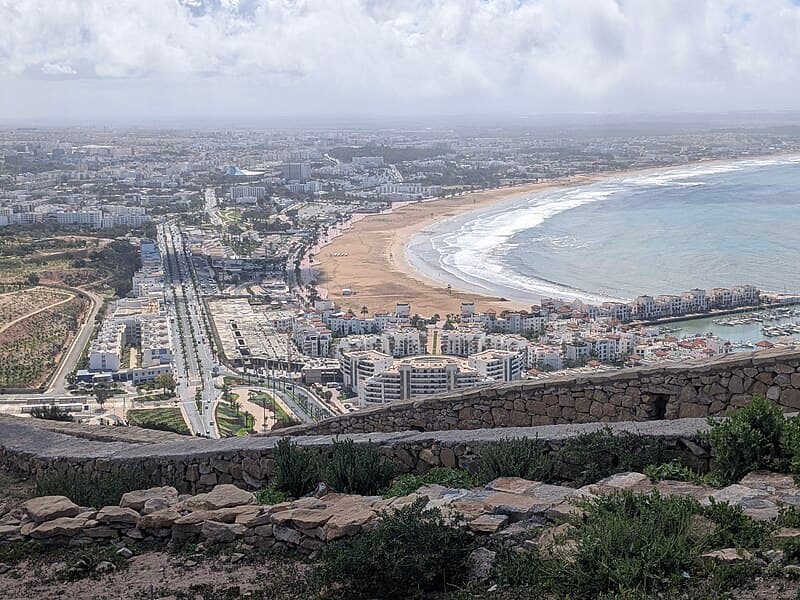
The remains of a 16th-century fortress on a hill 230 m above the city, the only structure that survived the earthquake. The walls have been restored, and from them there are views over the whole bay, the harbour and the slope beneath which the old town lies buried.

Tip: Since 2023 a cable car has run up from the lower station near the port, taking 5 minutes. You can walk back down the path, but only downhill and only in daylight — going up is a steep, shadeless hour's climb.

Admission:
cable car from MAD 100 return
Time needed:
2 h
Beach and promenade

Beach and promenade

whole coastline

A 10-km arc of fine golden sand sheltered by a headland, which keeps the waves gentle in the central section. A paved promenade with cafés, playgrounds and sun loungers runs alongside it, filling with local families in the evening. Lifeguards watch the marked sections all day.

Tip: Waves and currents grow stronger heading north from the centre. With children, stay in the southern half near the harbour, where the headland breaks the swell; the northern end is for surfers, and it gets choppy there in the afternoon wind.

Admission:
free, sun lounger from MAD 60
Time needed:
full day
Souk El Had

Souk El Had

Talborjt

The largest market in southern Morocco, walled and entered through several gates, divided into sectors by goods — spices, olives, argan, ceramics, textiles, livestock. Tens of thousands of people pass through daily, and it's the one place in Agadir that feels like old Morocco.

Tip: Enter through gate 6 or 7, where the food section with spices and olives begins; the gates near the car park lead straight into the souvenir section, where the bargaining is toughest. Closed on Mondays.

Admission:
free
Time needed:
3 h
Marina Agadir

Marina Agadir

northern end of the beach

A yacht marina at the northern end of the beach, with low white buildings, restaurants and a promenade around the jetty. It's the calmest stretch of the coast, free of hawkers, with the kasbah looming above. Both yachts and fishing boats moor here.

Tip: Restaurants right by the jetty charge tourist prices. About 300 m further at the fishing port are wooden stalls where grilled sardines with bread cost a fifth as much, and fishermen eat there themselves.

Admission:
free
Time needed:
2–3 h
Crocoparc

Crocoparc

Drarga, 15 km

A botanical garden 15 km northeast of the city with baobabs, cacti and argan trees, home to over 300 Nile crocodiles in terraced pools. It's well maintained and shaded, and makes for a good half-day out even with small children.

Tip: Crocodile feeding happens about once a week, with the date posted on the park's website; outside of that, the animals mostly lie still all day. A shuttle bus runs to the park from the centre, and a taxi there and back costs around MAD 150.

Admission:
from MAD 120, children from MAD 70
Time needed:
half day
Taghazout

Taghazout

19 km north

A fishing village 19 km north that has become North Africa's leading surf hub. Waves break over the rocky points of Anchor Point and Killer Point from September to April, and the village is packed with surf camps, cafés and houses stacked on the slope above the bay.

Tip: The best waves come in winter, not summer — the main surf season runs from October to March. Beginners head to the sandy beach in nearby Tamraght, since the rocky points at Taghazout can knock you around badly.

Admission:
free, surf lesson from MAD 350
Time needed:
half day
Paradise Valley

Paradise Valley

60 km northeast

A gorge in the Anti-Atlas mountains 60 km northeast, carved by the Tamraght river, where a cascade of natural pools with green water has formed among palms and rocks. Visitors jump in from the rocks and cross between pools on stepping stones.

Tip: Water levels are highest in spring after the winter rains; by August and September the upper pools tend to dry up, and only the first one near the car park is worth visiting. Bring water shoes — the rocks are sharp and slippery.

Admission:
free, parking MAD 20
Time needed:
full day
Souss-Massa National Park

Souss-Massa National Park

40 km south

A protected area along the coast south of the city at the mouth of the Massa river, home to the world's last wild population of the northern bald ibis. Flamingos stand in the lagoons, and gazelles and oryx graze in the sand dunes at an acclimatisation station.

Tip: Birds are best watched early morning or late afternoon — at midday the lagoons are quiet. Access is from the village of Sidi Rbat, and without your own car you'll struggle to get here; bring binoculars, as there's nowhere to rent them.

Admission:
from MAD 30
Time needed:
half day
Medina Polizzi and Vallée des Oiseaux

Medina Polizzi and Vallée des Oiseaux

Ben Sergao and city centre

2 stops for a day in the city: Medina Polizzi is a hand-built replica of a Moroccan medina made from local materials, with craft workshops, while Vallée des Oiseaux is a narrow green park in the middle of the city with aviaries, goats and a playground. Both stand in for the medina Agadir lost.

Tip: Visit Medina Polizzi in the morning, when craftsmen are actually at work in the workshops; by afternoon it's just a shop. The bird park is free and the cheapest activity for children in the city centre.

Admission:
medina from MAD 60, park free
Time needed:
3 h

Photos: Kasbah Agadir Oufella — Laminihasnaa (CC BY-SA 4.0) · Beach and promenade — Elmschrat (CC BY-SA 3.0) · Souk El Had — Oussama akbi (CC BY-SA 4.0) · Marina Agadir — MustaSensei (CC BY-SA 4.0) · Crocoparc — Veronik80000 (CC BY-SA 4.0) · Taghazout — 瑞丽江的河水 (CC BY-SA 4.0) · Paradise Valley — CHKOURRACH Larbi (CC BY-SA 4.0) · Souss-Massa National Park — This Photo was taken by Timothy A. Gonsalves. Feel free to use my photos, but please mention me as the author. I would (CC BY-SA 4.0) · Medina Polizzi and Vallée des Oiseaux — ZAINEB HACHAMI (CC BY-SA 4.0)

Where to stay

Areas and districts, matched to the kind of trip you are taking

Secteur Balnéaire

Best for: beach and first-time visits

The hotel strip between the promenade and Boulevard du 20 Août, where most of the big hotels stand and everything is within 10 minutes' walk of the sea. Restaurants here have European prices and menus, but it's safe and pleasant for an evening walk on the promenade. Anyone here mainly for the beach stays in this area.

Talborjt

Best for: cheap food and the souk

The district above the hotel zone, built for locals after the earthquake, with shops, bakeries and eateries where a tagine costs a quarter of the promenade price. It's a walk from here to Souk El Had. The beach is a 20-minute walk downhill, uphill on the way back.

Marina and harbour

Best for: quiet and seafood restaurants

The northern end of the coast around the yacht marina, with new apartments and the quietest stretch of beach. It lacks the buzz of the promenade, but it's close to the fishing port's grilled sardines and the cable car up to the kasbah. A taxi to the centre costs around MAD 20.

Taghazout and Tamraght

Best for: surfers and younger travellers

Villages 19 and 14 km north, where surf camps and rented houses above the bay take the place of hotels. Life revolves around waves, yoga and cafés; prices are lower than in Agadir and the atmosphere is completely different. Shared taxis and bus number 32 run into the city.

Getting around

From the airport

Agadir Al Massira Airport lies 25 km southeast of the city and receives charter and low-cost flights from across Europe, most with 1 stop, commonly via Casablanca, Madrid or Marseille. Bus number 22 runs from the airport to the centre roughly every hour for MAD 30, and taxis charge a fixed fare of around MAD 250. CTM and Supratours buses connect Agadir with Marrakech in 3.5 hours, with Essaouira in 3 hours and with Casablanca in 8 hours. There are no trains to Agadir — the rail network ends in Marrakech.

Agadir Al Massira (AGA) · 25 km

  • Hotel transfer· 30 min· included in stay
  • Taxi (fixed fare)· 30 min· MAD 250
  • Bus number 22· 1 h· MAD 30

Marrakesh Menara (RAK) · 250 km

  • CTM or Supratours bus· 3 h 30 min· MAD 140
  • Private transfer· 3 h· MAD 1,800

Around town

Agadir has 2 kinds of taxi, and it's worth knowing the difference: orange petit taxis work within the city, are metered, and a ride costs MAD 15–30; white grand taxis travel out of town, are shared with other passengers, and the fare is agreed in advance. The city's Alsa buses are cheap and run to Taghazout (line 32) and the airport (line 22). The promenade runs for 10 km and is good for walking or cycling. A rental car is worthwhile for Paradise Valley and Souss-Massa, which public transport doesn't reach.

Petit taxiOrange, city only, the meter is mandatory — if the driver doesn't switch it on, get out. · MAD 15
Grand taxiWhite, out of town and shared. Agree the fare beforehand, or pay for all 6 seats. · MAD 25
Alsa busLine 32 to Taghazout, 22 to the airport. Cheap, but irregular and crowded. · MAD 6
Rental carNeeded for Paradise Valley, Souss-Massa and the Anti-Atlas. Fuel is paid in cash. · MAD 350 / day
InDriveWorks in Agadir and tends to be cheaper than a petit taxi, especially in the evening and for longer rides. · MAD 20

Useful apps: Google Maps, InDrive, Maps.me

When to go

Agadir can be visited year-round, which is its main strength — January still brings 21°C and sunshine even in winter. The air is warmest in August and September, around 28°C, but the Atlantic stays cool: at its warmest it's 22°C in August and September, dropping to 17°C in winter. Anyone hoping for warm swimming will be disappointed; anyone wanting sun, beach and day trips without the heat has found the ideal spot. Rain falls only in the winter months, and even then just 4–5 days a month. Winter is best for surfing, spring for mountain trips.

Best time

April to June and September to November

What to avoid

nothing major — the sea is just too cold for swimming in December and January

MonthJanFebMarAprMayJunJulAugSepOctNovDec
Day21°22°23°23°24°25°27°28°28°27°24°21°
Night8°9°11°12°14°17°19°19°18°16°12°9°
Rainy days544210001345
Sea17°17°17°18°19°20°21°22°22°21°20°18°

Food & drink

Agadir is a fishing port, so the best food in the city is also the cheapest: at the wooden stalls by the fishing port you pick out sardines, prawns or squid, have them grilled on the spot, and get them served with bread and tomato salad for a few dozen dirhams. Elsewhere the city serves classic Moroccan tagines and, on Fridays, couscous. Southern Morocco adds 2 things of its own: argan oil, which grows only here and is pressed in women's cooperatives along the road to Essaouira, and amlou — a sweet paste of argan oil, almonds and honey, spread at breakfast.

What to try

Tagine

Meat or vegetables stewed in a cone-shaped clay pot that returns the steam to the food. The classic is chicken with salt-preserved lemons and olives; in the south it's also made with fish.

Couscous with beef and 7 vegetables

Served on Fridays after midday prayers; local restaurants often don't cook it on other days. The semolina is steamed 3 times, which is what makes it so light and fluffy.

Harira

A thick soup of tomatoes, chickpeas, lentils and lamb, thickened with flour. Eaten with dates and sweet chebakia pastries, especially during Ramadan to break the fast.

Pastilla

A crisp pastry of warqa filo pastry with pigeon or chicken, almonds and cinnamon, dusted with sugar. Sweet and savoury together — a taste you either love or don't.

Msemen and beghrir

Breakfast flatbreads: msemen is layered and buttery, beghrir is pocked with 1,000 tiny holes like a pancake. Both are spread with butter and argan honey.

Grilled sardines

The cheapest and best dish on the Atlantic coast. Bought by weight at the harbour stalls, grilled whole and eaten with bread and lemon.

Argan oil and amlou

Oil from the fruit of the argan tree grows only in southern Morocco. Amlou is its sweet version with ground almonds and honey, spread on bread — the best souvenir you can buy.

Sweet mint tea

Green tea with a handful of mint and plenty of sugar, poured from height to create foam. Turning down an offered glass simply isn't done.

What it costs

Mint tea at a café

MAD 10–20

Tagine in Talborjt

MAD 50–80

Grilled sardines at the fishing port

MAD 40–70

Dinner on the promenade

MAD 150–300 per person

0.5 l beer at a licensed venue

MAD 40–60

Petit taxi around the city

MAD 15–30

Surf lesson in Tamraght

from MAD 350

Cable car to the kasbah, return

from MAD 100

Indicative prices that change over time — treat them as a guide, not a price list.

Practical information

SocketsCEuroplug, two round pinsEFrench, with earth pin
Voltage220V / 50Hz
Tap waterTap water is treated, bottled is common — Tap water in Agadir is treated, but it's heavily chlorinated and can upset stomachs unused to the local bacteria. Drink bottled water instead — a 1.5-litre bottle costs MAD 6–8 at a shop. Avoid street salads and ice in drinks for the first few days.
TippingTips are given in small change and often: MAD 2–3 for a car park attendant, a few coins for a café waiter, 10% at a restaurant. A hotel porter expects MAD 10 per bag, a full-day tour guide MAD 50 per person. Keep plenty of coins and MAD 20 notes on hand — no one will be able to change a MAD 200 note.
Driving on theright
SafetyAgadir and the whole southern coast are among the safest parts of Morocco, and violent crime is rare. Do expect persistent touting on the promenade and in the souk, and fake guides who offer a 'shortcut' that ends at a carpet shop. Prices are negotiable everywhere except supermarkets and pharmacies — the first offer is usually 3 times too high. In the Atlantic, watch out for strong rip currents: swim only in the lifeguarded sections marked on the city beach.
Opening hoursShops are generally open from around 9am to 8pm, later in tourist areas. Souk El Had is closed on Mondays, state museums usually on Tuesdays. Around midday on Friday, shops close for an hour for the main prayer. During Ramadan, opening hours shift into the evening and restaurants serving locals don't operate during the day.
Customs & etiquetteMorocco is a Muslim country, but no one minds what you wear in the beach resorts — swimwear belongs on the beach and at the pool, while a T-shirt and longer trousers are fine in town and the souk. Alcohol is sold only in hotels, licensed restaurants and the designated sections of Carrefour and Marjane supermarkets, not on the street. During Ramadan, eating and smoking in public before sunset is avoided. Don't photograph people without permission; with street performers and water sellers, a photo is a paid service.
A few local wordsHello — Salám alejkumThank you — ŠukranNo, thank you — Lá, šukranHow much is it? — Bšhál?I don't want to buy anything — Mabghítš nešrí

How to plan your days

1 day

A day in Agadir

  1. 1Morning swim and stroll on the southern stretch of the beach.
  2. 2Lunch of grilled fish at the fishing port.
  3. 3Afternoon cable car to the kasbah for the bay views.
  4. 4Early evening at Souk El Had, if it's not Monday.

2 days

2 days including the coast to the north

  1. 1First day as above.
  2. 2Second morning: bus 32 to Taghazout.
  3. 3Surf lesson in Tamraght or coffee overlooking the bay.
  4. 4Afternoon return, evening at the marina and dinner by the jetty.

3 days

3 days including the mountains

  1. 1First 2 days as above.
  2. 2Third day, early morning drive to Paradise Valley.
  3. 3Swimming in the pools and lunch near the car park.
  4. 4Stop at an argan cooperative on the way back.
  5. 5If there's time left, Souss-Massa for flamingos or Crocoparc with children.

Day trips

Essaouira

175 km · 3 h by bus

A fortified port town with ramparts right above the Atlantic, blue fishing boats in the harbour and a UNESCO-listed medina. It's windy almost constantly, which has made it a kitesurfing hub. Supratours buses run several times a day, and the road passes through argan groves.

Marrakech

250 km · 3 h 30 min by bus

The imperial city, with Jemaa el-Fnaa square, souks, the Majorelle Garden and the Koutoubia Mosque. It's a demanding day trip — 9 hours of travel there and back — so staying overnight is a better bet. CTM buses run every 2 hours.

Taroudant

80 km · 1 h 15 min by car

A small town ringed by 6 km of earthen walls, often called Little Marrakech, minus the crowds of tourists. The souk here is the real thing, with locals doing the bargaining, not tourists. It's surrounded by the orange groves of the Souss valley.

Frequently asked questions

How warm is the ocean in Agadir?+

Cooler than you'd expect. The Atlantic reaches only 22°C even in the warmest months, August and September, and drops to 17°C in winter. The air, meanwhile, is pleasant year-round. If you want warm sea, choose the Mediterranean or the Red Sea; Agadir is about sun, beach and day trips.

Does Agadir have a medina?+

No — the old town was destroyed in the 1960 earthquake and was never rebuilt; it lies buried, along with its residents, beneath the grassy hill below the kasbah. In its place are the vast Souk El Had market, which is authentically Moroccan, and the hand-built replica Medina Polizzi on the edge of town.

Is Agadir good for families with children?+

Yes. The beach has fine sand, a headland breaks the waves in the southern section, and lifeguards watch over marked areas. The promenade is flat and safe even in the evening. For children there's Crocoparc, an aviary park in the centre, and camels on the beach. The northern end of the beach has stronger waves and currents, though — avoid it with small children.

Can you surf in Agadir?+

Only to a limited extent right in the city, because the headland breaks the waves. Surfing happens 19 km north in Taghazout, at the rocky points of Anchor Point and Killer Point, and in neighbouring Tamraght on a sandy beach where beginners learn. The main season runs from October to March; in summer the waves are small.

How much does food cost outside the hotel?+

It depends where. On the promenade, prices are European — dinner costs MAD 150–300 per person. In Talborjt or at the fishing port, a tagine costs MAD 50–80 and a plate of grilled sardines MAD 40. The difference between 2 streets can be threefold, without any difference in quality.

Is alcohol sold in Agadir?+

Yes, but only in hotels, licensed restaurants and separate sections of the Carrefour and Marjane supermarkets. Not on the street, in ordinary cafés or in the souk. A beer at a licensed venue costs MAD 40–60 — more than a main dish at a local eatery. During Ramadan, sales to foreigners are restricted.

Is a day trip from Agadir to Marrakech worth it?+

Not really. The journey takes 3.5 hours each way, leaving only 4 hours in the city itself and 9 hours on a bus. It makes more sense to stay overnight, or to choose Essaouira (3 h) or Taroudant (1 h 15 min) instead of Marrakech — both are manageable comfortably in a day.

Do I need to haggle in Agadir?+

In Souk El Had and souvenir shops, yes — the first price quoted is usually 2 to 3 times too high. Offer a third of it and start to walk away; the price will drop. Supermarkets, pharmacies and argan oil cooperatives have fixed prices. Taxis aren't bargained over — insist on the meter in the orange petit taxis.

Visa Requirements

Check the latest visa requirements for entering this country. Some nationalities may need to apply for a visa or e-visa before travel.

Check visa requirements

Emergency Numbers

Language

Arabic / French

Currency

MAD

Timezone

Africa/Casablanca

Dial Code

+212

Population

37.5M

Area

446,550 km²

Voltage

220V / 50Hz

Driving Side

Right

Top Hotels in Agadir

Live prices from 500+ properties

Loading hotels...

Planning a trip to Agadir?

Compare hundreds of hotels, find the best price, and book with free cancellation on TravelManiac.