Hotels in Marrakesh

Red medina, buzzing souks and snowy Atlas peaks

Marrakesh

LanguageArabic / French
CurrencyMAD
TimezoneAfrica/Casablanca
Temperature15-35 °C
Dial Code+212
Population37.5M
Area446,550 km²
SocketsType C / Type E
Tap waterBottled advised

Discover Marrakesh

Marrakesh is Morocco's most visited city and the most concentrated dose of Morocco you can get in a long weekend. Its heart is the medina, ringed by nineteen kilometres of earthen walls the colour of fired brick — a maze of lanes where things are still made, sold and haggled over much as they were five hundred years ago, and where no car can follow. In the middle lies Jemaa el-Fnaa, a market square of juice stalls and storytellers by day and a vast open-air kitchen by night. Around it are the palaces and gardens of the sultans, a madrasa with the finest stucco carving in the country and the old Jewish quarter, the Mellah. Beyond the walls is modern Gueliz with its cafés and galleries, and the cobalt-blue Majorelle Garden. From the city you can see the ridge of the High Atlas, white with snow in winter, and its valleys are an hour's drive away. Direct flights link Marrakesh with a long list of European cities, most of them under four hours. Four or five days is ideal: two for the medina, one for the gardens and the new town, and the rest for the mountains or the desert.

What to see

The places worth your time in Marrakesh, and what to expect at each

Jemaa el-Fnaa

Jemaa el-Fnaa

centre of the medina

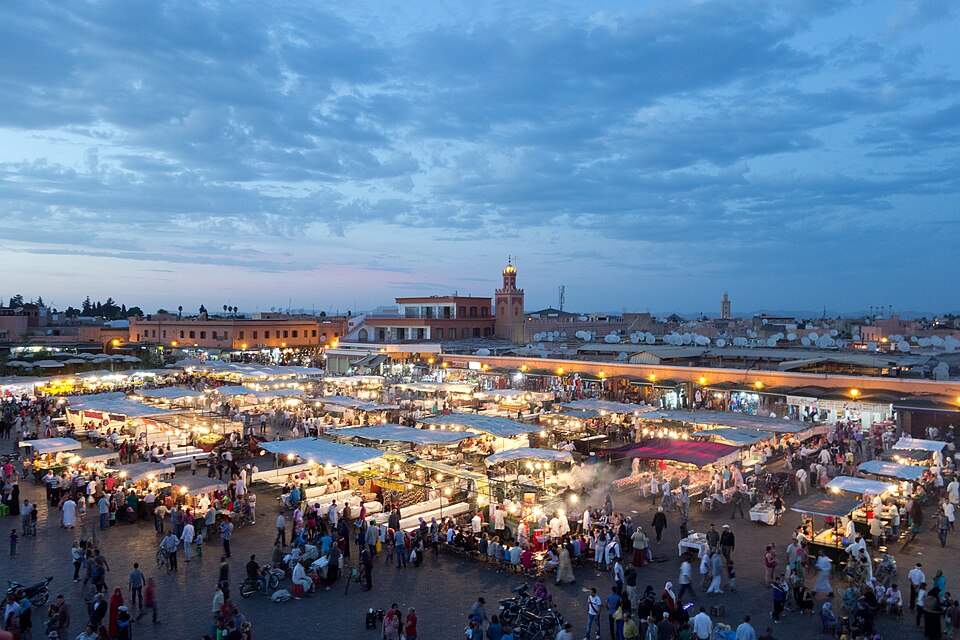
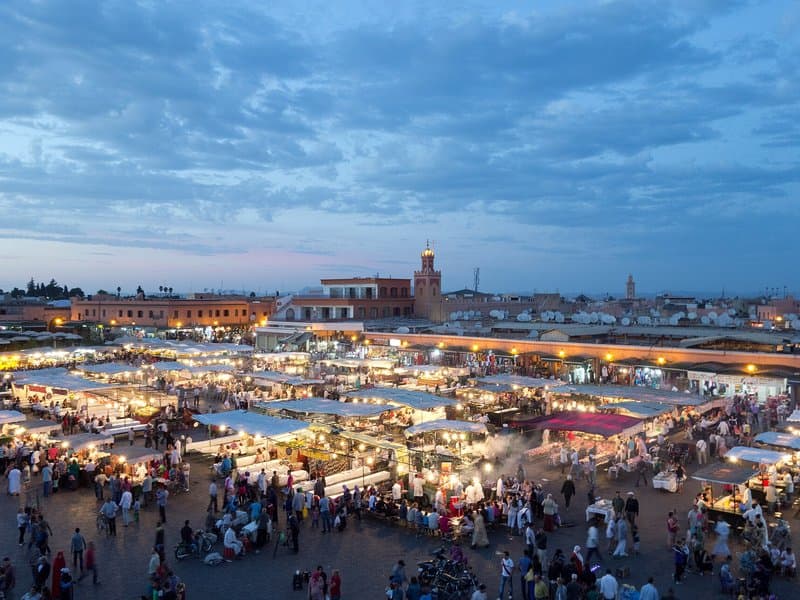
The medina's main square and the point around which the whole city turns. By day it fills with orange-juice stalls, snake charmers, monkey handlers and henna painters; in the afternoon the storytellers and gnawa musicians arrive. After five o'clock dozens of numbered grill stalls go up and the square becomes an open-air dining room.

Tip: The best view is from above: café terraces on the north and east sides let you up for the price of a tea or coffee — arrive half an hour before sunset, before the tables fill. At the food stalls, ask the price first and check nobody has put olives and bread on the table that you didn't order; they are charged separately.

Admission:
free
Time needed:
2–3 h, ideally in the evening
Koutoubia Mosque

Koutoubia Mosque

between the square and Hivernage

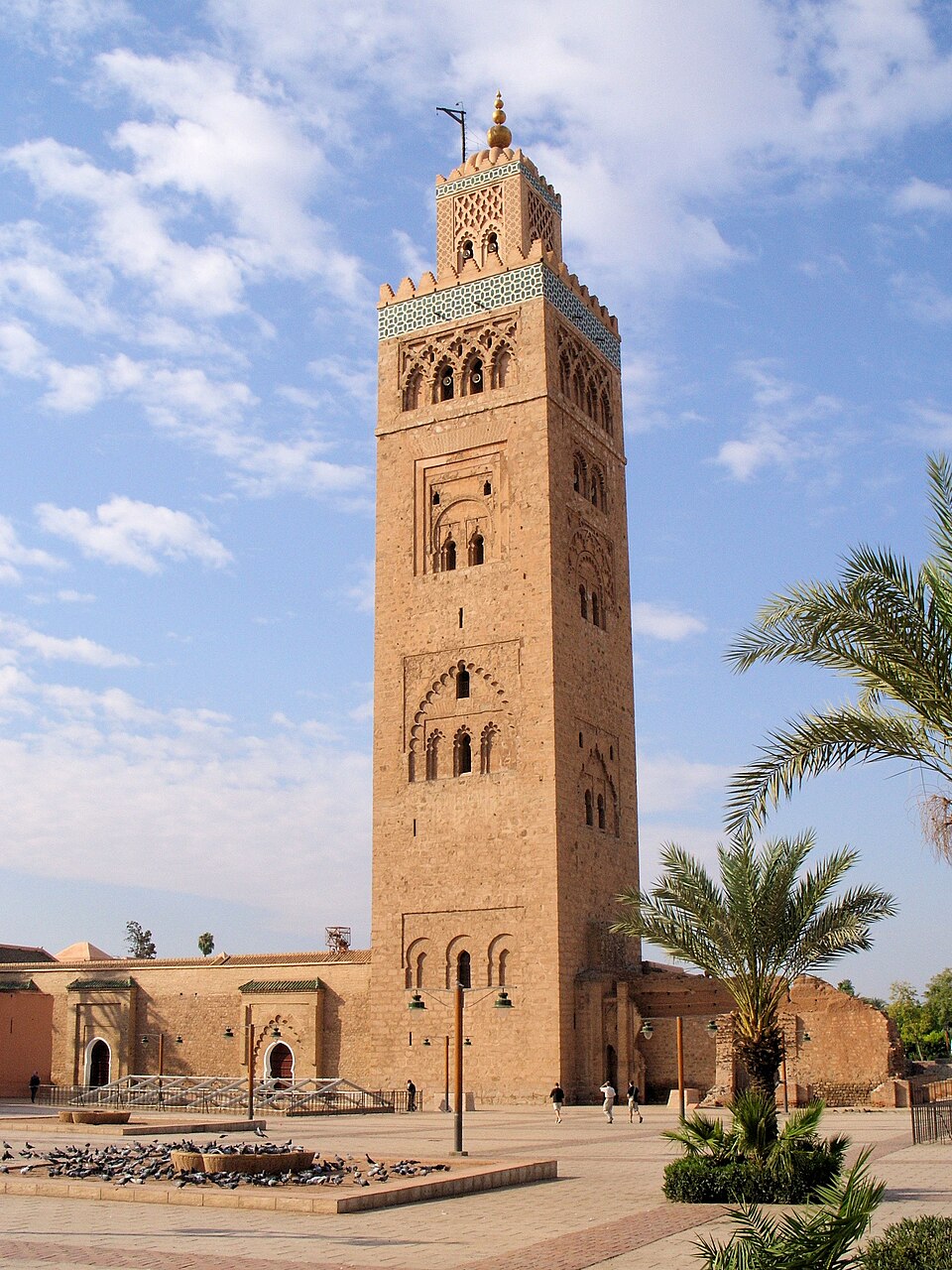
Marrakesh's largest mosque, built in the 12th century, whose seventy-seven-metre minaret is the landmark of the entire city and the model for the Hassan Tower in Rabat and the Giralda in Seville. Next to it lie the foundations of the first mosque, which had to be demolished because it was not correctly aligned towards Mecca.

Tip: Non-Muslims cannot go inside, but behind the mosque are rose gardens with benches, a good place to escape the noise of the square. The minaret is lit up at night, and the best photo is from along Avenue Mohammed V during the blue hour.

Admission:
free, exterior only
Time needed:
30 min
The medina souks

The medina souks

north of the medina

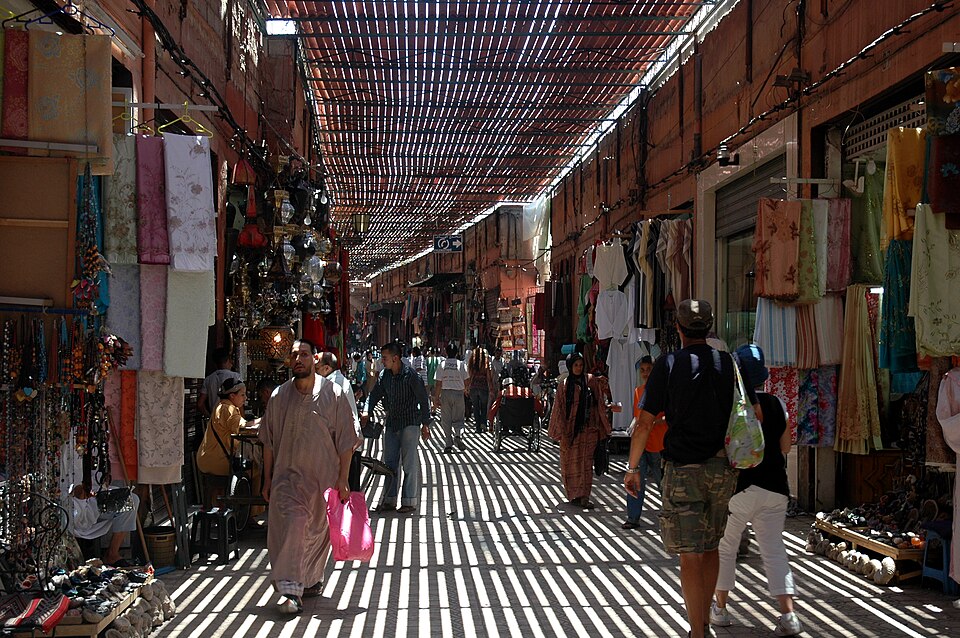
A web of covered and open markets north of the square, divided by trade: Semmarine for textiles, the dyers' souk with skeins of wool drying above the lane, metalworkers, lamp makers, leather goods and babouche slippers. At the centre is Rahba Kedima square with spices and baskets. The shops double as workshops, so you see craftsmen at work.

Tip: Download an offline map, but don't expect it to be precise — your landmarks are Rahba Kedima square and the Ben Youssef Madrasa. For spices and argan oil, a shop on Rahba Kedima with prices on labels beats a stall where they 'show you' saffron. Start haggling at a third of the asking price.

Admission:
free
Time needed:
half a day
Ben Youssef Madrasa

Ben Youssef Madrasa

north of the medina

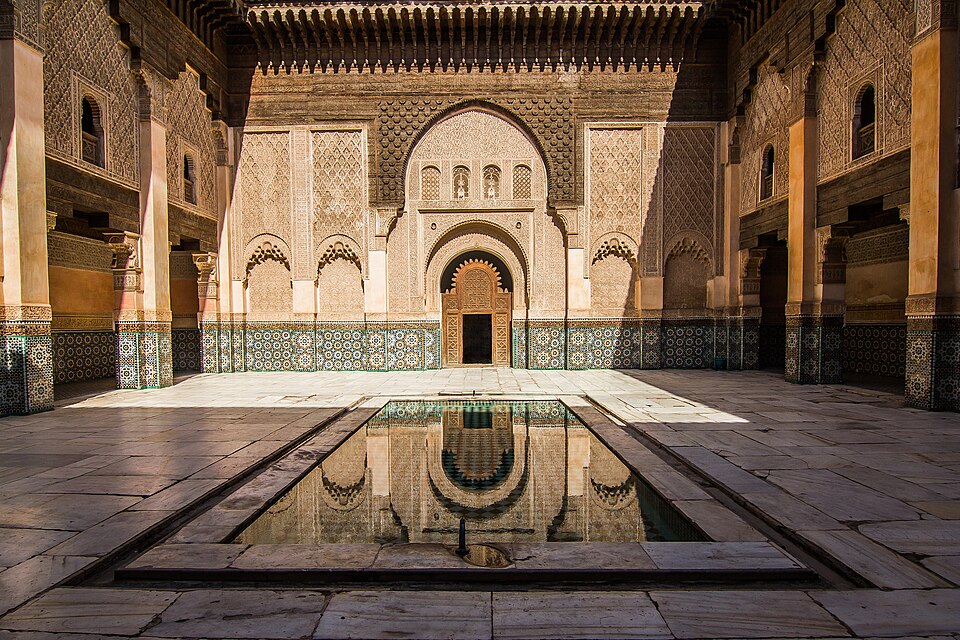
A 16th-century Quranic school where more than eight hundred students once lived in cells around a courtyard with a marble pool. The walls are covered in zellige tilework, carved cedar and stucco as fine as lace. After restoration between 2018 and 2022 it is the best-preserved monument of its kind in Morocco.

Tip: Come at nine when it opens, while the courtyard is empty and the light is soft; from eleven the tour groups rotate through. Right next door is the Marrakech Museum in the Mnebhi Palace, and a short walk away Le Jardin Secret — all three fit into one morning.

Admission:
50 MAD
Time needed:
1 h
Bahia Palace

Bahia Palace

Kasbah and Mellah

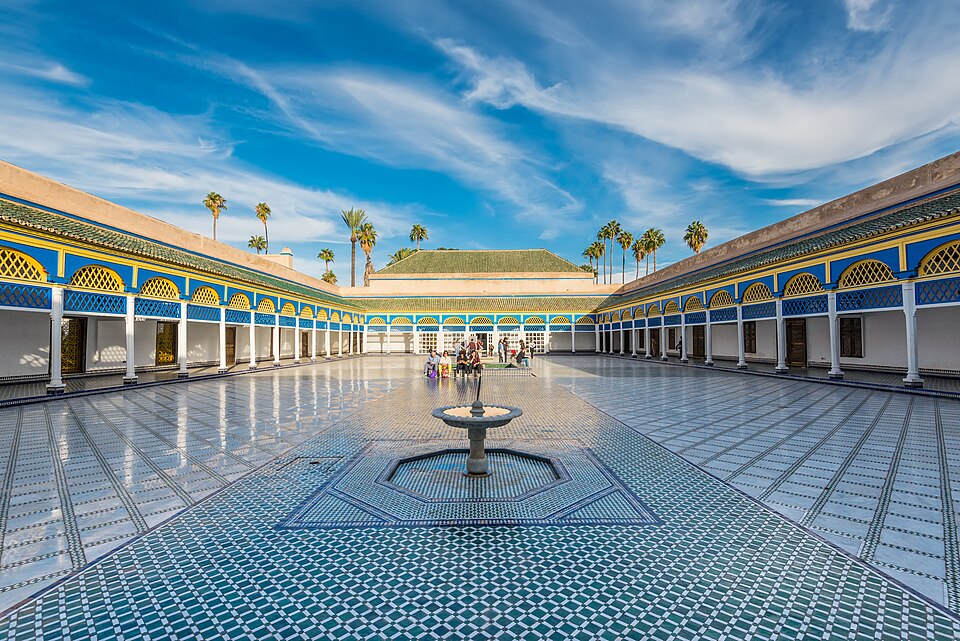
A late-19th-century grand vizier's palace with eight hectares of courtyards, gardens and rooms, which its builder kept extending according to how many wives and concubines he had. The painted cedar ceilings, mosaics and stucco came from the best workshops of the day, although none of the furniture survives.

Tip: Arrive at nine for opening; the tour coaches roll in at ten and the narrow passages jam up. Tickets are sold only at the entrance, in cash. On the way out, Rue Riad Zitoun el-Jdid has workshops that are cheaper than the main souks.

Admission:
100 MAD
Time needed:
1–1.5 h
Saadian Tombs

Saadian Tombs

Kasbah

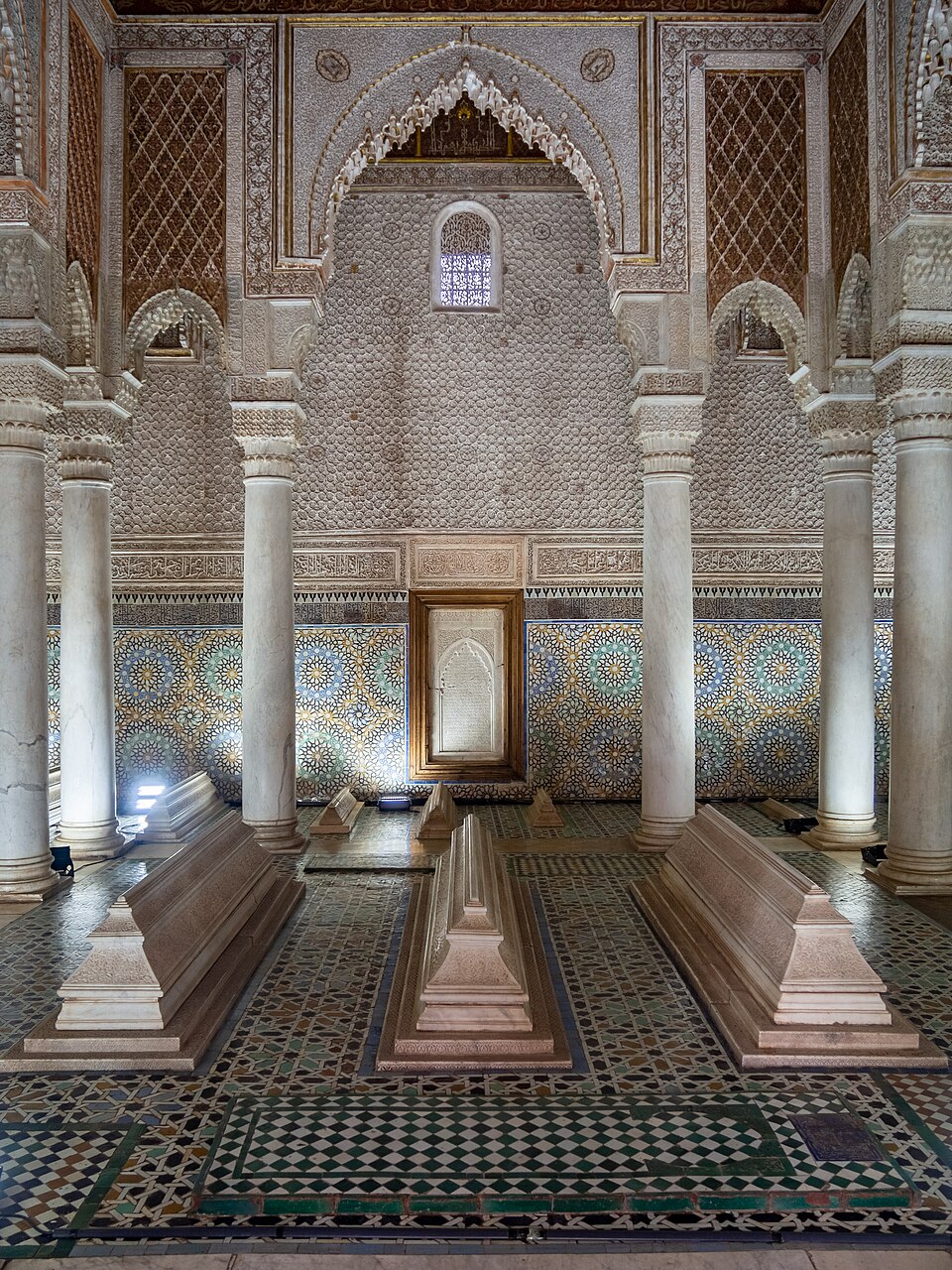
The 16th-century mausoleum of the Saadian dynasty, which a later sultan had walled up and which was only rediscovered by French aerial photographers in 1917. The most famous room is the Hall of Twelve Columns with the tomb of Sultan Ahmad al-Mansur, in Carrara marble and gilded stucco.

Tip: You can only peer into the Hall of Twelve Columns from one spot in the doorway, and at midday the queue for it can take half an hour. Come at nine or after four in the afternoon. The whole visit takes about thirty minutes, so don't expect more.

Admission:
100 MAD
Time needed:
45 min
El Badi Palace

El Badi Palace

Kasbah

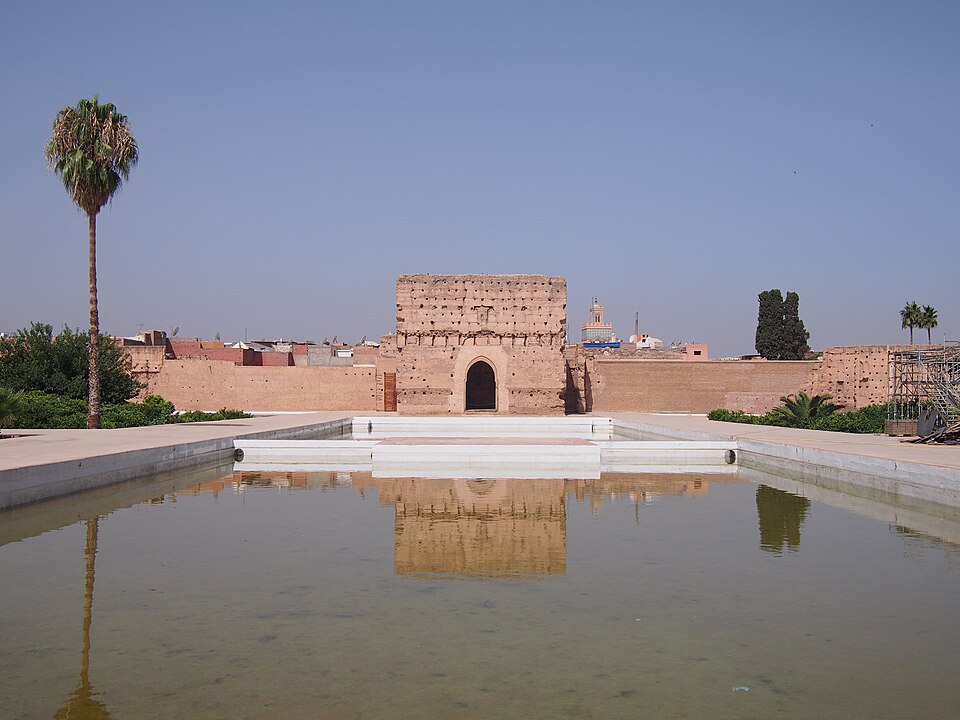
The ruins of the palace Sultan al-Mansur built with the riches won after defeating the Portuguese at the Battle of the Three Kings in 1578, once boasting hundreds of rooms, Italian marble and gilded ceilings. A century later another sultan stripped it and carted it off to Meknes. What remains are the walls, a vast courtyard with sunken pools and hundreds of stork nests.

Tip: Climb up to the terrace in the corner of the courtyard: it is the best view over the medina and the Atlas, included in the ticket. One of the pavilions displays the original 12th-century minbar from the Koutoubia — don't skip it, it's included too.

Admission:
100 MAD
Time needed:
1 h
Majorelle Garden

Majorelle Garden

Gueliz

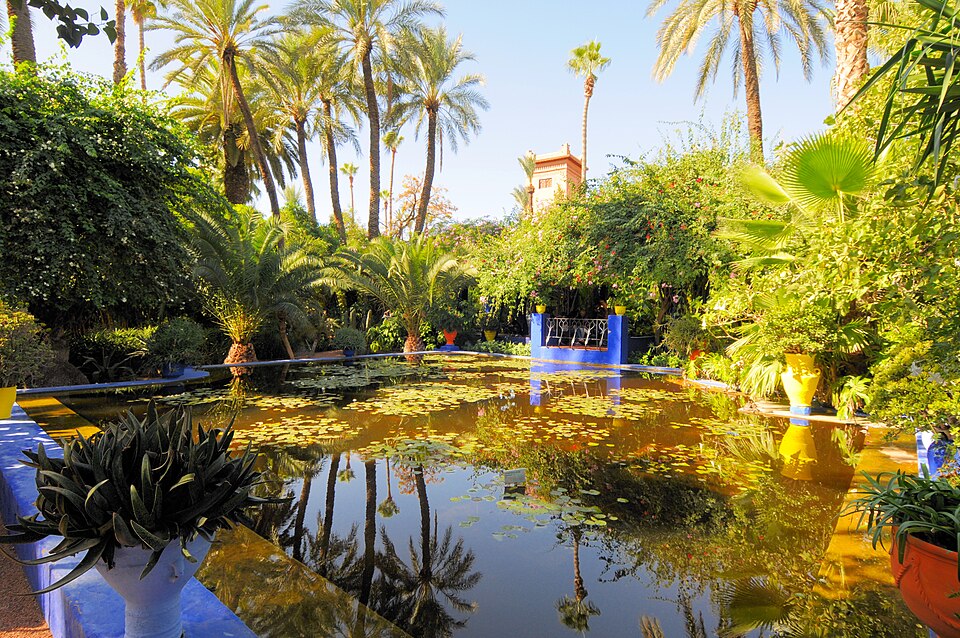
A garden laid out in the 1920s by the painter Jacques Majorelle and bought and saved in the 1980s by the fashion designer Yves Saint Laurent. Cacti, bamboo and palms from five continents stand out against a building painted in the shade that became known as Majorelle blue. Inside is the Berber Museum, and next door the Yves Saint Laurent Museum.

Tip: Tickets are sold only online at jardinmajorelle.com for a set time slot, and weekend mornings often sell out. Book the first entry at eight; by ten there are queues for photos along the paths. From the medina it is thirty minutes on foot or a taxi ride for twenty to thirty dirhams.

Admission:
from 170 MAD, museums extra
Time needed:
1.5 h
Le Jardin Secret

Le Jardin Secret

Mouassine

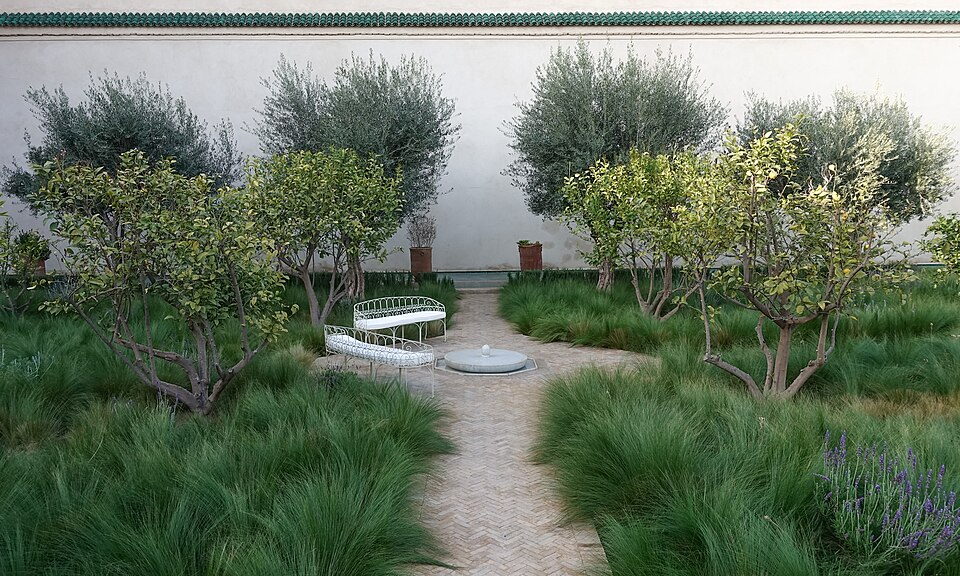
A restored 16th-century riad with two gardens — an Islamic one with geometric beds and water channels, and an exotic one with plants from around the world. It shows how irrigation from the underground khettara channels worked. In the middle of the noisiest part of the medina, the quiet here comes as a surprise.

Tip: For a small extra fee you can climb the tower, which looks out over the medina rooftops to the Koutoubia. The garden café serves reasonably priced tea in the shade — an ideal break between the souks and the Ben Youssef Madrasa, ten minutes away.

Admission:
around 100 MAD
Time needed:
1 h

Photos: Jemaa el-Fnaa — Boris Macek (CC BY-SA 3.0) · Koutoubia Mosque — Rol1000 (CC BY-SA 4.0) · The medina souks — DimiTalen (CC0) · Ben Youssef Madrasa — Wolfgang B (CC BY-SA 3.0) · Bahia Palace — Val Traveler (CC BY-SA 4.0) · Saadian Tombs — C messier (CC BY-SA 4.0) · El Badi Palace — C messier (CC BY-SA 4.0) · Majorelle Garden — Viault (CC BY-SA 3.0) · Le Jardin Secret — Bernhard Holub (CC BY-SA 4.0)

Where to stay

Areas and districts, matched to the kind of trip you are taking

Medina

Best for: a first visit and staying in a riad

The old city inside the walls, where you stay in riads — traditional houses built around a courtyard with a plunge pool and a roof terrace, often with only six to ten rooms. The quietest areas that are still close to everything are Mouassine and Riad Laarous in the north-west; Riad Zitoun in the south is nearer the palaces. Cars can't reach the riads: the taxi stops at a gate and porters wheel your luggage in on a cart for twenty to thirty dirhams.

Kasbah and Mellah

Best for: the palaces and a calmer medina

The southern part of the medina around the Saadian Tombs and the Bahia and El Badi palaces. From the 16th century the Mellah was the Jewish quarter, with its own Lazama Synagogue and a cemetery you can visit. There are fewer tourists and fewer hustlers than in the souks, and riads tend to be cheaper. The main square is fifteen minutes' walk away.

Gueliz and Hivernage

Best for: hotels with pools, restaurants and nightlife

The new town built by the French outside the walls, with wide boulevards, cafés, galleries and fixed-price shops. Hivernage, between Gueliz and the medina, is the hotel district with big resorts, clubs and restaurants serving alcohol. For families with children and anyone who wants a break from the medina it is the more comfortable choice; a taxi to the square costs twenty dirhams.

Palmeraie

Best for: resorts, golf and peace and quiet

A palm grove of a hundred thousand date palms ten kilometres north-east of the centre, home to luxury resorts, villas with pools and golf courses. People come here for camel and quad-bike rides. Without your own transport it is a long way from everything — hotels usually run a shuttle bus to the medina, and a taxi costs one hundred to one hundred and fifty dirhams.

Getting around

From the airport

Marrakesh Menara Airport is just six kilometres south-west of the medina. Direct flights connect it with dozens of European cities, and from autumn 2026 new routes start from Prague too — easyJet from 25 October 2026 twice a week, on Wednesdays and Sundays, and Eurowings from 7 November 2026 at weekends; the flight takes just under four hours. Otherwise, connections run via Madrid, Barcelona, Paris or Frankfurt. From the airport, bus L19 runs into the centre via Gueliz to the Koutoubia for thirty dirhams, and a petit taxi has a fixed daytime fare of one hundred to one hundred and fifty dirhams to the medina. Riads often offer their own transfer for one hundred and fifty to two hundred dirhams, including a porter from the gate. Trains from Casablanca take just under three hours, and CTM and Supratours coaches link Marrakesh with Agadir, Essaouira and Fes.

Marrakesh Menara (RAK) · 6 km

  • Bus L19· 30 min· 30 MAD
  • Petit taxi (fixed fare)· 20 min· 100 MAD
  • Riad transfer with porter· 25 min· 150 MAD

Casablanca Mohammed V (CMN) · 230 km

  • ONCF train with a change· 3 h 30 min· 150 MAD
  • Private transfer· 2 h 45 min· 1,500 MAD

Around town

The medina is explored on foot — it is two kilometres long and most lanes are too narrow for cars. Beige petit taxis carrying up to three passengers run between the medina, Gueliz and Majorelle; they have meters, but in Marrakesh drivers are reluctant to switch them on, so agree the fare first: twenty to forty dirhams around town, half as much again at night. Alsa city buses are cheap and serve Majorelle and the Palmeraie. Horse-drawn carriages wait by the Koutoubia with their fares posted on a board. For trips to the Atlas and the desert, go with an agency or a private driver; a hire car only makes sense once you leave the city.

On footThe only sensible way round the medina. Wear comfortable shoes — scooters ride even the narrowest lanes. · free
Petit taxiBeige, three passengers at most. Agree the fare before getting in; nights cost more. · 20 MAD
Alsa busRoutes from Place de Foucauld by the Koutoubia to Gueliz, Majorelle and the Palmeraie. · 4 MAD
Horse-drawn carriage (calèche)Sightseeing ride along the walls, fares posted at the rank by the Koutoubia. · 200 MAD / h
InDriveYou propose the fare yourself; usually cheaper than a taxi, especially to the airport and at night. · 25 MAD

Useful apps: Google Maps, InDrive, Maps.me

When to go

Marrakesh lies inland, without the cooling influence of the ocean, so summer here is nothing like Agadir: in July and August daytime highs reach thirty-seven degrees and often top forty, the medina bakes and the souks are half empty. Spring and autumn are best — from March to May and in October and November days are twenty-two to twenty-eight degrees and there is still snow on the Atlas. Winter days are eighteen to twenty degrees and sunny, but nights drop towards five degrees and riads are often unheated; pack a jumper and ask about heating. Rain is scarce, at most four days a month in winter.

Best time

March to May and October to November

What to avoid

July and August, when it tops 40 °C

MonthJanFebMarAprMayJunJulAugSepOctNovDec
Day18°20°23°25°29°33°37°37°32°28°22°19°
Night6°8°10°12°15°18°21°22°19°15°10°7°
Rainy days444431012444

Food & drink

In Marrakesh you eat cheaply on the street and expensively in riads, and both are worth it. On Jemaa el-Fnaa in the evening there are grilled skewers, harira for a few dirhams, boiled snails and sheep's heads for the brave. The city's speciality is tanjia — beef cooked overnight in a clay amphora in the embers beneath a hammam — and mechoui, whole lamb from a clay oven, sold by weight in the lane off the east side of the square. For a good dinner, head to the riad restaurants, where a five-course menu costs four hundred to seven hundred dirhams; for beer and wine, go to Gueliz. The truly local and cheap food is in the side streets around Rahba Kedima and in the Mellah.

What to try

Tagine

Meat or vegetables stewed in a conical clay pot that returns the steam to the food. The classic is chicken with salt-preserved lemons and olives; in the south it is also made with fish.

Tanjia

Beef or lamb with garlic, cumin, saffron and preserved lemon, sealed in a tall clay amphora and cooked overnight in the embers beneath a hammam. A men's dish — traditionally made by men for picnics and Fridays.

Mechoui

Whole lamb slow-roasted in a clay oven sunk into the ground, served without sides, just with cumin and salt for dipping. Sold by weight in the morning, until it runs out.

Harira

A thick soup of tomatoes, chickpeas, lentils and lamb, thickened with flour. Eaten with dates and the sweet pastry chebakia, above all during Ramadan to break the fast.

Pastilla

A crisp pie of paper-thin warqa pastry filled with pigeon or chicken, almonds and cinnamon, dusted with sugar. Sweet and savoury at once — a taste you either love or don't.

Babbouche

Snails simmered in a broth with anise, liquorice, thyme and pepper, served in bowls on the street. Locals drink the broth as a digestive; if snails aren't for you, at least try the soup.

Msemen and baghrir

Breakfast breads: msemen is layered and buttery, baghrir is a spongy pancake with a thousand holes. Both are spread with butter and argan honey.

Mint tea

Green tea with a handful of mint and plenty of sugar, poured from a height to raise a foam. Turning down an offered glass simply isn't done.

What it costs

Orange juice on the square

10–15 MAD

Mint tea in a café

15–25 MAD

Tagine in a local eatery

60–90 MAD

Dinner in a riad restaurant

350–700 MAD per person

Beer in Gueliz

50–80 MAD

Petit taxi around town

20–40 MAD

Hammam with scrub

local from 30 MAD, spa from 300 MAD

Night in a riad for two

800–2,000 MAD

Indicative prices that change over time — treat them as a guide, not a price list.

Practical information

SocketsCEuroplug, two round pinsEFrench, with earth pin
Voltage220V / 50Hz
Tap waterTap water is treated, bottled is common — Marrakesh draws its water from reservoirs in the Atlas and chlorinates it in the mains; locals drink it, but for an unaccustomed stomach it is not a good idea in the first few days. Bottled water costs six to eight dirhams for a 1.5-litre bottle in grocery shops, double that on the square and at the sights. In summer, allow three litres per person per day and carry a bottle with you — it's easy to buy in the souks, but there are no shops at the Menara or the Agdal.
TippingTips are given in small change and often: two to three dirhams for car-park attendants, a few coins for the waiter in a café, ten per cent in a restaurant. A hotel porter expects ten dirhams per bag, a guide on a full-day trip fifty per person. So always carry coins and twenty-dirham notes — nobody will break a two-hundred note for you.
Driving on theright
SafetyMarrakesh is safe for tourists, but it is a city where something is always being sold. The most common tricks: a boy in the souk announces that 'this way is closed' or that 'today is the last day of the Berber market' and leads you to a tannery or a shop that pays him commission; a woman on Jemaa el-Fnaa paints henna on your hand without asking and then wants two hundred dirhams. Don't let anyone hand you anything, and answer offers to 'just have a look' with a straight no. Pickpockets work the evening crowds on the square. Scooters race through the narrow medina lanes — keep close to the wall. In July and August the main risk is heat above forty degrees.
Opening hoursThe souks open gradually between nine and ten and close around eight in the evening; on Friday at midday there is an hour's lull for prayers, and some shops stay shut all afternoon. The Bahia Palace, the Saadian Tombs and the El Badi Palace are open daily from roughly nine to five. Jemaa el-Fnaa comes to life around five in the afternoon, when the grill stalls go up, and keeps going until midnight. During Ramadan opening hours are shorter and the city only wakes up after sunset.
Customs & etiquetteMarrakesh is not a beach resort: cover shoulders and knees, with loose trousers or a long skirt and a scarf to hand for women, and no vests or short shorts in the medina for men. Mosques, including the Koutoubia, are closed to non-Muslims; only madrasas and mausoleums are open. Alcohol is served in hotels, licensed riads and restaurants in Gueliz, but not in the medina or on the square. An invitation to tea in a shop is part of the haggling, not an obligation to buy. If you photograph street performers or snake charmers, you pay — agree the price first; ten to twenty dirhams is enough.
A few local wordsHello — Salám alejkumThank you — ŠukranNo, thank you — Lá, šukranHow much is it? — Bšhál?I don't want to buy anything — Mabghítš nešrí

How to plan your days

1 day

One day in the medina

  1. 1Majorelle at eight with a pre-booked ticket, then a taxi to Ben Youssef.
  2. 2The Ben Youssef Madrasa and Le Jardin Secret.
  3. 3Lunch on Rahba Kedima and an afternoon in the dyers' and metalworkers' souks.
  4. 4Sunset from a terrace above Jemaa el-Fnaa, dinner at the stalls on the square.

2 days

Two days: souks and palaces

  1. 1Day one as above.
  2. 2Day two: the Bahia Palace at nine, then the Mellah and the Lazama Synagogue.
  3. 3The Saadian Tombs and the view from the El Badi Palace terrace.
  4. 4A hammam in the afternoon, dinner in Gueliz or in a riad in the evening.

3 days

Three days with the Atlas

  1. 1The first two days as above.
  2. 2Day three: an early start for Imlil below Toubkal.
  3. 3A walk up to the village of Aroumd and lunch in a Berber house.
  4. 4Back in Marrakesh around five, the Menara Gardens by the reservoir in the evening.

Day trips

Imlil and the High Atlas

65 km · 1 h 30 min by car

A mountain village at 1,740 metres and the starting point for Toubkal, the highest peak in North Africa. On a day trip you walk to the village of Aroumd or to a pass above the valley, with a guide from the village and lunch with a Berber family. In winter there is snow up here and it is fifteen degrees colder than in the city.

Aït Benhaddou

190 km · 3 h 30 min by car

A fortified mud-brick ksar on the UNESCO list and the backdrop for Gladiator and Game of Thrones. The road crosses the Tizi n'Tichka pass at 2,260 metres with hairpin bends. As a day trip it takes twelve hours; staying overnight in Ouarzazate is more comfortable.

Ouzoud Falls

150 km · 2 h 30 min by car

A 110-metre cascade in the Middle Atlas where you can swim below the falls and take a raft out to the spray. Wild Barbary macaques live in the olive groves above. There is most water in spring; by September the flow is often weak.

Frequently asked questions

Are there direct flights to Marrakesh?+

Yes, from dozens of European cities, most taking three to four hours. New routes from Prague start in autumn 2026: easyJet from 25 October 2026 with two flights a week on Wednesdays and Sundays, and Eurowings from 7 November 2026 at weekends with an evening departure. Elsewhere, one change via Madrid, Barcelona or Frankfurt is usually enough.

Is it better to stay in a riad or a hotel?+

On a first visit, a riad in the medina — it's close to everything, full of atmosphere, and breakfast on the roof terrace is part of the experience. Bear in mind, though, that rooms around the courtyard can be noisy and cold in winter, and not every riad has a pool. With children or for a longer stay, a hotel with a pool in Hivernage or the Palmeraie is more comfortable.

How do I deal with hustlers in the souks?+

Ignore offers to show you the way, however friendly they seem, and don't ask boys in the street for directions — ask in a shop or café instead. 'That way is closed' almost always means someone wants to lead you elsewhere. A calm 'la, shukran' while you keep walking works best. Official guides carry a licence and charge around three hundred dirhams for half a day.

How much time do I need in Marrakesh?+

Three days for the city itself: one for the souks and the madrasa, one for the palaces and the Mellah, one for the gardens and Gueliz. Add a trip to the Atlas or Aït Benhaddou and you need four to five days. A weekend without excursions is enough if what draws you is mainly the medina and the food.

Can I travel to Marrakesh as a woman alone?+

Yes, it's common. Expect comments and approaches in the souks, which are irritating but mostly harmless. Modest clothing covering shoulders and knees, a confident walk and not responding all help. In the evening the square is safe thanks to the crowds; in empty medina lanes after ten at night, take a taxi instead.

How do I haggle in the souk?+

Before you start, find out what the item costs in a fixed-price shop — for example the Ensemble Artisanal on Avenue Mohammed V. Then offer a third to a half of the first price and raise it slowly. Walking away is your strongest argument. If you don't want something, don't ask the price at all — asking means you've started negotiating.

What currency is used in Morocco and how much cash should I carry?+

The Moroccan dirham, a closed currency — you can only buy it on arrival and you may not take it out of the country. Euros can be exchanged at the airport, banks and bureaux de change in the centre at practically the same rate, though an ATM withdrawal is often better value. Hotels, supermarkets and larger restaurants take cards; souks, taxis, beaches and small businesses are cash only. Allow at least three hundred dirhams per person per day outside the hotel.

Do I need a visa for Morocco?+

EU citizens don't: for a tourist stay of up to 90 days a passport valid for six months beyond your return date is enough. A national ID card is not accepted, even on a charter flight. On arrival you fill in an entry form with your accommodation address and get a stamp at passport control; independent travellers may be asked about a return ticket.

Visa Requirements

Check the latest visa requirements for entering this country. Some nationalities may need to apply for a visa or e-visa before travel.

Check visa requirements

Emergency Numbers

Language

Arabic / French

Currency

MAD

Timezone

Africa/Casablanca

Dial Code

+212

Population

37.5M

Area

446,550 km²

Voltage

220V / 50Hz

Driving Side

Right

Top Hotels in Marrakesh

Live prices from 500+ properties

Loading hotels...

More destinations in Morocco

Planning a trip to Marrakesh?

Compare hundreds of hotels, find the best price, and book with free cancellation on TravelManiac.