Hotels in Berlin

9 times the size of Paris, half the price and still under construction

Berlin

LanguageEnglish
CurrencyEUR
TimezoneGMT+1
Temperature2-25 °C
Dial Code+49
Population84.5M
Area357,022 km²
SocketsType C / Type F
Tap waterDrinkable

Discover Berlin

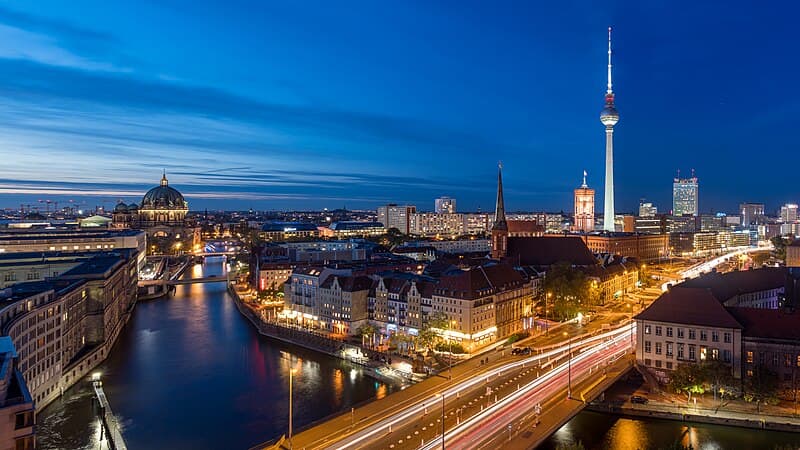
Berlin is Germany's largest city and also its least German — chaotic, cheap and permanently under construction. It covers 900 square kilometres, 9 times the area of Paris, but with a third of the population density, so getting between sights takes a while. Twentieth-century history is close at hand here and impossible to miss: a Prussian museum and a Nazi ministry stand 100 metres from a surviving stretch of the Wall, which ran through this city for 28 years and whose route is now marked by a double row of cobblestones right across the centre. For all that, Berlin isn't a sombre city — it has the best clubs in Europe, 3 opera houses, 170 museums and more bridges than Venice. Prices are still lower than in Frankfurt or Munich, with lunch for €10 and a döner for €7. Its excellent rail and air links from across Europe make Berlin one of the easiest big cities to reach for a long weekend.

What to see

The places worth your time in Berlin, and what to expect at each

Brandenburg Gate

Brandenburg Gate

Mitte

The only survivor of the city's 18 gates, built in 1791 modelled on the Propylaea in Athens and crowned with a quadriga carrying the goddess of victory. Napoleon carried it off to Paris; after his defeat it was returned. From 1961 it stood in the death strip between 2 walls, off-limits to everyone; today it's a symbol of reunification and the place where Berlin celebrates New Year's Eve.

Tip: Come after dark, when the gate is lit up and empty — during the day there's a crowd out front, plus costumed 'soldiers' who charge for photos and have nothing to do with the monument. 100 metres east on Pariser Platz stands the Hotel Adlon, and the Tiergarten begins right behind the gate. Set into the paving nearby is a double row of cobblestones marked „Berliner Mauer“, showing where the Wall used to run.

Admission:
free
Time needed:
30 min
Reichstag Building and Glass Dome

Reichstag Building and Glass Dome

Mitte

The German parliament building from 1894, burned down in 1933 and rebuilt in the 1990s by Norman Foster, who topped it with a glass dome and a spiral ramp. Visitors climb up above the heads of the MPs, and can look down into the debating chamber through a mirrored glass cone — an architectural metaphor for public oversight of power.

Tip: Entry is free, but you must register online at least 2 days in advance with the number of the passport or ID card you'll show at the entrance. In peak season slots fill up 3 weeks ahead; if nothing's left, try registering in person at the visitor centre on Scheidemannstraße. The best time is the last entry slot in the evening, when you walk through the dome after dark with the lit-up city below.

Admission:
free, advance registration required
Time needed:
1 h
Museum Island

Museum Island

Mitte

5 museums on an island in the Spree, a UNESCO World Heritage Site: the Pergamon Museum with Hellenistic and Babylonian structures moved here whole, the Neues Museum with the Nefertiti bust, the Altes Museum with antiquities, the Alte Nationalgalerie with 19th-century painting, and the Bode Museum with sculpture. It's one of the largest concentrations of museums anywhere in the world.

Tip: The Pergamon Museum has been largely closed since 2023 for renovation, and the main altar won't reopen until the end of the decade — check what's currently open before buying a ticket. Photography of Nefertiti at the Neues Museum is banned and enforced by guards. An all-day ticket covering all 5 museums pays for itself from the second museum and also saves you the ticket-office queue.

Admission:
from €14 for 1 museum, €24 for all
Time needed:
half a day
East Side Gallery

East Side Gallery

Friedrichshain

1.3 km of the original Wall along the Spree, painted in 1990 by 118 artists from 2 dozen countries — the longest continuous surviving stretch of the Wall and also the largest open-air gallery in the world. The best-known image is the fraternal kiss between Brezhnev and Honecker, and a Trabant bursting through the concrete.

Tip: Come in the late afternoon, when the sun lights up the painted side; in the morning the whole wall is backlit. The paintings are on the eastern side, meaning that under the original division, it's the side no one could reach during communism. The nearest station is Warschauer Straße, and afterwards you can walk across the bridge into Kreuzberg for dinner.

Admission:
free
Time needed:
1 h
Memorial to the Murdered Jews of Europe

Memorial to the Murdered Jews of Europe

Mitte

2,711 concrete slabs of varying heights across 19,000 square metres, arranged in a regular grid over undulating ground. Architect Peter Eisenman gave the work no explanation — you walk between the slabs, the ground dips, the slabs rise over your head and the sound of the city disappears. Underneath the memorial is an information centre telling the stories of individual families.

Tip: Walk into the middle, not just along the edge — the whole point of the design is to lose yourself and your view out, and it doesn't work from the edge. The information centre underneath is the quietest and most powerful part, and it's free; last entry is an hour before closing. Sitting or climbing on the concrete slabs isn't allowed, though some visitors do it anyway.

Admission:
free
Time needed:
1–1.5 h
TV Tower (Fernsehturm)

TV Tower (Fernsehturm)

Alexanderplatz

A 368-metre tower on Alexanderplatz, built by East Germany in 1969 to showcase its technical prowess, and still Germany's tallest structure. At 203 metres there's an observation deck, and a floor above it a revolving restaurant that completes a full turn in an hour. Berliners joked about the cross that appears in sunlight reflecting on the sphere, nicknaming it the Pope's revenge.

Tip: Book a timed ticket online, or you could wait up to an hour; the „fast view“ option skips the queue for a surcharge. The best time up top is an hour before sunset, when you can see the difference in roof colours between the eastern and western halves of the city. At the restaurant you book a table and entry is included in the price, which works out similar to a ticket plus a coffee.

Admission:
from €25
Time needed:
1 h
Berlin Wall Memorial on Bernauer Straße

Berlin Wall Memorial on Bernauer Straße

Mitte / Gesundbrunnen

The only place where a complete cross-section of the border fortifications survives: the outer wall, the death strip, anti-tank barriers, lighting and a watchtower. Bernauer Straße was a street where the houses stood in the East and the pavement in the West, so people jumped from windows; there's a window of remembrance with photos of those killed, and a chapel on the site of a demolished church.

Tip: This is where you'll learn the most about the Wall — far more than at Checkpoint Charlie. The viewing platform at the documentation centre across the street shows the strip from above, the only vantage point from which the whole system makes sense. Entry is entirely free, including the centre, and the open-air exhibition is accessible around the clock. Allow an hour and a half.

Admission:
free
Time needed:
1.5 h
Charlottenburg Palace

Charlottenburg Palace

Charlottenburg

Berlin's largest Prussian palace, built in 1699 as a summer residence for Queen Sophie Charlotte and expanded throughout the 18th century. Inside is the Porcelain Cabinet, with thousands of pieces of Chinese porcelain covering the walls to the ceiling, plus the crown jewels and baroque apartments. Behind the palace, a French garden gives way to an English-style park with a mausoleum and a teahouse.

Tip: The park behind the palace is free and open from dawn to dusk; it's the loveliest big park in the western part of the city, and on Sundays it's full of locals rather than tourists. For the palace itself, it's worth getting the combined ticket covering both the old and new wings. Take the U7 to Richard-Wagner-Platz or the U2 to Sophie-Charlotte-Platz, then walk 10 minutes.

Admission:
from €12, park free
Time needed:
2–3 h
Checkpoint Charlie

Checkpoint Charlie

Mitte / Kreuzberg

A former border crossing between the American and Soviet sectors, the only one foreigners were allowed to use, and the spot where American and Soviet tanks faced off in 1961. Today, all that remains of the original crossing is a replica guard booth with sandbags and a sign warning that you're leaving the American sector. Next door is the private Haus am Checkpoint Charlie museum, with stories of escapes.

Tip: The site itself is now the most commercial spot in Berlin and takes about 2 minutes to see — actors in uniform by the booth charge for photos and have no real connection to the site. The museum next door is overpriced, but the stories of escapes in cars with false floors and by hot-air balloon are worth it. Anyone who wants to learn about the Wall without the commercialism should head to Bernauer Straße instead.

Admission:
site free, museum from €18
Time needed:
30 min for the site, 2 h for the museum

Photos: Brandenburg Gate — Thomas Wolf, www.foto-tw.de (CC BY-SA 3.0) · Reichstag Building and Glass Dome — Hermann Rückwardt (Public domain) · Museum Island — Thomas Wolf, www.foto-tw.de (CC BY-SA 3.0) · East Side Gallery — Lklundin (CC BY-SA 3.0) · Memorial to the Murdered Jews of Europe — Alexander Blum (CC BY-SA 4.0) · TV Tower (Fernsehturm) — Christian Wolf (www.c-w-design.de) (CC BY-SA 3.0 de) · Berlin Wall Memorial on Bernauer Straße — N-Lange.de (CC BY-SA 3.0) · Charlottenburg Palace — ernstol (CC BY-SA 3.0) · Checkpoint Charlie — Roger Wollstadt (CC BY-SA 2.0)

Where to stay

Areas and districts, matched to the kind of trip you are taking

Mitte

Best for: first-time visits and sightseeing

The historic centre, with the Brandenburg Gate, Museum Island, Unter den Linden and Alexanderplatz. Most of what brings first-time visitors to Berlin is here, and it's all walkable. Accommodation is pricier than elsewhere, and the eastern part is fairly dead in the evening because of the offices. The northern part around Rosenthaler Platz, by contrast, is full of bars and makes the best compromise.

Kreuzberg

Best for: food and nightlife

A formerly poor district by the Wall, now the most vibrant part of the city — Turkish markets, döner on every corner, clubs in former factories and the cheapest pubs near the centre. Around Bergmannstraße it's quieter and more family-friendly; around Kottbusser Tor, louder and rawer. It's a 10-minute ride to Mitte on the U1 or U8.

Prenzlauer Berg

Best for: a quiet stay and cafés

A district north of the centre with the best-preserved turn-of-the-century buildings, since it escaped the bombing. Today it's the calmest and most family-friendly part of inner Berlin, with breakfast cafés, a Sunday market on Kollwitzplatz, and accommodation prices around a third lower than in Mitte. It's a 10-minute ride to the centre on tram M10 or the U2.

Charlottenburg

Best for: shopping and calm in the west

The western centre around Kurfürstendamm, which was the main avenue of West Berlin during the division. It's home to the KaDeWe department store, the zoo, and the bombed-out Kaiser Wilhelm Memorial Church, left as a memorial. The district is well-off, quiet and older; a poor choice if you want bars and clubs, a good one if you want calm and good transport links.

Getting around

From the airport

Berlin Brandenburg Airport (BER) lies 25 km south of the centre and is served by major hubs across Europe and beyond, including Frankfurt, Munich, Vienna, Zurich, Istanbul and Dubai. From the airport, the FEX train or the S9 S-Bahn line runs directly to the Hauptbahnhof in 35 minutes; you need a ticket for tariff zone ABC, since the airport sits in zone C. Berlin also has excellent rail links to major cities across Germany and neighbouring countries, with direct trains arriving at the Hauptbahnhof; long-distance buses cover the same routes and are usually the cheapest option, if slower. Drivers should note that Berlin has a low-emission zone, which requires a windscreen sticker to enter.

Berlin Brandenburg (BER) · 25 km

  • FEX train to Hauptbahnhof· 35 min· €4.70 (zone ABC)
  • S-Bahn line S9 to the centre· 45 min· €4.70
  • Taxi to Mitte· 40 min· €55

Around town

Berlin is huge, and you can't get by without public transport — 2 sights of interest are often 5 km apart. The network covers the U-Bahn metro, the S-Bahn suburban railway, trams in the eastern part of the city, and buses, all under a single fare system split into zones A, B and C. Visitors need zone AB at €3.80, or zone ABC at €4.70 for the airport. A day ticket for AB costs around €10 and pays for itself from the third ride. Tickets must be validated in the yellow machine on the platform before boarding — an unvalidated ticket counts as invalid, plain-clothes inspectors are common, and the fine is €60. There are no turnstiles anywhere, which tempts people to ride without paying, but checks are frequent. Buses 100 and 300 run from Alexanderplatz past Unter den Linden and the Brandenburg Gate to the Tiergarten for the price of an ordinary ticket, making it the cheapest sightseeing ride in the city.

U-Bahn metro9 lines, running every 4–10 minutes, all night at weekends. The densest network is in the western and central parts of the city. A ticket is valid on all forms of transport within the relevant zone. · €3.80, zone AB
S-BahnA suburban railway covering longer distances, including the Ringbahn loop around the whole inner city. The fastest connection between Mitte, Friedrichshain and Charlottenburg, and also the route from the airport. · €3.80
TramsRun mainly in the eastern part of the city, where East Germany never scrapped them. The M10 line links Prenzlauer Berg with Warschauer Straße and is a handy connection between where people live and where they go out for dinner. · €3.80
Day and weekly ticketsA day ticket for zone AB costs around €10, a small group ticket for up to 5 people around €25, and a weekly ticket around €42. It pays for itself from the third ride of the day. Don't forget to validate it in the yellow machine before your first ride. · from €10 / 24 h
Buses 100 and 300Run from Alexanderplatz past Unter den Linden, the Brandenburg Gate and the Reichstag to the Tiergarten. For the price of an ordinary ticket, it's a round sightseeing trip; on the double-decker buses, sit up front on the top deck. · €3.80
BikesBerlin is flat, with a dense network of cycle lanes and bike-share schemes. A signed route along the Spree and the former Wall runs right across the city. Cycle lanes are often marked on the pavement in a different paving colour, and pedestrians shouldn't step into them. · from €1 to unlock
When to go

May to September are best: Berlin comes alive outdoors, people barbecue in the parks, floating bars appear on the Spree, and it stays light until 10pm. Summer is warm, around 25°C, and only occasionally muggy, since the flat city catches the breeze. Winter is long, grey and dark — it gets dark soon after 3:30pm in December — but it's the cheapest season, and from late November 80 Christmas markets open across the city. February belongs to the Berlinale film festival, when hotels get pricier. Autumn is changeable, but September tends to be the most pleasant month of the year. If you're here for the museums and clubs, you can visit any time — the main draws are indoors.

Best time

May to September, plus Advent for the markets

What to avoid

December to February, if you don't cope well with dark, grey days

MonthJanFebMarAprMayJunJulAugSepOctNovDec
Day3°5°9°15°20°23°25°25°20°14°8°4°
Night-2°-2°1°4°9°12°14°14°11°7°3°0°
Rainy days108989998881011

Food & drink

Berlin cuisine on its own is hearty and plain — pork knuckle, sausage, potatoes — and the most typical Berlin dish is currywurst, sausage in curry sauce. The real Berlin food scene, though, is an immigrant one: döner kebab in its modern form was invented here in the 1970s, the largest Turkish community outside Turkey runs the market at Maybachufer, and the Vietnamese quarter in Lichtenberg cooks the cheapest soup in the city. Eating out is cheap: a döner for €7, currywurst for €5, a set lunch in a pub for €12. Sunday is a shopping trap, since shops are closed and only bakeries in the morning and shops at stations stay open. In pubs and at street stalls you often pay cash only, even if there's a card sticker on the door. Beer or Berliner Weisse — a sour wheat beer with raspberry or mint syrup — goes with the food.

What to try

Currywurst

Sausage sliced into rounds and covered in a tomato sauce with curry powder, served with chips or a bread roll. A Berlin invention from 1949 and street food number one, it costs around €4. The classic version is served „mit Darm“, meaning with the skin on.

Döner Kebab

In its modern form, a Berlin invention from the 1970s and now the best-selling fast food in the country. In a pocket of bread with shaved meat, salad and 3 sauces, it costs €6–7 and will keep you full for the rest of the evening.

Schweinshaxe

Roast pork knuckle with crackling skin, served with a dumpling and sauerkraut. A serving genuinely weighs over 1 kg and costs around €20 in a beer hall — a lot for 1 person, so 2 diners sharing is perfectly normal.

Schnitzel

In Germany it's made from pork and can't be called wiener unless it's veal. The most common versions are Jägerschnitzel with mushroom sauce and Zigeunerschnitzel with paprika sauce, served with chips or potato salad. In a pub it comes to around €15.

Brezel

A lye-dipped pretzel with coarse salt, baked fresh every morning. It costs around €1 at a bakery and 3 times that in a beer hall. The southern version is softer and thicker, the northern one firmer; it's always served alongside white sausage.

Beer

You order by style, not by brand: Helles is a pale lager, Weißbier a wheat beer, Dunkel a dark beer, Radler beer mixed with lemonade. A half-litre costs €4–5 in a pub, though many beer halls only pour the 1-litre Maß. Bottles carry an 8-cent deposit.

Kaffee und Kuchen

An afternoon ritual between 3pm and 5pm: filter coffee and a slice of cake at a café. The most common choices are Schwarzwälder Kirschtorte (Black Forest gateau) and apple Streuselkuchen. A slice of cake with coffee comes to around €8.

Berliner Weisse

A sour wheat beer at 3% ABV, drunk with raspberry or mint syrup and served in a wide glass with a straw. Without the syrup it's a shock on the first sip. Napoleon's soldiers are said to have called it the champagne of the north.

What it costs

Coffee at a café

€3–4.50

Half-litre of beer in a pub

€4–5

Döner kebab

€6–8

Currywurst with chips

€5–7

Set lunch in a pub

€12–16

Day transport ticket (zone AB)

from €10

Entry to 1 museum on the island

from €14

Night in a 3-star hotel for 2

€80–130

Indicative prices that change over time — treat them as a guide, not a price list.

Practical information

SocketsCEuroplug, two round pinsFSchuko
Voltage230V / 50Hz
Tap waterTap water is drinkable — Tap water is safe to drink throughout Germany and is regulated just as strictly as bottled water, so there's no point buying it. In restaurants, though, it's charged for like any other drink, and many places will refuse to bring it at all — ordering „Wasser“ gets you a bottle of mineral water, almost always sparkling. If you want still water, ask for „stilles Wasser“. PET bottles and cans carry a 25-cent Pfand deposit, refunded at a machine in every supermarket.
TippingTipping is 5–10% and is done at the table, not at a till. You don't just leave money lying there — you tell the server the total amount you want to pay ("22, please"), and they hand back the change. When paying by card, say the tip amount out loud, since the terminal often has no field for it. Cash is still widely used in Germany, and smaller pubs and bakeries may not take cards at all.
Driving on theright
SafetyGermany is a safe country, and visitors can walk the streets of its big cities without worry, even at night. The real risks are pickpocketing on the metro, at main stations and at Christmas markets, and bike theft. The areas around the main stations in Berlin, Munich and Frankfurt attract a rougher crowd after dark that's worth avoiding; elsewhere it's calm. The most common tourist mishap isn't crime but straying into a cycle lane — often marked on the pavement by a different paving colour, and cyclists won't swerve for you. The emergency number is 112, police 110.
Opening hoursOpening hours are regulated by law, and on Sundays almost everything is closed except restaurants, museums, bakeries for a few hours in the morning, and shops at stations and airports. Arrive on a Sunday and the main station is your only option for shopping. On weekdays, shops are typically open from around 9am or 10am to 8pm, supermarkets until 10pm. Museums usually close on Mondays. Restaurants serve continuously from midday, with the kitchen closing around 10pm; in a traditional pub, only Kaffee und Kuchen is served in the afternoon.
Customs & etiquetteAlways carry cash — contactless payment is common in chains, but pubs, street stalls and small museums often take cash only. Punctuality is taken seriously, and turning up 10 minutes late for a reservation can mean losing your table. In pubs it's normal to sit at a stranger's table if you ask „Ist hier frei?“ — doubly so at the long tables in beer halls, though a table marked Stammtisch is reserved for regulars and off-limits. Toasts are made with eye contact. Crossing on a red light even on an empty street isn't done, and locals will happily tell you off for it in front of children. Waste sorting is taken strictly.
A few local wordsGood day — Guten TagThank you — Danke schönPlease — BitteThe bill, please — Zahlen, bitteCheers — ProstGoodbye — Auf Wiedersehen

How to plan your days

1 day

A Day in Berlin

  1. 1Morning: Brandenburg Gate and the Memorial to the Murdered Jews of Europe.
  2. 2The Reichstag, with a pre-booked slot for the dome.
  3. 3Walk along Unter den Linden to Museum Island.
  4. 4Lunch, then one museum in the afternoon, ideally the Neues Museum with Nefertiti.
  5. 5Evening: Alexanderplatz and the TV Tower at dusk.

2 days

2 Days with the Wall

  1. 1Day 1 as above.
  2. 2Morning: the Berlin Wall Memorial on Bernauer Straße with its viewing platform.
  3. 3Checkpoint Charlie and the escapes museum, or the free Topography of Terror.
  4. 4Afternoon: the East Side Gallery in Friedrichshain.
  5. 5Evening: döner and a pub in Kreuzberg.

3 days

3 Days Including Potsdam

  1. 1Days 1–2 as above.
  2. 2Morning: S-Bahn to Potsdam, 45 minutes.
  3. 3Sanssouci Palace with its terraced vineyard and park.
  4. 4Afternoon: Cecilienhof Palace and the Dutch Quarter.
  5. 5Return to Berlin, with the last evening in Prenzlauer Berg.

Day trips

Potsdam and Sanssouci

35 km · 45 min by S-Bahn

The residence town of the Prussian kings, where Frederick the Great escaped Berlin and built Sanssouci — a single-storey palace on a terraced vineyard that could hold only 12 guests, and where women weren't allowed. The 300-hectare park also has the New Palace, a Chinese teahouse and an orangery. The town has a red-brick Dutch Quarter and Cecilienhof Palace, where Truman, Stalin and Churchill negotiated in 1945. Get here on the S7 S-Bahn line with a zone ABC ticket; from the station, take a bus or walk 20 minutes to Sanssouci. Palace tickets are timed, and it's worth booking online in season.

Sachsenhausen

35 km · 1 h by S-Bahn and on foot

A concentration camp in Oranienburg, set up in 1936 as a model camp and SS training centre for commandants of other camps. Around 200,000 prisoners passed through it. The triangular layout survives, along with the gate reading „Arbeit macht frei“, the barracks, the prison and the experiment station. After the war, Soviet administration ran a further internment camp on the site. Entry is free, an audio guide costs around €4, and a visit takes 3 hours. Take the S1 S-Bahn to Oranienburg, then it's a 20-minute walk. Not recommended for young children.

Spreewald

100 km · 1 h 15 min by train to Lübbenau

A UNESCO biosphere reserve where the Spree splits into 200 channels running between alder woods and gardens. Transport here runs by water: post and milk are delivered by boat, and flat punts, pushed along with a pole by a boatman, connect the houses. A punt trip takes 2–3 hours and costs around €20; if you'd rather set your own pace, hire a canoe. The area is home to the Sorbs, a Slavic minority with their own language, and produces Germany's best-known pickled gherkin. The train from Berlin to Lübbenau takes 1 hour 15 minutes.

Frequently asked questions

What's the best way to get to Berlin?+

Berlin has excellent direct rail links to major cities across Germany and neighbouring countries, arriving at the Hauptbahnhof; buses cover longer distances too and are usually the cheapest option, if slower. Flying rarely pays off for medium-range trips — Berlin Brandenburg Airport (BER) lies about 25 km south of the centre, and once you add check-in and the transfer into town, the total journey time is often much the same as the train.

Do I need to book the Reichstag in advance?+

Yes. Entry to the glass dome is free, but you must register online at least 2 days ahead using the ID number you'll show at the entrance. In peak season, slots fill up 3 weeks out. If nothing is left, try registering in person at the visitor centre on Scheidemannstraße, where places for the following days often open up.

How many days do I need for Berlin?+

3 days is a sensible minimum: 1 for the centre with the Gate, the Reichstag and Museum Island, 1 for the Wall, and 1 for the neighbourhoods or a day trip to Potsdam. In 2 days you can cover the centre and the Wall, but the museums get short shrift. Berlin is huge and moving between sights takes 20–30 minutes, so budget for that.

How much does transport in Berlin cost?+

A single ticket for zones AB costs €3.80; for the airport you need zone ABC at €4.70. A day ticket for AB costs around €10 and pays for itself from the third ride. Tickets must be validated in the yellow machine on the platform before boarding — there are no turnstiles anywhere, but plain-clothes inspections are frequent and the fine is €60.

Where should I go to see the Berlin Wall?+

Bernauer Straße, home to the Berlin Wall Memorial — the only place where a full cross-section of the fortifications survives, including the death strip and a watchtower, and where the viewing platform lets you see how the whole system worked. Entry is free. The East Side Gallery is the longest surviving stretch and the best for photos. Checkpoint Charlie today is mostly commercial and takes about 2 minutes to see.

Is the Pergamon Museum open?+

Only partly. The main building has been closed since 2023 for a major renovation, and the Pergamon Altar won't reopen until the end of the decade. Check the state museums' website before buying a ticket to see what's currently accessible — part of the collection is on temporary display elsewhere. The other 4 museums on the island are running as normal, including Nefertiti at the Neues Museum.

Is Berlin cheap?+

By western European standards, yes, though it's not what it was 10 years ago. A döner costs €6–8, currywurst €5–7, a half-litre of beer in a pub €4–5, and a double room in a hotel €80–130 a night. Many museums and all the major memorial sites, including the Reichstag, the Memorial to the Murdered Jews of Europe and Bernauer Straße, are free.

What can I do on a Sunday when everything's shut?+

Sunday is a legally mandated no-shopping day in Germany, with only bakeries open in the morning, plus restaurants, museums and shops at stations and the airport. It's actually the best day for museums, for the flea market at Mauerpark, where there's karaoke in the amphitheatre in the afternoon, and for a walk in the Tiergarten or the former Tempelhof airport. Do your shopping on Saturday or at the main station.

Visa Requirements

Check the latest visa requirements for entering this country. Some nationalities may need to apply for a visa or e-visa before travel.

Check visa requirements

Language

German

Currency

EUR

Timezone

GMT+1

Dial Code

+49

Population

84.5M

Area

357,022 km²

Voltage

230V / 50Hz

Driving Side

Right

Top Hotels in Berlin

Live prices from 500+ properties

Loading hotels...

More destinations in Germany

Planning a trip to Berlin?

Compare hundreds of hotels, find the best price, and book with free cancellation on TravelManiac.