Hotels in Munich

Germany's wealthiest city, where work stops at noon for the glockenspiel

Munich

LanguageEnglish
CurrencyEUR
TimezoneGMT+1
Temperature2-25 °C
Dial Code+49
Population84.5M
Area357,022 km²
SocketsType C / Type F
Tap waterDrinkable

Discover Munich

Munich is the capital of Bavaria and Germany's wealthiest big city, visible from the moment you step off the train: clean, expensive, and everything works. It's also the country's least Prussian and southernmost major city — Catholic, built in baroque rather than brick Gothic, with the Alps on the horizon and the pub at the center of social life. The historic core is small and entirely walkable, coverable in two hours, and holds a glockenspiel that performs three times a day to a crowd of several hundred every single time. Around the center are three things that make Munich Munich: the English Garden, bigger than Central Park, where people surf a standing wave on the river; beer gardens where you're allowed to bring your own food; and Oktoberfest, which draws six million people in mid-September. Add to that one of Europe's finest painting collections, the Alps an hour away by train, and a direct connection from Prague, and you have a city that works equally well for two days or a week.

What to see

The places worth your time in Munich, and what to expect at each

Marienplatz and the glockenspiel

Marienplatz and the glockenspiel

Altstadt

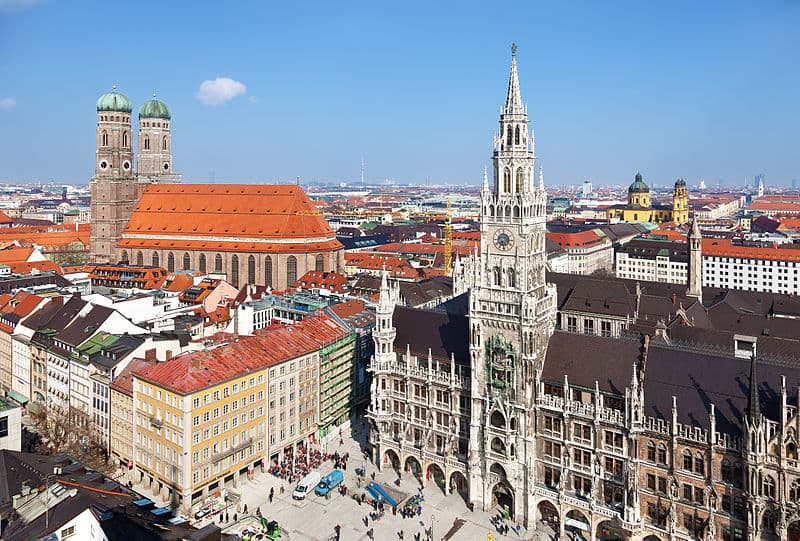
The city's main square since 1158, with a Marian column at its center erected in thanks for Munich surviving Swedish occupation. It's dominated by the neo-Gothic New Town Hall, with an eighty-three-meter tower and the Rathaus-Glockenspiel, where thirty-two life-size figures spin in a bay window: a knights' tournament and a coopers' dance. The performance lasts twelve minutes.

Tip: The glockenspiel plays at eleven and at noon, and additionally at five in the afternoon from March to October. Don't stand directly beneath it — the best view is from the café on the north side of the square, or from above, from the tower of St. Peter's Church right next door, reached via 306 steps, which also offers the best view of the city and the Alps on a clear day. The town hall tower has an elevator, but the view is worse.

Admission:
square free, Alter Peter tower 8 €
Time needed:
1 h
Frauenkirche

Frauenkirche

Altstadt

The Cathedral of Our Lady, built in 1488, a brick Gothic structure with two ninety-nine-meter towers topped by green Renaissance onion domes — Munich's most recognizable skyline feature. A city ordinance bans any new building in the center from being taller. Inside is the tomb of Emperor Louis the Bavarian and a footprint in the floor near the entrance known as the Devil's Footstep.

Tip: Legend has it that from the spot called the Devil's Footstep near the entrance, not a single window is visible — and indeed, from that exact point the columns hide every window, an architect's deliberate trick. Entry is free. The south tower can be climbed by elevator, but it's often closed for renovation for years at a stretch; check ahead, and if it's closed, head instead to Alter Peter, which also offers a view of this cathedral.

Admission:
free
Time needed:
45 min
Munich Residenz

Munich Residenz

Altstadt

The city residence of the Bavarian dukes, electors and kings, built up from 1385 into Germany's largest city palace — one hundred thirty rooms and ten courtyards. The tour route passes through the Antiquarium, the largest Renaissance hall north of the Alps, the Ancestral Gallery with one hundred twenty portraits, and the Imperial Hall. The treasury with the crown jewels and the Cuvilliés rococo theatre are ticketed separately.

Tip: It's enormous, and there's no way to see it all in one visit and still pay attention — pick either the state rooms circuit or the treasury, not both in one day. The rococo theatre is the loveliest spot in the whole complex, and many visitors miss it since it has its own entrance from Residenzstraße. Behind the Residenz is the Hofgarten, a quiet Renaissance garden with a pavilion where tango is danced in the afternoons.

Admission:
from 10 €, combined ticket 17 €
Time needed:
2–3 h
Nymphenburg Palace

Nymphenburg Palace

Nymphenburg

The summer residence of the Bavarian rulers, a baroque palace with a seven-hundred-meter facade, wider than Versailles. Inside is the Gallery of Beauties, where Ludwig I had thirty-six portraits of women painted regardless of their social rank, and a hall with a frescoed ceiling. The two-hundred-hectare park holds four hunting pavilions, of which Amalienburg is the high point of German rococo, plus a carriage museum.

Tip: The park is free and open from six in the morning; it's Munich's loveliest large garden and full of locals on Sundays. A combined ticket for the palace, the pavilions and the carriage museum is worthwhile, but the park pavilions close in winter — from November to March, buy only the palace ticket. Tram 17 from the main station gets you here in fifteen minutes.

Admission:
from 10 €, combined 20 €, park free
Time needed:
half a day
English Garden

English Garden

Schwabing / Lehel

A three-hundred-seventy-hectare city park, larger than Central Park, laid out in 1789 in the English landscape style. It contains a Chinese Tower with a beer garden seating seven thousand, the Greek-style Monopteros temple on a hill with a view of the city skyline, a boating lake, and several kilometers of paths along the Eisbach stream.

Tip: At the southern edge, by the bridge on Prinzregentenstraße, is a standing wave on the Eisbach stream where people surf year-round — in wetsuits in winter, even after dark. It's free to watch from the bridge and is the best free street spectacle in the city. Nude sunbathing is common in the park's northern section and surprises no one. You may bring your own food to the beer garden by the Chinese Tower, but not your own beer.

Admission:
free
Time needed:
half a day
Viktualienmarkt

Viktualienmarkt

Altstadt

A permanent market covering twenty-two thousand square meters just behind Marienplatz, operating since 1807, when the king had the food trade moved off the main square. One hundred forty stalls sell cheese, cold cuts, spices, flowers and southern fruit, with a maypole at its center and a beer garden for six hundred people beneath it.

Tip: In the beer garden in the middle of the market, bringing your own food bought from the surrounding stalls is allowed — and expected; you only buy the beer. It's the cheapest and best lunch in central Munich. Six major breweries rotate weekly through the garden, so a different beer is on tap each time. The market is closed on Sundays and holidays, which is easy to forget.

Admission:
free
Time needed:
1–2 h
Hofbräuhaus

Hofbräuhaus

Altstadt

The world's most famous beer hall, founded in 1589 as the Bavarian dukes' court brewery and opened to the public in 1828. The ground-floor hall seats a thousand people at long tables, a brass band plays in traditional dress, and beer is served exclusively in liter mugs. Upstairs is a dance hall, and the garden seats another four hundred people under chestnut trees.

Tip: It's a tourist institution that locals rarely visit, but it's worth experiencing once — just sit toward the back of the hall or in the garden, where it's quieter and the prices are the same. A table marked Stammtisch is reserved for regulars and off-limits. A liter of beer costs around thirteen euros. For the same atmosphere with more locals, try Augustiner-Keller or Hofbräukeller across the river.

Admission:
entry free, liter of beer from 13 €
Time needed:
2 h
Deutsches Museum

Deutsches Museum

Isarvorstadt

The world's largest technology museum, founded in 1903 on an island in the Isar River, with thirty thousand exhibits ranging from an underground mine replica to the first diesel engine and the submarine U1 to aircraft hanging from the ceiling. Many exhibits are functional and demonstrated live — most famous is the three-million-volt spark demonstration in a cage.

Tip: You can't cover it all in a day even at a brisk pace; pick two or three sections and skip the rest. The high-voltage spark demonstrations and the glass exhibit have set showtimes posted at the entrance and are the museum's highlight — plan around them. With kids, head for the underground mine replica and the children's section on the ground floor. The museum has been under long-term partial renovation, so check what's open.

Admission:
from 15 €
Time needed:
3–4 h
Olympiapark

Olympiapark

Olympiapark

The site of the 1972 Olympic Games, featuring a groundbreaking transparent roof of acrylic panels suspended on steel cables, meant to symbolize the lightness and openness of the new Germany. It includes a stadium, a swimming pool, an artificial hill built from wartime rubble, and a two-hundred-ninety-one-meter Olympic tower with a revolving restaurant and a rock museum.

Tip: The most exciting option is the rooftop tour of the stadium, where you walk on a rope harness above the seating and rappel down at the end — it must be booked in advance and only runs in good weather. Cheaper and also good is climbing the Olympiaberg, an artificial hill that's free to access and offers views of the Alpine ridge on a clear day. Right next door is the BMW museum and factory tours.

Admission:
park free, tower from 13 €
Time needed:
2–3 h

Photos: Marienplatz and the glockenspiel — Diliff (CC BY-SA 3.0) · Frauenkirche — Diliff (CC BY 2.5) · Munich Residenz — Bayreuth2009 (CC BY 3.0) · Nymphenburg Palace — Original: Richard Bartz, Munich aka Makro Freak Derivative work: Crassic (CC BY-SA 2.5) · English Garden — Carsten Steger (CC BY-SA 4.0) · Viktualienmarkt — Maximilian Dörrbecker (Chumwa) (CC BY-SA 2.0) · Hofbräuhaus — Kiban (Public domain) · Deutsches Museum — Burkhard Mücke (CC BY-SA 4.0) · Olympiapark — Martin Falbisoner (CC BY-SA 4.0)

Where to stay

Areas and districts, matched to the kind of trip you are taking

Altstadt

Best for: first-time visitors and sightseeing

The historic core within the former city walls, entirely walkable and small enough to cover in two hours. It holds Marienplatz with the glockenspiel, the Frauenkirche, the Residenz, the Viktualienmarkt and the Hofbräuhaus — nearly everything that brings first-time visitors to Munich. Housing here is the most expensive in the city, and it's quiet at night since almost no one actually lives here. Every metro and S-Bahn line crosses beneath it.

Schwabing

Best for: cafés and evening drinks

A former artists' quarter north of the center, home in the early twentieth century to Kandinsky, Rilke and Lenin, now wealthy and calm. It borders the English Garden, so the park is a five-minute walk away, and Leopoldstraße has the highest concentration of sidewalk cafés in the city. Ten minutes from the center by U3 or U6 metro.

Glockenbachviertel and Isarvorstadt

Best for: restaurants and nightlife

A district south of the center between Sendlinger Tor and the river, with the city's best restaurants and bars and its most open-minded atmosphere. A promenade runs along the Isar, where people grill and swim directly in the river in summer. Housing is about a quarter cheaper than in the core, and it's a fifteen-minute walk to Marienplatz.

Maxvorstadt

Best for: museums and student life

A district of museums and universities northwest of the center, home to the three Pinakothek galleries covering everything from Gothic to contemporary art, the Glyptothek with its ancient sculptures, and the Egyptian Museum. Around the university are the cheapest pubs in the wider center. On Sundays, admission to state museums costs a symbolic one euro, a deal found nowhere else in Germany.

Getting around

From the airport

A direct bus and a train with a connection both run from Prague to Munich, taking roughly five hours; a bus ticket bought in advance costs around twenty euros and is the simplest option. By car it's four and a half hours via Rozvadov. Flying from Prague isn't worthwhile, since Franz Josef Strauss Airport lies thirty-five kilometers northeast of the center and the transfer takes another forty-five minutes. Arriving passengers take S-Bahn line S1 or S8 to the main station; the ticket must be valid all the way to the outer zone and costs around thirteen euros, so for two or more people a group day ticket covering the whole network is worthwhile. The Lufthansa Express Bus runs every fifteen minutes and is somewhat faster.

Munich Franz Josef Strauss (MUC) · 35 km

  • S-Bahn S1 or S8 to Hauptbahnhof· 45 min· 13 €
  • Lufthansa Express Bus· 45 min· 13 €
  • Taxi to downtown· 40–50 min· 75 €

Around town

The historic core is entirely walkable, and everything between Marienplatz, the Residenz, the food market and the Hofbräuhaus is within ten minutes on foot. Nymphenburg, Olympiapark and the airport require public transit, which covers six U-Bahn lines, S-Bahn, trams and buses under a single zone-based fare. A single ticket for the inner M zone costs around 4 €, a day ticket around 9.50 €, and a group day ticket for up to five people around 18 €, always the better deal for two or more people. Tickets must be validated in a machine on the platform or on board before boarding; there are no turnstiles anywhere, but plainclothes inspections are frequent and the fine is sixty euros. Don't drive into the center: parking costs over three euros an hour, and much of the core is a pedestrian zone. Munich is flat with excellent bike lanes, making cycling faster than the metro.

U-Bahn metroSix lines, running every two to ten minutes, from around four in the morning to about one at night, later on weekends. Lines cross beneath Marienplatz and the main station. The fastest way around the city. · approx. 4 € zone M
S-BahnSuburban rail to the outskirts and the airport, running through a single tunnel through the center past Marienplatz and Hauptbahnhof. Take line S1 or S8 to the airport, S6 to Starnberg and its lake. · approx. 4 €, airport 13 €
TramsLine 17 from the main station to Nymphenburg, line 19 across the whole center. They run on the surface and are slower than the metro, but offer views of the city. · approx. 4 €
Group day ticketAround 18 € for up to five people for a full day within the inner zone; a single day ticket costs around 9.50 €. For two or more people, the group ticket is always cheaper than individual tickets. · from 9.50 € / 24 h
BikesMunich is flat, with a dense network of bike lanes and MVG Rad shared bikes. A path runs the length of the English Garden, and you can ride along the Isar all the way to the lakes. Don't step into a sidewalk bike lane. · from 1 € to unlock
Trains from HauptbahnhofForty minutes to Lake Starnberg and Lake Ammersee, ninety minutes to Salzburg, ninety minutes to Garmisch and the Zugspitze. The Bavaria-Ticket is valid all day on regional trains throughout Bavaria. · Bavaria-Ticket from 29 € for one person

When to go

May through September are best, when the beer gardens are open and you can sit outside — in Munich, social life during the warm half of the year moves entirely under the chestnut trees. Summer is pleasant, around twenty-five degrees, but it rains here more than anywhere else in Germany, since the city sits at the foot of the Alps; pack an umbrella even in August. Late September and early October belong to Oktoberfest, when the city is packed and hotels cost triple — anyone not specifically going for the festival should avoid those two weeks. Winter is cold, and Christmas markets fill Marienplatz. One local quirk is the Föhn, a warm Alpine wind that raises the temperature by ten degrees within a few hours and brings the mountains into view.

Best time

May through September, for beer garden weather

What to avoid

the two weeks of Oktoberfest, unless you're specifically going for it

MonthJanFebMarAprMayJunJulAugSepOctNovDec
Day3°5°10°15°19°23°25°24°20°14°8°4°
Night-5°-4°-1°3°7°11°13°13°9°5°1°-3°
Rainy days989101213121298910

Food & drink

Bavarian cuisine is a different country from the rest of Germany: white sausage, roast pork knuckle, pretzels and dumplings, all washed down with beer in liter mugs. It's served in three types of establishment, and the difference matters. A Wirtshaus is a pub serving hot food all day, a Biergarten is a beer garden under chestnut trees where the law allows you to bring your own food and buy only the beer, and a Bierkeller is its indoor, covered version. Beer gardens in particular offer the best value in the whole city — a piece of cheese and a pretzel from the Viktualienmarkt plus a half-liter of beer comes to about ten euros. Beer is ordered by style rather than brand: Helles is a pale lager, Weißbier is wheat beer, Radler is beer mixed with lemonade. In a pub it's normal to sit down at a stranger's table after asking if the seat is free. Always carry cash, since many pubs don't take cards.

What to try

Weißwurst

A white veal sausage poached in water, eaten exclusively before noon — tradition holds it should never hear the noon bell. The skin isn't eaten: either slit it lengthwise with a knife or suck the meat out. Sweet mustard, a pretzel and wheat beer are the classic accompaniments.

Schweinshaxe

Roast pork knuckle with crispy skin, served with a dumpling and cabbage. A single portion easily tops a kilo and costs around twenty euros at a pub — plenty for one, so two people sharing is completely normal.

Brezel

A lye-dipped pretzel with coarse salt, baked fresh every morning. It costs about a euro at a bakery, three times that at a pub. The southern version is softer and thicker, the northern one crunchier; it's always served alongside Weißwurst.

Beer

Ordered by style, not brand: Helles is a pale lager, Weißbier wheat beer, Dunkel dark, Radler beer with lemonade. A half-liter costs four to five euros at a pub, though many beer halls only pour the full one-liter Maß. Bottles carry an eight-cent deposit.

Obatzda

A spread made from ripened camembert, butter, onion and paprika, originally a way to use up over-ripe cheese. Served in beer gardens with a pretzel and chopped onion on top; a portion costs around seven euros and feeds two.

Schweinsbraten with dumpling

Roast pork with a dark beer gravy and a bread or potato dumpling, the classic Sunday Bavarian lunch. The crackling should be crispy, and the dumpling is meant to be dunked in the gravy. Around sixteen euros at a pub.

Leberkäse

A baked meatloaf sliced into thick slabs that, despite its name, contains neither liver nor cheese. Eaten in a bun with mustard as a three-euro snack, or hot with a fried egg and potato salad as lunch.

Kaffee und Kuchen

The afternoon ritual between three and five: filter coffee and a slice of cake at a café. The most common choices are Black Forest gateau and apple streusel cake. A slice with coffee runs about eight euros.

What it costs

Coffee at a café

3.50–5 €

Half-liter of beer at a pub

4.50–5.50 €

Liter of beer (Maß) at a beer hall

12–15 €

Pretzel from a stand

1.50–3 €

Roast pork knuckle at a pub

18–24 €

Day transit pass

from 9.50 €

Nymphenburg admission

from 10 €

Night at a 3-star hotel for two

110–180 €, triple during Oktoberfest

Indicative prices that change over time — treat them as a guide, not a price list.

Practical information

SocketsCEuroplug, two round pinsFSchuko
Voltage230V / 50Hz
Tap waterTap water is drinkable — Tap water is safe to drink throughout Germany and controlled just as strictly as bottled water, so buying it makes little sense. In restaurants, though, you pay for it like any other drink, and many places won't bring it at all — ordering "Wasser" gets you a bottle of mineral water, almost always sparkling. Ask for "stilles Wasser" if you want still. PET bottles and cans carry a twenty-five-cent Pfand deposit, refunded at a machine in every supermarket.
TippingTip five to ten percent, paid at the table, not at a register. It's not left lying on the table — instead you tell the server the total you want to pay ("twenty-two, please") and they hand back the change. When paying by card, say the tip amount out loud, since the terminal often has no field for it. Cash is still very common in Germany, and smaller pubs and bakeries may not take cards at all.
Driving on theright
SafetyGermany is a safe country, and visitors can walk the streets of its big cities without worry, even at night. The real risk is pickpocketing on the metro, at main stations and at Christmas markets, plus bicycle theft. The areas around the main stations in Berlin, Munich and Frankfurt attract their own crowd after dark, worth avoiding, but elsewhere things are calm. The most common tourist mishap isn't crime but stepping into a bike lane — often marked on the sidewalk by a different paving color, and cyclists won't swerve for you. The emergency number is 112, police 110.
Opening hoursOpening hours are regulated by law, and on Sundays almost everything is closed except restaurants, museums, bakeries for a few morning hours, and shops at train stations and airports. Anyone arriving on a Sunday can only shop at the main station. On weekdays, shops open roughly nine or ten to eight in the evening, supermarkets until ten. Museums are usually closed on Mondays. Restaurants serve food continuously from noon, with hot kitchens closing around ten; traditional pubs serve only Kaffee und Kuchen in the afternoon.
Customs & etiquetteAlways carry cash — contactless payment is standard at chains, but pubs, stalls and small museums often take cash only. Punctuality is taken seriously, and arriving ten minutes late for a reservation can mean losing the table. It's normal to sit at a stranger's table in a pub after asking "Ist hier frei?" — this applies doubly at the long tables in beer halls, though a table marked Stammtisch is reserved for regulars and off-limits. Toasts are made with eye contact. Crossing on a red light even on an empty street isn't done, and locals will happily point it out in front of children. Waste sorting is taken seriously.
A few local wordsHello — Guten TagThank you — Danke schönPlease — BitteThe bill, please — Zahlen, bitteCheers — ProstGoodbye — Auf Wiedersehen

How to plan your days

1 day

One day in Munich

  1. 1Before eleven at Marienplatz for the glockenspiel.
  2. 2Climb St. Peter's Church tower for the view of the Alps.
  3. 3Lunch at the Viktualienmarkt with your own food in the beer garden.
  4. 4Afternoon at the Frauenkirche and the Residenz or the treasury.
  5. 5Evening at the Hofbräuhaus or a pub in Glockenbachviertel.

2 days

Two days with a palace and a park

  1. 1Day one as above.
  2. 2Morning tram 17 to Nymphenburg, the palace and Amalienburg.
  3. 3Afternoon in the English Garden watching the surfers on the Eisbach.
  4. 4Beer garden by the Chinese Tower.
  5. 5Evening walk through Schwabing.

3 days

Three days with a trip to the Alps

  1. 1The first two days as above.
  2. 2Morning train to Füssen for Neuschwanstein Castle with a booked time slot.
  3. 3The Marienbrücke bridge and the view of the castle from above.
  4. 4Return to Munich in the evening.
  5. 5Last evening: either the Deutsches Museum or the Pinakotheken in Maxvorstadt.

Day trips

Neuschwanstein

120 km · 2 h by train and bus to Füssen

The castle of King Ludwig II, built between 1869 and 1886 as a stage set for Wagner's operas rather than a home — the king spent only eleven nights there and died before it was finished. Only a third of the rooms are complete, and the tour lasts thirty-five minutes. Tickets must be booked online weeks in advance for a fixed entry time; you won't get in on the spot during the season. The best view of the castle is from the Marienbrücke bridge over the gorge, which closes in winter or when icy. Take the train to Füssen, then bus 78, roughly two hours total; with the Bavaria-Ticket the round trip is covered by a single ticket.

Dachau

20 km · 40 min by S-Bahn and bus

The first Nazi concentration camp, established in March 1933, which served as the model for all the others and as a training center for guards. Two hundred thousand prisoners from more than thirty countries passed through it. What survives includes the gate bearing the inscription Arbeit macht frei, a barrack under reconstruction, the main building with its exhibition, and the crematorium. Admission is free, the audio guide costs around five euros, and you should allow three to four hours for the visit. Take S-Bahn line S2 to Dachau, then bus 726. It's not a place to bring young children.

Salzburg

150 km · 1 h 30 min by train

An Austrian city beneath the Hohensalzburg Fortress, birthplace of Mozart and the setting for The Sound of Music. Its UNESCO-listed old town, with narrow lanes and wrought-iron shop signs, can be covered in half a day; above it looms the largest surviving medieval fortress in Central Europe, reached by cable car. Beyond the town are the Mirabell Gardens and Hellbrunn Palace, with trick fountains designed to deliberately soak visitors. Trains run from Munich hourly, taking ninety minutes, and with the Bavaria-Ticket, valid all the way to Salzburg, two people travel more cheaply than with individual tickets.

Frequently asked questions

When is Oktoberfest, and is it worth going?+

It runs for about sixteen days from mid-September to the first Sunday of October, so mostly in September, not October. Admission to the Theresienwiese fairground is free; you only pay for food and beer, with a liter costing around fifteen euros. Anyone wanting a seat in a tent on the weekend needs to arrive before ten in the morning or have a table reservation. Hotels cost triple during those days and are booked out a year ahead.

How many days do I need for Munich?+

Two days cover the old town with the glockenspiel, the food market, the Residenz, Nymphenburg and the English Garden. Three days are better, since they allow for a full day trip — Neuschwanstein, Dachau or Salzburg. Anyone going for the museums should budget an extra day just for the Pinakotheken or the Deutsches Museum, since each fills a whole afternoon.

How do I get to Neuschwanstein?+

By train from the main station to Füssen, then bus 78 or 73 up to the castle, roughly two hours each way in total. The Bavaria-Ticket, valid all day on regional trains and buses, makes the round trip cheapest. Castle tickets must be booked online, often weeks ahead, with a fixed entry time — without a reservation you won't get in during the season.

How much does transport cost in Munich?+

A single ticket for the inner zone costs around four euros, a day pass around 9.50 euros, and a group day pass for up to five people around eighteen euros — for two or more people the group ticket is always the better deal. The airport fare is higher, around thirteen euros. Tickets must be validated in the machine before boarding; there are no turnstiles, but plainclothes inspectors check regularly and the fine is sixty euros.

Can I bring my own food into a beer garden?+

Yes, and it's a Bavarian tradition protected by common law — in a genuine beer garden, meaning one with chestnut trees and benches without tablecloths, you're allowed to bring your own food and only buy the beer. This doesn't apply to the section with laid tables and table service. The best combination is to buy cheese, cold cuts and a pretzel at the Viktualienmarkt and sit down with a beer right there.

When's the best weather in Munich?+

May through September, with temperatures around twenty-five degrees. But keep in mind Munich is Germany's rainiest major city, since it sits at the foot of the Alps — it rains even in August, and showers arrive quickly. One quirk is the Föhn, a warm Alpine wind that can raise the temperature by ten degrees within a few hours and brings the mountains into clear view.

Is Munich expensive?+

Along with Frankfurt, it's Germany's most expensive city, especially for accommodation — a night at a 3-star hotel for two costs one hundred ten to one hundred eighty euros, and triple that during Oktoberfest. Food and beer, by contrast, are comparable to the rest of the country: a half-liter for four and a half euros, a roast knuckle for twenty. The cheapest meal is a beer garden with your own food, and on Sundays state museums cost just one euro.

Is the City Tour Card or München Card worth it?+

Only if you plan to use public transit a lot while also visiting several paid museums. The card includes transport and ticket discounts, but most discounts are twenty percent off, not free entry. For two people over two days, a group day ticket plus individual admission tickets often works out cheaper — and on Sundays, state museums cost just one euro even without the card.
Visa Requirements

Check the latest visa requirements for entering this country. Some nationalities may need to apply for a visa or e-visa before travel.

Check visa requirements

Language

German

Currency

EUR

Timezone

GMT+1

Dial Code

+49

Population

84.5M

Area

357,022 km²

Voltage

230V / 50Hz

Driving Side

Right

Top Hotels in Munich

Live prices from 500+ properties

Loading hotels...

More destinations in Germany

Planning a trip to Munich?

Compare hundreds of hotels, find the best price, and book with free cancellation on TravelManiac.