Hotels in El Nido

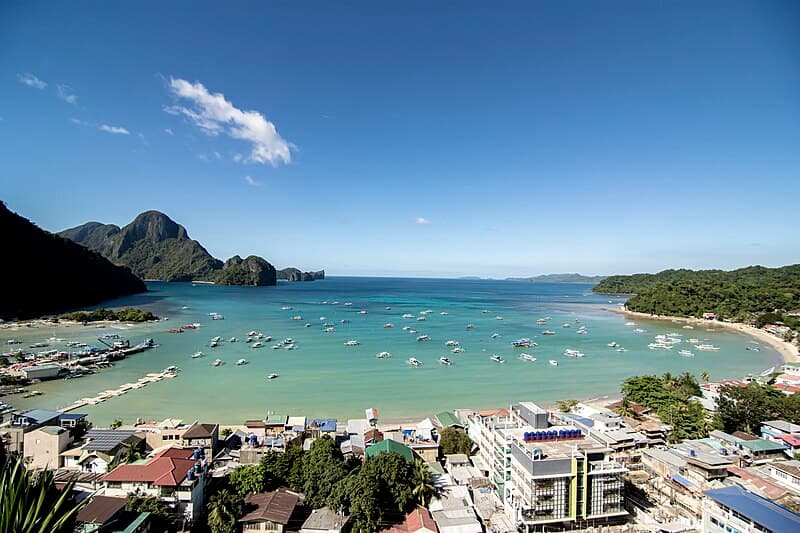
Limestone towers and lagoons in northern Palawan

El Nido

LanguageEnglish
CurrencyPHP
TimezoneGMT+8
Temperature26-34 °C
Dial Code+63
Population115M
Area300,000 km²
SocketsType A / Type B / Type C
Tap waterNot drinkable

Discover El Nido

El Nido sits on the northern tip of Palawan, and its essence is Bacuit Bay — 45 limestone islands rising from the sea like vertical towers up to 200 m tall. They formed by the same process as the formations in Krabi, Thailand, or Ha Long Bay in Vietnam, but are somewhat steeper, and the sea between them is noticeably clearer. Inside some of the islands hide lagoons accessible only through a crack in the rock, entered by kayak; the famous Big Lagoon on Miniloc Island is arguably the most photographed spot in the Philippines. The town itself is small, dusty and not particularly pretty — it's a starting point, not a destination, squeezed onto a narrow strip between the beach and the wall of Taraw Cliff. The whole bay is a protected area, and lagoon visits have been quota-based and booked in advance since 2023. Unlike Boracay, this isn't about beach and bars, but about being on a boat among the islands every day.

What to see

The places worth your time in El Nido, and what to expect at each

Big Lagoon

Big Lagoon

Miniloc Island, Tour A

El Nido's most famous spot: a shallow turquoise lagoon inside Miniloc Island, entered through a narrow crack between 2 limestone walls. Inside, the water reaches waist height, the bottom is sandy, and the walls rise 200 m sheer above the surface. Motorboats aren't allowed in — you enter by kayak.

Tip: Since 2023 a daily quota applies and the lagoon must be booked in advance through a Tour A operator. It looks best at high tide, when the water is bluest and the kayak can go right to the back; at low tide you'll wade in places. Bring a waterproof bag — you will get wet on the kayak.

Admission:
included in Tour A
Time needed:
1–2h
Small Lagoon

Small Lagoon

Miniloc Island, Tour A

A smaller, more enclosed lagoon on the same island, entered through a rock opening so low that you have to duck your head from the kayak, or simply swim through. Inside is a circular pool ringed by cliffs, with an underwater cave at one end.

Tip: It's quieter and more striking than the Big Lagoon, but tighter, and by midday 20 kayaks pack in here. If you can swim, leave the kayak at the entrance and swim in — you can fit through the lower opening and be inside alone before everyone else. Water shoes are useful, as the bottom is rocky.

Admission:
included in Tour A
Time needed:
1h
Secret Lagoon

Secret Lagoon

Miniloc Island, Tour A

A lagoon on Miniloc Island hidden behind a limestone wall, reached through a single door-sized opening right at water level — you go through one at a time, emerging into a small pool ringed by rock. It's the smallest of the lagoons and feels most like a roofless cave.

Tip: The opening is only passable at low tide; at high tide it's underwater and the lagoon gets skipped. Come with the morning boat — by around 11am there's a queue at the opening and 20 people cycling through inside. It's the last stop on Tour A, so it's worth asking the operator to visit it first instead.

Admission:
included in Tour A
Time needed:
45 min
Nacpan Beach

Nacpan Beach

north of town

A 4-km sandy beach 20 km north of town, one of the few genuinely long beaches in the area — most bays around El Nido are small. The sea has waves, coconut palms line its full length, and at the northern end there's a viewpoint over the neighbouring Calitang beach.

Tip: The tricycle ride takes 40 minutes along a dusty road and costs around 800 pesos return with waiting time. Go for the full day, not just 2 hours. The highlight is the hill between Nacpan and Calitang, from where you can see both beaches at once — it's a 20-minute climb and well worth it.

Admission:
free, tricycle from 800 PHP
Time needed:
full day
Taraw Cliff

Taraw Cliff

above town

A limestone wall rising 270 m directly behind town. A short but very steep climb over sharp karst rock leads to a viewing platform, from where the whole of Bacuit Bay and its islands come into view at once.

Tip: The rock is razor-sharp, and the gloves you're given at the entrance aren't a formality — without them you'll cut up your hands. You can only go with a guide and in sturdy shoes; flip-flops won't be let up. Set off at dawn — after 9am the heat on the rock is unbearable, with no shade at all.

Admission:
from 500 PHP with a guide
Time needed:
2–3h
Las Cabanas Beach

Las Cabanas Beach

The nearest usable beach from town, 4 km south and facing west — the only spot nearby where you can watch the sun set over the sea. Bars line the beach, and a zipline runs across it, ending on a small island just offshore.

Tip: A tricycle from town costs 200 pesos and takes 10 minutes. Arrive around 5pm, sit at a bar on the sand and watch the sunset — it's the best evening you can have in El Nido and costs a fraction of a boat tour. Swimming here is average; you come for the sunset.

Seven Commandos Beach

Seven Commandos Beach

Bacuit Bay, Tour A

A beach on a peninsula south of town, reachable only by water, with white sand, palm trees and a single bar selling fresh coconuts. It's the prettiest beach in Bacuit Bay and is usually Tour A's last stop before heading back.

Tip: The name comes from 7 Japanese soldiers who, according to local lore, were stranded here after the Second World War. To enjoy the beach without 30 boats, hire your own boat and arrive around 6am — it's 15 minutes from town, and there's no one here until 9am.

Admission:
included in Tour A
Time needed:
1h
Matinloc Shrine

Matinloc Shrine

Matinloc Island, Tour C

An abandoned Marian shrine from 1982 on Matinloc Island, built in a narrow gorge between cliffs and now half-derelict. A trail behind it leads up a limestone ridge with the best sea-level view over Bacuit Bay.

Tip: The climb up the ridge behind the shrine is short but crosses sharp karst and requires using your hands — flip-flops won't work. It's the best viewpoint on the whole Tour C, and many boats skip it unless passengers speak up. Ask in advance whether it's on the itinerary.

Admission:
included in Tour C plus 200 PHP
Time needed:
1h
Snake Island

Snake Island

Bacuit Bay, Tour B

A sandbar between Vigan Island and the mainland that emerges from the sea at low tide, forming an S-shaped path across the water — hence the name. The bar is a few metres wide, with waist-deep sea on either side. Above it is a viewpoint from which the whole formation is visible.

Tip: The sandbar only exists at low tide and is completely underwater at high tide — Tour B operators plan the route around tide tables, but it's worth asking whether you'll actually reach Snake Island at all. The climb to the viewpoint takes 10 minutes, and it's the only spot from which the sandbar looks like it does in photos.

Admission:
included in Tour B
Time needed:
1h

Photos: Big Lagoon — Marciano Villavito (CC BY-SA 4.0) · Small Lagoon — Fabio Achilli from Milano, Italy (CC BY 2.0) · Secret Lagoon — Henry de Monfreid, 1914 (Public domain) · Nacpan Beach — Micluna (CC BY-SA 4.0) · Taraw Cliff — David Stanley from Nanaimo, Canada (CC BY 2.0) · Las Cabanas Beach — Tuderna (CC BY 3.0) · Seven Commandos Beach — Fabio Achilli from Milano, Italy (CC BY 2.0) · Matinloc Shrine — Say Bernardo (CC BY-SA 4.0) · Snake Island — Fabio Achilli from Milano, Italy (CC BY 2.0)

Where to stay

Areas and districts, matched to the kind of trip you are taking

El Nido Town (Buena Suerte and Masagana)

Best for: cheapest accommodation and boat departures

A dusty little town squeezed between the beach and Taraw Cliff, home to tour-operator offices, restaurants, shops and the cheapest accommodation. The town beach is full of anchored boats and unusable for swimming. You stay here for convenience and price, not for beauty.

Corong-Corong

Best for: sunset and quiet close to town

A bay just south of town, facing west, with a calmer atmosphere, better mid-range hotels and sunset views. It's 10 minutes to the centre by tricycle or 20 on foot. A sensible compromise between convenience and quiet, and where most repeat visitors head.

Las Cabanas and the south

Best for: beach on your doorstep and evenings

A stretch of coast 4 km south of town with bars on the sand and the only proper sunset in the area. Accommodation is pricier and choice more limited, but you have a beach right below the hotel. For boat tours you commute into town, which is 10 minutes away.

Nacpan and the north

Best for: a long beach and seclusion

20 km north along a dusty road lies the 4-km Nacpan Beach, with a handful of hotels and nothing else. It's the prettiest beach in the region and the quietest spot, but it's an hour's journey each way to boat tours in Bacuit Bay. The choice for those who want to lie down, not travel around.

Getting around

From the airport

El Nido has a small airport, Lio, 5 km from town, served by a single airline using smaller aircraft from Manila and Cebu; flights are expensive and often cancelled due to weather. A cheaper and more reliable route is to fly into Puerto Princesa, Palawan's capital, and continue 5–6 hours by bus or minivan on a road that's now mostly paved. Flights from Europe typically involve 2 connections via hubs such as Dubai, Doha or Istanbul to Manila, continuing domestically from there; allow 24–30 hours in total. Many nationalities can enter visa-free for stays of up to 30 days, but you'll need a return ticket and a completed online eTravel registration. On arrival in El Nido, a 200-peso environmental fee is charged, valid for 10 days and required for all boat tours.

El Nido Lio Airport (ENI) · 5 km

  • Tricycle to town· 15 min· 200 PHP
  • Hotel transfer· 15 min· 500 PHP

Puerto Princesa International (PPS) · 230 km

  • Minivan to El Nido· 5h· 700 PHP
  • RORO bus· 6h· 500 PHP
  • Private transfer· 4h 30min· 6,000 PHP

Around town

You can walk around town on foot — it takes 10 minutes end to end. For everything else there's the tricycle, a motorbike with a sidecar, which is the only public transport in the area; prices are fixed and posted on signs by the market, but drivers still try it on with tourists — agree the price beforehand and carry small change. For Nacpan and other more distant beaches, you hire a tricycle with waiting time for the whole day. Scooters can be rented and are the cheapest way to get around, but the roads are dusty, potholed and unmarked; riding without the correct motorcycle licence will void most travel insurance. Bacuit Bay is only reachable by boat, and only with a registered operator.

TricycleThe only public transport. Prices are posted by the market, but agree the fare beforehand and carry small change. · 50 PHP
Tricycle for a full dayFor Nacpan and more distant beaches, including waiting time. Arrange it the morning before. · 800 PHP
Rental scooterThe cheapest way to get around, but the roads are dusty and potholed. Insurance won't pay out without the correct motorcycle licence. · 600 PHP/day
Bangka boat tourStandardised Tours A, B, C and D with fixed prices. Book a day ahead; the lagoons have a daily quota. · 1,400 PHP

Useful apps: Grab, Google Maps, Klook, Angkas

When to go

The best period is from November to April, when the dry amihan trade wind blows, the sea is calm and boats depart reliably every day. The peak is from December to March, when prices are highest and the lagoons busiest. May is hot but still mostly dry. From June to October the habagat monsoon brings rain and typhoons — the issue isn't the rain itself, but that the coast guard bans departures in bad weather and tours can be cancelled at short notice. Anyone travelling in this period should expect only 3 out of 5 days to actually go out. That's exactly why you should always leave a full day's buffer between your last boat tour and your international flight home.

Best time

November to April, peaking December to March

What to avoid

July to September, typhoons and cancelled tours

MonthJanFebMarAprMayJunJulAugSepOctNovDec
Day29°29°31°32°32°31°30°30°30°30°30°29°
Night24°24°25°26°26°25°25°25°25°25°25°24°
Rainy days75441218202019171210
Sea27°27°28°29°30°29°29°29°29°29°29°28°

Food & drink

El Nido is a small town and its food scene matches — a few dozen restaurants along 2 streets, mostly with similar menus mixing Filipino classics with what foreigners want. Seafood is the strong point: fish is picked out on ice and charged by weight, and grilled octopus or prawns cost a fraction of European prices. The cheapest meals are at the carinderia food stalls by the market, where you point at the pots and lunch costs around 150 pesos. On boat tours lunch is included and grilled right on the boat or the beach — often the best meal of the day. Fruit is cheap and mango shakes are sold on every corner. Bear in mind that El Nido has a limited power supply and many businesses run on generators, so not everything on the menu is available during outages.

What to try

Kinilaw

Raw fish cured in vinegar and calamansi with onion, ginger and chilli — the Filipino answer to ceviche, but sharper. Order it where the fish comes straight off the boat, not at an empty restaurant.

Adobo

Pork or chicken braised in vinegar, soy sauce, garlic and bay leaf. The national dish of the Philippines, which originated as a way of preserving meat in the tropical heat — hence the sharp tang.

Sinigang

A sour soup with meat or prawns and vegetables, soured with tamarind or guava. Filipinos eat it even in the height of the heat; served with rice, it's the most typical home-cooked lunch.

Chicken inasal

Chicken marinated in calamansi, ginger and annatto, grilled over charcoal and served with garlic rice. It originates from Bacolod and is recognisable by its orange colour from the annatto.

Lechón

A whole suckling pig roasted on a spit, with skin crackling like glass. It's cooked for celebrations and is best in Cebu, where it's stuffed with lemongrass; on tourist beaches it's sold by the portion in the evening.

Lumpia

Thin fried spring rolls with minced meat and vegetables, served with a sweet-and-sour dip. Sold individually at markets, they're the cheapest Filipino street food.

Mango shake

Filipino mangoes are among the sweetest in the world, and a shake made from fresh fruit and ice costs around 100 pesos on the beach. Ask whether it's made with fresh mango, not syrup — the difference is huge.

Halo-halo

Crushed ice with condensed milk, sweet beans, jelly, ube jam and ice cream on top. It looks like a failed experiment and tastes wonderful; the name literally means 'mix together'.

What it costs

Meal at a carinderia food stall

150–250 PHP

Dinner at a restaurant in town

500–900 PHP per person

San Miguel beer

70 PHP

Tour A or C with lunch

1,400–1,800 PHP

Private boat for a full day

from 8,000 PHP

Environmental fee (valid 10 days)

200 PHP

Tricycle to Nacpan and back, with waiting time

800 PHP

Night at a 3-star hotel in Corong-Corong

from 2,500 PHP for a double room

Indicative prices that change over time — treat them as a guide, not a price list.

Practical information

SocketsAtwo flat pins (US/JP)Btwo flat pins plus ground (US)CEuroplug, two round pins
Voltage220V / 60Hz
Tap waterDo not drink tap water — Don't drink the tap water. Filipinos themselves drink bottled water from refill stations, and every sari-sari store sells a bottle for a few pesos; resorts provide 2 per room per day. Ice in restaurants and bars is commercially made and safe, but shaved ice from a street cart isn't. Fresh buko coconut water is the cheapest and best drink on the islands, drunk straight from the nut.
TippingTipping is customary but lower than in America: 10% at restaurants, unless a service charge is already on the bill, which most tourist places add. Island-tour guides get 100–200 pesos per person, and tricycle drivers are tipped by rounding up. Resort staff are left a shared envelope at the end of the stay.
Driving on theright
SafetyThe tourist islands of the Visayas and Palawan are safe, with low crime against foreigners; security warnings for the south of the country concern Mindanao and Sulu, not these areas. The real risks are natural and travel-related. Typhoons cross the Philippines from June to October, cancelling flights and ferries for up to 3 days at a stretch — always leave a full day's buffer between an inter-island transfer and an international flight. Healthcare on the small islands is limited to a basic clinic, and a serious case means a flight to Manila, so insurance with repatriation cover is essential. Jellyfish appear in the sea from April to October, and some beaches have strong currents. The daytime heat is more intense than it looks — drink more than you feel like.
Opening hoursSari-sari stores are open from morning until night every day, larger supermarkets from 9am to 9pm. Beach restaurants close around 11pm, bars anywhere from midnight to 2am. Sunday mornings are quieter because of Mass, and some small businesses close. During typhoon season, boat traffic can be halted at short notice by the coast guard's decision — don't rely on catching a same-day connecting flight.
Customs & etiquetteFilipinos are warm and avoid confrontation at almost any cost — raising your voice or calling out a mistake in public causes a loss of face, and it always makes things worse, never better. Elders are addressed with 'po' and 'opo' at the end of a sentence, and this carries over into English too. English gets you through everywhere, as it's the country's second official language. The country is strongly Catholic: dress modestly for church, and swimwear belongs on the beach, not in the village. Topless sunbathing is not acceptable. Drug laws are strict even for small amounts.
A few local wordsHello — Magandang arawThank you — SalamatHow much does it cost? — Magkano?Yes / No — Oo / HindiThe bill, please — Bill out, please

How to plan your days

1 day

A day in El Nido

  1. 1At dawn, climb Taraw Cliff for a view over the whole bay.
  2. 2Breakfast in town, with the boat departing around 9am.
  3. 3Full-day Tour A: Big and Small Lagoons, Secret Lagoon, Seven Commandos.
  4. 4Return around 5pm, shower and rest.
  5. 5Sunset and dinner at a bar on Las Cabanas.

2 days

2 days: 2 tours

  1. 1Day 1: Tour A with the lagoons on Miniloc Island.
  2. 2Evening: sunset in Corong-Corong and seafood by weight.
  3. 3Day 2: Tour C — Matinloc Shrine, Hidden Beach and Helicopter Island.
  4. 4Return in the afternoon, last drink on the beach in the evening.

3 days

3 days: lagoons, islands and beach

  1. 1Day 1: climb Taraw at dawn, rest in the afternoon.
  2. 2Day 2: Tour A with the Big and Small Lagoons.
  3. 3Day 3: Tour C, or Tour B with Snake Island depending on the tide.
  4. 4Day 4 (half): Nacpan Beach with a tricycle hired for the day.
  5. 5Viewpoint between Nacpan and Calitang for both beaches at once.

Day trips

Tours A, B, C and D around Bacuit Bay

20 km · full day by boat

Island visits in El Nido are standardised into 4 fixed-price tours, offered identically by every operator. Tour A is the most popular and includes both lagoons on Miniloc plus Seven Commandos. Tour C is the most beautiful according to most visitors: Hidden Beach, Matinloc Shrine and Helicopter Island. Tour B is quieter, with Snake Island and caves, while Tour D is the least visited. Lunch is always included and grilled on board. With 2 days, take Tours A and C.

Port Barton

140 km · 3h 30min by minivan

A fishing village halfway to Puerto Princesa that looks like El Nido did 20 years ago: a dusty main street, power for only part of the day, and no big hotels. The islands in the bay are less dramatic than in Bacuit, but no one's on them, and there are turtles and reefs nearby. It's the best stopover for anyone continuing further south down Palawan, not a day-trip destination in itself.

Coron

170 km · 4h by fast ferry

An island north of Palawan, reached from El Nido by daily fast ferry. The scenery is similar — limestone towers and lagoons — but the main draw here is different: the bay holds 12 Japanese warships sunk by an American air raid in 1944, among the most accessible wreck dives in Asia. Add to that Kayangan Lake, with the clearest water in the Philippines. This isn't a single-day trip — allow 2–3 nights.

Frequently asked questions

When is the best time to visit El Nido?+

From November to April, when the dry amihan trade wind blows, the sea is calm and boats depart reliably. The peak is from December to March, with the highest prices. From June to October the habagat monsoon brings rain and typhoons — the issue isn't the rain itself, but that the coast guard bans departures in bad weather and tours get cancelled. Anyone travelling in this period should expect only 3 out of 5 days to actually go out.

How do Tours A, B, C and D work?+

Island visits in Bacuit Bay are standardised into 4 fixed-price tours, offered identically by every operator. Tour A includes both lagoons on Miniloc and Seven Commandos, and is the most popular. Tour C is the most beautiful according to most visitors: Hidden Beach, Matinloc Shrine and Helicopter Island. Tour B is quieter, with Snake Island, while Tour D is the least visited. Lunch is always included. With 2 days, take Tours A and C.

Do I need to book the lagoons in advance?+

Yes. Since 2023 the Big and Small Lagoons have had a daily visitor quota, booked through a Tour A operator, ideally 1 or 2 days ahead. In peak season capacity genuinely sells out, and anyone turning up at the pier in the morning without a booking won't get onto Tour A. You'll also need to pay a 200-peso environmental fee for the tours, valid for 10 days.

How do I get to El Nido?+

Either fly into the small Lio Airport 5 km from town, served by a single airline from Manila and Cebu — it's expensive and flights are often cancelled due to weather. Cheaper and more reliable is to fly into Puerto Princesa and continue 5–6 hours by minivan on a mostly paved road. From Europe, the journey usually involves 2 connecting flights via Manila and takes around 24–30 hours in total.

Is El Nido better than Boracay?+

It's a different type of holiday. Boracay has a 4-km white beach, bars, restaurants and comfort; El Nido town is dusty and its beach is unusable for swimming because it's full of anchored boats. You come to El Nido to spend every day on a boat among limestone islands. Beach loungers belong on Boracay; anyone after lagoons and scenery belongs in El Nido.

Where should I stay in El Nido?+

El Nido town has the cheapest accommodation and is closest to the boat departures, but it's dusty and noisy. Corong-Corong, just south, is quieter, has better hotels and sunset views, and is 10 minutes from the centre. Las Cabanas, 4 km further, has a beach right below the hotels and bars on the sand. Nacpan, 20 km north, is the prettiest beach and the quietest spot, but it's an hour's journey each way to the tour departures.

Is it worth climbing Taraw Cliff?+

Yes, it's the best view in the whole region, taking in all of Bacuit Bay at once. You can only go with a guide and in sturdy shoes — flip-flops won't be allowed up. The rock is razor-sharp, so the gloves you're given at the entrance aren't a formality. Set off at dawn — after 9am the heat on the rock becomes unbearable and there's no shade at all.

Should I expect power and internet outages?+

Yes. El Nido isn't connected to the main grid and power supply is limited; better hotels have generators, cheaper ones don't, so air conditioning may be off during the day. Mobile internet is slow, and there's no signal at all in Bacuit Bay. There are 3 ATMs in town, often empty or out of order — bring cash from Puerto Princesa or Manila, as most small businesses don't take cards.

Visa Requirements

Check the latest visa requirements for entering this country. Some nationalities may need to apply for a visa or e-visa before travel.

Check visa requirements

Language

Filipino / English

Currency

PHP

Timezone

GMT+8

Dial Code

+63

Population

115M

Area

300,000 km²

Voltage

220V / 60Hz

Driving Side

Right

Top Hotels in El Nido

Live prices from 500+ properties

Loading hotels...

More destinations in Philippines

Planning a trip to El Nido?

Compare hundreds of hotels, find the best price, and book with free cancellation on TravelManiac.