Hotels in Galle

A Dutch fort at the tip of the south coast

Galle

LanguageSinhala / Tamil
CurrencyLKR
TimezoneAsia/Colombo
Temperature26-32 °C
Dial Code+94
Population22.2M
Area65,610 km²
SocketsType D / Type G / Type M
Tap waterNot drinkable

Discover Galle

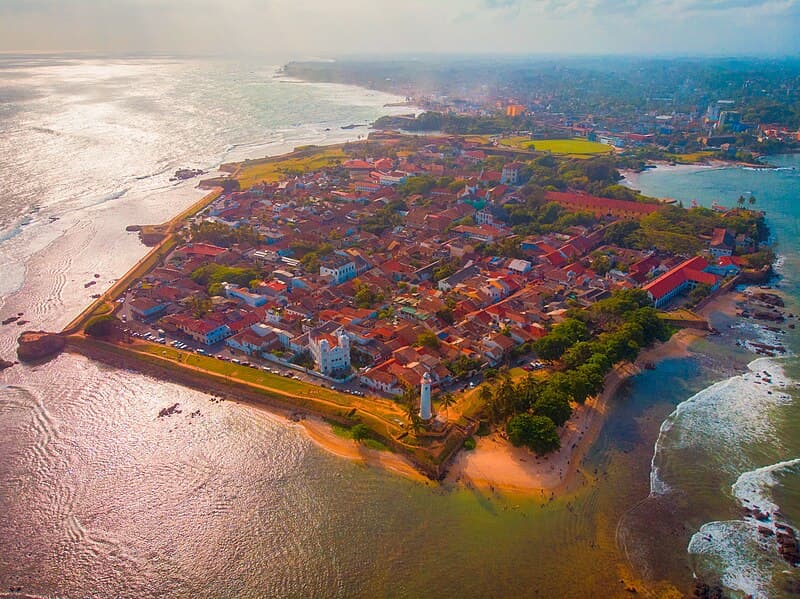
Galle is the best-preserved European fort in South Asia and, at the same time, a living town — inside the walls people live, go to school and sell fish; it isn't a museum piece. The harbour mattered long before Europeans arrived, but its present form came from the Dutch, who fortified it so well in the 17th century that the walls held back the 2004 tsunami even as the surrounding districts were destroyed. Inside stand colonial houses with verandas, a Dutch Reformed church with a floor of gravestones, and a lighthouse on the southern bastion. Around the fort spreads an ordinary Sri Lankan town with a market and a bus station. The beaches start a few kilometres away: Unawatuna, its bay sheltered by a reef, Koggala further east with its stilt fishermen, and Mirissa, the departure point for whale-watching trips. Colombo's airport is 130 km away on the expressway.

What to see

The places worth your time in Galle, and what to expect at each

Galle Fort Ramparts

Galle Fort Ramparts

the fort

3 km of Dutch fortifications built between 1663 and 1729 encircle the entire peninsula and can be walked in a full loop. The bastions carry Dutch names like Sun, Moon and Star, and in 2004 they held back the tsunami that destroyed the surrounding districts.

Tip: Walking the ramparts is free and best an hour before sunset, when local boys sit on the bastions and jump into the sea. At midday it's unbearable with no shade. You can join the walk from several points — there are no turnstiles.

Admission:
free
Time needed:
2 h
Galle Lighthouse

Galle Lighthouse

the fort, southeast bastion

A 26-metre white lighthouse from 1939 on the fort's southeast bastion, surrounded by palm trees. The original 1848 lighthouse burned down, and this one stands a little further along. It's the most photographed spot in town and is still in operation.

Tip: You can't go inside — it's photographed from outside. The small beach beneath the lighthouse looks tempting, but people jump from the rocks into shallow water there and injuries happen — head to Unawatuna for swimming instead.

Admission:
free from outside
Time needed:
45 min
Dutch Reformed Church

Dutch Reformed Church

the fort, Church Street

A church from 1755 with a floor paved in the gravestones of the Dutch settlers buried beneath it. Inside is a wooden pulpit made of calamander wood and a 19th-century organ. Services are still held here today.

Tip: The stones in the floor are genuine gravestones with dates of death and Dutch inscriptions — the most interesting thing in the church, and most visitors walk right over them without noticing. Entry is by donation.

Admission:
donation
Time needed:
30 min
The Fort's lanes

The Fort's lanes

the fort

A network of streets inside the walls lined with colonial houses, pillared verandas and tree-shaded courtyards. Today they hold boutique hotels, cafés, jewellers and tea shops, alongside ordinary houses, a school, a mosque and a courthouse.

Tip: Pedlar Street and Leyn Baan Street are prettiest early in the morning, before the shops open. Jewellery shops in the fort sell gems from Ratnapura, including fakes — don't buy anything expensive without an expert certificate.

Admission:
free
Time needed:
3 h
Maritime Museum

Maritime Museum

the fort, near the gate

A museum in a Dutch warehouse from 1671, built directly into the walls, devoted to shipwrecks in the surrounding waters and the spice trade. It holds finds from sunken East India Company vessels and an exhibit on the 2004 tsunami.

Tip: The building itself is more interesting than the collection — it's an original warehouse with huge timber beams. The museum is often closed on Mondays and during power cuts, which happen fairly often in the south, so check before heading over.

Admission:
from LKR 800
Time needed:
1 h
Unawatuna

Unawatuna

5 km east

A bay 5 km east of Galle, sheltered by a coral reef, making the water unusually calm for the south coast. Behind the beach runs an unbroken row of restaurants, guesthouses and bars; it's the main tourist hub in the area.

Tip: The beach narrowed after the tsunami, and hotels were built close to the water — at high tide, little is left of it in places. The best stretch is the western end near the pagoda. Mornings are quiet; day-trippers from Galle arrive in the afternoon.

Admission:
free
Time needed:
full day
Jungle Beach and Rumassala

Jungle Beach and Rumassala

Rumassala, 6 km

A small bay on the north side of Rumassala hill, reached along a forest path. According to the Ramayana, the entire hill is a chunk of the Himalayas dropped here by Hanuman while carrying healing herbs — which is why plants grow here that aren't found elsewhere in the south.

Tip: A path leads to the beach from the Japanese Peace Pagoda at the top of the hill, reachable by tuk-tuk. The water is calm and offers the best snorkelling near Galle, though shade on the beach is limited and there are no showers.

Admission:
free
Time needed:
half a day
Koggala stilt fishermen

Koggala stilt fishermen

Koggala, 15 km east

A tradition in which fishermen sit on poles driven into the shallows and catch small fish from them. It began after the Second World War due to a lack of space on the reef, and today only a handful of families keep it going, largely for photographers.

Tip: The fishermen by the road at Koggala charge a fee for photos, usually around 1,000 rupees, agreed in advance — otherwise you'll be charged afterwards and it's usually far more. Genuine fishermen head out at dawn, not at midday.

Admission:
photos from LKR 1,000
Time needed:
1 h
Koggala Lake and islands

Koggala Lake and islands

Koggala, 17 km east

The south coast's largest lake, with 8 islets, mangroves and a temple on one of them. Boat trips weave among water birds and monitor lizards; one island has a cinnamon farm demonstrating bark-peeling.

Tip: The boat trip lasts 1.5 hours and is arranged directly at the jetty, not through a hotel — it's far cheaper that way. Go early morning for the birds and because after 10am the water gets hot and the reflections disappear.

Admission:
boat from LKR 4,000
Time needed:
half a day

Photos: Galle Fort Ramparts — PIERRE ANDRE LECLERCQ (CC BY-SA 4.0) · Galle Lighthouse — PIERRE ANDRE LECLERCQ (CC BY-SA 4.0) · Dutch Reformed Church — J. L. K. van Dort (Public domain) · The Fort's lanes — Rovin Shanila (CC BY-SA 4.0) · Maritime Museum — Philip Nalangan (CC BY 4.0) · Unawatuna — Bernard Gagnon (CC BY-SA 3.0) · Jungle Beach and Rumassala — Hirushini Dematagoda (CC BY-SA 4.0) · Koggala stilt fishermen — Jakub Hałun (CC BY 4.0) · Koggala Lake and islands — Astronomyinertia (CC BY-SA 3.0)

Where to stay

Areas and districts, matched to the kind of trip you are taking

Inside the Fort

Best for: a first stay and atmosphere

Colonial houses within the walls, where everything is on foot and evenings mean walking the bastions. Accommodation here is the priciest and most boutique in the area, restaurants too. There's no beach — for swimming, it's a 10-minute tuk-tuk ride to Unawatuna.

Unawatuna

Best for: swimming and lower prices

A bay 5 km east with calm, reef-protected water, guesthouses, restaurants and bars. The best combination of beach and easy access to Galle. It gets fairly busy in season and the beach narrows in places at high tide.

Thalpe, Habaraduwa and Koggala

Best for: quiet villas and longer stays

The stretch between Unawatuna and Koggala, with villas, small resorts and rocky bays with natural pools. Quiet, fewer people, and better value for space. Without a tuk-tuk or scooter, getting to food and shops is harder.

Hikkaduwa

Best for: surfing and nightlife

A resort town 20 km north with a long beach, a surf scene and a protected lagoon where sea turtles swim. Noisier and cheaper than the Galle area. Coastal trains run here from Galle in 20 minutes.

Getting around

From the airport

The nearest airport is Bandaranaike near Colombo, 130 km to the north. Since the southern E01 expressway opened, the journey takes under 2 hours — it used to take 5. Airport express services and private transfers run from the airport and are the fastest option. The alternative is the coastal train from Colombo, which runs for 3 hours right along the sea and is one of the most beautiful rail routes in Asia, though slow and crowded in second class.

Bandaranaike International (Colombo) (CMB) · 130 km

  • Private transfer via expressway· 2 h· LKR 14,000
  • Airport bus plus long-distance coach· 3 h 30 min· LKR 1,500
  • Coastal train from Colombo· 3 h· LKR 400
  • Hotel transfer· 2 h· included in stay

Around town

The fort can be walked in 2 hours, and cars can't get inside it. Around the area, tuk-tuks are the way to go, and can be booked through the PickMe app — it charges by distance and works out far cheaper than haggling on the street. A train runs along the coast, stopping at Unawatuna, Koggala and Hikkaduwa, for a few tens of rupees. Scooters can be rented, but Sri Lankan traffic with its buses is demanding, and without a Category A licence your insurance won't pay out.

Tuk-tuk via PickMeThe app calculates the fare by distance; without it, you'll haggle on the street and pay several times more. · LKR 200
Coastal trainStops at Unawatuna, Koggala, Hikkaduwa; runs right along the sea and costs a few tens of rupees. · LKR 40
Driver for the dayThe most sensible option for inland trips and whale-watching; price includes fuel and waiting time. · LKR 10,000/day
Rented scooterCheap, but traffic is demanding; you need a Sri Lankan temporary licence, and without Category A your insurance won't pay out. · LKR 2,500/day

Useful apps: PickMe, Uber, Google Maps

When to go

The south and southwest coast has its season from December to April, when it's dry, the sea is calm and whale-watching boats sail reliably. From May to September the southwest monsoon reaches the coast: showers, a rough sea, and swimming at open beaches turns dangerous. During that period travellers in Sri Lanka head to the east coast, which is in season at that time. Temperatures hover around 30°C year-round, with the sea at 28°C.

Best time

December to April

What to avoid

May to September, because of the monsoon and rough seas

MonthJanFebMarAprMayJunJulAugSepOctNovDec
Day30°30°31°31°31°30°30°30°30°30°30°30°
Night23°23°24°25°25°25°25°25°24°24°23°23°
Rainy days658121514111113171510
Sea28°28°29°29°29°28°28°28°28°28°28°28°

Food & drink

The south coast serves rice and curry with 5 to 10 side dishes — and the gap between the tourist version and the home-cooked one is huge, so look for a place where locals eat lunch. Galle has its own speciality, ambul thiyal, tuna simmered with pepper and sour goraka until it turns black, a dish born as a way of preserving fish without a fridge. Hoppers are eaten for breakfast, kottu in the evening. Fish is bought fresh at the market by the bus station; in restaurants inside the fort, you're mainly paying for the location.

What to try

Rice and curry

The backbone of Sri Lankan cooking: a mound of rice surrounded by 5 to 10 bowls — dhal curry, vegetables, coconut sambol, crispy papadam. Served at lunch, with refills of the side dishes.

Ambul thiyal

Chunks of tuna simmered dry with pepper and dried goraka fruit until they turn black. A southern speciality that began as a way of preserving fish without refrigeration, keeping for several days.

Appa (hoppers)

A bowl-shaped pancake of rice flour and coconut milk fried in a small pan. Crack an egg into the middle and it becomes an egg hopper — Sri Lanka's most common breakfast.

Kottu roti

Chopped roti flatbread fried with vegetables, egg and meat, which the cook chops on the griddle with two cleavers. You'll hear the rhythmic clattering from the street — the sound of a Sri Lankan evening.

Idiappa (string hoppers)

Discs of pressed rice noodles steamed and served with dhal and coconut sambol. Breakfast or a light dinner, eaten with the hands.

Pol sambol

Grated coconut ground with chilli, lime and dried fish. Added to everything, and the fastest way to gauge how spicy a kitchen cooks.

Thambili

The orange king coconut, drunk through a hole hacked in the top; once you've finished, it's split open so you can eat the flesh. It costs a fraction of bottled water and is the best drink in the heat.

Ceylon tea

The island is the world's third-largest tea producer, and fresh high-grown leaf tea is a different drink altogether from the tea bags back home. Buy it at tea shops, not the airport; loose-leaf from the plantations costs a fraction of the price of gift boxes.

What it costs

Rice and curry at a local eatery

LKR 500–900

Lunch at a fort café

LKR 2,000–3,500

Seafood dinner

LKR 4,000–7,000 per person

Large Lion beer

LKR 700–1,200

Tuk-tuk to Unawatuna

LKR 600

Boat trip on Koggala Lake

from LKR 4,000/boat

Whale-watching trip from Mirissa

from LKR 8,000

Night at a 4-star hotel

LKR 18,000–35,000

Indicative prices that change over time — treat them as a guide, not a price list.

Practical information

SocketsDthree round pins (India)GBritish, three rectangular pinsMSouth African, large pins
Voltage230V / 50Hz
Tap waterDo not drink tap water — Tap water isn't drinkable — use bottled water even for brushing your teeth. A bottle costs around 100 rupees and hotels usually refill it for free. A great, cheaper alternative is thambili, the orange king coconut, hacked open with a machete by the roadside and drunk on the spot; it's sterile and replaces minerals better than water.
TippingA tip is expected almost everywhere and is usually 10%. Bills at hotels and better restaurants often already add 10% service plus tax, so the final total ends up around a quarter higher than the menu price. Round up for tuk-tuk drivers; temple guides are given 200–500 rupees.
Driving on theleft
SafetySri Lanka is a safe country with low crime against tourists, but the sea on the south coast kills people every year: rip currents are strong, most beaches have no lifeguard, and from May to September swimming is dangerous in many spots even for strong swimmers. Stick to bays protected by coral reefs and follow local advice rather than your own judgement. The second risk is traffic — long-distance buses drive aggressively, and renting a scooter without a Category A licence means your insurance won't pay out. Mosquitoes carry dengue fever, so repellent and a mosquito net are worth having; malaria isn't present on the island.
Opening hoursShops open from 9am to 8pm, supermarkets later. The key thing to know is poya — full moon day, a public holiday every month: offices close, no alcohol may be sold anywhere including hotel bars, and many restaurants don't serve meat. Check poya dates in advance, since you won't be able to buy beer even at a resort on that day. Temples, by contrast, are liveliest on poya.
Customs & etiquetteWear white or light-coloured clothing covering shoulders and knees when visiting temples; shoes and headwear come off at the entrance. Photographing yourself with your back to a Buddha statue is taken seriously — selfies with your back to a Buddha, and even Buddha tattoos, have repeatedly led to foreigners being detained and deported in Sri Lanka. Don't buy a Buddha statue as a souvenir; export is restricted. Use your right hand for giving and receiving, as the left is considered unclean. A head wobble means yes.
A few local wordsHello / long life to you — ÁjubóvanThank you — IstútiHow much is this? — Mékka kíjada?Good (tasty) — RasaiNot spicy, please — Sudu, særa nætuva

How to plan your days

1 day

A day in Galle

  1. 1Early morning in the fort's lanes, before the shops open.
  2. 2The Dutch Reformed Church and the Maritime Museum.
  3. 3Lunch at an eatery outside the walls, where locals eat.
  4. 4Afternoon swimming at Unawatuna.
  5. 5Sunset from the ramparts by the lighthouse, then dinner in the fort.

2 days

2 days on the coast

  1. 1Day 1 as above.
  2. 2Morning at Jungle Beach via Rumassala hill, with snorkelling.
  3. 3Lunch at Thalpe by the rock pools.
  4. 4Afternoon with the stilt fishermen at Koggala and a lake boat trip.
  5. 5Evening kottu at the market, then tea.

3 days

3 days with whales

  1. 1Days 1–2 as above.
  2. 2Depart at 6am for Mirissa and a whale-watching boat.
  3. 3Return around midday, relax on the beach.
  4. 4The next day, Udawalawe National Park for elephants.
  5. 5If time allows, take the train to Hikkaduwa for turtles.

Day trips

Mirissa and the whales

35 km · 45 min by car

From December to April, boats set out from Mirissa to see blue whales, which pass close to the coast here — one of the few places on earth where you can spot the largest animal on the planet on a half-day trip. Boats leave at 6am; choose an operator that keeps its distance from the animals.

Udawalawe National Park

100 km · 2 h 30 min by car

Sri Lanka's most reliable spot for watching wild elephants — around 500 live here, and you're almost certain to see a herd. Next to the park is an elephant nursery that releases hand-reared calves back into the wild. Morning or afternoon jeep safaris are on offer.

Bentota and the Madu River

55 km · 1 h by car

A resort town north of Galle with a long beach and the mouth of the Madu River, where boat trips wind through a mangrove maze of 65 islets. One holds a temple, another a cinnamon farm. Along the way is a turtle hatchery that releases young turtles.

Frequently asked questions

Is Galle Fort a heritage museum or a living town?+

A living town. Inside the walls people live, there's a school, a courthouse, a mosque and a market, and around 5,000 people call it home. Boutique hotels and cafés have only arrived in the last 20 years. That's exactly why Galle feels different from most preserved monuments.

When should I visit Sri Lanka's south coast?+

From December to April, when the southwest is dry and the sea is calm. From May to September the southwest monsoon hits the coast and swimming at open beaches is dangerous. During that period, travellers in Sri Lanka head to the east coast, which has the opposite season.

Can you swim in Galle?+

Not inside the fort itself — people jump from the rocks below the lighthouse into shallow water and injuries happen. For swimming, head 5 km to Unawatuna, whose bay is protected by a reef, or to Jungle Beach behind Rumassala hill, where you can also snorkel.

Is a whale-watching trip worth it?+

From December to April, yes — blue whales, the largest animal on the planet, can be spotted from Mirissa. Boats leave at 6am and the trip lasts around 5 hours. Choose an operator that keeps its distance; cheap boats chase and scare the animals.

Are the stilt fishermen real?+

The tradition is real and started after the Second World War, but today only a handful of families keep it going, and men sit by the road at Koggala posing for a fee. Agree the price for photos beforehand, otherwise you'll be charged afterwards and it's usually far higher.

What is poya and how does it affect me?+

It's full moon day, a public holiday in Sri Lanka every month. No alcohol may be sold anywhere, including hotel bars, offices close and many restaurants don't serve meat. Check the dates in advance, especially if you're planning an evening at a bar.

How do I get from the airport to Galle?+

The fastest way is a private transfer along the southern expressway, which takes under 2 hours. Cheaper is a combination of an airport bus and a long-distance coach at 3.5 hours. The prettiest but slowest option is the coastal train from Colombo, which runs for 3 hours right along the sea.

Can I buy gemstones in the fort?+

Jewellery shops in the fort sell stones from Ratnapura, but fakes and synthetic substitutes circulate among them too. Don't buy anything expensive here without an independent certificate from a gemological laboratory in Colombo. Tea and cinnamon, on the other hand, are safe buys in Galle.

Visa Requirements

Check the latest visa requirements for entering this country. Some nationalities may need to apply for a visa or e-visa before travel.

Check visa requirements

Language

Sinhala / Tamil

Currency

LKR

Timezone

Asia/Colombo

Dial Code

+94

Population

22.2M

Area

65,610 km²

Voltage

230V / 50Hz

Driving Side

Left

Top Hotels in Galle

Live prices from 500+ properties

Loading hotels...

More destinations in Sri Lanka

Planning a trip to Galle?

Compare hundreds of hotels, find the best price, and book with free cancellation on TravelManiac.