Hotels in Madrid

Europe's highest capital, where dinner happens at midnight

Madrid

LanguageEnglish
CurrencyEUR
TimezoneGMT+1
Temperature12-32 °C
Dial Code+34
Population47.6M
Area505,990 km²
SocketsType C / Type F
Tap waterDrinkable

Discover Madrid

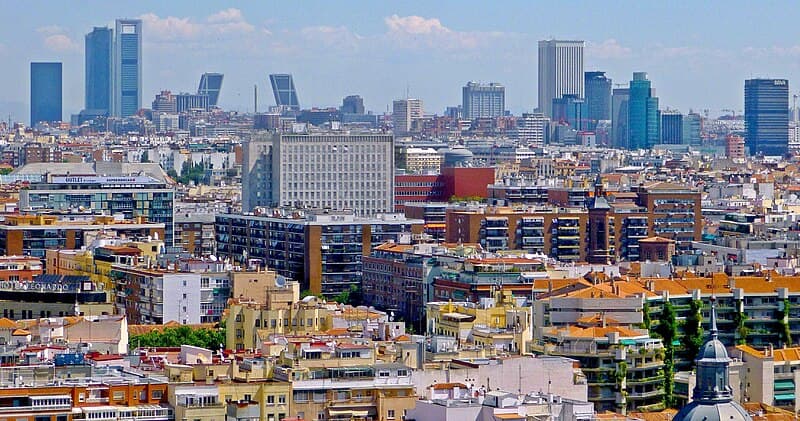
Madrid has only been the capital since 1561, when Philip II chose it for a single practical reason — it sat exactly in the middle of the country. Before that it was an unremarkable fortress town, and the city still shows that it was built by royal decree rather than trade: it has no river, no port, and no medieval core to compare with Toledo's. What it does have is everything the monarchs had shipped in from four continents. The golden triangle of museums along Paseo del Prado gathers Velázquez, Goya, Bosch's Garden of Earthly Delights, Picasso's Guernica and six hundred years of European painting in the Thyssen collection, all within a single kilometre. The city sits 650 metres above sea level, making it Europe's highest capital, and the climate shows it: over 35°C in summer, freezing in winter. Madrileños deal with it their own way — life shifts into the night, and the streets are busier at eleven at night than at six.

What to see

The places worth your time in Madrid, and what to expect at each

Museo del Prado

Museo del Prado

Paseo del Prado

One of the world's finest picture galleries, opened in 1819 from the royal collection. It holds Velázquez's Las Meninas, Goya's Black Paintings from the House of the Deaf Man, Bosch's Garden of Earthly Delights, Titian, Rubens and El Greco. The collection is narrow but deep — Spanish, Italian and Flemish painting at a density found nowhere else.

Tip: Entry is free in the last two hours before closing: Monday to Saturday from six to eight, Sunday from five to seven. The queue forms an hour ahead and it's a crush, but it works. If you're paying, come right at ten. You can't see the whole museum in one visit — pick Velázquez and Goya and let the rest go.

Admission:
€15, free last 2 h
Time needed:
3 h
Museo Reina Sofía

Museo Reina Sofía

Atocha

A museum of modern art in a former hospital building, whose centrepiece is Picasso's Guernica from 1937 — an eight-metre canvas depicting the bombing of a Basque town, which didn't return to Spain until after Franco's death. Preparatory sketches and studio photographs hang around it, alongside Dalí, Miró and Juan Gris.

Tip: Guernica hangs in room 205, and at midday it's three rows deep; go right at opening or in the early evening, when entry is free (Monday to Saturday from seven, Sunday from half past one). Photos aren't allowed near the painting, but are elsewhere in the museum. The glass lifts on the facade give a view over the city and are free to ride.

Admission:
€12, free evenings
Time needed:
2–3 h
Museo Thyssen-Bornemisza

Museo Thyssen-Bornemisza

Paseo del Prado

A private collection assembled over two generations by the Thyssen barons specifically to fill the Prado's gaps — Impressionism, Expressionism, Russian avant-garde and American painting, exactly what the Spanish royal collections never bought. It spans everything from Duccio to Hopper and Lichtenstein.

Tip: Of the three museums in the golden triangle, this is the least crowded and best seen chronologically from top to bottom — start on the second floor and work your way down the escalators. On Mondays from noon to four the permanent collection is free. The courtyard café is one of the few spots in the centre where you can sit quietly in the shade.

Admission:
€14, free Monday afternoons
Time needed:
2 h
Royal Palace

Royal Palace

Palacio

Europe's largest functioning royal palace — 3,400 rooms across 135,000 square metres, built after fire destroyed the old alcázar in 1734. The king doesn't live here, but it's used for state ceremonies. Open to visitors are the throne room, the porcelain room, the royal pharmacy and the only complete quartet of Stradivarius instruments in the world.

Tip: EU citizens get free entry in the last two hours before closing on presentation of ID, Monday to Thursday. The changing of the guard happens every Wednesday and Saturday at eleven, with a larger mounted ceremony once a month. The Sabatini Gardens beside the palace are open to all and offer the best view of the west facade.

Admission:
€14, free last 2 h for EU citizens
Time needed:
2 h
Plaza Mayor

Plaza Mayor

Centro

An enclosed rectangular square from 1619, lined with three storeys of balconies, once used for coronations, bullfights and Inquisition trials. Nine archways lead into the surrounding streets; the best known is Arco de Cuchilleros, with stairs down into the tavern district.

Tip: The restaurants right on the square have the worst value in Madrid, and the famous squid sandwich can be had fifty metres away for half the price. Beneath the arcades are shops selling hats and stamps that have been running for a century. There's a Christmas market here in December, and a Sunday-morning stamp-and-coin market.

Admission:
free
Time needed:
45 min
El Retiro Park

El Retiro Park

Retiro

A former royal garden of 118 hectares, given to the city in 1868 and UNESCO-listed since 2021. It holds a boating lake, the 1887 glass-and-iron Crystal Palace, a rose garden, and one of the world's few monuments to a fallen angel.

Tip: On Sunday mornings drummers gather by the lake and the puppet theatre draws the biggest crowd of families — it's the best time to see Madrileños living their ordinary life. The Crystal Palace is free and often hosts contemporary art installations. Renting a rowing boat on the lake costs a few euros for half an hour. The park has real shade, which matters enormously in a Madrid summer.

Admission:
free
Time needed:
1.5–2 h
Temple of Debod

Temple of Debod

Moncloa / Parque del Oeste

A genuine second-century-BC Egyptian temple, given to Spain by Egypt in 1968 in gratitude for helping save monuments threatened by the Aswan Dam. It was dismantled into blocks, shipped over and rebuilt in a park above the city, kept in its original east-west orientation.

Tip: This is the best spot in Madrid for sunset — the temple sits on a rise above Casa de Campo and reflects in the pool in front of it. Arrive half an hour early, as the terrace fills up after dark. Entry to the park is free, and so is entry to the temple itself, though visitor numbers are limited and it's closed on Mondays.

Admission:
free
Time needed:
1 h
Mercado de San Miguel

Mercado de San Miguel

Centro

A covered market from 1916 with a cast-iron structure and glass walls, just steps from Plaza Mayor. Nobody shops here for groceries anymore — it's thirty stalls selling tapas, oysters, ham, cheese and wine, eaten standing at the counters off paper trays.

Tip: It's convenient, not cheap: portions are small and the bill adds up faster than expected. Come for two or three tastings and a drink, not a full dinner. The worst time is between eight and eleven in the evening, when it's packed solid; it's quiet around half past eleven in the morning. For a real market with normal prices, go to Mercado de la Cebada or Antón Martín instead.

Admission:
free
Time needed:
1 h
Santiago Bernabéu Stadium

Santiago Bernabéu Stadium

Chamartín

Real Madrid's home ground for eighty thousand spectators, fitted since a 2024 renovation with a retractable roof and steel cladding. The tour route takes in the changing room, the bench, the tunnel onto the pitch, and a trophy hall holding fifteen Champions League titles.

Tip: Tours are booked online for a timed slot and get cancelled or shortened on match days — check the schedule first. Match tickets go on sale roughly two to three weeks ahead through the club's website; touts outside the stadium sell for triple the price and are often invalid. Metro line 10, Santiago Bernabéu station, runs right to the stadium.

Admission:
tour from €35
Time needed:
2 h

Photos: Museo del Prado — Emilio J. Rodríguez Posada (CC BY-SA 2.0) · Museo Reina Sofía — Museoreinasofia (CC BY-SA 3.0) · Museo Thyssen-Bornemisza — Kyle Magnuson from Los Angeles, United States (CC BY 2.0) · Royal Palace — Tim Adams (CC BY-SA 4.0) · Plaza Mayor — Jorge Franganillo (CC BY 2.0) · El Retiro Park — Max Alexander / PromoMadrid (CC BY-SA 2.0) · Temple of Debod — https://www.flickr.com/photos/jiuguangw (CC BY-SA 2.0) · Mercado de San Miguel — Fernando (CC BY-SA 4.0) · Santiago Bernabéu Stadium — Zoser (CC BY 4.0)

Where to stay

Areas and districts, matched to the kind of trip you are taking

Centro: Sol, Plaza Mayor and Ópera

Best for: a first visit and sightseeing

The historic core between Puerta del Sol, the Royal Palace and Plaza Mayor, where everything is within a twenty-minute walk. Puerta del Sol marks kilometre zero of Spain's road network and is the busiest spot in the country. Accommodation here is the priciest and can be noisy, since the streets stay lively until two in the morning. The metro has six stations and three lines here.

La Latina and Lavapiés

Best for: tapas and the Sunday market

Two neighbouring districts south of the centre: La Latina, with the densest cluster of tapas bars in the city around Calle Cava Baja, and Lavapiés, Madrid's most multicultural quarter, full of Indian, Senegalese and Moroccan restaurants. The El Rastro flea market takes over the whole area on Sundays. Prices are lower than in the centre, and it's ten minutes on foot to Plaza Mayor.

Paseo del Prado and Retiro

Best for: museums, greenery and a quieter stay

A broad tree-lined avenue holding three major museums and a botanical garden, backed by Retiro park and blocks of embassies. It's the quietest part of the centre and the best base for anyone here mainly for the art. Hotels cost more, but everything is walkable, and Atocha station, with trains to Toledo and Seville, sits at the southern end.

Malasaña and Chueca

Best for: nightlife, cafés and shopping

Two districts north of Gran Vía that together form the liveliest part of the city at night: Malasaña with its music bars and vintage shops, Chueca as the centre of Madrid's gay community, with restaurants and boutiques. Food here is cheaper and more contemporary than in the tourist centre, and the noise lasts until morning — worth weighing when choosing a hotel.

Getting around

From the airport

Direct flights from Prague to Madrid take just under three hours and run several times a day. Adolfo Suárez Barajas Airport lies twelve kilometres north-east of the city and has four terminals; T4 is set apart from the rest, with a shuttle bus between them — allow an extra twenty minutes. Metro line 8 runs into the centre but carries an airport supplement, bringing the fare to around five euros, and requires a change. The simplest option is express bus 203, running non-stop to Atocha station in forty minutes for five euros. A taxi has a flat fare of thirty-three euros to anywhere in the centre regardless of traffic. AVE high-speed trains to the rest of Spain depart from Atocha and Chamartín.

Madrid Barajas Adolfo Suárez (MAD) · 12 km

  • Express bus 203 to Atocha· 40 min· €5
  • Metro line 8 with a change· 35–45 min· €4.50–5
  • Cercanías commuter train from T4· 25 min to Chamartín· €2.60
  • Flat-fare taxi to the centre· 25–40 min· €33

Around town

Madrid's metro is one of the best in Europe: thirteen lines, three hundred stations, trains every two to five minutes, running from six in the morning to half past one at night. Fares are paid with a rechargeable Multi card for two and a half euros, shareable among several people outside rush hour, or with a contactless bank card tapped directly at the gate. A single ride in the centre starts at one and a half euros, and a ten-trip pass works out cheaper. The one-to-seven-day tourist pass also includes the airport supplement and buses. The centre itself is best explored on foot — it's twenty-five minutes from the Royal Palace to the Prado, and half the experience happens along the way. Don't bring a car into Madrid: the whole centre is the Madrid 360 low-emission zone, and driving in without a permit means a fine mailed to your home address.

MetroThirteen lines, the densest network in Spain. A ride in zone A costs €1.50–2, a ten-trip pass €12.20. The airport adds a three-euro supplement. · from €1.50
EMT busesOver two hundred routes plus night owl "búhos" buses that run when the metro is closed. Same fare as the metro, but tickets don't transfer between the two. · €1.50
Abono Turístico tourist passOne day €8.40, two days €14.20, seven days €35.40 for zone A. Includes the airport supplement, so it pays for itself on the airport trip alone. · €8.40 / day
Cercanías commuter trainsNine lines running beneath the centre, linking Atocha, Sol and Chamartín and reaching out to the suburbs — as far as El Escorial and Alcalá de Henares. The fastest way across the city. · from €1.80
BiciMAD shared bikesElectric bikes with docking stations across the city, built for Madrid's hills. A single ride costs around two euros; the centre has dedicated lanes with a 30 km/h limit. · from €2

Useful apps: Google Maps, Moovit, Metro de Madrid oficial, Cabify

When to go

Madrid's climate is inland and extreme: in July and August temperatures stay above 35°C, the city empties out and some restaurants close as Madrileños themselves head to the coast. Winter, by contrast, is bitterly cold, hovering around freezing in January. April, May, September and October are ideal, with 20–25°C and outdoor seating weather. May brings the San Isidro festival with free concerts and bullfights at Las Ventas. December is lit up and crowded, but hotel prices really spike around New Year's Eve, when hundreds of thousands gather at Puerta del Sol to eat twelve grapes on the chimes of midnight. For museums without queues, come in February.

Best time

April, May, September and October

What to avoid

July and August, for the heat and closed businesses

MonthJanFebMarAprMayJunJulAugSepOctNovDec
Day10°12°16°18°22°29°33°32°27°20°14°10°
Night2°2°5°7°11°16°19°19°15°11°6°3°
Rainy days544663113666

Food & drink

Madrid has no sea and no vineyards of its own, yet it's arguably where you eat best in Spain — fish comes in from Galicia, ham from Extremadura and wine from Rioja, and the Mercamadrid fish market is the second largest in the world after Tokyo's. The daily rhythm differs from what visitors expect: breakfast is just coffee with churros, lunch between two and four is the main meal, and dinner after nine is lighter. The best value is the midday menu del día — three courses with bread and a drink for twelve to eighteen euros, which most restaurants are legally required to offer on weekdays. Unlike in Andalusia, tapas in Madrid usually aren't free with a drink, with exceptions in Lavapiés and around the university. A draught vermouth before Sunday lunch is a local ritual.

What to try

Tapas

Small dishes ordered one after another and shared. In Andalusia many bars give them free with a drink; on the eastern coast they're charged separately.

Jamón ibérico

Cured ham from black, acorn-fed pigs, hand-sliced paper-thin. The gap between cheap serrano and ibérico de bellota is huge — try the pricier one.

Tortilla de patatas

A potato-and-onion omelette, served cold or warm as a tapa or in a roll. The cheapest safe bet for breakfast or a beach picnic.

Cocido madrileño

A thick broth with chickpeas, vegetables and several kinds of meat, served in three successive courses from the same pot. A winter Sunday meal that's ordered in advance and leaves no room for anything else.

Bocadillo de calamares

A roll filled with fried squid rings — Madrid's number-one sandwich, despite the city sitting three hundred kilometres from the sea. Bought at bars around Plaza Mayor, though not on the square itself, where it costs double.

Callos a la madrileña

Tripe stewed with chorizo, blood sausage and paprika, thick and spicy. A classic of old Madrid taverns; best tackled at midday, not in the evening.

Churros with chocolate

Fried dough sticks dipped in thick hot chocolate. In Spain these are eaten for breakfast or after midnight, not as a dessert after a meal.

Menu del día

A fixed-price three-course midday menu with bread and a drink, mandatory by law on weekdays. The cheapest way to eat well in Spain.

Vermut de grifo

Sweet red draught vermouth served with ice, a slice of orange and an olive, drunk before Sunday lunch. It costs around three euros and is the biggest social event of the week in La Latina.

What it costs

Coffee at the bar

€1.50–2.20

Caña (small beer) at a bar

€2–3

Midday menu del día

€12–18

Tapas dinner for two

€30–45

Metro ticket, zone A

from €1.50

Prado admission

€15, free last 2 h

Bernabéu stadium tour

from €35

Night in a 3-star hotel for two

€90–140

Indicative prices that change over time — treat them as a guide, not a price list.

Practical information

SocketsCEuroplug, two round pinsFSchuko
Voltage230V / 50Hz
Tap waterTap water is drinkable — Madrid's tap water is among the best in Spain — it comes from reservoirs in the Guadarrama mountains and is soft, unlike the hard, chlorinated water on the coast. Locals drink it routinely, and restaurants must serve it free on request; it's called "agua del grifo". Dozens of historic drinking fountains dot the city, and in summer, when temperatures top 35°C, staying hydrated matters even more than at the seaside.
TippingTipping isn't mandatory and Spaniards themselves leave little — small change at a café, rounding up or adding five percent at a restaurant. Ten percent is the upper limit and is given in cash, since card terminals usually have no tip option.
Driving on theright
SafetyThe real risk is essentially pickpocketing, and it is genuine — in the crush of the metro, at markets and on restaurant terraces, where bags get hung on the back of a chair. Keep documents and cash separate and don't leave your phone on the table. Evenings are safe even in the centre; just avoid the deserted industrial districts near the port area. The emergency number is the standard European 112, and operators speak English.
Opening hoursSmall shops keep a midday siesta roughly from half past one to five; chains and shopping centres run continuously until nine in the evening. Museums close on Mondays, and many offer free entry in the last two hours on Sundays. Restaurants open their kitchens at two for lunch and at eight for dinner.
Customs & etiquetteLunch runs from two to four, dinner after nine — anyone showing up at a restaurant at seven will find an empty room and often a closed kitchen. Swimwear belongs on the beach: walking around town shirtless or in a swimsuit is fined in most coastal towns, and the fines are actually enforced. Greetings are a handshake, or two kisses on the cheek between people who know each other. Spaniards talk loudly — it's not an argument.
A few local wordsGood morning / good day — Buenos díasThank you — GraciasPlease — Por favorThe bill, please — La cuenta, por favorCheers — Salud

How to plan your days

1 day

A day in Madrid

  1. 1Morning at the Royal Palace and the Sabatini Gardens.
  2. 2Walk via Plaza Mayor to Puerta del Sol.
  3. 3Lunch on a menu del día in La Latina.
  4. 4Afternoon at the Prado, Velázquez and Goya's Black Paintings.
  5. 5Evening at the Temple of Debod for sunset, then tapas on Cava Baja.

2 days

Two days with the museums

  1. 1Day one as above.
  2. 2Morning at Reina Sofía and Guernica in room 205.
  3. 3Lunch near Atocha, then an afternoon in Retiro park with the Crystal Palace.
  4. 4Evening at the Thyssen-Bornemisza, the least crowded of the three museums.
  5. 5Dinner after nine in Malasaña or Chueca.

3 days

Three days with a day trip

  1. 1The first two days as above.
  2. 2Morning train to Toledo, half an hour from Atocha.
  3. 3The cathedral, El Greco's Burial of the Count of Orgaz and the synagogue.
  4. 4Return in the afternoon and tour the Bernabéu, if you're a football fan.
  5. 5On Sunday, swap Toledo for the El Rastro flea market and a vermouth before lunch.

Day trips

Toledo

70 km · 33 min by high-speed train from Atocha

The former capital of Castile, perched on a rock encircled by the Tagus river, where Christians, Jews and Muslims lived side by side for centuries — the cathedral, two synagogues and a mosque still stand within a ten-minute walk of each other. In the church of Santo Tomé hangs El Greco's Burial of the Count of Orgaz, still in the spot it was painted for. Trains run hourly and must be booked ahead, as walk-up tickets often sell out.

Segovia

90 km · 30 min by high-speed train from Chamartín

A town beneath the Guadarrama mountains with a first-century Roman aqueduct whose 28-metre arches stand without mortar and remain intact. At the other end of the old town stands the Alcázar castle, said to have inspired Disney's castle. The local speciality is cochinillo, roast suckling pig, traditionally carved at the table with the edge of a plate to show how tender it is.

El Escorial and the Valley of the Fallen

50 km · 1 h by commuter train

Philip II's vast monastery-palace from 1584, burial place of most Spanish kings and home to a library with a frescoed vault and forty thousand volumes. Its layout is shaped like a grid in honour of Saint Lawrence. Ten kilometres further on stands the Valley of the Fallen, with a basilica carved into the rock and a 150-metre cross, built using prisoners of war — the country's most contested monument.

Frequently asked questions

When is entry to Madrid's museums free?+

The Prado is free for the last two hours of the day: Monday to Saturday from 6 to 8pm, and Sunday from 5 to 7pm. Reina Sofía is free Monday to Saturday from 7pm and Sunday from 1:30pm. The Thyssen has its permanent collection free on Mondays from noon to 4pm. A queue starts forming about an hour ahead, and you'll get in, just with a crowd — anyone wanting peace and quiet should pay and come in the morning instead.

How many days are enough for Madrid?+

Two days cover the Prado, Reina Sofía, the Royal Palace and the centre. Three days add a third museum, Retiro park and an unhurried evening of tapas. Four days make sense with a day trip to Toledo or Segovia, half an hour away by high-speed train. The centre is entirely walkable, so little time is lost getting around.

How do I get from the airport to the centre?+

The easiest option is the express bus 203, which runs non-stop to Atocha station in forty minutes and costs five euros. Metro line 8 is faster but requires a change and carries a three-euro airport supplement. A taxi has a flat fare of thirty-three euros to the whole city centre regardless of traffic or time of day, which is competitive if you're travelling as two or three.

What time do people eat lunch and dinner in Madrid?+

Lunch is between two and four and is the main meal of the day — that's when the menu del día, three courses for twelve to eighteen euros, is on offer. Dinner is after nine, with restaurants busiest around half past ten. Anyone who shows up at seven often finds the kitchen closed. Breakfast is just coffee with a pastry or churros — nobody thinks about a full plate in the morning here.

Do you get free tapas with a drink in Madrid?+

Usually not — that's an Andalusian and Granada custom. In Madrid, tapas are ordered and paid for. Exceptions are a few bars in Lavapiés, around the university, and some in La Latina, where olives or a slice of tortilla come free with a drink. Cheaper than tapas are "raciones" — large sharing plates for two or three.

Is Madrid safe?+

Yes, violent crime is rare and it's fine to walk around even the centre at night. The real risk is pickpocketing: on metro lines 5 and 1, at Puerta del Sol, in the crush on Gran Vía, and at the Sunday El Rastro market, where organised gangs operate. Wear your bag in front and don't leave your phone on a terrace table. The emergency number is 112.

Is a transport pass worth it?+

It mainly pays off because of the airport: the Abono Turístico tourist pass includes the airport supplement, so it saves six euros on the trip in and back alone. Anyone staying in the centre and walking everywhere can get by with a ten-trip pass for twelve euros, shareable among several people. The metro network is dense, but distances in the centre are so short that waiting for a train often isn't worth it.

Can you handle Madrid in summer?+

It can be done, but the schedule has to flip. In July and August afternoons often exceed 35°C and the sun beats down on white stone with no shade. Sightseeing happens before noon; between one and six you sit in a museum, in the shade in Retiro, or by a pool, and you head back out after seven. Some restaurants and theatres close for August, since Madrileños themselves leave town.

Visa Requirements

Check the latest visa requirements for entering this country. Some nationalities may need to apply for a visa or e-visa before travel.

Check visa requirements

Language

Spanish

Currency

EUR

Timezone

GMT+1

Dial Code

+34

Population

47.6M

Area

505,990 km²

Voltage

230V / 50Hz

Driving Side

Right

Top Hotels in Madrid

Live prices from 500+ properties

Loading hotels...

Planning a trip to Madrid?

Compare hundreds of hotels, find the best price, and book with free cancellation on TravelManiac.