Hotels in Venice

A hundred eighteen islands without a single car, made for getting lost on purpose

Venice

SpracheEnglish
WährungEUR
ZeitzoneGMT+1
Temperatur10-30 °C
Vorwahl+39
Bevölkerung59M
Fläche301,340 km²
SteckdosenTyp C / Typ F / Typ L
LeitungswasserTrinkbar

Entdecken Sie Venice

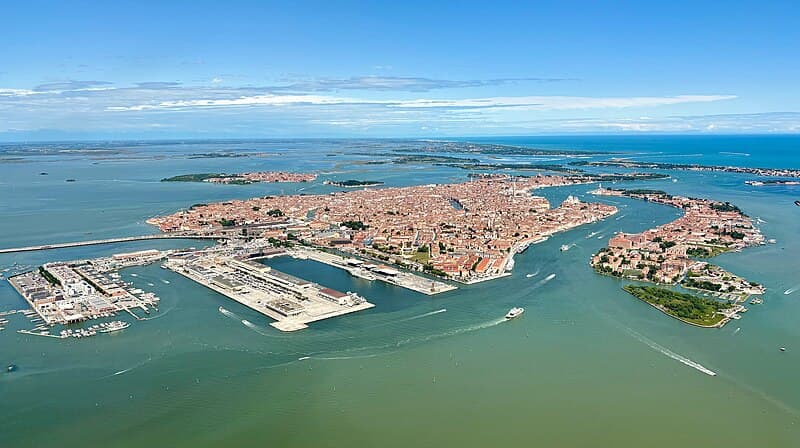
Venice stands on millions of oak piles driven into the mud of the lagoon, and it's the only major European city with no cars at all — not even ambulances or garbage trucks; everything moves by water or on foot. A hundred eighteen small islands are linked by four hundred bridges, and the only street wider than five meters is the Grand Canal. For a thousand years it was an independent republic controlling trade between Europe and the Levant, and it still shows on the facades: Byzantine domes next to Gothic windows next to Oriental arches. The historic center today has fewer than fifty thousand residents, while up to twice that many visitors arrive daily, which led the city, since 2024, to charge for entry itself on selected days. The best thing to do here is get lost — the entire center can be crossed in an hour and a half, and you can't fall off the island. Anyone wanting to see Venice without the crowds needs to get up at six in the morning, or come in November.

What to see

The places worth your time in Venice, and what to expect at each

St. Mark's Square

St. Mark's Square

San Marco

The only place in Venice actually called a 'piazza' — every other square is a 'campo.' An enclosed rectangle a hundred seventy meters long, lined on three sides by arcades with cafés and on the fourth by the basilica. It holds a ninety-nine-meter bell tower, a clock tower with a blue dial and two bronze Moors, and the Sansovino Library. During high water, the square floods first, since it's the lowest point in the whole city.

Tip: Cafés on the square charge a surcharge of around seven euros per person for seating with live music, on top of the drink price — it comes as a surprise on the bill, though it's legal and posted, just in small print. Espresso at the counter inside Caffè Florian costs a fraction of the outdoor table price. Arrive before seven in the morning, when the square is empty and the light is at its best all day.

Admission:
free
Time needed:
1 h
St. Mark's Basilica

St. Mark's Basilica

San Marco

An eleventh-century Byzantine church with five domes, built as the Doge's chapel over the remains of St. Mark, which Venetians stole from Alexandria in 828. Inside are eight thousand square meters of gold mosaics, a colored-marble floor rippled by centuries of settling foundations, and behind the altar the Pala d'Oro, a gold altarpiece studded with two thousand gems. The loggia displays copies of four bronze horses looted from Constantinople; the originals are kept inside.

Tip: Entry to the basilica costs three euros, but booking a timed slot online for a few euros more skips a line that can run an hour in season. The Pala d'Oro and the museum with the horses and loggia are ticketed separately — the museum is the best value, since the loggia gives a view over the square from above. Backpacks aren't allowed inside; check them for free at Calle San Basso nearby.

Admission:
from 3 €, museum 7 €
Time needed:
1–1.5 h
Doge's Palace

Doge's Palace

San Marco

The seat of the Venetian doges, and also a courthouse, prison and government office, built in Gothic style with a pink marble diamond pattern and a ground-floor arcade. The tour passes through the vast Great Council Hall, home to the world's largest canvas, Tintoretto's Paradise, through the armory and torture chamber, and across the Bridge of Sighs into the prison, from which Casanova is the only person ever to have escaped.

Tip: The ticket also covers three museums on the square, making it worthwhile even on a rainy afternoon. The best option, though, is the Itinerari Segreti tour — the secret passages with the inquisition's office and Casanova's cell under the lead roof — which must be booked ahead and only runs with a guide. Arrive at the palace at 8:30, right at opening; by eleven, the line stretches across the whole waterfront.

Admission:
from 30 €
Time needed:
2 h
Rialto Bridge

Rialto Bridge

San Polo / San Marco

The oldest of the four bridges over the Grand Canal, and for four hundred years the only way to cross it on foot. The 1591 stone arch replaced a wooden bridge that had collapsed twice, and carries two rows of shops with a passage down the middle. Around it lies the city's oldest market district, including the Pescheria fish market, running since 1097.

Tip: Take your photo of the bridge from the neighboring Ponte dell'Accademia or from vaporetto line 1, not from the bridge itself. The fish market runs Tuesday to Saturday, only until noon, and is the liveliest spot in all of Venice — right next to it are bacari where a glass of white wine and a plate of octopus cost a few euros, the cheapest decent lunch in the center.

Admission:
free
Time needed:
45 min
Grand Canal

Grand Canal

across the whole city

The city's main artery, just under four kilometers long in an inverted S shape, lined with a hundred palaces built so boats could sail straight into their ground floors. Its width ranges from thirty to ninety meters, and only four bridges cross it. The prettiest facades are Ca' d'Oro, with its Gothic stone lacework, and the Baroque church of Santa Maria della Salute at its mouth.

Tip: The best sightseeing ride in the city is vaporetto line 1 from Piazzale Roma to San Marco: it runs the length of the canal, stops fourteen times and costs a regular ticket, a fraction of a gondola's price. Sit at the back where the open-air seats are, ideally around eight in the morning or after sunset. The traghetto, a ferry gondola for locals, crosses the canal for two euros, standing up.

Admission:
vaporetto ticket 9.50 €
Time needed:
45 min cruise
Murano

Murano

lagoon, north

An island ten minutes by boat north of the center, where all of Venice's glass furnaces were relocated in 1291 — partly due to fire risk, partly to keep glassblowers from fleeing with trade secrets. Glass is still hand-blown in family workshops today, and a glass museum displays pieces dating back to Roman times. The island has its own miniature Grand Canal and is far calmer than the center.

Tip: Ignore the men near San Marco offering 'free transport to see glassblowing' — they take you to particular shops with pressure to buy. Take an ordinary vaporetto, line 4.1 or 12, instead. Genuine glass carries a Vetro Artistico Murano sticker; glass without it is often from China. Combine Murano with Burano in a single day — boats between the islands run every half hour.

Admission:
vaporetto ticket
Time needed:
half day
Burano

Burano

lagoon, north

A fishing island forty minutes by boat from the center, famous for houses painted in bold colors — fishermen supposedly painted them so they could spot their own in the fog, and color changes today require official permission. Besides the colors, there's a tradition of handmade lace, with its own museum, and the leaning bell tower of the church of San Martino. The island is small and can be covered in two hours.

Tip: Take vaporetto line 12 from Fondamente Nove rather than a marketed excursion cruise — the trip takes forty-five minutes and costs a regular ticket. The best light on the colorful houses is in the morning until ten or after five in the afternoon; at midday the contrast is harsh. On the way back, you can stop at Torcello, the lagoon's oldest inhabited island, home to a seventh-century basilica and a population of ten.

Admission:
vaporetto ticket
Time needed:
half day
Gallerie dell'Accademia

Gallerie dell'Accademia

Dorsoduro

A collection of Venetian painting from the fourteenth to eighteenth centuries, housed in a former church and monastery. It's the most complete overview of the Venetian school anywhere: Bellini, Giorgione, Titian, Veronese, Tintoretto and Canaletto all under one roof. On display are Giorgione's The Tempest, Veronese's enormous Feast in the House of Levi, and Leonardo's Vitruvian Man, shown only rarely due to its fragility.

Tip: It's the least crowded major gallery in Venice, ideal for a rainy day or a hot afternoon. Free entry on the first Monday of the month. Right past the Accademia bridge is the Peggy Guggenheim Collection, modern art in her former canalside home — combining both in one afternoon covers six hundred years of painting.

Admission:
from 15 €
Time needed:
2 h
La Fenice Theatre

La Fenice Theatre

San Marco

An opera house that has burned down three times and been rebuilt three times — hence 'Fenice,' the phoenix. It last burned in 1996 and was restored down to the last detail using original plans and photographs. It premiered Verdi's Rigoletto and La Traviata. The auditorium is small, gilded, and clearly a painstaking 1990s reconstruction.

Tip: Guided tours run on days without rehearsals and take half an hour — check the schedule, since visits get cancelled at short notice. Performance tickets start around thirty euros for partial-view seats in the upper boxes, which is plenty for the acoustics. Dress rehearsals tend to be cheaper and have a more relaxed atmosphere.

Admission:
12 € tour, performances from 30 €
Time needed:
1 h

Photos: St. Mark's Square — Matthias Süßen (CC BY-SA 4.0) · St. Mark's Basilica — Zairon (Public domain) · Doge's Palace — Didier Descouens (CC BY-SA 4.0) · Rialto Bridge — kallerna (CC BY-SA 4.0) · Grand Canal — Didier Descouens (CC BY-SA 4.0) · Murano — Wittylama (CC BY-SA 4.0) · Burano — kallerna (CC BY-SA 4.0) · Gallerie dell'Accademia — Didier Descouens (CC BY-SA 4.0) · La Fenice Theatre — Dimitris Kamaras from Athens, Greece (CC BY 2.0)

Where to stay

Areas and districts, matched to the kind of trip you are taking

San Marco

Best for: first-time visitors and sightseeing

The heart of the city, with the square, the basilica, the palace and the La Fenice theatre. Everything essential is within a ten-minute walk, which is its one advantage — accommodation and food prices are the highest in Venice, and daytime crowds are the thickest. The lanes north of the square around Campo San Zulian and Campo Manin are noticeably calmer, and the difference is obvious after just a few minutes' walk.

Cannaregio

Best for: staying and everyday life

The most populous district, in the north of the island, where people still actually live. It holds the Venetian Ghetto — the first ghetto in the world, the source of the word — with five synagogues and a museum, the long straight Strada Nova street, and a row of taverns with local prices. It's a twenty-five-minute walk to San Marco and ten to Santa Lucia station. The best value-for-location balance in the city.

Dorsoduro

Best for: galleries and evening drinks

A quiet district on the southern shore, home to the Accademia, the Guggenheim Collection and the church of Salute. The university is here too, bringing the most students and the cheapest bars — on Campo Santa Margherita, people sit outside in the evening with a three-euro drink. The southern Zattere waterfront offers a kilometer-long promenade facing Giudecca, without a single alley to interrupt it.

Castello

Best for: quiet and the Biennale

The largest district, in the east of the island, home to the Arsenale — a medieval shipyard that could build a galley in a single day — and the Giardini gardens, host to the Biennale every other year. The further east you go, the fewer tourists and the more ordinary the prices; on the streets past Via Garibaldi, vegetables are sold straight from boats. San Marco is a fifteen-minute walk along the waterfront.

Getting around

From the airport

Direct flights from Prague to Venice take under two hours, with cheap fares around a thousand crowns one way. Marco Polo Airport sits thirteen kilometers away on the mainland, connected to the city by bus to Piazzale Roma for ten euros in twenty minutes, or the Alilaguna boat straight into the lagoon, taking an hour and twenty minutes for fifteen euros — prettier but slow, and not much fun with luggage on a crowded boat. Low-cost carriers often fly into Treviso, forty kilometers away, with a direct bus taking an hour. By car, you can only reach Piazzale Roma or the Tronchetto parking garage, costing around thirty euros a day; cars aren't allowed into the city itself. By train, routes run via Vienna and Villach, and Santa Lucia station sits right on the Grand Canal, making for the most pleasant arrival.

Venice Marco Polo (VCE) · 13 km

  • ATVO / ACTV bus to Piazzale Roma· 20–25 min· 10 €
  • Alilaguna boat into the lagoon· 1 h 20 min· 15 €
  • Water taxi to the center· 30 min· 120 €

Treviso (low-cost carriers) (TSF) · 40 km

  • ATVO bus to Piazzale Roma· 1 h· 12 €

Around town

In Venice you walk or take a boat — there's no third option. The entire historic center can be crossed from the station to San Marco in forty-five minutes, making walking the fastest way to get around; the vaporetto along the Grand Canal takes a bit longer, since it stops fourteen times. A single vaporetto ticket costs 9.50 € and is valid for seventy-five minutes, so it's worth it only occasionally; anyone planning more than two rides should get a 24-hour pass for 25 € or a 48-hour pass for 35 €. Tap the ticket against the reader post on the dock before boarding — checks happen at random, and the fine is sixty euros. Gondolas have a fixed price list: ninety euros for thirty minutes until seven in the evening, a hundred ten after seven, for the whole boat seating up to five, not per person. A cheaper experience is the traghetto, a ferry gondola crossing the Grand Canal for two euros, ridden standing up.

VaporettoWater bus, the main way to get around the city and into the lagoon. Line 1 runs the full Grand Canal with every stop, line 2 is the express version. Lines 4.1 and 12 run to Murano and Burano from Fondamente Nove. · 9.50 € single ticket
ACTV time pass24 hours for 25 €, 48 hours for 35 €, 72 hours for 45 €. Valid on all vaporetto routes, including the islands. Worth it from the third ride onward; anyone staying central and walking should buy single tickets instead. · 25 € / 24 h
TraghettoA ferry gondola crossing the Grand Canal where there's no bridge. The ride takes two minutes, costs two euros, and is taken standing up — even locals don't sit down. Runs only certain hours during the day. · 2 €
GondolaFixed pricing: 90 € for thirty minutes until 19:00, 110 € after 19:00, for the boat seating up to five, not per person. Singing costs extra and is negotiated beforehand. A route off the Grand Canal through the small canals is prettier.
Water taxiFast wooden motorboats that can reach any hotel entrance directly. From the airport to the center, 120 €; around the city, from 70 €. Makes sense for four people with luggage, otherwise not. · from 70 €
On footThe fastest way to get around the center. Yellow signs on corners point the way to San Marco, the Rialto and the station — follow them and you won't get lost, even when the streets' own logic fails you. · free

When to go

The best months are April, May, September and early October: pleasant temperatures, everything open and a bearable number of visitors. July and August are stifling in the lagoon, around thirty degrees with no breeze, making the narrow streets hot and the canals noticeable. Winter is damp and foggy, but this is when Venice is at its most beautiful and cheapest — in November and January the city is nearly empty and hotels cost half price. From October to January comes acqua alta, high water, when a tide combined with a southerly wind floods the lowest-lying spots, including St. Mark's Square; the city announces it by siren, and raised walkways go up over the flooded areas. Carnival in February is stunning but also the busiest and most expensive week of the year besides summer.

Best time

April to June and September to mid-October

What to avoid

August for heat and crowds, carnival week for prices

MonthJanFebMarAprMayJunJulAugSepOctNovDec
Day7°9°13°18°23°27°29°29°25°19°13°8°
Night0°1°5°9°14°18°20°20°16°12°6°2°
Rainy days667998676786
Sea9°9°11°14°19°23°26°26°23°19°15°11°

Food & drink

Venetian cuisine is built on fish and the lagoon, and differs from the rest of Italy in two ways: rice or polenta often replaces pasta, and everything carries a hint of sweetness from onion and raisins, a legacy of trade with the Levant. Places split into osterie, serving full meals, and bacari, standing wine bars where a glass of wine costs two euros — called an ombra — paired with a one-bite cicchetto for a euro and a half. Hopping between three bacari and eating your way through is cheaper and better than sitting down at a San Marco restaurant with a menu turistico. Avoid places with photos of dishes in the window and menus in five languages at the entrance; the same food on a campo two streets over, without a canal-view terrace, costs half as much. Watch for fish priced by weight — the menu price is often per hundred grams, not per portion, and the bill can be a surprise.

What to try

Cicchetti

Venetian one-bite snacks at the bacaro counter: a slice of bread topped with whipped salt-cod baccalà mantecato, a sardine, octopus or tuna. Each costs a euro and a half to three euros, paired with an ombra of white wine for two. Three or four pieces make a dinner.

Sarde in saor

Fried sardines marinated for two days in stewed onion with vinegar, raisins and pine nuts. A sweet-and-sour preparation invented by sailors to make fish last at sea. Served cold as a starter or as a cicchetto.

Risotto al nero di seppia

Risotto dyed coal-black with cuttlefish ink, studded with pieces of cuttlefish. It stains teeth and lips, so best avoided right before a date; the flavor is milder than it looks. An authentic version is looser and spreads across the plate.

Fegato alla veneziana

Calf's liver braised with a large amount of onion and white wine, served with white polenta. Venice's oldest city dish and the cheapest honest meat on the menu, around sixteen euros.

Baccalà mantecato

Dried cod whipped with olive oil into a white foam, with no cream or butter — the smoothness comes purely from the emulsion. Spread on grilled polenta or bread, it's the city's most common cicchetto.

Spritz

A Venetian invention: white wine or prosecco with a bitter liqueur and soda, garnished with an olive or orange slice. Ordered by liqueur — Aperol makes it sweeter, Select or Campari more bitter and more of a local choice. At a bar it costs three to four euros.

Prosecco and house wine

House wine is ordered as 'vino della casa' by the quarter or half liter in a carafe, usually a quarter the price of a bottle. At a good trattoria it's drinkable; on the tourist waterfront, not so much.

Bussolai and frittelle

Ring-shaped butter cookies from Burano, dipped in sweet wine, and fried raisin doughnuts made only during carnival season from January to February. Outside that window, you won't find frittelle.

What it costs

Espresso at the counter

1.20–1.50 €

Spritz at a bar

3–4.50 €

Cicchetto at a bacaro

1.50–3 €

Lunch at an osteria

18–28 €

Vaporetto ticket

9.50 €

48-hour transit pass

35 €

Gondola, 30 minutes (whole boat)

90 €

Night at a 3-star hotel for two

120–200 €

Indicative prices that change over time — treat them as a guide, not a price list.

Practical information

SocketsCEuroplug, two round pinsFSchukoLItalian
Voltage230V / 50Hz
Tap waterTap water is drinkable — Tap water in Italy is safe to drink and monitored more strictly than bottled water, and public drinking fountains are common in squares — in Rome they're called nasoni, and every larger city has hundreds. A sign reading 'acqua non potabile' means the opposite, and it's usually only found on old park fountains. Restaurants don't offer tap water; the server automatically brings bottled and asks 'naturale, o frizzante?' — still or sparkling.
TippingTipping in Italy isn't done as a percentage like in America. Restaurant bills usually include a coperto, a cover charge for the table setting and bread, typically two to three euros per person — that stands in for a tip. When service is excellent, round up or leave a few euros on the table. At a café, nothing is expected. Payment terminals usually have no tip option.
Driving on theright
SafetyItaly is a safe country, and violent crime rarely affects tourists. The real risks are pickpocketing in crowds, at metro exits and around monuments, and theft from parked cars — nothing visible, not even an empty bag, should be left inside a car parked on the street. In the south and in tourist centers, watch for bills padded with items you didn't order; a price list must be posted visibly. The emergency number 112 works, and operators speak English.
Opening hoursShops open around nine, and many smaller ones close for a midday break from half past one to half past three, later in the south. Supermarkets and chains in tourist centers run continuously. Most shops are closed on Sundays; restaurants and cafés are not. Museums typically close on Mondays. Restaurants open for lunch from half past twelve to half past two and for dinner from half past seven — arrive at six and you'll find the kitchen closed.
Customs & etiquetteCappuccino is drunk only in the morning — ordering one after lunch is the clearest tourist tell; espresso follows a meal instead. At the counter, coffee costs a fraction of the table price, and menus usually show two columns. Churches require covered shoulders and no shorts above the knee; major basilicas enforce this at the door. Walking around town in swimwear isn't done, and seaside resorts fine it. Keep your receipt — Italian law fines customers who leave without one, not just the vendor.
A few local wordsGood day — BuongiornoThank you — GraziePlease — Per favoreThe bill, please — Il conto, per favoreCheers — SaluteGoodbye — Arrivederci

How to plan your days

1 day

A day in Venice

  1. 1Before seven, the empty St. Mark's Square.
  2. 2St. Mark's Basilica right after opening, plus the loggia with the horses.
  3. 3The Doge's Palace and the Bridge of Sighs.
  4. 4Lunch at a bacaro near the fish market behind the Rialto.
  5. 5Afternoon vaporetto line 1 the length of the Grand Canal, then getting lost in Dorsoduro.

2 days

Two days with the islands

  1. 1Day one as above.
  2. 2Morning boat 12 from Fondamente Nove to Burano.
  3. 3Return via Murano for the glass museum and a workshop visit.
  4. 4Afternoon at the Gallerie dell'Accademia or the Guggenheim Collection.
  5. 5Evening spritz on Campo Santa Margherita and dinner at an osteria.

3 days

Three days including the quieter districts

  1. 1The first two days as above.
  2. 2Morning in Cannaregio and the Venetian Ghetto.
  3. 3Lunch on Strada Nova and a walk into Castello.
  4. 4Afternoon at the Arsenale and the Giardini, with Biennale exhibitions.
  5. 5Evening performance or tour of La Fenice theatre.

Day trips

Padua

40 km · 25 min by train

A university town where Galileo taught, home to Italy's second-oldest university with a surviving 1594 anatomical theater. The main reason to visit is the Scrovegni Chapel, with Giotto's fresco cycle considered the starting point of European painting — entry is by reserved time slot for groups of twenty-five, preceded by fifteen minutes in a climate-controlled chamber to stabilize humidity. Trains run every fifteen minutes and cost around five euros. Caffè Pedrocchi, famous for going a hundred years without doors because it never closed, is ten minutes from the station.

Verona

120 km · 1 h 10 min by train

A city with the third-largest surviving Roman arena in the world, host to an opera festival since 1913 — in summer, twelve thousand people sit on its stone steps holding candles. Besides the arena, there's the medieval Piazza delle Erbe, Castelvecchio castle with its bridge over the Adige, and the famous balcony that has nothing to do with Juliet and was actually added in the 1930s. A fast train from Venice takes seventy minutes. Opera tickets start around thirty euros for unreserved stone steps, where a cushion is standard equipment.

Treviso

30 km · 30 min by train

A small walled town threaded with canals and mill streams, nicknamed 'little Venice,' where you'll meet locals over an aperitivo instead of crowds. It's the birthplace of tiramisu and red radicchio, and prosecco is grown in the surrounding hills. The center takes two hours to see: the walls, a fish market on a small island in the water, and the arcades around Piazza dei Signori. Trains run twice an hour and cost under four euros. It's the cheapest way to get a proper lunch near Venice.

Frequently asked questions

Do I have to pay an entrance fee to Venice?+

On selected days of the peak season, typically weekends and holidays from April to July, a day-visit fee of around five euros applies to the historic center and must be registered online in advance. Anyone staying overnight in Venice doesn't pay the fee but still has to register and get confirmation from their accommodation. It's checked at random at the train station and on Piazzale Roma.

How many days are enough for Venice?+

Two days cover San Marco, the Rialto, the Grand Canal and one gallery. Three days are better, since a full day for Murano and Burano only fits a two-day itinerary at the cost of rushing. Anyone staying four days can add a trip to Padua or Verona, both under an hour by train.

How much does a gondola cost?+

The price is fixed by law: 90 € for thirty minutes until seven in the evening, and 110 € after seven. That's the price for the whole boat, which seats up to five people, not per person — split four or five ways, it works out to about twenty euros a head. Singing isn't included and is negotiated separately. A cheap alternative is the traghetto, a ferry gondola across the Grand Canal for two euros.

Is a time-based vaporetto ticket worth it?+

It's worth it if you're planning trips to the islands or staying farther from the center. A single ticket costs 9.50 €, so a 35 € forty-two-hour pass pays for itself after four rides. Anyone staying in the center and walking will save on single tickets — Venice can be crossed from the station to San Marco in forty-five minutes, faster than by boat.

What is acqua alta, and what do you do about it?+

Acqua alta, or high water, happens when a tide combined with a southerly wind floods the lowest-lying spots, mainly St. Mark's Square. It occurs most often from October to January, lasts two to three hours around the tide's peak, and the city announces it in advance by siren and app. Raised walkways are set up over flooded areas, and shops sell rubber boot covers. It doesn't cancel plans, just shifts them.

Where can I eat without falling into a tourist trap?+

Avoid places with photos of dishes in the window, menus in five languages, and a terrace right on the main route. Go to a bacaro near the fish market behind the Rialto, or an osteria in Cannaregio or Castello, two streets off the main flow. Cicchetti at the counter for a euro and a half each are the cheapest and best dinner in the city. With fish, check whether the price is per hundred grams or per portion.

When is Venice least crowded?+

In November, January and the first half of February, outside carnival. It's cold and damp, but the city is nearly empty, the basilica has no line, and hotels cost half the summer price. The worst times, by contrast, are August and carnival week. Even in season, before nine in the morning and after seven in the evening, the center becomes an entirely different city.

Can I get from the airport to Venice at night?+

The ATVO bus and city line 5 to Piazzale Roma run until roughly midnight, followed only by an infrequent night service. The Alilaguna boat's last departure is around midnight. After midnight, options are a water taxi for a hundred twenty euros or a land taxi to Piazzale Roma followed by a walk. Anyone landing after eleven at night should arrange transport in advance.

Visabestimmungen

Prüfen Sie die aktuellen Visabestimmungen für die Einreise in dieses Land.

Visabestimmungen prüfen

Sprache

Italian

Währung

EUR

Zeitzone

GMT+1

Vorwahl

+39

Bevölkerung

59M

Fläche

301,340 km²

Spannung

230V / 50Hz

Fahrseite

Rechts

Top Hotels in Venice

Live-Preise von 500+ Unterkünften

Hotels werden geladen...

Planen Sie eine Reise nach Venice?

Vergleichen Sie Hunderte von Hotels, finden Sie den besten Preis und buchen Sie mit kostenloser Stornierung.