Hotels in Ayia Napa

Cyprus's whitest sand, and nights that run until daylight

Ayia Napa

LanguageEnglish
CurrencyEUR
TimezoneGMT+2
Temperature14-34 °C
Dial Code+357
Population1.3M
Area9,251 km²
SocketsType G
Tap waterDrinkable

Discover Ayia Napa

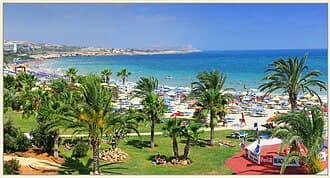
As recently as the 1960s, Ayia Napa was a fishing village of 200 people with a monastery at its centre. The Turkish occupation of Famagusta in 1974 stripped the Cypriot coast of its main resort, and within 20 years Ayia Napa had replaced it — today it has over 200 hotels packed into an area you can walk across in half an hour. The sand here is lighter and finer than anywhere else on the island, ground from coastal limestone, and the sea above it glows turquoise even on a cloudy day. Nissi Beach is Cyprus's most photographed beach, and in July only those who arrive before 10 will find space. Yet a completely different Cyprus begins just outside the resort: Cape Greco, with its white cliffs and sea caves, is 15 minutes away, and its trails run along cliff edges above water 30 metres deep. Ayia Napa has 2 faces that rarely meet in the same week — families in the hotels on the western side, and the bar district around the square, which gets going at midnight. Larnaca is 45 kilometres away, around 40 minutes along the motorway.

What to see

The places worth your time in Ayia Napa, and what to expect at each

Ayia Napa Monastery

Ayia Napa Monastery

Centre

A fifteenth-century Venetian monastery built over a cave where, according to legend, an icon of the Virgin Mary was found — giving the town its name, Ayia Napa meaning "holy forest". An octagonal marble fountain stands in the courtyard, and a sycamore tree over 600 years old grows before the gate, older than everything else in town.

Tip: The monastery is free and sits exactly between the bar district and the main street, making it the quietest spot within half a kilometre at midday. Enter through the back gate from the car park — the main entrance tends to be taken up by tour groups.

Admission:
free
Time needed:
45 min
Nissi Beach

Nissi Beach

3 km west

A 500-metre arc of white sand with the islet of Nissi just offshore, reached by a natural sandbar — at low tide you can wade across waist-deep. The water is shallow and clear up to 50 metres from shore, and in high season DJ-led beach parties run in the afternoon.

Tip: Before 10 in the morning the beach is quiet and sunbeds are free; after 11 the front row sells out and afternoon music carries into the water. For the same water and quiet, cross the rocky ridge to neighbouring Limnara — it's 200 metres away and usually has a tenth of the crowd.

Admission:
free, sunbeds from €12.50
Time needed:
full day
Cape Greco

Cape Greco

9 km east

A national forest park on a rocky headland between Ayia Napa and Protaras, where white limestone cliffs drop into water 30 metres deep, coloured every bit as vividly as in photos. A network of marked trails covering over 20 kilometres runs past the chapel of Saints Anargyroi and viewpoints on both sides of the coast.

Tip: The car park by the chapel is small and full after 9. Bring 2 litres of water per person on the loop — there's no stall or drinking water anywhere in the park, and shade is practically nonexistent. The light on the cliffs is best an hour before sunset.

Admission:
free
Time needed:
3–4 h
Sea caves near Cape Greco

Sea caves near Cape Greco

7 km east

A series of limestone caverns carved out at the northern edge of the cape, which you can swim or climb into. Above the main cave is a platform where locals and tourists jump into the water; the depth below is over 8 metres and the bottom is clear.

Tip: The caves can be reached by car along a dirt track off the Protaras road, with parking right above them — 10 minutes from Ayia Napa. Don't jump without first checking the water: the level changes through the day and there are hidden ledges near the edges.

Admission:
free
Time needed:
2 h
Makronissos Beach

Makronissos Beach

5 km west

3 connected sandy coves 5 kilometres west of the centre, separated by low rocky outcrops and sheltered from the east wind. Above the beach lies a Hellenistic-era burial ground with 19 tombs cut directly into the rock, alongside the remains of a quarry.

Tip: Of the 3 coves, the westernmost is almost always the quietest, since it's furthest from the car park. The tombs are freely accessible and sit above the beach, not right beside it — the sign is small, and most people walk past without noticing.

Admission:
free, sunbeds from €12.50
Time needed:
half a day
Sculpture Park

Sculpture Park

2 km east

An open-access clifftop site above the sea on the road to Protaras, displaying over 200 sculptures by artists from dozens of countries — growing since 2014 through an annual symposium where sculptors carve directly on site from Cypriot limestone.

Tip: The park has no gate or opening hours and is best after sunset, when the light is soft and the stone still warm. At midday it's hot with no shade. Across the road is a cactus garden, also free to enter.

Admission:
free
Time needed:
1 h
Thalassa Sea Museum

Thalassa Sea Museum

Centre

A 3-storey museum next to the monastery, built around a replica of the Kyrenia ship, a fourth-century-BC merchant vessel whose original was found wrecked off the north coast. Alongside it is a collection of marine life, archaeological finds from underwater excavations, and the history of Cypriot seafaring.

Tip: It's the only indoor attraction in town and the sensible choice in rain or midday heat. Admission is free on Mondays. The ship sits in an atrium spanning 3 floors — the best view of it is from the top gallery, not from below.

Admission:
from €4
Time needed:
1.5 h
Ayia Napa Marina

Ayia Napa Marina

1.5 km west

A new marina opened in 2022 with 600 berths, residential towers and a restaurant-lined promenade, built at the western edge of town. Yachts are moored here, and it's the departure point for excursion boats to Cape Greco as well as glass-bottomed boats over underwater wrecks.

Tip: Restaurants at the marina cost a quarter to a third more than the same kind of place 2 streets up — fine for a coffee and an evening stroll, less so for a family dinner. Boats to Cape Greco leave at 12; the afternoon trip tends to be choppier because of the wind.

Admission:
free, boat trips from €25
Time needed:
2 h
Agia Thekla and Landa

Agia Thekla and Landa

7 km west

A pair of quieter beaches between Ayia Napa and Potamos, home to the white chapel of Agia Thekla built over a rock-cut cave right by the water. The sand is coarser than at Nissi, but the beaches are wider and considerably less crowded even in August.

Tip: This is the best choice for families with small children: the entry into the water is gentle, waves are minimal and it's 30 metres from the car park to the sea. Weddings are often held at the little chapel, so a wedding party isn't unusual on a weekend morning.

Admission:
free
Time needed:
half a day

Photos: Ayia Napa Monastery — Bayreuth2009 (CC BY 3.0) · Nissi Beach — Urieli100 (CC BY-SA 4.0) · Cape Greco — kallerna (CC BY-SA 4.0) · Sea caves near Cape Greco — Dmitry Panov (CC BY 3.0) · Makronissos Beach — Marek Ślusarczyk (Tupungato) Photo portfolio (CC BY 3.0) · Sculpture Park — Qasinka (CC0) · Thalassa Sea Museum — Claus Ableiter (CC BY-SA 3.0) · Ayia Napa Marina — Στέφανος Νικολάου (CC BY-SA 4.0) · Agia Thekla and Landa — C messier (CC0)

Where to stay

Areas and districts, matched to the kind of trip you are taking

Centre and the square

Best for: nightlife and walkability

The loop around the monastery and Seferis Square, where most bars, clubs and cheaper hotels are found. Everything is within walking distance, including Pantachou beach. Noise from the bar district carries through closed windows until 4 in the morning — anyone wanting to sleep should choose accommodation at least 2 blocks from the square.

Nissi Avenue

Best for: beaches and families with older children

The main strip running from the centre to Nissi Beach, lined on both sides with hotels and apartments. It's 10 to 20 minutes on foot into the centre, or a few minutes by bus, and just a few 100 metres down the hill to the beach. Accommodation here is the priciest in Ayia Napa, and August books out 6 months ahead.

Makronissos and the west

Best for: calm and families with young children

A strip of hotels and apartments near Makronissos and Agia Thekla beaches, 4 to 7 kilometres from the square. The noise doesn't reach here and the beaches are far emptier, at the cost of depending on a car or bus. There are few restaurants, most belonging to hotels.

Kokkinos and the road to Protaras

Best for: cheaper apartments with a car

The inland side of the resort above the main road, plus the villages of Sotira and Liopetri a few kilometres further. Apartments here are about a third cheaper, taverns cook for locals, and the nights are cooler. It's 2 to 5 kilometres to the sea, so a car is essential.

Getting around

From the airport

The nearest airport is Larnaca, 45 kilometres west, served in season by both charter and scheduled flights from across Europe; the transfer along the A3 motorway takes 40 minutes. The alternative is Paphos, but that's a 150 kilometres from Ayia Napa and a 2-hour drive, worthwhile only if the flight is significantly cheaper. A direct airport bus runs from Larnaca to Ayia Napa several times a day and is the cheapest connection; tickets are bought from the driver. Anyone renting a car should be ready to drive on the left from the moment they leave the airport.

Larnaca (LCA) · 45 km

  • Hotel transfer· 40–60 min· included in package
  • Airport bus· 1 h· €9
  • Taxi from the airport· 40 min· €65
  • Rental car· 40 min· €35 / day

Paphos (PFO) · 150 km

  • Rental car· 2 h· €35 / day
  • Shared transfer· 2 h 30 min· €35

Around town

Ayia Napa can be walked across entirely; it's half an hour from the monastery to Nissi Beach along the main street. Yellow buses on routes 101 and 102 run around the resort and to Protaras every 15 to 20 minutes, and past midnight in season; tickets are bought from the driver, and a day pass works out better than 2 single fares. For Cape Greco and the more distant beaches, a car or quad bike — hired by almost everyone here — is more convenient. Taxis have a fixed fare to Protaras and the airport, but are expensive for short trips around town.

Bus 101 and 102Ayia Napa–Protaras–Paralimni loop every 15–20 minutes, running late into the night in summer. · €1.50 / ride, €5 / day
Rental carNeeded for Cape Greco and inland trips; drive on the left, parking in town is free outside the centre. · €35 / day
Quad bike or scooterThe most popular way to get around the resort; helmets are compulsory and checked by police. · €25 / day
Water taxi to the beachesFrom the harbour to Nissi, Konnos and Fig Tree Bay several times a day in season. · €15 return

Useful apps: Google Maps, Bolt, Cyprus By Bus, Nextbike Cyprus

When to go

This has the longest swimming season on Cyprus: the sea stays above 22 degrees from May to November and is warmest in September, around 27. The best times are late May and June, when it's warm, the sea has already warmed up and prices are lower than in summer, and then the second half of September into early October. July and August bring 33 degrees in the shade, packed beaches and the highest accommodation prices. From November to March most hotels and restaurants close and the resort empties out, although it's still possible to sit outside at midday.

Best time

June and the second half of September

What to avoid

August for the heat and prices, November to March for closed hotels

MonthJanFebMarAprMayJunJulAugSepOctNovDec
Day17°17°19°22°26°30°32°32°30°27°23°19°
Night9°9°10°12°16°20°22°23°21°18°14°11°
Rainy days1086321001469
Sea18°17°17°19°21°24°26°27°27°25°22°20°

Food & drink

There are 2 completely different ways to eat in Ayia Napa. On the main strips, dozens of restaurants with picture menus, English breakfasts and pizza cater to a week-long stay and cook accordingly. Traditional Cypriot taverns serving meze, kleftiko and souvla lie a little further inland — in Sotira, Liopetri and Deryneia, 10 minutes by car — and the difference in both price and quality is significant. In the town itself, the fish taverns by the harbour and the sheftalia-in-pita stalls open until morning are worth seeking out. Always ask the price of fish per kilogram in advance.

What to try

Meze

Not a starter, but a way of eating: waiters bring 15 to 30 small dishes in succession until you say stop. It's ordered for the whole table, for at least 2 people, and expect a 3-hour dinner — pace yourself, as meat always comes last.

Halloumi

A Cypriot cheese made from sheep's and goat's milk that doesn't melt and grills until crisp. It's had protected status since 2021, and you can tell it's the real thing by its salty taste and slight squeak between the teeth. Eaten with melon at breakfast, or grilled with lemon alongside a beer.

Sheftalia

Minced pork with onion and parsley wrapped in lamb caul fat, which melts on the grill and bastes the meat. Best in pita with tahini and tomato as street food for a few euros; with halloumi, it's the cheapest filling dinner on the island.

Souvla

Large chunks of pork or lamb slow-cooked for 3 hours on a long skewer over charcoal — not to be confused with souvlaki, which are small skewers. It's the Sunday family meal, and taverns often only make a limited number of portions, which sell out by evening.

Kleftiko

A lamb shoulder roasted overnight in a clay oven sealed with dough, so it cooks in its own steam. The meat falls off the bone by itself. It's made to order, and at good taverns you should book it a day ahead, otherwise you'll get a reheated morning batch.

Grilled fish and octopus

Barbounia (red mullet), tsipoura (sea bream) and grilled octopus are charged by weight — ask the price per kilogram in advance, typically between 140 euros. Maridha, small fried fish eaten whole, is cheaper and just as good.

Loukoumades

Fried balls of leavened dough drizzled with syrup and sprinkled with cinnamon, eaten hot. Sold at markets and pastry shops, and the cheapest dessert in the country — a portion costs around 3 euros.

Commandaria and zivania

Commandaria is a sweet dessert wine made from sun-dried grapes, produced continuously since the time of the Crusaders and considered the oldest named wine in the world. Zivania is a pomace brandy of around 45 percent, poured as a farewell drink in the mountain villages.

What it costs

Coffee on the promenade

€3–4.50

Sheftalia or souvlaki in pita

€4–6

Lunch at an inland tavern

€12–18

Meze for 2

€50–65

Half-litre beer at a bar

€4.50–6

2 sunbeds and a parasol at Nissi

€12.50–25

Thalassa Museum

from €4

Night in a 4* hotel in August

€180–280

Indicative prices that change over time — treat them as a guide, not a price list.

Practical information

SocketsGBritish, three rectangular pins
Voltage240V / 50Hz
Tap waterTap water is drinkable — Tap water in Cyprus is safe to drink, but it's very hard and along the south coast comes largely from desalination plants, giving it a flat, chalky taste. Most people filter it or buy bottled water for drinking — a half-litre bottle costs around 30 cents in a supermarket, over a euro at a beach bar. In the mountain villages the water comes from springs and is excellent.
TippingRestaurants in Cyprus commonly add a 10 percent service charge to the bill — before tipping, check whether a "service" line is already there. If it is, rounding up with small change is enough. If not, 10 percent is standard. Round up in taxis, and leave 1–2 euros a day for housekeeping.
Driving on theleft
SafetyCyprus is one of the safest countries in the European Union, and crime is minimal even in the resorts. The most realistic risk is traffic: driving is on the left, roundabouts go clockwise, and most accidents involve tourists in their first 2 days with a rental car. Beaches use a flag system, and rip currents can form near the headlands in the afternoon wind. The sun is strong even under a parasol from June to September, so factor-50 sunscreen and a hat aren't overkill. The 112 emergency line works and operators speak English.
Opening hoursIn the resorts, shops are open in season from 9 until 10 in the evening, 7 days a week, with supermarkets open until around 9 to 7 on Sundays. Out of season, from November to March, much of the tourist-zone shops and restaurants close completely and reopen in April. Pharmacies run an on-call rota, posted on each one's door.
Customs & etiquetteCyprus is Orthodox, and churches and monasteries expect covered shoulders and knees; at monasteries such as Kykkos, a shawl is lent at the entrance. Swimwear belongs on the beach, not in shops or taverns. Lunch is eaten between 4, dinner after 8, and meals at taverns run long — the waiter won't bring the bill unasked, you have to request it. Cypriots aren't Greek and don't like the 2 being confused; the island's 1974 division is a sensitive topic best not raised first.
A few local wordsHello — Jasas (Γεια σας)Thank you — EfcharistóPlease — ParakalóThe bill, please — To logariasmó, parakalóCheers — JamasGoodbye — Andío

How to plan your days

1 day

1 day in Ayia Napa

  1. 1Before 9 at Nissi Beach, while it's still empty and sunbeds are free.
  2. 2Around midday, Ayia Napa Monastery and shade under the sycamore.
  3. 3Lunch at a tavern above the centre, not on the main strip.
  4. 4Afternoon at the Sculpture Park and the cactus garden above the sea.
  5. 5Sunset from the marina pier and dinner at a fish tavern.

2 days

2 days with Cape Greco

  1. 1Day 1 as above.
  2. 2Morning drive to Cape Greco while the car park is still free.
  3. 3A loop of the trails past the chapel of Saints Anargyroi and the viewpoints.
  4. 4Swimming and jumping at the sea caves, lunch out in Protaras.
  5. 5Evening back in Ayia Napa's square, which gets going after 11.

3 days

3 days covering the whole east

  1. 1The first 2 days as above.
  2. 2Morning at Makronissos beach and the rock-cut tombs above it.
  3. 3Afternoon at Deryneia and the viewpoint over closed-off Famagusta.
  4. 4Or instead, a boat trip to Fig Tree Bay and Konnos Bay.
  5. 5Final evening, meze at a tavern in Sotira or Liopetri.

Frequently asked questions

Is Ayia Napa suitable for families with children?+

Yes, but it depends where you stay. The western side around Makronissos and Agia Thekla is quiet, with a gentle entry into the water and no night noise. The area around the square is the bar district, where music plays until 4 in the morning and carries through closed windows. The difference is 2 kilometres, but it makes for a completely different holiday.

When is Nissi Beach least crowded?+

Before 10 in the morning and after 5 in the afternoon. Between 15, the front row of sunbeds sells out and a DJ plays from around midday in season. Anyone wanting the same water without the crowds can cross the rocky ridge to neighbouring Limnara beach, which most people never reach even though it's only 200 metres away.

Do I need a car in Ayia Napa?+

Not for staying in the resort itself — buses 101 and 102 run every 15 minutes along the whole coast as far as Paralimni, and at night too in summer. A car pays off for Cape Greco, the inland villages and a trip to Larnaca. Expect to drive on the left; most tourist accidents happen in the first 2 days.

How do I get from Larnaca Airport to Ayia Napa?+

The cheapest option is the airport bus, which takes about an hour and costs around 9 euros; tickets are bought from the driver and services connect with the main arrivals. A taxi costs around 65 euros per car and takes 40 minutes. Most package holidays include the transfer; for independently booked flights, it's worth pre-booking a shared transfer.

Can I travel from Ayia Napa to northern Cyprus?+

Yes, the Deryneia crossing is open, and EU citizens can cross with a passport or national ID card free of charge. The key thing is car insurance: standard rental policies don't cover the north, and third-party cover is bought at the crossing for 20 to 35 euros depending on the length of stay. Purchases above a set limit may not be carried back across the crossing.

When is the sea still warm in Ayia Napa?+

The sea stays above 22 degrees from May to early November and is warmest in September, around 27. The eastern tip of Cyprus has the longest swimming season on the island. By October the air is already below 30, but the sea is still like June, making it the best compromise between warmth and calm.

Is Cape Greco manageable with children?+

The shorter loop from the car park by the chapel to the path above the caves is fine, a flat 2 kilometres. The longer routes run along unfenced cliff edges and aren't suitable with young children. The whole park has no shade or water stall, so it's best done in the morning or late afternoon, and bring your own supply.

How many days do I need in Ayia Napa?+

You can cover the resort itself and its beaches in 2 days. A week makes sense as a beach holiday with excursions: Cape Greco, Protaras, Larnaca and the crossing to Famagusta are all within an hour's drive. Anyone wanting to see the Troodos Mountains, Paphos or Nicosia should plan a full day and a car.

Visa Requirements

Check the latest visa requirements for entering this country. Some nationalities may need to apply for a visa or e-visa before travel.

Check visa requirements

Language

Greek / Turkish

Currency

EUR

Timezone

GMT+2

Dial Code

+357

Population

1.3M

Area

9,251 km²

Voltage

240V / 50Hz

Driving Side

Left

Top Hotels in Ayia Napa

Live prices from 500+ properties

Loading hotels...

More destinations in Cyprus

Planning a trip to Ayia Napa?

Compare hundreds of hotels, find the best price, and book with free cancellation on TravelManiac.