Hotels in Paphos

Roman mosaics a hundred metres from the sea

Paphos

LanguageGreek / Turkish
CurrencyEUR
TimezoneAsia/Nicosia
Temperature14-34 °C
Dial Code+357
Population1.3M
Area9,251 km²
SocketsType G
Tap waterDrinkable

Discover Paphos

Paphos is the only resort in Cyprus where you can walk from your hotel to the beach through a UNESCO World Heritage site. The entire town has held that listing since 1980, because beneath Kato Paphos lies a Hellenistic and Roman city with floor mosaics ranking among the best-preserved in the Mediterranean — and only about a tenth of the site has been excavated. Paphos was the island's capital for a thousand years and the port through which Cypriot copper was shipped across the empire; in Christian tradition, it's also where Saint Paul converted the Roman governor to the faith. The modern town splits into two parts that barely relate to each other: tourist-facing Kato Paphos down by the sea, with hotels and ancient ruins, and Ktima up on the hill, home to the market, government offices and everyday Cypriot life. The coast here is rocky with sandy coves, the sea runs two degrees cooler than the island's east side, and summer is two degrees more bearable. The airport is fifteen kilometres away, a twenty-minute drive.

What to see

The places worth your time in Paphos, and what to expect at each

Paphos Archaeological Park

Paphos Archaeological Park

Kato Paphos

Extensive ruins of the ancient city right by the harbour, centred on four Roman villas with floor mosaics from the second to fifth centuries — the House of Dionysos, the House of Theseus, the House of Aion and the House of Orpheus. Also on site are an odeon, an agora, Saranta Kolones castle and an early Christian basilica.

Tip: The mosaics sit under shelters, but the paths between them are in open sun, and the whole park takes about two hours — go right at opening at eight, or after four. The ticket is valid all day, so you can step out for lunch and come back. The House of Theseus tends to be least crowded, since it's furthest from the entrance.

Admission:
from €4.50
Time needed:
2–3 h
Tombs of the Kings

Tombs of the Kings

2 km north

An underground necropolis from the fourth century BC, carved directly into the coastal rock, with tombs laid out like houses, complete with Doric columns around open courtyards. Despite the name, no king was ever buried here — only high officials of the Ptolemaic administration.

Tip: The site is large, and the tombs are spread far apart along unpaved paths — sturdy shoes, not sandals. Steps into the underground chambers are steep and without railings, and it's about ten degrees cooler down there, which is reason enough to go at midday. The entrance is a five-minute walk from the last hotel zone.

Admission:
from €2.50
Time needed:
1.5 h
Petra tou Romiou

Petra tou Romiou

25 km southeast

A rock formation in the sea twenty-five kilometres southeast of town, where, according to Hesiod, Aphrodite was born from sea foam. The beach is coarse pebble, the shoreline framed by white chalk cliffs, and a viewing terrace with an information centre sits above the road.

Tip: An underpass beneath the main road leads from the car park to the rock — sadly, people really do try to dash across the four-lane highway instead. The water is deep right at the shore and the current around the rock is strong, with no lifeguard. For photos, sunset from the terrace above the road beats the view from the water's edge.

Admission:
free
Time needed:
1.5 h
Paphos Castle

Paphos Castle

the harbour

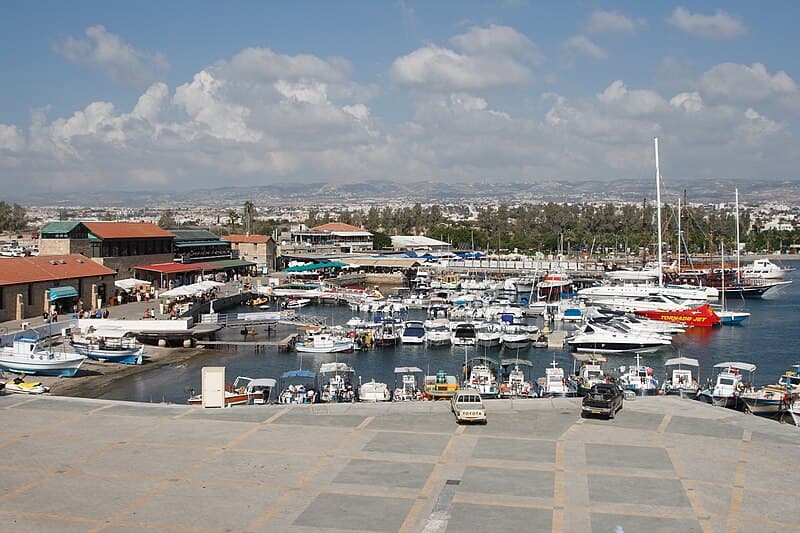
A square fort at the end of the harbour pier, originally Byzantine, rebuilt by the Lusignans, torn down by the Venetians and rebuilt again by the Ottomans in 1592. Under British rule it served as a salt warehouse. Inside is a single room and a staircase to the roof, with views over the harbour and the archaeological park.

Tip: The visit takes twenty minutes, and the main draw is the view from the roof. In September an opera festival is staged below the castle, with the stage set right on the pier. The harbour itself is Paphos's most expensive spot for food — fine for coffee, but walk two streets over for lunch.

Admission:
from €2.50
Time needed:
45 min
Panagia Chrysopolitissa and St Paul's Pillar

Panagia Chrysopolitissa and St Paul's Pillar

Kato Paphos

A site with the remains of a fourth-century early Christian basilica, its mosaic floors, and the Church of Agia Kyriaki at its centre. A pillar here is traditionally said to be where Saint Paul was flogged with thirty-nine lashes before converting the governor Sergius Paulus to the faith.

Tip: Entry is free, and the site stays open in the evening too, when it's lit up and empty. The Church of Agia Kyriaki hosts both Anglican and Orthodox services, so it fills up on Sunday mornings. The mosaics are viewed from wooden walkways raised above floor level.

Admission:
free
Time needed:
1 h
Agios Neophytos Monastery

Agios Neophytos Monastery

10 km north

A monastery ten kilometres north of town, founded in 1159 by the hermit Neophytos, who carved his own cell, chapel and tomb directly into the rock face. The rock-cut hermitage is decorated with Byzantine frescoes from the twelfth and fifteenth centuries, the best-preserved set of its kind in Cyprus.

Tip: The rock-cut section charges a separate entry fee and is the more valuable half — the frescoes in the hermit's cell outshine the main monastery church. Bring long trousers or a skirt; wraps are lent at the gate but often run out in season. The monastery closes for a midday break roughly from twelve to two.

Admission:
from €2
Time needed:
1.5 h
Akamas Peninsula and Lara Beach

Akamas Peninsula and Lara Beach

50 km northwest

The last undeveloped stretch of the Cypriot coast, in the northwest, protected as a nature reserve: scrub-covered hills, gorges and coves with no road access. From June to August, loggerhead and green sea turtles lay eggs on Lara Beach, with nests marked by protective cages.

Tip: Only an unpaved, rocky track leads to Lara, and standard rental agreements forbid driving on it — you need either a 4x4 with the right contract or a boat from Latchi. The beach closes overnight because of the nests, and neither sunbeds nor umbrellas are allowed, since a pole could pierce a clutch of eggs.

Admission:
free
Time needed:
a full day
Kouklia and Palaipafos

Kouklia and Palaipafos

16 km southeast

A village sixteen kilometres southeast of Paphos, on whose edge lies Old Paphos, home to the sanctuary of Aphrodite — the main pilgrimage site of the ancient Mediterranean, visited for over twelve centuries. A museum in the medieval Lusignan manor above the excavations displays finds including the black conical stone that represented the goddess.

Tip: The site tends to be nearly empty, since most organised tours bypass it on the way to Aphrodite's Rock. The museum is the most interesting part and sits in the shade. The village sells local wine, and the bakery has oven-fresh bread you won't find at the roadside stops nearby.

Admission:
from €4.50
Time needed:
2 h
Coral Bay

Coral Bay

12 km north

The best sandy beach near Paphos, twelve kilometres north: a six-hundred-metre arc of fine sand held between two limestone headlands that break the waves, leaving calm, shallow water. Above the beach runs a whole street of restaurants, shops and watersports rentals.

Tip: This is the only genuinely sandy, shallow beach within reach of Paphos, so by ten in August it's packed, along with the car park. Bus 615 from Kato Paphos runs every fifteen minutes and saves the search for parking. The northern end below the cliff tends to be noticeably less crowded.

Admission:
free, sunbeds from €12.50
Time needed:
a full day

Photos: Paphos Archaeological Park — Sergey Galyonkin from Kyiv, Ukraine (CC BY-SA 2.0) · Tombs of the Kings — Mgiganteus1 at en.wikipedia (CC BY-SA 3.0) · Petra tou Romiou — Diego Delso (CC BY-SA 4.0) · Paphos Castle — Wikimedia Commons (CC BY-SA 2.5) · Panagia Chrysopolitissa and St Paul's Pillar — Gerda Arendt (CC0) · Agios Neophytos Monastery — rene boulay (CC BY-SA 3.0) · Akamas Peninsula and Lara Beach — Michal Klajban (CC BY-SA 4.0) · Kouklia and Palaipafos — Wojciech Biegun (CC BY-SA 3.0) · Coral Bay — TomasNY (talk) (CC BY-SA 3.0)

Where to stay

Areas and districts, matched to the kind of trip you are taking

Kato Paphos

Best for: a first visit, heritage sites and walkability

The lower, seaside part of town, with the harbour, the archaeological park and most of the hotels. Everything essential is within twenty minutes on foot, including the Tombs of the Kings. Restaurants around the harbour are pricier and more tourist-oriented than elsewhere in Paphos. The most practical choice for a car-free week.

Ktima, the upper town

Best for: Cypriot everyday life and lower prices

The historic town on a hill three kilometres above the sea, with a covered market, shops, museums and tavernas for locals. Food prices run roughly a third lower than down at the harbour. Buses to Kato Paphos run every ten minutes; walking down takes half an hour, walking up rather less willingly.

The strip toward the Tombs of the Kings

Best for: large hotels and quiet

A straight road running north from the archaeological park, lined with four- and five-star hotels with their own beaches and pools. The coast here is rocky with steps into the water, not sandy. It's a ten- to twenty-minute walk into the centre along the seafront promenade.

Chlorakas and Coral Bay

Best for: a sandy beach and apartments

Suburbs and villages seven to twelve kilometres north, where apartments and smaller hotels cost less and where the area's best sandy beach lies. Bus 615 runs to Paphos every fifteen minutes. Without a car or the bus, you're limited to one street of restaurants.

Getting around

From the airport

Paphos Airport lies fifteen kilometres southeast of town and is the island's second-largest; charter and low-cost flights serve it in season, with a twenty-minute transfer into town. Bus 612 gets from the airport to Kato Paphos in under an hour for around one and a half euros, the cheapest airport link anywhere in Cyprus. Larnaca Airport is a hundred forty kilometres away via the A6 motorway, an hour and a half's drive — worth considering for a significantly cheaper flight or as part of a loop around the island. Car rental is available at both airports.

Paphos (PFO) · 15 km

  • Hotel transfer· 20 min· included in package
  • Bus 612· 50 min· €1.50
  • Taxi from the airport· 20 min· €35
  • Rental car· 20 min· €32 / day

Larnaca (LCA) · 140 km

  • Rental car· 1 h 30 min· €32 / day
  • Intercity bus via Limassol· 3 h· €11
  • Shared transfer· 2 h· €35

Around town

Kato Paphos is entirely walkable, and it's a half-hour stroll along the seafront promenade from the harbour to the Tombs of the Kings. Buses 610 and 611 run between the lower and upper towns every ten minutes, and line 615 heads to Coral Bay every quarter hour — the densest public transport network on the island, with a day pass costing five euros. For the Akamas, Kouklia and Aphrodite's Rock, a car is necessary; a taxi over these distances costs more than a full day's rental. Parking downtown is metered near the harbour, free further up in town.

City buses 610, 611, 615Kato Paphos–Ktima every 10 minutes, Coral Bay every 15; a day pass covers all of them. · €1.50 / ride, €5 / day
Rental carNecessary for the Akamas, Kouklia and mountain villages; driving is on the left, and standard contracts forbid the road to Lara. · €32 / day
Boat from Latchi to the AkamasSightseeing cruises to the Blue Lagoon and Lara, several times daily in season. · €30
TaxiCheap within town, pricier than a full-day rental for trips outside Paphos. · €5 flag fall

Useful apps: Google Maps, Bolt, Cyprus By Bus, Nextbike Cyprus

When to go

The west coast is Cyprus's mildest region: in July and August it runs two to three degrees cooler than Nicosia, and a reliable sea breeze kicks in every afternoon. Swimming works from May to November, with the sea warmest in September. For sightseeing and the Akamas, April, May and October are best, with full days for walking outdoors and hills still green after rain. Winter is mild, and unlike the eastern resorts, Paphos stays open year-round, drawing golfers and hikers even in January.

Best time

May, June and the second half of September

What to avoid

August, for prices and crowded beaches

MonthJanFebMarAprMayJunJulAugSepOctNovDec
Day17°17°19°22°25°28°30°31°29°27°23°19°
Night9°9°10°12°15°19°21°22°20°17°14°11°
Rainy days975321001358
Sea18°17°17°19°21°24°26°27°27°25°23°20°

Food & drink

Paphos has an advantage the eastern resorts lack: wine villages and mountain taverns are half an hour away. Within the town itself, the difference tracks altitude — restaurants at the harbour cook for one-time visitors and price accordingly, while up in Ktima and in villages like Tsada or Letymbou, meze, oven-baked kleftiko and afelia with coriander cost noticeably less. Ask the price per kilo for fish before ordering. The local specialty is the spicy pafitiko loukaniko sausage, and wines from vineyards on the Troodos slopes have reached a quality the island didn't have twenty years ago.

What to try

Meze

Not a starter, but a whole way of eating: fifteen to thirty small dishes arrive one after another until you say stop. Ordered for the whole table, minimum two people, and it runs a three-hour dinner — pace yourself, since meat always comes last.

Halloumi

A Cypriot sheep-and-goat's-milk cheese that doesn't melt and grills up crisp. It's had protected status since 2021, and you'll know it by its salty flavour and slight squeak between the teeth. Eaten with melon at breakfast, or grilled with lemon alongside a beer.

Kleftiko

A lamb shoulder baked overnight in a clay oven sealed with dough, so it cooks in its own steam. The meat falls off the bone by itself. It's made to order, and good tavernas need a day's notice — otherwise you'll get a version reheated from earlier.

Afelia

Pork stewed in red wine with crushed coriander seeds, a flavour you won't find elsewhere in the Mediterranean. Served with bulgur pilaf called pourgouri. The most typical inland Cypriot dish.

Souvla

Large chunks of pork or lamb on a long skewer over charcoal, slow-cooked for three hours — not to be confused with souvlaki, which are small skewers. It's a Sunday family dish, and tavernas often serve only a limited number of portions that sell out by evening.

Grilled fish and octopus

Barbounia (red mullet), tsipoura (sea bream) and grilled octopus are priced by weight — ask the price per kilo up front; it typically runs sixty to eighty euros. Maridha, small fried fish eaten whole, is cheaper and just as good.

Commandaria and zivania

Commandaria is a sweet dessert wine made from sun-dried grapes, produced continuously since the time of the Crusaders and considered the oldest wine in the world still made under its original name. Zivania is a pomace brandy around forty-five percent, poured as a farewell drink in the mountains.

Glyko tou koutaliou

'Spoon sweets': fruit or nuts preserved in thick syrup, served alongside a glass of cold water as a welcome to guests. Mountain villages serve it in nearly every other house, and jars of it make the best souvenir.

What it costs

Coffee at the harbour

€3.50–5

Lunch at a taverna in Ktima

€10–15

Dinner at a harbourside restaurant

€25–40 per person

Meze for two

€45–60

Beer, 0.5 l

€4–5.50

Archaeological park

from €4.50

Two sunbeds and umbrella at Coral Bay

€12.50–17

Night in a 4-star hotel in August

€150–240

Indicative prices that change over time — treat them as a guide, not a price list.

Practical information

SocketsGBritish, three rectangular pins
Voltage240V / 50Hz
Tap waterTap water is drinkable — Tap water in Cyprus is safe and hygienic, but very hard, and in the south much of it comes from desalination plants, giving it a flat, chalky taste. Most people filter it or buy bottled for drinking — a half-litre costs around thirty cents at a supermarket, over a euro at a beach bar. In mountain villages, spring water flows and it's excellent.
TippingCypriot restaurants commonly add a ten percent service charge to the bill — before leaving a tip, check whether a 'service' line is already there. If it is, rounding up with small change is enough. If not, ten percent is standard. In a taxi you round up; housekeeping gets one to two euros a day.
Driving on theleft
SafetyCyprus is one of the safest countries in the EU, and crime is minimal even at the resorts. The most real risk is traffic: driving is on the left, roundabouts go clockwise, and most accidents involve tourists in their first two days behind the wheel of a rental. Beaches use a flag system, and rip currents form near headlands in the afternoon wind. Sun exposure from June to September is strong even under an umbrella; factor fifty and a hat aren't overkill. The emergency number 112 works, and operators speak English.
Opening hoursTowns keep traditional hours: shops from nine to seven, with a midday break roughly from two to five in July and August, when the heat becomes unbearable. On Wednesday and Saturday afternoons, smaller shops outside tourist zones tend to close. Supermarkets and malls run without a break until nine, and until seven on Sundays. Museums close on Mondays and stay open later in the evening in summer.
Customs & etiquetteCyprus is Orthodox, and covered shoulders and knees are expected in churches and monasteries; at monasteries like Kykkos, a wrap is lent at the entrance. Swimwear belongs on the beach, not in shops or tavernas. Lunch runs between one and three, dinner after eight, and tavernas expect a long sit — the waiter won't bring the bill unannounced, you have to ask for it. Cypriots aren't Greeks and don't like being mistaken for them; the island's 1974 division is a sensitive topic best not raised first.
A few local wordsHello — Jasas (Γεια σας)Thank you — EfcharistóPlease — ParakalóThe bill, please — To logariasmó, parakalóCheers — JamasGoodbye — Andío

How to plan your days

1 day

One Day in Paphos

  1. 1Arrive at eight at the archaeological park, before the mosaics sit in full sun.
  2. 2The castle on the pier and the view from its roof over the harbour.
  3. 3Lunch in upper Ktima near the covered market.
  4. 4Afternoon at the Tombs of the Kings, in the cool of the underground chambers.
  5. 5Evening at Panagia Chrysopolitissa, lit up and empty.

2 days

Two Days with Aphrodite

  1. 1Day one as above.
  2. 2Morning drive to Kouklia for the sanctuary of Aphrodite at Old Paphos.
  3. 3Lunch in the village, with a winery stop on the way back.
  4. 4Afternoon at Petra tou Romiou and a swim off the pebble beach.
  5. 5Sunset from the viewing terrace above the road.

3 days

Three Days with the Akamas

  1. 1The first two days as above.
  2. 2Morning at Agios Neophytos Monastery and its rock-cut hermitage with frescoes.
  3. 3Drive to Latchi and a boat out to the Blue Lagoon in the Akamas.
  4. 4Or a 4x4 trip out to Lara turtle beach.
  5. 5Return via Coral Bay for a swim on the sand.

Day trips

Troodos and Kykkos

70 km · 1 h 30 min by car

A mountain range with the island's highest peak, Mount Olympus, and ten UNESCO-listed Byzantine churches whose shingled roofs hide twelfth-century frescoes. Kykkos Monastery, the wealthiest on Cyprus, holds a silver-covered icon attributed to the Evangelist Luke. There's skiing here in winter.

Polis and the Baths of Aphrodite

40 km · 45 min by car

A quiet town in the northwest with a campsite in a eucalyptus grove and the fishing harbour of Latchi, from which boats depart for the Akamas. A short way on stands a small spring-fed grotto where Aphrodite is said to have bathed, and the start of the Aphrodite Trail along the coastal hills.

Limassol and Kourion

65 km · 50 min by car on the motorway

The ancient city of Kourion sits on a cliff, with a theatre for three and a half thousand spectators and mosaics in the House of Eustolios; nearby is the Hospitaller castle of Kolossi and Limassol's marina. Combine it with wine tasting in Omodos, in the Krasochoria wine region, on the way back.

Frequently asked questions

Is Paphos worth it if I mainly want a beach?+

The coastline right in Paphos is rocky, with steps down into the water; the nearest sandy beach is at Coral Bay, twelve kilometres north. If a beach is your only goal, Ayia Napa and Protaras suit better. In exchange, Paphos has the most heritage sites on the island, a milder summer and mountains within an hour — it's the choice for a holiday that isn't just about lying down.

How much time do I need for the archaeological park?+

Two to three hours for the four mosaic villas, the odeon and Saranta Kolones castle. The ticket is valid all day, so you can step out for lunch and return. Go right after eight or after four — in between, the paths between sites sit in full sun, and the only shade is over the mosaic pavilions.

How do I get to Lara Beach to see the turtles?+

Only an unpaved, rocky track leads there, and standard rental agreements forbid driving on it — you need either a 4x4 with the right contract or a boat trip from Latchi harbour. From June to August, sea turtles lay eggs there, nests are marked with cages, the beach closes overnight, and umbrellas are banned.

Is Paphos open in winter too?+

Yes — unlike Ayia Napa and Protaras, hotels and restaurants here run year-round. January days average around seventeen degrees, and people come for golf and hiking in the Akamas. The sea, though, sits around eighteen degrees, swimmable only with willpower; hotel pools are usually heated.

Do I need a car in Paphos?+

Not for the town itself — buses 610, 611 and 615 run every ten to fifteen minutes, and a day pass costs five euros. A car pays off for the Akamas, Kouklia, Aphrodite's Rock and the mountain villages, which public transport barely reaches. Driving is on the left, and mountain roads are narrow with a rock face on one side.

Why is the whole of Paphos on the UNESCO list?+

The 1980 listing covers the ancient city in Kato Paphos with its Roman mosaics, the Tombs of the Kings, and the sanctuary of Aphrodite in Kouklia. The reasoning: Paphos was the island's capital for over a thousand years and a pilgrimage centre for the cult of Aphrodite, and its floor mosaics rank among the best-preserved in the eastern Mediterranean.

Where can I eat well and cheaply in Paphos?+

In the upper town of Ktima around the covered market, and in the villages on the hillsides above town, where meze and kleftiko are made for locals. Prices there run about a third lower than at the harbour, for better food. Have coffee and enjoy the view at the harbour, but take bus 610 uphill for dinner.

How many days are enough for Paphos?+

Three days for the town and its heritage sites. A week makes sense, since the Akamas, Troodos, Kouklia and Limassol with Kourion are all within ninety minutes. Paphos also makes the best base for a loop around the western part of the island, combining the coast with mountain villages and wineries.

Visa Requirements

Check the latest visa requirements for entering this country. Some nationalities may need to apply for a visa or e-visa before travel.

Check visa requirements

Language

Greek / Turkish

Currency

EUR

Timezone

Asia/Nicosia

Dial Code

+357

Population

1.3M

Area

9,251 km²

Voltage

240V / 50Hz

Driving Side

Left

Top Hotels in Paphos

Live prices from 500+ properties

Loading hotels...

More destinations in Cyprus

Planning a trip to Paphos?

Compare hundreds of hotels, find the best price, and book with free cancellation on TravelManiac.