Hotels in Limassol

Harbour, vineyards and the island's longest promenade

Limassol

LanguageGreek / Turkish
CurrencyEUR
TimezoneAsia/Nicosia
Temperature14-34 °C
Dial Code+357
Population1.3M
Area9,251 km²
SocketsType G
Tap waterDrinkable

Discover Limassol

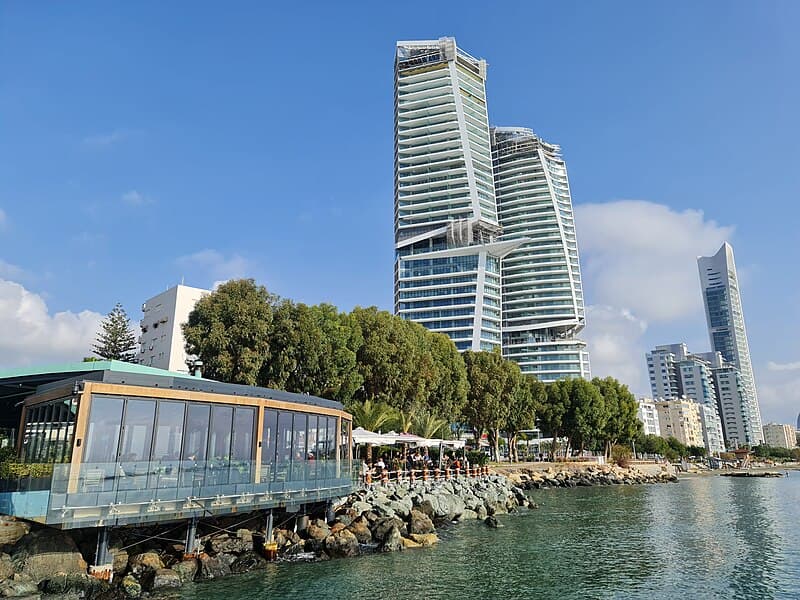
Limassol is Cyprus's second-largest city and the only one that doesn't depend primarily on tourism — it's the island's main port, home to shipping companies, and since 2014 also a city with a marina for 1,000 yachts and skyscrapers rising above the shore. For visitors, that means a different kind of holiday from the resorts in the east: the beaches are dark, pebbly and less spectacular, but in return there's year-round life, restaurants that cater to locals, and the island's most interesting ancient sites within half an hour. The castle in the middle of the old town is where Richard the Lionheart married Berengaria of Navarre in 1191 and had her crowned Queen of England; a few kilometres further on stands the Knights Hospitaller fortress of Kolossi, from which production of the sweet commandaria wine was once overseen. Above Limassol rise the slopes of Troodos, with the Krasochoria wine region and its 40-odd wineries, an easy afternoon trip away. The Molos seafront promenade runs for 3 km and is the best public space Cyprus has produced.

What to see

The places worth your time in Limassol, and what to expect at each

Limassol Castle

Limassol Castle

Old town

A low fortress in the middle of the old town, built on the site of an early Christian basilica and rebuilt by the Ottomans. Tradition holds that Richard the Lionheart married Berengaria of Navarre in its chapel in 1191. Today it houses the Cyprus Medieval Museum, with tombstones, weapons and Byzantine pottery.

Tip: The best part is the rooftop terrace, reached by a narrow spiral staircase — it looks out over both the old harbour and the marina. The museum takes 1 hour to go round and is air-conditioned, making it a sensible choice in the midday heat. Around the castle is the district with the city's best bars.

Admission:
from €4.50
Time needed:
1 h
Molos Promenade

Molos Promenade

Centre

A 3 km waterfront park between the old harbour and the Olympic stadium, opened in 2010: wooden piers jutting out over the water, a small salt pool, sculptures and shaded avenues. It's Limassol's main public space, where locals gather to run, cycle and take evening walks.

Tip: The prettiest stretch is between the castle and the marina, with free sun loungers right over the water. It's cooler and busiest before 8am and after 7pm; at midday the promenade offers almost no shade. Bikes can be rented from stands along the route.

Admission:
free
Time needed:
2 h
Amathus

Amathus

11 km east

The remains of one of Cyprus's oldest city-states, founded around 1100 BC on a hilltop above the sea at the eastern edge of present-day Limassol. Excavated so far are the agora with its restored columns, an acropolis with a temple of Aphrodite, and baths; part of the city lies beneath the sea just offshore.

Tip: The site sits right by the main hotel zone, and most guests drive past without going in — admission is cheap, and at 8am there's usually no one around. The path up to the acropolis is unpaved, so sandals aren't a great idea. The whole bay is visible from the slope.

Admission:
from €2.50
Time needed:
1.5 h
Kourion

Kourion

19 km west

The island's most impressive ancient site, on a cliff 100 metres above the sea: a Greco-Roman theatre seating 3,500 spectators, the House of Eustolios with its mosaic floors, an early Christian basilica, and baths with underfloor heating. The city was destroyed by an earthquake in 365 AD and never rebuilt.

Tip: In July and August, ancient tragedies and concerts are staged in the theatre, a completely different experience from a daytime visit — the programme is usually published only a month ahead. There's no shade during the day and a sea breeze blows through, so wear a hat, but one that won't blow away.

Admission:
from €4.50
Time needed:
2–3 h
Sanctuary of Apollo Hylates

Sanctuary of Apollo Hylates

21 km west

A sacred precinct dedicated to Apollo as protector of the forests, 2 km from Kourion, in use for 8 centuries from the 7th century BC. It has a partially restored temple with Corinthian columns, pilgrim lodgings, a palaestra and a treasury where offerings were deposited.

Tip: The site is smaller and much quieter than Kourion, and most organised tours skip it. Tickets are sold separately, but a combined ticket with Kourion works out cheaper. For photos without people, come an hour before closing, once the tour buses have left.

Admission:
from €2.50
Time needed:
1 h
Kolossi Castle

Kolossi Castle

14 km west

A 3-storey Knights Hospitaller keep from 1454, built on the site of an earlier fortress, with walls 2.5 metres thick and an external staircase that could be removed in defence. From here, the sugar-cane estates were administered and the sweet commandaria wine was produced, named after the order's commandery.

Tip: The visit takes half an hour, and the main reward is the roof, with views over the fields and the sea. Beside the tower stand the remains of a sugar mill with a giant waterwheel, which most visitors miss. It combines well with Kourion, 5 km away on the same road.

Admission:
from €2.50
Time needed:
45 min
Akrotiri Salt Lake

Akrotiri Salt Lake

10 km southwest

Cyprus's largest lake, on the Akrotiri peninsula, which dries into a salt flat in summer and fills with rainwater in winter. From November to March it hosts up to 20,000 wintering greater flamingos and more than 200 other bird species; a nature trail with observation points runs around the lake.

Tip: The flamingos are only here in the winter half of the year, and you get closest to them from the observation point near the village of Zakaki, not from the main road. In summer the lake is a dry white plain, a sight in its own way, but without the birds. The peninsula belongs to a British base, and military installations should not be photographed.

Admission:
free
Time needed:
2 h
Ladies Mile

Ladies Mile

12 km southwest

The longest beach near Limassol: 7 km of flat, dark sand along the Akrotiri peninsula, free of hotels and development, with just a few beach bars. It's named after the British officers who used to bring their horses here for rides. The water is shallow, with a flat seabed for tens of metres from shore.

Tip: The sand is dark and scorches your feet at midday — flip-flops aren't optional. Because of the shallows, the water is noticeably warmer than elsewhere, making it the best beach in the area for small children. The road passes the harbour and part of the peninsula where photography is banned — take the signs seriously.

Admission:
free, sunbeds from €10
Time needed:
half a day
Omodos

Omodos

42 km northwest

A wine village on the slopes of Troodos, with a cobbled square, the Monastery of the Holy Cross, and stone houses selling wine, dried fruit and lace. It's the most visited village in the Krasochoria region, surrounded by several dozen family wineries.

Tip: The village fills with tour groups from the coast around midday, and the square is packed between 11am and 2pm; at 9am or after 5pm it's empty. A tasting at a small winery off the square works out cheaper, and they pour more generously than the shops on the main street. Don't drive afterwards — the road back is mountainous.

Admission:
free
Time needed:
3 h

Photos: Limassol Castle — Dickelbers (CC BY-SA 3.0) · Molos Promenade — Mboesch (CC BY-SA 4.0) · Amathus — Hermann Junghans (CC BY-SA 3.0 de) · Kourion — Michal Osmenda from Brussels, Belgium (CC BY 2.0) · Sanctuary of Apollo Hylates — Carole Raddato from FRANKFURT, Germany (CC BY-SA 2.0) · Kolossi Castle — Vegard Ottervig (Public domain) · Akrotiri Salt Lake — Badseed (Public domain) · Ladies Mile — Beyond My Ken (CC BY-SA 4.0) · Omodos — Hagai Agmon-Snir حچاي اچمون-سنير חגי אגמון-שניר (CC BY-SA 4.0)

Where to stay

Areas and districts, matched to the kind of trip you are taking

Old town and marina

Best for: first-time visitors, bars and restaurants

The area around the castle, with narrow lanes, restored warehouses and the marina, built in 2014. It has the most restaurants and bars in the city, and everything is within walking distance. The beach, though, is some way off and pebbly, so this suits those more interested in the city than swimming.

Germasogeia and the tourist zone

Best for: beachfront hotels and the beach

A strip of large hotels stretching east from the centre along the coast to Amathus, with a promenade, beaches and hotel pools. It's a 15-minute bus ride to the old town. The beaches are dark and pebbly with a strip of sand at the waterline, but the water is clean and the facilities good.

Potamos Germasogeias and Dasoudi

Best for: families and shade on the beach

The middle stretch of coast around the Dasoudi eucalyptus grove, the only shaded spot on Limassol's beaches. There are playgrounds, a running trail through the trees, and a quieter beach than by the big hotels. Accommodation is in apartments and smaller hotels, and cheaper than in the tourist zone.

The Krasochoria wine villages

Best for: a car-based stay away from the coast

Villages on the slopes of Troodos, 20–40 km above the city — Omodos, Vouni, Lofou and others. Accommodation is in stone houses and guesthouses, it's 8°C cooler at night than down below, and the sky is free of light pollution. Reaching the sea means a mountain drive, so this isn't a choice for a beach holiday.

Getting around

From the airport

Limassol has no airport of its own and lies roughly midway between Cyprus's 2 airports — Larnaka is 70 km away via the A5 motorway, about 50 minutes, and Pafos 65 km, roughly the same time. Direct airport buses run from both airports to the city centre and the tourist zone about once an hour and are the cheapest option. A taxi from Larnaka costs around €80. Anyone planning trips to Troodos and Kourion should hire a car straight at the airport, since rental prices in Limassol itself are higher.

Larnaka (LCA) · 70 km

  • Airport bus· 1 h· €9
  • Hotel transfer· 50 min· included in package
  • Airport taxi· 50 min· €80
  • Car hire· 50 min· €32/day

Pafos (PFO) · 65 km

  • Airport bus· 1 h· €9
  • Airport taxi· 50 min· €75
  • Car hire· 50 min· €32/day

Around town

Limassol stretches for about 15 km along the coast, and only part of it is walkable — the Molos Promenade from the castle to the marina and on eastwards. City buses run along the coastal avenue every 10–15 minutes and connect the tourist zone with the old town; a day ticket costs €5. Cycling is a good option thanks to the flat promenade, with rental stands along its whole length. For Kourion, Kolossi and the wine villages, a car is needed, since buses run there only a few times a day and not at all on Sundays.

City bus 30The backbone route along the coast between the old town and the tourist zone, every 10–15 minutes. · €1.50/ride, €5/day
Bike from a rental standStands along the whole Molos Promenade; the route is flat and separated from traffic. · €1/30 min
Car hireEssential for Kourion, Kolossi and Krasochoria; driving is on the left, and parking downtown is in paid zones. · €32/day
Intercity busDirect services to Nicosia, Larnaka and Pafos from the terminal by the old harbour. · €5–7

Useful apps: Google Maps, Bolt, Cyprus By Bus, Nextbike Cyprus

When to go

Limassol can be visited year-round, since it doesn't depend solely on the season and few places close in winter. Swimming is best from June to October, with the sea staying above 22°C until November. April, May and October are best for Kourion, Amathus and the mountain villages — in summer, the shade-free heat at the excavation sites is hard to bear with children. Flamingos are at the salt lake from November to March, exactly when the coast is quiet. Late February brings the island's biggest carnival.

Best time

May, June and October

What to avoid

August for sightseeing, though fine for the beach

MonthJanFebMarAprMayJunJulAugSepOctNovDec
Day17°17°19°23°26°30°32°32°30°27°23°19°
Night9°9°10°13°16°20°22°23°21°18°14°11°
Rainy days1086321001469
Sea18°17°17°19°22°25°27°28°27°25°22°20°

Food & drink

Over the past decade, Limassol has become the best place to eat in Cyprus — thanks to its large expat community and the fact that the city doesn't depend on the tourist season alone, traditional tavernas, Lebanese restaurants and modern kitchens all thrive side by side. Meze is ordered for the whole table and takes about 3 hours. The fish tavernas are worth the trip to Zygi, 20 km to the east, where the cooking happens right by the harbour. Above the city begins the Krasochoria wine region, with around 40 wineries offering tastings for a few euros and producing varietal wines from the local xynisteri and maratheftiko grapes.

What to try

Meze

Not a starter, but a whole way of eating: the staff bring 15–30 small dishes in succession, for as long as it takes until you say enough. It's ordered for the whole table, for at least 2 people, and you should plan on a 3-hour dinner — save room, since the meat always comes last.

Halloumi

A Cypriot cheese made from sheep's and goat's milk that doesn't melt and grills up crisp. It's had protected status since 2021, and you can tell the real thing by its saltiness and the slight squeak between your teeth. It's eaten with watermelon at breakfast, or grilled with lemon alongside a beer.

Souvla

Large chunks of pork or lamb slow-cooked for 3 hours on a long charcoal spit — not to be confused with souvlaki, which are small skewers. It's a Sunday family dish, and tavernas usually only have a limited number of portions, which sell out by evening.

Afelia

Pork stewed in red wine with crushed coriander seeds, a flavour you won't find elsewhere in the Mediterranean. Served with pourgouri wheat pilaf. The most typical dish of Cyprus's inland kitchens.

Kolokasi

A potato-like root vegetable, stewed with pork and celery, that Cypriots have eaten since Byzantine times. It's a winter dish, and in summer only a few traditional tavernas still make it — if you see it on the menu, the kitchen is the real deal.

Grilled fish and octopus

Barbounia (red mullet), tsipoura (sea bream) and grilled octopus are charged by weight — ask the price per kilo before you order; it's typically between €60 and €80. Cheaper and just as good is maridha, small fried fish eaten whole.

Commandaria and zivania

Commandaria is a sweet dessert wine made from raisined grapes, produced without interruption since the time of the Crusades and considered the oldest named wine in the world. Zivania is a pomace brandy at around 45% ABV, poured for you in the mountain villages as a parting drink.

Loukoumades

Fried balls of yeast dough drizzled with syrup and dusted with cinnamon, eaten hot. Sold at fairs and pastry shops, and the cheapest dessert in the country — a portion costs around €3.

What it costs

Coffee at the marina

€4–5.50

Lunch at a taverna in the old town

€12–18

Dinner at a marina restaurant

€35–55 per person

Meze for 2

€50–70

Beer, 0.5 l

€4–6

Kourion

from €4.50

Winery tasting

€5–15 per person

Night in a 4-star hotel in August

€160–260

Indicative prices that change over time — treat them as a guide, not a price list.

Practical information

SocketsGBritish, three rectangular pins
Voltage240V / 50Hz
Tap waterTap water is drinkable — Tap water in Cyprus is safe and hygienic to drink, but it's very hard and, in the south, largely comes from desalination plants, giving it a bland to chalky taste. Most people filter it or buy bottled water for drinking — a half-litre costs around 30 cents at a supermarket, over a euro at a beach bar. In the mountain villages, the water comes from springs and is excellent.
TippingRestaurants in Cyprus commonly add a 10% service charge to the bill — before you tip, check whether a 'service' line is already there. If it is, just round up with small change. If not, 10% is standard. In taxis, round up the fare; leave housekeeping €1–2 per day.
Driving on theleft
SafetyViolent crime is rare, and towns are safe even at night. The most common trouble for tourists is traffic-related: driving on the left, strict and genuinely enforced fines for drink-driving and using a phone while driving, and paid blue zones with towing. In the entertainment districts, watch out for inflated bills at venues with a tout standing outside the door. Photographing military areas and the buffer zone is prohibited and taken seriously.
Opening hoursTowns keep traditional hours: shops from 9am to 7pm, with an afternoon break from around 2pm to 5pm in July and August, when the heat is unbearable. On Wednesday and Saturday afternoons, smaller shops outside the tourist zones tend to close. Supermarkets and shopping centres run without a break until 9pm, and until 7pm on Sundays. Museums close on Mondays and extend their hours into the evening in summer.
Customs & etiquetteCyprus is Orthodox, and covered shoulders and knees are expected in churches and monasteries; at monasteries like Kykkos, you can borrow a wrap at the entrance. Swimwear belongs on the beach — don't wear it into a shop or taverna. Lunch is eaten between 1pm and 3pm, dinner after 8pm, and people linger at tavernas — the waiter won't bring the bill unasked, you have to request it. Cypriots aren't Greeks and don't like being mistaken for them; the island's 1974 division is a sensitive topic best not raised first.
A few local wordsHello — Jasas (Γεια σας)Thank you — EfcharistóPlease — ParakalóThe bill, please — To logariasmó, parakalóCheers — JamasGoodbye — Andío

How to plan your days

1 day

A day in Limassol

  1. 1Morning: the castle and medieval museum, then the lanes of the old town.
  2. 2Lunch at a taverna away from the marina, where the cooking is for locals.
  3. 3Afternoon: the Molos Promenade and a rest on the piers over the water.
  4. 4A swim at Dasoudi, the city's only shaded beach.
  5. 5Dinner at the marina and a walk along the waterfront after dark.

2 days

2 days with the ancient sites

  1. 1Day 1 as above.
  2. 2At 8am, head to Kourion before the theatre is in full sun.
  3. 3The Sanctuary of Apollo Hylates, 2 km further on, usually empty.
  4. 4Lunch at Kourion Beach below the cliff.
  5. 5On the way back, Kolossi Castle and the sugar mill with its waterwheel.

3 days

3 days with wine

  1. 1Days 1–2 as above.
  2. 2Morning: the village of Omodos, before the tour groups arrive.
  3. 3A tasting at a family winery in Krasochoria.
  4. 4Lunch at a mountain taverna and a stop in Vouni or Lofou.
  5. 5Return via Amathus and a last swim in the bay.

Day trips

Troodos and Kykkos

55 km · 1 h 10 min by car

A mountain massif with the island's highest peak, Olympos, pine forests and 10 UNESCO-listed Byzantine churches whose shingle roofs protect 12th-century frescoes. Kykkos Monastery holds an icon attributed to the evangelist Luke and is the wealthiest in Cyprus. In January and February, people ski on the slopes of Olympos.

Nicosia

85 km · 1 h by motorway

Europe's last divided capital, where you cross the buffer zone on foot at Ledra Street with an ID card. On the south side are the Venetian walls, the Cyprus Museum with finds from across the island, and the Laiki Geitonia district; on the north side, the Büyük Han caravanserai and the cathedral converted into the Selimiye Mosque.

Pafos

65 km · 50 min by motorway

A town entirely UNESCO-listed, with Roman floor mosaics in the archaeological park by the harbour and the rock-cut Tombs of the Kings. On the way, you can stop at Aphrodite's Rock, Petra tou Romiou, and the Sanctuary of Aphrodite at Kouklia, turning it into a full day out.

Frequently asked questions

Are the beaches in Limassol nice?+

They're clean and well equipped, but the sand is dark to grey and most beaches are pebbly rather than sandy — a big difference from Ayia Napa or Protaras. The best are Dasoudi, with its eucalyptus grove that provides the only shade on the coast, and Ladies Mile on the Akrotiri peninsula, with shallow, warm water.

Is Limassol worth it as a base for the whole of Cyprus?+

Yes, it's the best-located town on the island: Pafos, Larnaka and Nicosia are all within 1 hour on the motorway, and Troodos is 70 minutes away. Ayia Napa and Protaras are further, around 1.5 hours. With a car, you can tour the whole south of the island from here without repacking.

When are the flamingos at the salt lake?+

From November to March, when the lake fills with rainwater; at the winter peak there can be up to 20,000 of them. In summer the lake is a dry white salt flat with no birds. You get closest to the flocks from the observation point near Zakaki, not from the main road — bring binoculars.

How much time do I need for Kourion?+

2–3 hours for the theatre, the House of Eustolios with its mosaics, the basilica and the baths. The site sits on a shade-free cliff with a sea breeze, so go in the morning or late afternoon. In July and August, ancient tragedies and concerts are staged in the theatre — the programme is usually announced about a month ahead.

Can you visit the wineries from Limassol without a car?+

Not easily. Rural buses to the Krasochoria villages run only a few times a day and not at all on Sundays. The simplest option is an organised tasting tour, which also solves the problem of not being able to drive after tasting. If you go by car, the driver won't be able to taste — police do check for alcohol on the mountain roads.

What is commandaria?+

A sweet dessert wine made from sun-dried grapes, produced without interruption on the slopes above Limassol since the time of the Crusades, and considered the oldest named wine in the world. It's named after the Knights Hospitaller commandery at Kolossi, from where its production was once overseen. It's sold at wineries in the Krasochoria villages.

Is Limassol expensive?+

It's the most expensive town in Cyprus, but there are big differences within the city. The marina and the new waterfront developments have prices on a par with Western Europe, while tavernas in the old town and inland districts are about a third cheaper for the same or better food. Accommodation is priciest in the tourist zone to the east.

How many days are enough for Limassol?+

2 days for the town itself. With Kourion, Kolossi, the wine villages and a trip to Troodos, that's 4–5 days. As a base for the whole of southern Cyprus, allow a week, since both airports and most of the sights are within an hour's drive.

Visa Requirements

Check the latest visa requirements for entering this country. Some nationalities may need to apply for a visa or e-visa before travel.

Check visa requirements

Language

Greek / Turkish

Currency

EUR

Timezone

Asia/Nicosia

Dial Code

+357

Population

1.3M

Area

9,251 km²

Voltage

240V / 50Hz

Driving Side

Left

Top Hotels in Limassol

Live prices from 500+ properties

Loading hotels...

More destinations in Cyprus

Planning a trip to Limassol?

Compare hundreds of hotels, find the best price, and book with free cancellation on TravelManiac.