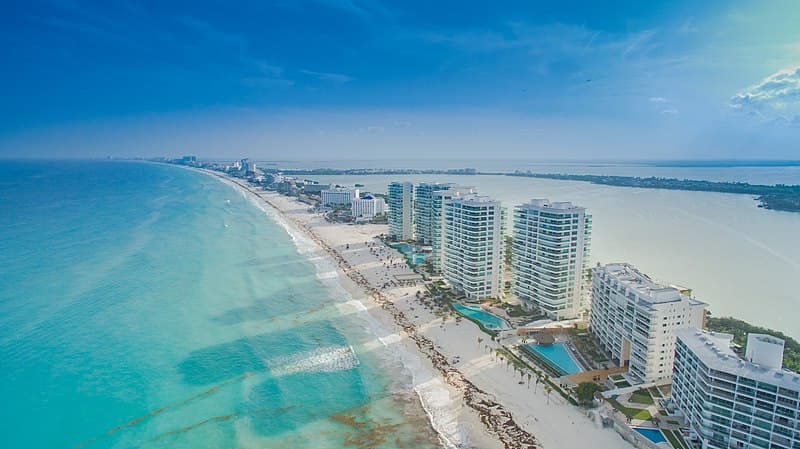
When's the best time to visit Cancún?+
December to April, when it's dry and temperatures sit around 29°C. December to March is peak season with the highest prices, and March brings American spring break, when the zone fills with students. May to October is hot, humid, with afternoon showers. Hurricane season peaks in September. From April to August, beaches facing the open ocean can also be swamped with sargassum seaweed.
What is sargassum seaweed, and how much of a problem is it?+
It's brown seaweed that has drifted from the Atlantic to the Caribbean coast of Mexico every year since 2011, from April to August. It piles up on the beach and smells; hotels clean it up, but sometimes there's too much to keep pace with. The worst-hit beaches face the open sea on the east side of the hotel zone's '7' shape; the north side around Playa Langosta and Playa Tortugas, and Isla Mujeres, are far less affected.
Do I need a visa for Mexico?+
No — most nationalities, including EU and US citizens, don't need a visa and can stay in the country for up to 180 days as tourists. Your passport must be valid for the whole stay. The paper FMM card has been discontinued; instead you get a stamp on entry showing the number of days allowed — always check how many days the officer has recorded, since a shorter period than 180 days sometimes gets written by mistake, and it can cause problems on departure.
Can I drink tap water in Cancún?+
No, and the widespread myth that hotels have filtration doesn't hold either. Mexicans themselves drink only bottled water, and every shop sells a bottle for a few pesos. Ice in hotels, chain restaurants and tourist restaurants is made from treated water and is safe; skip it at street stalls. Fruit with a peel is safer than salad.
Is Cancún safe?+
The Quintana Roo tourist zone is among the safest parts of Mexico, and cartel-related violence barely touches tourists. The real risks are 3: ocean currents, where a flag system applies and red means no swimming; ATMs with tampered card readers, so withdraw only inside a bank or hotel; and timeshare sellers, who'll hold you up at the airport or in hotel lobbies with an hour-long presentation in exchange for a promised free excursion.
How do I get around the hotel zone cheaply?+
By the R1 or R2 bus, which runs the length of Kukulcán Boulevard and into downtown every few minutes from 5am to midnight and costs 12 pesos. It's reliable, tourists use it too, and it's far cheaper than a taxi, which can cost as much as $20 for a short hop within the zone. Pay the driver in cash. Uber operates only in a limited way in Cancún, blocked by the local taxi lobby.
Is a day trip to Chichén Itzá worth it?+
Yes, but plan for a full day, with 2.5 hours of travel each way. It's worth catching the first morning ADO bus and arriving by 8am when the gates open — by midday the site is scorching and packed with tour buses. Bring a guide, since without commentary it's just a pile of stones. Climbing the pyramid has been banned since 2008. Anyone after something more visually striking and closer by should head to Tulum instead.
How much do you tip in Mexico?+
At a restaurant, 10–15%, usually in cash, since card payments often can't add a tip. At an all-inclusive resort, $1–2 for the bartender and $2 a day for housekeeping. Gas station attendants who pump for you get 5–10 pesos. Check your bill — in tourist zones service is often already included, in which case you don't tip again.