Hotels in Los Cabos

Where cactus desert falls into the Sea of Cortez

Los Cabos

LanguageEnglish
CurrencyMXN
TimezoneGMT-7
Temperature18-32 °C
Dial Code+52
Population129M
Area1,964,375 km²
SocketsType A / Type B
Tap waterNot drinkable

Discover Los Cabos

Los Cabos is the shared name for two very different towns at the southern tip of the Baja California peninsula, and the thirty-two-kilometre corridor between them. Cabo San Lucas is the louder of the two, built around a marina, clubs and tour boats; San José del Cabo is a quiet colonial town with an arts district and a plaza anchored by a mission church. Between them runs a road lined with resorts, golf courses and turnoffs to beaches. The landscape has nothing in common with Mexico's Caribbean coast — it's semi-desert, with cardón cacti ten metres tall running straight down to the sea, and where the Sea of Cortez meets the Pacific Ocean stands El Arco, a rock arch carved by the waves. That meeting of two seas is what gives Los Cabos its unusual biodiversity: humpback whales migrate here from December to April, sea lions live here year-round, and Cabo Pulmo holds the only living coral reef on North America's Pacific coast. Winter temperatures run about ten degrees cooler than Cancún — the single most important thing to know when planning a trip.

What to see

The places worth your time in Los Cabos, and what to expect at each

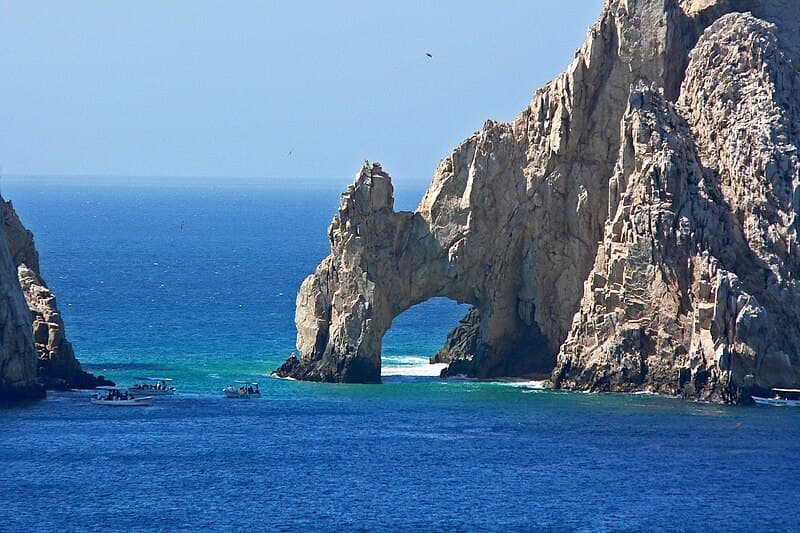
El Arco

El Arco

Land's End, Cabo San Lucas

A natural rock arch at the very tip of the peninsula, carved by the waves into a granite cliff where the Sea of Cortez meets the Pacific Ocean. It's the destination's defining landmark, reachable only by water, on a water taxi from the marina or from Médano Beach.

Tip: A water taxi from the marina costs a fraction of an organised boat tour, and is arranged right at the dock — agree the price for the round trip, including waiting time. Go early in the morning, when the sea is calm and the light hits the arch from the front — in the afternoon you're shooting into the sun and the photos aren't worth it.

Admission:
water taxi from MXN 300
Time needed:
1–2 h
Playa del Amor (Lover's Beach)

Playa del Amor (Lover's Beach)

Land's End

A small beach right beside the arch, reachable only by water, split into two sides by a rocky ridge: a calm side facing the Sea of Cortez, and a wild side facing the Pacific known as Playa del Divorcio. Snorkelling among the rocks with sea lions is good on the bay side.

Tip: Only enter the water on the bay side. The Pacific side looks just as inviting and has deadly rip currents — someone dies there almost every year, and there's no lifeguard. Bring water and shade; there's nothing on the beach, not even a stall.

Admission:
water taxi from MXN 300
Time needed:
2 h
Playa El Médano

Playa El Médano

Cabo San Lucas

Cabo San Lucas's main town beach, three kilometres long, with calm water sheltered by the peninsula and a direct view of El Arco. The only beach in Cabo San Lucas where swimming is genuinely safe, which is why it's lined with beach bars, rental stalls and vendors.

Tip: This is also the most heavily hawked spot in Los Cabos — expect to be approached by a dozen vendors an hour. Say no clearly and repeat it, or they won't let up. Loungers at beach bars can often be had free with a minimum consumption, cheaper than a paid entry fee.

Admission:
free
Time needed:
full day
Cabo San Lucas Marina

Cabo San Lucas Marina

Cabo San Lucas

A horseshoe-shaped harbour for three hundred and eighty yachts, ringed by restaurants, shops and fishing charter offices. Every boat tour departs from here, and it's the town's evening centre. At dock three, the day's catch is weighed in every afternoon.

Tip: The marlin weigh-in around four in the afternoon is the best free show in Cabo San Lucas. Cabo is the world capital of marlin sport fishing, and October brings the Bisbee's tournament, with the largest prize money anywhere.

Admission:
free
Time needed:
2 h
San José del Cabo arts district

San José del Cabo arts district

San José del Cabo

A few blocks of colonial buildings along Calle Álvaro Obregón, home to thirty galleries that hold a joint opening every Thursday evening from November to June — the street closes to traffic, galleries pour wine, and live music plays. It's the most cultured evening to be had anywhere in Los Cabos.

Tip: The Art Walk is free and starts at five in the afternoon, wrapping up around nine. Parking nearby is hopeless at that hour — arrive by bus or taxi. On other days the galleries keep normal hours, but the atmosphere is completely different.

Admission:
free
Time needed:
3 h
Playa Chileno

Playa Chileno

the corridor

A sheltered bay along the corridor between the two towns, with calm water, rocky headlands on either side, and the best shore-accessible snorkelling anywhere in Los Cabos. It's one of the few beaches on the corridor where swimming is officially safe, and it has parking, showers and toilets.

Tip: Arrive before ten — the lot is small and full by noon. Snorkelling is best around the rocks on the right side of the bay. Most beaches along the corridor look beautiful but are off-limits for swimming — look for the blue sign reading 'playa apta para nadar'.

Admission:
free
Time needed:
half a day
Whale watching

Whale watching

from Cabo San Lucas Marina

From mid-December to mid-April, humpback whales migrate through the waters off Los Cabos to give birth after arriving from Alaska, joined by fin whales and orcas. Boats leave the marina several times a day, and humpbacks breach close enough that no binoculars are needed.

Tip: The morning departure has calmer seas and better light. Small fast boats get closer than the large catamarans, but are rougher in choppy water — anyone prone to seasickness should choose the bigger boat. Most operators offer a free repeat trip if you don't see a whale.

Admission:
from $50
Time needed:
3 h
Estero San José

Estero San José

San José del Cabo

A river mouth in San José del Cabo where fresh water meets the sea, forming a wetland with a palm grove and over two hundred bird species, including herons and ospreys. It's a green island in the middle of the desert, ringed by a path with viewing platforms.

Tip: Best early in the morning for birds and cooler temperatures; kayaks can be rented here too. Most visitors to Los Cabos don't know the wetland exists and walk right past it along the beach — access is from the San José hotel zone and it's free.

Admission:
free
Time needed:
2 h
Plaza Mijares and the mission church

Plaza Mijares and the mission church

San José del Cabo

The main square, Plaza Mijares, framed by a matching colonnade and the eighteenth-century Misión San José del Cabo Añuití church, whose mosaic above the entrance depicts the martyrdom of a missionary during the 1734 Pericú uprising. Restaurants and craft shops line the surrounding streets.

Tip: The plaza comes alive only after sunset, when families come out and the ice-cream carts appear; by day it's empty and scorching. Concerts are often held on the plaza on Fridays and Saturdays. It's the most pleasant place in Los Cabos for an ordinary evening free of touts and bars.

Admission:
free
Time needed:
1–2 h

Photos: El Arco — User:Stan Shebs (CC BY-SA 3.0) · Playa del Amor (Lover's Beach) — Kirt Edblom from Kihei, Hi, United States (CC BY-SA 2.0) · Playa El Médano — Alexis Doine (CC0) · Cabo San Lucas Marina — Alexis Doine (CC0) · San José del Cabo arts district — Thelmadatter (CC BY-SA 4.0) · Playa Chileno — Ñ (CC BY-SA 3.0) · Whale watching — Diego Delso (CC BY-SA 4.0) · Estero San José — Sharon Hahn Darlin (CC BY 2.0) · Plaza Mijares and the mission church — Juan Emilio Prades Bel (CC BY-SA 4.0)

Where to stay

Areas and districts, matched to the kind of trip you are taking

Cabo San Lucas

Best for: nightlife, boat trips and fishing

The livelier of the two towns, built around the marina and Médano Beach. Every boat heading to El Arco, whale watching or fishing departs from here, and this is where the clubs run until dawn. Everything is walkable, but it's also the noisiest and most heavily touted spot in Los Cabos.

San José del Cabo

Best for: quiet, culture and evening strolls

A colonial town thirty-two kilometres northeast, with a plaza, a mission church, an arts district and Thursday gallery openings. The hotel zone sits by the beach, a fifteen-minute walk from the centre. The quieter, more cultured choice; anyone wanting nightlife has to go to Cabo San Lucas.

The Corridor (Corredor Turístico)

Best for: large resorts and golf

Thirty-two kilometres of road between the two towns, lined with the largest and priciest resorts, nine golf courses, and the prettiest bays, including Chileno and Santa María. There's no getting around here without a car, and taxis in either direction are expensive — expect to spend most of your time within the resort itself.

Todos Santos and the Pacific side

Best for: surfers and getting away from it all

An hour north along the Pacific coast sits the town of Todos Santos, with galleries and mango orchards, surrounded by long, empty, wave-battered beaches. The sea here is cooler and unsafe for swimming, but it's the best surf region in Baja California Sur and the least touristed part of the region.

Getting around

From the airport

Los Cabos International Airport sits thirteen kilometres north of San José del Cabo and mainly serves flights from the United States and Canada. There's no direct connection from the Czech Republic, and the trip always means at least one, usually two, connections — typically via Madrid or Frankfurt to Mexico City, then a two-and-a-half-hour domestic leg, or via Dallas and Los Angeles. Total travel time is eighteen to twenty-two hours. Czech citizens don't need a visa and can stay in Mexico for up to a hundred and eighty days; check the number of days stamped on entry. Anyone connecting through the United States needs an ESTA authorisation even for transit only. From the airport it's twenty minutes to San José del Cabo, forty-five to Cabo San Lucas.

Los Cabos International (SJD) · 13 km

  • Hotel transfer included in stay· 20–45 min· included
  • Shared shuttle to Cabo San Lucas· 1 h· $20
  • Ruta del Desierto bus· 1 h· MXN 150
  • Taxi to Cabo San Lucas· 45 min· $90

La Paz (LAP) · 160 km

  • Aguila bus to Cabo San Lucas· 3 h· MXN 400

Around town

The public Ruta del Desierto bus runs between the two towns along the highway roughly every half hour, stopping at the airport and along the corridor, and costs around a hundred and fifty pesos — vastly cheaper than a taxi, which wants eighty dollars for the same trip. Within each town, everything is walkable; both have compact centres. Taxis have no meters, and fares in Los Cabos are among the highest in Mexico — always agree the price beforehand. Uber technically operates here but is blocked by the taxi union and can't pick up at the airport. Anyone staying on the corridor, or heading to Todos Santos or Cabo Pulmo, needs a car — the roads are good and easy to drive.

Ruta del Desierto busRuns between Cabo San Lucas, the airport and San José del Cabo roughly every half hour, air-conditioned. The cheapest way to move between the towns. · MXN 70
TaxiNo meters and very expensive — a trip between the towns costs eighty dollars. Always agree the fare in advance. · MXN 300
Water taxiFrom the marina or Médano Beach to El Arco and Playa del Amor. Arranged directly at the dock; price covers the round trip including waiting time. · MXN 300
Rental carEssential for the corridor, Todos Santos and Cabo Pulmo. Mandatory Mexican insurance costs extra; watch for unmarked speed bumps (topes). · MXN 700 / day

Useful apps: Uber, DiDi, Google Maps, Waze

When to go

Los Cabos has a completely different climate from Mexico's Caribbean coast, and that's the most important thing to know when planning. It's semi-desert: it rains only around twenty days a year, and winter is noticeably cool — in January the air reaches twenty-five degrees, but the sea is only twenty-one and evenings are cold, so pack a sweater. The most pleasant stretch runs March to June and October to November, warm with a comfortable sea. July to September is hot, over thirty-four degrees, and the only season with real rain, including the occasional Pacific hurricane. Whales are present from mid-December to mid-April, which redeems a winter visit.

Best time

March to June and October to November

What to avoid

August and September, for heat and hurricanes

MonthJanFebMarAprMayJunJulAugSepOctNovDec
Day25°26°27°29°31°33°34°34°34°32°29°26°
Night13°12°13°14°16°19°22°23°23°21°18°15°
Rainy days211001356422
Sea21°20°20°21°23°26°28°29°29°28°26°23°

Food & drink

Baja California has its own cuisine, distinct enough from the rest of Mexico to have earned its own name, Baja Med — a mix of Mexican foundations, Mediterranean ingredients and Asian technique, since the peninsula is a fishing region open to influence from California. This is where the fish taco was born — battered fish with cabbage and a white sauce, now eaten worldwide. Ceviche made from oysters and shrimp from the Sea of Cortez is cheaper and fresher here than almost anywhere. The region is also home to the one Mexican wine region that matters — the Valle de Guadalupe, in the north of the peninsula, whose wines appear on every good menu here. The best food isn't in the hotel restaurants along the corridor, but at food trucks in Cabo San Lucas and small places in San José del Cabo.

What to try

Tacos de pescado

Pieces of white fish in beer batter, fried and wrapped with shredded cabbage and a white sauce. A Baja California invention, and best from a food truck, not a boardwalk restaurant.

Ceviche

Raw fish or shrimp cured in lime juice with onion, tomato and cilantro, served with tostadas. Baja California also does an oyster version; order where turnover is fast, not at an empty restaurant.

Tacos al pastor

Pork marinated in chili and annatto, roasted on a vertical spit in the Lebanese-influenced style and sliced onto small corn tortillas with pineapple, onion and cilantro. Eaten standing at an evening stall; three tacos make a portion.

Elote

Boiled corn on the cob coated in mayonnaise, dusted with cotija cheese and chili, finished with lime. Sold from carts along the boardwalks for around twenty-five pesos.

Cochinita pibil

A Yucatán specialty: pork marinated in bitter orange juice and achiote paste, wrapped in banana leaf and pit-roasted. Served with pickled red onion and a habanero hot sauce — add it drop by drop.

Sopa de lima

A Yucatán soup of chicken broth with lime and crispy tortilla strips. Light, tangy, and the best thing to eat in the morning heat of thirty degrees.

Chiles en nogada

Poblano peppers stuffed with minced meat and fruit, topped with a walnut sauce and pomegranate seeds. A seasonal dish from August to September, and not done properly outside that window.

Margarita

Tequila, triple sec and lime, with salt on the glass rim. The genuine version uses one-hundred-percent agave tequila — if a resort offers a mixto version, ask for the difference; it's usually free and noticeably better.

What it costs

Three fish tacos from a stall

MXN 80–120

Lunch at a marina restaurant

MXN 400–700

Beer at an OXXO convenience store

MXN 25

Margarita at a beach bar

MXN 180–250

Bus between Cabo San Lucas and San José

MXN 150

Water taxi to El Arco

from MXN 300

Whale-watching trip

from $50

Night in a 4-star hotel

from $180 for a double

Indicative prices that change over time — treat them as a guide, not a price list.

Practical information

SocketsAtwo flat pins (US/JP)Btwo flat pins plus ground (US)
Voltage127V / 60Hz
Tap waterDo not drink tap water — Don't drink tap water anywhere in Mexico — the myth about filtered hotel water doesn't hold up. Mexicans themselves drink only bottled water from twenty-litre garrafón jugs, and every shop sells bottles for a few pesos. Ice at hotels, chain restaurants and tourist establishments is made from treated water and is safe; skip it at a roadside stall. Only eat washed vegetables where locals themselves eat them — otherwise stick to things with a peel.
TippingTipping is customary in Mexico, and staff depend on it: ten to fifteen percent at a restaurant, ideally in cash, since card payments often can't add a tip. At an all-inclusive resort, one to two dollars for the bartender and two dollars a day for housekeeping is standard. Gas station attendants who pump for you get five to ten pesos. Watch for bills in tourist zones that already include a service charge — don't tip again on top of it.
Driving on theright
SafetyThe tourist zones of both Quintana Roo and Baja California Sur are among the safest parts of Mexico, and cartel-related violence essentially never touches tourists — that's a problem elsewhere in the country. The real risks here are three. First, the sea: open beaches have strong rip currents, and the flag system is enforced — red means no swimming, and a lifeguard won't save you. Second, street scams, mainly ATMs with tampered card readers — withdraw only inside a bank or a resort, never from a street machine. Third, timeshare salespeople, who will hold you up at the airport or in a hotel lobby for a one-hour presentation in exchange for a promised free excursion. Avoid inland towns off the tourist routes after dark.
Opening hoursRestaurants in tourist zones open from eight in the morning until eleven at night, and bars until two, later on weekends. Chedraui and Walmart supermarkets run from seven to eleven, including Sundays. Archaeological sites open at eight, with last entry around five, and midday heat there is nearly unbearable. Banks are open weekdays until four, Saturdays until noon. On holidays like Día de Muertos, half the town closes.
Customs & etiquetteMexicans are more polite and formal than visitors expect: greet before asking anything, addressing people as señor and señora isn't overly formal, and direct criticism is phrased indirectly. Haggling belongs at markets and with street vendors, not in shops or restaurants. Cover up when visiting churches and archaeological sites, and climbing pyramids is banned at most sites now. Jokes about drug cartels and illegal migration don't land and Mexicans dislike them.
A few local wordsGood morning — Buenos díasThank you — GraciasHow much does it cost? — ¿Cuánto cuesta?The bill, please — La cuenta, por favorIs it not spicy? — ¿No pica?

How to plan your days

1 day

One day in Los Cabos

  1. 1Morning water taxi from the marina to El Arco and Playa del Amor.
  2. 2Late morning swimming on the bay side, back around eleven.
  3. 3Lunch: fish tacos from a stall in Cabo San Lucas.
  4. 4Afternoon snorkelling at Chileno Bay along the corridor.
  5. 5Early evening marlin weigh-in at the marina, dinner by the harbour.

2 days

Two days: both towns

  1. 1Day one: El Arco, Playa del Amor and Médano in the afternoon.
  2. 2Evening at Cabo San Lucas Marina.
  3. 3Day two: bus to San José del Cabo.
  4. 4Morning at the Estero San José wetland and Plaza Mijares.
  5. 5Thursday evening: the Art Walk in the arts district.

3 days

Three days: sea, desert and whales

  1. 1Day one: morning whale-watching trip, afternoon at Médano.
  2. 2Day two: El Arco, Playa del Amor and Chileno Bay.
  3. 3Day three: drive to Todos Santos along the Pacific side.
  4. 4Afternoon return via San José del Cabo and the plaza.
  5. 5A final dinner in the lanes of the arts district.

Day trips

Todos Santos

75 km · 1 h by car

A town on the Pacific side of the peninsula, once a sugar-mill centre and now an artists' colony with galleries, cafés and mango orchards. Long, empty, wave-battered beaches surround it, popular with surfers — Cerritos is the most accessible and has a surf school. Only Cerritos is safe for swimming; the other beaches have strong currents. The road there crosses cactus desert and is the most beautiful drive in the region.

Cabo Pulmo

100 km · 2 h by car

A national park protecting a twenty-thousand-year-old coral reef, the only living reef on North America's Pacific coast. In 1995 local fishermen themselves asked for a fishing ban, and within two decades the park's biomass had grown by four hundred percent — the most successful marine conservation story in the world. Snorkelling and diving among schools of jack fish here is unlike anything near Cabo San Lucas. The last twenty kilometres are unpaved.

La Paz and Espíritu Santo Island

160 km · 2 h 15 min by car

The capital of Baja California Sur, on the Sea of Cortez side, a calm port town with a five-kilometre seafront promenade where the whole town strolls in the evening. Boats leave from here for the UNESCO-listed Espíritu Santo Island, home to a sea lion colony you can swim with, and from October to April whale sharks pass through. It's a lot to pack into one day — an overnight stay is ideal.

Frequently asked questions

When is the best time to visit Los Cabos?+

From March to June and October to November, when it's warm, dry and the sea is a comfortable temperature. Winter here is cooler than most people expect — in January the air reaches twenty-five degrees, but the sea is only twenty-one and evenings are cold. July through September is hot, over thirty-four degrees, and the only season with real rain, including the occasional hurricane. Whales are present from mid-December to mid-April.

What's the difference between Cabo San Lucas and San José del Cabo?+

Cabo San Lucas is the livelier town, built around the marina from which every boat departs, with clubs that run until dawn. San José del Cabo is a quiet colonial town with a plaza, a mission church and an arts district that holds a joint gallery opening every Thursday from November to June. Between them runs a thirty-two-kilometre corridor of large resorts and golf courses.

Can you swim everywhere in Los Cabos?+

No, and this is the single most important safety fact about the whole destination. Much of the beach along the corridor, and the entire Pacific coastline, has strong rip currents and swimming is banned there — look for a blue sign reading 'playa apta para nadar'. The safe spots are Médano in Cabo San Lucas, Chileno Bay and Santa María along the corridor, and the bay side of Playa del Amor. The Pacific side of that same beach, known as Playa del Divorcio, is genuinely dangerous.

How do I get to the El Arco rock arch?+

Only by water. The cheapest way is a water taxi, arranged directly at the marina dock or on Médano Beach — agree the price for the round trip, including waiting time, up front. Organised boat tours cost several times as much. Go early in the morning, when the sea is calm and the sun lights the arch from the front — in the afternoon you'll be shooting into the sun. Trips are cancelled when the swell is too rough to approach the arch.

Are there direct flights to Los Cabos from Prague?+

No, there's no direct connection. The trip means at least one, usually two, connections — typically via Madrid or Frankfurt to Mexico City, then a two-and-a-half-hour domestic flight, or via US airports. Total travel time is eighteen to twenty-two hours. Anyone connecting through the United States needs an ESTA authorisation even for transit only.

Is Los Cabos expensive?+

It's Mexico's most expensive destination, and prices are often quoted straight in dollars, since the region lives off American and Canadian visitors. Restaurants by the marina cost about what they would in California. You'll save money eating at stalls and small places in San José del Cabo, taking the Ruta del Desierto bus instead of taxis, and shopping at OXXO convenience stores. Taxis are by far the biggest expense — a trip between the two towns costs eighty dollars.

Will I see whales?+

From mid-December to mid-April, with high probability — humpback whales migrate here from Alaska to give birth, joined by fin whales and orcas. Boats leave the marina several times a day, and most operators offer a free repeat trip if you don't see a whale. The morning departure has calmer seas. Outside this season there are no whales, so ignore any tours offered then.

Do I need a car in Los Cabos?+

If you're staying in one of the towns and not venturing beyond El Arco and Médano, no. If you're staying on the corridor, or want to see Todos Santos, Cabo Pulmo or the remote beaches, you need one — taxis over those distances are prohibitively expensive. The cheap Ruta del Desierto public bus runs between both towns and the airport roughly every half hour and is enough for most visitors.

Visa Requirements

Check the latest visa requirements for entering this country. Some nationalities may need to apply for a visa or e-visa before travel.

Check visa requirements

Language

Spanish

Currency

MXN

Timezone

GMT-7

Dial Code

+52

Population

129M

Area

1,964,375 km²

Voltage

127V / 60Hz

Driving Side

Right

Top Hotels in Los Cabos

Live prices from 500+ properties

Loading hotels...

More destinations in Mexico

Planning a trip to Los Cabos?

Compare hundreds of hotels, find the best price, and book with free cancellation on TravelManiac.