Hotels in El Gouna

Egypt's Venice, with lagoons, a marina and kitesurfing

El Gouna

LanguageArabic
CurrencyEGP
TimezoneAfrica/Cairo
Temperature18-38 °C
Dial Code+20
Population104M
Area1,001,450 km²
SocketsType C / Type F
Tap waterNot drinkable

Discover El Gouna

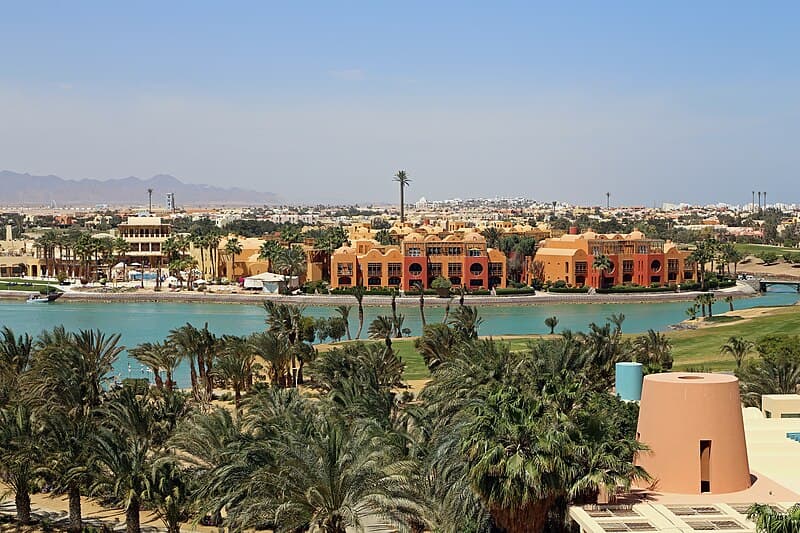
El Gouna is a privately built resort 25km north of Hurghada, which has grown since 1989 across 10 million square metres of bare desert. It isn't a hotel zone in the usual sense: it's a working small town with its own hospital, school, water treatment and desalination plant, home to a permanent community, where 20 hotels, restaurants and villas spread across a network of artificial islands linked by lagoons and bridges. You get between parts of town by boat or free buses, and the buildings are built in a low-rise Nubian style with domes and coloured render, not concrete towers. The heart of the resort is Downtown, or Kafr El Gouna, with Tamr Henna Square, and Abu Tig Marina, where yachts moor and people sit out until morning in season. The water in the lagoons is calm and shallow, the sea has a reef close to shore, and the northern Mangroovy beach, thanks to its constant wind, is one of the best kitesurfing spots in the world. Of Egypt's resorts, El Gouna is the most expensive, the most manicured and the least Egyptian.

What to see

The places worth your time in El Gouna, and what to expect at each

Abu Tig Marina

Abu Tig Marina

south of town

A yacht harbour in the southern part of town with several hundred berths, surrounded by low white buildings with restaurants, bars and shops. This is the social heart of El Gouna — most of what happens in the resort in the evening happens here, and in October it hosts a film festival.

Tip: The marina has 3 tiers, and prices drop the further back you go from the water. Sitting by the yachts means paying for the view; places a row back serve the same food for two-thirds of the price. Nightclubs charge a cover with a minimum spend in season.

Admission:
free
Time needed:
half a day
Downtown and Tamr Henna Square

Downtown and Tamr Henna Square

Kafr El Gouna

The resort's pedestrian centre, with a paved square, palm trees, shops, a bakery and restaurants all around. The architecture copies Nubian villages — low domes, vaults and earthy colours — and it's where hotel guests mix with permanent residents.

Tip: Downtown has 2 supermarkets at normal Egyptian prices, while hotel shops charge multiples of that. Buy your water, biscuits and sunscreen here. In the evening there's free live music on the square.

Admission:
free
Time needed:
3 h
Zeytuna Beach

Zeytuna Beach

island offshore

A sand island just off the coast, reached by boat from the marina or the lagoon. It's El Gouna's best beach: white sand, shallow calm water and a bar with loungers. Boats run back and forth every half hour all day.

Tip: Beach admission is charged, though for guests of most hotels it's discounted or included — check at reception so you don't pay twice. The last boat back leaves around 6pm; miss it and you're stuck on the island.

Admission:
from EGP 300
Time needed:
full day
Mangroovy Beach and kitesurfing

Mangroovy Beach and kitesurfing

north of town

A northern beach with a shallow lagoon and a steady north wind, home to several kitesurfing schools. The water stays waist-deep for hundreds of metres from shore, making it one of the best places in the world to learn kitesurfing from scratch with no risk of deep water.

Tip: The wind blows most reliably from April to September and is usually strongest in the afternoon; mornings suit beginners better. Book lessons ahead, as schools fill up days in advance during the season.

Admission:
beach entry from EGP 250, course from EGP 3,000
Time needed:
full day
The lagoons and inter-island boat routes

The lagoons and inter-island boat routes

across the resort

A network of artificial channels and lagoons runs through the entire resort, linking the islands with their hotels and villas. The water taxi runs fixed routes like a bus, and it's the most pleasant way to get around El Gouna — the whole town looks different from the water.

Tip: The water taxi timetable is posted on the jetties, with the last services running around midnight. Cheaper than a sightseeing cruise is simply buying a regular ticket and riding the whole route — it amounts to almost the same thing.

Admission:
ticket from EGP 60
Time needed:
2 h
Shaab El Erg reef

Shaab El Erg reef

25km north

A horseshoe-shaped reef about an hour north by boat, nicknamed Dolphin House because a pod of spinner dolphins regularly gathers in its lagoon. The shallows inside the horseshoe have coral heads and suit even inexperienced snorkellers.

Tip: Boats leave the marina around 8am and return in the afternoon. Dolphins aren't guaranteed — your best chance is in the morning. Your own snorkel and mask beat rented ones, which tend to be scratched and leak.

Admission:
trip from EGP 900
Time needed:
full day
Giftun Islands

Giftun Islands

40km south

2 protected islands off Hurghada with white beaches, turquoise shallows and reefs all around. Boat trips head here from along the coast, and part of Giftun Kebir island has loungers and a bar, while the rest is undeveloped.

Tip: National park entry is charged separately from the trip price, paid in cash on the boat — bring small notes. Trips from El Gouna sail longer than those from Hurghada, so expect to spend 3–4 hours on the island, not the full day.

Admission:
trip from EGP 900 plus park entry
Time needed:
full day
El Gouna Golf Course

El Gouna Golf Course

centre of the resort

An 18-hole course set among the lagoons with views of the Red Sea and the Eastern Desert mountains, open year-round. A path circles it for walking or running, and it's the greenest spot in the area.

Tip: Play early in the morning or late afternoon — at midday in summer the course hits over 35°C. Club and buggy rental should be booked ahead, and guests of some hotels get a discount on green fees.

Admission:
green fee from EGP 1,500
Time needed:
half a day
El Gouna Museum

El Gouna Museum

Downtown

A small collection of replicas of Egypt's most significant monuments, from the pre-dynastic period through to the Greeks and Romans, arranged chronologically with explanations. It doesn't claim to be an original collection — it's a primer before a trip to Luxor.

Tip: You can get round it in an hour, and it's worth doing the day before a trip to Luxor or Cairo, so you know what you're looking at. Admission is low, and it's air-conditioned inside during the midday heat.

Admission:
from EGP 100
Time needed:
1 h

Photos: Abu Tig Marina — Marc Ryckaert (CC BY 3.0) · Downtown and Tamr Henna Square — Hussein Bicar (Public domain) · Zeytuna Beach — G.Garitan (CC BY-SA 3.0) · Mangroovy Beach and kitesurfing — Marc Ryckaert (CC BY 3.0) · The lagoons and inter-island boat routes — Marc Ryckaert (CC BY 3.0) · Shaab El Erg reef — Alexander Vasenin (CC BY-SA 3.0) · Giftun Islands — user:vberger (Public domain) · El Gouna Golf Course — Marc Ryckaert (MJJR) (CC BY 3.0) · El Gouna Museum — Hussein Bicar (Public domain)

Where to stay

Areas and districts, matched to the kind of trip you are taking

Downtown (Kafr El Gouna)

Best for: a first visit and getting around on foot

The resort's pedestrian core, with a square, shops, supermarkets and restaurants at normal Egyptian prices. Hotels here are smaller and cheaper than by the sea, and you reach the beach by free bus or boat. For travellers who don't want to be confined to a hotel compound, this is the best base.

Abu Tig Marina

Best for: nightlife and couples

A harbourside district in the south with hotels right by the moorings, restaurants and bars that play music into the small hours in season. It's the most expensive and liveliest part of El Gouna, with the best choice of food in the resort. The beach here is short and partly artificial — for swimming, head to Zeytuna.

The lagoons and residential islands

Best for: calm and longer stays

A network of small islands with villas and smaller hotels linked by bridges and canals, home to permanent residents and reached by water taxi. It's quiet, with water right outside the window and zero night-time noise. For food and shopping, it's a short boat ride to Downtown.

Mangroovy and the northern coast

Best for: kitesurfing and watersports

The northernmost part of the resort, with a shallow lagoon, steady wind and kitesurfing schools. Hotels here tend to be more casual and full of sports enthusiasts, with practically no evening scene. Buses to Downtown and the marina run roughly every half hour.

Getting around

From the airport

Hurghada Airport lies 35km to the south, and the transfer to El Gouna takes around 40 minutes along the coast road. Charter flights connect from many European cities. Hotel buses and taxis also run from the airport, taxis costing around EGP 800. Go Bus coaches link El Gouna with Cairo in 6 hours and Luxor in 5. A shuttle bus runs from Downtown to Hurghada several times a day.

Hurghada International (HRG) · 35 km

  • Hotel transfer· 40 min· included in stay
  • Taxi· 35 min· EGP 800
  • El Gouna shuttle bus· 50 min· EGP 200

Marsa Alam International (RMF) · 300 km

  • Private transfer· 4 h· EGP 3,000
  • Go Bus via Hurghada· 5 h· EGP 300

Around town

El Gouna has something that works nowhere else in Egypt: its own public transport. A network of buses runs around the resort linking Downtown, the marina, the hotels and the northern beaches, free for guests of most hotels, with timetables posted at the stops. A second layer is the water-taxi network across the lagoons, working just like the buses but on water. On top of that are tuk-tuks, whose fare is agreed in advance. You won't need a car at all — and for a trip to Hurghada, the shuttle bus is cheaper than a taxi.

El Gouna busesA loop between Downtown, the marina, the hotels and Mangroovy. Free for guests of most hotels. · free
Water taxiScheduled routes across the lagoons, with the last services around midnight. · EGP 60
Tuk-tukShort hops around the resort; the fare is agreed in advance, as there's no meter. · EGP 50
Shuttle bus to HurghadaSeveral times a day from Downtown, cheaper and more reliable than a taxi. · EGP 200
Rented bikeThe resort is flat and has cycle paths, making a bike the most pleasant way to get around. · EGP 150/day

Useful apps: Google Maps, Uber

When to go

Swimming is possible year-round, but winter is cooler than people expect: in January the air is 21°C and the sea 22°C, and a jumper is useful in the evening. The most pleasant months are April, May, October and November, with air around 30°C and the sea at 27°C. July and August bring 36°C, bearable only thanks to the dry air and constant wind. That wind is El Gouna's speciality: it blows almost continuously from the north, which is exactly why kitesurfers come here, while for everyone else it means the waterfront often feels cooler than the thermometer suggests.

Best time

April, May, October and November

What to avoid

December to February, if you want warm evenings

MonthJanFebMarAprMayJunJulAugSepOctNovDec
Day21°22°25°29°33°35°36°36°34°31°27°23°
Night10°11°13°17°21°24°25°26°24°20°16°12°
Rainy days000000000000
Sea22°21°21°23°25°27°28°29°29°27°25°23°

Food & drink

El Gouna has an exceptional choice of food outside the hotels by Egyptian standards — over 100 places in Downtown and the marina, from Lebanese and Italian to sushi and genuine Egyptian classics. Prices are higher than in Hurghada but lower than in Europe, and the gap between a spot on the water and one a street back is often a third of the cost. Fish is brought in from the port in Hurghada, and marina restaurants let you pick yours from a display case. Unlike the rest of Egypt, alcohol is readily available here, both in bars and in shops in Downtown.

What to try

Koshary

Rice, lentils, pasta and chickpeas with fried onions and tomato sauce — the national dish and the cheapest lunch in the country.

Ta'ameya

Egyptian falafel made from fava beans instead of chickpeas, fried to a deep green and eaten in a pocket of bread for breakfast.

Grilled fish

At harbourside restaurants you pick your fish from a display case and pay by weight; served with tahini and bread.

Molokhia

A thick green soup made from jute leaves with garlic, served with rice and chicken. A very distinctive flavour.

Karkade

A hibiscus-flower infusion, drunk hot or cold. Egypt's most common soft drink.

Umm Ali

A warm dessert of filo pastry baked in milk with nuts and raisins, Egypt's answer to bread pudding.

Fatta

Layers of rice, toasted bread and meat topped with garlic vinegar and tomatoes. A festive dish that rarely appears on tourist menus.

Sayadeya

Fish braised with cumin and caramelised onion, served over rice coloured with fish stock. A speciality of the Red Sea coast and the Nile Delta.

What it costs

Coffee in Downtown

EGP 60–100

Lunch at an ordinary restaurant

EGP 250–400

Dinner by the marina

EGP 600–1,200 per person

Half-litre of beer at a bar

EGP 120–180

Admission to Zeytuna Beach

from EGP 300

Water taxi across the lagoons

from EGP 60

Kitesurfing course

from EGP 3,000

Guided day trip to Luxor

from EGP 3,000

Indicative prices that change over time — treat them as a guide, not a price list.

Practical information

SocketsCEuroplug, two round pinsFSchuko
Voltage220V / 50Hz
Tap waterDo not drink tap water — El Gouna has its own desalination and treatment plant, and its tap water is better quality than elsewhere in Egypt — it's fine for brushing your teeth. For drinking, though, buy bottled water; it costs a few pounds and is included at all-inclusive hotels. Ice at bars within the resort is made from treated water and is safe.
TippingA tip known as baksheesh is expected for practically every service in Egypt — porters, housekeeping, drivers. Keep small notes on you; EGP 10–20 is usually enough.
Driving on theright
SafetyRed Sea resorts are safe and well policed. The main risks are stomach upsets from food or ice, strong sun, and coral reefs that can easily cut you. Wear shoes in the water and don't touch the reef — it's illegal and can carry a fine.
Opening hoursShops and restaurants in Downtown and the marina are open roughly from 10am to midnight, later in high season. Supermarkets in Downtown run daily until 11pm. During Ramadan, the schedule shifts later into the night, but hotel operations and the marina bars run as usual.
Customs & etiquetteSwimwear is fine within the resort, but dress more modestly outside it — women should cover shoulders and knees. Alcohol is barely sold outside the hotels. Don't photograph local people without asking, and it's forbidden near military sites.
A few local wordsHello — As-salám alejkumThank you — ŠukranNo, thank you — Lá, šukranHow much does this cost? — Bikám?Too expensive — Gháli awi

How to plan your days

1 day

A day at the resort

  1. 1Morning: boat to Zeytuna Beach for a swim.
  2. 2Lunch on the beach or back in Downtown.
  3. 3Afternoon: stroll through Downtown and Tamr Henna Square.
  4. 4Evening: Abu Tig Marina and dinner a row back from the water.

2 days

2 days by the sea

  1. 1Day 1 as above.
  2. 2Day 2 morning: boat to the Shaab El Erg reef for dolphins.
  3. 3Snorkelling in the horseshoe shallows and lunch on board.
  4. 4Return in the afternoon, evening water taxi across the lagoons.

3 days

3 days including Luxor

  1. 1The first 2 days as above.
  2. 2Day 3: set off at 4am for a full-day trip to Luxor.
  3. 3Karnak, the Valley of the Kings and the temple of Hatshepsut.
  4. 4Return late in the evening.
  5. 5If a day remains, a kitesurfing lesson at Mangroovy or a round of golf.

Day trips

Hurghada

25 km · 35 min by bus

The largest Red Sea resort, with the Dahar market, a marina and Sheraton Street. Prices here are noticeably lower than in El Gouna, which is why people come to shop and eat. The shuttle bus from Downtown is cheaper and more comfortable than a taxi.

Luxor

290 km · 4 h by car

Karnak Temple, the Valley of the Kings and the temple of Queen Hatshepsut on the west bank of the Nile. Trips leave here from around 4am and return late in the evening; it's a demanding day, but the only chance to see ancient Egypt as part of a beach holiday.

Monastery of St Anthony

180 km · 2 h 30 min by car

The oldest Christian monastery in the world, founded in the 4th century at the foot of the Eastern Desert mountains. Coptic monks live within its walls, the church has medieval frescoes, and above the monastery is the cave where the hermit Anthony lived. Trips here run less often, usually by request.

Frequently asked questions

How is El Gouna different from Hurghada?+

El Gouna is a privately built and managed town on lagoons with its own infrastructure — tidy, clean, with free transport and no touts or persistent street selling. Hurghada is a real Egyptian town with a market, noise and noticeably lower prices. El Gouna is pricier and calmer; Hurghada is cheaper and more varied.

Is El Gouna good for families with children?+

Yes. The lagoons are shallow and calm, the resort has no traffic and free buses, and Zeytuna Beach has sand with a gentle slope into the water. Many hotels have kids' clubs. Do bear in mind, though, that entry to the sea at some hotels is over reef via a jetty — ask about this in advance.

How much does food cost outside the hotels?+

More than elsewhere in Egypt. Coffee in Downtown costs EGP 60–100, lunch EGP 250–400, dinner by the marina EGP 600–1,200 per person. Places set back from the water and the supermarkets in Downtown, where prices are normal Egyptian ones, are cheaper. It's exactly this price gap that draws people to shop in Hurghada instead.

Do I need a taxi in El Gouna?+

No. A network of buses runs around the resort, free for guests of most hotels, along with a scheduled water-taxi service across the lagoons. A tuk-tuk is handy late at night. A shuttle bus from Downtown to Hurghada costs EGP 200, a fraction of a taxi fare.

Can you drink tap water in El Gouna?+

The resort has its own desalination and treatment plant, and the water is better quality than elsewhere in Egypt — it's fine for brushing your teeth, and ice in bars is safe. For drinking, though, stick to bottled water; it costs a few pounds and is included at all-inclusive hotels.

When's the best time for kitesurfing here?+

The wind blows year-round, but most reliably from April to September, when it's present almost daily and strongest in the afternoon. Mangroovy Beach has a shallow lagoon you can stand in, making it one of the best places in the world for beginners. Book lessons a few days ahead, as schools fill up in season.

Is El Gouna noisy?+

It depends where you are. Abu Tig Marina plays music into the small hours in season, and hotels right by the moorings will hear it. Downtown is lively until midnight but not loud. The lagoons, the residential islands and the northern coast are completely quiet in the evening. Ask how far a hotel is from the marina before booking.

What can you do when the wind is too strong?+

A northerly wind blows here almost constantly, and on strong days it cancels boat trips to the reefs. Backup options include golf, the museum in Downtown, the lagoons — sheltered and calm even in wind — and a shopping trip to Hurghada. Kitesurfers, on the other hand, get their best day of the week.

Visa Requirements

Check the latest visa requirements for entering this country. Some nationalities may need to apply for a visa or e-visa before travel.

Check visa requirements

Language

Arabic

Currency

EGP

Timezone

Africa/Cairo

Dial Code

+20

Population

104M

Area

1,001,450 km²

Voltage

220V / 50Hz

Driving Side

Right

Top Hotels in El Gouna

Live prices from 500+ properties

Loading hotels...

More destinations in Egypt

Planning a trip to El Gouna?

Compare hundreds of hotels, find the best price, and book with free cancellation on TravelManiac.