Hotels in Goa

Portuguese India with baroque churches and beaches

Goa

LanguageEnglish
CurrencyINR
TimezoneGMT+5:30
Temperature20-40 °C
Dial Code+91
Population1.43B
Area3,287,263 km²
SocketsType C / Type D / Type M
Tap waterNot drinkable

Discover Goa

Goa was a Portuguese colony for 450 years — longer than British rule lasted over the rest of India — and wasn't merged into India until 1961. The legacy is still visible today: in baroque churches, in surnames like Fernandes and Pereira, in the fact that pork is cooked here, alcohol is drunk openly and Catholics make up a quarter of the population. It's also India's smallest state and one of its wealthiest. 100km of coastline splits into 2 halves with distinct characters: the north around Baga and Anjuna is loud, cheap and full of markets and parties, while the south from Colva to Palolem is calm, pricier and family-friendly. In between sits Panaji with its Portuguese quarter, and a few kilometres further on lies Old Goa, home to churches from an era when this city was bigger than Lisbon. The season runs from November to March; the monsoon from June to September closes the beaches.

What to see

The places worth your time in Goa, and what to expect at each

Basilica of Bom Jesus

Basilica of Bom Jesus

Old Goa, 10km from Panaji

A baroque church from 1605 in Old Goa, where the body of Saint Francis Xavier — a missionary who died in 1552 and whose remains never decomposed — lies in a silver casket. The laterite façade was deliberately left unplastered, making it the only church of its kind in India.

Tip: The relics are shown to the public only once a decade during an exposition; otherwise you'll see the ornate casket held high above the floor. Covered legs and shoulders are required for entry even in the tropical heat.

Admission:
free
Time needed:
1 h
Sé Cathedral

Sé Cathedral

Old Goa, 10km from Panaji

The largest church in Asia, completed in 1652 and dedicated to Saint Catherine. It has a single tower, since the other collapsed in the 18th century and was never rebuilt. Inside is a gilded altar and the so-called Golden Bell, the loudest in Goa.

Tip: The cathedral and basilica stand opposite each other, and you can see both in 2 hours. Arrive before 10am, ahead of the buses of Indian pilgrims; at midday it gets stuffy inside and there's a queue at the entrance.

Admission:
free
Time needed:
1 h
Palolem Beach

Palolem Beach

south, 70km from Panaji

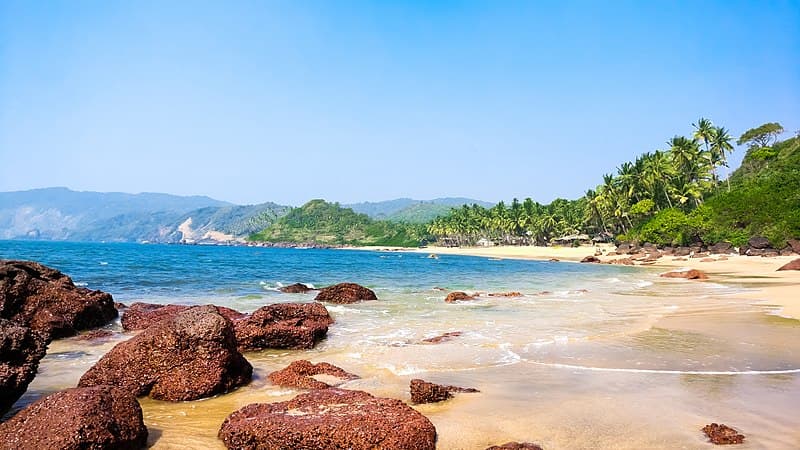
A crescent-shaped bay in south Goa lined with palm trees, with calm, shallow water sheltered by 2 rocky headlands. Wooden huts line the beach, taken down each year before the monsoon and rebuilt afterwards.

Tip: Because loud music is banned after 10pm, so-called silent discos are held here, where everyone dances wearing headphones. Beachfront hut accommodation is only legal in season — outside November to April, nothing stands here at all.

Admission:
free
Time needed:
full day
Anjuna and its flea market

Anjuna and its flea market

north, 18km from Panaji

A beach with a rocky shoreline that was the centre of the hippie community in the 1960s and still holds its reputation as Goa's most alternative spot. A flea market is held here every Wednesday, born out of travellers selling each other belongings before heading home.

Tip: The market starts around 9am and winds down by 6pm; late morning is best. Prices are set for haggling, and the first offer is often triple — bargain with a smile and a willingness to walk away, which works best.

Admission:
free
Time needed:
half day
Baga and Calangute

Baga and Calangute

north, 15km from Panaji

2 adjoining beaches that form north Goa's tourist hub: water sports, beach bars, restaurants and thousands of people in season. Calangute is longer and busier; Baga has a river mouth at its northern end, with a quieter stretch beyond it.

Tip: This is the busiest spot in the whole state and not suited to a quiet holiday. Those wanting the buzz only in the evening can stay in neighbouring Candolim and walk over along the beach. Haggle for water sports, as prices are quoted absurdly high.

Admission:
free
Time needed:
full day
Fort Aguada

Fort Aguada

Candolim, 18km from Panaji

A Portuguese fort from 1612 above the mouth of the Mandovi river, built against the Dutch and the Marathas. It holds Asia's oldest surviving lighthouse and a huge cistern with a capacity of 2.25 million litres of water — hence the name Aguada, meaning waterworks.

Tip: The upper section with the lighthouse is freely accessible and offers the best view of the northern beaches. The lower section was a prison until 2015 and is now a museum with a separate entrance. Go in the late afternoon for the sunset over the sea.

Admission:
free, museum from INR 50
Time needed:
2 h
Fontainhas in Panaji

Fontainhas in Panaji

Panaji

The capital's Latin Quarter, with narrow lanes and houses in ochre, blue and green, repainted every year after the monsoon following old Portuguese tradition. It's the best-preserved piece of Portuguese India and is a listed protected zone.

Tip: The neighbourhood is small and can be walked in an hour, but people actually live here — don't photograph into windows and yards. The best light for photos is early morning; by day the quarter is hot with no shade, while cafés come alive towards evening.

Admission:
free
Time needed:
2 h
Chapora Fort

Chapora Fort

Vagator, 20km from Panaji

Fort ruins on a hill above Vagator beach, offering views of the northern coast as far as Anjuna. Indians know it as the backdrop of the 2001 film Dil Chahta Hai and come here because of it; mainly the ramparts remain of the fort itself.

Tip: It's a 15-minute climb up a stony, shadeless path — go for sunset. Park down by the village; anyone arriving by scooter should lock it up, as it's a regular target for theft.

Admission:
free
Time needed:
2 h
Mapusa Market

Mapusa Market

Mapusa, 13km from Panaji

A Friday market in this northern district town, where Goans come to shop rather than tourists. Fruit, dried fish, spices, Goan chorizo and earthenware are sold here — it's the best place to see how the state lives away from the coast.

Tip: The market is busiest on Friday mornings and winds down around 2pm. Spices and cashews cost a third of beach-stall prices here. Bring small notes, as change is often unavailable for large bills.

Admission:
free
Time needed:
3 h

Photos: Basilica of Bom Jesus — iMahesh (CC BY-SA 4.0) · Sé Cathedral — iMahesh (CC BY-SA 4.0) · Palolem Beach — iMahesh (CC BY-SA 4.0) · Anjuna and its flea market — Vyacheslav Argenberg (CC BY 4.0) · Baga and Calangute — Aditya Mandke (CC BY-SA 4.0) · Fort Aguada — Nanasur at English Wikipedia (CC BY-SA 3.0) · Fontainhas in Panaji — CorreiaPM (Public domain) · Chapora Fort — Nikhilb239 (CC BY 3.0) · Mapusa Market — Sankalpkanyalkar (Public domain)

Where to stay

Areas and districts, matched to the kind of trip you are taking

North Goa: Baga, Calangute, Candolim

Best for: buzz, low prices and nightlife

The most built-up and cheapest part of the state, with the highest concentration of hotels, bars and water sports. It's very lively in season, and the beaches are packed. Candolim is a calmer option within walking distance of Baga and tends to be the most sensible compromise.

Anjuna, Vagator and Arambol

Best for: an alternative scene and markets

A stretch further north with a rocky coastline, hippie history, a flea market and parties. Accommodation is cheap, often in huts. The beaches are less suited to swimming due to the rocky seabed, but this is Goa's most interesting atmosphere.

South Goa: Palolem, Agonda, Colva

Best for: peace and quiet and families

The calmer half of the state, with wide beaches, lighter development and higher prices. Palolem and Agonda have huts right on the beach, while Colva and Benaulim have large hotels. It's an hour and a half by car to the northern markets and bars.

Panaji and Old Goa

Best for: sightseeing without the beach

The state capital, with the Portuguese Fontainhas quarter, and Old Goa 10km further on with its UNESCO-listed baroque churches. The sea is a quarter of an hour away. The choice for those who want to see Portuguese India, not just the coast.

Getting around

From the airport

Goa has 2 airports: the older Dabolim in the centre of the state, and the new international airport at Mopa in the north, opened in 2023. Many European cities offer flights with a single connection, typically via the Gulf, with the journey taking around 13 hours, plus seasonal charters. From the airport, a prepaid taxi from the counter in the terminal or an app is your best bet; Mopa is closer to the northern beaches, Dabolim to the southern ones. An overnight train from Mumbai also runs to Goa, taking 11 hours along the coast.

Manohar International (Mopa) (GOI) · 35 km

  • Hotel transfer to the northern beaches· 45 min· included in the stay
  • Prepaid taxi to Baga· 50 min· INR 1,500
  • Taxi to Palolem (south)· 2 h 15 min· INR 3,500

Dabolim (Goa International) (GOX) · 30 km

  • Prepaid taxi to Palolem· 1 h 20 min· INR 2,200
  • Prepaid taxi to Calangute· 1 h· INR 1,400

Around town

Goa has no public transport that's practical for tourists — local buses run, but slowly and only along the main routes. Most people rent a scooter, which is cheap here and the most common way to get around; without an A-category licence, though, insurance won't pay out after an accident, and police do carry out checks. Taxis are unusually expensive in Goa due to a strong local lobby that long blocked ride-hailing apps; Uber and Ola work today, but not everywhere. Distances between north and south run to about 2 hours by car.

Rented scooterThe most common way to get around the state; a helmet is compulsory, and insurance won't pay out without an A-category licence. · INR 400/day
Taxi and UberApps work mainly around Panaji and the airports; elsewhere, local taxis run at fixed fares. · INR 500
Motorcycle taxi (pilot)A Goan speciality: a rider on a motorbike with a yellow fuel tank takes you on the back seat. · INR 100
Car with driverThe most comfortable option for full-day trips to Old Goa or the waterfalls. · INR 2,500/day

Useful apps: Uber, Ola, Google Maps, Zomato

When to go

The season runs from November to March: dry, around 32°C, with every beach shack up and running. December to February is best, when even the nights are pleasant. April and May are unbearably muggy, with humidity above 80%. From June to September the monsoon hits — it rains heavily almost daily, beach structures are legally dismantled, water sports stop and sea swimming is banned. On the plus side, the whole state turns green and prices drop to a third.

Best time

December to February

What to avoid

June to September, for the monsoon and closed beaches

MonthJanFebMarAprMayJunJulAugSepOctNovDec
Day32°32°33°33°33°30°29°29°30°32°33°33°
Night19°20°23°25°26°25°24°24°24°24°22°20°
Rainy days0001522272416720
Sea28°28°29°30°30°29°28°28°28°29°29°28°

Food & drink

Goan cuisine is an Indian base with a Portuguese layer: vinegar, garlic, pork and bread — baked nowhere else in India. Locals' everyday meal is fish curry with rice, while the festive dish here is vindaloo and xacuti. Feni, a spirit distilled from cashew apples, can only be made in Goa. Beach shacks are seasonal wooden structures that are legally dismantled before the monsoon — from June to September practically nothing runs by the sea, and people eat inland instead.

What to try

Xit kodi (fish curry with rice)

A Goan curry of coconut milk, tamarind and chilli with fish, served with rice. It's locals' everyday lunch, and in canteens it's sold as a thali with refills included.

Vindaloo

Pork in vinegar, garlic and chilli — the name comes from the Portuguese vinha d'alhos. The original Goan version is sour, not just hot; the version served in Indian restaurants across Europe shares little but the name.

Xacuti

A thick curry of roasted coconut and more than 10 spices, usually with chicken. It's slow-cooked and is the Sunday meal of Goan families; the touristy version tends to be simplified.

Prawn balchão

Prawns cured in a fiery chilli-and-vinegar paste — more a pickled side than a main course. It keeps for weeks and is sold in jars as a souvenir.

Poi

A round leavened bread of Portuguese origin, baked in Goa every morning and delivered by bicycle. It's dipped into curry and is the only leavened bread in Indian cuisine.

Bebinca

A layered dessert of coconut milk, eggs and butter, baked layer by layer — the classic version has 16. It's served warm and is a Goan Christmas classic.

Feni

A spirit distilled from cashew apples or palm sap, made only in Goa and protected by a designation of origin. It has a sharp aroma and is drunk with lime and soda; it's not legally sold outside Goa.

Thali

A metal tray of rice, several bowls of curry, dal and bread, with sides topped up for free until you're full. It's the cheapest way to eat well in India, usually for around 150 rupees.

What it costs

Thali at a local canteen

INR 150–250

Lunch at a beach shack

INR 400–700

Seafood dinner

INR 800–1,500 per person

Large Kingfisher beer

INR 120–200

Scooter rental for a day

INR 400

Sunbed and parasol

INR 200–400

Full-day trip to the waterfalls

from INR 2,000

Night in a 4-star hotel

INR 4,000–8,000

Indicative prices that change over time — treat them as a guide, not a price list.

Practical information

SocketsCEuroplug, two round pinsDthree round pins (India)MSouth African, large pins
Voltage230V / 50Hz
Tap waterDo not drink tap water — Never drink tap water, brush your teeth with it, or add it to drinks. Bottled water costs around 20 rupees a litre — check the seal is intact, as refilled bottles are a common scam in India. Only take ice in hotels and established venues.
TippingTipping is expected and part of the budget. In restaurants, 10% unless service is already charged; porters get 50 rupees a bag; drivers on a full-day trip get 300–500 rupees. Keep small change handy, as vendors often can't give change and you end up overpaying without it.
Driving on theleft
SafetyThe most common serious injuries among foreign tourists in India have nothing to do with crime: top of the list is riding a scooter or motorbike without a helmet and without an A-category licence, which voids insurance, followed closely by drowning in rip currents, since most beaches have no lifeguard and the sea is dangerous from May to October. Crime against tourists is mostly petty theft and pricing scams. Women travelling alone should avoid deserted beaches after dark. Possession of any drugs is punished very harshly in India, including marijuana and including foreigners, and beach parties are regularly checked.
Opening hoursShops are usually open from 10am to 9pm, including Sundays. Beach bars and restaurants in Goa are seasonal structures: they're built in October and legally dismantled before the monsoon in May, so from June to September practically nothing runs by the sea. Temples open at dawn, close around midday and reopen in the afternoon. Public holidays and elections bring so-called dry days, with a ban on alcohol sales.
Customs & etiquetteTake off your shoes before entering a temple, mosque or private home, and photography is banned in many temples. The left hand is considered unclean — hand over food, money and gifts with the right. Outside beaches and resorts, covered clothing is expected, especially shoulders and knees for women; Goa is more relaxed than the rest of the country, but it still applies in churches or villages. Cows are sacred and have right of way everywhere, including on the road. Wobbling the head from side to side means agreement, not disagreement.
A few local wordsHello — NamasteThank you — DhanjavádHow much does this cost? — Kitne ká hai?Not spicy, please — Mirči nahíThe bill, please — Bil dídžije

How to plan your days

1 day

A day in Goa

  1. 1Morning at the beach for a swim before the sun gets too strong.
  2. 2Late morning at Fort Aguada, home to Asia's oldest lighthouse.
  3. 3Lunch at a beach shack with fish curry.
  4. 4Afternoon rest in the shade, when the heat is at its worst.
  5. 5Sunset from Chapora Fort and dinner by the sea.

2 days

2 days with Portuguese India

  1. 1Day 1 as above.
  2. 2Morning in Old Goa for the Basilica of Bom Jesus and Sé Cathedral.
  3. 3Lunch in Panaji, afternoon stroll through Fontainhas.
  4. 4Return to the coast in the early evening.
  5. 5Dinner with vindaloo and a glass of feni.

3 days

3 days with markets and the interior

  1. 1Days 1 and 2 as above.
  2. 2Wednesday's flea market in Anjuna, Friday's market in Mapusa.
  3. 3Lunch at an inland canteen away from the coast.
  4. 4Next day, a full-day trip to Dudhsagar Falls and a spice plantation.
  5. 5If time allows, head south to quiet Palolem.

Day trips

Dudhsagar Falls

60 km · 2 h by car and off-road vehicle

A 300m-high cascade on the border with Karnataka, crossed by a railway bridge — the name means "sea of milk" in Konkani. The falls can only be reached by an organised off-road vehicle from Kolem. They're most powerful right after the monsoon in October and November, while in April it's often just a trickle.

Divar and Chorão islands

12 km · 30 min by car and ferry

2 islands in the Mandovi river just outside Panaji, reached by free ferry. Divar is village Goa without the tourists, with Portuguese villas and a hilltop church; Chorão has the Salim Ali bird sanctuary in the mangroves, with herons and kingfishers.

Cabo de Rama and the southern coast

50 km · 1 h 15 min by car

Goa's oldest fort, on a clifftop above the sea, named after the hero of the Ramayana. It's freely accessible, practically empty and offers a view of the entire southern coast. On the way lie the quiet beaches of Agonda and Cola with its lagoon.

Frequently asked questions

When should you go to Goa?+

From November to March, when it's dry and every beach shack is standing; December to February is best. April and May are muggy, and from June to September the monsoon hits — beach structures are legally dismantled, swimming is banned and most services by the sea shut down.

Is north or south Goa better?+

The north is cheaper, livelier and has markets, bars and nightlife; the south is quieter, pricier and better suited to families and relaxation. Baga and Palolem are 2 hours apart by car, so decide in advance — commuting between them daily doesn't make sense.

Why are there Catholic churches in Goa?+

Goa was a Portuguese colony for 450 years and wasn't merged into India until 1961, 14 years after the rest of the country's independence. Catholics make up around a quarter of the population, and the Portuguese legacy shows in the language, names, cuisine and architecture.

Do I need a visa for India?+

Yes. Most nationalities apply for an electronic e-Visa online, usually a few days to a week before travel; processing typically takes up to 3 working days. Your passport must be valid for 6 months beyond entry and have 2 blank pages.

Can I ride a scooter in Goa?+

Physically yes, and it's the most common way to get around, but legally you need an A-category licence and an international driving permit. Without them, riding is illegal, police carry out checks, and crucially your travel insurer won't cover treatment or repatriation after an accident.

Can you drink alcohol publicly in Goa?+

Yes — unlike most of India, very relaxed rules apply here, and alcohol is the cheapest in the country thanks to low excise duty. Drinking directly on the beach is banned in some municipalities though, and glass has no place on the sand. Sales are banned on election days and public holidays.

Is it safe to swim in Goa?+

In season, yes — the main beaches have lifeguards and flags. Away from them, and especially from May to October, rip currents are strong and drownings happen every year. Never swim after drinking, and follow the flags even if the water looks calm.

What is feni?+

A spirit distilled from cashew apples or palm sap that can legally only be made in Goa and carries a protected designation of origin. It has a sharp aroma and is drunk with lime, ice and soda. It's barely sold outside Goa, making it the most typical souvenir you can bring home from there.

Visa Requirements

Check the latest visa requirements for entering this country. Some nationalities may need to apply for a visa or e-visa before travel.

Check visa requirements

Language

Hindi / English

Currency

INR

Timezone

GMT+5:30

Dial Code

+91

Population

1.43B

Area

3,287,263 km²

Voltage

230V / 50Hz

Driving Side

Left

Top Hotels in Goa

Live prices from 500+ properties

Loading hotels...

More destinations in India

Planning a trip to Goa?

Compare hundreds of hotels, find the best price, and book with free cancellation on TravelManiac.