Hotels in Nessebar

Forty churches on a rock in the middle of the sea

Nessebar

LanguageBulgarian
CurrencyBGN
TimezoneEurope/Sofia
Temperature2-28 °C
Dial Code+359
Population6.5M
Area110,879 km²
SocketsType C / Type F
Tap waterDrinkable

Discover Nessebar

Nessebar is the oldest town on the Bulgarian coast and the only one worth visiting even without a beach. It sits on a rocky peninsula linked to the mainland by a narrow four-hundred-meter isthmus, and within an area smaller than twenty hectares it preserves more than forty medieval churches — more churches per resident than anywhere else in Europe. It was founded by the Thracians, followed by the Greeks as Mesembria, then the Byzantines and the Ottomans, each layer leaving something behind. Nineteenth-century wooden houses with stone ground floors and overhanging wooden upper stories stand directly on ancient foundations, and the town walls disappear into the sea in places. The whole old town has been a UNESCO World Heritage Site since 1983. The new town on the mainland is an ordinary resort with a long sandy beach and hotels that serve as a base. Three kilometers north, Sunny Beach begins, making the combination of history and beach holiday easier here than anywhere else in Bulgaria.

What to see

The places worth your time in Nessebar, and what to expect at each

The old town on the peninsula

The old town on the peninsula

the peninsula

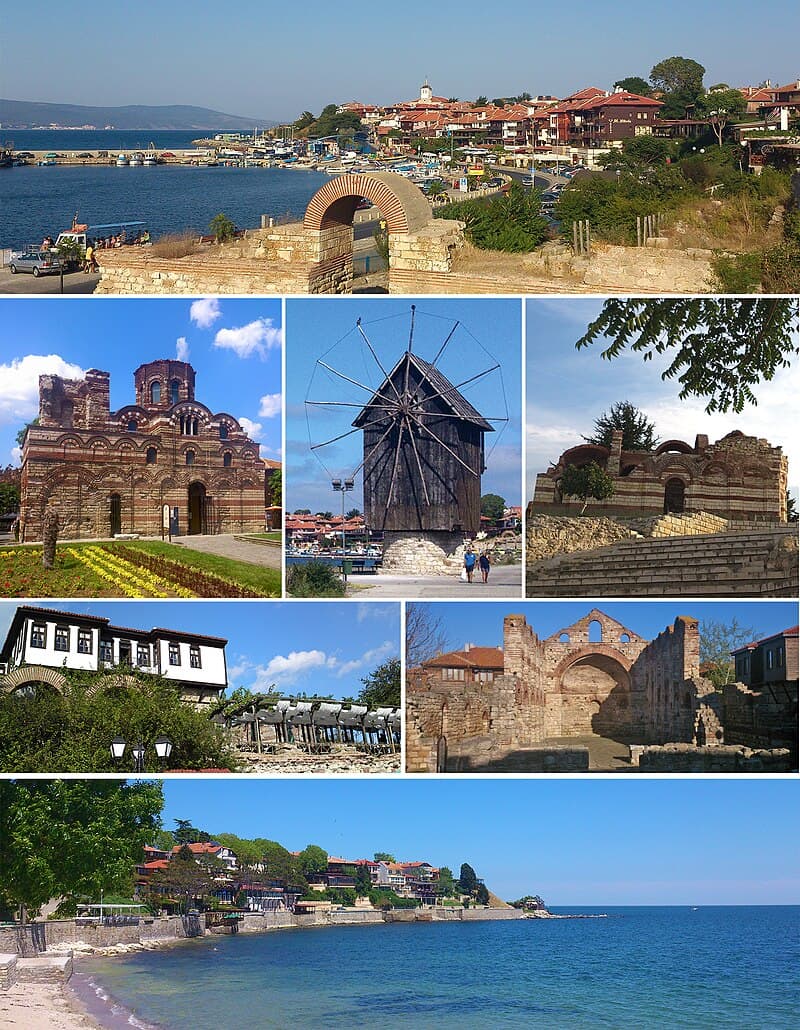
The historic core sits on a rock ringed by walls, with cobbled lanes, wooden houses and a church on every corner. The peninsula's perimeter can be walked in an hour, and on the south side you can see the foundations of ancient walls beneath the water.

Tip: Come early in the morning or after seven in the evening — during the day, tour groups pour in from Sunny Beach and the main street becomes impassable.

Admission:
free
Time needed:
half a day
Church of Christ Pantocrator

Church of Christ Pantocrator

main street

The town's best-preserved and most photographed church, dating to the thirteenth century. The facade alternates bands of brick and white stone, decorated with ceramic rosettes and a swastika-meander frieze — unusually rich ornamentation for Eastern Orthodoxy.

Tip: Walk all the way around the facade, since each side has different decoration; the best light is late afternoon.

Admission:
from 3 €
Time needed:
30 min
Church of St. Stephen

Church of St. Stephen

old town

A plain-looking eleventh-century basilica from the outside, but inside more than two hundred fifty wall paintings cover almost every centimeter of the walls. The sixteenth-century fresco cycle ranks among the most complete in Bulgaria, complemented by a carved iconostasis.

Tip: It's the only church in Nessebar with an interior preserved to this extent — if you only pay for one admission, make it this one.

Admission:
from 3 €
Time needed:
45 min
Church of St. John Aliturgetos

Church of St. John Aliturgetos

south shore

An unfinished fourteenth-century structure standing roofless right above the sea. It was never consecrated, hence the name meaning "non-liturgical." Its ornamental brick, stone and ceramic masonry ranks among the high points of late Byzantine architecture.

Tip: Best at sunset, when the brickwork lights up with the open sea behind it.

Admission:
free
Time needed:
30 min
Archaeological Museum

Archaeological Museum

by the town gate

A collection spanning the Thracian settlement through Greek Mesembria to the Middle Ages: ancient anchors pulled from the sea, coins minted in the town, gravestone stelae and icons from the surrounding churches. The museum stands right by the old town's entrance gate.

Tip: Start here before heading into the lanes — without context, the churches blur into one pile of bricks.

Admission:
from 5 €
Time needed:
1 h
The old windmills on the isthmus

The old windmills on the isthmus

entrance to the old town

A wooden windmill on a stone base stands right on the narrow isthmus between the mainland and the peninsula, and has become the town's symbol. It's Nessebar's most photographed spot, especially with the sun setting behind it over the bay.

Tip: From the isthmus you can see both the old town and the Sunny Beach bay at once — come an hour before sunset for photos.

Admission:
free
Time needed:
20 min
South beach and the harbor

South beach and the harbor

the peninsula

A fishing harbor with taverns right on the water and a smaller sandy beach below the town walls. Both tourist boats and genuine fishing boats dock here, selling the morning's catch. Quieter than the beaches in the new town.

Tip: Fish is cheapest around midday, when the morning catch comes in; by evening restaurants are already selling frozen stock.

Admission:
free
Time needed:
3 h
Sunny Beach

Sunny Beach

3 km north

An eight-kilometer sandy beach just north of Nessebar, with water parks, a promenade and the liveliest nightlife on the coast. It can be reached from Nessebar on foot along the coastal path, or by bus every fifteen minutes.

Tip: If you're staying in Nessebar and just want a wide beach without the bustle, head to the southern end of Sunny Beach — it's the closest and calmest stretch.

Admission:
free, sunbed from 8 €
Time needed:
full day
Pomorie and the salt lake

Pomorie and the salt lake

18 km south

An old salt-producing town on a narrow spit with a shallow lagoon, where salt is still raked by hand today. The black therapeutic mud is used in spa treatments, and the lake is home to nesting waterbirds, including flamingos. Pomorie also has a winery and the Monastery of St. George.

Tip: The salt museum is small but shows the whole process, from flooding the lagoon to raking the salt; the mud treatment is applied only in a designated area.

Admission:
museum from 4 €
Time needed:
half a day

Photos: The old town on the peninsula — NightBlade151 (CC BY-SA 3.0) · Church of Christ Pantocrator — Chrumps (CC BY-SA 4.0) · Church of St. Stephen — MrPanyGoff (CC BY-SA 3.0) · Church of St. John Aliturgetos — MrPanyGoff (CC BY-SA 3.0) · Archaeological Museum — Svik at Bulgarian Wikipedia (CC BY-SA 3.0) · The old windmills on the isthmus — Nenko Lazarov (CC BY 2.5) · South beach and the harbor — Pudelek (Marcin Szala) (CC BY-SA 3.0) · Sunny Beach — Victor Belousov (CC BY 3.0) · Pomorie and the salt lake — Boby Dimitrov from Sofia, Bulgaria (CC BY-SA 2.0)

Where to stay

Areas and districts, matched to the kind of trip you are taking

The old town on the peninsula

Best for: atmosphere and a short stay

Stay right among the churches in converted wooden houses. The evenings are the best part, once the tour groups leave and the peninsula empties out. The downsides are restaurant noise, small rooms, and the fact that you can't really drive here — parking is outside the walls.

The new town on the mainland

Best for: the beach and families

An ordinary resort with a long sandy beach, supermarkets and hotels with pools. It's fifteen minutes on foot across the isthmus to the old town. The most sensible combination if you're staying a week and want both beach and history.

The southern stretch near Sunny Beach

Best for: a wide beach with everything within reach

The section between Nessebar and the resort, where the beach is at its widest yet the club noise doesn't reach. You can walk to the old town along the coast, and it's three bus stops to the nightlife.

Ravda

Best for: lower prices and quiet

A village five kilometers south with a calm beach favored by Bulgarian families. Restaurants are a third cheaper than in Nessebar, and evenings here are genuinely quiet. History and nightlife require a bus ride.

Getting around

From the airport

The nearest airport is Burgas, thirty kilometers south, served in season by charter flights from Prague. The transfer takes half an hour and is usually included in package holidays. Traveling independently, a bus runs from the airport via Burgas's Yug bus station, from where direct services to Nessebar and Sunny Beach leave every half hour. You can't drive into the old town — parking is in a large paid lot outside the walls.

Burgas (BOJ) · 30 km

  • Hotel transfer· 35 min· included with stay
  • Bus via Yug station· 1 h 15 min· 5 €
  • Taxi· 30 min· 30 €
  • Bolt from the airport· 30 min· 22 €

Varna (VAR) · 100 km

  • Bus via Varna· 2 h 30 min· 10 €
  • Private transfer· 1 h 30 min· 75 €

Around town

The old town is a pedestrian zone, walkable in an hour, but the paving is uneven and a struggle with a stroller or in heels. City bus line 1 runs between Nessebar, Sunny Beach and Sveti Vlas every fifteen minutes until midnight. During the day, water taxis run between Nessebar and the resort, a nicer trip than the road. A car is more of a burden in Nessebar — it can't enter the historic core, and parking outside the walls is paid.

Bus line 1Nessebar – Sunny Beach – Sveti Vlas, every 10–15 minutes until midnight. · 1 €
Water taxiFrom the harbor to Sunny Beach and the marina at Sveti Vlas, hourly during the day. · 5 €
On footYou can walk the whole peninsula in an hour; it's fifteen minutes across the isthmus to the new town. · free
Bus to BurgasDirect services from the new town every half hour, journey time under an hour. · 4 €

Useful apps: Google Maps, Bolt, Moovit

When to go

Swimming season runs from mid-June to mid-September, with the sea reaching twenty-six degrees in August. But the old town itself is worth visiting in May, June and especially the second half of September too, when the tour groups vanish and the peninsula can be explored in peace. In July and August, between eleven and five, the main street is jammed and people-free photos are impossible. From November to April, most restaurants are closed and it's windy.

Best time

June and September

What to avoid

midday in July and August, when tour groups arrive

MonthJanFebMarAprMayJunJulAugSepOctNovDec
Day6°7°11°16°22°26°29°29°25°19°13°8°
Night0°0°3°8°13°17°20°20°16°12°7°2°
Rainy days8788874357910
Sea8°7°8°11°17°22°25°26°23°19°14°10°

Food & drink

Restaurants on the old town's main street cook for passing tourists, and the prices reflect it. The real good eating in Nessebar is found at the harbor on the south side and in the side streets, where fresh fish and sprats are grilled. The Bulgarian staples are here too: shopska salad, sirene cheese, clay dishes straight from the oven. For the cheapest food, head to the new town or to Ravda, where dinner costs half what it does on the peninsula.

What to try

Shopska salad

Tomatoes, cucumber, peppers and coarsely grated sirene cheese. Ordered with everything, and the cheapest sure bet at any mehana.

Kebapche and kyufte

A grilled roll and patty of minced meat with cumin, the classic of Bulgarian grilling. Served with fries and lyutenitsa relish.

Tarator

A cold soup of sour milk, cucumber, garlic and walnuts. In summer it's the only dish that goes down easily in the midday heat.

Banitsa

Layered pastry with sirene cheese, breakfast across the whole country. Bought at a bakery for a few coins, washed down with boza, a fermented grain drink.

Kavarma

Meat stewed with vegetables and baked in a clay dish, a hearty meal served along the coast year-round.

Tsatsa

Fried sprats with lemon, served in piles as an appetizer with beer. Best straight from the harbor taverns.

Black Sea-style mussels

Mussels steamed in wine with garlic, often in a white sauce in the southern part of the coast. Cheap and fresh.

Rakia

A spirit distilled from plums or grapes, drunk chilled alongside shopska salad before the main course, not after.

What it costs

Coffee in the old town

3–4 €

Tsatsa with lemon

5–7 €

Dinner at the harbor

15–22 € per person

Beer, 0.5 l

2.50–4 €

Admission to one church

3 €

Archaeological Museum

5 €

Bus to Sunny Beach

1 €

Night at a 3-star hotel in the new town

50–90 €

Indicative prices that change over time — treat them as a guide, not a price list.

Practical information

SocketsCEuroplug, two round pinsFSchuko
Voltage230V / 50Hz
Tap waterTap water is drinkable — Tap water is safe to drink in Bulgaria and routinely treated along the coast, though it tastes harder than in Czechia. Cheap bottled water is sold at every supermarket, and on mountain trips you can drink from public springs.
TippingNot mandatory, but it's customary to round up and leave around ten percent at a restaurant. Give tips in cash directly to the server — card terminals in Bulgaria generally don't allow entering one.
Driving on theright
SafetyNessebar is very safe; the only common risk is pickpocketing in the crowds on the main street around midday. The paving on the peninsula is uneven and slippery in places, so sturdy shoes are worthwhile. Only park in paid lots outside the walls — elsewhere you risk being towed. Restaurants with a tout standing at the door tend to charge well above average — check the menu before you sit down.
Opening hoursThe resorts come alive from mid-May to the end of September; outside the season, most hotels, restaurants and exchange offices are closed. Supermarkets are open daily roughly from seven a.m. to ten p.m., museums close on Mondays and extend their hours into the evening in summer.
Customs & etiquetteBulgarians nod their head up and down for "no" and shake it side to side for "yes" — for a question like "is this seat free?" it's safer to ask in words. Cover your shoulders when entering Orthodox churches, and this is enforced in both Nessebar and Sozopol. Photographing icons with flash is not allowed.
A few local wordsHello — Dobar denThank you — BlagodaryaPlease — MolyaCheers — NazdraveThe bill, please — Smetkata, molya

How to plan your days

1 day

A day in the old town

  1. 1Morning at the Archaeological Museum by the gate for context.
  2. 2A church circuit: Pantocrator, St. Stephen, St. John Aliturgetos.
  3. 3Lunch at the harbor from the morning's catch.
  4. 4Afternoon walking the walls' perimeter and a swim at the south beach.
  5. 5Sunset by the windmill on the isthmus.

2 days

Two days with the beach

  1. 1Day one as above.
  2. 2Day two: a full morning at the new town beach or the southern end of Sunny Beach.
  3. 3Afternoon water taxi to the marina at Sveti Vlas.
  4. 4Dinner back in Nessebar once the tour groups have left.

3 days

Three days including the surroundings

  1. 1The first two days as above.
  2. 2Day three: bus to Pomorie for the salt lake and salt museum.
  3. 3Afternoon continuing to Burgas, the Sea Garden and the pier.
  4. 4Return by evening bus.
  5. 5If a day remains, Sozopol to the south or Cape Emine to the north.

Day trips

Burgas

30 km · 50 min by bus

A port city with the country's loveliest sea garden, a wooden pier and a lively center free of tourist markups. A good option for a windy or rainy day.

Sozopol

70 km · 1 h 30 min

The south coast's other ancient town, quieter and less rebuilt than Nessebar, with wooden houses and two long beaches. Easily combined with a visit to the Ropotamo nature reserve.

Cape Emine

25 km · 40 min by car

The point where the main ridge of the Balkan Mountains, after seven hundred kilometers, meets the sea. A lighthouse, monastery ruins, and the best view over the whole Sunny Beach bay.

Frequently asked questions

Why is Nessebar a UNESCO site?+

For the extraordinary concentration and variety of monuments packed into a small area: on twenty hectares stand the remains of a Thracian settlement, ancient walls, more than forty churches from different periods, and nineteenth-century wooden folk architecture. It was inscribed in 1983.

How many churches can you actually visit?+

Most of those forty are ruins or foundations freely visible from the street. Admission is charged at around five sites, the most interesting being the Church of St. Stephen with its two hundred fifty frescoes. The Church of St. John Aliturgetos stands roofless above the sea and is free to enter.

When should I come to avoid the crowds?+

Early morning until ten, or after seven in the evening. Between eleven and five, tour groups arrive from Sunny Beach and the main street becomes impassable. Outside July and August, the peninsula is manageable all day.

What currency is used in Bulgaria?+

Since January 1, 2026, in euros, which replaced the lev at a fixed rate of 1.95583 lev per euro. Older banknotes are no longer in circulation. Cards are accepted almost everywhere, including small taverns, but small cash amounts are useful for tips and the beach.

Can you swim at Nessebar?+

Yes. The new town on the mainland has a long sandy beach with a gently sloping seabed, and there's a smaller beach by the southern harbor on the peninsula. Three kilometers north, the eight-kilometer Sunny Beach begins, reachable by bus every fifteen minutes.

Is it better to stay in the old or new town?+

Two to three days in the old town — the evening atmosphere after the tour groups leave is worth it. For a week-long family holiday, stay in the new town or the southern part of Sunny Beach, where hotels have pools, the beach is right around the corner, and prices are lower.

How do I get from Sunny Beach to Nessebar?+

By bus number 1, which runs along the coast every fifteen minutes until midnight and costs under a euro. During the day, water taxis also run from the harbor, and there's a tourist train. On foot along the coast it takes about an hour.

How much time do I need for Nessebar?+

Half a day is enough for the old town alone if you're just walking around, or a full day if you want the museum and the ticketed churches. It also works well as a base for a full week, thanks to the beach and buses running both directions along the coast.

Visa Requirements

Check the latest visa requirements for entering this country. Some nationalities may need to apply for a visa or e-visa before travel.

Check visa requirements

Language

Bulgarian

Currency

BGN

Timezone

Europe/Sofia

Dial Code

+359

Population

6.5M

Area

110,879 km²

Voltage

230V / 50Hz

Driving Side

Right

Top Hotels in Nessebar

Live prices from 500+ properties

Loading hotels...

Planning a trip to Nessebar?

Compare hundreds of hotels, find the best price, and book with free cancellation on TravelManiac.