Hotels in Sozopol

The oldest town on the coast — and one that stayed true to itself

Sozopol

LanguageBulgarian
CurrencyBGN
TimezoneEurope/Sofia
Temperature2-28 °C
Dial Code+359
Population6.5M
Area110,879 km²
SocketsType C / Type F
Tap waterDrinkable

Discover Sozopol

Sozopol is the oldest town on the western Black Sea coast — the Greeks founded it in the sixth century BC as Apollonia, and the harbour has operated without interruption ever since. The old town sits on a rocky peninsula, its narrow lanes packed with wooden houses from the 18th and 19th centuries: a stone ground floor, an overhanging wooden upper storey clad in dark boards, grapevines trailing across the street. Unlike Nesebar, it isn't overrun by coach tours in the same numbers, so the town feels more lived-in and more like a place where people actually live. The new town on the mainland has two long sandy beaches — Harmani and Kavatsi — backed by dunes and pine forest. Sozopol is also a cultural address: every September it hosts the Apollonia arts festival, which draws visitors from across Bulgaria. South from here begins a wilder stretch of coast with coves, the Ropotamo nature reserve and the Strandzha mountains, the best-preserved part of Bulgaria's nature. The season runs from mid-June to mid-September.

What to see

The places worth your time in Sozopol, and what to expect at each

Sozopol Old Town

Sozopol Old Town

peninsula

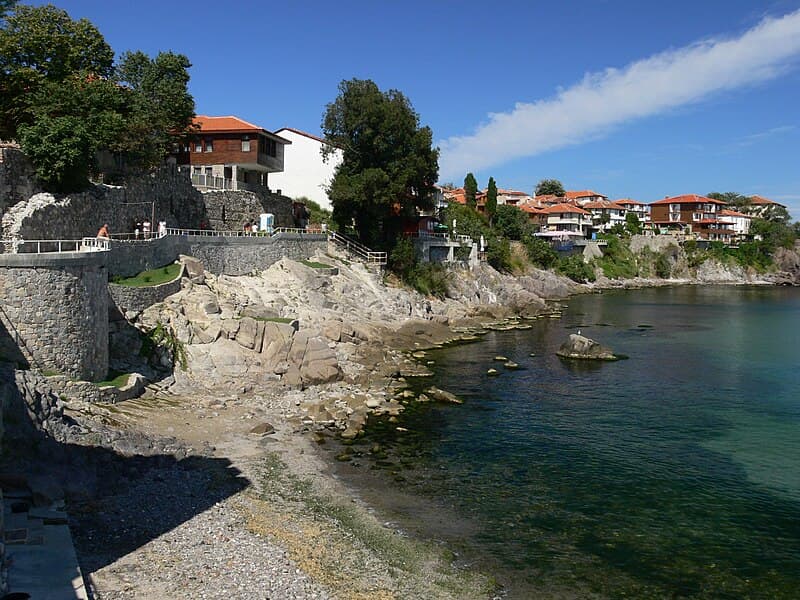
Wooden houses from the 18th and 19th centuries in narrow lanes on the rock, with stone ground floors and overhanging upper storeys clad in dark boards. Between them are small churches, artists' studios and taverns with sea views. The whole peninsula is a protected heritage site.

Tip: The prettiest route is the southern path along the cliffs above the sea — most visitors stay on the main street and miss it.

Admission:
free
Time needed:
half a day
St. Ivan Island

St. Ivan Island

1 km offshore

Bulgaria's largest island, facing Sozopol, with the remains of a medieval monastery where relics attributed to John the Baptist were discovered in 2010. Alongside the excavations stands a lighthouse, and dozens of seabird species nest here.

Tip: Boats leave the harbour only in calm seas, and capacity is limited — buy your ticket a day ahead, directly at the harbour.

Admission:
boat trip from €15
Time needed:
3 h
Ropotamo Nature Reserve

Ropotamo Nature Reserve

12 km south

The mouth of the Ropotamo river, surrounded by floodplain forest, dunes and rock formations, one of Bulgaria's oldest protected areas. Boats glide along the river among water lilies, and herons, cormorants and pelicans nest here.

Tip: Boats leave from the bridge on the main road roughly every hour; go on the morning trip for the best chance of seeing birds.

Admission:
boat trip from €8
Time needed:
half a day
Harmani Beach

Harmani Beach

new town

A wide sandy beach right below the new town, separated from the old town by just a rocky spur. The seabed slopes gently, and there's a beach patrol, bars and dunes behind it. The most accessible beach, a ten-minute walk from the old town.

Tip: The northern end near the rocks has the fewest people and the best view back to the wooden houses on the peninsula.

Admission:
free, sunlounger from €8
Time needed:
all day

Kavatsi Beach

3 km south

The longest beach in the area, over a kilometre of fine sand backed by dunes and pine forest, two kilometres south of town. Waves here tend to be bigger than in the bay, drawing surfers, and there's considerably more space than at Harmani.

Tip: The southern end has no sunloungers, and with your own parasol you'll find quiet even in August; people also bring dogs down here.

Admission:
free, sunlounger from €8
Time needed:
all day
Dyuni and the southern coves

Dyuni and the southern coves

8 km south

A gated resort, and above all a huge dune-backed beach between Sozopol and the Ropotamo river mouth, fringed by a sand ridge several metres high. The dunes are protected and accessed only via marked boardwalks.

Tip: Stepping off the boardwalks onto the dunes isn't allowed — fines are genuinely handed out, and the sand is sensitive to foot traffic.

Admission:
free
Time needed:
half a day
Primorsko

Primorsko

20 km south

A family resort twenty kilometres south with two wide beaches and prices much lower than Sozopol's. Nearby is the Thracian sanctuary of Beglik Tash, stone circles three thousand years old, set right in the forest above the sea.

Tip: Beglik Tash lies just off the road to Primorsko and is signposted; the loop between the boulders takes an hour along a forest path.

Admission:
sanctuary from €4
Time needed:
half a day
Sea Garden, Burgas

Sea Garden, Burgas

35 km north

A vast clifftop park above the sea, with avenues of plane trees, a summer theatre and steps down to the beach. A wooden pier stretches fifty metres out over the water from the park, and half the town strolls along it at dusk.

Tip: Buses run from Sozopol to Burgas every half hour and the ride takes forty minutes — you don't need a car for this trip.

Admission:
free
Time needed:
3 h
Strandzha

Strandzha

50 km south

Bulgaria's largest protected area: low, forested mountains on the Turkish border, with ancient oak forests, Thracian burial mounds and villages where fire-dancing on hot coals survives to this day. The least disturbed stretch of Bulgaria's nature.

Tip: Strandzha is practically inaccessible without a car, and mountain roads mean slow going; petrol stations are few and far between.

Admission:
free
Time needed:
all day

Photos: Sozopol Old Town — Nenko Lazarov (CC BY 2.5) · St. Ivan Island — Evgord at Bulgarian Wikipedia (CC BY-SA 3.0) · Ropotamo Nature Reserve — Original uploader was Evgord at bg.wikipedia (CC BY-SA 3.0) · Harmani Beach — John Gerrard Keulemans (Public domain) · Dyuni and the southern coves — Wikimedia Commons (CC BY 2.0) · Primorsko — Boby Dimitrov from Sofia, Bulgaria (CC BY-SA 2.0) · Sea Garden, Burgas — LadyPopular (CC BY-SA 3.0) · Strandzha — Wikimedia Commons (CC BY 2.0)

Where to stay

Areas and districts, matched to the kind of trip you are taking

Old town on the peninsula

Best for: atmosphere and couples

Rooms in converted wooden houses with sea views and taverns just steps from the door. The nicest place to stay in the whole area, but the lanes are narrow, cars can't reach it, and in peak season restaurant noise carries late into the night.

New town near Harmani

Best for: families and the beach

Ordinary development with hotels and apartments a few minutes from the wide sandy beach, plus supermarkets and the bus stop for Burgas. It's a ten-minute walk to the old town. The most practical choice for a week-long holiday.

Kavatsi

Best for: quiet, dunes and longer stays

The area by the longest beach, two kilometres south, between pine forest and dunes. Fewer restaurants and shops, but space and quiet. Not ideal without a car or a willingness to walk half an hour into town.

Dyuni and the southern coast

Best for: all-inclusive and undisturbed calm

A gated complex eight kilometres south by a huge dune-backed beach. Everything is inside the complex, including restaurants and pools. Getting to Sozopol means a shuttle or taxi — it's not walkable.

Getting around

From the airport

The nearest airport is Burgas, thirty-five kilometres north, which receives charter flights from Prague in season. The transfer to Sozopol takes three quarters of an hour and is usually included in package deals. Travelling independently, take a bus from the airport to Burgas's South (Yug) bus station, then a direct service to Sozopol, which runs every half hour and costs around four euros. Cars can't enter the old town — parking is in front of the peninsula.

Burgas (BOJ) · 35 km

  • Hotel transfer· 45 min· included in package
  • Bus via Yug station· 1 h 20 min· €5
  • Taxi· 40 min· €35
  • Bolt from the airport· 40 min· €25

Varna (VAR) · 140 km

  • Bus via Burgas· 3 h 30 min· €14
  • Private transfer· 2 h 15 min· €95

Around town

The old town is a pedestrian zone and can be walked in an hour, though the lanes are steep and the paving uneven. The new town and Harmani beach are reached on foot; Kavatsi is a half-hour walk or a few minutes by taxi. Buses to Burgas run every half hour from the station in the new town. For Ropotamo, Primorsko and Strandzha, a car is your best option, since scheduled services are infrequent and return late.

Bus to BurgasFrom the station in the new town every half hour; journey time 40–50 minutes. · €4
On footThe old town, Harmani and the new town are all within comfortable walking distance. · free
Taxi and BoltA few euros to Kavatsi or Dyuni; insist on the meter in a taxi. · €3
Rental carNeeded for Ropotamo, Beglik Tash and Strandzha; parking near the old town is paid. · €30 / day

Useful apps: Google Maps, Bolt, Moovit

When to go

Swimming is possible from mid-June to mid-September, with the sea warmest in August at 26°C. But Sozopol is pleasant outside peak season too — the old town lives on year-round, and September brings the Apollonia arts festival, filling the town with concerts and exhibitions. Late June and September are best, when the sea is warm and the lanes are still walkable. From November to April most accommodation is closed.

Best time

late June and September, with the Apollonia Festival

What to avoid

November to April, when things are closed and it's windy

MonthJanFebMarAprMayJunJulAugSepOctNovDec
Day6°7°11°16°22°26°29°29°25°19°13°8°
Night0°0°3°8°13°17°20°20°16°12°7°2°
Rainy days8788874357910
Sea8°7°8°11°17°22°25°26°23°19°14°10°

Food & drink

Sozopol is a fishing town, and fish is the backbone of the menu here — fried sprats, grilled bonito at the end of summer, mussels in wine, and fish soup. Alongside that, the usual Bulgarian repertoire: shopska salad, sirene cheese, grilled meats, clay bowls. Restaurants along the southern rim of the peninsula have the best views and prices to match; the best value is found in eateries in the newer streets and in Primorsko. The southern coast is also fig and white-wine country.

What to try

Shopska salad

Tomatoes, cucumber, peppers and coarsely grated sirene cheese. Ordered alongside everything, and the safest cheap bet at any tavern.

Kebapche and kyufte

A grilled log and patty of minced meat with cumin, the classic of Bulgarian grill fare. Served with fries and lyutenitsa relish.

Tarator

A cold soup of yoghurt, cucumber, garlic and walnuts. In summer it's the only dish that goes down easily at midday heat.

Banitsa

Filo pastry with sirene cheese, the whole country's breakfast. Bought at the bakery for a few cents and washed down with boza, a fermented grain drink.

Kavarma

Meat stewed with vegetables and baked in a clay bowl, a hearty dish cooked on the coast year-round.

Tsatsa

Fried sprats with lemon, served in little piles as an appetiser with beer. Best straight from the harbour taverns.

Palamida

Black Sea bonito grilled over charcoal, a seasonal fish of late summer and autumn. The coast is full of it in September.

Black Sea-style mussels

Mussels steamed in wine with garlic, often in a white sauce further south along the coast. Cheap and fresh.

What it costs

Coffee in the old town

€3–4

Tsatsa with lemon

€5–7

Dinner with fish

€18–26 per person

Beer, 0.5 l

€2.50–4

Two sunloungers with a parasol

€8–14

Ropotamo river boat trip

from €8

Bus to Burgas

€4

Night in a guesthouse in the old town

€50–90

Indicative prices that change over time — treat them as a guide, not a price list.

Practical information

SocketsCEuroplug, two round pinsFSchuko
Voltage230V / 50Hz
Tap waterTap water is drinkable — Tap water in Bulgaria is drinkable and routinely treated on the coast, though it tastes harder than many visitors are used to. Cheap bottled water is sold in every supermarket, and on mountain trips you can drink from public springs.
TippingNot obligatory, but customary: round up, and leave around ten percent at a restaurant. Give tips in cash directly to staff — card terminals in Bulgaria generally don't support adding a tip.
Driving on theright
SafetySozopol is a safe town with low crime; the main nuisance is pickpockets on the main street during peak season. The pavement on the peninsula is uneven and steep, and smooth-soled shoes slip easily. Kavatsi and Dyuni beaches can have bigger waves and occasional rip currents — follow the beach patrol's flags. The dunes are protected, so stick to the marked boardwalks.
Opening hoursThe resorts come alive from mid-May to the end of September; outside season most hotels, restaurants and exchange offices are closed. Supermarkets are open daily roughly from seven a.m. to ten p.m.; museums close on Mondays and extend their hours into the evening in summer.
Customs & etiquetteBulgarians nod their head up and down for "no" and shake it side to side for "yes" — for a yes/no question like "is this table free?" it's safer to ask verbally. Shoulders should be covered when entering Orthodox churches, and this is enforced in both Nesebar and Sozopol. Flash photography of icons is not allowed.
A few local wordsGood day — Dobar denThank you — BlagodaryaPlease — MolyaCheers — NazdraveThe bill, please — Smetkata, molya

How to plan your days

1 day

A day in the old town

  1. 1Morning loop through the peninsula's lanes while they're still quiet.
  2. 2The southern cliff path above the sea.
  3. 3Lunch with fish at the harbour.
  4. 4Afternoon swim at Harmani.
  5. 5Sunset from the rocks, dinner on the peninsula.

2 days

Two days with the beaches

  1. 1Day one as above.
  2. 2Day two: a full morning at long Kavatsi beach.
  3. 3Afternoon boat trip along the Ropotamo river among water lilies.
  4. 4Back for dinner in the old town.

3 days

Three days with the surroundings

  1. 1The first two days as above.
  2. 2Day three, morning boat to St. Ivan Island.
  3. 3Afternoon drive to the Thracian sanctuary of Beglik Tash above Primorsko.
  4. 4Swim in Primorsko and dinner there, where it's cheaper.
  5. 5If there's a day to spare, Burgas's Sea Garden or the Strandzha mountains.

Day trips

Burgas

35 km · 45 min by bus

A port city with the country's largest sea garden park, a wooden pier and an archaeological museum. Buses run every half hour, making it the easiest day trip from Sozopol.

Nesebar

70 km · 1 h 30 min

A medieval town on a peninsula with forty churches, a UNESCO World Heritage Site. Best done as a full-day trip with a change in Burgas; it's the most valuable historic site on the whole coast.

Tsarevo and the southern coast

45 km · 50 min by car

The southernmost stretch of the Bulgarian coast before the Turkish border, with small coves, fishing villages and access to the Strandzha mountains. Practically unreachable without a car.

Frequently asked questions

Is Sozopol or Nesebar better?+

Nesebar has more valuable monuments and more churches, but also far more tourists and a rebuilt main street. Sozopol is more lived-in, calmer, and has notably better beaches — Harmani and Kavatsi are long sandy beaches backed by dunes. For a beach holiday we recommend Sozopol; for a day of sightseeing, Nesebar.

What are the beaches like in Sozopol?+

Two main ones: Harmani, right below the new town, wide with a gentle slope and ten minutes from the old town, and Kavatsi, two kilometres south, over a kilometre long with dunes and a pine forest. Kavatsi tends to have bigger waves, while Harmani is calmer and closer.

What currency is used in Bulgaria?+

Since 1 January 2026 the currency has been the euro, which replaced the lev at a fixed rate of 1.95583 leva per euro. Old banknotes are no longer in circulation. Cards are accepted almost everywhere, including small eateries, but keep some cash for tips and the beach.

What is the Ropotamo Nature Reserve?+

A protected river mouth twelve kilometres south, where you take a boat trip through the floodplain forest among water lilies. Herons, cormorants and pelicans nest here, and protected plants grow on the dunes. A boat trip costs from €8 and departs from the bridge on the main road.

Can you get to St. Ivan Island?+

Yes, boats leave from the harbour, but only in calm seas and with limited capacity. On the island are the remains of a medieval monastery where relics attributed to John the Baptist were found in 2010, and a lighthouse. Buy your ticket a day ahead, directly at the harbour.

Do I need a car?+

Not for Burgas, since buses run every half hour. But a car is useful for the south — Ropotamo, the Thracian sanctuary of Beglik Tash, Primorsko and the Strandzha mountains lie off the main routes, and scheduled buses return at inconvenient hours.

What is the Apollonia Festival?+

A Bulgarian arts festival held every year in Sozopol in the first half of September. Ten days of concerts, theatre, exhibitions and film screenings in the streets of the old town. Accommodation for this period sells out earlier than in August — book ahead.

When is the best time to visit?+

Late June or September. In September the sea is still at 23°C, prices drop, the old town empties out, and the Apollonia Festival is on. July and August are the warmest but also the most expensive and the most crowded in the lanes.

Visa Requirements

Check the latest visa requirements for entering this country. Some nationalities may need to apply for a visa or e-visa before travel.

Check visa requirements

Language

Bulgarian

Currency

BGN

Timezone

Europe/Sofia

Dial Code

+359

Population

6.5M

Area

110,879 km²

Voltage

230V / 50Hz

Driving Side

Right

Top Hotels in Sozopol

Live prices from 500+ properties

Loading hotels...

Planning a trip to Sozopol?

Compare hundreds of hotels, find the best price, and book with free cancellation on TravelManiac.