Hotels in Saranda & Ksamil

Albania's Ionian coast, opposite Corfu

Saranda & Ksamil

LanguageAlbanian
CurrencyALL
TimezoneEurope/Tirane
Temperature10-30 °C
Dial Code+355
Population2.8M
Area28,748 km²
SocketsType C / Type F
Tap waterNot drinkable

Discover Saranda & Ksamil

Saranda is the main resort of southern Albania, spread like an amphitheatre around a bay directly opposite the Greek island of Corfu, which lies in plain view just twelve kilometres across the sea. The town itself is densely packed with concrete hotels, but it has a lively promenade, a port with ferries to Greece and, a few minutes' drive away, the reason everyone comes: the turquoise Ionian Sea. Fifteen kilometres south is the village of Ksamil, with white pebble beaches and four wooded islets you can swim or kayak to. A little further on lies ancient Butrint, a UNESCO World Heritage Site and one of the most important archaeological sites in the Balkans. Inland, the karst spring of the Blue Eye wells up from the rock, and the stone town of Gjirokastër is an hour's drive away. The water here is clearer and warmer than on Albania's Adriatic coast, the season is longer and prices are still lower than on Corfu — though in August Ksamil is overrun.

What to see

The places worth your time in Saranda & Ksamil, and what to expect at each

Butrint

Butrint

20 km south

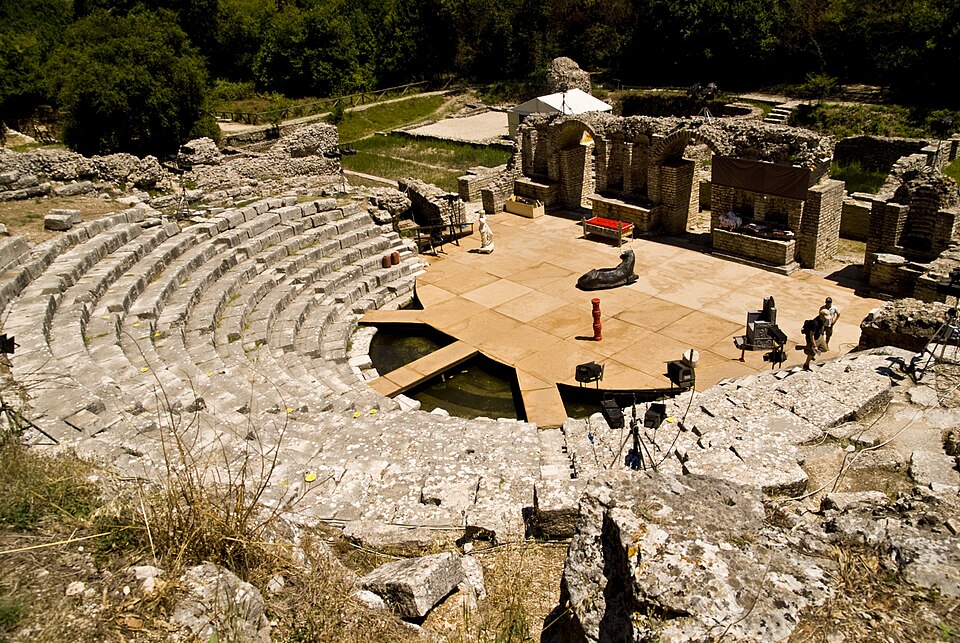
An ancient city inhabited without a break for two and a half thousand years, from Greek colony to Roman town, Byzantine bishopric and Venetian fortress. In the woods of a peninsula by the lake you will find a theatre, a baptistery with a mosaic floor, a great basilica and walls with the Lion Gate. It has been on the UNESCO list since 1992.

Tip: Arrive at 8 am on the first bus from Saranda — until about 10 it is quiet and shady, then the tour groups from Corfu arrive. The baptistery mosaic is usually covered with sand to protect it.

Admission:
from 1,000 lek
Time needed:
3 hrs
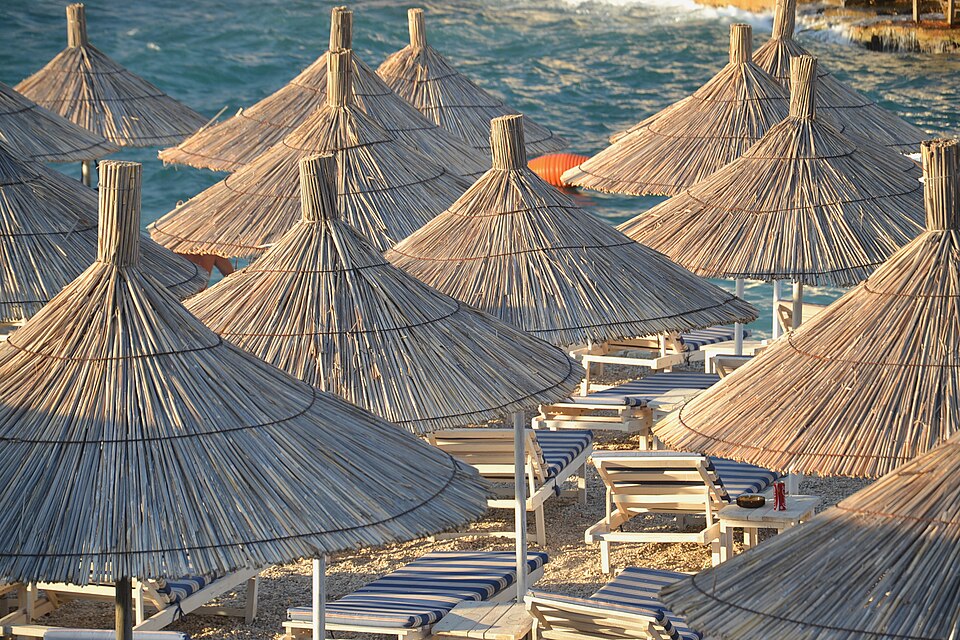
Ksamil Beaches

Ksamil Beaches

15 km south

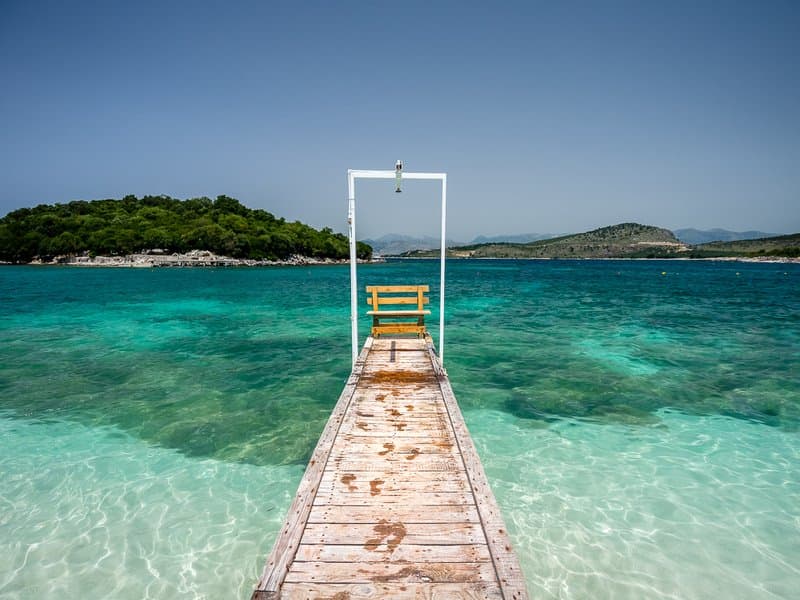
A string of small pebble and sand coves with crystal-clear turquoise water along the village of Ksamil. Most of the shore is divided between bars and restaurants that charge for sunbeds, and in high season there is little free space for a towel. The sea is shallow and calm.

Tip: In July and August you need to claim a front-row sunbed by 9 am. The coves at the northern end of the village, towards Saranda, are cheaper and quieter.

Admission:
free, sunbeds from 1,500 lek
Time needed:
full day
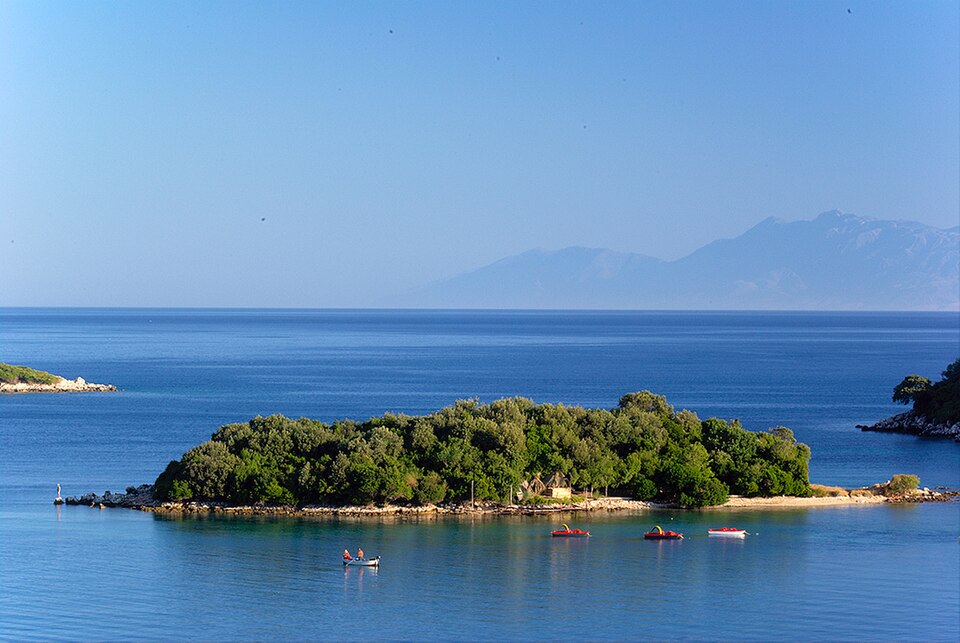
Ksamil Islets

Ksamil Islets

Ksamil

Four small wooded islets just off Ksamil with white beaches and clear water. You can reach the largest in a few minutes by kayak, pedalo or water taxi, and strong swimmers make it across. In season there are beach bars on the islets too.

Tip: Renting a kayak for an hour costs less than a water taxi there and back — bring a dry bag and water shoes, as parts of the islets are rocky.

Admission:
boat from 500 lek
Time needed:
half a day
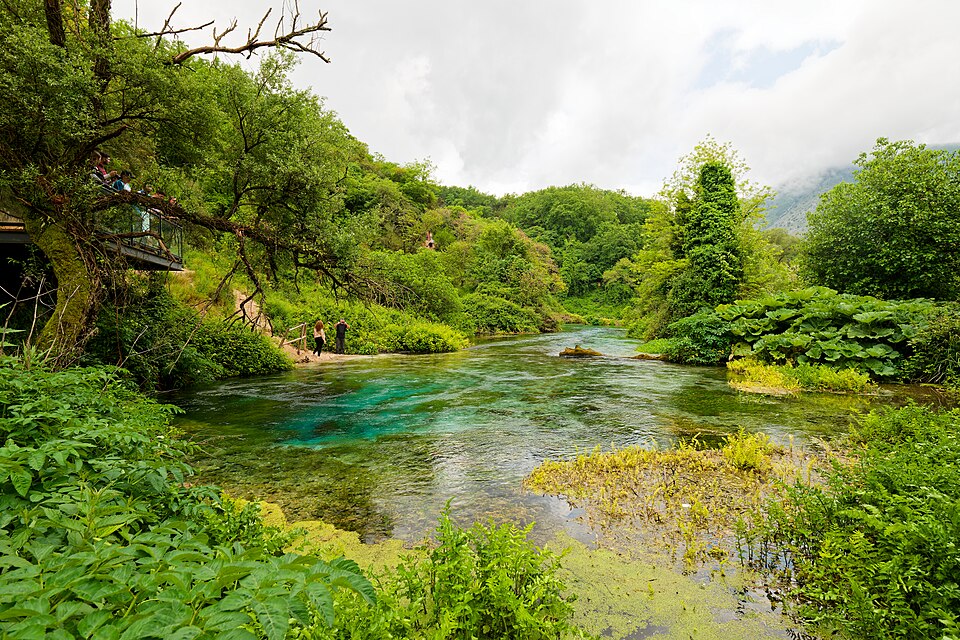
Blue Eye

Blue Eye

22 km east

An inland karst spring where water rises from a depth of more than 50 metres and forms a vivid blue pool ringed with green. The water stays at around 10°C all year. The path from the car park follows a stream through the woods.

Tip: Swimming in the spring is forbidden and enforced, so do not come for that. Arrive before 10 am — by midday there is a queue for the platform above the spring.

Admission:
from 200 lek
Time needed:
2 hrs
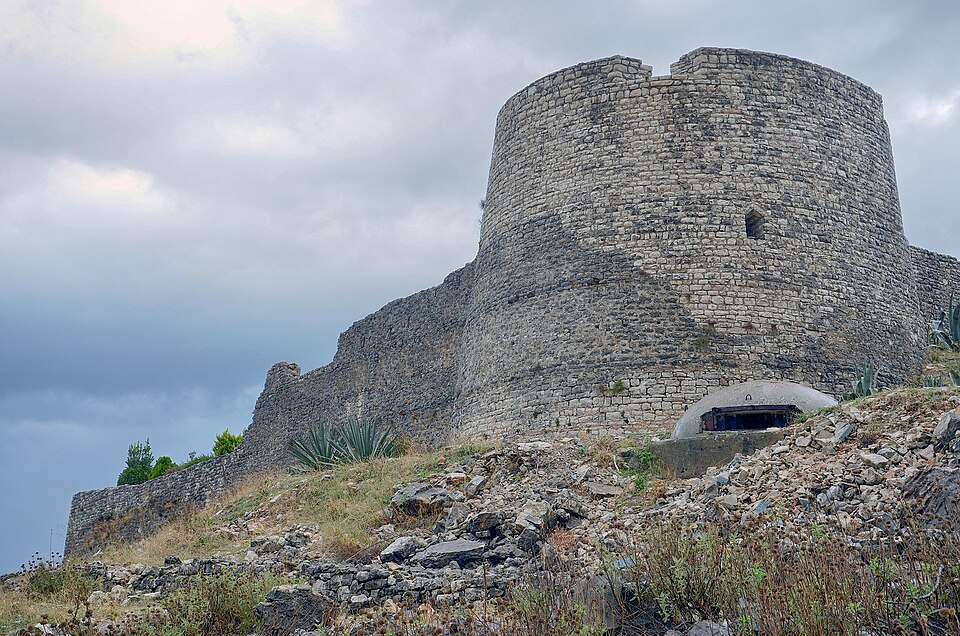
Lëkurësi Castle

Lëkurësi Castle

3 km above town

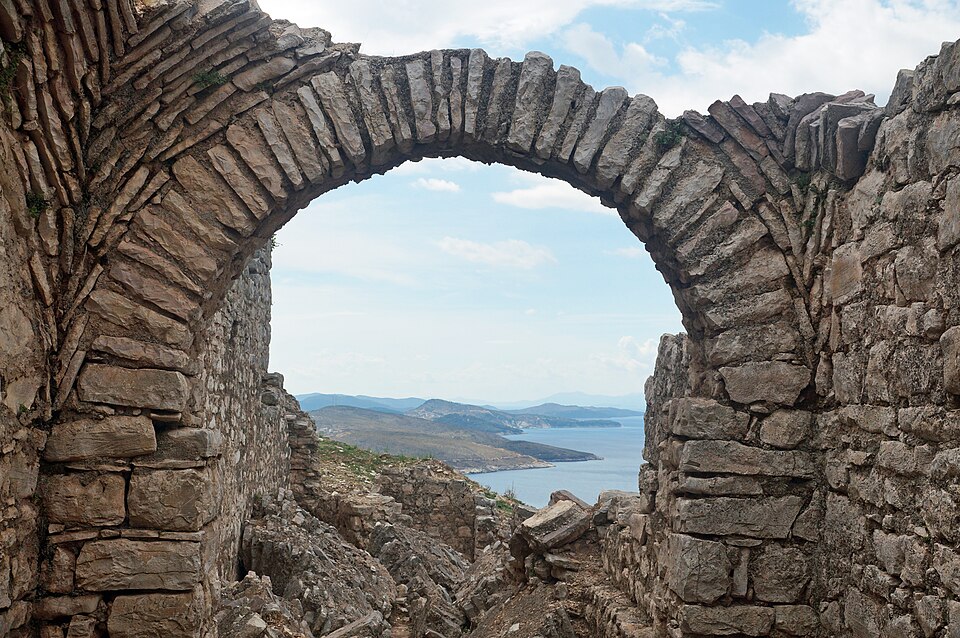
A 16th-century fortress on the hill above Saranda, built by Sultan Suleiman to guard the coast. Inside there is now a restaurant with a terrace, and the walls look out over the whole town, Butrint, the lake and Corfu.

Tip: Take a taxi up an hour before sunset — on foot it is an hour uphill along the road with no shade. A coffee on the terrace is enough; you do not have to stay for dinner.

Admission:
free
Time needed:
1.5 hrs
Monastery of the Forty Saints

Monastery of the Forty Saints

2 km above town

The ruins of a 6th-century Byzantine monastery on the hill above town, which gave Saranda its name — Agioi Saranta means Forty Saints in Greek. The walls of the basilica and its crypts survive. The site sees few visitors and is freely accessible.

Tip: A narrow road climbs up from the northern part of town — if driving, note there is only a small turning space at the top. The view is best in the morning, when Corfu is backlit.

Admission:
free
Time needed:
1 hr
Promenade and Ancient Synagogue

Promenade and Ancient Synagogue

centre

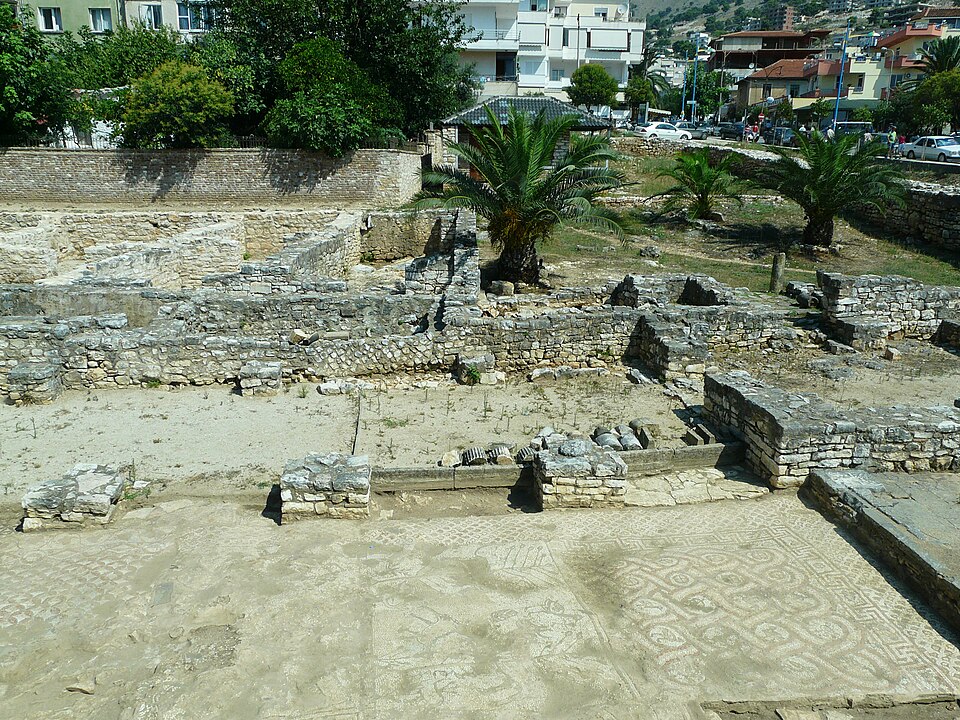
The seafront promenade around the bay, where the whole town heads in the evening. Nearby in the centre are the remains of a 5th-century synagogue, later converted into a church, with sections of mosaic floor. It is one of the oldest Jewish sites in the Balkans.

Tip: The synagogue ruins sit in a pit between buildings on the main street and are often fenced off — the mosaics are visible from outside.

Admission:
free
Time needed:
1 hr
Pasqyra Beach

Pasqyra Beach

10 km south

A cove of white pebbles and strikingly clear water between Saranda and Ksamil, nicknamed Mirror Beach. A short path leads down from the road. It is smaller and quieter than Ksamil, with just one bar behind the beach.

Tip: The Ksamil bus will stop at the turn-off on request — tell the driver Pasqyra; it is a ten-minute walk down.

Admission:
free
Time needed:
half a day
Phoenice

Phoenice

20 km east

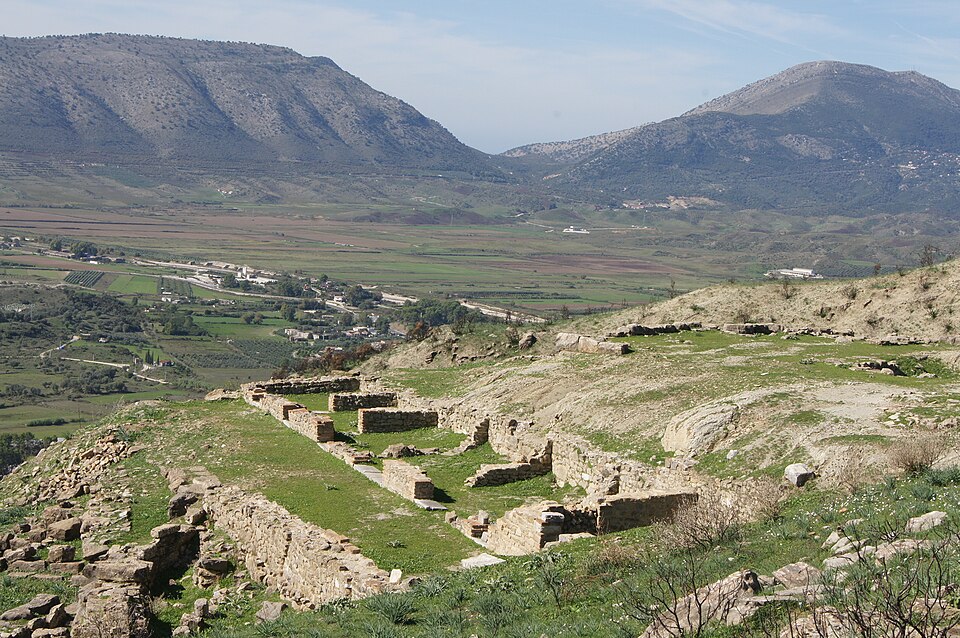
The ruins of the capital of ancient Epirus on a hill above the village of Finiq, with walls, a theatre and cisterns. Archaeologists are still digging here and the site has almost no visitors. The ridge looks out over Lake Butrint and towards the Greek border.

Tip: Combine it with the Blue Eye, as both lie in the same direction from Saranda. Bring water and sturdy shoes — there is no shade or shop around the ruins.

Admission:
from 300 lek
Time needed:
1.5 hrs

Photos: Butrint — Geoff Wong (CC BY 2.0) · Ksamil Beaches — Pudelek (Marcin Szala) (CC BY-SA 3.0) · Ksamil Islets — Artur Malinowski - @Flickr: https://www.flickr.com/photos/am1974/ (CC BY 2.0) · Blue Eye — Holger Adams (CC BY-SA 4.0) · Lëkurësi Castle — Pasztilla¨aka Attila Terbócs (CC BY-SA 4.0) · Monastery of the Forty Saints — Albinfo (CC BY-SA 4.0) · Promenade and Ancient Synagogue — Piotrus (CC BY-SA 3.0) · Pasqyra Beach — Bilby (CC BY 3.0) · Phoenice — Robmor01 (CC BY-SA 4.0)

Where to stay

Areas and districts, matched to the kind of trip you are taking

Central Saranda

Best for: nightlife and day trips

Hotels along the promenade and in the streets above it, within walking distance of the Corfu ferry port and the buses to Ksamil and Butrint. The most restaurants and bars, and the best base for excursions. The town beaches, however, are small, pebbly and crowded.

Ksamil

Best for: swimming and a beach holiday

A village beside the south's prettiest beaches, with the islets in view. Accommodation is in smaller hotels and apartments, and Butrint is five minutes away. In July and August it is extremely crowded and prices are the highest on the Albanian coast.

North Saranda and Pasqyra

Best for: peace and quiet with a car

Newer hotels on the northern edge of town and along the road to Ksamil, often with their own pool or small cove. Quieter than the centre, but without a car or the bus you depend on the hotel. Good value outside peak season.

Borsh and Lukovë

Best for: wilder beaches

Villages on the Riviera thirty to forty kilometres north, with long pebble beaches and olive groves. Fewer people and lower prices than in Ksamil, but you need a car and must be ready for a winding road. For those who want to avoid the crowds.

Getting around

From the airport

Saranda has no airport of its own. The fastest route is a flight to Corfu, which has charter and scheduled flights from across Europe in summer, followed by a ferry from the old port in Corfu Town — the fast boat takes 30 to 40 minutes. The alternative is a flight to Tirana, also well connected to European cities, then five hours by bus or transfer over the mountains. Tour operators usually bring guests via Tirana with the transfer included. Driving from Central Europe is around 1,700 kilometres.

Corfu – Ioannis Kapodistrias Airport (CFU) · 30 km

  • Taxi to the port and fast ferry· 1 hr 15 min· €35
  • Conventional ferry· 1 hr 30 min crossing· €25

Tirana – Mother Teresa Airport (TIA) · 280 km

  • Bus from Tirana· 5–6 hrs· 1,800 lek
  • Private transfer· 4 hrs 30 min· €150
  • Hotel transfer· 4 hrs 30 min· included in package

Around town

A local bus runs from Saranda to Ksamil and Butrint roughly every hour, more often in summer, and the ride to Ksamil takes twenty minutes. For the Blue Eye, Phoenice and Gjirokastër you are better off with a taxi, a hire car or an organised tour, as buses run only a few times a day. Taxis have no meters, so agree the fare in advance. Ferries to Corfu sail several times a day, and for a day trip an ID card or passport is all you need.

Bus Saranda – Ksamil – ButrintFrom the promenade every 30 to 60 minutes in summer; buy tickets from the conductor. · 100 lek
TaxiSaranda to Ksamil costs about 1,500 lek; agree the fare in advance. · 800 lek
Hire car or scooterWorth it for the Blue Eye, Phoenice, Gjirokastër and the Riviera to the north. · €35 / day
Ferry to CorfuFast boats and conventional ferries from Saranda port, several times a day. · €25

Useful apps: Google Maps, Maps.me, XE Currency, Booking.com

When to go

The Ionian coast is the warmest part of Albania. You can swim from June to mid-October, and in August the sea is a clear 26°C. July and August are hot, and Ksamil gets so full there is no room on the beach for a towel. June and September are best, with warm water, lower prices and Butrint bearable without the heat. From November to April it rains and most hotels in Ksamil close.

Best time

June and September

What to avoid

August for the crowds, November to March for the rain

MonthJanFebMarAprMayJunJulAugSepOctNovDec
Day14°15°17°20°25°29°32°32°28°24°19°15°
Night6°6°8°11°15°19°21°22°18°14°10°7°
Rainy days12111086311481314
Sea15°15°15°17°20°23°25°26°24°22°19°17°

Food & drink

Southern Albania eats plenty of fish, mussels and vegetables with olive oil, and the cooking is close to Greek. Ksamil is known for the mussels farmed in Lake Butrint — a portion in a restaurant costs about 800 lek. Inland they cook lamb and goat, and in Gjirokastër the rice balls called qifqi. Beachfront restaurants are often twice as expensive as those in the village one street up. Albanians eat dinner around 9 pm.

What to try

Lake Butrint mussels

Mussels from the farms in the lagoon behind Ksamil, steamed with wine and garlic or baked. They are fresh and cheap, and best eaten right in Ksamil.

Ionian fish

Sea bass and sea bream, levrek and koce in Albanian, grilled whole with olive oil and oregano. The freshest are in the tavernas by Saranda's port, where you pick your fish straight from the ice.

Qifqi

Fried balls of rice, egg and mint, a speciality of Gjirokastër. They are served as a starter with yoghurt and cost a few hundred lek.

Petulla

Fried yeast-dough puffs that start the day in the south. They are eaten warm with honey, white cheese or jam and cost a few dozen lek apiece at a bakery.

Albanian salad

Tomatoes, cucumber, onion, olives and a slab of white cheese, dressed with local olive oil. It is ordered with every meal and costs 300 to 500 lek.

Olives and olive oil

Southern Albania is olive-grove country, and trees hundreds of years old grow around Borsh. Olives and oil from local presses come with every meal, and a bottle of oil makes a good souvenir.

Oshaf

A sweet pudding of sheep's milk and dried figs, the traditional dessert of Gjirokastër. It is served chilled — look for it in family-run restaurants in the old town.

Raki

Grape or plum brandy that your host will pour as a welcome and again at the end of the meal. Homemade raki is often over 50 per cent, so sip it slowly.

What it costs

Espresso in a café

100–200 lek

Byrek or gyros

150–300 lek

Dinner in a restaurant

1,500–3,000 lek per person

Beer, 0.5 l

300–500 lek

Two sunbeds in Ksamil

1,500–4,000 lek

Butrint entry

from 1,000 lek

One-way ferry to Corfu

€25–40

Night in a 4-star hotel

€80–150

Indicative prices that change over time — treat them as a guide, not a price list.

Practical information

SocketsCEuroplug, two round pinsFSchuko
Voltage230V / 50Hz
Tap waterDo not drink tap water — Tap water in Albania is not recommended for drinking. Coastal water systems are old and struggle in high season, and hotel water is often heavily chlorinated or comes from a tank on the roof. Use bottled water for drinking and brushing your teeth: a 1.5-litre bottle costs 60 to 80 lek in a shop and twice that on the beach. Restaurants do not offer tap water — you order a bottle.
TippingTips are expected in Albania and given in cash. In a café you round up; in a restaurant leave around 10 per cent, as service is rarely included. Give beach-bar staff and transfer drivers 100 to 200 lek. Hotels and better restaurants take cards, but beach bars, sunbed attendants, taxis and small places want cash — ideally in lek, as euros are converted at poor rates.
Driving on theright
SafetySaranda and Ksamil are safe for tourists; petty theft mostly involves belongings left unattended on the beach. The bigger risks lie elsewhere: the mountain road from Tirana over the pass is long and winding and the local driving style aggressive, the rocky beaches have sea urchins, and in July and August the sun is fierce with little shade. Taxis and boats to the islets have no fixed prices, so agree them in advance. The emergency number is 112, police 129.
Opening hoursCafés open as early as 7 am, and Albanians spend much of the day in them. In the resorts, shops and supermarkets open daily from 8 am until 10 or 11 pm, Sundays included. Government offices and banks close around 3 pm. Museums are often closed on Mondays and cut their hours out of season. From November to April most hotels and restaurants in the resorts are closed.
Customs & etiquetteMind the gestures: older Albanians often nod up and down to mean “no” and shake their head from side to side for “yes”, while younger people mostly use the European convention — if in doubt, ask in words. Cover shoulders and knees in mosques and churches. Hospitality is a matter of honour, so do not bluntly turn down an invitation to coffee or raki. Swimsuits are the norm on the beach; topless sunbathing only in secluded spots.
A few local wordsGood afternoon — MirëditaThank you — FaleminderitPlease — Ju lutemYes / no — Po / JoHow much is it? — Sa kushton?The bill, please — Llogarinë, ju lutemCheers — Gëzuar

How to plan your days

1 day

A day between Butrint and Ksamil

  1. 1Take the first morning bus to Butrint and spend three hours in the ancient city.
  2. 2Lunch on mussels in Ksamil.
  3. 3Afternoon swimming and a kayak trip to the islets.
  4. 4Back to Saranda in the evening for a stroll along the promenade.

2 days

Two days with the Blue Eye

  1. 1Day one as above.
  2. 2On the morning of day two, go by taxi or car to the Blue Eye.
  3. 3On the way back, the ruins of Phoenice above the village of Finiq.
  4. 4Sunset at Lëkurësi Castle above the town.

3 days

Three days including Gjirokastër

  1. 1The first two days as above.
  2. 2On day three, drive to Gjirokastër in the morning, an hour away.
  3. 3The castle with its weapons museum, the Ottoman Skenduli House and the old bazaar.
  4. 4Back in the afternoon for a swim at Pasqyra Beach.

Day trips

Gjirokastër

55 km · 1 hr by car

A UNESCO-listed stone town with slate roofs, a huge castle and Ottoman tower houses. It is the birthplace of Enver Hoxha and the writer Ismail Kadare. You can stop at the Blue Eye on the way.

Corfu

25 km · 35 min by fast boat

The Greek island directly opposite Saranda, whose old town of Corfu is a UNESCO World Heritage Site. Go in the morning, return in the evening: fortresses, Venetian lanes and coffee on the Liston. Prices, though, are Greek, not Albanian.

Himarë and Porto Palermo

60 km · 1 hr 30 min by car

The Albanian Riviera to the north, with a steep coastline and pebble beaches. In the bay of Porto Palermo, Ali Pasha of Tepelena's fortress stands on a peninsula, and Himarë has an old town on a hill above the sea.

Frequently asked questions

Is it better to stay in Saranda or Ksamil?+

It depends on what you want. Ksamil has the best beaches and quiet evenings, but it is overcrowded and pricier in August. Saranda has more restaurants, the promenade and better connections for day trips and Corfu, but you take the bus to go swimming.

What is the best way to get to Saranda?+

The quickest route is a flight to Corfu and then the ferry, which takes 30 to 90 minutes depending on the boat. The other option is a flight to Tirana and five hours over the mountains by bus or transfer. Tour operators usually fly via Tirana.

Do I need a passport for the ferry from Corfu?+

EU citizens need only a valid national ID card, although this is the external Schengen border and there are passport checks on both sides. Factor them into your plans — in high season the queue before departure can take half an hour.

Can you swim in the Blue Eye?+

No, swimming and jumping into the spring is forbidden and enforced. The water is also around 10°C all year round. People come for the walk through the woods and the view from the platform above the spring, best reached in the morning.

How much does Butrint cost to visit?+

Entry is from 1,000 lek, about €10, payable on site in cash or by card. A visit takes two to three hours. It opens at 8 am, and it is best to arrive straight away, before the groups from Corfu get there.

Does Ksamil have sandy beaches?+

They are mostly pebble with patches of sand, but the water is shallow, calm and crystal clear, so they suit children too. Water shoes are worth having because of the stones and sea urchins. Most of the beach is split between bars with paid sunbeds.

Can I pay in euros in Saranda?+

The official currency is the lek, at roughly 100 lek to the euro. Thanks to Corfu next door, euros are accepted almost everywhere, but the rate is usually poor and change comes in lek. Carry lek in cash for sunbeds, taxis and markets.

When is the best weather in Saranda?+

June and September: the sea is 23 to 25°C, daytime highs are around 30°C and Ksamil is not overcrowded. August has the warmest water but also the crowds and the highest prices. Swimming is possible until about mid-October.

Visa Requirements

Check the latest visa requirements for entering this country. Some nationalities may need to apply for a visa or e-visa before travel.

Check visa requirements

Language

Albanian

Currency

ALL

Timezone

Europe/Tirane

Dial Code

+355

Population

2.8M

Area

28,748 km²

Voltage

230V / 50Hz

Driving Side

Right

Top Hotels in Saranda & Ksamil

Live prices from 500+ properties

Loading hotels...

More destinations in Albania

Planning a trip to Saranda & Ksamil?

Compare hundreds of hotels, find the best price, and book with free cancellation on TravelManiac.