Hotels in Corfu

A Venetian town in Greece's greenest island

Corfu

LanguageGreek
CurrencyEUR
TimezoneEurope/Athens
Temperature12-33 °C
Dial Code+30
Population10.4M
Area131,957 km²
SocketsType C / Type F
Tap waterBottled advised

Discover Corfu

Corfu is the westernmost and greenest of the major Greek islands — 4 million olive trees, planted here by the Venetians, hold moisture in the soil, so the island never turns yellow the way the Cyclades do. 4 centuries of Venetian and then British rule made it the least "Greek" place in Greece: the UNESCO-listed old town has arcades reminiscent of Venice, a cricket pitch left by the British, and the highest concentration of Italian surnames in the country. The west coast is dramatic, with bays hemmed in by cliffs around Paleokastritsa, while the east is calmer, shallower and home to most of the resorts. The island is 90 kilometres long and mountainous, so journeys take longer than they look on a map. The season runs from May to October, but even then Corfu is rainier than the rest of Greece.

What to see

The places worth your time in Corfu, and what to expect at each

Corfu Old Town

Corfu Old Town

Παλιά Πόλη

Corfu Town

A maze of narrow lanes called kantounia between 2 Venetian fortresses, UNESCO-listed. Here you'll find the arcaded street of the Liston, modelled on Paris's Rue de Rivoli, the Church of Saint Spyridon holding the relics of the island's patron saint, and the tallest building in town, at 6 storeys.

Tip: The cricket pitch by the Liston is still in use today — a British legacy you won't see anywhere else in Greece.

Admission:
free
Time needed:
3 h
Old Fortress

Old Fortress

Παλαιό Φρούριο

Corfu Town

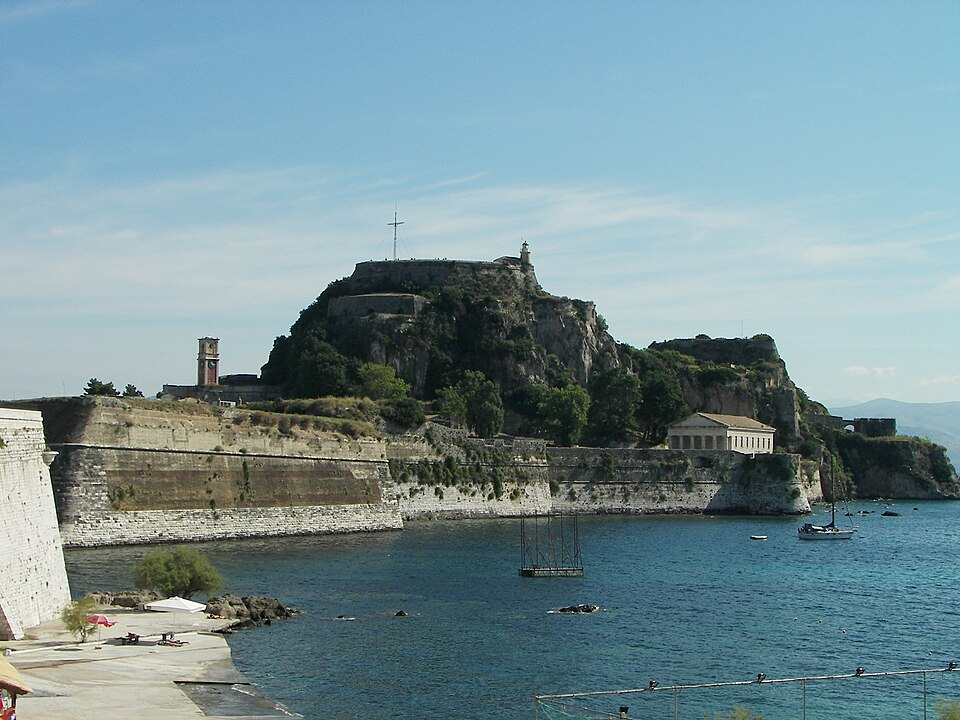
A Venetian fortress on a rocky headland, separated from the town by an artificial moat that the sea still flows through today. Inside stands the British Church of St George, built in the style of a Doric temple, and the top of the lighthouse gives a view over the whole town and the Albanian coast.

Tip: There's an entry fee, but the Contrafossa moat itself, with its moored boats, is freely accessible and more photogenic than the fortress itself.

Admission:
from €6
Time needed:
1.5 h
Achilleion

Achilleion

10 km south

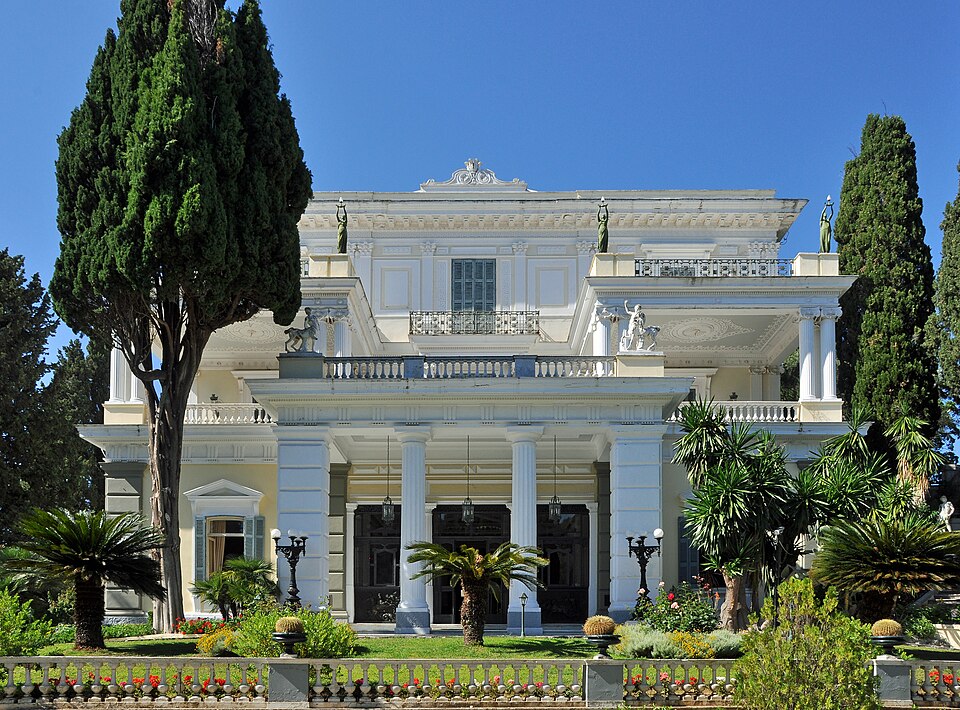
A palace built for Empress Elisabeth of Austria, known as Sisi, after the death of her son Rudolf. Both the interiors and the gardens are devoted to Achilles, whose monumental statue stands in the garden overlooking the sea. After Sisi's death, the palace was bought by Kaiser Wilhelm II.

Tip: The gardens are more interesting than the interior — save most of your time for the statue of the Dying Achilles and the view south over the island.

Admission:
from €10
Time needed:
2 h
Paleokastritsa

Paleokastritsa

25 km northwest

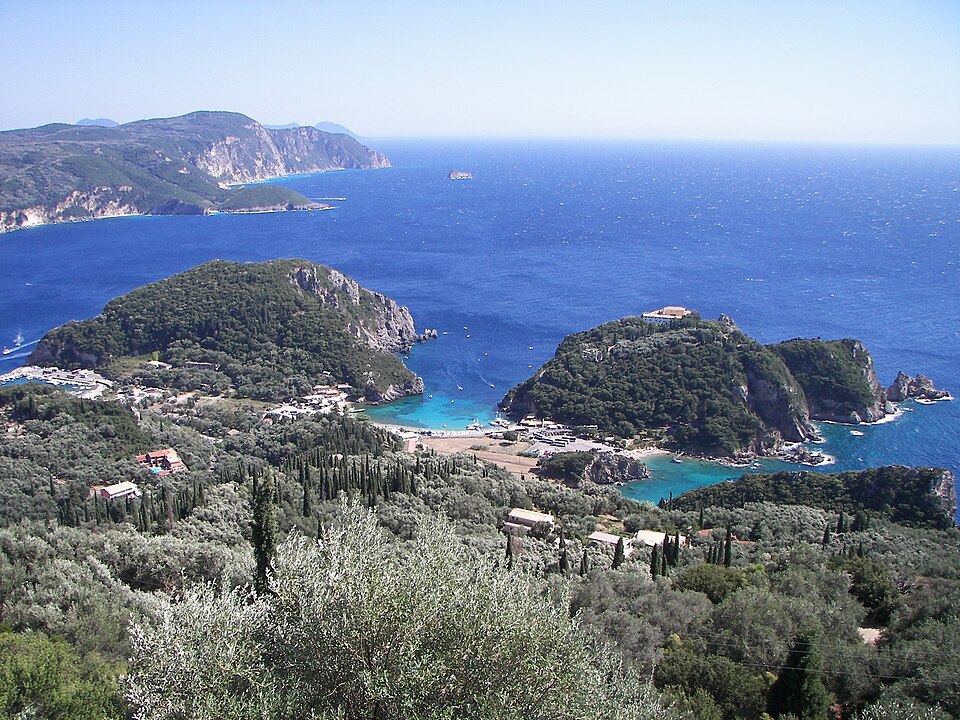
A cluster of 6 coves on the west coast, hemmed in by forested cliffs, with the clearest water on the island. Above the bay stands the 13th-century Panagia Theotokos Monastery, with a small icon museum and a courtyard full of bougainvillea.

Tip: Boats leave the beach for the cliff caves — a half-hour trip for a few euros is the best way to see the coves.

Admission:
free, monastery by donation
Time needed:
half a day
Angelokastro

Angelokastro

30 km northwest

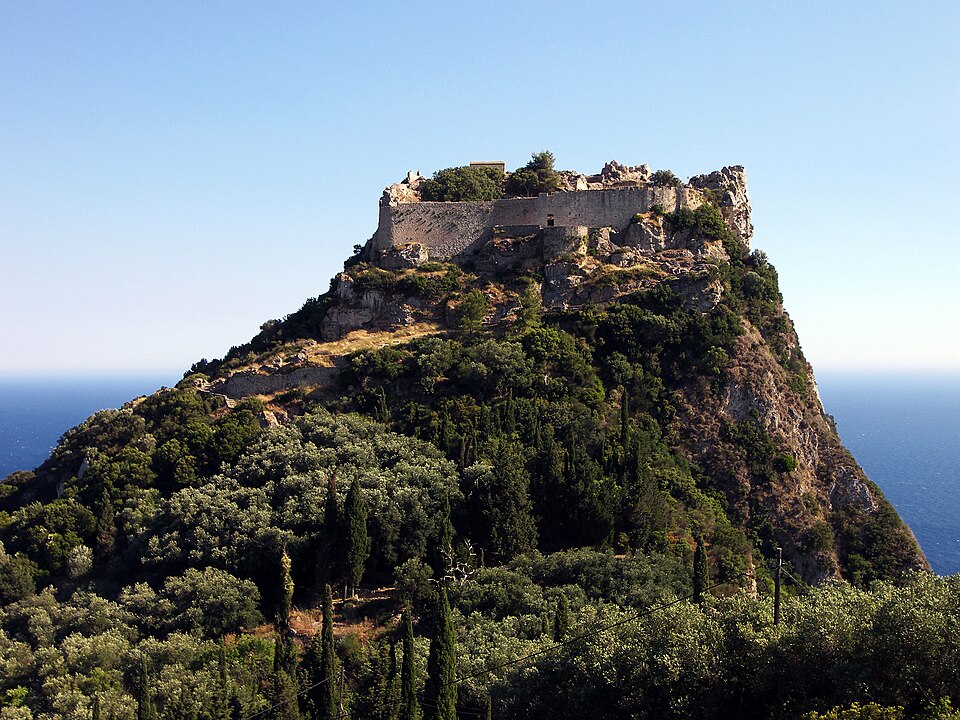
A Byzantine fortress atop a 300-metre cliff above the west coast, which was never conquered. It's reached only by a steep footpath; what remains at the top are the walls, a cistern and a chapel. The view from here is among the best in the Ionian Sea.

Tip: The climb from the car park takes 20 minutes over uneven stones — don't wear flip-flops, and bring water.

Admission:
from €4
Time needed:
2 h
Pontikonisi and Vlacherna

Pontikonisi and Vlacherna

Ποντικονήσι

5 km south

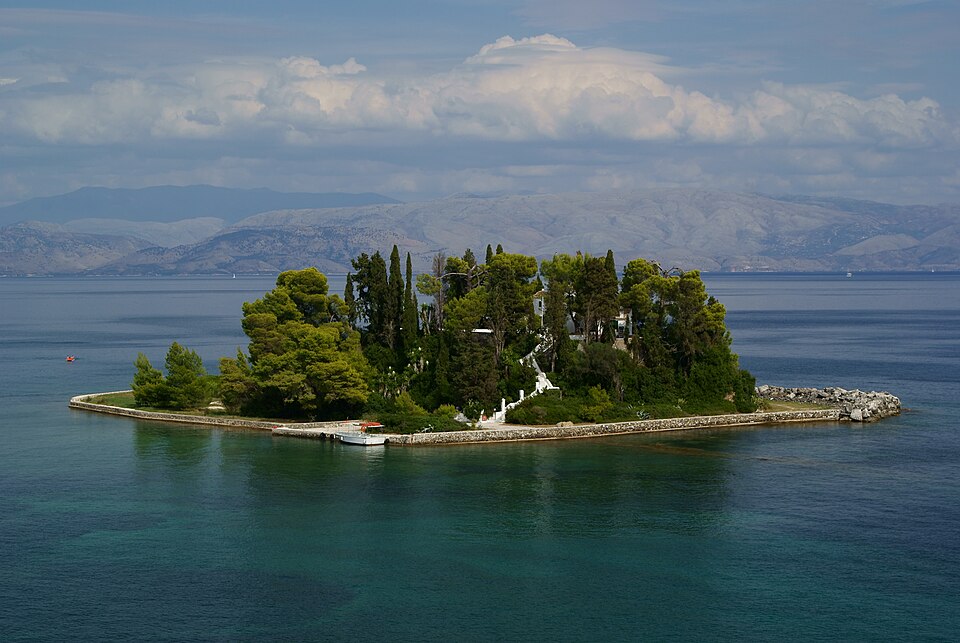
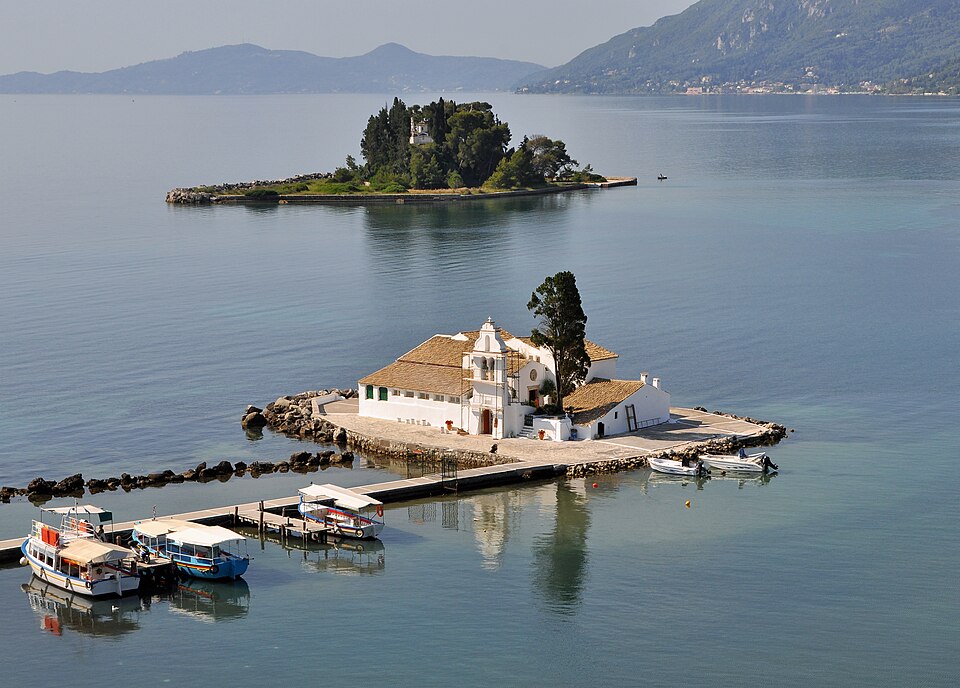
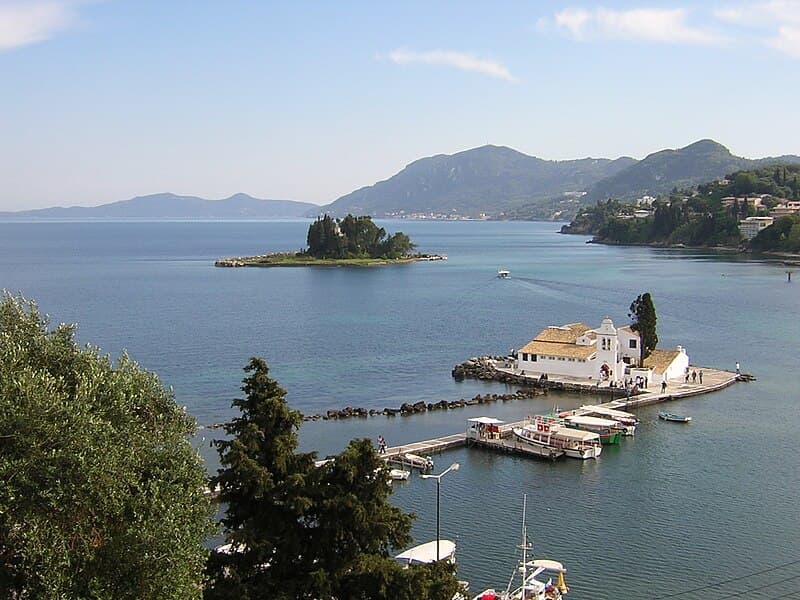
The most photographed sight on the island: the white Vlacherna Monastery at the end of a narrow jetty, with the forested islet of Pontikonisi behind it, said by legend to be the petrified ship of Odysseus's Phaeacians. Planes land directly overhead.

Tip: The best view is from the Kanoni viewpoint above the bay, not from the jetty — and if a plane happens to land at that moment, you'll get a photo you can't take anywhere else.

Admission:
free
Time needed:
1 h
Kanoni Viewpoint

Kanoni Viewpoint

4 km south

A terrace above the strait with views of Vlacherna Monastery, the islet of Pontikonisi and the airport runway all at once. The name comes from a French cannon that stood here during the Napoleonic occupation. A footbridge leads from the viewpoint across the lagoon to the jetty.

Tip: Come around 6pm — the light is best and landings are most frequent at that time.

Admission:
free
Time needed:
45 min
Sidari and the Canal d'Amour

Sidari and the Canal d'Amour

Σιδάρι

35 km north

A resort on the north coast known for sandstone formations that the sea has carved into narrow channels and tunnels. Legend has it that a couple who swim through the channel together will never split up. The beaches here are sandy and the sea is shallow.

Tip: Ferries leave Sidari for the Diapontia Islands — Erikoussa and Mathraki are empty and crystal-clear, unlike Sidari itself.

Admission:
free
Time needed:
half a day
Mount Pantokrator

Mount Pantokrator

35 km north

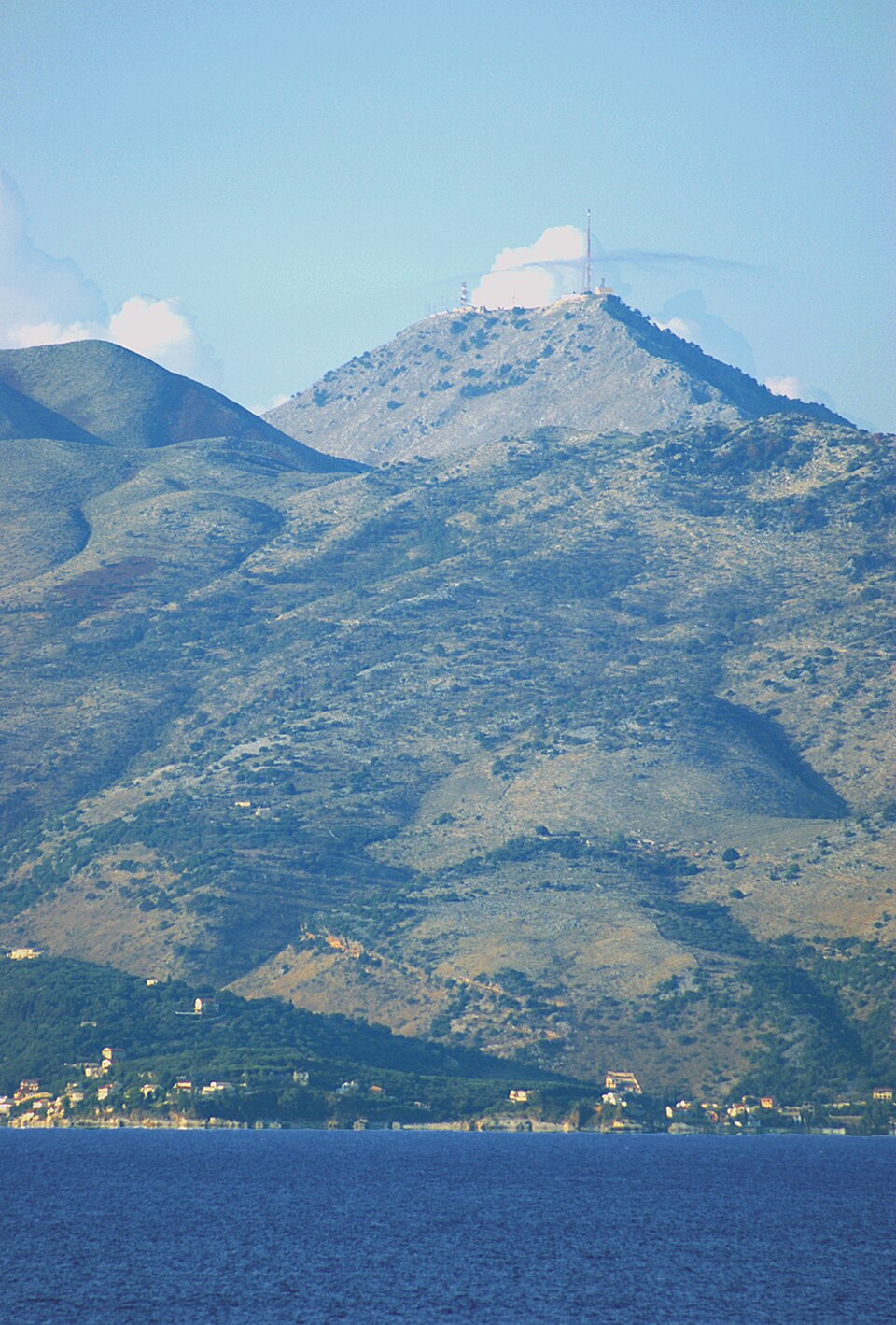
The island's highest point, at 906 metres, with a 14th-century monastery on the summit. On a clear day you can see the whole of Corfu, the Albanian mountains and even the distant Italian coast. The road up is narrow, winding and has no barriers.

Tip: Go early in the morning — after 9am the summit often clouds over in haze and the view of Italy disappears.

Admission:
free
Time needed:
half a day

Photos: Corfu Old Town — Olivier Touzeau (Public domain) · Old Fortress — Own work I am the author. Dr.K. 15:51, 6 September 2006 (UTC) (CC BY-SA 3.0) · Achilleion — Marc Ryckaert (MJJR) (CC BY 3.0) · Paleokastritsa — Wikimedia Commons (CC BY-SA 3.0) · Angelokastro — Dr.K. (CC BY-SA 3.0) · Pontikonisi and Vlacherna — Dreamsdestroyer (CC BY-SA 4.0) · Kanoni Viewpoint — Marc Ryckaert (CC BY 3.0) · Sidari and the Canal d'Amour — Arbustum (CC BY-SA 4.0) · Mount Pantokrator — Albinfo (CC BY-SA 3.0)

Where to stay

Areas and districts, matched to the kind of trip you are taking

Corfu Town

Best for: first-time visitors and sightseeing

The only place on the island with year-round life, restaurants and museums. Accommodation in the Venetian houses is atmospheric, but without pools or a beach. It's also the best base for bus travel, since every route starts here.

Dassia and Gouvia

Best for: families and all-inclusive stays

The east coast a few kilometres north of town, home to most of the large hotels. The sea here is calm and shallow, and the beaches are a mix of pebble and sand. It's a quarter of an hour by bus to town, which makes this area the most practical choice for a first holiday on Corfu.

Paleokastritsa and the west

Best for: the prettiest coves and snorkelling

The west coast, with bays hemmed in by cliffs and the clearest water on the island. Scenically the finest part of Corfu. The beaches are smaller and deeper, though, and the access paths are steep, which makes it harder going with small children or without a car.

Kassiopi and the northeast

Best for: peace and quiet and small coves

The northeast coast facing the Albanian mountains, with a series of small pebble coves and the fishing village of Kassiopi. Quieter and tidier than the area around town, and popular with British visitors. Getting around without a car is difficult here, though.

Getting around

From the airport

Corfu has Ioannis Kapodistrias International Airport just 3 kilometres from the centre of the main town — the runway runs right over the lagoon at Kanoni, making the approach an experience in itself. In season, charter and scheduled flights arrive from numerous European cities. From the airport you can reach the town by city bus, taxi, or on foot in under half an hour. Corfu can also be reached by ferry from Venice, Ancona or Bari in Italy.

Corfu Ioannis Kapodistrias (CFU) · 3 km

  • City bus to the centre· 15 min· €1.70
  • Taxi to Corfu Town· 10 min· €15
  • Taxi to Dassia· 25 min· €30
  • Hotel transfer· 15–70 min depending on resort· included in stay

Around town

The blue city buses serve Corfu Town and its immediate surroundings up to 15 kilometres out, while the green intercity KTEL buses run to more distant resorts and villages. All routes start from the capital, so getting from one resort to another means passing through the centre and takes a long time. The island is mountainous, and the roads are narrow, winding and without barriers in the hills. If you want to see Paleokastritsa, Angelokastro and the north, rent a car — otherwise you'll spend half your holiday on a bus.

Blue city busesCorfu Town and the surrounding area up to 15 km, including Kanoni and Achilleion. · €1.70
Green KTEL busesIntercity routes to resorts and villages, all passing through the capital. · €2.50
Rental carThe only sensible way to explore the west and north of the island. The roads are narrow and winding. · €35 / day
TaxiBlue-and-white cars, with fixed fares for main routes posted at the taxi rank. · €4 flag fall

Useful apps: Moovit, Google Maps

When to go

June and September are the best months: warm at around 28°C, the sea pleasant and the island still green. July and August are the hottest and busiest, and also the most expensive. Corfu is also the rainiest Greek island — from November to March it gets more rainfall than London, and most resorts close. April and May are lovely for sightseeing, with the island covered in flowers, but the sea is barely 17°C.

Best time

June and September

What to avoid

November to March, when it rains heavily and resorts close

MonthJanFebMarAprMayJunJulAugSepOctNovDec
Day14°14°16°19°24°28°31°31°27°22°18°15°
Night5°5°7°9°13°17°19°19°17°13°10°7°
Rainy days131210964236101315
Sea16°15°15°17°20°23°25°26°24°22°20°18°

Food & drink

Corfiot cuisine is the most Italian of any in Greece — 4 centuries of Venetian rule left behind pasta, meats stewed in sauces, and the use of cinnamon in savoury dishes. A local speciality is the kumquat, a tiny citrus fruit turned into liqueur and preserves, and found nowhere else in Greece. In tavernas, several dishes are ordered to share at the centre of the table, and dinner starts after 9pm. For genuinely local cooking, head to the villages inland, where meals follow the seasons.

What to try

Pastitsada

Rooster or beef stewed in a cinnamon-spiced tomato sauce, served with thick pasta. The most typical Corfiot dish.

Sofrito

Thin slices of veal in a sauce of white wine, garlic and parsley. A Venetian legacy without a single tomato.

Bourdeto

Fish stewed in a spicy paprika sauce, traditionally made with scorpionfish. Spicier than you'd expect to find in Greece.

Kumquat

A tiny citrus fruit grown only on Corfu; liqueur, preserves and candied fruit are all sold everywhere as souvenirs.

Tsitsibira

A ginger lemonade brought to the island by the British, still made here today to the original recipe.

Sykomaida

A pressed fig cake with ouzo and spices, a traditional rustic dessert served with homemade spirits.

What it costs

Greek coffee or frappé

€3–4

Gyros in pitta

€4–5

Dinner at a taverna

€20–30 per person

Beer, 0.5 l

€4–5

Sunbed and umbrella

€10–15 for 2 sunbeds

Bus to Paleokastritsa

€3

Car rental per day

from €35

Night in a 4-star hotel

€100–160

Indicative prices that change over time — treat them as a guide, not a price list.

Practical information

SocketsCEuroplug, two round pinsFSchuko
Voltage230V / 50Hz
Tap waterTap water is treated, bottled is common — Tap water on Corfu is safe to drink and good quality, and the island has plenty of its own sources. Bottled water is mostly a matter of habit.
TippingNot mandatory. At tavernas, people round up or leave 5–10%, provided a service charge hasn't already been added.
Driving on theright
SafetyCorfu is very safe. The main risks are on the road: narrow mountain roads without barriers, especially the routes up to Pantokrator and Angelokastro. On pebble beaches watch out for sea urchins, and in Paleokastritsa for rocky patches beneath the surface.
Opening hoursShops in the resorts stay open late into the evening, 7 days a week. Museums close early in the afternoon and are usually shut on Mondays. Outside the season, opening hours shrink significantly, and in Paleokastritsa almost everything closes.
Customs & etiquetteShoulders and knees should be covered when visiting monasteries; at both Paleokastritsa and Vlacherna, wraps are lent out at the entrance. In Greece, toilet paper goes in the bin, not the bowl. Going topless on the beach is common.
A few local wordsHello — KaliméraThank you — EfcharistóPlease — ParakalóCheers — JamasThe bill, please — To logariasmó, parakaló

How to plan your days

1 day

A Day in Corfu Town

  1. 1Morning in the old town, the Liston and the Church of Saint Spyridon.
  2. 2The Old Fortress and the view from the lighthouse.
  3. 3Lunch in the kantounia lanes, off the main route.
  4. 4Afternoon at Kanoni, Vlacherna and Pontikonisi, dinner on the waterfront.

2 days

2 Days with the West Coast

  1. 1Day 1 as above.
  2. 2Day 2 morning at Paleokastritsa and the monastery above the bay.
  3. 3A boat trip to the cliff caves, and a swim.
  4. 4Afternoon climb up to Angelokastro, returning in the evening through the mountain villages.

3 days

3 Days Including the North

  1. 1Days 1–2 as above.
  2. 2Day 3 early morning up Mount Pantokrator, while it's still clear.
  3. 3Descend to Kassiopi and swim in one of the nearby coves.
  4. 4Afternoon at Sidari and the Canal d'Amour.
  5. 5Return journey via Achilleion, time permitting.

Day trips

Paxos and Antipaxos islands

45 km · 1 h by speedboat

2 small islands south of Corfu, with blue caves in the western cliffs and beaches on Antipaxos with Caribbean-clear water. The island's most popular full-day boat trip.

Butrint in Albania

30 km · 1 h 30 min by ferry and car

A UNESCO-listed ancient city with a theatre, baptistery and Venetian fortress, set in a national park by a lagoon. The ferry sails to Sarandë, 20 minutes by car from the site. Don't forget your passport.

Inland villages and Old Perithia

40 km · 1 h by car

The island's oldest village, beneath Mount Pantokrator, abandoned in the 1960s and now partly restored. Stone houses, a handful of tavernas and total silence — the opposite of the coastal resorts.

Frequently asked questions

Do I need a car in Corfu?+

If you want to see more than just your resort, then yes. Buses run reliably, but every route passes through the capital, so getting from one resort to another can take up to 2 hours. For Paleokastritsa and the north, a car is practically essential.

Is Corfu rainy?+

Yes, it's the rainiest Greek island — from November to March it gets more rainfall than London. That's exactly why it's so green, though. In the main season from June to September, rainfall is minimal, and in July and August there's practically none.

Which coast is better?+

The east coast is calmer and shallower, with most of the resort hotels, making it well suited to families. The west coast around Paleokastritsa is far more scenic, with crystal-clear water in coves between cliffs, but the beaches are smaller and the approaches steeper.

When is the sea warmest?+

In August, when the water reaches 26°C, and in September at 24°C. Comfortable swimming runs from June to early October. In May the sea is at 20°C, which is still cool for most people.

Is a trip to Paxos worth it?+

Yes, it's one of the best experiences Corfu has to offer. The blue caves in the western cliffs of Paxos and the crystal-clear water off Antipaxos are stunning. Allow a full day, and bear in mind that in choppier seas you won't be able to reach the caves.

Can you travel to Albania from Corfu?+

Yes, the ferry to Sarandë runs several times a day and takes around 1.5 hours. The most popular destination is the UNESCO-listed ancient site of Butrint. You'll need a passport; an ID card isn't enough.

Why is cricket played in Corfu?+

Because of British rule over the island between 1815 and 1864. The British left behind a cricket pitch right in the centre of town by the Liston, and the tradition has survived to this day. It's the only place in Greece where cricket is regularly played.

How many days are enough for Corfu?+

3–4 days with a car for the island itself, if you want to see the town, the west coast and the north. For a classic week-long beach holiday, this is the ideal amount of time, as it still leaves room for a boat trip to Paxos or Albania.

Visa Requirements

Check the latest visa requirements for entering this country. Some nationalities may need to apply for a visa or e-visa before travel.

Check visa requirements

Language

Greek

Currency

EUR

Timezone

Europe/Athens

Dial Code

+30

Population

10.4M

Area

131,957 km²

Voltage

230V / 50Hz

Driving Side

Right

Top Hotels in Corfu

Live prices from 500+ properties

Loading hotels...

Planning a trip to Corfu?

Compare hundreds of hotels, find the best price, and book with free cancellation on TravelManiac.