Hotels in Torrevieja

A pink lake, salt in the air, and Europe's healthiest climate

Torrevieja

LanguageSpanish
CurrencyEUR
TimezoneEurope/Madrid
Temperature12-32 °C
Dial Code+34
Population47.6M
Area505,990 km²
SocketsType C / Type F
Tap waterDrinkable

Discover Torrevieja

Torrevieja lies at the southern tip of the Costa Blanca, fifty kilometers from Alicante, and is set apart from other resorts by two salt lakes, between which the town sits. One of them, Salinas de Torrevieja, glows a deep pink thanks to the algae Dunaliella salina and brine shrimp, visible even from the air; the other, La Mata, is green and forms a nature reserve where flamingos winter. Salt has been extracted here since the 13th century, and it remains the largest salt works in Europe — the combination of evaporation from the lakes and sea air gave the town a reputation for exceptionally healthy air, once cited even in a World Health Organization report. The town itself is low-rise, flat and far more Spanish in feel than neighboring resorts: a large community of northern European retirees lives here, but without hotel towers — accommodation is mostly apartments and bungalows. The coastline alternates between rocky stretches and sand, with several small beaches right in the center and dunes to the north. The season is one of the longest in Spain, with comfortable swimming from June through the end of October.

What to see

The places worth your time in Torrevieja, and what to expect at each

Salinas de Torrevieja (Pink Lake)

Salinas de Torrevieja (Pink Lake)

south of town

Fourteen square kilometers of salt water that, thanks to algae and brine shrimp, ranges from pale pink to raspberry depending on the season and sunlight. Salt is still extracted here industrially, and the white salt mounds on the shore are among the largest in Europe. A paved path for walkers and cyclists runs around the lake.

Tip: The color is most vivid from June to September around midday, when the most salt has evaporated — after rain, the lake fades. Swimming is prohibited and monitored by security; salt bathing is only offered in a designated section near La Mata.

Admission:
free
Time needed:
2 h
Lagunas de La Mata Nature Park

Lagunas de La Mata Nature Park

5 km north

The area's second, green lake north of town, a protected reserve since 1988. More than a hundred bird species nest or winter here, including a flamingo colony, and several marked trails run along dikes between the salt flats and pine forest.

Tip: Flamingos are reliably visible from October to March; in summer only a few remain. Bring binoculars — viewing points sit several hundred meters from the water, and without them the birds are just white dots.

Admission:
free
Time needed:
2–3 h
Delfín S-61 Submarine

Delfín S-61 Submarine

harbor

A decommissioned Spanish submarine from 1973, moored right in the harbor, open for visitors to walk its full length from the torpedo tubes to the engine room. The corridors are so narrow you have to move sideways, and all the original equipment remains in place. A customs sailing ship, part of the same museum, is moored alongside.

Tip: Inside it stays above twenty-five degrees even in winter, with no ventilation — go right after opening. Not accessible with a stroller or for those with limited mobility, since entry to the interior is via a ladder through a hatch.

Admission:
from 3 €
Time needed:
1 h
Playa del Cura

Playa del Cura

center

The town's main beach, divided into three sections by breakwaters, with fine pale sand and calm water. It sits right below the promenade in the center, two minutes from restaurants and shops, with lifeguards, showers and wheelchair access.

Tip: The beach is narrow and fills up by eleven in August. The northern end near the breakwater tends to be less crowded, with calmer water sheltered by the pier.

Admission:
free, sunbed from 5 €
Time needed:
full day
Playa de los Locos

Playa de los Locos

1.5 km north

A longer beach north of the center, where the rocky coastline gives way to sand. It's the only spot nearby with real waves for surfing — hence the surf school here — and the southern end has rocky coves good for snorkeling.

Tip: Waves mostly appear from September to May; the sea is calm in summer. Morning is best here too, since the beach faces east and gets windy in the afternoon.

Admission:
free
Time needed:
half day
Harbor and the Dique de Levante breakwater

Harbor and the Dique de Levante breakwater

harbor

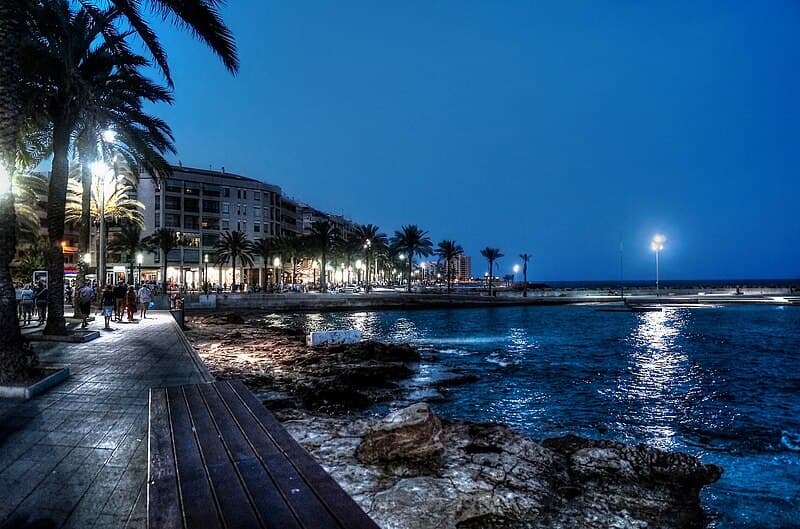
A kilometer-and-a-half breakwater enclosing the harbor, walkable all the way to the end among fishing boats and yachts. The morning catch is unloaded and auctioned in the harbor hall, and in the evening it's the locals' favorite place for a stroll.

Tip: It's almost always breezy at the end of the breakwater, with the best sunset view of the town. The fish auction starts around five in the afternoon and can be watched from a viewing gallery.

Admission:
free
Time needed:
1.5 h
Playa de la Mata

Playa de la Mata

5 km north

The area's longest beach, more than two kilometers of sand along the village of the same name, five kilometers north of the center. It's wide, with a very gradual entry into the water and pine-covered dunes at the northern end — the best choice for families with small children.

Tip: Behind the dunes at the northern end of the beach lies a shaded pine grove with picnic tables, the only place in the area to escape the midday sun without paying for an umbrella.

Admission:
free, sunbed from 5 €
Time needed:
full day
Paseo Juan Aparicio promenade

Paseo Juan Aparicio promenade

center

A coastal promenade linking the harbor to Playa del Cura, running along a low cliff with sea views. Along it stand a statue of habanera singers, a fountain clock, and viewing gazebos; in the evening, the whole town comes out for a stroll.

Tip: Best an hour before sunset, when handicraft stalls line the promenade. The ice cream shops on Calle Ramón Gallud are half the price of those right along the railing.

Admission:
free
Time needed:
1 h
Molino del Agua Park

Molino del Agua Park

3 km north

A pine park between the town and the dunes at Playa de la Mata, home to a restored windmill once used to pump water, which gives the park its name. Several shaded loop trails run through it, along with playgrounds, and the path ends right in the dunes by the sea.

Tip: It's the cheapest way to spend the midday hours when the beach is unbearable — the pine shade is about five degrees cooler. Bus number 1 stops at the entrance, or it's a twenty-minute bike ride from the center.

Admission:
free
Time needed:
1.5 h

Photos: Salinas de Torrevieja (Pink Lake) — Ryan Hodnett (CC BY-SA 4.0) · Lagunas de La Mata Nature Park — L-Bit (CC BY-SA 4.0) · Delfín S-61 Submarine — Zarateman (CC0) · Playa del Cura — Ximonic (Simo Räsänen) (CC BY-SA 4.0) · Playa de los Locos — Ximonic (Simo Räsänen) (CC BY-SA 4.0) · Harbor and the Dique de Levante breakwater — Ximonic (Simo Räsänen) (CC BY-SA 4.0) · Playa de la Mata — Ximonic (Simo Räsänen) (CC BY-SA 4.0) · Paseo Juan Aparicio promenade — Ximonic (Simo Räsänen) (CC BY-SA 4.0) · Molino del Agua Park — Ximonic (Simo Räsänen) (CC BY-SA 4.0)

Where to stay

Areas and districts, matched to the kind of trip you are taking

Center and Playa del Cura

Best for: a car-free stay and nightlife

The flat core around the harbor, the promenade and the main shopping street, Ramón Gallud, with shops, restaurants and a market. Beaches and the bus station are both within walking distance. Accommodation is mostly apartments in 1980s high-rises, with the lowest prices in the area.

La Mata

Best for: families with young children

A village five kilometers north with the area's longest and widest beach and a very gradual entry into the water. Quieter, lower-rise, fewer shops, but plenty of beachside restaurants. Buses run to central Torrevieja every half hour, taking about fifteen minutes.

Punta Prima and Playa Flamenca

Best for: newer apartments and quiet

South of town, where a string of residential complexes with pools and small coves runs alongside the Sunday market in La Zenia, the largest on the coast. Accommodation here is newer bungalows, and it's close to the Cabo Roig reserve. Getting around without a car is harder.

Los Balcones and inland areas

Best for: lowest prices and longer stays

Residential neighborhoods between town and the pink lake, popular with northern European retirees for the winter. Accommodation here is the cheapest, and large supermarkets are nearby, but it's three to five kilometers to the sea, hard to manage without a car or bike.

Getting around

From the airport

The nearest airport is Alicante-Elche, forty-five kilometers north, served in season by both charter and low-cost flights from Prague. A direct bus to Torrevieja runs from the terminal several times a day and takes under an hour; outside those departures, a transfer at Alicante's bus station is needed. A second option is Murcia airport, forty-five kilometers to the southwest, but with far fewer connections. There is no train service to Torrevieja — the nearest station is in Alicante.

Alicante-Elche (ALC) · 45 km

  • Direct Costa Azul bus· 55 min· 9 €
  • Bus to Alicante plus a transfer· 1 h 30 min· 7 €
  • Taxi· 40 min· 65 €
  • Hotel transfer· 50 min· included in package

Región de Murcia (Corvera) (RMU) · 45 km

  • Bus with a transfer in Murcia· 1 h 45 min· 10 €
  • Rental car· 40 min· 28 € / day

Around town

The town is flat and the center is entirely walkable; city bus lines 1 and 2 run to the northern beaches and the lakes roughly every half hour for under two euros. Intercity buses run along the coast south to Punta Prima and Cabo Roig, and north to Guardamar. A bike is the best option overall: paved cycle paths circle both lakes and run along the coast, and the terrain is flat throughout. A car is only worth it for day trips, since parking downtown is difficult in season.

City busesLine 1 to La Mata and Molino del Agua park, line 2 to the southern residential areas. · 1.60 €
Rental bikeFlat cycle paths circle the pink lake and run along the coast. The cheapest way to reach the lagoons. · 8 € / day
Costa Azul busesCoastal routes to Guardamar, Santa Pola, Alicante and south to La Zenia. · 2–8 €
Rental carUseful for trips to Elche and Cartagena. Paid blue zones downtown apply in season, even in the evening. · 28 € / day

Useful apps: Google Maps, Moovit, Cabify, El Tiempo AEMET

When to go

Torrevieja has the driest climate on the entire Spanish coast — around three hundred millimeters of rainfall a year, less than many semi-deserts. Swimming is good from June through the end of October, with the sea reaching twenty-six to twenty-seven degrees in August and September, the warmest on the Costa Blanca. July and August are hot and full of Spanish families from Madrid, and apartment prices double. May, June, September and October are the most pleasant. Winter is mild and sunny at around eighteen degrees and draws long-stay visitors; it's also when the lagoons hold the most flamingos.

Best time

June, September and the first half of October

What to avoid

August, for prices and crowded beaches

MonthJanFebMarAprMayJunJulAugSepOctNovDec
Day17°18°20°22°25°28°31°31°29°25°21°18°
Night6°7°8°10°13°17°20°21°18°15°10°7°
Rainy days333431013544
Sea14°14°15°16°19°23°26°27°26°22°19°16°

Food & drink

Torrevieja belongs to the Valencian Community, so rice dishes are the local staple — cooked in stock made from fish caught that same night, not from frozen ingredients. Local specialties are built around salt: fish baked in a salt crust, and dried fish roe called hueva, sliced like cured meat. Rice dishes are paired with young white wine from Alicante, and dessert with sweet Fondillón. Lunch is served at two, dinner after nine, though the harbor restaurants serve outside those hours too.

What to try

Arroz a banda

Rice cooked in fish stock, with the fish served separately alongside aioli. It's the main Sunday dish at the local harbor restaurants.

Caldero del Mar Menor

A fisherman's pot of rice, capers and fish seasoned with ñora pepper, originally from the neighboring Mar Menor. Cooked right in the pot and ordered for two.

Fish in a salt crust

Sea bass or sea bream baked under a mound of coarse salt, cracked open at the table. Given the local salt industry, it's Torrevieja's most characteristic dish.

Hueva de mújol

Dried, pressed mullet roe, sliced thin and eaten with olive oil and almonds. Also sold at harbor shops as a souvenir.

Salazones

Salt-cured dried fish — mojama tuna, mackerel, anchovies. Served as a tapa with beer, and deliberately very salty.

Paella

Rice cooked in a wide, shallow pan, originally from Valencia. The authentic version uses rabbit and chicken; the seafood version is more of a tourist favorite, but still good. It's a lunch dish, not dinner, and ordered for two or more.

Fondillón from Alicante

A sweet wine from Monastrell grapes, aged in barrels for at least ten years, one of the few Spanish wines registered as a historic category.

Tinto de verano

Red wine with lemon soda and ice — what locals order at lunch while tourists drink sangria. Cheaper and lighter.

What it costs

Coffee and tostada

2.50–3.50 €

Menu del día (set lunch)

10–14 €

Arroz a banda for two

30–40 €

Beer, 0.33 l

2–3 €

Two sunbeds with umbrella

10–15 €

Entry to the S-61 submarine

3 €

Rental bike for a day

8 €

Week in a 4-person apartment in season

450–800 €

Indicative prices that change over time — treat them as a guide, not a price list.

Practical information

SocketsCEuroplug, two round pinsFSchuko
Voltage230V / 50Hz
Tap waterTap water is drinkable — Tap water in Spain is safe and hygienic, but along the southern coast it's quite hard and tastes of chlorine, so even locals routinely buy bottled water. At restaurants, tap water — called 'agua del grifo' — must be provided free on request.
TippingTipping isn't mandatory, and Spaniards themselves tip lightly — small change at a café, rounding up or adding five percent at a restaurant. Ten percent is the upper limit, given in cash, since card terminals rarely have a tip option.
Driving on theright
SafetyTorrevieja is a calm town with low crime; the main risk is break-ins to parked cars in residential areas and near the beaches, so don't leave anything visible inside. Lifeguards patrol the beaches under a flag system, and Playa de los Locos can have strong waves and rip currents in autumn. Swimming in the salt lakes is banned and fined. Summers here are extremely dry, so you'll need more water than you'd expect.
Opening hoursShops in the center take a midday siesta roughly from two to five; supermarkets and chains stay open all day until nine in the evening. The Friday market on Avenida Delfín Viudes is the largest in the area and wraps up around two in the afternoon. On Sundays, only the market in La Zenia and restaurants are open; other shops are usually closed.
Customs & etiquetteLunch runs from two to four, dinner after nine — arriving at a restaurant at seven often means an empty room and a closed kitchen. Swimwear belongs on the beach: walking around town shirtless or in swimwear is fined in most coastal towns, and fines are genuinely enforced. Greetings are a handshake, or two cheek kisses between acquaintances. Spaniards talk loudly; it's not an argument.
A few local wordsGood day — Buenos díasThank you — GraciasPlease — Por favorThe bill, please — La cuenta, por favorCheers — Salud

How to plan your days

1 day

A day between salt and sea

  1. 1Morning at Playa del Cura, while the sand is cool and the beach is quiet.
  2. 2Around midday, bike or drive to the pink lake when the color is most vivid.
  3. 3Rice-dish lunch at a harbor restaurant, afternoon at the Delfín submarine and the Dique de Levante breakwater.
  4. 4Evening stroll on the Paseo Juan Aparicio and dinner overlooking the sea.

2 days

Two days with dunes and birds

  1. 1Day one as above.
  2. 2Day two, take the bus to La Mata in the morning for its long sandy beach.
  3. 3Late morning loop through the Lagunas de La Mata nature park with binoculars.
  4. 4Lunch in La Mata, afternoon in the shaded Molino del Agua park and the dunes by the sea.
  5. 5Return on foot or by bike along the coastal cycle path back to the center.

3 days

Three days with a trip to Alicante

  1. 1The first two days as above.
  2. 2Day three, take the bus to Alicante and ride the elevator or walk up to Santa Bárbara castle.
  3. 3Morning in the old Santa Cruz quarter and a walk along the Explanada promenade.
  4. 4Lunch in Alicante, afternoon optionally by boat to Tabarca island.
  5. 5Return on the last bus, which departs around nine in the evening.

Day trips

Alicante

50 km · 1 h by bus

The provincial capital, with the Santa Bárbara fortress atop a hundred sixty-meter cliff, reached by an elevator bored inside the hill. Below the castle lies the old Santa Cruz quarter with pastel-colored houses, and the Explanada promenade paved with six and a half million marble tiles. Boats to Tabarca island depart from the harbor.

Guardamar del Segura and Santa Pola

15 km · 20 min by car

Guardamar has the most extensive dunes on the coast — over four hundred hectares of pine forest, planted in the 19th century to stop advancing sand from swallowing the village. A little further on, Santa Pola has salt flats with flamingos and a harbor with a ferry to Tabarca, the only inhabited island of the Valencian Community.

Elche

40 km · 40 min by car

A city with the largest palm grove in Europe — more than two hundred thousand date palms planted by the Moors as part of an irrigation system, and listed as UNESCO World Heritage. In the Huerto del Cura garden grows the seven-hundred-year-old Imperial Palm, with seven trunks from a single root. The local museum holds a copy of the Lady of Elche bust.

Frequently asked questions

Why is the lake in Torrevieja pink?+

The color comes from the algae Dunaliella salina, which produces a red pigment in extremely salty water, and tiny brine shrimp (Artemia salina) that feed on it. The shade shifts with sunlight and salt concentration — it's most vivid from June to September around midday, and fades after rain.

Can you swim in the pink lake?+

Not in the Salinas de Torrevieja itself — it's an active salt-mining operation, and swimming is banned and fined. Bathing in strongly salty water is possible in a designated section near the village of La Mata, where people also cover themselves in mud. Afterward you need to rinse off with fresh water, or your skin stays coated in salt.

Is Torrevieja suitable for families with young children?+

Yes, especially the La Mata area, which has the area's longest and widest beach, a very gradual entry into the water, and pine shade behind the dunes. The town is flat, so it's easy going with a stroller. Playa del Cura in the center is convenient but fills up by eleven in the morning in August.

Do I need a car in Torrevieja?+

If you're staying in the center or in La Mata, no — beaches and lagoons are reachable on foot, by bus or by bike, and the terrain is completely flat. For accommodation in the southern residential areas like Punta Prima or Los Balcones, a car is worth it, since buses run less frequently there.

When is the sea warmest?+

In August and September, when it reaches twenty-six to twenty-seven degrees — the warmest water anywhere on the Costa Blanca, thanks to the shallow, sheltered coastline. Swimming is comfortable from June, when the sea is twenty-three degrees, through the end of October at twenty-two. From December to April it drops below sixteen.

Where can I see flamingos?+

In the Lagunas de La Mata nature park north of town, reliably from October to March, when they winter there. In summer only a few remain. Marked trails with observation points circle the lagoon, but the birds are often several hundred meters away, so without binoculars you won't see much.

Is it true Torrevieja has the healthiest climate?+

The local council cites an older World Health Organization report suggesting that the combination of evaporation from the salt lakes and sea air benefits the respiratory system. What's verifiable is that the climate here is exceptionally dry — around three hundred millimeters of rainfall a year — with more than three hundred sunny days.

What are habaneras, and why are they in Torrevieja?+

Cuban sailors' songs, brought here by sailors who transported salt to Cuba in the 19th century. Since 1955, an international habanera singing competition has been held here, taking place in late July and early August in the open-air Eras de la Sal amphitheater near the harbor.

Visa Requirements

Check the latest visa requirements for entering this country. Some nationalities may need to apply for a visa or e-visa before travel.

Check visa requirements

Language

Spanish

Currency

EUR

Timezone

Europe/Madrid

Dial Code

+34

Population

47.6M

Area

505,990 km²

Voltage

230V / 50Hz

Driving Side

Right

Top Hotels in Torrevieja

Live prices from 500+ properties

Loading hotels...

Planning a trip to Torrevieja?

Compare hundreds of hotels, find the best price, and book with free cancellation on TravelManiac.