Hotels in Brussels

Europe's most beautiful square, a peeing boy, and more beers than you can count

Brussels

IdiomaEnglish
MonedaEUR
Huso horarioGMT+1
Temperatura4-22 °C
Prefijo+32
Población11.6M
Área30,689 km²
EnchufesTipo C / Tipo E
Agua del grifoPotable

Descubra Brussels

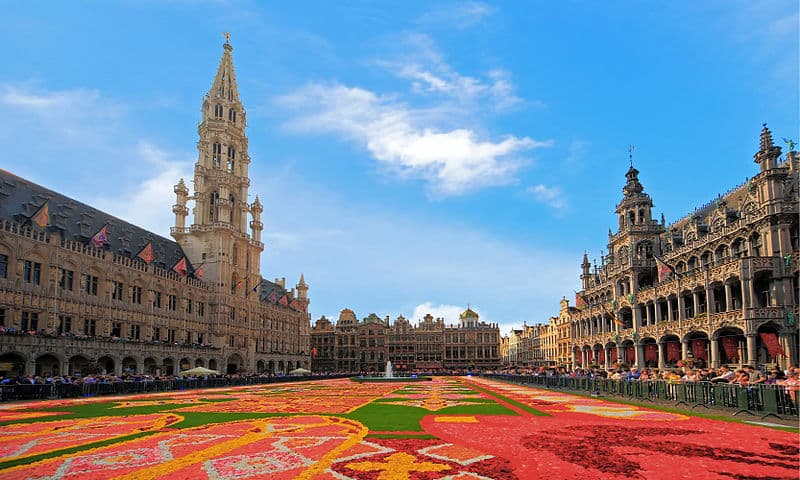
Brussels grew up around 979 on a small island in the marshes of the River Senne, and its name comes from the old "broekzele", meaning settlement in the marsh. The river now runs hidden beneath the boulevards, with no trace of it left above ground. The Grand-Place you're standing on is largely younger than it looks: the French marshal Villeroy bombarded it in 1695, and Brussels' guilds rebuilt their houses within 4-years, each grander than the last — hence the density of gold on a single square. Belgium itself was only founded in 1830, and Brussels rose from a provincial town to a capital 3-times over: for the new state, for both the Flemish and Walloon communities, and, from the 1950s, for the European institutions, which today employ over 40,000 people here. The city has two million residents, both French and Dutch are spoken, and it's an hour by train to Bruges, an hour and a quarter to Amsterdam, and an hour and a half to Paris.

What to see

The places worth your time in Brussels, and what to expect at each

Grand-Place

Grand-Place

Centre / Grand-Place

A square lined with late-seventeenth-century guild houses covered in gilded statues and gables, with a Gothic town hall whose tower rises 96 metres, and the so-called King's House opposite. A UNESCO World Heritage site, called by Victor Hugo the most beautiful square in Europe.

Tip: It's best at dusk, when the façade lighting comes on and the gold genuinely glows; at midday the square sits in harsh shade and is packed. Every other August, the cobbles are covered for 3-days in a begonia flower carpet, the biggest event of the year. Cafés right on the square charge triple — a street away, prices are normal.

Admission:
free
Time needed:
1 h
Manneken Pis

Manneken Pis

Centre

A bronze statue of a urinating boy, 51 centimetres tall, on the corner of Rue de l'Étuve and Rue du Chêne, installed in 1619. It's been stolen several times; today's statue is a copy, with the original kept in a museum. Its wardrobe of more than a thousand costumes is changed several times a week.

Tip: It's the smallest famous statue in Europe, and nine out of ten visitors leave disappointed — treat it as a 2-minute stop on the way from the Grand-Place. The dressing schedule is posted on the railings, and beer flows from the fountain on special occasions. His costumes are on display at the Garderobe museum 50 metres away. There's also a female version, Jeanneke Pis, and a canine one, Zinneke Pis.

Admission:
free
Time needed:
15 min
Atomium

Atomium

Laeken / Heysel

Nine steel spheres, 18 metres in diameter, joined by tubes, representing an iron crystal magnified 150 billion times. Built for the 1958 World's Fair as a temporary structure, it's now a symbol of the city. Five spheres hold exhibitions, and the top one offers a viewpoint at 102 metres.

Tip: The escalator through the tube between the spheres is the longest in Europe and the best part of the visit. You go up by lift, and in summer there's a queue — buy a timed ticket online. Nearby are Mini-Europe, with models of European landmarks, and Laeken Park, whose royal greenhouses open to the public for just 3-weeks each April and May.

Admission:
€16
Time needed:
1.5–2 h
Royal Museums of Fine Arts

Royal Museums of Fine Arts

Mont des Arts / Sablon

6-museums in one complex on Mont des Arts: old masters including Bruegel the Elder and Rubens, fin-de-siècle art, modern art housed underground, and above all the Magritte Museum, with 230 works — the largest collection of his paintings in the world.

Tip: The Magritte Museum has its own separate entrance and sells out in high season — book online. It's arranged chronologically from top to bottom, so take the lift to the top floor and walk down. On the last Wednesday afternoon of the month from 1pm, entry to the permanent collections is free. Closed on Mondays.

Admission:
€15 Magritte, €10 old masters
Time needed:
2–3 h
Cathedral of St Michael and St Gudula

Cathedral of St Michael and St Gudula

Treurenberg

A Gothic cathedral built over three centuries from 1226, with two towers 69 metres tall and sixteenth-century stained glass designed by court painters. Belgian royal weddings and funerals are held here. In the crypt, the exposed foundations of an eleventh-century Romanesque church are visible.

Tip: Entry to the main nave is free; only the crypt with its Romanesque foundations and the treasury charge admission — and the crypt is worth the extra €3. The baroque pulpit showing Adam and Eve being cast out of paradise is carved from a single block of oak. The cathedral sits halfway up the slope between the upper and lower town, so it fits naturally into a walking route.

Admission:
free, crypt €3
Time needed:
45 min
Cinquantenaire Park and Arch

Cinquantenaire Park and Arch

European quarter

A park with a triumphal arch topped by a bronze quadriga, built for the fiftieth anniversary of Belgian independence in 1880. 3-museums sit in the wings around the arch: a military museum, the Autoworld car museum, and a museum of art and history spanning ancient Egypt to the Americas.

Tip: The military museum has free entry, and its arch balcony gives an open view over the European quarter and the whole city — the cheapest viewpoint in Brussels, and hardly anyone knows about it. The way up to the balcony passes through the aviation hall, with 200 aircraft, which is worth visiting in its own right. The park is a 10-minute metro ride from the centre.

Admission:
park and military museum free
Time needed:
2 h
Belgian Comic Strip Center

Belgian Comic Strip Center

Centre / Sablon

A comic-strip museum in an Art Nouveau department store built by Victor Horta in 1906 — the building is as much a reason to visit as the collection. Inside is the history of Belgian comics from Tintin through the Smurfs to Lucky Luke, original artwork and the rocket from Tintin's trip to the Moon.

Tip: Belgium is a comic-strip nation, and the city has more than 50 large comic murals painted on building gables; a route map is available at the museum and free from the tourist office, and it's the best way to cross the centre off the main tourist trail. The Art Nouveau glass-roofed hall is open to enter even without a ticket, including the café and bookshop.

Admission:
€14
Time needed:
1.5 h
Musical Instruments Museum

Musical Instruments Museum

Mont des Arts

A collection of 8,000 instruments from around the world, housed in the 1899 Art Nouveau Old England department store, with its black steel and glass façade. Visitors get headphones that switch on automatically at each display case and play the sound of the instrument in front of them.

Tip: The rooftop restaurant has one of the best views over lower Brussels, and you can reach it by lift without buying a museum ticket — most people don't know that and pay for views elsewhere instead. The museum is a great rainy-day option. Several times a week, historical instruments from the collection are played in the concert hall, at a fraction of a normal concert ticket.

Admission:
€15
Time needed:
2 h
Sablon and Place Royale

Sablon and Place Royale

Sablon

A pair of squares in the upper town: the Grand Sablon, with antique shops, chocolatiers and a weekend market, and above it Place Royale, with neoclassical façades and an equestrian statue of Godfrey of Bouillon. Between them stands the Gothic Church of Notre-Dame du Sablon, with its stained glass.

Tip: The terrace at Place Royale gives the best open view over the lower town and the town hall tower, especially before sunset. The chocolate shops on the Sablon — Wittamer, Pierre Marcolini, Neuhaus — are the reason people come to Brussels for chocolate, and you can try pralines individually here. The antiques market runs Saturday and Sunday mornings.

Admission:
free
Time needed:
1.5 h

Photos: Grand-Place — Celuici (CC BY-SA 4.0) · Manneken Pis — Bruxelles_Manneken_Pis.jpg: Myrabella derivative work: Myrabella (talk) (CC BY-SA 3.0) · Atomium — Trougnouf (Benoit Brummer) (CC BY 4.0) · Royal Museums of Fine Arts — Michel wal (CC BY-SA 3.0) · Cathedral of St Michael and St Gudula — Luc Viatour (CC BY-SA 3.0) · Cinquantenaire Park and Arch — Diego Delso (CC BY-SA 4.0) · Belgian Comic Strip Center — Otter (CC BY-SA 4.0) · Musical Instruments Museum — Trougnouf (Benoit Brummer) (CC BY 4.0) · Sablon and Place Royale — Julian Lupyan (CC0)

Where to stay

Areas and districts, matched to the kind of trip you are taking

Centre and Grand-Place

Best for: first-time visitors and sightseeing

The pedestrian core within the so-called Pentagon, home to the Grand-Place, Manneken Pis, the comic strip museum, the Galeries Saint-Hubert and most hotels. Everything is within walking distance, so you won't need transport. Restaurants right on the main route, especially in Rue des Bouchers, charge tourist prices — a couple of blocks away, prices are normal.

Sablon and Mont des Arts

Best for: museums, chocolate and quieter evenings

The upper town on the slope above the centre, home to the Royal Museums, the Magritte Museum, the Musical Instruments Museum and the royal palace, and with the highest concentration of chocolatiers and antique shops. It's quiet, with good hotels and the best views over lower Brussels. It's a 10-minute walk down into the centre, uphill on the way back.

Saint-Gilles and Ixelles

Best for: Art Nouveau, restaurants and value for location

Two adjoining districts south of the centre with the highest concentration of Art Nouveau architecture in the world, including the Horta House and Rue Vanderschrick. Around Place Flagey and the Ixelles ponds are the city's best restaurants and cafés, and accommodation costs a quarter less than in the centre. It's a 10-minute metro or tram ride to the middle of town.

European quarter

Best for: institutions, modern hotels and weekend calm

The glass buildings of the Commission and Parliament around Schuman Square, with the Parlamentarium visitor centre and the House of European History, both free. It's busy and hotels are pricey on weekdays; at weekends the district empties out and prices fall — the cheapest way to stay close to the centre in Brussels.

Getting around

From the airport

Brussels is well served by direct flights from across Europe. The main airport, Zaventem, lies 12 kilometres northeast of the centre, and a train from the underground station beneath the terminal runs to all three of Brussels' main stations — Nord, Central and Midi — in 17 minutes, 4-times an hour, for around €11, including the airport surcharge. Low-cost airlines land at Charleroi, 55 kilometres away, with a bus to the centre taking an hour; it's marketed on flight tickets as Brussels South, which is worth bearing in mind. Brussels is also one of the best rail hubs in Europe: the Eurostar to London takes 2-hours, and Thalys reaches Paris in an hour and a half and Amsterdam in an hour and a quarter, making it easy to combine with another destination. Driving into the compact centre is more trouble than it's worth.

Brussels Zaventem (BRU) · 12 km

  • SNCB train to Bruxelles-Central· 17 min· €11.50
  • Bus 12 or 21 to Schuman· 30 min· €7
  • Taxi· 25–40 min· €45

Brussels South Charleroi (low-cost airlines) (CRL) · 55 km

  • Flibco bus to Bruxelles-Midi· 1 h· €17

Around town

The historic core of Brussels is small, and the Grand-Place, Manneken Pis, the cathedral and the Sablon can all be covered on foot in 2-hours — though the whole area is built on a slope between the lower and upper town, so there's a fair amount of uphill walking. The Atomium, the European quarter and Ixelles call for transport: the metro, trams and STIB buses run on a single fare, valid for an hour with transfers, bought via the app or by tapping a contactless bank card at the reader. The metro has four lines, and its stations are decorated with works by Belgian artists, including a Magritte-themed loop. Belgium's SNCB trains are essential for day trips: direct trains to Bruges, Ghent and Antwerp all leave from Bruxelles-Midi, and weekend return fares are half price. Don't bring a car into the centre — parking starts at €3 an hour, and since 2025 a strict low-emission zone covers the whole region.

Metro, tram and bus (STIB)A single ticket is valid for an hour with unlimited transfers. Pay by tapping a contactless bank card at the reader or via the app; buying from the driver costs more. The metro runs from 5am to midnight, later on Fridays and Saturdays. · €2.10
STIB day travelcard24 hours for €8, 48 hours for €14, 72 hours for €18. Worth it from your fourth trip of the day, and also valid on weekend Noctis night buses. · €8 / 24 h
SNCB trains for day tripsDirect trains leave Bruxelles-Midi for Bruges (1 h), Ghent (35 min) and Antwerp (45 min) several times an hour. Return fares are half price at weekends. · from €10 return
Airport trainFrom the underground station beneath the Zaventem terminal to Bruxelles-Central in 17 minutes, 4-times an hour. The fare includes an airport surcharge, so it costs more than a regular train ride of the same distance. · €11.50
On footIt's a 10-minute uphill walk from the Grand-Place to the Sablon, and the same to the cathedral. Between the lower and upper town, an escalator at Mont des Arts and a lift near the Marolles save you the stairs. · free

Useful apps: STIB-MIVB, SNCB, Google Maps, Villo!

When to go

Brussels has no strong single season, and the weather is similar year-round to much of northern-central Europe, just with more rain — it rains 10–12 days in every month. May, June and September are the best months: a pleasant 20 degrees, open terraces and fewer crowds than in high summer. July and August are the busiest months, but also the cheapest for accommodation, since the institutions are on holiday and the hotels that rely on business travel cut their rates. The same is true of weekends year-round — Friday to Sunday is cheaper in Brussels than weekdays, the reverse of the rest of Europe. December belongs to the Plaisirs d'Hiver Christmas market, with an ice rink and a light show on the Grand-Place, and it's the nicest time for a short city break. Every other August, the square is covered for 3-days in a flower carpet of 800,000 begonias.

Best time

May, June and September for the weather, December for the Christmas markets

What to avoid

November and February, when it's wet with little else going on

MonthJanFebMarAprMayJunJulAugSepOctNovDec
Day6°7°11°15°18°21°23°23°19°15°10°7°
Night1°1°3°5°9°12°14°14°11°8°4°2°
Rainy days12101191010101010111212

Food & drink

Belgium is one of Europe's great food countries, and Brussels takes it seriously: chips have their own stands, called a frituur; mussels have their own season; and beer comes in over 1,500 varieties, each with its own glass. Restaurants cook in fixed blocks from noon to 2pm and from 6pm to 10pm — outside those hours you'll only get drinks, so turning up at 4:30pm gets you nowhere. The worst value for money is in Rue des Bouchers right by the Grand-Place, where staff tout for custom on the street; the best food is in traditional estaminet pubs and in the Saint-Gilles and Ixelles districts. Pralines are bought by weight on the Sablon, and the difference between a chain shop and a small chocolatier is obvious from the first bite. Public toilets charge 50 cents to a euro for the attendant, even in restaurants — keep some change handy.

What to try

Moules-frites

A kilo pot of mussels cooked in white wine, celery and onion, served with chips on the side. The season runs from September to April; outside it, the mussels are imported. Eat the open ones and discard any that stay shut; an empty shell doubles as tongs for the rest.

Frites from a frituur

Belgian chips are fried twice — first to soften, then again until crisp — and sold from a stand called a frituur or friterie, in a paper cone with sauce. The classics are andalouse, samouraï and, above all, mayonnaise; ketchup marks you out as a tourist.

Carbonnade flamande

Beef stewed in dark Belgian beer with onion, gingerbread and mustard, which give it a sweet-sour edge. Served with chips, it's Flanders' signature dish, and at a good restaurant it's simmered for over 4 hours.

Waterzooi

A creamy Ghent soup with chicken or fish, root vegetables and egg yolk, thick enough to count as a main course. The original version uses fish, though chicken is more common today. Served with bread and potatoes.

Stoemp

Mashed potato mixed with stewed vegetables — carrot, leek or cabbage — served with sausage or bacon. A Brussels home-cooking staple you'll find in a pub rather than a tourist restaurant, often as a set lunch.

Brussels and Liège waffles

2 different things: the Brussels waffle is light, rectangular and served with sugar or fruit, while the Liège waffle is dense, irregular in shape and has pearl sugar baked into the batter, which caramelises. The Liège version is eaten plain, on the go, with no toppings.

Pralines

The filled chocolate praline is a Belgian invention from 1912. The difference between a chain shop on the Grand-Place and a small chocolatier is obvious from the first bite; they're sold by weight, and 100 grams starts at €5. In summer, they will melt in your bag.

Trappist and lambic beers

Belgium brews over 1,500 beers. Trappist beers (Westmalle, Chimay, Rochefort) are brewed by monks and run 10–12 percent alcohol, while lambic from the Pajottenland region ferments with wild yeast and is sour — gueuze and kriek are versions of it. Order by the beer's name.

Speculoos

A crisp cinnamon-and-clove biscuit, traditionally baked for St Nicholas's Day and now eaten year-round. Served with coffee across the country and also made into a spread. Hand-shaped ones from a market stall are a class above the packaged kind.

What it costs

Coffee at a café

€3–4

Half-litre of Belgian beer

€4.50–7

Cone of chips from a frituur

€4–6

Pot of mussels with chips

€26–34

Dinner at a restaurant

€30–45 per person

STIB day travelcard

€8

Atomium

€16

Night in a 3-star hotel for two

€90–160, less at weekends

Indicative prices that change over time — treat them as a guide, not a price list.

Practical information

SocketsCEuroplug, two round pinsEFrench, with earth pin
Voltage230V / 50Hz
Tap waterTap water is drinkable — Belgian tap water is safe and drinkable, but it's hard and more heavily chlorinated than some visitors are used to, and not everyone likes the taste. Restaurants won't bring it to you for free — in Belgium it's customary to order a paid bottle, and if you ask for tap water ("une carafe d'eau"), you're often charged for it as a carafe, at €2–3. Bottled water in a shop costs around 70 cents, so it's worth buying a large bottle for your hotel room.
TippingService and VAT are included in the price, and tipping is purely optional: round up the bill, or add around 5 percent at a restaurant if you're happy with the service. Public toilets, though, charge the attendant 50 cents to a euro, even in restaurants, at stations and in shopping centres — keep change on you, or you won't get in. Cards work almost everywhere, but many smaller places, especially frituur stands and markets, only take Belgium's Bancontact debit cards or cash.
Driving on theright
SafetyBrussels and Belgian cities are generally safe, but pickpocketing is notably more common here than in Scandinavia — especially on the metro, at Bruxelles-Midi and Centraal stations, on the Grand-Place and in the crowds around Manneken Pis. Bruxelles-Midi station has the worst reputation in the country, and it's not worth lingering there at night longer than necessary. The Molenbeek district and part of Anderlecht are poor, but a visitor has no real reason to go there. Violent crime against tourists is rare. The emergency number is 112.
Opening hoursShops open at 10am and close at 6 or 7pm; most are closed on Sundays, except in the tourist centre and at markets, which in turn tend to run on Sunday mornings. Restaurants cook in fixed blocks from noon to 2pm and 6pm to 10pm; the kitchen shuts in between and you'll only get drinks. Many restaurants and museums close on Mondays. Museums open at 10am, and the royal collections offer free entry on the last Wednesday afternoon of the month.
Customs & etiquetteBelgium is bilingual, and language is a sensitive topic: Brussels is officially French and Dutch, but in Flanders it's best not to address people in French, and vice versa in Wallonia. The safest approach is to start in English, or greet people with "bonjour" in Brussels and Wallonia and "goedendag" in Flanders. Belgians take offence at their country being described as an appendage of France or the Netherlands, and especially at chips being credited to France. Greetings are a handshake, or three cheek kisses among people who know each other. Beer is ordered by name, not by style, and each one has its own glass — serving it in the wrong glass is a real faux pas for a bartender.
A few local wordsHello — Bonjour / GoedendagThank you — Merci / Dank uPlease — S'il vous plaît / AlstublieftThe bill, please — L'addition, s'il vous plaîtCheers — Santé / Schol

How to plan your days

1 day

A day in Brussels

  1. 1Morning at the Grand-Place while it's still quiet, then the Galeries Saint-Hubert.
  2. 22-minutes at Manneken Pis, then the cathedral on the way up.
  3. 3Lunch at an estaminet pub away from Rue des Bouchers.
  4. 4Afternoon at the Magritte Museum and a wander around the Sablon's chocolate shops.
  5. 5Early evening back at the Grand-Place, once the façade lighting comes on.

2 days

2-days at a gentler pace

  1. 1Day one as above.
  2. 2Morning at the Atomium and, if you like, Mini-Europe.
  3. 3Metro to the European quarter, lunch, and the free House of European History.
  4. 4Afternoon at Cinquantenaire Park and the view from the arch's balcony.
  5. 5Dinner and a beer in Saint-Gilles or by the ponds in Ixelles.

3 days

3-days with a day trip

  1. 1First 2-days as above.
  2. 2Train to Bruges, an hour away, for a full day in the medieval city.
  3. 3If you'd rather stay closer, swap Bruges for Ghent, just 35 minutes away.
  4. 4Return in the early evening for the comic strip museum or the instruments museum.
  5. 5Last evening, a Belgian beer tasting in a pub near the Grand-Place.

Day trips

Bruges

90 km · 1 h by train

The best-preserved medieval town in northern Europe, one of the wealthiest on the continent in the fourteenth century, which then froze in time for five 100-years once its harbour canal silted up — which is exactly why it looks the way it does today. The Belfort bell tower has 366 steps and the best view from the top; tickets are sold for timed slots. St John's Hospital houses paintings by Memling, and the Church of Our Lady holds the only Michelangelo sculpture to leave Italy in his lifetime. Trains from Brussels run every half hour, and the return fare is halved at weekends.

Ghent

55 km · 35 min by train

A university city with medieval architecture to rival Bruges, but with 75,000 students instead of crowds of tourists — it feels livelier, cheaper and less hollowed out by tourism. St Bavo's Cathedral holds the van Eyck brothers' Ghent Altarpiece from 1432, one of the most important paintings in European art history and the most stolen artwork ever. The Castle of the Counts of Flanders stands right in the city centre on the water and is fully open to explore, ramparts included. The Graslei waterfront is the best spot in Belgium for an evening beer.

Waterloo

20 km · 45 min by train and bus

The battlefield where, on 18 June 1815, Napoleon's career ended, along with a quarter-century of European wars. In the middle of the plain stands the Lion's Mound, an artificial hill with 226 steps and a bronze lion on top, giving a full view of the battlefield's layout. An underground museum walks through the battle hour by hour, and a 1912 panorama painting measures 110 metres around. Every June, a re-enactment with several thousand participants is held here, and booking ahead is essential.

Frequently asked questions

How many days are enough for Brussels?+

2 days cover the Grand-Place, Sablon, Magritte, the Atomium and the European quarter without rushing — the centre is small and walkable. 3 days let you add a day trip by train to Bruges or Ghent, the best thing to do nearby. Brussels also makes a great base: both Amsterdam and Paris are just over an hour away by train.

Is it true that Manneken Pis is a letdown?+

The statue is 51 centimetres tall and stands behind railings on a street corner, so yes, most people leave surprised. Treat it as a 2-minute stop on the way from the Grand-Place, not a destination in itself. His wardrobe of more than a thousand costumes, displayed in the Garderobe museum 50 metres away, and the dressing schedule posted right on the railings, are more interesting.

Where should I eat in Brussels to avoid tourist traps?+

Avoid Rue des Bouchers right by the Grand-Place, where waiters hustle for custom on the pavement and tourist prices buy average food — it's the city's best-known trap. You'll eat well in traditional estaminet pubs and in the Saint-Gilles and Ixelles districts, and at the markets. Restaurants only cook from noon to 2pm and from 6pm to 10pm — the kitchen is closed in between.

How do I get from the airport to the centre?+

From Zaventem, take the train from the underground station right beneath the terminal — it runs 4 times an hour, reaches Bruxelles-Central in 17 minutes and costs around €11.50 including the airport surcharge. From Charleroi, which is marketed on flight tickets as Brussels South, the Flibco bus takes an hour to Bruxelles-Midi and costs €17 — factor that into your timing.

Do I need to speak French in Brussels?+

No, you'll get by in English almost everywhere. Brussels is officially bilingual, French and Dutch, and language is a sensitive subject: in Flanders (Bruges, Ghent, Antwerp), it's best not to address people in French. The safest approach is to start in English, or greet people with "bonjour" in Brussels and "goedendag" in Flanders. Belgians also take offence at their country, or their chips, being credited to France.

Why is Brussels cheaper at weekends?+

Because hotels rely on business travel to the European institutions and on conferences, both of which happen on weekdays. From Friday to Sunday, and in July and August when the institutions are on holiday, prices routinely drop by a third. It's the opposite of what you'd expect elsewhere in Europe, and it's the easiest way to save money here.

Is Brussels safe?+

Yes — violent crime against visitors is rare, but pickpocketing is more common here than in northern Europe, especially on the metro, at the Grand-Place, around Manneken Pis and at Bruxelles-Midi station, which has the worst reputation in the country and isn't a place worth lingering at night longer than necessary. Wear your bag on your front. The emergency number is 112.

How much do Belgian pralines cost and where should I buy them?+

By weight, from €5 per 100 grams at a small chocolate shop, double that at a shop right on the Grand-Place. The best selection is on the Sablon — Wittamer, Pierre Marcolini, Neuhaus — where you can also buy them individually to try. In summer, expect them to melt in your bag; airport shops have comparable prices and keep them chilled.

Requisitos de visa

Verifique los requisitos de visa actuales para ingresar a este país.

Verificar requisitos de visa

Números de emergencia

Idioma

Dutch / French / German

Moneda

EUR

Huso horario

GMT+1

Prefijo

+32

Población

11.6M

Área

30,689 km²

Voltaje

230V / 50Hz

Lado de conducción

Derecha

Mejores hoteles en Brussels

Precios en vivo de 500+ propiedades

Cargando hoteles...

Planea un viaje a Brussels?

Compare cientos de hoteles, encuentre el mejor precio y reserve con cancelación gratuita.