Hotels in Funchal

Madeira's capital, built in an amphitheatre above the bay

Funchal

IdiomaPortuguese
MonedaEUR
Huso horarioAtlantic/Madeira
Temperatura12-28 °C
Prefijo+351
Población10.3M
Área92,212 km²
EnchufesTipo C / Tipo F
Agua del grifoPotable

Descubra Funchal

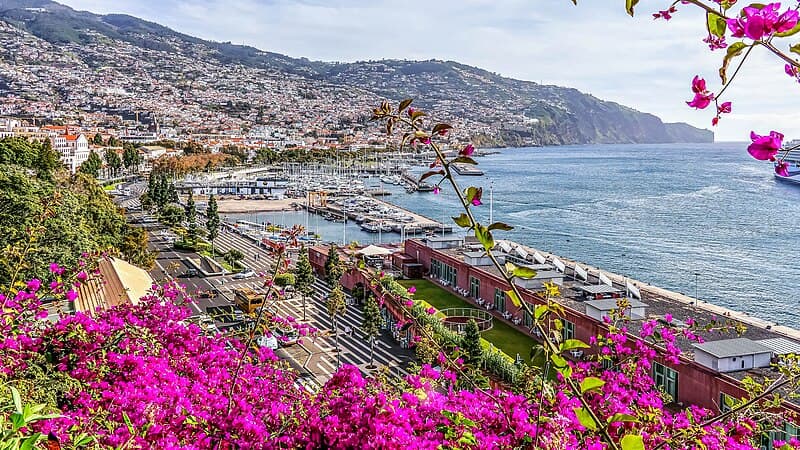
Funchal is built in a natural amphitheatre that rises from the sea to 600m, so wherever you go, you're either walking uphill or downhill. It was founded in 1424 and takes its name from the fennel the first settlers found growing there. For centuries it was the last port of call before the voyage to the Americas, which explains the fortresses above the harbour, as well as how Madeira wine came about — alcohol was added to help it survive the crossing through the tropics, and it was soon discovered that heating in the ship's hold actually improved it. Today it's a city of 110,000 people, where in a single afternoon you can walk through a market of tropical fruit, ride a cable car 600m above the rooftops and come back down in a wicker toboggan on wooden runners, steered by 2 men in white. There's no beach here; people swim in sea-water pools along the promenade in Lido. It's a year-round destination: 19 degrees in January, 26 in August, with the high season measured not by heat but by festivals — the flower festival in April and the New Year's Eve fireworks over the bay.

What to see

The places worth your time in Funchal, and what to expect at each

Mercado dos Lavradores

Mercado dos Lavradores

Zona Velha

A market building from 1940 with two floors of balconies around an open courtyard, azulejo tile panels at the entrance, and a fish hall on the ground floor selling espada — a black deep-sea fish with eyes like saucers. Upstairs are stalls selling passion fruit, custard apples and mangoes.

Tip: Vendors on the upper floor offer fruit samples and then expect you to buy — prices there run three times supermarket levels. Tasting and saying thanks is fine, just make it clear straight away. The fish hall is most interesting in the morning, between 7 and 9am.

Admission:
from €1
Time needed:
1 h
Monte Cable Car

Monte Cable Car

Zona Velha → Monte

A cable car running from the harbour promenade up to the village of Monte, at 550m. The 15-minute ride passes directly above the roofs, gardens and yards of houses on the hillside, and is the best view of how Funchal is laid out.

Tip: A one-way ticket is enough — the way down is by toboggan or bus number 20, and a return ticket goes to waste. Sit on the right-hand side in the direction of travel; the left side is nothing but rock the whole way.

Admission:
from €12.50 one way
Time needed:
1 h
Monte Wicker Toboggans

Monte Wicker Toboggans

Monte

Wicker baskets on wooden runners, used since 1850 to descend 2km down a paved road from Monte to the Livramento district. They're steered by two carreiros dressed in white with straw hats, who brake with rubber-soled boots and reach speeds of up to 30km/h.

Tip: The ride ends in Livramento, not in the city — taxi drivers wait at the bottom and take advantage of that. Bus number 20 or 21 stops 100m from the finish and reaches the centre in 10 minutes. A photographer along the track will try to sell you a photo you never asked for.

Admission:
from €30 for two
Time needed:
20 min
Monte Palace Tropical Garden

Monte Palace Tropical Garden

Monte

A hillside garden around a former hotel, where 7 hectares combine a Japanese koi pond, a collection of oriental sculptures, 15th-century Portuguese azulejo tiles and a collection of African minerals. You walk down a network of staircases along the slope.

Tip: The entrance is at the top and the whole garden is walked downhill, so start here and leave the cable car ride for last. Anyone with knee trouble should go the other way from the lower gate — otherwise you'll face 400 steps down.

Admission:
from €15
Time needed:
2–3 h
Sé Cathedral

Sé Cathedral

City centre

One of the few buildings on the island that has stood unchanged since it was completed in 1514. Plain on the outside, it has a cedar-wood ceiling inlaid with ivory in Mudéjar style, found nowhere else in Portugal.

Tip: The ceiling is the main reason to go inside, and it's best seen in the morning, when light streams through the south-facing windows into the nave. Entry is free, but visitors aren't admitted during services — outside Sundays, around 11am is the safest time.

Admission:
free
Time needed:
30 min
Zona Velha and Rua de Santa Maria

Zona Velha and Rua de Santa Maria

Zona Velha

The oldest street in the city, where the Arte de Portas Abertas project began in 2011: owners let artists paint the doors of empty buildings, and a run-down neighbourhood turned into an open-air gallery with 200 painted doors and restaurants.

Tip: The best photos are in the morning, when the tables outside restaurants are still folded away and the doors are fully visible. In the evening, the street fills with outdoor seating and only the top corners of most doors show.

Admission:
free
Time needed:
2 h
São Tiago Fortress

São Tiago Fortress

Zona Velha

A yellow fortress from 1614 at the eastern end of the old town, built against pirates and expanded in the 18th century. Its ramparts hold a terrace with views along the whole coastline and down onto Barreirinha's pebble beach and seawater pool.

Tip: Below the fortress is Barreirinha, a lido with ladders down to the sea and a seawater pool used by locals. Entry costs a few euros, and it's the closest option for a swim in Funchal outside a hotel.

Admission:
from €3
Time needed:
1 h
Madeira Botanical Garden

Madeira Botanical Garden

Monte, 3km above the centre

A garden above the city at 350m, with geometric beds of succulents in coloured bands, a collection of palms and endemic Madeiran plants, and a terrace with views over the whole bay and the airport on the horizon.

Tip: A second cable car, the one from Monte, goes up here too, so both can be combined into one morning. Bus number 30 is a cheaper way up, but the stop is 100m in altitude below the entrance.

Admission:
from €7.50
Time needed:
2 h
Madeira Wine Cellars

Madeira Wine Cellars

City centre

Blandy's Wine Lodge in the centre occupies a former Franciscan monastery and is the oldest cellar still operating on the island. In the roof space, barrels age in the heat under a tin roof — exactly what gives Madeira its oxidised, caramel flavour.

Tip: A tour with a sommelier and three samples takes an hour and is far better than tasting at the counter. An open bottle of Madeira keeps for years, making it the one wine that survives a trip in a suitcase without any harm.

Admission:
tour from €8
Time needed:
1.5 h

Photos: Mercado dos Lavradores — Luke H. Gordon (CC BY 2.0) · Monte Cable Car — Jongleur100 (Public domain) · Monte Wicker Toboggans — Luis Miguel Bugallo Sánchez (Lmbuga) (CC BY-SA 4.0) · Monte Palace Tropical Garden — H. Zell (CC BY-SA 3.0) · Sé Cathedral — Diego Delso (CC BY-SA 4.0) · Zona Velha and Rua de Santa Maria — Dietmar Rabich (CC BY-SA 4.0) · São Tiago Fortress — H. Zell (CC BY-SA 3.0) · Madeira Botanical Garden — H. Zell (CC BY-SA 3.0) · Madeira Wine Cellars — Origenes.Adamantius (CC BY-SA 4.0)

Where to stay

Areas and districts, matched to the kind of trip you are taking

Zona Velha

Best for: evening entertainment and atmosphere

The oldest quarter, on the east side of the centre, with painted doors, the market, São Tiago Fortress and the densest concentration of restaurants in the city. The Monte cable car departs from here. Accommodation is in small guesthouses, and evenings stay lively until around 11pm, after which the quarter quickly settles down.

City Centre and Avenida Arriaga

Best for: a first visit without a car

The commercial core, with the cathedral, Blandy's wine cellars, the theatre and the promenade down to the harbour, where cruise ships dock. Everything essential is within a 20-minute walk, and most bus lines terminate here. The most practical place to stay for anyone without a car.

Lido and São Martinho

Best for: swimming and hotels

A hotel zone 2km west of the centre along the seafront promenade, with ladder platforms into the water, sea-water pools and Formosa Beach with its black shingle. Most of the island's large hotels are located right here. A seafront promenade leads to the centre, a 30-minute walk.

Monte

Best for: cooler nights and gardens

A village 550m above the city, reached by cable car and the starting point for the wicker toboggan rides. It has two large gardens and a pilgrimage church where the last Austrian emperor, Charles I, is buried. Nights here are 5 degrees cooler than down below, which is appreciated in summer.

Getting around

From the airport

Cristiano Ronaldo Airport lies 16km east of Funchal and is known for its runway built on concrete pillars over the sea. Landings can be bumpy because of crosswinds, and in strong gusts flights are diverted to Porto Santo or the Canary Islands. From mainland Europe, seasonal charter flights run direct, while the rest of the year most routes connect through Lisbon. The Aerobus airport bus runs into the city, stopping at hotels along the promenade, and the drive by car takes 20 minutes on the motorway. A ferry from Porto Santo also arrives in Funchal.

Madeira Cristiano Ronaldo (FNC) · 16 km

  • Aerobus to hotels· 40 min· €5
  • Taxi or Bolt· 20 min· €25
  • Hotel transfer· 20–30 min· included in stay
  • Public bus SAM no. 53· 1 h· €5

Around town

Funchal can be explored on foot, but it's a hillside city — there's up to 300m of elevation between the promenade and the upper neighbourhoods, and you'll feel it in summer. The Horários do Funchal city buses run frequently and are cheap; tickets bought from the driver cost more than from a machine. A car is a hindrance in the centre: streets are narrow, one-way, and parking is in paid garages. Bolt works reliably and, for short distances, comes out cheaper than a taxi with its flag-fall fare.

On footThe centre, Zona Velha and the promenade to Lido are linked by a seafront footpath. · free
City busLines 20 and 21 to Monte, 30 to the botanical garden; tickets from a machine are cheaper than from the driver. · €2
Cable carTwo routes: from the harbour to Monte, and from Monte to the botanical garden. Faster than the bus, with views. · €12.50
BoltThe cheapest way to get back uphill in the evening; a car usually arrives in the centre within 5 minutes. · €4

Useful apps: Google Maps, Moovit, Bolt, IPMA

When to go

Funchal is a year-round destination with no real winter: 19 degrees in January, 26 in August. April to June are the most pleasant months, when it's dry and the city is in bloom — the Festa da Flor flower festival, with its allegorical parade, takes place in April. September and October are best for swimming, with the water at 23 degrees. Around New Year, Funchal is packed: the fireworks display over the bay is among the biggest in the world, and hotels sell out a year in advance.

Best time

April to June, and September and October

What to avoid

New Year, unless you want to pay triple for the fireworks

MonthJanFebMarAprMayJunJulAugSepOctNovDec
Day19°19°20°20°21°23°25°26°26°24°22°20°
Night13°13°13°14°15°17°19°20°20°18°16°14°
Rainy days877642114789
Sea19°18°18°18°19°20°21°23°23°23°21°20°

Food & drink

Funchal serves food you won't find elsewhere in Portugal: espada com banana, beef skewers grilled on a laurel branch, and bolo do caco flatbread with garlic butter, served alongside almost everything. The restaurants on Rua de Santa Maria are the most visible, and priced accordingly; two streets up, expect to pay about a third less. Poncha is drunk in small bars called poncharias, where it's mixed to order — it looks like lemonade and comes in at around 20%. Kitchens serve from noon to 3pm and from half past six to 10pm.

What to try

Espada com banana

Fillet of black scabbardfish — a deep-sea fish with fearsome teeth, caught only off Madeira and Japan — fried and served with grilled banana and passion-fruit sauce. The combination sounds odd and works.

Espetada em pau de louro

Cubes of beef skewered on a laurel branch, seasoned with coarse salt and grilled over charcoal. The skewer hangs from a stand right above the table, and you pull the meat off it. The laurel gives an aroma a metal skewer never could.

Bolo do caco

A flatbread made from wheat flour and sweet potato, baked on a hot stone and served with garlic butter. It comes with almost everything, and as a street-stall snack it costs around €2.

Poncha

Sugarcane rum with honey and lemon or tangerine juice, mixed with a wooden pestle called a caralhinho. It tastes like lemonade and comes in at around 20% — after 3, walking gets tricky.

Lapas grelhadas

Limpets grilled in their own shell with garlic butter and lemon, the island's number-one starter. Served by the dozen on a hot iron plate.

Madeira wine

A fortified wine that's heated and deliberately oxidised, which means an open bottle never spoils. Dry Sercial is drunk before a meal, sweet Malvasia after it. A cellar tasting costs around €5.

Bolo de mel

A dark cake made from sugarcane molasses with nuts and spices, baked at Christmas and keeping for a year. It's never cut with a knife but broken by hand — a tradition taken seriously on the island.

Sopa de tomate e cebola

A tomato and onion soup with a poached egg and bread, Madeira's classic working-man's lunch. Almost every tavern in the mountain villages makes it, for around €4.

What it costs

Espresso (bica)

€0.80–1.20

Bolo do caco with garlic butter

€2–3.50

Poncha at a poncharia

€3.50–5

Dinner with espada

€15–22 per person

Cable car to Monte, one way

€12.50

Wicker toboggan ride

€30 for two

Cellar tour with tasting

€8–20

Night in a 4-star hotel in Lido

€90–150

Indicative prices that change over time — treat them as a guide, not a price list.

Practical information

SocketsCEuroplug, two round pinsFSchuko
Voltage230V / 50Hz
Tap waterTap water is drinkable — Tap water is safe and monitored throughout Portugal, though in the south and on the islands it's hard and can taste of chlorine. Bottled water costs around 30 cents for 1.5 litres in a supermarket. Restaurants don't normally serve tap water — order "água" and they'll bring a bottle and charge for it.
TippingTipping isn't expected in Portugal, and the Portuguese themselves leave little — small change at a café, 5% or rounding up at a restaurant. 10% is generous and reserved for genuinely good service. Card machines usually have no tip option, so it's left in cash on the table.
Driving on theright
SafetyThe main risk here is pickpocketing, mainly on trams, at markets and on restaurant terraces, where bags get hung over the back of a chair. Keep documents and money separate. It's safe even in the centre at night; the only real nuisance for tourists is street sellers offering drugs, who move on after a single "não, obrigado". The emergency number is 112, and operators speak English.
Opening hoursSmaller shops close for a midday break roughly from 1pm to 3pm; shopping centres run continuously until 10pm, including Sundays. Museums are closed on Mondays, and many offer free entry on Sunday mornings. Restaurant kitchens open at noon for lunch and at half past seven for dinner; arrive at 6pm and you'll find only the bar open.
Customs & etiquetteLunch is eaten between noon and 2pm, dinner after 7:30pm — the Portuguese eat earlier than the Spanish. Anything the waiter brings to the table unordered (olives, pâté, cheese, bread) is the couvert and is charged; if you don't want it, simply return it politely and it won't appear on the bill. People greet with a handshake, or two kisses between acquaintances. Swimwear belongs on the beach, not in shops or promenade cafés.
A few local wordsHello — Bom diaThank you (said by a man / a woman) — Obrigado / ObrigadaPlease — Por favorThe bill, please — A conta, por favorCheers — Saúde

How to plan your days

1 day

A day in Funchal

  1. 1Morning: Mercado dos Lavradores, while the fish hall is still open.
  2. 2Zona Velha and the painted doors on Rua de Santa Maria.
  3. 3Cable car to Monte, the Monte Palace garden and the pilgrimage church.
  4. 4Wicker toboggan ride down to Livramento, then bus back to the centre.
  5. 5Early evening: the cathedral and a tasting tour at Blandy's cellar.

2 days

2 days with the sea

  1. 1Day 1 as above.
  2. 2Day 2 morning: the botanical garden and views over the whole bay.
  3. 3Afternoon: walk the promenade to Lido and swim in the sea-water pools.
  4. 4Early evening: São Tiago Fortress and dinner in Zona Velha.

3 days

3 days with a trip out of town

  1. 1Days 1–2 as above.
  2. 2Day 3 morning: Câmara de Lobos, the fishing cove with colourful boats.
  3. 3Late morning: the Cabo Girão glass viewpoint above the terraced fields.
  4. 4Lunch at a mountain restaurant with espetada on a laurel skewer.
  5. 5Afternoon: the Eira do Serrado viewpoint over the Curral das Freiras basin.

Day trips

Câmara de Lobos and Cabo Girão

15 km · 25 min

A fishing cove with colourful boats, once painted by Winston Churchill, where the best poncha on the island is made. A few kilometres further on is Cabo Girão, a 580m-high cliff with a glass viewing platform above terraced fields by the water.

Pico do Areeiro

25 km · 45 min

A peak 1,800m high, reached by a road all the way to the top. On a clear morning you stand above an unbroken layer of cloud. Set off before dawn — cloud usually rolls in from the south around 11am and the view disappears. It's 10 degrees cooler up here than in the city.

Porto Moniz and the North Coast

45 km · 1 h 15 min

Natural pools carved into cooled lava on the north-western tip, which fill with seawater at high tide. Along the way you can stop in São Vicente, at the Véu da Noiva waterfall, and detour into the Fanal laurel forest if it's misty.

Frequently asked questions

Does Funchal have a beach?+

Not a sandy one. You swim in sea-water pools and at ladder platforms along the promenade in Lido and near São Tiago Fortress. The nearest beach is Formosa, with black volcanic shingle, 3km to the west. For real sand, take the ferry to Porto Santo or drive to Machico.

Is the wicker toboggan ride worth it?+

It takes 20 minutes and costs €30 for 2, so it's certainly not about transport. For the experience, yes — the wicker toboggans have run since 1850, steered by 2 men in white who brake with the soles of their boots and can reach speeds of up to 30km/h. The ride ends in Livramento, not in the centre.

How do I get from the airport to Funchal?+

The airport is 16km east of the city. The Aerobus airport bus stops at hotels along the promenade and takes 40 minutes for €5. A taxi or Bolt costs around €25 and takes 20 minutes on the motorway. Hotel transfers are often included in package stays.

Do I need a car in Funchal?+

Not in the city itself — it's more of a hindrance, since the streets are narrow, one-way, and parking is in paid garages. Buses are frequent and cheap, and Bolt works reliably. Renting a car makes sense for individual days when you want to head into the mountains or to the north of the island.

When is the weather best in Funchal?+

April to June, and September and October. The difference between months is small, with only 7 degrees between January and August. The Festa da Flor flower festival takes place in April, and the grape harvest festival in September. September and October are best for swimming, when the ocean reaches 23 degrees.

What is Madeira wine, and is it worth it?+

A fortified wine that's deliberately heated and oxidised — originally because it improved on the voyage through the tropics in a ship's hold. An open bottle keeps for years, which makes it an ideal gift. Dry Sercial is drunk before a meal, sweet Malvasia after it. A cellar tour with tasting costs from €8.

Is Funchal expensive?+

It's the most expensive place on the island, but still cheaper than the Canaries or the Balearics. Coffee costs around €1, dinner with espada €15–22, and a hotel in Lido €90–150 a night. The priciest items are the tourist attractions: toboggans, cable cars and gardens add up fast.

How many days in Funchal are enough?+

2 days for the city itself. But Funchal really makes sense as a base for the whole island, so a sensible stay is 5 to 7 days, with trips into the mountains, to the north, and possibly to Porto Santo. 9 out of 10 hotels on Madeira are located right here and in the surrounding area.

Requisitos de visa

Verifique los requisitos de visa actuales para ingresar a este país.

Verificar requisitos de visa

Números de emergencia

Idioma

Portuguese

Moneda

EUR

Huso horario

Atlantic/Madeira

Prefijo

+351

Población

10.3M

Área

92,212 km²

Voltaje

230V / 50Hz

Lado de conducción

Derecha

Mejores hoteles en Funchal

Precios en vivo de 500+ propiedades

Cargando hoteles...

More destinations in Portugal

Planea un viaje a Funchal?

Compare cientos de hoteles, encuentre el mejor precio y reserve con cancelación gratuita.