Hotels in Da Nang

Beach, mountains and a bridge held up by stone hands

Da Nang

LangueEnglish
DeviseVND
FuseauGMT+7
Température24-34 °C
Indicatif+84
Population99.5M
Superficie331,212 km²
PrisesType A / Type C / Type F
Eau du robinetNon potable

Découvrez Da Nang

Da Nang is Vietnam's third-largest city and the only major city in the country with a 30-kilometre stretch of sandy beach directly behind its main avenue. During the war the Americans built a base here and called My Khe beach 'China Beach'; today a row of hotels and resorts stands behind it. The city itself is modern, clean and unusually well organised by Vietnamese standards — it's known for a series of bridges over the Han River, one shaped like a dragon that breathes fire and water on weekends. Above the city rise the Ba Na Hills, with a French-era hill station and the Golden Bridge, held up since 2018 by two giant stone hands. Da Nang's real value, though, lies in its location: Hoi An is half an hour away, Hue is 2 hours over the Hai Van Pass, and the My Son temples lie an hour to the south.

What to see

The places worth your time in Da Nang, and what to expect at each

Ba Na Hills and the Golden Bridge

Ba Na Hills and the Golden Bridge

25 km west

A hill station at 1,400 metres, founded by the French in the 1920s for the cool climate. Today it's a theme park with a French village and the Golden Bridge — a 150-metre walkway that appears to be held up by two giant stone hands.

Tip: The cable car up is one of the longest in the world and the ride takes 20 minutes. Go right at opening at 8am, because after 10am the bridge gets crowded and the summit clouds over by afternoon. It's usually around 10 degrees cooler up top.

Admission:
from VND 900,000
Time needed:
full day
Marble Mountains

Marble Mountains

9 km south

Five limestone hills named after the five elements, riddled with caves holding Buddhist shrines. In the largest, Huyen Khong cave, a shaft of light falls through an opening in the ceiling straight onto a Buddha statue; during the war it served as a Viet Cong field hospital.

Tip: A lift runs up to the main peak, Thuy Son, but head back down via the steps past the smaller caves, where the crowds don't go. Entry to the Am Phu cave, with its scenes of hell, is charged separately and is the most interesting part of the whole site.

Admission:
from VND 40,000
Time needed:
3 h
My Khe Beach

My Khe Beach

eastern coast of the city

A wide sandy beach running over 10 kilometres along the city, with a gentle slope into the water and lifeguards. Americans called it China Beach during the war, and today it's the city's main beach, lined with a promenade, restaurants and hotels.

Tip: Vietnamese come to the beach at 5am and again after 5pm, since daytime sun is too strong — a practical habit worth adopting. From October to December there tend to be waves and red flags.

Admission:
free
Time needed:
full day
Dragon Bridge

Dragon Bridge

centre, Han River

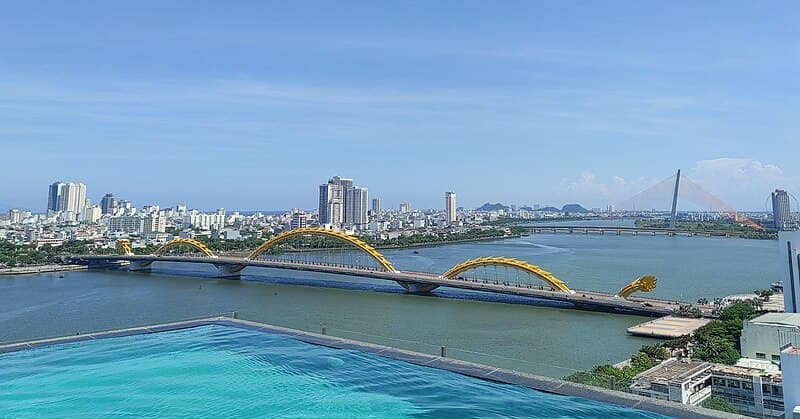
A 600-metre bridge over the Han River shaped like a dragon, opened in 2013 to mark the city's liberation anniversary. On Saturday and Sunday at 9pm the dragon breathes fire from its mouth, then water; coloured lights come on along the railing.

Tip: Crowds gather for the show and the bridge closes to traffic — arrive half an hour early and stand on the right side in the direction the water shoots, or you'll get sprayed. The best view of the whole bridge is from the east bank, from a riverside café.

Admission:
free
Time needed:
1 h
Son Tra Peninsula and Linh Ung Pagoda

Son Tra Peninsula and Linh Ung Pagoda

10 km northeast

A forested peninsula northeast of the city that Americans called Monkey Mountain. On its slope stands a 70-metre statue of the goddess of mercy, Quan Am, the tallest in Vietnam, and the forest is home to the rare red-shanked douc langur.

Tip: The road around the peninsula is a mountain road with several viewpoints; part of it is off-limits to tourists on scooters because of accidents, and police check for it. You're most likely to spot langurs early in the morning in the treetops near the viewpoints above the bay.

Admission:
free
Time needed:
half day
Museum of Cham Sculpture

Museum of Cham Sculpture

centre, near the Dragon Bridge

A collection of nearly a thousand sandstone sculptures from Cham temples, the largest of its kind in the world — Champa was a Hindu kingdom that ruled Central Vietnam from the 2nd to the 17th century. The French built the building in 1915 specifically for this collection.

Tip: Visit the museum before the My Son temples, not after — the best reliefs from My Son are here, while only brick towers remain on site. An audio guide is free via a QR code at the entrance.

Admission:
from VND 60,000
Time needed:
1.5 h
Hai Van Pass

Hai Van Pass

25 km north

A mountain pass at 500 metres on the ridge that divides north and south Vietnam both climatically and historically. French and American fortifications stand at the top, with views of the coast on both sides. Trucks now use the tunnel, so the old road is quiet.

Tip: The pass is often in cloud even when it's sunny below — the cloud sits right on the ridge and that's its normal state. Morning is the best time to go. The trip can be combined with a visit to Hue or a loop back via Lang Co lagoon.

Admission:
free
Time needed:
half day
Con Market and the Han River waterfront

Con Market and the Han River waterfront

centre

The city's largest market with 3,000 stalls, selling food, fabric and everything else; downstairs is a food section with 10 kinds of local noodle soup. Nearby runs the riverfront with its bridges and evening lights.

Tip: The food section of the market is best around 11am, when everything is fresh and it's not yet packed. Prices aren't posted and get inflated for foreigners — ask the price upfront and don't be afraid to haggle, up to half off for food.

Admission:
free
Time needed:
2 h
Non Nuoc Beach and the stone-carving village

Non Nuoc Beach and the stone-carving village

9 km south

The quieter southern end of the city beach, below the Marble Mountains, next to a village of stone carvers. Marble has been worked here for 500 years, and life-sized statues of Buddhas, lions and angels stand in front of the workshops.

Tip: Marble is now imported, since quarrying at the Marble Mountains is banned for conservation reasons. Small carvings can be bought and shipped; check the weight with the seller first, as postage from Vietnam often costs more than the stone itself.

Admission:
free
Time needed:
half day

Photos: Ba Na Hills and the Golden Bridge — DvTor8303 (CC0) · Marble Mountains — Viethavvh at vi.wikipedia (Public domain) · My Khe Beach — Jpatokal (CC BY-SA 4.0) · Dragon Bridge — Bùi Thụy Đào Nguyên (CC BY-SA 3.0) · Son Tra Peninsula and Linh Ung Pagoda — CEphoto, Uwe Aranas (CC BY-SA 3.0) · Museum of Cham Sculpture — Unknown authorUnknown author (Public domain) · Hai Van Pass — Vyacheslav Argenberg (CC BY 4.0) · Con Market and the Han River waterfront — Dragfyre (CC BY-SA 3.0) · Non Nuoc Beach and the stone-carving village — Vyacheslav Argenberg (CC BY 2.0)

Where to stay

Areas and districts, matched to the kind of trip you are taking

An Thuong and My Khe Beach

Best for: a first stay, with the beach close by

The tourist district behind the city beach, with hotels of every class, restaurants, cafés and bars. The beach is a few hundred metres away, the centre 10 minutes by taxi. The most sensible base for combining swimming with day trips around the area.

The centre by the Han River

Best for: the city, food and the bridges

The riverbank with Con Market, a museum and bridges that light up in the evening. Accommodation prices are lower than by the beach, and the food here is the best and cheapest. The sea is 20 minutes on foot or 5 minutes by taxi over the bridge.

Non Nuoc and the southern beach

Best for: resorts and quiet

The southern end of the coast below the Marble Mountains, with large resorts and golf courses. The beach here is wider and emptier than in the city. It's closer to Hoi An than to central Da Nang, which suits anyone planning to visit both.

Son Tra and the northern coast

Best for: views and seclusion

The slope of the peninsula, with luxury resorts on the bay and views of the city across the water. Complete quiet and nature right outside the door. Without a taxi or hotel transfer you can't get anywhere from here, and there's no nightlife at all.

Getting around

From the airport

Da Nang International Airport sits right in the city, 3 kilometres from the centre and 5 from the beach — one of the best-located airports in Asia. Direct flights connect it to major Asian hubs, and from Europe it typically takes around 17 hours with 1–2 connections. Grab is the cheapest way in from the airport; taxis from the rank are pricier. Da Nang is also a stop on the so-called Reunification Express, the train that runs the length of the coast from Hanoi to Ho Chi Minh City.

Da Nang International (DAD) · 5 km

  • Grab to My Khe beach· 15 min· VND 90,000
  • Taxi to the centre· 10 min· VND 120,000
  • Hotel transfer· 15 min· included in the stay
  • Transfer to Hoi An· 45 min· VND 350,000

Around town

Da Nang is manageable by Vietnamese standards, and traffic isn't as dense as in Hanoi or Saigon. The simplest option is the Grab app, which works for both cars and motorbikes — a bike ride costs half the price of a car and is faster in traffic. Buses run but aren't practical for visitors. Scooters are cheap to rent, but riding legally requires an international driving licence recognised in Vietnam, otherwise riding is illegal and insurance won't pay out.

Grab (car and motorbike)The cheapest and simplest way around the city; a motorbike costs roughly half the price of a car. · VND 30,000
Rented scooterCheap, but illegal without a recognised international driving licence, and uninsured. · VND 120,000/day
Driver for the dayThe most sensible option for day trips to Hue via Hai Van and to My Son; the price includes fuel and waiting time. · VND 1,200,000
Coastal trainThe Da Nang–Hue stretch over the Hai Van Pass is among the most scenic rail journeys in Asia, taking 2.5 hours. · VND 100,000

Useful apps: Grab, Be, Google Maps, Vietnam Airlines

When to go

The best period is February to May: dry, around 30 degrees, with the sea warming up. Summer, from June to August, is the hottest, with 35 degrees and high humidity, but the sea is calm and it's dry. From September to December the rainy season arrives with typhoons — October and November are the worst months, with rain nearly every day, a rough sea and red flags flying on the beach. January is cooler, around 25 degrees, with the sea at 23 degrees.

Best time

February to May

What to avoid

September to December, because of rain and typhoons

MonthJanFebMarAprMayJunJulAugSepOctNovDec
Day25°26°29°31°34°34°34°34°32°29°27°25°
Night19°20°22°24°25°26°26°26°25°23°22°20°
Rainy days137558881014192118
Sea23°23°24°26°28°29°29°29°29°27°26°24°

Food & drink

Central Vietnam cooks differently from both Hanoi and Saigon, and Da Nang is the best place to try it. The local speciality is mì Quảng noodles with minimal broth and crispy rice cracker, plus bánh xèo with peanut sauce and nem lụi grilled on lemongrass. The best food is at Con Market and in eateries with no English menu, not the restaurants along the seafront promenade. Seafood is picked live from tanks and charged by weight — get the price per kilo confirmed upfront, it's the most common source of misunderstandings.

What to try

Mì Quảng

Wide noodles coloured with turmeric in a small amount of intense broth, with prawns, pork, peanuts and crispy rice cracker. A Central Vietnamese speciality that isn't done properly anywhere else in the country.

Bánh xèo

A crispy turmeric rice pancake filled with prawns and bean sprouts, torn apart, wrapped in lettuce with herbs and dipped in fish sauce. The name means 'sizzling', after the sound it makes frying.

Nem lụi

Minced pork grilled on a lemongrass skewer over charcoal, wrapped in rice paper with herbs and dipped in a thick peanut sauce. A Central Vietnamese dish assembled right at the table.

Bánh mì

A baguette left over from French colonial days, filled with pâté, meat, pickled vegetables and coriander. The best come from bicycle stalls and cost a fraction of a café price.

Phở

A broth simmered overnight from beef bones, star anise and cinnamon, served with rice noodles and slices of meat. Eaten for breakfast rather than dinner, with fresh herbs and bean sprouts added yourself at the table.

Gỏi cuốn

Fresh, unfried rice-paper rolls with prawn, noodles and herbs. A light, safe choice in the heat; the dip is usually peanut or fish sauce.

Cà phê sữa đá

Strong coffee dripped through a metal filter into sweetened condensed milk and poured over ice. Vietnam is the world's second-largest coffee producer, and this is how it's drunk here.

Bia hơi

Freshly brewed draught beer with no preservatives, delivered daily and drunk on low stools by the street. It costs a couple of thousand dong and is the cheapest beer in the world.

What it costs

Bánh mì from a stall

VND 20,000–35,000

Noodle soup at an eatery

VND 40,000–60,000

Dinner at a tourist restaurant

VND 250,000–450,000 per person

Bia hơi draught beer

VND 10,000–20,000

Iced coffee with condensed milk

VND 25,000

Ba Na Hills with cable car

from VND 900,000

Grab to the beach from the airport

VND 90,000

Night in a 4-star hotel

VND 1,200,000–2,500,000

Indicative prices that change over time — treat them as a guide, not a price list.

Practical information

SocketsAtwo flat pins (US/JP)CEuroplug, two round pinsFSchuko
Voltage220V / 50Hz
Tap waterDo not drink tap water — Tap water isn't drinkable, use bottled water even for brushing teeth. A bottle costs around VND 10,000 and hotels usually restock it free. Ice in drinks is safe, it's produced centrally and you can identify it by the cylinder shape with a hole in the middle. Iced coffee with condensed milk is sold everywhere and is among the best in the world.
TippingTipping isn't a Vietnamese tradition and isn't given in cheap eateries. In tourist restaurants and hotels, round up or leave 5–10%; guides and drivers on a full-day trip are given VND 100,000–200,000. Watch out for the zeros: the VND 20,000 and VND 500,000 notes are a similar colour, and mixing them up is the most common payment mistake.
Driving on theright
SafetyThe most real risk in Vietnam is traffic. It's dense, motorbikes ride on pavements too, and you cross the road at a slow, steady pace without stopping so riders can go around you — stopping mid-crossing is what causes collisions. Riding a scooter requires a Vietnamese or recognised international driving licence; without it, riding is illegal and insurance won't pay out, which matters given the local accident rate. Crime is otherwise low, though bag and phone snatching by a passing motorbike does happen in bigger cities. In the sea, watch for rip currents from October to December, when red flags fly on Central Vietnam's beaches.
Opening hoursVietnam gets up early: markets run from 5am and the best food is gone by 9am. Shops open at 8am and close around 9pm, and many smaller businesses take a midday break from noon to 2pm. Pho restaurants serve mainly in the morning, while evenings are for street-side tables. During Tết, around late January and early February, almost the entire country closes for a week, including restaurants, making it the worst possible time to travel.
Customs & etiquetteGive and receive with both hands, especially with older people. At temples and pagodas, cover your shoulders and knees, and take off your shoes. Don't raise your voice or show irritation, a public row means a loss of face for both sides. Haggling is normal and expected at markets, but not in fixed-price shops. If you photograph a woman carrying baskets on a pole, it counts as a paid service — agree the price first.
A few local wordsHello — Xin chàoThank you — Cảm ơnHow much does it cost? — Bao nhiêu tiền?The bill, please — Tính tiềnDelicious — Ngon quá

How to plan your days

1 day

A day in Da Nang

  1. 1My Khe beach at 5am, the way locals do it.
  2. 2Breakfast: mì Quảng at an eatery with no English menu.
  3. 3Late morning: the Marble Mountains and Huyen Khong cave.
  4. 4Afternoon: the Museum of Cham Sculpture.
  5. 5Evening: the Han River waterfront, and at 9pm on weekends, the Dragon Bridge.

2 days

2 days with the mountains

  1. 1Day 1 as above.
  2. 2At 8am, cable car up to Ba Na Hills.
  3. 3The Golden Bridge and French village, returning before noon ahead of the crowds.
  4. 4Afternoon: Son Tra Peninsula and Linh Ung Pagoda.
  5. 5Dinner with seafood picked live from a tank.

3 days

3 days with Hoi An

  1. 1The first 2 days as above.
  2. 2Morning: Hoi An, half an hour's drive south.
  3. 3The old town with lanterns, the covered bridge and made-to-measure tailors.
  4. 4Return after dark, when the lanterns are lit.
  5. 5With time to spare, the Hai Van Pass and Hue the next day.

Day trips

Hoi An

30 km · 40 min by car

A trading port that has barely changed since the 18th century, because the river silted up and ships stopped calling. Its UNESCO-listed old town has a covered Japanese bridge, Chinese assembly halls and hundreds of tailor shops that can make a suit in a day. Silk lanterns light up in the evening.

My Son

55 km · 1 h 15 min by car

A cluster of brick Cham temples from the 4th to 13th centuries in a mountain valley, once the Hindu centre of the Champa kingdom. Of the original 70 structures, around 20 survived American bombing. Go for the first entry at 6am, when it's cool and mist hangs between the towers.

Hue

100 km · 2 h by car over the Hai Van Pass

Vietnam's last imperial capital, with its Citadel, the Purple Forbidden City and imperial tombs scattered along the Perfume River. The drive over the Hai Van Pass is a highlight in itself; by train it's the most scenic coastal route in the country.

Frequently asked questions

Is the Golden Bridge at Ba Na Hills worth it?+

Yes, if you arrive right at opening at 8am. After 10am the 150-metre-long walkway gets crowded and by afternoon the summit clouds over. The cable car up is one of the longest in the world and is included in the ticket. It's usually around 10 degrees cooler up top than down below.

When should I visit Da Nang?+

February to May, when it's dry and a pleasant 30 degrees. Summer is the hottest but dry. September to December is the rainy season with typhoons — October and November are the worst, with rain nearly every day and a rough sea with red flags on the beach.

Is it better to stay in Da Nang or Hoi An?+

Da Nang has the beach, the airport and better access to day trips, while Hoi An has old-town atmosphere but is smaller and gets crowded in season. It's a 30-minute drive between them. Anyone who wants swimming and day trips should base in Da Nang and visit Hoi An in the evening.

Can I ride a scooter in Vietnam?+

Legally only with a Vietnamese driving licence or an international licence that Vietnam recognises — and that's not a given, so check the current rules first. Without it, riding is illegal and insurance won't cover treatment or repatriation, which is a real risk given the local traffic.

Does the Dragon Bridge breathe fire every day?+

No, only on Saturday and Sunday at 9pm, plus on public holidays. The dragon first breathes fire, then water; the bridge closes to traffic for that time. Arrive half an hour early and stand where the water won't land on you.

Do I need a visa for Vietnam?+

Most nationalities need a visa. The simplest option is the electronic e-Visa, applied for online and typically processed within 3 working days; it covers single or multiple entry depending on the type chosen. Your passport must be valid for at least 6 months after entry.

What food is Da Nang known for?+

Mì Quảng — wide noodles coloured with turmeric in a small amount of intense broth with prawns, pork, peanuts and crispy rice cracker. Also bánh xèo and nem lụi grilled on lemongrass skewers. These are Central Vietnam specialities that aren't done properly anywhere else in the country.

Can you swim in Da Nang?+

Yes, My Khe beach is wide, with a gentle slope into the water and lifeguards, and it runs for over 10 kilometres along the city. It's best from February to August. From October to December there tend to be waves and rip currents, and red flags fly on the beach — take them seriously.

Conditions de visa

Vérifiez les conditions de visa actuelles pour entrer dans ce pays.

Vérifier les conditions de visa

Langue

Vietnamese

Devise

VND

Fuseau

GMT+7

Indicatif

+84

Population

99.5M

Superficie

331,212 km²

Tension

220V / 50Hz

Côté de conduite

Droite

Meilleurs hôtels à Da Nang

Prix en direct de 500+ hébergements

Chargement des hôtels...

More destinations in Vietnam

Vous planifiez un voyage à Da Nang?

Comparez des centaines d'hôtels, trouvez le meilleur prix et réservez avec annulation gratuite.