Hotels in Monastir

A ribat above the sea, the airport around the corner, and Sousse's quieter neighbor

Monastir

LangueArabic / French
DeviseTND
FuseauAfrica/Tunis
Température12-35 °C
Indicatif+216
Population12.5M
Superficie163,610 km²
PrisesType C / Type E
Eau du robinetNon potable

Découvrez Monastir

Monastir is a coastal town on a headland forty kilometers south of Hammamet and twenty kilometers from Sousse, known to many travelers mainly as the landing point for charter flights to Tunisia. But the town itself is one of the prettiest on the coast: on a rocky point above the sea stands an eighth-century ribat, the oldest fortified monastery in North Africa, next to a cemetery of white tombstones and the golden dome of the mausoleum of Habib Bourguiba, Tunisia's first president, who was born here. Around it sits a tidy center with a medina, a wide promenade and a yacht marina. Most hotels sit in the Skanes zone along a seven-kilometer beach between town and the airport, so the transfer from the plane takes just ten minutes. Monastir is quieter and tidier than Sousse, but smaller with less going on outside the season. The coastal Sahel Metro railway connects it to Sousse, the airport and Mahdia, making it an easy base to explore from without a car.

What to see

The places worth your time in Monastir, and what to expect at each

Ribat of Harthema

Ribat of Harthema

old town

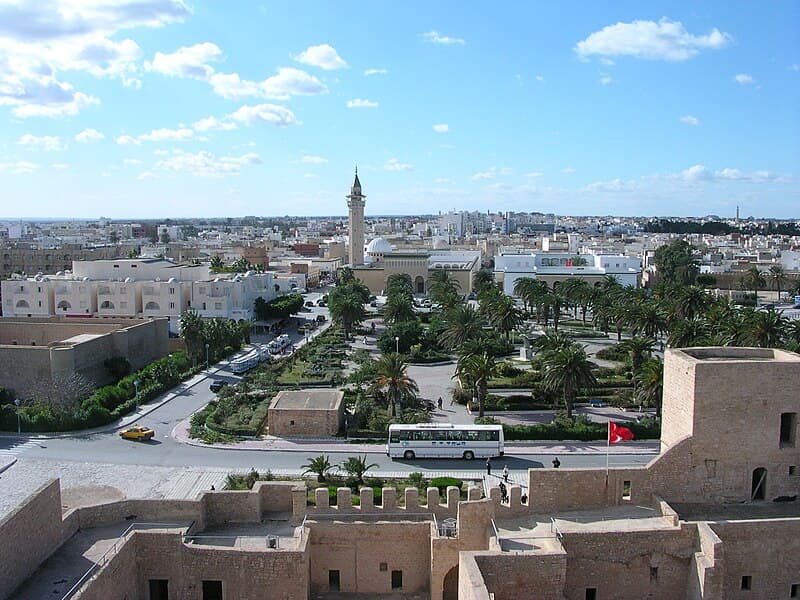
A fortified monastery founded in 796 on a rock above the sea, the oldest surviving one in North Africa. Inside are monks' cells, a prayer hall and a courtyard; the Nador watchtower offers a view over the whole peninsula. Filmmakers used it as a backdrop for both Life of Brian and Jesus of Nazareth.

Tip: The Nador tower is reached by a narrow spiral staircase with no handrail — sandals won't cut it. The best light for photographing the ribat from outside is from the cemetery opposite, an hour before sunset.

Admission:
from 8 TND
Time needed:
1–2 h
Mausoleum of Habib Bourguiba

Mausoleum of Habib Bourguiba

Sidi el Mezeri cemetery

The tomb of Tunisia's first president, at the end of the cemetery avenue, with a golden dome, two thirty-meter minarets and a marble interior. Bourguiba was born in Monastir and had the mausoleum built during his own lifetime; it was completed in 1963.

Tip: Admission is free and it's usually open in the morning; afternoons it often closes without notice. Photography is allowed both outside and inside, but not of the guard at the entrance.

Admission:
free
Time needed:
30 min
Great Mosque

Great Mosque

old town

A ninth-century mosque right next to the ribat, built from the same sandstone and expanded as late as the eleventh century. The prayer hall stands on columns salvaged from nearby Roman buildings, so no two are alike. From outside it looks like a continuation of the fortress walls.

Tip: Non-Muslims can't enter, but you can look down into the courtyard from the ribat's gallery — it's the only place to see the whole mosque at once.

Admission:
free from outside
Time needed:
30 min
Medina and souk

Medina and souk

downtown

A small medina behind the ribat, partly rebuilt in the 1960s, making it airier and less maze-like than the ones in Sousse or Tunis. It sells pottery, spices and textiles, but the sales pressure here is considerably gentler than in the bigger cities.

Tip: Prices in Monastir are firmer than in Sousse and there's less haggling — if a vendor quotes something close to the price at an ONAT state shop, it's fair and not worth pushing lower.

Admission:
free
Time needed:
2 h
Marina Cap Monastir

Marina Cap Monastir

harbor

A yacht harbor for four hundred boats right below the fortress walls, ringed by white buildings with restaurants and cafés. From the pier you can see both the ribat and the mosque at once, and in the evening it's the place for a stroll. Boats to the Kuriat Islands depart from here.

Tip: Restaurants on the first pier charge tourist prices, but at the back of the marina are a few places where boat crews eat — the same fish costs roughly half as much there.

Admission:
free
Time needed:
2–3 h
Skanes Beach

Skanes Beach

Skanes, 5 km northwest

A seven-kilometer strip of light sand between town and the airport, lined with most of the area's hotels. The seabed slopes gently, the water is calm and the beach is wide. Stretches in front of hotels are groomed and staffed, with free sections in between without loungers.

Tip: Planes land low and loudly over the northern end of the beach — if you're a light sleeper, pick a hotel in the southern half of Skanes, closer to town.

Admission:
free, loungers from 15 TND
Time needed:
a full day
Kuriat Islands

Kuriat Islands

18 km offshore

Two uninhabited islands eighteen kilometers offshore, with clear shallows and one of the last Tunisian beaches where loggerhead turtles lay their eggs. The larger island has a nineteenth-century lighthouse and a conservation station that monitors the nests.

Tip: Boats leave the marina around nine and return in the afternoon. The islands have no shade or drinking water — bring your own water, a hat and a swim shirt, since the sun there is relentless.

Admission:
boat from 60 TND
Time needed:
a full day
Lamta and the Leptiminus Museum

Lamta and the Leptiminus Museum

12 km south

A fishing village twelve kilometers south, built on the site of the Punic-Roman port city of Leptiminus. A small museum in a former fort displays mosaics, amphorae and tomb finds straight from the surrounding fields, and it's rarely crowded.

Tip: The museum is open mornings and admission costs a few dinars. Take the Sahel Metro toward Mahdia to Lamta station, then it's a ten-minute walk from the station.

Admission:
from 6 TND
Time needed:
2 h
Sidi el Mezeri Cemetery

Sidi el Mezeri Cemetery

between the ribat and the mausoleum

A sprawling white cemetery between the ribat and the mausoleum, in use since the twelfth century. The tombstones are low, whitewashed and packed tightly together, among them the tomb of the saint Sidi el Mezeri. The main path to the mausoleum runs right through the cemetery.

Tip: The cemetery is a working one, not a museum — on Fridays and during funerals, avoid walking through or taking photos. It's quietest early in the morning, when the white stone is still cool and the light is soft.

Admission:
free
Time needed:
30 min

Photos: Ribat of Harthema — Mohamed Ezzi (CC BY-SA 4.0) · Mausoleum of Habib Bourguiba — Photographer : Mgdalena Siudy (Freta) , Workshop : Kassus (CC BY-SA 3.0) · Great Mosque — Hamed Gamaoun (CC BY-SA 4.0) · Medina and souk — Mietek Ł (CC BY-SA 3.0) · Marina Cap Monastir — patano (CC BY-SA 3.0) · Skanes Beach — Mietek Ł (CC BY-SA 3.0) · Kuriat Islands — NASA (Public domain) · Lamta and the Leptiminus Museum — Yamen (CC BY 3.0) · Sidi el Mezeri Cemetery — Benoît Prieur (CC0)

Where to stay

Areas and districts, matched to the kind of trip you are taking

Skanes

Best for: beach and all-inclusive stays

The hotel zone along a long beach between town and the airport, home to most tourists. The beach is wide and sandy, hotels have pools and entertainment programs, but there's almost nothing to walk to outside the resort grounds. Downtown Monastir is five kilometers away, reachable by Sahel Metro or taxi for about five dinars.

Downtown and the medina

Best for: a first visit and getting around on foot

The area around the ribat, the mosque and the marina, where everything is within a ten-minute walk and evenings mean strolling the promenade. Accommodation is cheaper here than in Skanes, and you're surrounded by an actual working town with a market and cafés. The downtown coastline, though, is rocky and narrow — head to Skanes for swimming.

Marina Cap Monastir

Best for: evening life and dining

The harbor district below the fortress walls, with restaurants, cafés and a few hotels right on the water. It's Monastir's liveliest spot after dark, yet without the clubs and noise found in Sousse. Good for couples who don't want to spend evenings at the hotel bar.

Khniss and the southern edge

Best for: quiet and longer stays

A residential area south of downtown with apartments, shops for locals, and beaches with room to spare even in August. Tourist infrastructure is practically nonexistent here, but prices in shops and eateries are genuinely local. A city bus and taxis (about three dinars) run downtown.

Getting around

From the airport

Monastir Habib Bourguiba Airport sits eight kilometers from downtown, right at the edge of the Skanes hotel zone, so the transfer from plane to hotel takes just ten to fifteen minutes — the shortest in all of Tunisia. Charter flights from Prague take roughly three hours. The coastal Sahel Metro also runs from the airport to Monastir, Sousse and Mahdia, with a ticket costing under two dinars. By car, Monastir sits on the coastal road between Sousse and Mahdia; Tunis is one hundred sixty kilometers away via the A1 highway, about two hours.

Monastir Habib Bourguiba (MIR) · 8 km

  • Hotel transfer· 10 min· included in package
  • Taxi downtown· 15 min· 12 TND
  • Sahel Metro· 20 min· 1.5 TND

Enfidha–Hammamet (NBE) · 65 km

  • Taxi· 55 min· 90 TND
  • Private transfer· 55 min· 110 TND

Around town

Monastir is small, and downtown can be covered on foot in an hour. The key link is the coastal Sahel Metro railway, connecting Mahdia, Lamta, Monastir, the airport, Skanes and Sousse; it runs roughly every half hour and costs one to three dinars, making it the easiest way to get anywhere along the coast without a car. Yellow metered taxis operate in town, costing under five dinars for local trips. You only need a car for El Jem and the interior. Parking downtown is free outside peak season, and attended for a dinar in summer.

Sahel MetroCoastal train Mahdia – Monastir – airport – Sousse, every 30 minutes until evening. · 1 TND
Yellow taxiMeter is mandatory; under five dinars around town, about thirty to Sousse. · 3 TND
City busRoutes to Khniss and Skanes, cheap but irregular, stopping in the evening. · 0.8 TND
Louage shared vansShared minibuses to Sousse, Mahdia and El Jem from the station by the market. · 3 TND
Rental carWorth it for El Jem, Kairouan or the Sahara. Along the coast, the train is enough. · 110 TND / day

Useful apps: Google Maps, Bolt, Maps.me

When to go

The season follows the rest of the central Tunisian coast: swimming works from June through early October, with the sea warmest in August and September at twenty-six to twenty-seven degrees. But Monastir sits on a headland and is windier than Sousse, which makes the hot months more bearable. September is the most pleasant. April and May are ideal for touring the ribat and visiting Mahdia, though the sea is only seventeen to twenty degrees. In winter it hovers around seventeen degrees, and only some hotels stay open.

Best time

September, then June

What to avoid

August, due to full hotels and daytime heat

MonthJanFebMarAprMayJunJulAugSepOctNovDec
Day17°18°20°22°26°30°33°33°30°26°21°18°
Night7°7°9°11°15°19°22°22°20°17°12°8°
Rainy days766542114668
Sea15°14°15°17°20°23°26°27°26°23°20°17°

Food & drink

Monastir lives off the sea, and it shows on the menus: the staples are grilled fish, charcoal-grilled octopus and fish couscous, cooked here with harissa and saffron. The cheapest meals are found in the streets behind the medina and in Khniss, the priciest right at the marina. Several bakeries in town fry brik and mlaoui flatbreads each morning, and the market sells fresh local dates and olives. Alcohol is available at restaurants by the marina and in hotels, but nowhere else.

What to try

Brik

A thin sheet of malsouka pastry fried with egg, tuna and parsley. The yolk inside stays runny, so you bite the corner first and eat it by hand over the plate.

Couscous

The whole country's Friday meal: semolina steamed over a pot of meat and vegetables. In coastal towns it's also made with fish, a version you won't get at your hotel.

Méchouia salad

Roasted peppers, tomatoes and garlic crushed in a mortar, with tuna, egg and olives. Served cold as a starter, and the best way to gauge the strength of the local harissa.

Ojja

A tomato-and-harissa skillet dish with eggs cracked in, usually with merguez sausage or shrimp. Quick, spicy, and the cheapest hot meal at any local eatery.

Lablabi

A chickpea soup with garlic and cumin, into which you crumble stale bread right in the bowl. A workers' breakfast, sold in the morning and often sold out by midday.

Harissa

A paste of roasted chilies, garlic and cumin, brought to your table with bread before the menu even arrives. Tunisian harissa is spicier than the Moroccan kind — taste your first spoonful carefully.

Makroud and pine-nut tea

Diamond-shaped semolina pastries filled with dates and soaked in honey, served with strong sweet green tea topped with a handful of pine nuts.

Grilled fish by the kilo

Pick your dorado, sea bass or red mullet from the display case and pay by weight. The price per kilo is usually posted on a board — have the fish weighed in front of you.

What it costs

Coffee downtown

2–3 TND

Mlaoui or brik from a bakery

3–6 TND

Grilled fish by the marina

35–60 TND per person

Celtia beer, 0.5 l

7–10 TND

Two sun loungers with an umbrella

15–25 TND

Sahel Metro to Sousse

2.5 TND

Ribat admission

8 TND

Boat to the Kuriat Islands

from 60 TND

Indicative prices that change over time — treat them as a guide, not a price list.

Practical information

SocketsCEuroplug, two round pinsEFrench, with earth pin
Voltage230V / 50Hz
Tap waterDo not drink tap water — Don't drink the tap water — it's chlorinated, hard, and tastes unpleasant in summer. A 1.5-liter bottle of water costs under a dinar in a shop, roughly four times that at a hotel. Avoid ice in drinks outside your hotel, and wash fruit with bottled water.
TippingSmall tips are expected: round up at a café, leave around ten percent at a restaurant, and give hotel porters a dinar per bag. Card terminals can't add a tip, so keep small notes of one and five dinars handy. Guides and drivers on a full-day excursion expect roughly five dinars per person.
Driving on theright
SafetyBoth the resorts and the medina are safe, and police are visible in tourist zones. The most common nuisance isn't crime but pushy sales tactics: someone in the medina may approach you claiming to lead you to “my brother's workshop” and steer you into a carpet shop. A polite 'lā, shukran' and continuing to walk is enough. Taxis have meters — insist the driver uses it, or they'll quote triple the price. In the sea, watch the flags; afternoon winds can be strong on the southern beaches.
Opening hoursShops in the resorts are open from nine until late in the evening, including Sundays; the medina and souks close around noon on Fridays for prayers. Offices and banks operate from eight to four, and only until one in summer. During Ramadan the daily rhythm shifts: cafés and restaurants outside hotels don't open until after sunset, while hotel service continues as normal.
Customs & etiquetteTunisia is a secular but Muslim country: swimwear is fine at the resort, but wear a t-shirt and trousers or a knee-length skirt in town and the medina. Non-Muslims are usually not allowed past the courtyard of a mosque. The left hand isn't used for eating or handing objects to someone. Don't photograph people, especially women, without asking, and photography is forbidden near police and military sites.
A few local wordsHello — As-salām alaykumThank you — ShukranNo, thank you — Lā, shukranHow much does it cost? — B'kaddech?That's too expensive — Ghālī barsha

How to plan your days

1 day

A day in old Monastir

  1. 1Morning at the ribat and climbing the Nador tower above the sea.
  2. 2Walk through the cemetery to the Bourguiba mausoleum.
  3. 3Lunch at the back of the marina, where boat crews eat.
  4. 4Afternoon swim at Skanes and an evening stroll along the promenade.

2 days

Two days with the sea and Mahdia

  1. 1First day as above.
  2. 2Second day, morning by Sahel Metro to Mahdia.
  3. 3The old town on the peninsula, the Skifa el Kahla gate and the fish market.
  4. 4Return by afternoon train and dinner in the medina.

3 days

Three days including the islands

  1. 1First two days as above.
  2. 2Third day, morning boat from the marina to the Kuriat Islands.
  3. 3Snorkeling in the shallows and lunch on board.
  4. 4Return in the afternoon, evening at the marina.
  5. 5If you have a spare day, El Jem or the museum in Lamta.

Day trips

Mahdia

45 km · 1 h by train

A fishing town on a narrow peninsula with the Skifa el Kahla gate, a cemetery above the sea, and the nicest beach in the area. It sees a fraction of the tourists Sousse does, and the afternoon fish market at the harbor is one of the liveliest in the country.

El Jem Amphitheater

40 km · 45 min by car

A Roman amphitheater built for thirty-five thousand spectators, standing in the middle of today's small town, with access to both its tiers and its underground passages. In July and August, evening concerts of a symphonic festival are held in the arena.

Sousse

20 km · 30 min by train

The neighboring city, Tunisia's third largest, with a UNESCO-listed medina, a ribat and an eight-kilometer beach. It's noisier and livelier than Monastir, with bigger souks and cheaper shopping. The coastal train runs there every half hour.

Frequently asked questions

How far is it from the airport to the hotels?+

The airport sits right at the edge of the Skanes hotel zone, so the transfer takes only ten to fifteen minutes — the shortest in Tunisia. Downtown Monastir is eight kilometers away and a taxi costs about twelve dinars. Sousse is half an hour away, Hammamet an hour.

Do planes disturb Monastir?+

In the northern part of Skanes, yes — planes land low over the beach, and in high season there are several an hour. The noise is brief but loud. If you're a light sleeper, choose a hotel in the southern half of Skanes or right in town, out of reach of the flight path.

Is Monastir a better choice than Sousse?+

It depends what you want. Monastir is quieter, tidier and has a shorter transfer, but it's smaller with fewer restaurants and less nightlife. Sousse has a bigger medina, more shopping and livelier evenings, but is noisier and more congested. A train runs between them every half hour, so you can stay in one and visit the other.

Can you swim right in Monastir town?+

Only to a limited extent — the coastline downtown is rocky and narrow. Sandy beaches begin in Skanes, five kilometers northwest, and continue seven kilometers toward the airport. Sahel Metro trains and taxis run there for about five dinars, so swimming is easy to reach even if you stay in town.

Is a trip to the Kuriat Islands worth it?+

Yes, if you don't mind spending the whole day in the sun. The water is clear and shallow, and the islands have no buildings besides a lighthouse and a sea turtle conservation station. There's no shade or drinking water, though, so bring your own supplies, a hat and a swim shirt. Boats start at sixty dinars.

When is the sea warmest?+

In August and September, when it reaches twenty-six to twenty-seven degrees. The best balance of warm water and bearable air comes in the first half of September. June has twenty-three degrees, May twenty. Being on a headland, it's windier here than in Sousse, so the water warms up slightly more slowly.

How do I get from Monastir to the Sahara?+

The easiest option is a two-day organized tour from your hotel to Douz and Matmata with an overnight stay, since a one-way trip takes four to five hours. By your own car it's three hundred forty kilometers to Douz via the highway and the road through Gabès. A one-day version means nine hours on a bus and isn't worth it.

Do I need to haggle in Monastir?+

Less than in Sousse or Tunis. Vendors in the small medina usually quote a price close to the final one, and the sales pressure here is mild. State-run ONAT shops with fixed prices give you a benchmark — if a souk offer is similar, it's fair.

Conditions de visa

Vérifiez les conditions de visa actuelles pour entrer dans ce pays.

Vérifier les conditions de visa

Langue

Arabic / French

Devise

TND

Fuseau

Africa/Tunis

Indicatif

+216

Population

12.5M

Superficie

163,610 km²

Tension

230V / 50Hz

Côté de conduite

Droite

Meilleurs hôtels à Monastir

Prix en direct de 500+ hébergements

Chargement des hôtels...

More destinations in Tunisia

Vous planifiez un voyage à Monastir?

Comparez des centaines d'hôtels, trouvez le meilleur prix et réservez avec annulation gratuite.