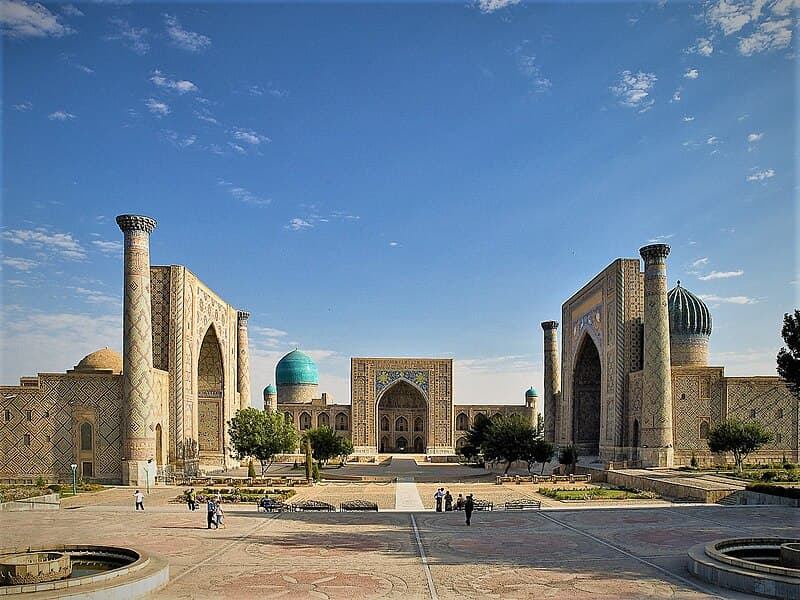
Timur's Silk Road capital, where blue domes rise on every side
Samarkand
LangueUzbek
DeviseUZS
FuseauAsia/Tashkent
Température5-35 °C
Indicatif+998
Population36M
Superficie449,009 km²
PrisesType C / Type F
Eau du robinetNon potable
Découvrez Samarkand
Samarkand is one of the oldest continuously inhabited cities on earth — founded around 700 BC, conquered by Alexander the Great, razed by Genghis Khan and rebuilt by Timur, who made it the capital of an empire stretching from India to Anatolia in 1370. The reason people travel here dates from the Timurid era and the reign of his grandson Ulugh Beg: colossal portals covered in blue and turquoise tilework, among the most striking buildings in the Islamic world. The Registan, with its three madrasas around an open square, is the most photographed site in Central Asia, and the Shah-i-Zinda necropolis is a continuous lane of twenty mausoleums where every inch of wall is faced with ceramic tile. The city today has half a million residents and is clearly split in two: Soviet-era boulevards with parks, and an old Tajik-speaking quarter of mudbrick houses and a maze of lanes around the bazaar. Uzbekistan has opened up to tourism since 2018, EU and Czech citizens need no visa, prices are low, and a high-speed train from Tashkent gets you here in two hours. It is the most easily reached exotic destination Europe has to offer.
What to see
The places worth your time in Samarkand, and what to expect at each
Registan
City centre
A square framed on three sides by madrasas that together form a visual shorthand for all of Central Asia. The oldest is the Ulugh Beg Madrasa from 1420, where Timur's grandson taught astronomy; opposite stands the seventeenth-century Sher-Dor, whose portal features tigers and human faces within a rising sun, an unusual choice in Islamic architecture; the third, Tilya-Kori, has a gold-covered prayer hall that used roughly three kilograms of gold in its decoration.
Tip: Buy a ticket and go inside all three madrasas — the courtyards are now full of small shops, but Tilya-Kori hides a golden hall you'd never guess from outside. For a small tip, the guard will sometimes let you up the minaret of the Ulugh Beg madrasa in the evening for the best view in the city; it's semi-official but common practice. The light is best an hour after sunrise and an hour before sunset — at midday the tiles wash out. The evening illumination from outside is free.
Admission:
from 65,000 UZS
Time needed:
2 h
Shah-i-Zinda
Northeast, near Afrasiyab
A funerary lane climbing a slope above the old town, made up of more than twenty fourteenth- and fifteenth-century mausoleums built for Timur's relatives and courtiers. The name means "the living king" and refers to the shrine of Qusam ibn Abbas, a cousin of the Prophet Muhammad. It's the most complete surviving display of Timurid ceramic work anywhere — every mausoleum uses a different pattern and technique.
Tip: Come right at opening, at seven or eight, since the lane is narrow and queues form by ten. The staircase at the entrance carries a superstition: whoever counts the same number of steps going up as coming down is said to have a clean soul — locals take it seriously and count out loud. It's a pilgrimage site, so covered shoulders and knees are expected. The best photos are from the upper end looking down.
Admission:
from 50,000 UZS
Time needed:
1.5 h
Bibi-Khanym Mosque
Near Siab Bazaar
A vast Friday mosque that Timur had built after his campaign in India between 1399 and 1404, intended to be the largest in the Islamic world. Ambition outran the engineering: the eighteen-metre dome began collapsing during Timur's own lifetime, and the mosque stood in ruins for centuries before partial restoration in the 1980s. An enormous marble Quran stand still sits in the courtyard.
Tip: Inside you can see exactly where the restoration ends and the original structure begins — the unrestored section, with its tiles falling away, is actually the most interesting part, since it shows what the rest of the building looked like before repairs. Tradition holds that a woman hoping to conceive should walk three times around the marble Quran stand in the courtyard. A gate at the back of the mosque leads straight into the Siab Bazaar, making the two an easy combination.
Admission:
from 40,000 UZS
Time needed:
1 h
Gur-e-Amir
South of centre
Timur's 1404 mausoleum, topped with a ribbed turquoise dome, holds his own tomb along with those of his sons and his grandson Ulugh Beg. The interior, faced in alabaster and gilding, ranks among the richest in Central Asia; the building became the model for Humayun's Tomb in Delhi and, through it, for the Taj Mahal. Timur's headstone is carved from a single block of dark green jade.
Tip: Soviet anthropologist Mikhail Gerasimov opened the tomb in June 1941 and reconstructed Timur's face from his skull; legend has it the tomb bore an inscription warning that opening it would bring war — Germany invaded the USSR two days later. It's best visited after dark, when the mausoleum is lit up and nearly empty; it's typically open until nine in the evening. It's an easy ten-minute walk from the Registan.
Admission:
from 50,000 UZS
Time needed:
1 h
Ulugh Beg Observatory
Northeast, 4 km from centre
The remains of an observatory built around 1420 by Timur's grandson Ulugh Beg — an astronomer who calculated the length of the sidereal year to within twenty-five seconds and compiled a catalogue of 1,020 stars that remained unmatched in Europe for two centuries. Of the original three-storey circular building, only the underground section of a giant marble sextant survives, forty metres in radius and set into the rock.
Tip: The surviving fragment itself is small and unremarkable without context — visit the adjoining museum first, where the sextant's workings are explained, or you'll just see a buried arc in the ground. Ulugh Beg was killed on his own son's orders and his observatory was levelled; a Russian archaeologist only rediscovered it in 1908. It's four kilometres from the centre and pairs well with Afrasiyab, right next door.
Admission:
from 40,000 UZS
Time needed:
1 h
Siab Bazaar
Near Bibi-Khanym
The city's main market, right next to the Bibi-Khanym mosque, the largest in Samarkand and the one place where you see the city without a tourist filter. Vendors sell Samarkand bread, mountains of dried apricots, raisins, almonds and pistachios, spices, kurt — salted, dried balls of sheep's milk — and everything else an Uzbek household needs.
Tip: Come between seven and ten in the morning, when the bazaar is at its busiest and the bread is still warm; by afternoon it thins out considerably. Samarkand's lepyoshka is only baked here and is carried as a gift across Uzbekistan, since it keeps for weeks in the dry climate. Try the dried fruit — vendors offer samples themselves and no one considers it rude; bargaining is expected, done with a smile, and usually starts around half the asking price. Bring cash, as no one here takes cards.
Admission:
free
Time needed:
1–1.5 h
Afrasiyab and its museum
North, near Shah-i-Zinda
Broad earthen mounds north of the city, all that remains of the original Samarkand — a city massacred and razed by Genghis Khan in 1220 and never rebuilt on the same site. A museum at the edge of the site houses seventh-century wall paintings depicting a Sogdian embassy, the only surviving painting of its kind from Central Asia at that time.
Tip: The mounds themselves look, to the untrained eye, like plain earth hills — go for the museum and its Sogdian frescoes. They depict a Chinese princess on a boat, Turkic horsemen and a procession of ambassadors, giving a sense of how cosmopolitan the city was even before Islam arrived. The museum is air-conditioned, which in summer is a selling point on its own. It's a five-minute walk from Shah-i-Zinda and easy to combine with it.
Admission:
from 30,000 UZS
Time needed:
1 h
Hazrat Khizr Mosque
Above Siab Bazaar
A mosque on a rise above the Siab Bazaar, standing on the site of Samarkand's oldest shrine from the eighth century, dedicated to the legendary wanderer Khizr, protector of travellers. The current building dates to the nineteenth century, with a painted wooden ceiling and an open ayvan porch overlooking all of Afrasiyab and the domes of Bibi-Khanym.
Tip: This is the best viewpoint in the city, and it's nearly free, yet a fraction of the crowd that visits the Registan bothers to come. Next to the mosque is the mausoleum of Uzbekistan's first president, Islam Karimov, which matters more to locals than all the Timurid monuments combined — expect to see pilgrims here, not tourists. It's loveliest an hour before sunset, when the domes opposite turn gold.
Admission:
from 25,000 UZS
Time needed:
45 min
Konigil Paper Mill
Konigil, 8 km from centre
A workshop in a village eight kilometres from the centre that revived the production of Samarkand paper from mulberry bark — a technology the Arabs learned in the eighth century from captured Chinese papermakers here in Samarkand, and from there carried on to Europe. The bark is boiled, pounded to pulp by a water-powered mill, lifted onto a screen and smoothed with agate.
Tip: The whole process is demonstrated live and takes about half an hour; the paper itself is for sale and makes the best souvenir from Samarkand, since you won't find it anywhere else in the world. The same site has a garden teahouse by a stream where you can have lunch in the shade — in summer, it's the most pleasant spot in the area. A round-trip taxi from the centre with waiting time costs about 100,000 UZS; combine it with a visit to the Ulugh Beg Observatory.
Areas and districts, matched to the kind of trip you are taking
City centre around the Registan
Best for: first-time visitors and the main sights
A Soviet-planned district of boulevards, parks and the pedestrian street Tashkentskaya, from which the Registan, Gur-e-Amir and the bazaar are all within reach. Most hotels, restaurants and currency exchanges are here, making it the most convenient base. Distances are bigger than they look — it's a ten-minute walk from the Registan to Gur-e-Amir, twenty-five to Shah-i-Zinda. Safe and tidy in the evening, though quiet.
The old quarter near Shah-i-Zinda
Best for: authentic lodging and old-town atmosphere
A maze of mudbrick courtyard houses between the bazaar, Bibi-Khanym and Shah-i-Zinda, where Tajik is spoken more than Uzbek. Lodging here means converted family homes with a courtyard, and it's the most atmospheric place to stay — the bazaar wakes you in the morning and all the main sights are within walking distance. Streets have no numbers or Latin-script names, so have your location sent ahead.
University Boulevard and the new centre
Best for: food, cafés and evening life
The strip along University Boulevard north of the Registan, with parks, fountains and cafés that draw local students in the evening. Restaurants here are cheaper than near the monuments and offer the best choice of food beyond plov. Lodging runs about a quarter cheaper than in the centre, and it's a fifteen-minute walk or a five-minute, 20,000-UZS taxi ride to the Registan.
Silk Road Samarkand
Best for: modern hotels and families with children
A new tourist district by an artificial lake on the city's eastern edge, opened in 2022, with eight international hotels, a promenade and the Eternal City ethnographic park. It's comfortable, air-conditioned and entirely new, but has nothing to do with historic Samarkand, and it's a ten-minute taxi ride to the centre. A good choice for families and for summer, when the centre hits forty degrees.
Flights from the Czech Republic to Samarkand require one connection, most often via Istanbul with Turkish Airlines or via Tashkent with Uzbekistan Airways; Samarkand itself has had a new international terminal since 2022, with direct flights from Istanbul and Dubai. The most common route, though, is to fly into Tashkent and continue by the Afrosiyob high-speed train, which covers three hundred kilometres in two hours and costs around 150,000 UZS in economy class. Tickets go on sale three weeks ahead on railway.uz and sell out within days in high season, so buy as soon as your flight is booked. Czech citizens don't need a visa for stays up to thirty days in Uzbekistan. Driving across Central Asia is not recommended, as roads off the main routes are poor.
Samarkand International (SKD) · 8 km
Taxi to the centre· 15 min· 50,000 UZS
Bus to the centre· 30 min· 2,000 UZS
Tashkent (the country's main gateway airport) (TAS) · 300 km
Afrosiyob high-speed train from Tashkent· 2 h 10 min· 150,000 UZS
Regular Sharq train· 3 h 30 min· 90,000 UZS
Shared taxi· 4 h· 150,000 UZS
Around town
Samarkand is spread out, and the main sights aren't close together: it's ten minutes on foot from the Registan to Gur-e-Amir, twenty-five to Shah-i-Zinda, and four kilometres to the Ulugh Beg Observatory. In summer, with temperatures of thirty-five degrees and up, walking is unpleasant and taxis are the practical answer — a ride across town costs 20,000–30,000 UZS and is agreed before you get in, since there are no meters. Yandex Go works in the city and is the surest way to avoid overpaying; otherwise, the first price quoted to a tourist tends to run double the going rate. City buses cost 2,000 UZS, paid by card or cash to the driver, but the routes are hard to work out. For a full day covering the outlying sights, it's worth hiring a driver for half a day at 300,000–400,000 UZS.
Taxi around townThe most common way to get around. The price is agreed in advance; a ride across the centre costs 20,000–30,000 UZS. Without agreeing a price up front, expect to be quoted roughly double; bring cash. · 20,000 UZS
Yandex GoThe app works in both Samarkand and Tashkent and shows the price upfront, the best protection against overpaying. It needs an internet connection — pick up a local SIM at the airport for a few tens of thousands of som. · from 15,000 UZS
City busesFrequent and very cheap, at 2,000 UZS a ride. Routes are labelled in Russian and Uzbek and are hard to find on maps; the line along University Boulevard is the most useful one for visitors. · 2,000 UZS
Half-day driverThe most practical way to cover the observatory, Konigil and Afrasiyab in one afternoon. Arranged through your hotel, it costs 300,000–400,000 UZS for half a day including waiting time. · 300,000 UZS
Afrosiyob high-speed trainTo Tashkent in 2 h 10 min, to Bukhara in 1 h 30 min. Tickets go on sale three weeks ahead on railway.uz and vanish within days in high season — buy early. · 150,000 UZS
Useful apps: Yandex Go, Google Maps, Google Translate with Russian, railway.uz
When to go
April, May, September and October are best — temperatures around twenty-five degrees, dry weather and forgiving light for photography. April is also the greenest month of the year, with apricot trees blooming around the city. June through August are brutal: temperatures above thirty-five degrees, often nearing forty, and between nine and six there's little to do outdoors — anyone travelling in summer should plan sightseeing for morning and evening and spend the afternoon at the hotel. Winter is mild but bleak: around zero, damp and snowless, though the sites are empty and lodging costs half as much. Navruz around March 21st is the biggest holiday of the year and the city comes alive, but hotels fill up. Ramadan doesn't slow the city down — restaurants stay open.
Best time
April, May, September and October
What to avoid
July and August, due to heat above 35°C
Month
Jan
Feb
Mar
Apr
May
Jun
Jul
Aug
Sep
Oct
Nov
Dec
Day
6°
9°
15°
22°
28°
34°
36°
35°
30°
23°
15°
9°
Night
-2°
0°
5°
10°
14°
19°
21°
19°
14°
9°
4°
0°
Rainy days
9
9
10
9
6
2
1
1
1
5
7
9
Food & drink
Eating in Samarkand is cheap and filling. The cheapest option is a canteen or bazaar stall, where plov, samsa and tea together cost 30,000–50,000 UZS; restaurants aimed at tourists around the Registan charge roughly double and add a ten percent service charge. Samarkand plov differs from the Tashkent version: the rice is steamed separately from the meat, comes out lighter and less greasy, and is served with yellow carrots and chickpeas. Plov is cooked from early morning and is often sold out by noon — it's a lunch dish, not a dinner one. Bread here is baked differently than in the rest of the country: Samarkand's lepyoshka is harder, heavier and keeps for weeks, which is why it's carried home as a gift. Meals are washed down with unsweetened green tea, served in a pot for the whole table. Alcohol is available, but you won't find it in traditional teahouses.
What to try
Plov (osh)
The national dish: rice steamed in sheep-tail fat with carrots, onion, chickpeas and mutton, with every region cooking its own version. It's made in huge cauldrons from early morning and is often sold out by noon — plov is eaten at lunch, not dinner. A portion costs 20,000–40,000 UZS.
Shashlik
Marinated meat grilled on skewers over charcoal, most often mutton, beef or minced lyulya-style. It's ordered by the skewer rather than by portion, always with raw onion in vinegar on the side. Best found where the smoke drifts straight out onto the street.
Lagman
Hand-pulled noodles with braised meat and vegetables, served either as a soup or pan-fried dry as "kovurma lagman". A legacy of Uyghur cuisine, and the safest choice for anyone who finds plov too rich.
Samsa
A triangular or round pastry filled with meat and onion, baked stuck to the wall of a clay tandoor oven. It's the best street food in the country at 3,000–6,000 UZS, and you can tell a fresh one because it burns your fingers.
Lepyoshka
Round bread baked in a tandoor, stamped with a decorative pattern and black nigella seeds in the centre. Samarkand's version is harder and keeps for weeks, which is why it's carried to Tashkent as a souvenir. It's broken by hand and never set face-down.
Manti and chuchvara
Manti are large steamed dumplings filled with meat and onion; chuchvara is the small version served floating in soup. Both are eaten with sour cream and are the cheapest hot dish on most menus.
Halva, navat and dried fruit
Uzbek halva is made from flour and butter, not sesame. Navat is crystallised sugar on a string, nibbled alongside tea instead of a sugar cube. The bazaars are full of dried apricots, raisins and almonds — buy by weight, and taste before you buy, as vendors will offer a sample themselves.
Green tea and pomegranate juice
Kok choy, unsweetened green tea, is served with every meal in a pot for the whole table and costs a couple of thousand som. Black tea is more of a Tashkent habit. In autumn, pomegranate juice is pressed everywhere, and a litre costs less than a single glass would back home.
What it costs
Green tea at a teahouse
5,000–10,000 UZS
Plov at a canteen
25,000–40,000 UZS
Dinner at a restaurant near the Registan
90,000–150,000 UZS
Samsa from a stall
4,000–8,000 UZS
Taxi around town
20,000–30,000 UZS
Registan admission
from 65,000 UZS
High-speed train to Tashkent
from 150,000 UZS
Night in a guesthouse for two
250,000–500,000 UZS
Indicative prices that change over time — treat them as a guide, not a price list.
Practical information
SocketsCEuroplug, two round pinsFSchuko
Voltage220V / 50Hz
Tap waterDo not drink tap water — Don't drink tap water in Uzbekistan — it's chlorinated, but the pipes are old and even locals boil it first. Bottled water costs 2,000–4,000 UZS for a litre and a half at a shop, triple that at a hotel; buy it at an ordinary shop rather than near the sights. Green tea is served with every meal and is the safest drink in the country. In summer, with temperatures above thirty-five degrees, plan on three litres per person per day — dehydration is a more common problem here than upset stomachs.
TippingTipping isn't expected, but tourist restaurants in Samarkand and Tashkent add a ten percent service charge directly to the bill — check the receipt before adding more. Drivers on a full-day trip are given five to ten dollars, guides ten to fifteen. Visa and Mastercard work at hotels and upscale restaurants, but the bazaar, taxis and small teahouses are cash-only. ATMs dispense both som and dollars but often run empty; change money at a bank or hotel, never on the street.
Driving on theright
SafetyUzbekistan is a safe country for tourists with very low street crime, and police are a constant presence in city centres. The real risks lie elsewhere: heat above thirty-five degrees from June to August, traffic where pedestrians have no right of way even at crossings, and stomach trouble from street food. Photographing the metro has been allowed since 2018, but military sites and border areas are off-limits. Foreigners must have proof of registration for every night of their stay — hotels issue it automatically, so ask for it explicitly with private accommodation. The emergency number is 112.
Opening hoursBazaars open at dawn and the best goods are gone by ten; by afternoon they're half-empty, and smaller markets tend to close on Mondays. Sights open from eight or nine until six, later in summer, and often charge an extra fee for photography. Restaurants serve from noon until ten at night, teahouses from morning. Ramadan doesn't slow the country down — Uzbekistan is a secular state and restaurants stay open — but smaller towns visibly empty out during the day.
Customs & etiquetteUzbek hospitality is not to be refused: an invitation to tea should be accepted, and your host will keep topping up your cup rather than letting it sit empty. Tea is poured a little at a time, never to the brim — a full cup is a signal that it's time to leave. Lepyoshka bread is never set face-down and is never cut with a knife, only broken by hand. Shoes come off before entering a mosque, women cover their hair with a scarf, and men should avoid shorts. The left hand isn't used to pass food. Haggling at the bazaar is expected and usually starts around half the first price quoted, done with a smile — rudeness doesn't work here.
A few local wordsHello — Assalomu alaykumThank you — RahmatPlease / you're welcome — MarhamatHow much is it? — Qancha turadi?Too expensive — Juda qimmatGoodbye — Xayr
How to plan your days
1 day
A day in Samarkand
1Right at opening, Shah-i-Zinda while the lane is still empty.
2The Bibi-Khanym mosque and Siab Bazaar with warm bread.
3Plov for lunch at a canteen, not near the Registan.
4In the afternoon, the Registan and all three madrasas, including the golden hall.
5After dark, Gur-e-Amir and the illuminated Registan from outside.
2 days
Two days with Ulugh Beg
1Day one as outlined above.
2In the morning, the Ulugh Beg Observatory and its sextant museum.
3Afrasiyab and the Sogdian frescoes in the air-conditioned museum.
4In the afternoon, the Konigil paper mill and lunch at the garden teahouse.
5In the early evening, the Hazrat Khizr mosque for the view over the domes.
3 days
Three days with a day trip
1The first two days as outlined above.
2Drive over the pass to Shakhrisabz, Timur's birthplace.
3The ruins of the Ak-Saray palace and the mausoleums, lunch on site.
4Return in the afternoon, shopping at the bazaar.
5Alternative: a high-speed train to Bukhara overnight and back.
Day trips
Shakhrisabz
85 km · 1 h 30 min by car
Timur's birthplace beyond a mountain pass south of Samarkand, where he built the Ak-Saray summer palace — all that remains are two pylons thirty-eight metres tall that once framed an arch spanning twenty-two metres, the largest of its kind in Central Asia. The Kok Gumbaz mosque and a tomb Timur originally intended for his own burial also survive. In 2016 the town was cautioned by UNESCO over insensitive redevelopment of its centre. It's reached by taxi over the Takhtakaracha Pass at seventeen hundred metres, and the drive itself is scenic.
A small town in the foothills south of Samarkand whose market, held beneath thousand-year-old plane trees, is the largest rural bazaar in the area and one of the few places still selling old suzani — hand-embroidered textiles — alongside everyday goods for locals. It's best on Sunday morning, when it's busiest, but runs daily. Prices are a fraction of what dealers ask for the same items around the Registan, and bargaining is tougher. A round-trip taxi from the centre with waiting time costs about 200,000 UZS.
Frequently asked questions
Do I need a visa for Uzbekistan?+
No. Citizens of the Czech Republic and most EU countries can visit Uzbekistan visa-free for stays of up to thirty days, provided their passport is valid for at least three months after the return date. You do need proof of registration for every night you stay — hotels issue this automatically, and it is occasionally checked on departure. If you're staying with a private host or through a booking platform, ask explicitly for the registration slip, or you may run into trouble when leaving.
How many days do I need for Samarkand?+
Two days cover the essentials: day one for Shah-i-Zinda, Bibi-Khanym, the bazaar and the Registan, day two for the Ulugh Beg Observatory, Afrasiyab, Konigil and the Hazrat Khizr mosque. Three days are worth it if you add a trip to Shakhrisabz. Samarkand is rarely visited alone, though — the usual route is Tashkent, Samarkand, Bukhara and optionally Khiva, which needs eight to ten days. High-speed trains connect the cities, so it's an easy trip to string together.
How do I get from Samarkand to Bukhara and Tashkent?+
By the Afrosiyob high-speed train: two hours ten minutes to Tashkent, ninety minutes to Bukhara. A ticket costs around 150,000 UZS in economy class, roughly the price of a nice lunch. Tickets go on sale three weeks ahead on railway.uz and sell out within days during the spring and autumn peak season — buy as soon as your flight is confirmed, since the alternative is a shared taxi and four hours on the road.
What about money, and do cards work?+
The currency is the Uzbek som, and banknotes come in large stacks — you'll need a thick wad for an ordinary day. Visa and Mastercard work at hotels and upscale restaurants, but the bazaar, taxis and canteens are cash-only. ATMs dispense both som and dollars but are often empty, so change cash at a bank or hotel and keep a reserve. Dollars and euros exchange best; old or creased notes are sometimes refused.
When is the best time to visit?+
April, May, September and October — around twenty-five degrees Celsius and dry. July and August routinely top thirty-five degrees, and between nine and six there's little you can do outdoors; if you must travel in summer, sightsee at six in the morning and after seven in the evening. Winter is mild, hovering around zero with no snow — the sites are empty and lodging is half price, but it's damp and grey. Around March 21st is Navruz, the biggest holiday of the year, when the city and its hotels fill up.
Will I get by in English?+
At hotels and with guides, yes; elsewhere, less so. Uzbekistan speaks Uzbek and Russian, with Russian serving as the lingua franca for the older generation, and Samarkand also has a large Tajik-speaking population. Anyone who knows a little Russian, or can at least read Cyrillic, has a big advantage. Download Google Translate with Russian and Uzbek offline. A few words of Uzbek — rahmat, assalomu alaykum — open doors more than you'd expect.
Is Samarkand safe?+
Yes, it's among the safest tourist destinations in Asia — street crime is very low and police presence in the centre is constant. The real risks lie elsewhere: summer heat above thirty-five degrees, traffic where pedestrians have no right of way even at crossings, and stomach trouble from street food and tap water. Drink only bottled water, look both ways at crossings, and carry three litres per person per day in summer.
How should I dress, and what's considered polite?+
Uzbekistan is a secular state and no one expects tourists to cover up, but mosques and pilgrimage sites such as Shah-i-Zinda call for covered shoulders and knees, and women should bring a headscarf. Shoes come off inside mosques. Bread is broken by hand, never cut with a knife or set face-down. An invitation to tea is not declined. Haggling at the bazaar is expected, usually starting around half the first price quoted, and is done with a smile — rudeness doesn't work here.
Conditions de visa
Vérifiez les conditions de visa actuelles pour entrer dans ce pays.