Hotels in Zadar

An ancient forum where the sea itself plays music

Zadar

LangueCroatian
DeviseEUR
FuseauEurope/Zagreb
Température8-28 °C
Indicatif+385
Population3.9M
Superficie56,594 km²
PrisesType C / Type F
Eau du robinetPotable

Découvrez Zadar

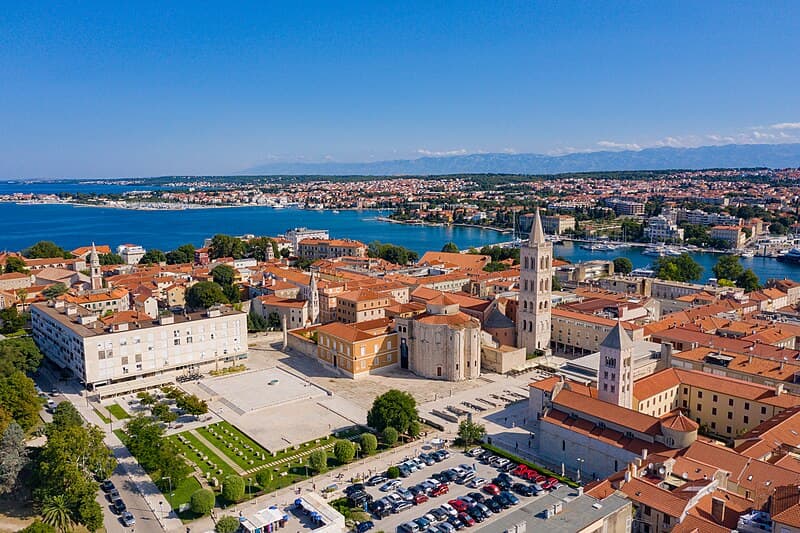
Zadar is the oldest continuously inhabited city in Croatia, and the only one where the sea itself makes music on the main square. Venetian walls encircle the peninsula that holds the old town; inside stands a first-century Roman forum, overlooked by the cylindrical Church of St. Donatus, built from dismantled ancient columns. At the tip of the peninsula are two installations by architect Nikola Bašić — the Sea Organ, which turns waves into sound through pipes hidden in the steps, and the solar circle Greeting to the Sun. Alfred Hitchcock once claimed Zadar has the most beautiful sunset in the world, and by ten in the evening the waterfront fills with people who've come to check for themselves. Zadar also makes an excellent base for exploring northern Dalmatia: within ninety minutes you can reach five national parks. The airport is thirteen kilometres from the centre.

What to see

The places worth your time in Zadar, and what to expect at each

Sea Organ

Sea Organ

Peninsula, western tip

A wide staircase at the western end of the peninsula, built over thirty-five embedded pipes. Waves push air through them, and the steps produce a continuous chord that shifts with the strength of the sea and never sounds quite the same twice. Built in 2005 on the site of a 1950s concrete quay.

Tip: The sound is much stronger when it's windy and there are waves — in total calm, the organ is almost silent. It's best to arrive half an hour before sunset and sit right on the steps, not on the promenade above them.

Admission:
free
Time needed:
1 h
Greeting to the Sun

Greeting to the Sun

Peninsula, western tip

A twenty-two-metre circle of glass plates set into the waterfront right next to the Sea Organ. During the day it charges photovoltaic cells; after dark, a light composition beneath the plates responds to the wave-driven rhythm of the organ. The energy generated also powers the waterfront lighting.

Tip: The light show only starts about twenty minutes after sunset, not immediately — most tourists leave too soon. After dark, the circle is popular with children who run across it, so expect some bustle.

Admission:
free
Time needed:
45 min
Church of St. Donatus

Church of St. Donatus

Forum

A cylindrical pre-Romanesque building from the ninth century, twenty-seven metres tall and windowless in its lower section. It's built from stones taken from the dismantled Roman forum, so ancient altars and inscriptions lie upside-down in its foundations. No services are held here; it's used for concerts because of the acoustics.

Tip: Inside is an empty, undecorated space, so a short visit is enough. It's worth catching one of the summer early-music concerts, though — the round building's acoustics are the whole reason concerts are held here.

Admission:
from €5
Time needed:
30 min
Roman Forum

Roman Forum

Forum

The largest Roman forum on the eastern Adriatic coast, ninety metres long, founded under Emperor Augustus. Today it's an open square with ruins you can freely walk among, including a column once used as a pillory in the Middle Ages — the chains are still attached.

Tip: The forum is freely accessible and best in the morning, when it's empty. The stone heats up at midday and offers no shade at all; the cafés along its edge make a good pause.

Admission:
free
Time needed:
45 min
Cathedral of St. Anastasia

Cathedral of St. Anastasia

Forum

The largest Romanesque cathedral in Dalmatia, completed in the thirteenth century, with a two-tiered arcaded façade and a bell tower fifty-six metres tall. A sarcophagus behind the altar holds the relics of St. Anastasia, given to the city by a Byzantine emperor in the ninth century.

Tip: The bell tower is a separate ticket, climbed via wooden stairs; the view over the peninsula and the Kornati islands is the best in Zadar. The tower closes over lunch, so check the opening hours posted at the door.

Admission:
bell tower from €3
Time needed:
45 min
Kalelarga and the Square of Five Wells

Kalelarga and the Square of Five Wells

Old town

Kalelarga is the old town's main street, wide and straight since Roman times, where the evening promenade takes place. At the other end of the peninsula lies the Square of Five Wells — a 1574 cistern that supplied the city with water during the Ottoman siege, with five stone wellheads in a row.

Tip: Above the five wells is Queen Jelena Madijevka Park, with a Venetian bastion and shaded benches — the only spot with real greenery in central Zadar, and half-empty at midday.

Admission:
free
Time needed:
1 h
Museum of Ancient Glass

Museum of Ancient Glass

Peninsula, near the harbour

A collection of nearly two thousand glass vessels from Roman graves around Zadar, from tear-catcher bottles to funerary urns. In the basement is a working glass workshop demonstrating ancient glass-blowing techniques, with finished pieces sold on site.

Tip: Glass-blowing demonstrations don't run all day, only at fixed times posted at the ticket desk — without one, the museum is just display cases. Ask about the schedule right when you enter.

Admission:
from €7
Time needed:
1 h
Kolovare Beach

Kolovare Beach

1 km southeast

The city's main beach, a ten-minute walk from the old town, a mix of pebbles and concrete platforms with steps into the water. It has a pine-shaded promenade, showers, a lifeguard and a few cafés — a city beach rather than a resort one, but reachable without a car.

Tip: A quieter, cleaner stretch continues further southeast toward the Hotel Kolovare, where most people don't bother going. Sea urchins are present both on the rocky sections and among the pebbles, so water shoes are worth wearing.

Admission:
free, sunbeds from €12
Time needed:
half a day
Puntamika Peninsula and Borik

Puntamika Peninsula and Borik

4 km northwest

The northwestern coastline four kilometres from the centre, with sand and pebble beaches, a marina, hotels and a stretch of pine woods reaching almost to the water. It's Zadar's main resort strip — shallow water, floating slides, and the best sunsets over the island of Ugljan.

Tip: Buses 5 and 8 run here from the centre every fifteen to twenty minutes, and the ride takes about a quarter hour. Sunbeds are paid for on Borik beach; two hundred metres further at Puntamika, free rocky spots are available.

Admission:
free, sunbeds from €15
Time needed:
full day

Photos: Sea Organ — Ben Snooks (CC BY-SA 2.0) · Greeting to the Sun — dronepicr (CC BY 2.0) · Church of St. Donatus — Martin Falbisoner (CC BY-SA 4.0) · Roman Forum — Palauenc05 (CC BY-SA 4.0) · Cathedral of St. Anastasia — H.Helmlechner (CC BY-SA 4.0) · Kalelarga and the Square of Five Wells — Silverije (CC BY-SA 3.0) · Museum of Ancient Glass — Carole Raddato from FRANKFURT, Germany (CC BY-SA 2.0) · Kolovare Beach — Silverije (CC BY-SA 4.0) · Puntamika Peninsula and Borik — Joadl (CC BY-SA 3.0)

Where to stay

Areas and districts, matched to the kind of trip you are taking

The peninsula (old town)

Best for: first-time visitors and sightseeing

Inside the Venetian walls, everything is within a ten-minute walk, including the Sea Organ and the forum. Accommodation is in apartments in old buildings, with few hotels. Bars in Varoš are lively in the evening, quiet after midnight. Cars aren't allowed in, and parking is before the bridge.

Borik and Puntamika

Best for: swimming and pool hotels

A resort strip four kilometres northwest, home to most of Zadar's hotels, a marina, and pine-shaded beaches. A fifteen-minute bus ride to the centre. This is where to stay if the goal is a seaside holiday rather than city sightseeing.

Voštarnica and Relja peninsula side

Best for: cheaper apartments and local life

The district across the bridge toward the mainland, with the market, a shopping centre and the bus station. The old town is a ten-minute walk across the bridge, or a one-minute ferry ride. Accommodation here costs noticeably less than on the peninsula.

Petrčane and Zaton

Best for: family resorts outside the city

Ten to fifteen kilometres northwest lie large holiday villages with pools, water parks and private beaches, popular for week-long family stays. Buses run to Zadar, or it's a twenty-minute drive, so the city stays a single day trip.

Getting around

From the airport

Zadar Airport is near Zemunik, thirteen kilometres southeast of the centre, and in season receives both charter and low-cost flights. An airport bus timed to arrivals runs into the city, stopping at the main bus station and near the peninsula. Zadar also sits on the A1 motorway, so driving from Prague takes roughly nine hundred kilometres and eleven hours. Ferries run from the harbour to the nearby islands of Ugljan, Pašman and Dugi otok, and catamarans to Silba and Olib.

Zadar (Zemunik) (ZAD) · 13 km

  • Airport bus to the centre· 25 min· €5
  • Taxi to the old town· 20 min· €25
  • Hotel transfer· 20–35 min· included in stay
  • Rental car from the airport· 20 min· €40/day

Around town

The old town on the peninsula is entirely walkable, crossed end to end in twenty minutes. From the peninsula to the Voštarnica district, you can cross by the rowed ferry known as the barkajol, running since the thirteenth century for under two euros. City buses run by Liburnija serve Borik, Petrčane and Nin. Trips to national parks need a car or an organised tour, since scheduled bus services mostly run only morning and evening.

Liburnija busLines 5 and 8 to Borik and Puntamika every fifteen minutes, extending further to Nin. · €1.60
Barkajol ferryA rowed boat across the harbour to Voštarnica, operating continuously since the thirteenth century. · €1.50
Island ferryTo Ugljan, Pašman and Dugi otok from the ferry terminal, with or without a car. · €4
Rental carNecessary for Plitvice, Paklenica and Krka; there's no parking on the peninsula, so cars stay before the bridge. · €40/day

Useful apps: Google Maps, Jadrolinija, Bolt, Arriva Croatia

When to go

Swimming season runs from June to the end of September, with the sea warmest in August at twenty-five degrees. June and September are best, when it's warm but the national parks aren't overcrowded and accommodation costs a third less. In winter, the bura wind blows down from the Velebit mountains, sometimes for several days, closing the bridge at Maslenica to campervans and trailers. April and May are ideal for Plitvice and Paklenica, but the sea is too cold for swimming.

Best time

June and September

What to avoid

January and February, because of the bura wind and closed resorts

MonthJanFebMarAprMayJunJulAugSepOctNovDec
Day10°11°14°18°23°27°30°30°25°20°15°11°
Night4°4°6°9°14°18°20°20°17°13°9°5°
Rainy days98899744791110
Sea13°12°13°15°19°23°25°25°23°20°17°15°

Food & drink

Northern Dalmatia combines sea and hinterland: alongside fish from the Kornati islands, you'll find lamb from the Velebit mountains and cheese from Pag, an hour's drive north. Zadar's own specialty is maraschino, a liqueur made from marasca cherries, distilled here since 1821 and once exported to the royal courts of Europe. The market by the harbour is one of the best in Dalmatia and runs from six in the morning. In the old town's tavernas, you pay for location; two streets over in Relja, the same dish costs a third less.

What to try

Pršut and Pag cheese

Air-dried ham from Dalmatia or Istria, and hard sheep's-milk cheese from the island of Pag, where sheep graze on grass salted by the bura wind. The standard cold starter with a glass of wine.

Janjetina s ražnja

Whole lamb roasted on a spit, sold by the kilogram at roadside stands inland. Half a kilo per person is a serving; the bones count toward the weight.

Brudet

A thick fish stew made from several kinds of fish with tomatoes, served with polenta. A fisherman's dish made from whatever didn't sell that day, so it's a little different every time.

Peka

Meat and potatoes cooked slowly for three hours under an iron bell covered in hot embers. Arguably the best Croatian dish there is, but it must be ordered a day ahead and for at least two people.

Crni rižot

Risotto with octopus or cuttlefish, coloured black with cuttlefish ink. It tastes of the sea and reliably stains your teeth — skip the white shirt.

Škampi na buzaru

Shrimp stewed in white wine, garlic and breadcrumbs, eaten with your hands. Order it somewhere that puts a bowl for shells and a wet napkin on the table — a sign they do it properly.

Maraschino

A clear liqueur made from marasca cherries, which grow only around Zadar. It's been distilled here since 1821, drunk ice-cold after a meal or mixed into cocktails.

Fritule

Small fried doughnuts with raisins and lemon zest, dusted with sugar. Sold in paper cones along the promenade, the cheapest dessert on the coast.

What it costs

Coffee on Kalelarga

€2.50–3.50

Lunch at a konoba

€12–18

Fish dinner

€25–35 per person

Beer, 0.5 l

€3.50–4.50

Cathedral bell tower

from €3

Museum of Ancient Glass

from €7

Full-day boat trip to the Kornati islands

from €55

Night at a 4-star hotel

€100–160

Indicative prices that change over time — treat them as a guide, not a price list.

Practical information

SocketsCEuroplug, two round pinsFSchuko
Voltage230V / 50Hz
Tap waterTap water is drinkable — Tap water is drinkable throughout Croatia and tastes good; on the coast it comes from karst springs. There's no need to buy bottled water — just fill a bottle in your apartment each morning. In restaurants, though, tap water isn't offered as standard, and bottled water is what gets charged.
TippingTipping is customary but modest: rounded up at a café, around ten percent at a restaurant for good service. Card terminals usually don't have a tip option, so it helps to carry some cash. In a taxi, just round up.
Driving on theright
SafetyViolent crime is rare, and towns are safe even at night. The only real risk is pickpocketing in crowds on the main street and near cruise-ship landings. Watch out for bills at venues with a street tout — overpriced items with no listed price are the most common tourist annoyance in coastal towns, so confirm the price beforehand. Cars can't be parked in the centres without a paid zone, and towing is reliably enforced.
Opening hoursShops are open roughly from eight to eight, shopping centres until nine. Most shops are closed on Sundays by law, with exceptions for bakeries, newsstands and shops at stations and gas stations. Museums close on Mondays, though many extend their hours into the evening in peak season. Cafés on the main square open at seven in the morning and close around midnight.
Customs & etiquetteSwimwear belongs on the beach — walking around town centres in swimwear or without a shirt is fined under municipal bylaws in Croatia, and in Dubrovnik, Split and Hvar fines are genuinely issued, starting at a hundred euros. Shoulders and knees should be covered in churches. Croatians take pride in being Croatian, not 'former Yugoslavia'; don't be the one to bring up the 1990s war. Breakfast is light, lunch is around two, and dinner after eight.
A few local wordsHello — Dobar danThank you — HvalaPlease — MolimThe bill, please — Račun, molimCheers — Živjeli

How to plan your days

1 day

One day in Zadar

  1. 1Morning at the Roman Forum, the Church of St. Donatus and the cathedral bell tower.
  2. 2The harbour market and lunch in Relja.
  3. 3Afternoon at the Museum of Ancient Glass and the Square of Five Wells.
  4. 4Before sunset, the Sea Organ; after dark, the Greeting to the Sun.
  5. 5Dinner and an evening stroll along Kalelarga.

2 days

Two days including a national park

  1. 1Day one as the single-day plan above.
  2. 2A full-day boat trip to the Kornati islands and Telašćica.
  3. 3A swim in the salt lake Mir on Dugi otok.
  4. 4Return in the early evening, dinner on the peninsula.

3 days

Three days including Plitvice

  1. 1The first two days as above.
  2. 2Early morning drive to the Plitvice Lakes, entering through the upper gate.
  3. 3A loop along the wooden boardwalks around the cascades.
  4. 4Return via the Velebit mountains with views over the Adriatic.
  5. 5If time allows, a further day at Nin and its sandy beaches.

Day trips

Plitvice Lakes

130 km · 2 h by car

Sixteen lakes linked by cascades, constantly reshaping themselves as travertine builds up and dams the flow. Wooden boardwalks lead right over the water. In season, tickets are sold for time slots and often sell out a day ahead; swimming is prohibited.

Kornati and Telašćica

40 km · 2 h by boat

A hundred forty islands with no water, electricity or permanent residents, the densest archipelago in the Mediterranean. The neighbouring Telašćica reserve has steep cliffs dropping ninety metres into the sea and the salt lake Mir, a few degrees warmer than the open sea.

Nin and Paklenica

17 km · 25 min by car

Nin is a small town on an islet in a lagoon, home to the smallest cathedral in the world and the only long sandy beach near Zadar. Half an hour further begins Paklenica — Velebit canyons with climbing walls and marked mountain trails.

Frequently asked questions

How does the Sea Organ work?+

Beneath the steps on the waterfront are thirty-five pipes of varying length. Waves push air into them, sounding the pipes so the sea plays a continuous chord. The sound is louder with bigger waves — on a calm day it's barely audible. Listening is free and continuous.

When does the Greeting to the Sun light up?+

About twenty minutes after sunset, not right away. The glass circle charges photovoltaic cells during the day, and in the evening a light show underneath it runs, driven by the movement of the waves. It's worth waiting — most visitors leave too early and miss the show.

Is Zadar a good base for day trips?+

The best in Croatia. Within ninety minutes you can reach Plitvice, Krka, Paklenica, the Kornati islands and Pag. No other Croatian city has five national parks within such easy reach. Day trips do require a car or an organised tour, though.

Where can you swim in Zadar?+

The closest to the centre is the pebble beach Kolovare, a ten-minute walk away. Better beaches shaded by pine trees are in Borik and on Puntamika, four kilometres northwest, reached by a fifteen-minute bus ride. For sand, head to Nin, where a shallow lagoon suits small children.

Is it worth buying Plitvice tickets in advance?+

In July and August it's essential. The park sells tickets for time slots, and morning slots often sell out days ahead. Buy online and take the earliest possible slot at seven in the morning — by ten the trails fill up and queues form on the boardwalks.

What is a barkajol?+

A rowed ferry across Zadar's harbour, connecting the peninsula with the Voštarnica district, running continuously since the thirteenth century. The crossing takes a minute and costs under two euros. It's the oldest continuously operating taxi service in Europe, and also the fastest shortcut.

Does the bura wind blow in Zadar?+

Yes, in winter and spring — it blows down from the Velebit mountains and can gust past a hundred kilometres an hour. It closes the Pag bridge and the bridge at Maslenica to trailers and campervans. In peak season it's rare; summer instead brings the pleasant afternoon maestral sea breeze.

How many days are enough for Zadar?+

One day for the city itself — the peninsula can be walked in an afternoon. But Zadar makes the most sense as a base: with two or three trips to national parks and islands, you can easily fill a week, and accommodation costs less than in Split or Dubrovnik.

Conditions de visa

Vérifiez les conditions de visa actuelles pour entrer dans ce pays.

Vérifier les conditions de visa

Langue

Croatian

Devise

EUR

Fuseau

Europe/Zagreb

Indicatif

+385

Population

3.9M

Superficie

56,594 km²

Tension

230V / 50Hz

Côté de conduite

Droite

Meilleurs hôtels à Zadar

Prix en direct de 500+ hébergements

Chargement des hôtels...

Vous planifiez un voyage à Zadar?

Comparez des centaines d'hôtels, trouvez le meilleur prix et réservez avec annulation gratuite.