Hotels in Yellowstone

The world's oldest national park, sitting atop a supervolcano that keeps the ground bubbling with geysers

Yellowstone

SpracheEnglish
WährungUSD
ZeitzoneGMT-7
Temperatur5-30 °C
Vorwahl+1
Bevölkerung335M
Fläche9,833,520 km²
SteckdosenTyp A / Typ B
LeitungswasserTrinkbar

Entdecken Sie Yellowstone

Yellowstone is the world's first national park, established in 1872, covering nearly nine thousand square kilometres — larger than the whole of the South Moravian Region. It sits on a high plateau in Wyoming at around two thousand four hundred metres, directly above one of the largest active volcanoes on Earth. Heat from magma just a few kilometres below the surface powers more than ten thousand thermal features — half of all the geysers on the planet, colourful hot springs, mud pots and travertine terraces. Alongside the geysers, Yellowstone is the best place in North America for wildlife: thousands of bison and elk graze in the valleys, and grizzly and black bears, wolves, moose and pronghorn all live here. A figure-eight road, the Grand Loop, runs through the park for 229 kilometres, and driving between the main sites takes one to two hours, often longer because of herds on the road. You need at least three days for the park, and in-park lodging sells out a year ahead in summer. Since 2026, foreign visitors pay a surcharge on top of admission.

What to see

The places worth your time in Yellowstone, and what to expect at each

Old Faithful

Old Faithful

Upper Geyser Basin

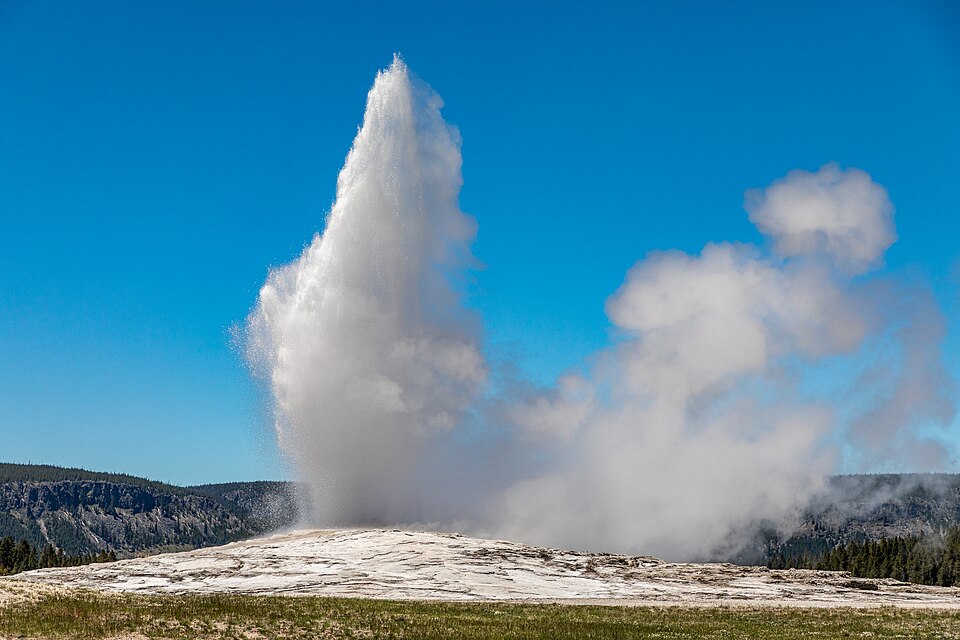
The world's most famous geyser, blasting water thirty to fifty metres high roughly every sixty to a hundred ten minutes, for two to five minutes at a time. Its regularity means eruptions can be predicted within ten minutes. Around it is a bench amphitheatre and the historic wooden Old Faithful Inn, built in 1904.

Tip: Check the next eruption forecast in the NPS app, on the sign at the visitor centre, or at the hotel. Instead of the boardwalk where a thousand people stand, walk twenty minutes up to Observation Point on the hill above the geyser — the view is better and the crowd is a tenth the size. Anyone who stays overnight can watch an eruption by moonlight almost alone.

Admission:
included in admission
Time needed:
1 h
Upper Geyser Basin

Upper Geyser Basin

Old Faithful

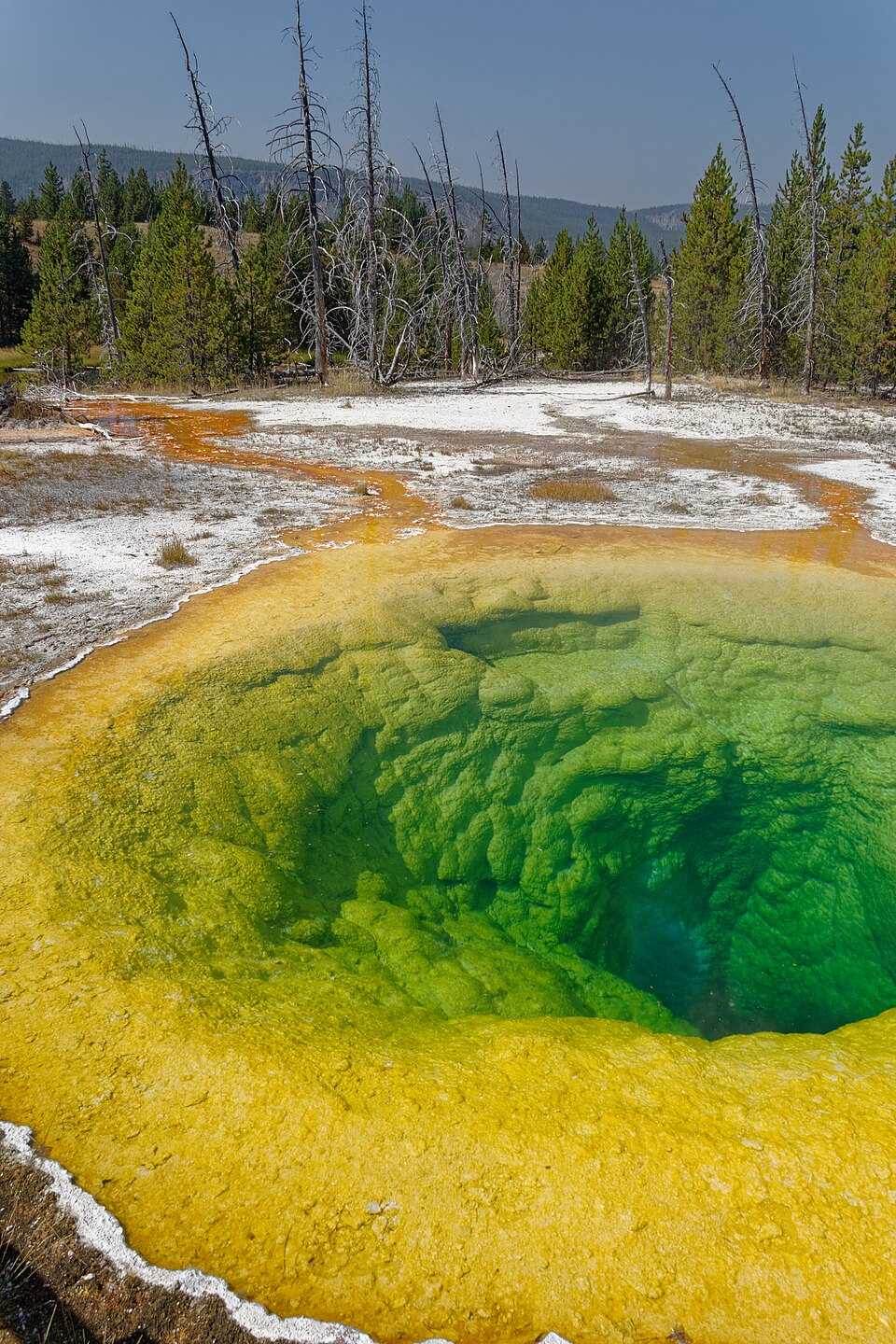
The valley around Old Faithful holds the highest concentration of geysers on Earth — more than a hundred fifty within under three square kilometres. Boardwalks lead past the Grand, Castle, Riverside and Beehive geysers to the crystalline Morning Glory Pool at the far end of the valley. Only six of the geysers here have predictable eruptions.

Tip: Walk the loop out to Morning Glory Pool, five kilometres on flat ground, which most visitors skip. Grand Geyser, the tallest predictable geyser at up to sixty metres, erupts only twice a day with a two-hour margin of error — if you're within the window, wait it out. The Old Faithful Inn has a vast wooden lobby with a fireplace inside, worth a look even without staying there.

Admission:
included in admission
Time needed:
2–3 h
Grand Prismatic Spring

Grand Prismatic Spring

Midway Geyser Basin

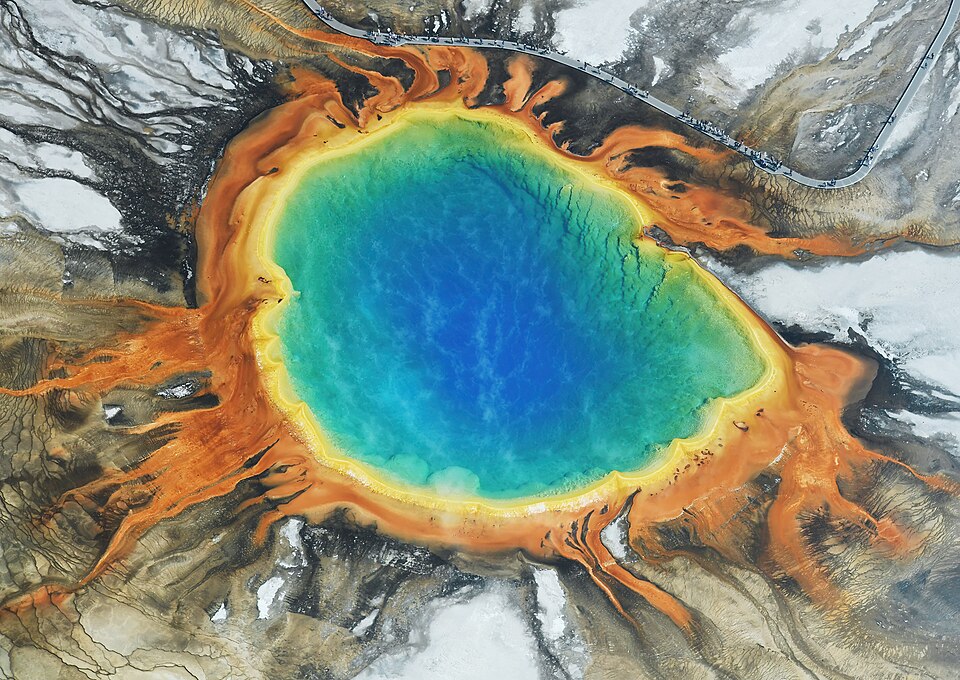
The largest hot spring in the United States, a hundred twelve metres across, with blue water at its centre ringed by bands of yellow, orange and red from heat-loving bacteria. From the boardwalk right at the spring's edge, mostly steam is visible — the colours only stand out from above. The spring lies in the Midway Geyser Basin.

Tip: The best view is from the overlook above the spring on the Fairy Falls trail, a kilometre and a half from the parking lot. Go on a sunny morning around ten or eleven, when the steam thins and the colours are most vivid — early morning leaves the spring shrouded in mist. Continue on to Fairy Falls itself, an eight-kilometre round trip.

Admission:
included in admission
Time needed:
1–3 h
Norris Geyser Basin

Norris Geyser Basin

Norris

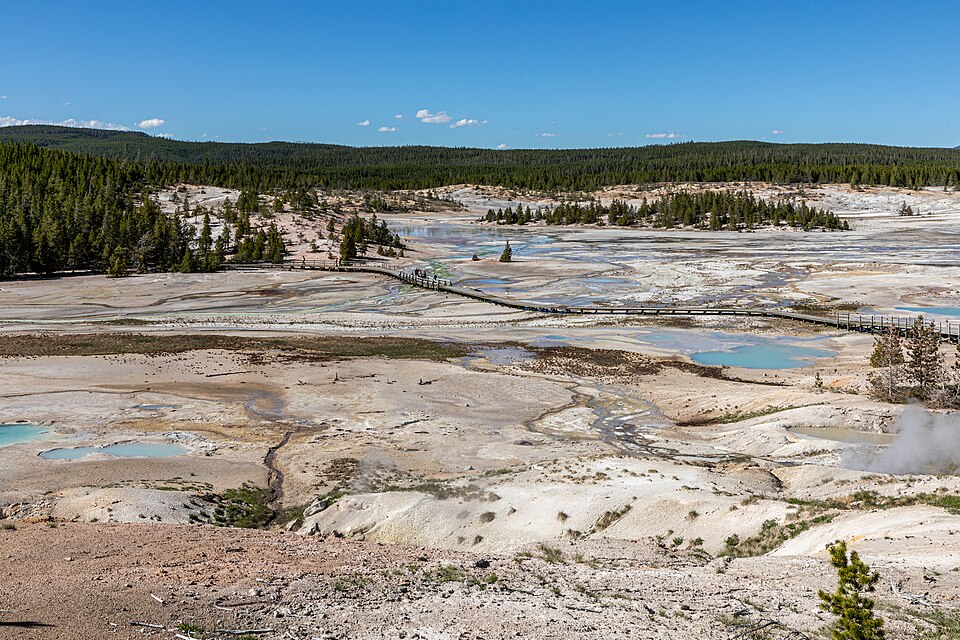
The hottest and most acidic geothermal area in the park, where boreholes have measured two hundred forty degrees just three hundred metres below the surface. Porcelain Basin is a white plain with milky blue springs, and Steamboat, the tallest active geyser on Earth at a hundred metres, erupts irregularly — anywhere from days to years apart.

Tip: Norris is where activity changes most often — new springs appear and old ones vanish, and boardwalks have to be rerouted. Walk both loops, Porcelain Basin and Back Basin, roughly three kilometres in two hours. Echinus Geyser and Steamboat are unpredictable, and the odds of catching an eruption are low.

Admission:
included in admission
Time needed:
2 h
Mammoth Hot Springs

Mammoth Hot Springs

North of the park

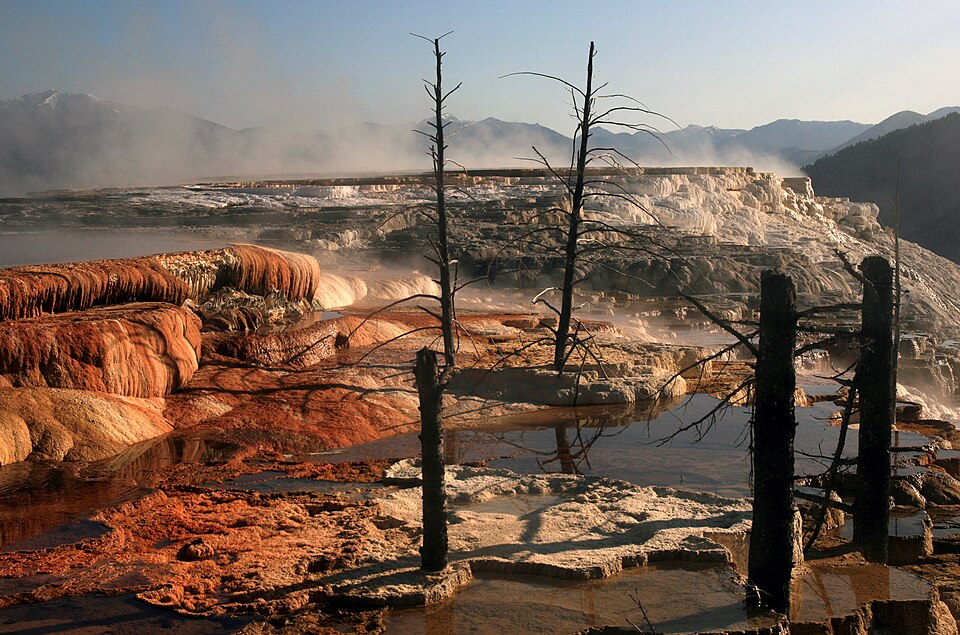
Cascading white and orange travertine terraces on a hillside, formed as calcium carbonate precipitates out of hot water. The terraces can grow by a metre a year and keep changing — some dry out and turn white, while new ones form elsewhere. Below the terraces sits a village with the historic Fort Yellowstone and elk grazing on the lawns.

Tip: The upper terraces are toured by car along the one-way Upper Terrace Drive loop, while the lower ones are walked via boardwalks. In autumn rut, elk wander through the village and bulls turn aggressive, so keep your distance. Just past the north entrance, by the river, is Boiling River, once a spot for soaking in hot water — check whether it's currently open.

Admission:
included in admission
Time needed:
2 h
Grand Canyon of the Yellowstone

Grand Canyon of the Yellowstone

Canyon Village

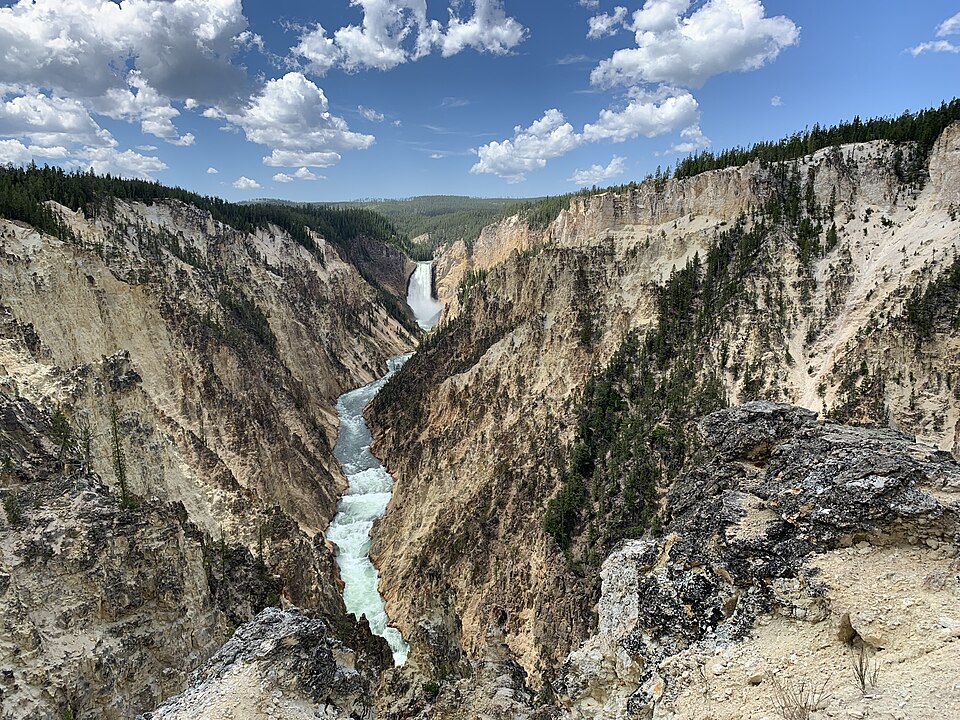
The canyon of the Yellowstone River, thirty kilometres long and up to three hundred seventy metres deep, with yellow and orange walls of thermally altered rock that gave the park its name. The Lower Falls drop ninety-four metres, twice the height of Niagara.

Tip: Artist Point on the south rim is the most famous viewpoint, but fills with tour buses by morning. From Brink of the Lower Falls, switchback stairs take you right to the edge, where the water plunges below you. Uncle Tom's Trail, with two hundred steps to the base of the falls, is often closed — check at the Canyon Village visitor centre.

Admission:
included in admission
Time needed:
2–3 h
Hayden Valley

Hayden Valley

Central park

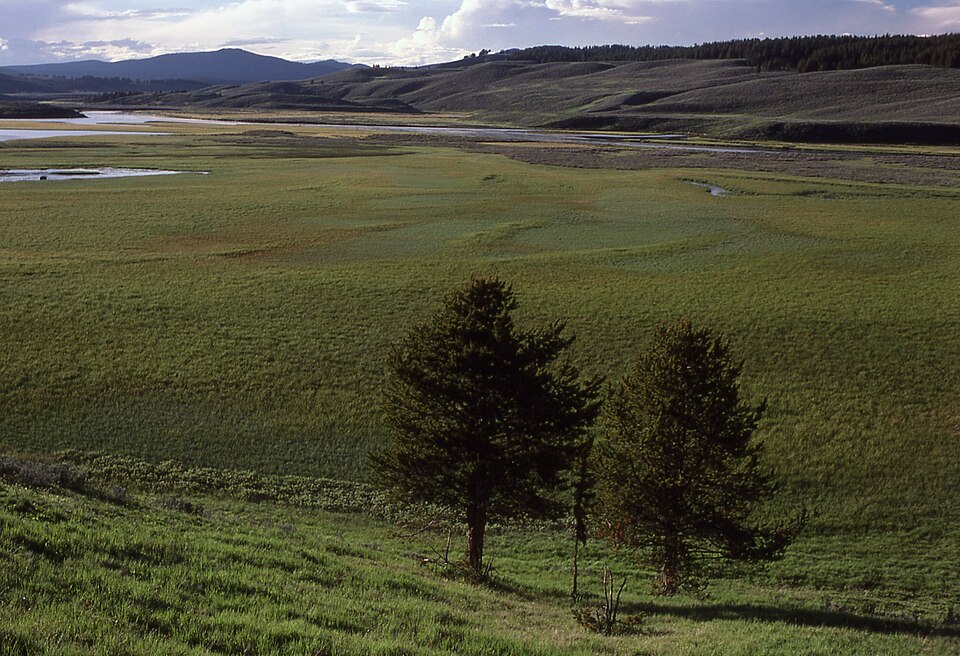
A broad grassy valley of the Yellowstone River between Canyon and the lake, where bison herds graze in summer and grizzlies and wolves hunt along the river. The road runs right through the valley, so wildlife can be watched straight from the car. In July and August, bison rut fills the valley with the roar of bulls.

Tip: Bison often stand right on the road, causing traffic jams lasting tens of minutes — let them pass and don't get out of the car. For grizzlies and wolves, arrive at dawn or dusk and look for clusters of people with binoculars and spotting scopes at pullouts. Bringing your own binoculars is essential.

Admission:
included in admission
Time needed:
1–3 h
Lamar Valley

Lamar Valley

Northeast of the park

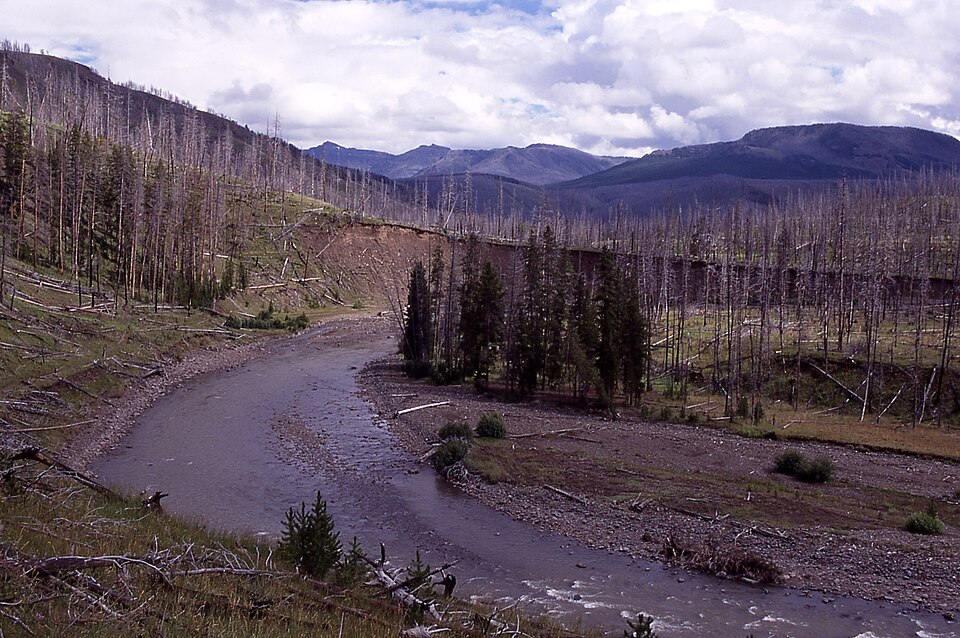
A remote valley in the park's northeast, nicknamed the American Serengeti. Large herds of bison, pronghorn and elk graze here, and it's the best place in the world to watch wild wolves, reintroduced to the area in 1995. The valley is accessible by car year-round.

Tip: Wolves are visible at dawn and dusk, usually at a kilometre or more, so a spotting scope is essential. Local wolf-watchers gather at the same pullouts every morning and are usually happy to let you look through their scopes. Winter and spring are best, when wolves stand out against the snow. Stay in Gardiner or Cooke City.

Admission:
included in admission
Time needed:
half a day
Yellowstone Lake and West Thumb

Yellowstone Lake and West Thumb

South of the park

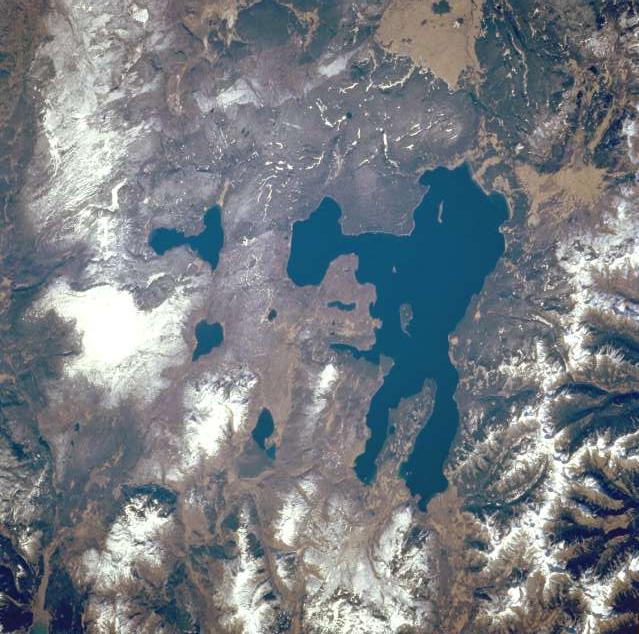
The largest high-altitude lake in North America, at 2,357 metres, with a 227-kilometre shoreline and water that stays cold even in summer. On its western shore lies the West Thumb Geyser Basin, where hot springs and cone geysers emerge directly from the lake or along its edge.

Tip: The boardwalk loop at West Thumb takes an hour, and the view of the lake against the Absaroka Mountains is loveliest in the morning. The historic 1891 Lake Hotel, with its white veranda and lake view, is the park's oldest hotel — you don't need to be a guest to have a drink by the piano at sunset. Swimming in the lake isn't recommended, as the water stays cold.

Admission:
included in admission
Time needed:
1–2 h

Photos: Old Faithful — Dietmar Rabich (CC BY-SA 4.0) · Upper Geyser Basin — Dirtsc (CC BY-SA 3.0) · Grand Prismatic Spring — Carsten Steger (CC BY-SA 4.0) · Norris Geyser Basin — Dietmar Rabich (CC BY-SA 4.0) · Mammoth Hot Springs — Brocken Inaglory (CC BY-SA 3.0) · Grand Canyon of the Yellowstone — Erik Whalen (CC BY-SA 4.0) · Hayden Valley — J. Schmidt (Public domain) · Lamar Valley — Jim Peaco (Public domain) · Yellowstone Lake and West Thumb — NASA (Public domain)

Where to stay

Areas and districts, matched to the kind of trip you are taking

Old Faithful and Canyon, inside the park

Best for: geysers, wildlife at dawn

Hotels and cabins inside the park at the main sites: the Old Faithful Inn, Lake Hotel, Canyon Lodge and Mammoth Hotel. You save hours of driving every day and are at the geysers and wildlife spots by dawn. Reservations open thirteen months ahead and sell out.

West Yellowstone

Best for: first-time visitors, choice of amenities

A town at the west entrance, closest to the geysers — an hour to Old Faithful. The widest range of hotels, motels and restaurants, plus a centre for viewing captive bears and wolves. Busy and loud in summer.

Gardiner

Best for: the north side, year-round access

A small town at the north entrance with the Roosevelt Arch, open year-round. Closest to Mammoth Hot Springs and the Lamar Valley, and in winter the only entrance open to cars. Rafting on the Yellowstone River and elk wandering the streets.

Cody and Jackson

Best for: combining with the surrounding region

Cody, at the east entrance, is Buffalo Bill's cowboy town, with a rodeo every summer evening. Jackson, to the south, is a more upscale base for combining with Grand Teton. Both are two to three hours from Yellowstone's main sites.

Getting around

From the airport

From Prague, flights connect with one or two stops, most often via Denver, Salt Lake City or Minneapolis. The nearest major airport is Bozeman (BZN) in Montana, a hundred forty-five kilometres from both the north and west entrances. Jackson Hole (JAC) is in the south near Grand Teton, Cody (COD) near the east entrance, and West Yellowstone (WYS) right at the west entrance, though only in summer. Salt Lake City (SLC) is five hours' drive and often the cheapest option. A rented car is essential to get around the park, since there's no public transport. Travel to the US requires an electronic ESTA authorization.

Bozeman Yellowstone (BZN) · 145 km

  • Rental car to the west entrance· 1 h 45 min· USD 60/day
  • Shuttle to West Yellowstone· 2 h· USD 80

Jackson Hole (JAC) · 90 km

  • Rental car to the south entrance· 1 h 30 min· USD 80/day

West Yellowstone (summer only) (WYS) · 3 km

  • Taxi or hotel shuttle· 5 min· USD 15

Around town

Getting around Yellowstone means driving your own car along the figure-eight Grand Loop Road, 229 kilometres long, with a speed limit of seventy kilometres an hour and frequent jams caused by wildlife. Driving between the main areas takes an hour, double that with stops. There's no public transport or bus service in the park, only organised tours from the gateway towns. Gas is available at a few spots inside the park, but at a premium. In winter, only snowmobiles and tracked snowcoach buses run, from West Yellowstone and Gardiner to Old Faithful.

Rental carThe only practical way to tour the park. · USD 60/day
Organised tour from a gateway townA full-day guided loop from West Yellowstone or Gardiner. · USD 150
Winter snowcoachA tracked bus to Old Faithful, December through March. · USD 200
BicycleOn the roads in spring, before they open to cars. · USD 50/day

Useful apps: NPS App, NPS Yellowstone (geyser eruptions), Recreation.gov, Google Maps (offline)

When to go

Peak season runs from June to August: all roads, hotels and trails are open, daytime temperatures hover around twenty-five degrees but drop below ten at night, and the geysers draw huge crowds. The best windows are late May to early June and September: fewer people, bison calves and bears in spring, elk rut and aspen colours in autumn. From November to April, roads are closed to cars and the park becomes a snowbound wilderness with frosts below minus twenty — winter Yellowstone, with geysers steaming and wolves against the snow, is stunning, but only accessible on an organised tour. Snow can fall in any month, even July.

Best time

late May–June, September

What to avoid

November–April, if you want to drive yourself

MonthJanFebMarAprMayJunJulAugSepOctNovDec
Day-2°1°5°10°16°21°26°26°20°13°4°-2°
Night-13°-11°-7°-3°2°6°9°8°4°-1°-7°-12°
Rainy days98991110876689

Food & drink

Inside the park, meals are had at hotel restaurants, cafeterias and grocery stores; the food is average and pricey, and evening restaurant tables need booking in summer. The most practical option is a picnic — the park has dozens of picnic spots with tables. Rocky Mountain cuisine centres on meat: beef from Montana and Wyoming, bison, elk, and trout from mountain rivers. A regional specialty is huckleberries, wild berries similar to blueberries, used in ice cream, pies and lemonade. West Yellowstone and Gardiner have steakhouses and breweries.

What to try

Bison burger

A burger made from lean bison meat, sweeter and less fatty than beef. Every restaurant and cafeteria in the park serves it, for twenty to twenty-five dollars.

Elk

Steak or sausage made from elk meat, a true Rocky Mountain game dish. The meat is lean and often served with a wild-berry sauce.

Huckleberries

Wild berries similar to blueberries that can't be cultivated and are only picked in the mountains. Huckleberry ice cream, pie or lemonade is the taste of summer in Montana and Wyoming.

Trout

Rainbow and brook trout from mountain rivers, grilled or pan-fried in butter. Fishing in the park is popular but requires a permit.

Rocky Mountain oysters

Breaded and deep-fried bull testicles, a cowboy specialty from ranch country. Tried mostly out of curiosity in Cody and Jackson.

American breakfast

Eggs with toast, pancakes with maple syrup, or a breakfast burrito, plus bottomless coffee refilled without asking. Portions last well into the afternoon, so an eighteen-dollar breakfast can double as lunch.

Craft beer

Colorado has the highest number of microbreweries per capita in the country, and their beers tend to be stronger than they look. At altitudes above two thousand metres, alcohol takes effect noticeably faster, especially on the first evening after arrival.

What it costs

Park entry per vehicle (7 days)

USD 35

Foreign-visitor surcharge from 2026, per person

USD 100

Bear spray

USD 50

Bison burger in the park

USD 20–25

Dinner at a hotel restaurant in the park

USD 40–70

Gas in the park, per gallon

USD 4–5

Night in an in-park cabin for two

USD 200–400

Night at a motel in West Yellowstone for two

USD 150–300

Indicative prices that change over time — treat them as a guide, not a price list.

Practical information

SocketsAtwo flat pins (US/JP)Btwo flat pins plus ground (US)
Voltage120V / 60Hz
Tap waterTap water is drinkable — Tap water is drinkable throughout the United States, and restaurants will serve it free with ice — just ask for 'tap water'. Buying bottled water is unnecessary and expensive — a bottle costs two to three dollars in a shop, five near an attraction. It's worth carrying a refillable bottle, since airports and parks have filling stations. Ice is everywhere, and drinks are served noticeably colder than is typical in Europe.
TippingTipping isn't optional — it's part of the server's wage. At a table-service restaurant, eighteen to twenty percent of the pre-tax total is standard; at a bar, a dollar per drink; taxi and rideshare drivers get fifteen percent; housekeeping gets three to five dollars per night; porters two dollars per bag. Payment terminals usually offer preset percentage buttons — note that these are sometimes calculated on the tax-included total. Sales tax is also added on top of the listed price on menus and shelves, roughly five percent in Hawaii and seven percent in Florida, so the final total is always higher than the sticker price.
Driving on theright
SafetyMost injuries in Yellowstone aren't caused by bears but by bison: people approach for a photo, and a one-tonne bison can charge at fifty kilometres an hour. Keep a distance of at least twenty-five metres from bison and elk, and more than ninety metres from bears and wolves. In geothermal areas, stay only on the boardwalks — the thin crust over boiling water can collapse, and people have died here. On backcountry trails, carry bear spray (available in the park for around fifty dollars, though it can't be taken on a plane), hike in a group, and talk loudly. Weather changes quickly, and snow is possible in any month. Cell signal exists only near the main visitor centres.
Opening hoursThe park is open year-round, but most roads are closed to cars from November to April, with access only by snowmobile or snowcoach; only the northern road from Gardiner to Cooke City through the Lamar Valley stays open all year. Roads open gradually from mid-April to the end of May and close from early November. In-park hotels run a season from May to October. Visitor centres are open from eight to seven in summer.
Customs & etiquetteThe friendly small talk from staff is a professional norm, not an invitation to friendship. Queuing is respected, and personal space is larger than in Europe. Haggling happens only over cars and at flea markets, never elsewhere. Smoking is banned in practically all indoor spaces and on many beaches. Questions about salary or politics aren't opened with strangers. In Hawaii, additional local customs apply: the aloha spirit means not rushing or pushing, shoes come off before entering a home, and sacred sites and stones are never moved, even as a souvenir.
A few local wordsHello — Hi / Good morningThank you — Thank youThe bill, please — Check, pleaseJust looking — Just looking, thanksHow much is it with tax? — How much is it with tax?Tap water, please — Tap water, please

How to plan your days

1 day

Yellowstone in one day (from West Yellowstone)

  1. 1Morning at Grand Prismatic, viewed from the Fairy Falls overlook.
  2. 2Upper Geyser Basin and an Old Faithful eruption.
  3. 3Lunch at the Old Faithful Inn.
  4. 4Afternoon drive via Norris to Canyon and Artist Point.
  5. 5Bison in the Hayden Valley on the way back.

2 days

Yellowstone in two days

  1. 1Day 1: Grand Prismatic, Old Faithful, Upper Geyser Basin and Morning Glory Pool.
  2. 2Evening: an Old Faithful eruption at sunset.
  3. 3Day 2: Hayden Valley at dawn, then the Grand Canyon of the Yellowstone.
  4. 4Afternoon: Norris Geyser Basin and Mammoth Hot Springs.
  5. 5Overnight in Gardiner.

3 days

Yellowstone in three days

  1. 1Day 1: south and west — West Thumb, the lake, Old Faithful and Grand Prismatic.
  2. 2Day 2: Canyon and Hayden Valley, then Norris and Mammoth.
  3. 3Day 3: dawn in the Lamar Valley for wolves and bison.
  4. 4Afternoon: Tower Fall and a hike up Mount Washburn.
  5. 5Return via the Beartooth Highway, or continue on to Grand Teton.

Day trips

Grand Teton

90 km · 1 h 30 min by car from Yellowstone's south side

The neighbouring national park, home to America's most photographed mountain range — the granite peaks of the Tetons rise straight out of the flat Jackson Hole valley with no foothills. Highlights include the Mormon Row barns, Jenny Lake with a boat shuttle to a hike up Cascade Canyon, and moose along the Snake River. One day is enough for sightseeing, two for hiking.

Beartooth Highway

110 km · 2 h 30 min by car from Lamar

A mountain road from Cooke City to Red Lodge that a journalist once called the most beautiful road in America. It climbs to 3,337 metres across an alpine plateau with lakes, snowfields even in July, and mountain goats. It's open only from late May to mid-October, and weather can change within minutes.

Jackson

90 km · 1 h 30 min by car

A Western town to the south with a square framed by elk-antler arches, saloons, galleries and winter skiing. In winter, more than five thousand elk gather at the National Elk Refuge just outside town, and sleigh rides go out to see them. A good base for Grand Teton.

Frequently asked questions

How much does Yellowstone admission cost in 2026?+

A vehicle pass for seven days costs thirty-five dollars. Since 1 January 2026, foreign visitors aged sixteen and over pay a surcharge of one hundred dollars per person at Yellowstone and ten other of the most-visited parks; the annual America the Beautiful pass for foreign visitors costs two hundred fifty dollars and cancels the surcharge. Combined with Grand Teton, the annual pass pays off. Check current rules at nps.gov.

How many days are enough for Yellowstone?+

At least three days: one for the geysers around Old Faithful and Grand Prismatic, one for Canyon, Hayden and Norris, one for Mammoth and Lamar with the wildlife. In two days you can drive the Grand Loop, but only by car. A single-day visit only allows time for the southern loop.

Should I stay inside the park or outside?+

Staying inside the park saves two to three hours of driving every day, and puts you at the geysers and wildlife spots at dawn. In-park hotels are booked out thirteen months in advance. Outside the park, West Yellowstone is closest to the geysers, and Gardiner closest to Mammoth and Lamar. An ideal split is two nights in the south and one in the north.

Will I see a bear or a wolf?+

You're guaranteed to see bison and elk, likely to see a grizzly bear with some luck in the Hayden and Lamar valleys and along roadsides in spring. Wolves are visible only at dawn in the Lamar Valley with a spotting scope, usually at a great distance. The best chances are in spring and autumn — in summer, wildlife retreats into the mountains.

How should I behave around bison?+

Keep a distance of at least twenty-five metres, which is farther than people expect — you'll need a telephoto lens for a photo. If a bison changes behaviour, raises its tail, or turns to face you, leave immediately. On the road, let them pass, don't honk, and don't get out of the car. Every year, bison injure several tourists.

Is Yellowstone safe given the volcano?+

Yes. The supervolcano is closely monitored, and scientists don't expect an eruption on any meaningful timescale. The real risks are smaller hydrothermal explosions and, above all, boiling springs — in the geothermal areas, stay on the boardwalks and never step off them.

When are the roads open?+

Most roads open gradually from the third Friday in April through the end of May and close in early November. Only the northern road from Gardiner to Cooke City is open year-round. The Beartooth Highway is open from late May to mid-October. Check current status at nps.gov/yell.

Can Yellowstone be combined with Grand Teton?+

Yes, the two parks sit right next to each other, separated by only a few kilometres. Grand Teton is ninety minutes' drive from Yellowstone's south entrance. The loop Jackson – Grand Teton – Yellowstone – Bozeman is a classic week-long route.

Visabestimmungen

Prüfen Sie die aktuellen Visabestimmungen für die Einreise in dieses Land.

Visabestimmungen prüfen

Sprache

English

Währung

USD

Zeitzone

GMT-7

Vorwahl

+1

Bevölkerung

335M

Fläche

9,833,520 km²

Spannung

120V / 60Hz

Fahrseite

Rechts

Top Hotels in Yellowstone

Live-Preise von 500+ Unterkünften

Hotels werden geladen...

Planen Sie eine Reise nach Yellowstone?

Vergleichen Sie Hunderte von Hotels, finden Sie den besten Preis und buchen Sie mit kostenloser Stornierung.