Hotels in Albufeira

A fishing town that became the Algarve's largest resort

Albufeira

LanguagePortuguese
CurrencyEUR
TimezoneEurope/Lisbon
Temperature12-28 °C
Dial Code+351
Population10.3M
Area92,212 km²
SocketsType C / Type F
Tap waterDrinkable

Discover Albufeira

Albufeira is the largest resort on Portugal's southern coast, and a place that can be experienced in 2 completely different ways. The old town is still a whitewashed fishing settlement clinging to a cliff, with cobbled lanes, churches and a tunnel that leads straight to the beach — once used by fishermen to haul their nets through. 2 kilometres away, in Oura, stands the Strip: a kilometre of bars, clubs open until morning and the loudest nightlife in the country. In between lie 15 km of coastline, broken by orange sandstone cliffs into dozens of small beaches, reached by steps or a lift. The water is Atlantic, so 2–3°C cooler than in Spain, and the swell tends to be noticeable. Faro airport is 40 km away, a half-hour transfer, and thanks to mild winters the season runs from April to the end of October. The resort stays open outside peak season too, though around half the venues on the Strip close for winter.

What to see

The places worth your time in Albufeira, and what to expect at each

Praia dos Pescadores and the old town

Praia dos Pescadores and the old town

Old Town

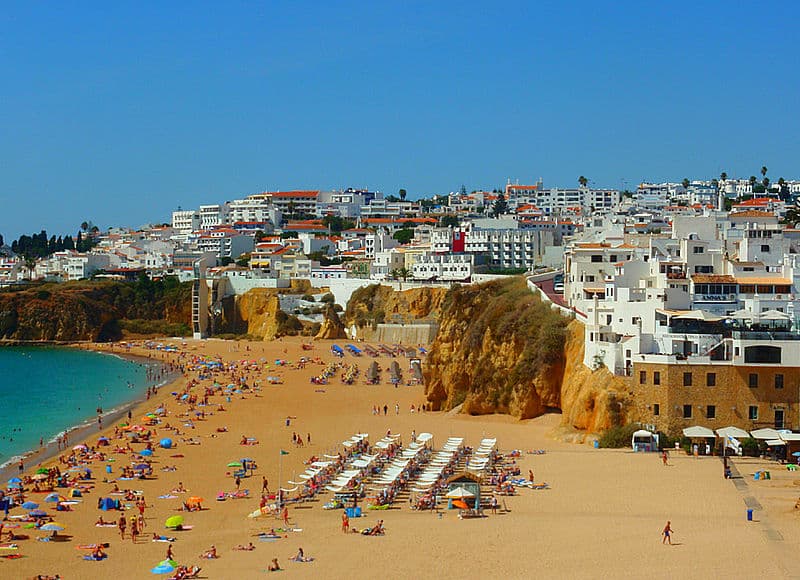
The main beach beneath the old town, where fishermen were still hauling boats onto the sand as late as the 1980s. Above it rises the white townscape, with St Anne's Church and the Pau da Bandeira viewpoint. A covered tunnel from the 1950s runs from Largo Engenheiro Duarte Pacheco square down to the beach.

Tip: Next to the tunnel there's a free inclined lift — look for the glass tower on Rua Latino Coelho. It saves eighty steps back up with your beach bags.

Admission:
free
Time needed:
3 h
Praia da Falésia

Praia da Falésia

10 km east

A 6-km beach beneath rust-orange, pine-topped cliffs that run uninterrupted all the way to Vilamoura. The cliff face shifts in colour with the light, from yellow to deep red, making it the most photographed spot in the Algarve.

Tip: There are only a few ways down the cliff, and they're far apart. Park at Praia da Falésia-Açoteias, not at Olhos de Água — otherwise you'll be walking 3 km along the beach to get back to the car.

Admission:
free, sun lounger from €15
Time needed:
half day
Praia de São Rafael

Praia de São Rafael

4 km west

A small bay of white sand flanked on both sides by pierced rock formations with arches and caves. The sheltered position keeps the water calmer than on the open beaches, and it's clear enough to see the bottom.

Tip: The car park above the beach fills up by 10.30am. Arrive before 10am, or after 4pm once the first wave of visitors heads back to their hotels.

Admission:
free
Time needed:
half day
Praia da Galé and Praia da Coelha

Praia da Galé and Praia da Coelha

6–8 km west

A pair of beaches to the west: Galé is wide and open, lined with restaurants, while Coelha is a tiny cove between cliffs, reached down a wooden staircase, with barely 200 m of sand.

Tip: Coelha has no shade and no shop, just a single stall. Bring water and an umbrella from your hotel — there's nothing to buy on-site, and the nearest supermarket is 3 km away.

Admission:
free
Time needed:
half day
Oura and the Strip

Oura and the Strip

Oura, 2 km east

Areia de Oura beach, and above it Avenida Sá Carneiro, known to everyone simply as the Strip: a kilometre of bars, karaoke, dance clubs and food stalls running from 10pm to 6am. The liveliest nightlife in Portugal.

Tip: Taxis run from the hotels to the Strip, but fares climb noticeably after 2am on the way back. Agree the price beforehand, or book a ride through the Bolt app before midnight.

Admission:
free
Time needed:
evening
Marina de Albufeira

Marina de Albufeira

3 km west

A marina built in 2003 in a cove west of the city, ringed by houses painted in bold blue, yellow and red. Boats bound for the sea caves and dolphin-watching moor here, alongside a cluster of restaurants and rental outfits.

Tip: Prices for Benagil trips can vary by as much as €15 for the same cruise between different stalls. Walk the whole pier and haggle — outside peak season, prices drop immediately.

Admission:
free, tours from €25
Time needed:
2 h
Zoomarine

Zoomarine

Guia, 8 km northwest

A marine and entertainment park between Albufeira and Guia, with dolphins, sea lions, birds of prey, aquariums and a pool area with slides. It also houses a marine animal rescue centre serving the whole southern coast.

Tip: Tickets bought online in advance tend to run €5–8 cheaper than at the gate, and the park doesn't discount during the day. The pool area doesn't open until around 11am, so there's little point arriving earlier.

Admission:
from €32
Time needed:
full day
Paderne Castle

Paderne Castle

Paderne, 14 km north

The ruins of a 12th-century Moorish fortress built of rammed earth above the Quarteira river valley, one of the 7 castles depicted on Portugal's coat of arms. A Gothic church stands below the walls, and a medieval bridge crosses the river.

Tip: The final kilometre is an unpaved track, followed by a 10-minute walk to the castle. After winter rain it's only passable with a higher-clearance car — leave the car at the turn-off and walk it instead.

Admission:
free
Time needed:
1.5 h
Olhos de Água

Olhos de Água

7 km east

A former fishing village east of Albufeira, named for the freshwater springs that seep up right through the beach sand. At low tide you can watch cold water well up from the sand and form rings on the surface.

Tip: The springs only appear at low tide. Check the tide times (maré) posted at the beach entrance or in the IPMA app — otherwise you'll arrive and see nothing.

Admission:
free
Time needed:
2 h

Photos: Praia dos Pescadores and the old town — Jose A. (CC BY 2.0) · Praia da Falésia — Diana5cruz (CC BY-SA 4.0) · Praia de São Rafael — Beeston (CC BY 3.0) · Praia da Galé and Praia da Coelha — Beeston (CC BY 3.0) · Oura and the Strip — Kolforn (CC BY 3.0) · Marina de Albufeira — NASA/GSFC/MITI/ERSDAC/JAROS, and U.S./Japan ASTER Science Team (Public domain) · Zoomarine — Joseolgon (CC BY-SA 3.0) · Paderne Castle — Beechgrove at English Wikipedia (Public domain) · Olhos de Água — muffinn from Worcester, UK (CC BY 2.0)

Where to stay

Areas and districts, matched to the kind of trip you are taking

Old Town

Best for: first-time visits and strolling

Whitewashed buildings on the cliff above the main beach, lanes full of restaurants and more atmosphere than anywhere else in Albufeira. Everything is walkable, but that means steps and hills. It's lively in the evening, though not noisy like Oura, making it the best choice for couples and first-time visitors.

Oura and Montechoro

Best for: nightlife and lower prices

2 kilometres east of the centre, around the Strip. The densest concentration of hotels and apartments in Albufeira, and the lowest prices outside season. Music carries through closed windows until 3am — anyone wanting sleep should pick a room facing away from the street.

Praia da Falésia and Olhos de Água

Best for: families and a quiet holiday

The eastern side, with large resorts scattered through pine woods above the cliffs, 7–10 km from the centre. The beach is endless and never crowded, but the setting is entirely hotel-based — without a car or bus you can't reach the town, and a taxi costs around €15.

Marina and Praia da Galé

Best for: boat trips and golf

The western side, with the harbour, colourful houses and a string of beaches beneath the cliffs. Quieter than the centre, with a good choice of apartments and the closest access to the Benagil boats. It's a 3-km walk to the old town along the coastal promenade.

Getting around

From the airport

Albufeira is reached via Faro airport, 40 km to the east, which receives charter and low-cost flights from across Europe in season. The transfer by car takes half an hour along the A22 motorway. A direct bus runs from the airport, though it can mean a long wait outside the terminal; a cheaper alternative is the train, whose line to Ferreiras stops 6 km from the centre, with a connecting town bus from there. Book your return transfer with a buffer, since the motorway backs up on Friday afternoons.

Faro (FAO) · 40 km

  • Hotel transfer· 30–45 min· included in stay
  • Taxi or Bolt· 30 min· €45
  • Bus (Vamus/Aerobus)· 1 h 10 min· €8
  • Train to Albufeira-Ferreiras· 40 min + bus· €5

Around town

Albufeira sprawls along a 15-km strip, and walking between the old town, Oura and Falésia isn't realistic. The Giro town buses run several routes on a single ticket, roughly every half hour until 11pm. Taxis are cheap given the short distances, and Bolt is reliable and roughly a third cheaper. A car is only worth it for trips out of town; parking in the centre is paid and, in season, hopeless.

Giro busThe town network linking the old town, Oura, the marina and Olhos de Água, until 11pm. · €1.50
BoltThe cheapest way to reach the Strip in the evening and back; a car usually arrives within 5 minutes in the centre. · €5
Rental carWorthwhile for Benagil, Silves and the western beaches. The A22 motorway uses electronic tolls, which the rental company arranges. · €30 / day
Tourist trainA loop route between the old town, marina and Oura; slow, but spares you paying for taxis with children. · €5

Useful apps: Google Maps, Moovit, Bolt, IPMA

When to go

The season runs from April to the end of October, longer than in the Mediterranean, since winters are mild and January air temperatures reach 16°C. Swimming works from June to October, though the Atlantic keeps the sea below 22°C even in August. June and September are best: warm without soaring past 30°C, full restaurants and prices roughly half those of August. July and August are the most expensive, with the Strip in full swing. The resort doesn't close in winter, but about half its venues do.

Best time

June and September

What to avoid

August for the prices and crowds, December to February for closed venues

MonthJanFebMarAprMayJunJulAugSepOctNovDec
Day16°17°19°20°23°26°29°29°27°23°19°17°
Night9°9°10°11°13°17°19°19°18°15°12°10°
Rainy days655531003667
Sea16°16°16°17°18°20°21°22°22°20°18°17°

Food & drink

Albufeira lives off tourism, so on the main streets you'll find English breakfasts and pizza just as easily as Portuguese food. Genuine Algarve cuisine is 2 streets back from the beach: grilled fish charged by weight, seafood cataplana and piri-piri chicken. Fish is chosen from ice at the entrance, and you should ask the price per kilo up front — for sea bream and sea bass it runs around €30. Lunch is served from noon to 3pm, dinner from 6.30pm; arrive at 6pm and you'll find only a bar open.

What to try

Cataplana

Seafood stewed with sausage and peppers in the sealed copper pot that gives the dish its name. It's cooked for 2 or more and takes 40 minutes to prepare, so it's ordered right at the start of the meal.

Sardinhas assadas

Sardines grilled over charcoal, eaten with bread and boiled potatoes. The season runs from June to October; outside it they're frozen and not worth ordering.

Frango piri-piri

Chicken grilled with a hot marinade made from African bird's-eye chillies, Portugal's number-one fast food. You can ask for it milder, but the grill house will assume you want it full strength.

Bacalhau

Dried, salted cod, Portugal's national ingredient, prepared in hundreds of ways. The most common are bacalhau à brás (shredded with matchstick fries and egg) and bacalhau com natas. It's desalted for 2 days before cooking, so it's not something you can make from scratch on a whim.

Arroz de marisco

A loose seafood rice, served in a clay bowl, thicker than soup and looser than a risotto. Ordered for 2, it's the best value-for-money dish on the Portuguese coast.

Pastel de nata

A flaky pastry case with custard filling, served warm with cinnamon and icing sugar. Around €1.20 at a bakery, double that near the beach.

Ginjinha

A sweet liqueur made from sour cherries macerated in aguardente, drunk as a shot after a meal, sometimes with a cherry in the glass. In the Algarve, medronho, a spirit distilled from strawberry-tree fruit, is more often on offer instead.

Vinho verde

A young, fresh wine from the north with a light fizz and low alcohol, around 9%. Served chilled with fish, it's the one lunchtime wine that won't leave you drowsy in the afternoon.

What it costs

Espresso (bica)

€0.80–1.20

Pastel de nata

€1.20–2.50

Set lunch menu

€10–14

Fish dinner at a restaurant

€25–35 per person

0.33 l beer (imperial)

€2–4

2 sun loungers with umbrella

€15–20

Boat trip to Benagil Cave

€25–45

Night in a 4* hotel in season

€110–180

Indicative prices that change over time — treat them as a guide, not a price list.

Practical information

SocketsCEuroplug, two round pinsFSchuko
Voltage230V / 50Hz
Tap waterTap water is drinkable — Tap water is safe and monitored throughout Portugal, but in the south and on the islands it's hard and can taste of chlorine. Bottled water costs around 30 cents per 1.5 litres at a supermarket. Restaurants don't usually serve tap water — order 'água' and you'll get a bottle, which is charged.
TippingTipping isn't expected in Portugal, and locals themselves leave little — small change at a café, 5% or a round-up at a restaurant. 10% is generous and reserved for genuinely good service. Card machines usually have no tip option, so it's left in cash on the table.
Driving on theright
SafetyPortugal is one of the safest countries in Europe, and violent crime is rare. The real risk is pickpocketing on the promenade and belongings left under a towel on the beach. Never leave visible luggage in a parked car. The Atlantic is the bigger concern: currents are strong and waves higher than in the Mediterranean, so follow the flags flown by the lifeguard station — a red flag means no swimming and is enforced with fines. The emergency number is 112.
Opening hoursShops in the resort are open from 10am to 7 or 8pm, including Sundays in season; supermarkets until 10pm. Restaurants serve lunch from noon to 3pm and dinner from 6.30pm to 10pm, with the kitchen closed in between. Museums and monuments close on Mondays, and last entry is usually half an hour before closing.
Customs & etiquetteLunch is eaten between noon and 2pm, dinner after 7.30pm — Portuguese eat earlier than the Spanish. Anything the waiter brings to the table unordered (olives, pâté, cheese, bread) is the couvert and will be charged; if you don't want it, simply return it politely and it won't appear on the bill. Greetings are a handshake, or 2 kisses between acquaintances. Swimwear belongs on the beach, not in shops or at a promenade café.
A few local wordsHello — Bom diaThank you (said by a man / a woman) — Obrigado / ObrigadaPlease — Por favorThe bill, please — A conta, por favorCheers — Saúde

How to plan your days

1 day

A day in Albufeira

  1. 1Morning in the old town: St Anne's Church, the lanes and the Pau da Bandeira viewpoint.
  2. 2Down the tunnel to Praia dos Pescadores, a swim and lunch above the beach.
  3. 3Afternoon move to Praia de São Rafael for the rock arches.
  4. 4Evening at the marina, choosing a boat trip for the next day, then dinner by the harbour.

2 days

2 days with beaches and a boat trip

  1. 1First day as above.
  2. 2Second morning, a boat from the marina to Benagil Cave and the beaches beneath the cliffs.
  3. 3Afternoon at Praia da Falésia and a walk beneath the orange cliffs.
  4. 4Evening at Oura and the Strip, or a quiet dinner in the old town.

3 days

3 days including the interior

  1. 1First 2 days as above.
  2. 2Third day, drive inland to Paderne Castle and the medieval bridge over the Quarteira.
  3. 3Lunch in Silves beneath the red walls of the Moorish fortress.
  4. 4Return via Guia, with an afternoon at Zoomarine if travelling with children.
  5. 5Early evening at Olhos de Água and the beach springs at low tide.

Day trips

Benagil Cave

30 km · 45 min by car or 2 h by boat

Portugal's most photographed spot: a vaulted sea cave with a hole in its roof and a sandy beach inside. Entry is allowed only by kayak, paddleboard or small boat, with larger vessels staying outside the entrance. Half-day cruises run there from Albufeira's marina.

Lagos and Ponta da Piedade

50 km · 45 min

A historic town from which Portugal's voyages of discovery once set sail, with city walls and a former slave market. Beyond the town lies Ponta da Piedade — rocky headlands, arches and tunnels above turquoise water, reached by steps from the lighthouse.

Faro

40 km · 35 min

The regional capital, with city walls, a cathedral and a chapel decorated with human bones. Boats leave the harbour for the Ria Formosa lagoon and its sand islands, invisible from the mainland. A good choice for a windy day when the beach isn't worth it.

Frequently asked questions

Is Albufeira good for families with children?+

Yes, but it depends on the area. The eastern stretch around Praia da Falésia and Olhos de Água is quiet, with wide beaches. Oura and the Strip aren't suitable for families because of the noise until morning. Both the old town and most beaches are reached by stairs, which makes things awkward with a pushchair.

How warm is the sea in Albufeira?+

Cooler than you'd expect. This is the Atlantic, not the Mediterranean: the water is 20°C in June and 22°C in August and September, the warmest it gets all year. That's fine for swimming, but the first dip takes some resolve. The hotel pool tends to be warmer.

Do I need a car in Albufeira?+

Not for a beach holiday — the Giro town buses connect all parts of the resort, and Bolt is cheap. A car is worthwhile if you want to reach Benagil, Lagos or the interior. Bear in mind that parking in the centre is paid and, in summer, practically unavailable.

How far is Faro airport?+

40 km along the A22 motorway, about a 30-minute drive. A transfer is often included in the package; a taxi costs around €45. The cheapest option is the train to Albufeira-Ferreiras station and a bus from there — around €5 in total, taking 1.5 hours.

What is the Strip and can you avoid it?+

A kilometre-long strip of bars and clubs in the Oura district, 2 km from the old town, open until 6am. It's easy to avoid: just stay in the old town, near the marina, or at one of the resorts by Falésia. The noise only reaches Oura itself and Montechoro.

When is the best time to visit Albufeira?+

June and September offer the best mix of weather and price: 25–27°C, warm sea and prices around a third lower than in August. April and May are pleasant for sightseeing, but the sea is still cold for swimming, around 17°C.

Are the beaches in Albufeira sandy?+

Yes, all the main beaches have fine, light-coloured sand. The quirk is that sandstone cliffs separate them from one another, so instead of 1 long beach there are around 15 small ones. Each has its own steps or path down, and walking along the shore between them often isn't possible.

How expensive is Albufeira compared with Spain?+

10–20% cheaper. Coffee costs around €1, a set lunch menu €10–14, and beer €2–4 depending on the venue. The most expensive things are accommodation in August and boat trips; the cheapest food is at family-run restaurants a street back from the beach.

Visa Requirements

Check the latest visa requirements for entering this country. Some nationalities may need to apply for a visa or e-visa before travel.

Check visa requirements

Language

Portuguese

Currency

EUR

Timezone

Europe/Lisbon

Dial Code

+351

Population

10.3M

Area

92,212 km²

Voltage

230V / 50Hz

Driving Side

Right

Top Hotels in Albufeira

Live prices from 500+ properties

Loading hotels...

More destinations in Portugal

Planning a trip to Albufeira?

Compare hundreds of hotels, find the best price, and book with free cancellation on TravelManiac.