Hotels in Madeira

A volcanic island with levadas instead of beaches

Madeira

LanguagePortuguese
CurrencyEUR
TimezoneAtlantic/Madeira
Temperature12-28 °C
Dial Code+351
Population10.3M
Area92,212 km²
SocketsType C / Type F
Tap waterDrinkable

Discover Madeira

Madeira lies nine hundred kilometres from mainland Portugal, closer to Africa than to Europe, and is a volcanic peak rising more than 1,800 metres out of the ocean. Anyone coming for a sandy beach has made a mistake: the coastline is rocky, there are only a handful of natural sandy beaches, and even those have black volcanic shingle. What the island does have, unlike anywhere else in Europe, is 2,500 kilometres of levadas — channels dug since the 15th century to carry water from the rainy north to the southern slopes. Paths run alongside them, letting you cross the island almost on the level even though thousand-metre cliffs surround you. Up top are bare volcanic ridges above the clouds, in the middle a UNESCO-listed laurel rainforest, and below, terraces of bananas and vineyards. The climate is subtropical and seasonless: the gap between January and August is just seven degrees, and something is in bloom all year round.

What to see

The places worth your time in Madeira, and what to expect at each

Pico do Areeiro

Pico do Areeiro

central Madeira, 25 km from Funchal

The island's third-highest peak, at 1,818 metres, reachable by car all the way to the radar dome on top. On a clear day you stand above an unbroken layer of cloud, with views across a gorge full of volcanic spires to neighbouring Pico Ruivo.

Tip: Go for sunrise, between six and nine. Cloud tends to roll in from the south around eleven, and by noon the summit is often in mist. It's about ten degrees colder up here than at sea level, and windy — a jacket isn't overkill.

Admission:
free
Time needed:
2–4 h
Pico Ruivo and the PR1 ridge trail

Pico Ruivo and the PR1 ridge trail

central Madeira

Madeira's highest point, at 1,861 metres, with no road leading up. The classic PR1 route runs seven kilometres along the ridge from Pico do Areeiro, through tunnels cut into the rock and stairways above drops of two hundred metres.

Tip: The route is one-way and you can't drive back to your start — either arrange a pickup from Achada to Teixeira, or plan on six hours there and back. The tunnels are dark even at midday, so a headlamp is worth carrying even for a day hike.

Admission:
from €3 (trail fee)
Time needed:
5–6 h
Levada do Caldeirão Verde

Levada do Caldeirão Verde

Santana, north coast

The island's best-known levada walk: thirteen kilometres along a channel dating from 1500, from the village of Queimadas through four tunnels to a cauldron where a hundred-metre waterfall drops into a green pool. The path is almost flat throughout.

Tip: The tunnels are unlit and low — in the lowest section you have to stoop. A headlamp and a rain jacket are essential, as the rock drips even in dry weather. The car park at Queimadas is small and full after nine.

Admission:
from €3 (trail fee)
Time needed:
5 h
Cabo Girão

Cabo Girão

Câmara de Lobos, 15 km from Funchal

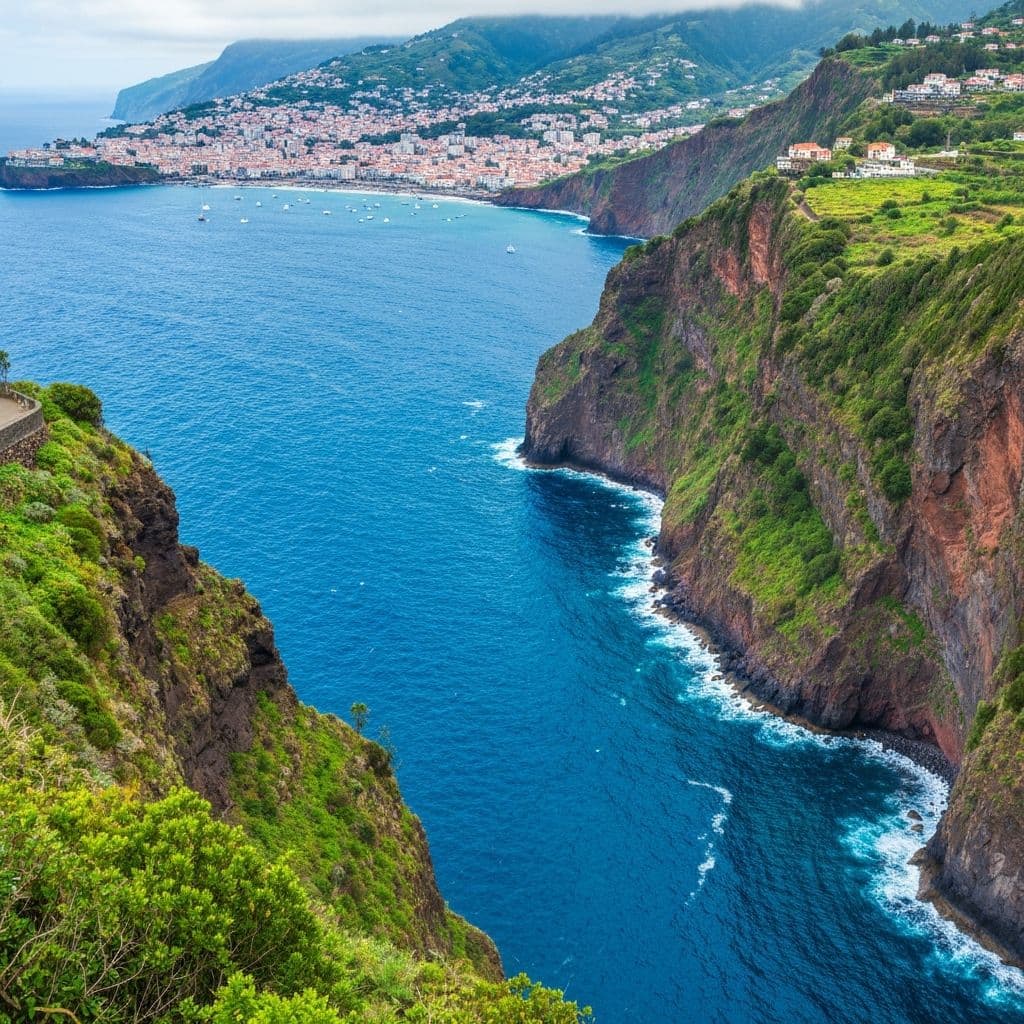
One of Europe's highest sea cliffs, dropping 580 metres straight into the ocean. Since 2012 a glass skywalk has jutted out from the edge, from which you can look down on a narrow strip of terraced fields still farmed right at the water's edge.

Tip: Heels are a bad idea on the glass floor, and there's a queue at midday. Late afternoon is best, when the sun lights up the cliff face and the coach parties have left. Parking is free two hundred metres above the viewpoint.

Admission:
from €2
Time needed:
1 h
Porto Moniz and the lava pools

Porto Moniz and the lava pools

north-west, 45 km from Funchal

A village on the north-western tip where cooled lava has formed a chain of natural pools along the shore, replenished by seawater at high tide. Part is developed as a public pool with ladders and a lifeguard; part remains wild and free.

Tip: The paid pools are calmer, but the wild section fifty metres further on is prettier and free. Water shoes help, as the lava is sharp as glass. In heavy surf the pools close and there's nothing to be done about it.

Admission:
pools from €3
Time needed:
half a day
Ponta de São Lourenço

Ponta de São Lourenço

Caniçal, east of the island

The island's easternmost tip and its exact opposite: a treeless, wind-scoured peninsula of red and ochre volcanic layers dropping into the sea on both sides. An eight-kilometre loop, the PR8, runs out along it.

Tip: There isn't a metre of shade on the whole route, and the wind is deceptive — you'll burn even while feeling cold. Bring a litre and a half of water per person; the kiosk is only at the start by the car park and often closed by midday.

Admission:
free
Time needed:
3–4 h
Fanal laurel forest

Fanal laurel forest

Porto Moniz, north-west

A plateau at eight hundred metres with ancient til laurels, their gnarled trunks up to six hundred years old. It's the most photogenic patch of laurisilva, a rainforest that survives in Europe only here and is UNESCO-listed.

Tip: Fanal only really comes alive in fog, when the trees emerge from the mist — in sunshine it just looks like an ordinary pasture. Fog is most common early morning and towards evening. The road up is narrow and visibility in fog can drop to twenty metres, so drive slowly.

Admission:
free
Time needed:
2 h
Santana and its thatched cottages

Santana and its thatched cottages

Santana, north of the island

A village on the north coast famous for its palheiros: triangular cottages with thatched roofs reaching to the ground, painted white with red and blue doors. A few in the village serve as a museum; hundreds more stand scattered through the countryside, still lived in.

Tip: The cottages around the square are a tourist backdrop and charge admission. Drive two kilometres inland towards Queimadas instead — inhabited palheiros stand among the fields there, photographable without a fence or a crowd.

Admission:
from €1
Time needed:
2 h
Curral das Freiras

Curral das Freiras

inland, 17 km from Funchal

A village at the bottom of a crater ringed by thousand-metre walls, reachable only on foot over the ridge until 1959. It's named after nuns who hid here from pirates in the 16th century. Chestnuts grown here go into both a liqueur and a soup.

Tip: Don't stop in the village down below — head up to the Eira do Serrado viewpoint instead, from where you can see the whole basin with the village at the bottom. Parking is by the hotel, a ten-minute walk through the woods from the viewpoint.

Admission:
free
Time needed:
3 h

Photos: Pico do Areeiro — Krib (CC BY-SA 4.0) · Pico Ruivo and the PR1 ridge trail — Ramessos (CC BY-SA 4.0) · Levada do Caldeirão Verde — myself (Bernard Leprêtre) (CC BY-SA 2.5) · Cabo Girão — Bjørn Christian Tørrissen (CC BY-SA 3.0) · Porto Moniz and the lava pools — Bjørn Christian Tørrissen (CC BY-SA 3.0) · Ponta de São Lourenço — Richard Bartz (CC BY-SA 3.0) · Fanal laurel forest — Dietmar Rabich (CC BY-SA 4.0) · Santana and its thatched cottages — Thomas Hobbs (CC BY-SA 2.0) · Curral das Freiras — Diego Delso (CC BY-SA 4.0)

Where to stay

Areas and districts, matched to the kind of trip you are taking

Funchal and the south coast

Best for: a first visit and a base for day trips

The capital and the surrounding towns of Caniço and Câmara de Lobos, home to nine in ten of the island's hotels. Warmest, sunniest and best connected — every bus line and every tour departs from here. Anyone without a car has no other sensible base on Madeira.

North coast (Santana, São Vicente, Porto Moniz)

Best for: nature and levada walks

The green, damp and cooler side of the island, with three times the rainfall of the south — and the source of the water the levadas carry. It has the most hiking trails and the fewest hotels. Accommodation is in small guesthouses, and a car is practically essential here.

East (Machico, Caniçal)

Best for: beaches and airport proximity

The driest and sunniest corner of the island, with the airport and two of the island's few sandy beaches — their sand shipped in from Morocco. It's half an hour from Funchal on the motorway. Quieter and cheaper than the capital, though the evening scene is limited.

Highlands (Paul da Serra, Encumeada)

Best for: hiking above the clouds

A plateau at 1,500 metres in the middle of the island, the starting point for most ridge trails. There's no accommodation apart from a few mountain huts, and the weather changes within half an hour. Visited as a day trip from the south, not a place to base yourself.

Getting around

From the airport

Flights to Madeira land at Cristiano Ronaldo Airport in Santa Cruz, sixteen kilometres east of Funchal, known for its runway built on concrete pillars above the sea. Arrivals can be bumpy due to crosswinds, and in strong gusts flights are diverted to Porto Santo or the Canaries — worth bearing in mind if you have a connecting flight. Charter flights run from Prague in season; the rest of the year it's a connection via Lisbon. The transfer to Funchal takes twenty minutes on the motorway.

Madeira Cristiano Ronaldo (FNC) · 16 km

  • Hotel transfer· 20–30 min· included in package
  • Aerobus to Funchal· 40 min· €5
  • Taxi or Bolt· 20 min· €25
  • Rental car· straight from the terminal· €35 / day

Around town

Madeira is only fifty-seven kilometres long, but the rugged terrain means everywhere takes twice as long to reach as the map suggests. The VR1 motorway runs along the south, and more than a hundred tunnels have been bored through the island, so the drive from Funchal to Porto Moniz takes about an hour. Horários do Funchal buses serve the south reliably, but the north and the interior get only a handful of runs a day, almost none on Sundays. A car is effectively a necessity on Madeira — just be ready for old roads with gradients up to 25 percent and parking on a slope.

Rental carThe only way to see the north and the mountains properly. Requires confidence on steep grades and reversing in narrow streets. · €35 / day
Horários do Funchal busesA dense network along the south coast; only a few services a day to the north, and limited at weekends. · €2
Organised minibus tourA sensible substitute for a car for day loops around the north, including a pickup at the end of a one-way trail. · €35
Taxi for a hikeArranged pickup from the end of the PR1 trail or a levada walk, so you don't have to retrace your steps. · €30

Useful apps: Google Maps, Moovit, Bolt, IPMA

When to go

Madeira doesn't really have seasons in the usual sense: January averages 19°C, August 26°C, and it's a good destination year-round. The best months for sightseeing are April to June, when it's dry and the island is in bloom, plus September and October. For swimming, September and October are best, with the ocean at 23°C — it drops to 18°C in winter, which is a short affair without a wetsuit. The north stays cooler year-round and gets three times as much rain as the south, even in summer.

Best time

April to June, plus September and October

What to avoid

nothing major; December and January bring the most rain and the mountains are often in cloud

MonthJanFebMarAprMayJunJulAugSepOctNovDec
Day19°19°20°20°21°23°25°26°26°24°22°20°
Night13°13°13°14°15°17°19°20°20°18°16°14°
Rainy days877642114789
Sea19°18°18°18°19°20°21°23°23°23°21°20°

Food & drink

Madeiran cuisine rests on two ingredients you won't find elsewhere in Portugal: the deep-sea black scabbardfish (espada) and beef skewers grilled on a laurel branch. Both come with bolo do caco, a flatbread baked on a hot stone with garlic butter. The fruit is subtropical — bananas from terraced plots, passion fruit, custard apples and mango — best sampled at the market in the capital. To drink there's poncha, a rum with honey and lemon that tastes harmless and comes in at 20 percent. Lunch runs from noon to three, dinner from half past six to ten.

What to try

Espada com banana

Fillet of black scabbardfish — a deep-sea fish with alarming teeth caught only around Madeira and Japan — fried and served with fried banana and passion-fruit sauce. The combination sounds odd and works.

Espetada em pau de louro

Cubes of beef skewered on a laurel branch, seasoned with coarse salt and grilled over charcoal. The branch is hung from a stand right over the table and the meat is pulled straight off it. The laurel gives an aroma a metal skewer never could.

Bolo do caco

A flatbread of wheat flour and sweet potato baked on a hot stone, served with garlic butter. You'll get it with everything, and as a snack from a street stall it costs around two euros.

Poncha

Sugar-cane rum with honey and lemon or tangerine juice, mixed with a wooden pestle called a caralhinho. It tastes like lemonade and comes in at around 20 percent — after three, walking gets tricky.

Lapas grelhadas

Limpets grilled in their own shell with garlic butter and lemon, the island's top starter. Served by the dozen on a hot iron plate.

Madeira wine

A fortified wine that's heated and deliberately oxidised, so an opened bottle won't spoil. Dry sercial is drunk before a meal, sweet malvasia after. A tasting in a wine lodge costs around five euros.

Sopa de tomate e cebola

Tomato-and-onion soup with a poached egg and bread, the traditional Madeiran working man's lunch. Nearly every tavern in the mountain villages serves it, for around four euros.

Bolo de mel

A dark cake made from sugar-cane molasses with nuts and spices, baked at Christmas and kept for a year. It isn't cut with a knife but broken by hand — islanders take this seriously.

What it costs

Espresso (bica)

€0.80–1.20

Bolo do caco from a street stall

€2–3

Poncha

€3.50–5

Espetada at a mountain restaurant

€12–18

Marked-trail fee

€3 per person per day

Rental car per day

€35–55

Full-day minibus tour

€35–55

Night in a 4-star hotel in Funchal

€90–150

Indicative prices that change over time — treat them as a guide, not a price list.

Practical information

SocketsCEuroplug, two round pinsFSchuko
Voltage230V / 50Hz
Tap waterTap water is drinkable — Tap water is safe and monitored throughout Portugal, though in the south and on the islands it's hard and can taste of chlorine. Bottled water costs around 30 cents for a litre and a half at the supermarket. Restaurants don't routinely serve tap water — order "água" and you'll get a bottle, billed accordingly.
TippingTipping isn't expected in Portugal, and locals themselves leave little — small change at a café, five percent or rounding up at a restaurant. Ten percent is generous and reserved for genuinely good service. Card terminals usually have no tip option, so it's left in cash on the table.
Driving on theright
SafetyPortugal is one of the safest countries in Europe and violent crime is rare. The real risk is pickpocketing on the promenade and items left unattended under a beach towel. Never leave a car with visible luggage inside. The Atlantic is a bigger concern: currents are strong and waves higher than in the Mediterranean, so follow the flags at the lifeguard post — a red flag means no swimming and is enforced with fines. The emergency number is 112.
Opening hoursShops in resort towns open from ten to seven or eight in the evening, and in high season on Sundays too; supermarkets stay open until ten. Restaurants serve lunch from noon to three and dinner from half past six to ten, with the kitchen closed in between. Museums and sights close on Mondays, and last entry is usually half an hour before closing.
Customs & etiquetteLunch runs from noon to two, dinner after half past seven — Portuguese eat earlier than the Spanish. Anything the waiter brings to the table unordered (olives, pâté, cheese, bread) is the couvert and will be charged; if you don't want it, just return it politely and it won't be billed. Greetings are a handshake, or two kisses between people who know each other. Swimwear belongs on the beach, not in a shop or a café on the promenade.
A few local wordsGood morning / good day — Bom diaThank you (male / female speaker) — Obrigado / ObrigadaPlease — Por favorThe bill, please — A conta, por favorCheers — Saúde

How to plan your days

1 day

A day in the mountains

  1. 1Sunrise at Pico do Areeiro, before the clouds roll in.
  2. 2Descend to Ribeiro Frio and a short levada walk to the Balcões viewpoint.
  3. 3Lunch inland, then the Eira do Serrado viewpoint above Curral das Freiras in the afternoon.
  4. 4Late afternoon at Cabo Girão and the glass skywalk above the seaside terraces.

2 days

Two days: a levada and the north

  1. 1Day one as above.
  2. 2Day two: a full-day levada walk to Caldeirão Verde from Queimadas, headlamp and rain jacket in hand.
  3. 3On the way back, Santana and the thatched cottages around the village.
  4. 4Return via the north coast road through São Vicente, dinner in Câmara de Lobos.

3 days

Three days across the island

  1. 1The first two days as above.
  2. 2Morning three at the Fanal laurel forest, if there's fog.
  3. 3Late morning at the Porto Moniz lava pools, swimming in the tidal basins.
  4. 4On the way back, the Véu da Noiva viewpoint and the old road beneath the waterfalls.
  5. 5A fourth day, if time allows, for the Ponta de São Lourenço peninsula and the PR8 trail.

Day trips

Porto Santo

50 km · 2 h 30 min by ferry

A neighbouring island with six miles of golden sand — exactly what Madeira lacks. The sand is even used for therapeutic wraps. The ferry leaves Funchal in the morning and returns in the evening, so it's doable as a day trip, though you'll only get about five hours on the beach.

Ilhas Desertas

30 km · 3 h by boat

Uninhabited rocky islands on the south-eastern horizon, a protected reserve home to one of the last colonies of Mediterranean monk seals. Landing is only allowed on Deserta Grande with a permit; regular tours anchor offshore and swim from the boat.

Funchal

0 km · depends on where you stay

The capital is most visitors' base, but it deserves a day of its own: the Lavradores market, the cathedral, the Monte cable car, the wicker toboggan run and the Madeira wine lodges. No car and no planning needed — it's all within a two-kilometre radius.

Frequently asked questions

Does Madeira have sandy beaches?+

Barely. The coastline is rocky and the natural beaches have black volcanic shingle. The two sandy beaches in Machico and Calheta are artificial, with sand shipped in from Morocco. Anyone wanting real sand needs to take the ferry to Porto Santo, which has six miles of golden beach.

Do I need a car on Madeira?+

Pretty much. Buses reliably serve only the south coast, with just a few runs a day to the north and the mountains. Without a car you can manage Funchal and its surroundings, but you'll depend on organised tours for the rest of the island. Expect tunnels, hairpin bends and gradients of up to 25 percent.

When is the weather best on Madeira?+

April to June, plus September and October. It's dry, 20–25°C, and the mountains tend to be cloud-free. The difference between months is small — only seven degrees separate January and August. The north of the island is cooler year-round and gets three times as much rain as the south.

What are levadas?+

Channels that carry water from the rainy north to the dry southern slopes, dug since the 15th century. There are more than 2,500 kilometres of them, and a maintained path runs alongside most. Thanks to the gradient they're nearly level, so you can cross a mountainous island without much climbing.

Do you have to pay for the hiking trails?+

Yes, since 2021. The marked PR trails cost three euros per person per day; the ticket is bought online or from a machine at the trailhead and checked on the path itself. There's no charge for freely accessible viewpoints or routes outside the official network.

Is swimming in the ocean possible?+

Yes, but it's colder than you'd expect: the warmest months are September and October, when the water reaches 23°C, dropping to 18°C in winter. Swimming mostly happens in built sea pools and on platforms with ladders, since entry from the shore is often rocky and the surf strong.

Is the flight into Madeira really that demanding?+

The landing is among the toughest in Europe: the runway sits on pillars above the sea, and crosswinds sweep down from the mountains. Arrivals can be bumpy, and in strong gusts flights are diverted to Porto Santo or the Canaries. Pilots need a special qualification to fly into Madeira, so safety isn't the issue.

How many days are enough for Madeira?+

Five to seven days. In three days you can cover the mountains, one levada and Funchal, but not the north or the eastern peninsula. A week lets you add Porto Santo or two longer hikes. Distances are short, but the terrain means everything takes twice as long as the map suggests.

Visa Requirements

Check the latest visa requirements for entering this country. Some nationalities may need to apply for a visa or e-visa before travel.

Check visa requirements

Language

Portuguese

Currency

EUR

Timezone

Atlantic/Madeira

Dial Code

+351

Population

10.3M

Area

92,212 km²

Voltage

230V / 50Hz

Driving Side

Right

Top Hotels in Madeira

Live prices from 500+ properties

Loading hotels...

More destinations in Portugal

Planning a trip to Madeira?

Compare hundreds of hotels, find the best price, and book with free cancellation on TravelManiac.