Hotels in Lisbon

Seven hills, yellow trams and the cheapest big city in western Europe

Lisbon

LanguageEnglish
CurrencyEUR
TimezoneGMT+0
Temperature12-28 °C
Dial Code+351
Population10.3M
Area92,212 km²
SocketsType C / Type F
Tap waterDrinkable

Discover Lisbon

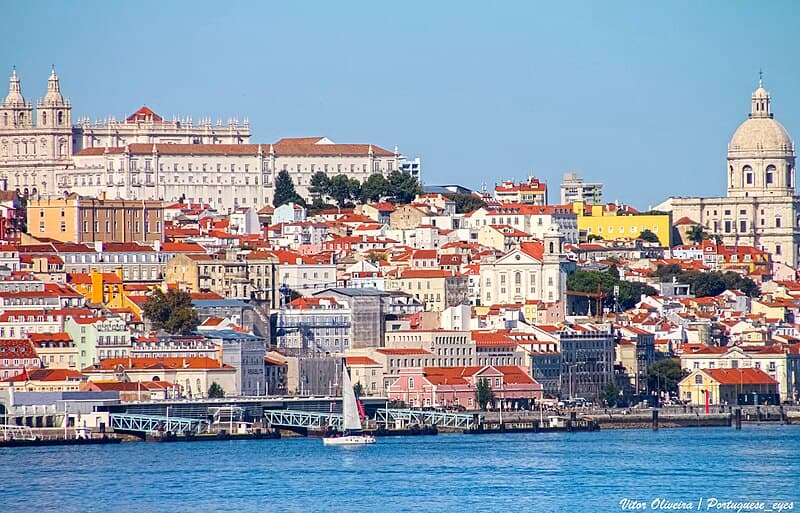
Lisbon sits on 7 hills above the mouth of the Tagus, and it's the only western European capital where you can eat a decent meal for €12. The city has 2 faces, split by a single date: 1 November 1755, when an earthquake, fire and tsunami levelled most of the lower town. What stood higher up — Alfama below the castle and Bairro Alto — survived, and you can still get happily lost in its streets, barely 2 metres wide. The lower district, Baixa, was rebuilt from scratch to a strict grid within just 5 years, making it the first seismically engineered city in Europe. Add to that the Belém district, from where caravels once set sail around Africa, 300 days of sunshine a year, and the mildest winter on the continent — January here feels as mild as April does further north in Europe. Visitors with 2 days can cover Belém and 1 hill; with 3, add Sintra. There's a lot of uphill walking, so footwear matters here more than in most cities.

What to see

The places worth your time in Lisbon, and what to expect at each

Jerónimos Monastery

Jerónimos Monastery

Belém

A vast monastery of the Hieronymite order in Belém, funded by a 5% tax on spices imported from India and completed over 100 years. Manueline style — Portugal's late Gothic — appears here in its purest form: stone ropes, knots, seaweed and armillary spheres on every column. The church holds the tombs of Vasco da Gama and the poet Camões, but the highlight is the 2-storey cloister, where no two columns are alike.

Tip: Entry to the church is free and uses a different queue from the one for the monastery cloister — people often miss this and wait needlessly in the long one. The cloister has an entry fee, and it's worth buying a timed ticket online. It's quietest right at 10am or after 4:30pm, once the tour buses have left.

Admission:
from €12 for the cloister, church free
Time needed:
1.5–2 h
Belém Tower

Belém Tower

Belém

A 5-storey defensive tower from 1519 that originally stood mid-river and now sits on the bank — the Tagus shifted its course after the earthquake. It served as a lighthouse, customs post and prison, and is Portugal's most photographed building. Inside are bare halls, a terrace with cannon niches, and a stone rhinoceros on the corner of the bastion, the first depiction of a rhinoceros in European art.

Tip: There's little to see inside, and a single narrow spiral staircase handles both directions on a traffic-light system — in high season the wait below can run to 40 minutes. If you're short on time, photograph the tower from outside and put the ticket money towards the monastery instead. The best light for photos is late afternoon, when the sun lights up the river-facing façade.

Admission:
from €8
Time needed:
1 h
St George's Castle

St George's Castle

Alfama

A Moorish fortress on the city's highest hill, taken by crusaders in 1147. Little survives inside the walls — the earthquake and centuries of rebuilding saw to that — but you can walk the ramparts along 11 towers, and the view is the best in Lisbon: all of Baixa laid out below, the 25 de Abril Bridge and the mouth of the Tagus. Dozens of peacocks live on the grounds, and there's a periscope that projects a live image of the city onto a circular table.

Tip: Tickets are sold online with a timed entry slot, and without one the queue can run to an hour. Don't walk uphill — the 737 bus runs from Praça da Figueira right up to the gate. Go in the late afternoon: not only is the light better, but Alfama's surrounding lanes then lead naturally downhill, so the rest of the day is all downhill walking.

Admission:
from €15
Time needed:
1.5–2 h
Alfama

Alfama

Alfama

The oldest district in the city, and the only one to survive the earthquake almost untouched, since it stands on bedrock. It's a maze of staircases and lanes so narrow no car can fit, with washing lines strung overhead and houses where people live downstairs and sing fado on the floor above. Inside stands the Romanesque Sé Cathedral and two viewpoints, Santa Luzia and Portas do Sol.

Tip: Alfama isn't a place to visit with a fixed plan, but not entirely without one either — anyone who just keeps heading downhill always ends up somewhere. It's liveliest on Thursday and Saturday mornings, when the Feira da Ladra flea market takes over Campo de Santa Clara. In June, during the Saint Anthony festival, sardines are grilled on every corner and the neighbourhood stays up all night.

Admission:
free
Time needed:
half a day
Tram 28

Tram 28

across the whole city

A line of yellow Remodelado trams from the 1930s that runs from Martim Moniz through Graça, Alfama, Baixa and Chiado all the way to Estrela. The cars are wooden, have a hand brake, and hold only a few dozen people; the climbs are so steep and the corners so tight that you can reach out and touch the house fronts along the way. It's also an ordinary bus route, well, tram route, that locals ride to work.

Tip: Board at the terminus — Martim Moniz or Campo de Ourique — not partway along the route, since in Baixa you often can't get on at all. Ride before 8am, when the tram is half-empty and the light is best; between 11am and 5pm it's a packed trap for pickpockets. A ticket bought from the driver costs €3.20, or €1.80 with a Navegante card.

Admission:
€3.20 from the driver
Time needed:
45 min for the full route
Praça do Comércio

Praça do Comércio

Baixa

A vast square opening straight onto the river, built after the earthquake on the site of the royal palace. Yellow arcaded buildings line three sides, with the Tagus on the fourth and a stone staircase down to the water where monarchs once disembarked. An equestrian statue of Joseph I stands at the centre, and on the north side rises the Rua Augusta triumphal arch with its viewing terrace.

Tip: The arch's terrace is reached by lift from Rua Augusta and costs just under €5 — it's the cheapest big view in the city, and the queue is usually shorter than for the castle. In the corner of the square is Lisbon's oldest café, Martinho da Arcada, once frequented by Pessoa. The steps down to the river are the best spot for sunset, and they're free.

Admission:
free, arch terrace €4.50
Time needed:
1 h
Santa Justa Lift

Santa Justa Lift

Baixa / Chiado

A cast-iron lift from 1902, built by a student of Gustave Eiffel, connecting lower Baixa with Bairro Alto 45 metres above. The cabins are wood-panelled with brass grilles. At the top is a viewing platform overlooking the whole grid of Baixa, the castle opposite, and the ruins of the Carmo church, roofless ever since the earthquake.

Tip: There's no need to join the queue below, which can run to an hour — the upper platform is reached free of charge from Largo do Carmo, via Rua do Carmo and a passage beside the church. Anyone with a day travel ticket already has the lift included and skips the queue too. The ruined Carmo church next door houses a cheap museum and is the quietest spot in the centre.

Admission:
€5.30, free with a day ticket
Time needed:
30 min
Oceanário de Lisboa

Oceanário de Lisboa

Parque das Nações

Europe's second-largest aquarium, on the site of the former Expo 98, built around a single central tank holding 5 million litres of water, viewable from two levels and all four sides. Around it sit 4 separate habitats — the North Atlantic, Antarctica, the Pacific coast and the tropical Indian Ocean — with penguins, otters and manta rays. Over 15,000 animals live here.

Tip: It's the best rainy-day and family option, but everyone knows that — avoid it on Saturday afternoons and in bad weather. Go at 10am when it opens, and walk the route against the flow of the crowd, straight to the main tank first. Parque das Nações is reached by the red metro line to Oriente, 20 minutes from the centre.

Admission:
from €25
Time needed:
2–3 h
Monument to the Discoveries

Monument to the Discoveries

Belém

A 52-metre concrete prow of a caravel on the bank of the Tagus in Belém, with Henry the Navigator at the head and 33 figures of Portuguese explorers, cartographers and missionaries behind him. It was built in 1960 to mark the 500th anniversary of Henry's death. Inside, a lift climbs to a viewing terrace 65 metres up.

Tip: Set into the paving in front of the monument is a huge compass rose mapping the voyages of discovery with their dates — from street level it looks like decoration, and only makes sense once seen from the terrace above, so save it for the way down. Across the street is Pastéis de Belém, the bakery that has made the original custard tarts since 1837; the queue out the door is for takeaway, while inside is often quiet.

Admission:
€10 for the lift to the terrace
Time needed:
45 min

Photos: Jerónimos Monastery — Heartshade (CC BY 4.0) · Belém Tower — Lisbon Photoshoots (CC BY-SA 4.0) · St George's Castle — fulviusbsas (CC BY-SA 3.0) · Alfama — Arne Müseler (CC BY-SA 3.0 de) · Tram 28 — Ввласенко (CC BY-SA 4.0) · Praça do Comércio — Deensel (CC BY 2.0) · Santa Justa Lift — Dicklyon (CC BY-SA 4.0) · Oceanário de Lisboa — Alvesgaspar (CC BY-SA 3.0) · Monument to the Discoveries — Alvesgaspar (CC BY-SA 3.0)

Where to stay

Areas and districts, matched to the kind of trip you are taking

Baixa and Chiado

Best for: first-time visits and shopping

The lower town, rebuilt to a strict grid after the earthquake, with the pedestrian avenues Rua Augusta and Rua Garrett, shops and cafés. It's all flat here and within walking distance of both Rossio station and the river, a real advantage after a day on the hills. Housing is pricier than elsewhere and noisy at night, since Bairro Alto begins right above Chiado. Reached by the blue and green metro lines.

Alfama and Graça

Best for: atmosphere and fado

Historic lanes below the castle, home to small guesthouses and flats with views. It's the prettiest part of the city and also the toughest on feet and luggage — many addresses can't be reached by car or taxi, and the final stretch is on foot up steps. In the evening, fado houses here typically have a minimum spend of around €30. Mornings are quiet, with washing strung up overhead.

Bairro Alto and Príncipe Real

Best for: nightlife and restaurants

Above Chiado begins a neighbourhood that's shut during the day and turns, from 10pm, into one long street of people drinking outside — in Bairro Alto, drinking happens on the pavement, and the bars are little more than hatches. A bit further up is Príncipe Real, quieter, with a park, garden restaurants and the best design shops in the city. Staying right in Bairro Alto at the weekend means not sleeping much.

Belém

Best for: sights and families

A quiet district 6 km downstream, home to the monastery, the tower, the Monument to the Discoveries and 3 museums, including the coach museum. It's the better part of a day's worth of sights, reached by tram 15E from Praça da Figueira in 25 minutes, or by train from Cais do Sodré. Accommodation here is cheaper and quieter than in the centre, but it's dead at night, and dinner means heading back into town.

Getting around

From the airport

Lisbon's airport, Humberto Delgado, is well connected by direct flights from major hubs across Europe, including London, Paris, Madrid and Frankfurt. It sits just 7 km from the centre, practically inside the city — one of the most centrally located airports in Europe — and the red metro line from Aeroporto station reaches downtown in 25 minutes for the price of an ordinary ticket. A taxi to Baixa costs €15–20, as does Uber or Bolt, both of which work well here. Watch out for late-night arrivals: the metro runs until 1am, after which only the night bus 208 or a taxi with a night surcharge remain.

Lisbon Humberto Delgado (LIS) · 7 km

  • Red metro line to the centre· 25 min· €1.80
  • Aerobus bus to Cais do Sodré· 35 min· €4
  • Taxi / Uber to Baixa· 15–25 min· €15

Around town

Lisbon is a walking city, but not a flat one — two points 500 metres apart can involve a 50-metre climb and plenty of steps. That's exactly why the historic lifts and funiculars here count as public transport, not extra attractions. The cheapest option is the rechargeable Navegante card, bought from a machine in the metro for €0.50, which you can top up with either individual rides at €1.80 or a day pass at €7 covering the metro, buses, trams and lifts. A ticket bought from the driver on a tram costs almost double. The metro has 4 lines, runs from 5:30am to 1am, and is fast, though it only serves the flatter parts of the city. Don't drive in the centre: the streets are one-way, parking is expensive, and there's no turning a car around in Alfama.

Metro4 colour-coded lines, running every 4–9 minutes, operating from 6:30am to 1am. The fastest way from the airport and to Parque das Nações, but it doesn't reach the hillier neighbourhoods. · €1.80 with a Navegante card
TramsHistoric yellow trams on routes 28 and 12, plus the modern 15E to Belém. These are ordinary transit routes, not sightseeing rides, and they get packed in the centre. · €1.80 with a card, €3.20 from the driver
Funiculars and liftsThe Elevador da Glória, da Bica and do Lavra whisk you from the lower town uphill in 1 minute and are covered by the day ticket. The Bica is the most photogenic, with a view down to the river. · included with the day ticket
Daily Navegante ticket€7 for 24 hours, covering everything including lifts and funiculars. It pays off from the 3rd ride of the day; the card itself costs a one-off €0.50. · €7 / 24 h
Uber and BoltBoth run reliably and are cheaper than taxis. A ride across the centre costs €5–8, which works out better value than tickets for two people, especially uphill in the evening. · from €5
Coastal trainsA suburban train runs from Cais do Sodré along the river to Cascais every 20 minutes, and from Rossio to Sintra every half hour. These are ordinary trains costing just a few euros. · €2.40 to Cascais

When to go

Lisbon has the mildest climate of any European capital and can be visited year-round — in January it's around 15 degrees in the day with plenty of sunshine. The best months are April, May, September and October: warm without being hot, the sea still or already bearable, and prices lower than in summer. July and August are hot and, above all, packed, with the highest accommodation prices of the year and queues for the tram in Alfama. Winter is damp and rainy, but the showers are short and sharp, so an umbrella is enough to keep the day's plans intact. For the full experience, come in mid-June for the Santos Populares festivities, when the whole of Alfama dances and grills sardines in the street for 2 nights running.

Best time

April to June and September to October

What to avoid

the first half of August, for the heat, prices and crowds

MonthJanFebMarAprMayJunJulAugSepOctNovDec
Day15°16°19°20°23°27°29°29°27°22°18°15°
Night8°9°10°11°13°16°18°18°17°15°11°9°
Rainy days109886311481011
Sea15°15°15°16°17°18°19°20°20°19°17°16°

Food & drink

Lisbon's cuisine is built on fish, pork and bread, and it's still cheap — a set lunch menu with soup, a main course and a drink, known as prato do dia, costs €8–12 at an ordinary tavern. Places fall into 3 types: a tasca is a simple tavern with a paper tablecloth and a menu chalked on a board; a cervejaria is a beer hall specialising in seafood charged by weight; and a marisqueira is their pricier cousin. Whatever the waiter brings to the table unordered — olives, pâté, cheese, bread — is called couvert and is charged for; if you don't want it, politely send it back and you won't be billed. The cheapest meals are found in markets and bakeries, the priciest on the terraces around Praça do Comércio and at the Time Out Market, which is excellent but costs double what a tavern 2 streets away charges.

What to try

Bacalhau

Dried, salted cod — Portugal's national ingredient, prepared in hundreds of ways. The most common is bacalhau à brás (shredded with matchstick fries and egg) and bacalhau com natas. It's desalted for 2 days before cooking, so it's not something you can prepare from scratch at home.

Sardinhas assadas

Sardines grilled over charcoal, eaten with bread and boiled potato. The season runs from June to October; outside it they're frozen and not worth ordering.

Pastel de nata

A flaky pastry cup filled with custard cream, served warm with cinnamon and icing sugar. Around €1.20 at a bakery, double that by the beach.

Caldo verde

A potato soup with shredded kale and a slice of chouriço sausage. Cheap, filling and found in every tavern; typically served as a starter before dinner.

Arroz de marisco

A brothy seafood rice served in an earthenware pot, thicker than a soup and looser than a rice dish. Ordered for 2, it's the best value-for-flavour dish on the Portuguese coast.

Ginjinha

A sweet cherry liqueur macerated in aguardente, drunk as a shot after a meal, sometimes with a cherry at the bottom. In the Algarve, medronho — a spirit distilled from arbutus berries — is more often on offer instead.

Vinho verde

A young, fresh wine from the north with a light sparkle and low alcohol, around 9%. Served chilled with fish, and the one wine at lunch that won't leave you drowsy by the afternoon.

Bifana

A slice of pork loin stewed in garlic, white wine and paprika, tucked into a plain bread roll. The number-one street food, costing around €3 and eaten standing at the counter with mustard and a beer. In Lisbon it's made juicier than in the north, where it's spicier.

What it costs

Espresso (bica) at the counter

€0.80–1.20

Pastel de nata

€1.20–1.50

Half-litre of beer (imperial)

€2–3.50

Set lunch menu at a tasca

€9–13

Dinner for two at a cervejaria

€45–70

Daily Navegante ticket

€7

Entry to St George's Castle

from €15

Night in a 3-star hotel for two

€90–150

Indicative prices that change over time — treat them as a guide, not a price list.

Practical information

SocketsCEuroplug, two round pinsFSchuko
Voltage230V / 50Hz
Tap waterTap water is drinkable — Tap water is safe and monitored across Portugal, though in the south and on the islands it's hard and can taste of chlorine. Bottled water costs around 30 cents for a 1.5-litre bottle at the supermarket. Restaurants don't routinely serve tap water — order água and they'll bring a bottle and charge for it.
TippingTipping isn't expected in Portugal, and locals themselves leave little — small change at a café, 5% or a round-up at a restaurant. 10% is generous and reserved for genuinely good service. Card machines rarely have a tip option, so it's left in cash on the table.
Driving on theright
SafetyThe real risk here is essentially just pickpocketing, on trams, at markets and at restaurant terraces where bags are hung on chair backs. Keep documents and cash separate. It's safe in the centre even at night; the only thing tourists genuinely encounter is street sellers offering drugs, who move on after a simple no, thank you. The emergency number is 112, and operators speak English.
Opening hoursSmaller shops take a midday break roughly from 1 to 3pm, while shopping centres run continuously until 10pm, including Sundays. Museums close on Mondays, and many offer free entry on Sunday mornings. Restaurant kitchens open at noon for lunch and 7:30pm for dinner; arrive at 6pm and you'll find only the bar open.
Customs & etiquetteLunch runs between 12 and 2pm, dinner after 7:30pm — Portuguese eat earlier than Spaniards. Whatever the waiter brings to the table unordered (olives, pâté, cheese, bread) is couvert and is charged for; if you don't want it, simply send it back and you won't be billed. Greetings are a handshake, or 2 kisses between acquaintances. Swimwear belongs on the beach, not in shops or promenade cafés.
A few local wordsHello — Bom diaThank you (male / female speaker) — Obrigado / ObrigadaPlease — Por favorThe bill, please — A conta, por favorCheers — Saúde

How to plan your days

1 day

A day in Lisbon

  1. 1Morning tram 15E to Belém for the Jerónimos Monastery, right after opening.
  2. 2Belém Tower from outside and the Monument to the Discoveries, then a pastel de nata at Pastéis de Belém.
  3. 3Afternoon back to Baixa and up the Santa Justa Lift to the viewing platform.
  4. 4Early evening at St George's Castle for the sunset view.
  5. 5Dinner in Alfama on the way back down the hill.

2 days

2 days with Alfama and Bairro Alto

  1. 1Day 1 as above.
  2. 2Morning on tram 28 from the terminus at Martim Moniz through Graça to Estrela.
  3. 3The Sé Cathedral, the Portas do Sol and Santa Luzia viewpoints, and wandering through Alfama.
  4. 4Afternoon in Chiado, coffee at A Brasileira and shopping on Rua Garrett.
  5. 5Evening: a glass of ginjinha in Bairro Alto and fado in a small house.

3 days

3 days including Sintra

  1. 1The first 2 days as above.
  2. 2Morning train from Rossio to Sintra, 40 minutes.
  3. 3Palácio da Pena and the Moorish castle, then down on foot through the woods to the town.
  4. 4Afternoon at Quinta da Regaleira with its initiation well.
  5. 5Train back, dinner in Príncipe Real.

Day trips

Sintra

28 km · 40 min by train from Rossio

Forested hills with a microclimate 5 degrees cooler than Lisbon, and 5 palaces within sight of one another. At the top stands the yellow-and-red Pena Palace, a 19th-century Romantic confection, next to the ruins of a Moorish castle with walls running along the ridge, and down in the town, Quinta da Regaleira with its initiation well, reached by a spiral staircase 9 storeys underground. Trains run from Rossio every half hour, and a return ticket costs around €5; from the station a 434 bus or tuk-tuk covers the climb. Set aside a whole day for it all, and book Pena tickets online in advance — they often sell out on the spot.

Cascais and Estoril

30 km · 40 min by train from Cais do Sodré

A former fishing village that Portugal's kings turned into a summer residence, today a seaside town with a marina, beaches and quiet lanes. The train hugs the river the whole way, with water in view throughout; a ticket costs €2.40 and trains run every 20 minutes. Just outside town is Boca do Inferno, a rocky chasm where the surf crashes in, and further on, Guincho beach, popular for surfing and rarely without wind. Estoril, one stop earlier, has the largest casino in Europe and quieter beaches.

Óbidos

85 km · 1 h by bus from Campo Grande

An entire town ringed by walls, which Portuguese kings gave their wives as a wedding gift for centuries. Inside are whitewashed houses striped in blue and yellow, a single main street, and a castle that's now a hotel. You can walk the full loop of the town along the ramparts, which have no railing — not recommended with small children. The local speciality is ginjinha served in a chocolate cup, which you eat once you've drunk the liqueur. It's reached by a direct Rápida Verde bus, and entry to the town is free.

Frequently asked questions

How many days are enough for Lisbon?+

3 days is a reasonable minimum: 1 for Belém, 1 for the hills with the castle and Alfama, and 1 for a day trip to Sintra. In 2 days you can manage Belém and the centre, but Sintra won't fit, which is a shame. Anyone adding a 4th day could head to the sea at Cascais or leave more time for food and viewpoints.

Is the Lisboa Card worth it?+

It's only worth it if you're really going hard. The 24-hour card costs around €27 and covers public transport, the train to Sintra and Cascais, and entry to the Jerónimos Monastery, Belém Tower and other museums. If you manage the monastery, the tower and lots of rides in a single day, it pays off; if you're mainly walking and sightseeing, a €7 daily Navegante ticket plus individual tickets works out cheaper.

How do I get from the airport to the centre?+

The red metro line runs direct from Aeroporto station, and with 1 change you're in Baixa in 25 minutes; a ticket costs €1.80 on a rechargeable Navegante card. A taxi or Uber costs €15–20 and takes about the same in rush hour. After 1am the metro stops running, leaving only the night bus 208 or a taxi.

Is tram 28 really that crowded?+

Yes — between 11am and 5pm you often can't even get on in the centre, and it's standing room only, packed in. The solution is simple: board at the terminus, Martim Moniz or Campo de Ourique, and travel before 8am or after 7pm. Keep your bag in front of you on board — it's the spot with the highest rate of pickpocketing in the city.

When is the weather best in Lisbon?+

April to June and September to October. Daytime temperatures sit between 22 and 28 degrees, rain is rare and the crowds aren't as bad as in summer. July and August bring 30 degrees or more, which is tough going on the hills. Winter is mild, around 15 degrees in the day, but it sees the most rain of the year.

Can you swim in Lisbon?+

Not right in the city — the River Tagus isn't suited to swimming. The nearest beaches are in Cascais and Estoril, 40 minutes by train, though the water there is Atlantic and stays around 20 degrees even in August. The sea is warmer and calmer across the bridge on the Setúbal peninsula, reached by ferry from Cais do Sodré and then a bus to Costa da Caparica.

Is Lisbon safe?+

Yes — violent crime barely affects tourists, and it's fine to walk through the centre in the evening. The real risk is pickpocketing on tram 28, on the metro line from the airport, and at restaurant terraces where bags get hung on chair backs. In Bairro Alto and around Rossio, street sellers offering drugs will approach you in the evening; a simple no thanks and they move on.

How much does food and drink cost?+

An espresso at the counter costs €0.80–1.20, a half-litre of beer €2–3.50, and a set lunch menu with soup and a main €9–13. Dinner for 2 at an ordinary tavern with wine comes to around €40, and at a seafood cervejaria €70 or more, since it's charged by weight. A pastel de nata costs around €1.20.

Visa Requirements

Check the latest visa requirements for entering this country. Some nationalities may need to apply for a visa or e-visa before travel.

Check visa requirements

Language

Portuguese

Currency

EUR

Timezone

GMT+0

Dial Code

+351

Population

10.3M

Area

92,212 km²

Voltage

230V / 50Hz

Driving Side

Right

Top Hotels in Lisbon

Live prices from 500+ properties

Loading hotels...

More destinations in Portugal

Planning a trip to Lisbon?

Compare hundreds of hotels, find the best price, and book with free cancellation on TravelManiac.