Hotels in Athens

The city that invented democracy, theatre and philosophy — and still eats dinner at 10pm

Athens

LanguageEnglish
CurrencyEUR
TimezoneGMT+2
Temperature12-33 °C
Dial Code+30
Population10.4M
Area131,957 km²
SocketsType C / Type F
Tap waterBottled advised

Discover Athens

Athens is the oldest continuously inhabited capital in Europe, and at the same time one of the youngest in appearance: when the government of the new Greek state relocated here in 1834, fewer than 10,000 people lived in a village beneath the rock, and everything else was built afterwards. Hence the contrast that catches visitors off guard at first — 1960s concrete blocks standing next to a marble outcrop 25 centuries old. The golden age lasted barely 50 years, between the victory over the Persians and the Peloponnesian War, and it's to this period that the Parthenon, Sophocles, Socrates and the first democratic vote all belong. Today 4 million people live in the greater metropolitan area, nearly half of Greece's population. What matters for visitors is that everything essential lies within a 20-minute walk of the Acropolis, while the sea is half an hour away by tram and the port of Piraeus, with ferries to the islands, is 50 minutes by metro.

What to see

The places worth your time in Athens, and what to expect at each

Acropolis and Parthenon

Acropolis and Parthenon

Acropolis

A sacred rock 156 metres above the city, topped by the Parthenon, built between 447 and 432 BC, the Erechtheion temple with its caryatids in place of columns, the Temple of Athena Nike, and the monumental Propylaea gateway. The marble comes from nearby Mount Pentelicus, and the temple doesn't have a single truly straight line — every one curves subtly so it appears straight to the eye.

Tip: Tickets are for a timed hourly slot and are bought online; from April to October the number of visitors per hour is capped, and midday slots often sell out. Go for the first slot at 8am — by around 11am the rock exceeds 30 degrees with no shade. Sturdy-soled shoes are essential, as the marble is polished smooth. The side entrance near the Theatre of Dionysus has a shorter queue.

Admission:
€20 (€30 in high season)
Time needed:
2–3 h
Acropolis Museum

Acropolis Museum

Makrygianni

A glass building by Bernard Tschumi from 2009, built over an excavated ancient neighbourhood visible underfoot through a glass floor. The top floor holds the Parthenon Gallery, oriented exactly like the temple above it, with the original frieze completed by plaster casts of the sections held in the British Museum.

Tip: Visit this after the Acropolis, not before — only then does the Parthenon Gallery make sense. It's quietest at 8am, or on Friday evenings, when it stays open until 10pm. The second-floor café has a terrace with a direct view of the rock and is surprisingly cheap; you can reach it without a ticket to the collections.

Admission:
from €15
Time needed:
2 h
Ancient Agora

Ancient Agora

Monastiraki / Thissio

The square where the everyday life of classical Athens played out: trials, trade and Socrates teaching all happened here. It holds the best-preserved Greek temple anywhere, the Temple of Hephaestus from 449 BC, and the reconstructed Stoa of Attalos, which houses a museum with voting tokens and a klepsydra water clock used to time speeches.

Tip: This is the most pleasant archaeological site in the city — there's shade, grass and tortoises, and only a fraction of the Acropolis crowd comes here. The combined ticket, valid 5 days for 7 sites, works out cheaper than buying 2 separately. The Temple of Hephaestus survives because it served as a Christian church for 1,000 years.

Admission:
€10, or combined for €30
Time needed:
1.5–2 h
Temple of Olympian Zeus

Temple of Olympian Zeus

Syntagma / Pangrati

The largest temple in ancient Greece, built over 630 years with interruptions, finally completed by Emperor Hadrian in 131 AD. Of the 104 columns, 17 metres tall, 15 still stand, and a 16th lies toppled exactly as a storm left it in 1852 — it's the best place to see how the columns were assembled from stacked drums.

Tip: The site is small and can be seen in half an hour, so it's only worth a special visit with the combined ticket, or a look over the fence from Hadrian's Arch right next door, which is free. The Acropolis rises behind the columns, the best photo composition in the city. It's 5 minutes from the temple to both the Panathenaic Stadium and the National Garden.

Admission:
€8, or combined for €30
Time needed:
45 min
Panathenaic Stadium

Panathenaic Stadium

Pangrati

The only stadium in the world built entirely of white marble, on the site of an ancient one from 330 BC. Its current form was restored for the first modern Olympics in 1896, and it seats 50,000. To this day the Athens Marathon finishes here, and the Olympic flame is handed over here before flying to the host country.

Tip: Admission includes an audio guide and access to the underground tunnel athletes ran through, as well as a small museum with posters from every modern Olympics. The best view is from the top row, reached via steep steps. Those who'd rather not pay can still see the inside of the stadium from the pavement in front of the main entrance.

Admission:
€10
Time needed:
1 h
National Archaeological Museum

National Archaeological Museum

Exarchia

The largest collection of Greek antiquity in the world: the golden Mask of Agamemnon from Mycenae, the bronze statue of Poseidon from Cape Artemision, Cycladic idols, and the Antikythera mechanism — a 2,000-year-old geared computer for calculating planetary positions, found in a shipwreck in 1901.

Tip: It lies off the tourist trail in Exarchia, and few visitors make it here despite being the best museum in the country. Set aside a full morning. The Antikythera mechanism is in the second-to-last room and many visitors walk past it — it's an unassuming corroded lump of bronze behind glass, with a model alongside. The surrounding neighbourhood is best avoided in the evening.

Admission:
€12
Time needed:
3 h
Lycabettus Hill

Lycabettus Hill

Kolonaki

The highest hill in the city, 277 metres above sea level, topped with the white chapel of St George and views taking in the Acropolis, the whole metropolitan sprawl, and on a clear day the sea near Piraeus. Legend says Athena dropped it while carrying a rock for the Acropolis.

Tip: A funicular runs up from Aristippou Street in Kolonaki through a tunnel with no view, or take the path from the west side, a 25-minute walk. Go an hour before sunset and stay for the Acropolis lighting up. The café at the top has tourist prices, so bring water from below.

Admission:
free on foot, funicular €10
Time needed:
1.5–2 h
Tower of the Winds and Roman Agora

Tower of the Winds and Roman Agora

Plaka / Monastiraki

A 12-metre octagonal marble tower from the 1st century BC that functioned as a water clock, sundial and weathervane all at once — each face carries a relief of one of the 8 winds. It stands at the centre of the Roman Agora, a marketplace built here under Caesar and Augustus.

Tip: The tower is the best-preserved ancient building in Athens, and since 2016 you can go inside. The site is small but sits right on the path between Monastiraki and Plaka, so it's easy to take in along the way. Right next door stands Athens' only surviving Ottoman-era mosque and Hadrian's Library with its colonnade.

Admission:
€8, or combined for €30
Time needed:
45 min
Monastiraki and the flea market

Monastiraki and the flea market

Monastiraki

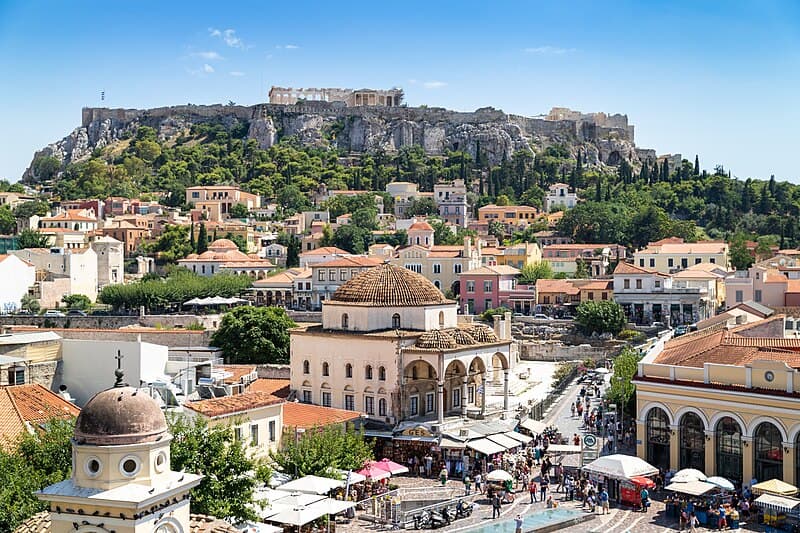
The square beneath the Acropolis where the metro, a seventeenth-century mosque, a Byzantine church and the start of Hadrian's Library all meet. From here Ifestou Street leads into a flea market that on Sundays spreads into the surrounding streets, selling everything from vinyl records to army surplus.

Tip: The rooftop bars around the square offer the best value for a view of the floodlit Acropolis — a coffee here costs €5 where elsewhere you'd pay €15 for a cocktail. The Sunday market is best between 9am and 11am. Adrianou Street has fixed-price tavernas aimed at tourists; for good food, head 2 streets north into Psyrri.

Admission:
free
Time needed:
1–2 h

Photos: Acropolis and Parthenon — Giles Laurent (CC BY-SA 4.0) · Acropolis Museum — Destroyinghistorygr (Public domain) · Ancient Agora — Chabe01 (CC BY-SA 4.0) · Temple of Olympian Zeus — Jean-Pierre Dalbéra from Paris, France (CC BY 2.0) · Panathenaic Stadium — Mister No (CC BY 3.0) · National Archaeological Museum — Thomas Wolf, www.foto-tw.de (CC BY-SA 3.0 de) · Lycabettus Hill — Apaleutos25 (CC BY-SA 4.0) · Tower of the Winds and Roman Agora — George E. Koronaios (CC BY-SA 2.0) · Monastiraki and the flea market — George E. Koronaios (CC BY-SA 4.0)

Where to stay

Areas and districts, matched to the kind of trip you are taking

Plaka

Best for: a first visit and evening strolls

The oldest inhabited district in the city, clinging to the northern slope of the Acropolis, with cobbled lanes, neoclassical houses and bougainvillea. Cars are almost entirely banned, and everything essential is a 20-minute walk away. Taverna prices run higher than elsewhere, and menus posted in 5 languages are a warning sign; even so, this is the most pleasant place in the city to stay.

Monastiraki and Psyrri

Best for: food, markets and nightlife

A pair of neighbouring districts north of the Agora. Monastiraki is market-driven and touristy; Psyrri, just behind it, was once a workshop district and is now full of mezedopoleia, bars and street art, drawing Athenians themselves. It has the best cheap food in the centre and stays lively until 2am. Both are a 5-minute walk from a metro station.

Koukaki and Makrygianni

Best for: a quieter stay close to the Acropolis

A residential district south of the Acropolis around the Acropolis Museum, reached by the Dionysiou Areopagitou pedestrian promenade. It's quiet, with normal prices, cafés for locals, and hotels with rooftop terraces looking onto the rock. The centre and the main sights are a 10-minute walk away, and the Acropoli metro station sits right here.

Kolonaki

Best for: shopping, galleries and the views from Lycabettus

An upmarket district on the slope below Lycabettus, with boutiques, cafés, the Benaki Museum and the Museum of Cycladic Art. It's the priciest address in the city and the best spot for an afternoon coffee away from the crowds. Both the funicular and the footpath up Lycabettus start here, and it's a 10-minute walk downhill to Syntagma.

Getting around

From the airport

Athens is served by direct flights from most major European cities, with journey times typically between 2 and 4 hours depending on where you start, more frequent in summer and less so out of season. Eleftherios Venizelos Airport lies 35 kilometres east of the centre and has 3 sensible connections: metro line M3 direct to Syntagma in 40 minutes, the X95 express bus to the same spot in about an hour, and a taxi with a fixed statutory fare to the centre, not metered. The airport metro runs on its own higher fare and only about every half hour, while the bus runs around the clock. From Athens, ferries to the islands leave from the port of Piraeus, 20 minutes from the centre on the M1 metro line.

Athens Eleftherios Venizelos (ATH) · 35 km

  • Metro M3 to Syntagma· 40 min· €9
  • X95 express bus· 60–90 min· €5.50
  • Fixed-fare taxi to the centre· 40 min· €40 (€55 at night)
  • Suburban train to Piraeus· 1 h· €9

Around town

The whole historic centre is walkable, and you don't need transport at all between the Acropolis, the Agora, Plaka and the Acropolis Museum — a continuous 3-kilometre pedestrian promenade links them. The metro has 3 lines and is the fastest way to reach Piraeus or the airport; the Syntagma and Monastiraki stations double as small archaeological museums, since construction hit ancient layers and the finds were put on display in place. A ticket covers 90 minutes across the whole network, including transfers, and must be validated at a yellow machine. A separate, pricier fare applies to the airport. Taxis are cheap, but insist on the meter, or use the FREE NOW app. You don't need a car in Athens, and parking is a nightmare.

Metro3 lines. M1 links the centre with Piraeus, M2 and M3 cross the city; M3 runs to the airport at a special fare. Operates from 5.30am to midnight, until 2am on Fridays and Saturdays on M2 and M3. · €1.20 for 90 minutes
Trolleybuses and busesA dense network covering districts without a metro and the coast. Covered by the same ninety-minute ticket. Buses don't run to reliable intervals, and in the centre walking is often faster. · €1.20
Coastal tramThe only line from Syntagma to the sea at Palaio Faliro and on to Voula. The trip to the beach takes about 40 minutes and is the cheapest way from the centre to a swim. · €1.20
Day and multi-day tickets24 hours for €4.10, 5 days for €8.20. Neither covers the airport routes, which always need a separate ticket. · €4.10 / 24 h
Taxi and FREE NOWThe base fare is low, and a ride across the centre costs €5–8. Insist the meter is running; from the airport a fixed tariff applies and isn't negotiable. · from €4

Useful apps: Google Maps, OASA Telematics, FREE NOW, Ferryhopper

When to go

Athens is the driest major city in Europe, and you'll feel it in summer: July and August regularly exceed 35 degrees, there's no shade on the Acropolis, and during heatwaves the site closes around midday. The best months are April, May, late September and October — warm enough for the sea but bearable on the stone. Autumn has the added advantage that the sea is at its warmest after summer. Winter is mild, around 13 degrees, with only occasional rain, and the sights are empty, though they keep shorter hours, closing at 5pm. Easter is the biggest holiday of the year, and the city empties out as Athenians head to the countryside — a great time for the sights and a bad one for closed shops.

Best time

April, May, late September and October

What to avoid

July and August because of the heat on the Acropolis

MonthJanFebMarAprMayJunJulAugSepOctNovDec
Day13°14°16°20°25°30°33°33°29°23°18°15°
Night7°7°8°11°16°20°23°23°19°16°12°9°
Rainy days9876421136810
Sea16°15°15°16°19°23°25°26°25°23°20°18°

Food & drink

Athenian food is Greek cuisine without the island romance and with more meat: gyros, souvlaki, roast lamb and mezedes with ouzo. The type of place matters. A taverna is a classic restaurant with mains, a mezedopoleio or ouzeri serves small shared plates and is the cheapest way to try a lot of things, a psistaria grills meat, and a souvlatzidiko does gyros in pita for €3–4. People eat late: at 8pm a taverna is often empty, filling up after 10pm. Dishes are ordered for the centre of the table and shared, not as individual plates. Tavernas around Plaka and Adrianou Street with photo menus on display are a tourist trap; 2 streets over in Psyrri or Koukaki you'll eat better for half the price.

What to try

Souvlaki and gyros pita

Grilled skewered or spit-roasted meat in pita bread with tomato, onion, tzatziki and chips tucked inside. The cheapest full meal in the country; "kalamaki" is the skewer without the pita.

Moussaka

Layers of aubergine, minced meat and potato under béchamel, baked in a tray. It's made in the morning to last the whole day, so it's fresh at midday and just reheated by evening — which is why Greeks eat it for lunch.

Meze and tzatziki

A set of small dishes — tzatziki, taramasalata, fava, melitzanosalata — shared and eaten with bread. Ordered alongside ouzo or tsipouro, and in a mezedopoleio it takes the place of a main course.

Choriatiki (Greek salad)

Tomato, cucumber, onion, peppers, olives and a slab of feta with oregano and olive oil, with no lettuce. Served as a shared starter, and bread for mopping up the leftover oil is expected.

Grilled octopus

Sun-dried and then grilled over charcoal, with olive oil and vinegar. You can spot a good place by octopus visibly hanging on a line; the frozen kind is rubbery.

Spanakopita and tiropita

A spinach or cheese pie made with filo pastry, sold by the piece at bakeries. The most common Greek breakfast and the cheapest food you can grab, around €2.

Loukoumades

Fried balls of leavened dough drizzled with honey and dusted with cinnamon and nuts, served hot. An ancient dessert still made the same way today; drunk with cold water, not coffee.

Frappé and freddo espresso

Frappé is whipped instant coffee over ice; freddo espresso is the newer, better version made with real espresso. Order it "sketos" for no sugar, "metrios" for medium sweet, or "glykos" for sweet.

Ouzo and tsipouro

An anise spirit that turns milky white once water is added. Sipped slowly with mezedes, never shot back and never on an empty stomach. Tsipouro is a grape spirit, often without anise in the north.

What it costs

Freddo espresso

€2.50–3.50

Gyros in pita from a stand

€3.50–5

Half-litre of beer at a taverna

€4–5

Dinner at a mezedopoleio

€15–22 per person

90-minute public transport ticket

€1.20

Acropolis admission

€20–30 depending on season

Combined ticket for 7 sites

€30

Night at a 3* hotel for 2

€70–120

Indicative prices that change over time — treat them as a guide, not a price list.

Practical information

SocketsCEuroplug, two round pinsFSchuko
Voltage230V / 50Hz
Tap waterTap water is treated, bottled is common — Tap water in Athens is safe to drink and tastes good, piped in from the Mornos reservoir via a 200-kilometre aqueduct. That's not true on the islands: most rely on desalination or boreholes, and bottled water is the norm there. Restaurants routinely serve bottled water for half a euro, the legal maximum price for half a litre at non-touristy places. Public drinking fountains and cisterns can be found in the old districts.
TippingTipping in Greece is a matter of rounding up, or 5–10 percent, given in cash on the table — card terminals usually don't have a tip option. The bill is often brought with a small plate of fruit or a free shot of spirits; that's hospitality, not a chargeable item. At a taverna you often pay at the till. A cover charge (for bread) may only be billed when it's shown on the menu.
Driving on theright
SafetyGreece is a safe country, and violent crime is rare even in big cities. In Athens there are 2 specific things to watch for: pickpockets on the metro line to Piraeus and at Monastiraki, who work the doors just before they close, and the area around Omonoia Square and the Vathi district after dark, which give visitors no reason to go there. Demonstrations near Syntagma are common, are announced in advance, and are easy to avoid. In summer, wildfires threaten the outskirts of cities — follow firefighters' instructions without question. The emergency number is 112, the tourist police 1571.
Opening hoursOpening hours are split: on Monday, Wednesday and Saturday shops open only in the morning, roughly 9am to 3pm, and on Tuesday, Thursday and Friday they open in the morning and again from 5pm to 8pm. Supermarkets and tourist shops run all day. Sundays are closed outside tourist zones. Archaeological sites open from 8am to 8pm in summer, only until 5pm in winter, with last entry half an hour before closing. Museums usually close on Tuesdays. Lunch is eaten after 2pm, dinner after 9pm.
Customs & etiquetteNodding the head upward with a tongue click means "no" in Greece, not agreement. An open palm held out towards someone (the moutza) is an insult, so wave with your fingers together instead. At a taverna, dishes are ordered for the centre of the table and shared; nobody orders an individual plate. Shorts and bare shoulders are unwelcome in churches and monasteries, and scarves are usually available to borrow at the entrance. High heels are banned at historic sites to protect the marble. Flushing paper down the toilet is forbidden in older buildings, as the plumbing can't handle it.
A few local wordsGood day — KaliméraThank you — EfcharistóPlease / you're welcome — ParakalóThe bill, please — To logariasmó, parakalóCheers — Jamas

How to plan your days

1 day

1 day in Athens

  1. 18am at the Acropolis, before the heat and the crowds arrive.
  2. 2Down to the Theatre of Dionysus and the Acropolis Museum.
  3. 3Lunch in Koukaki or Psyrri, not beneath the Acropolis.
  4. 4Afternoon at the Ancient Agora and the Temple of Hephaestus.
  5. 5Early evening at Monastiraki, then dinner on a rooftop terrace overlooking the rock.

2 days

2 days with the museums

  1. 1Day 1 as above.
  2. 2Morning at the National Archaeological Museum for the Mycenaean gold and the Antikythera mechanism.
  3. 3Lunch, then the Temple of Olympian Zeus and the Panathenaic Stadium in the afternoon.
  4. 4A walk through the National Garden to Syntagma for the changing of the guard.
  5. 5A climb up Lycabettus before sunset.

3 days

3 days with the sea or a day trip

  1. 1The first 2 days as above.
  2. 2Morning tram to the coast at Glyfada for a swim.
  3. 3Or a full-day trip to Cape Sounion and the Temple of Poseidon.
  4. 4Afternoon at the Monastiraki flea market, if it's a Sunday.
  5. 5A final evening of mezedes and ouzo in Psyrri.

Day trips

Cape Sounion and the Temple of Poseidon

70 km · 1 h 45 min by bus

The southernmost tip of Attica, with the Doric Temple of Poseidon from 444 BC, standing on a cliff 60 metres above the sea and once a landmark for ships sailing into Athens. Lord Byron carved his name into one of the columns. Visitors come for sunset, when the temple is lit from behind; buses leave from Mavromateon Street, and the last return departs shortly after dark.

Delphi

180 km · 2 h 30 min by bus

The oracle the Greeks considered the centre of the world, on the slopes of Mount Parnassus above a valley of olive groves. The Sanctuary of Apollo survives, along with a theatre, a stadium and a museum holding the Bronze Charioteer, one of the finest Greek bronzes ever found. Buses run from the Liosion terminal 3 times a day, but it's demanding as a day trip — most people choose an organised tour or stay overnight.

The Saronic Gulf islands: Hydra and Aegina

40 km · 40–90 min by boat from Piraeus

The nearest islands, reachable in the morning with a return the same evening. Aegina is 40 minutes away by high-speed ferry and has the Temple of Aphaia and pistachio orchards. Hydra is 1.5 hours away and has no cars or motorbikes at all — transport is by mule and water taxi, making it the most peaceful spot within reach of Athens. Boats leave from Piraeus, reached from the centre by the M1 metro line.

Frequently asked questions

Do I need to book my Acropolis ticket in advance?+

Yes, since 2024 timed entry slots with a capped number of visitors per hour have been in force, and in season they often sell out several days ahead. Buy online through the official portal. The ticket is tied to a specific hour, not the whole day, and arriving late is not tolerated. Visitors coming outside high season can usually still buy one on the spot.

Is the combined ticket worth it?+

Yes, if you're planning to visit more than 2 sites. The combined ticket, €30, is valid for 5 days and covers the Acropolis, the Ancient and Roman Agoras, Kerameikos, the Temple of Olympian Zeus, Hadrian's Library and Aristotle's Lyceum. The Acropolis alone costs €30 in high season, so the other sites are effectively free on top.

When is the best time to visit the Acropolis?+

At 8am when it opens, or 2 hours before closing. In summer the rock exceeds 35 degrees with no shade and no water for sale — bring your own. During heatwaves the site closes around midday and tickets for that slot get shifted. The marble is polished smooth, so wear sturdy shoes, not sandals.

How many days are enough for Athens?+

2 days cover the Acropolis, the Acropolis Museum, the Agora and Plaka. 3 days add the National Archaeological Museum and Lycabettus, or a trip to Cape Sounion. Anyone heading on to the islands should leave Athens at least 2 days, at the start or the end — it's a destination in its own right, not just a transfer point for the ferry.

How do I get from the airport to the centre?+

By metro line M3 direct to Syntagma in 40 minutes for €9, or by the X95 express bus to the same spot for €5.50, which runs around the clock and can take an hour or more in traffic. Taxis charge a fixed statutory fare of €40 to the centre by day and €55 at night, not metered. Standard day travel cards don't cover the airport routes.

Is Athens safe?+

Yes, violent crime is rare. Watch your pockets on the M1 metro line to Piraeus and at Monastiraki, where pickpockets work the doors just before they close. The area around Omonoia Square and the Vathi district have nothing to offer visitors after dark. Demonstrations near Syntagma are common, are announced in advance, and are easy to avoid.

Can you take a day trip to the sea from Athens?+

Yes. The tram from Syntagma reaches the Athens Riviera coast in 40 minutes, at Palaio Faliro, Glyfada or Voula, which have both organised and public beaches. Anyone wanting an island can take the metro to Piraeus and a high-speed ferry to Aegina in 40 minutes, or to Hydra in 1.5 hours; both can be done there and back in a single day.

When do people eat dinner in Athens?+

Late. At 8pm a taverna is often empty, and it fills up after 10pm, with the kitchen cooking until midnight. Arrive at 7pm and you'll get a table, but you'll be alone in the place, and it'll clearly be a tourist-hours crowd. Lunch is eaten after 2pm. Dishes are ordered for the centre of the table and shared — nobody orders their own individual plate.

Visa Requirements

Check the latest visa requirements for entering this country. Some nationalities may need to apply for a visa or e-visa before travel.

Check visa requirements

Language

Greek

Currency

EUR

Timezone

GMT+2

Dial Code

+30

Population

10.4M

Area

131,957 km²

Voltage

230V / 50Hz

Driving Side

Right

Top Hotels in Athens

Live prices from 500+ properties

Loading hotels...

Planning a trip to Athens?

Compare hundreds of hotels, find the best price, and book with free cancellation on TravelManiac.